Recognition: no theorem link
Read, Extract, Classify: A Tool for Smarter Requirements Engineering
Pith reviewed 2026-05-13 00:58 UTC · model grok-4.3
The pith
ReXCL automates the extraction and classification of requirements from documents using heuristics and fine-tuned models to enhance software development.
A machine-rendered reading of the paper's core claim, the machinery that carries it, and where it could break.
Core claim
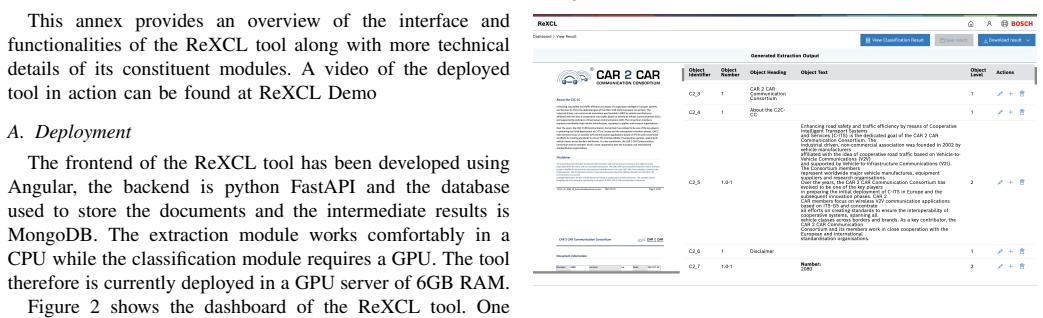
ReXCL features an Extraction module that converts raw requirement documents into a predefined schema via heuristics and predictive modeling, and a Classification module that labels requirements through adaptive fine-tuning of encoder models, with the overall result being improved efficiency and accuracy in requirements management and export capability to external tools.
What carries the argument
The ReXCL tool's dual-module architecture for automated extraction and classification of requirements.
If this is right
- Streamlines the software development life-cycle by automating requirements handling.
- Reduces time and errors in processing semi-structured requirement documents.
- Enables seamless integration with existing requirements engineering tools via export.
- Provides a novel automated schematization method for requirements.
Where Pith is reading between the lines
- Could be extended to other domains involving document schematization beyond software requirements.
- May benefit from ongoing model updates to maintain performance on evolving document styles.
- Integration with collaborative platforms could further improve team-based requirements management.
Load-bearing premise
That the combination of heuristics, predictive modeling, and fine-tuned encoders will perform reliably across varied real-world requirement documents without major retraining.
What would settle it
Running ReXCL on a diverse set of previously unseen requirement documents and finding no measurable gain in speed or accuracy over manual methods.
Figures


read the original abstract
This paper presents the ReXCL tool, which automates the extraction and classification processes in requirements engineering, enhancing the software development life-cycle. The tool features two main modules: Extraction, which processes raw requirement documents into a predefined schema using heuristics and predictive modeling, and Classification, which assigns class labels to requirements using adaptive fine-tuning of encoder-based models. The final output can be exported to external requirement engineering tools. Performance evaluations indicate that ReXCL significantly improves efficiency and accuracy in managing requirements, marking a novel approach to automating the schematization of semi-structured requirement documents.
Editorial analysis
A structured set of objections, weighed in public.
Referee Report
Summary. The paper presents the ReXCL tool for automating extraction and classification in requirements engineering. The Extraction module processes raw semi-structured requirement documents into a predefined schema using heuristics combined with predictive modeling. The Classification module assigns class labels via adaptive fine-tuning of encoder-based models. Output can be exported to external RE tools. The central claim is that performance evaluations show ReXCL significantly improves efficiency and accuracy, offering a novel approach to automating schematization of such documents.
Significance. If the performance claims hold with rigorous evidence, the work could provide a practical contribution to requirements engineering by reducing manual effort in processing semi-structured documents and integrating with existing tools. The hybrid heuristics-plus-ML design for extraction and the adaptive fine-tuning for classification represent a reasonable engineering approach. However, the absence of any quantitative validation means the significance is currently potential rather than demonstrated. No machine-checked proofs or reproducible artifacts are mentioned.
major comments (1)
- [Abstract] Abstract: The assertion that 'Performance evaluations indicate that ReXCL significantly improves efficiency and accuracy' is unsupported by any reported datasets (size, domain, format), metrics (precision/recall, accuracy/F1, time reduction), baselines (manual processes or prior tools), error analysis, or statistical tests. This directly undermines the central claim of improvement and novelty, as the tool's value cannot be assessed without reproducible evidence.
minor comments (1)
- [Tool description] The high-level description of the heuristics in the Extraction module and the adaptive fine-tuning procedure in the Classification module would benefit from pseudocode or concrete examples to improve reproducibility and clarity.
Simulated Author's Rebuttal
We thank the referee for their constructive feedback on our manuscript. We address the major comment below and outline our planned revisions to strengthen the paper.
read point-by-point responses
-
Referee: [Abstract] Abstract: The assertion that 'Performance evaluations indicate that ReXCL significantly improves efficiency and accuracy' is unsupported by any reported datasets (size, domain, format), metrics (precision/recall, accuracy/F1, time reduction), baselines (manual processes or prior tools), error analysis, or statistical tests. This directly undermines the central claim of improvement and novelty, as the tool's value cannot be assessed without reproducible evidence.
Authors: We agree that the abstract claim is currently unsupported by detailed evidence in the manuscript, which weakens the central contribution. In the revised version, we will remove the unsubstantiated assertion from the abstract. We will add a new dedicated Evaluation section that reports: the datasets (with sizes, domains, and formats), metrics (precision, recall, F1, accuracy, and time reduction), baselines (manual processing and prior tools), error analysis, and statistical tests. We will also update the abstract to accurately summarize these results. This will make the performance claims verifiable and address the concern about reproducibility. revision: yes
Circularity Check
No circularity: tool architecture paper contains no derivations or self-referential logic
full rationale
The manuscript describes a software tool (ReXCL) with two high-level modules—Extraction via heuristics plus predictive modeling, and Classification via adaptive fine-tuning of encoders—followed by an export step. No equations, parameter-fitting procedures, uniqueness theorems, or derivation chains appear in the provided text. The sole performance statement is an empirical assertion without reported metrics or baselines, but this is an unsupported claim rather than a circular reduction of any output to its own inputs. No self-citations are invoked as load-bearing premises, and the architecture is presented as a direct engineering description rather than a mathematical derivation.
Axiom & Free-Parameter Ledger
Reference graph
Works this paper leans on
-
[1]
A Supervised Learning Approach For Heading Detection , author=. 2018 , eprint=
work page 2018
-
[2]
Journal of emerging trends in computing and information sciences , volume=
The role of requirement engineering in software development life cycle , author=. Journal of emerging trends in computing and information sciences , volume=
-
[3]
IEEE 30th International Requirements Engineering Conference (RE) , pages=
Retraining a BERT model for transfer learning in requirements engineering: A preliminary study , author=. IEEE 30th International Requirements Engineering Conference (RE) , pages=. 2022 , organization=
work page 2022
-
[4]
Devlin, Jacob and Chang, Ming-Wei and Lee, Kenton and Toutanova, Kristina , booktitle=
-
[5]
Computer Standards & Interfaces , year=
Classification of software requirements using BERT-based deep learning , author=. Computer Standards & Interfaces , year=
-
[6]
arXiv preprint arXiv:2202.02617 , year=
Adaptive Fine-Tuning of Transformer-Based Language Models for Named Entity Recognition , author=. arXiv preprint arXiv:2202.02617 , year=
- [7]
-
[8]
Clerk Maxwell, A Treatise on Electricity and Magnetism, 3rd ed., vol
J. Clerk Maxwell, A Treatise on Electricity and Magnetism, 3rd ed., vol. 2. Oxford: Clarendon, 1892, pp.68--73
-
[9]
I. S. Jacobs and C. P. Bean, ``Fine particles, thin films and exchange anisotropy,'' in Magnetism, vol. III, G. T. Rado and H. Suhl, Eds. New York: Academic, 1963, pp. 271--350
work page 1963
-
[10]
Elissa, ``Title of paper if known,'' unpublished
K. Elissa, ``Title of paper if known,'' unpublished
-
[11]
Nicole, ``Title of paper with only first word capitalized,'' J
R. Nicole, ``Title of paper with only first word capitalized,'' J. Name Stand. Abbrev., in press
- [12]
-
[13]
Young, The Technical Writer's Handbook
M. Young, The Technical Writer's Handbook. Mill Valley, CA: University Science, 1989
work page 1989
discussion (0)
Sign in with ORCID, Apple, or X to comment. Anyone can read and Pith papers without signing in.