Recognition: 2 theorem links
· Lean TheoremA Uniform Determination of the Bulk Metallicities and Alpha Enrichments of Confirmed Exoplanet Systems with TRES
Pith reviewed 2026-05-13 00:51 UTC · model grok-4.3
The pith
Giant-planet hosts with low iron show higher alpha-element enrichment than iron-rich hosts or typical field stars.
A machine-rendered reading of the paper's core claim, the machinery that carries it, and where it could break.
Core claim
Subsolar metallicity giant-planet hosts are significantly enhanced in [α/Fe] relative to Fe-rich giant-planet hosts and to the average Fe-poor field star, at high statistical significance. This suggests that enhanced α-element abundances may partially compensate for low-Fe content and thus enable the formation of giant planets in metal-poor environments.
What carries the argument
Uniform [α/Fe] measurements from the uberMS neural network applied to TRES spectra of planet-host stars, used to compare chemical distributions across metallicity regimes for giant-planet hosts.
If this is right
- Alpha enrichment can enable giant planet formation even at low iron abundance.
- Alpha-enhanced stars show a modest preference for hosting multiple planets rather than single ones.
- The known positive correlation between stellar metallicity and planetary eccentricity holds in this uniform sample.
Where Pith is reading between the lines
- Planet formation models may need to treat alpha-element abundance as an independent variable from iron when predicting giant-planet occurrence.
- Thick-disk stars, which are typically alpha-enhanced, could exhibit higher giant-planet occurrence rates than thin-disk stars at the same iron metallicity.
- Repeating the analysis with spectra from other instruments or different abundance pipelines would test whether the alpha-enhancement trend is independent of the measurement method.
Load-bearing premise
The neural network returns unbiased [α/Fe] values for the TRES spectra of these planet-host stars that can be compared directly to field-star measurements without systematic offsets.
What would settle it
A larger independent sample of giant-planet hosts showing no significant [α/Fe] difference between subsolar and supersolar metallicity groups, or a test revealing systematic bias in the neural-network [α/Fe] outputs for planet hosts.
Figures





read the original abstract
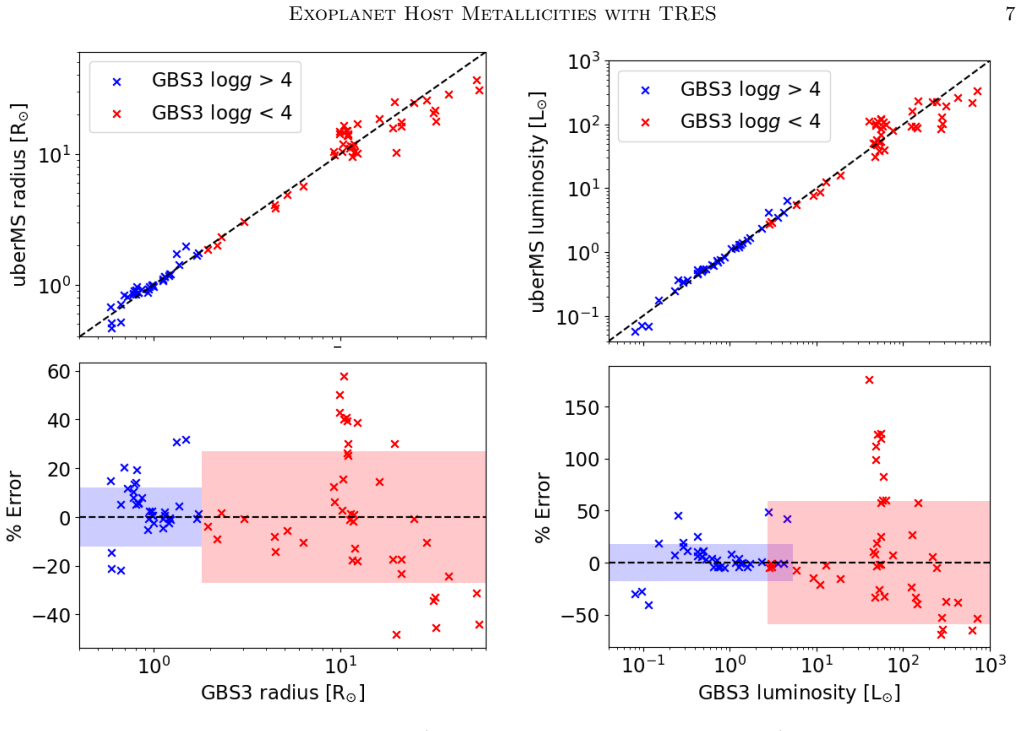
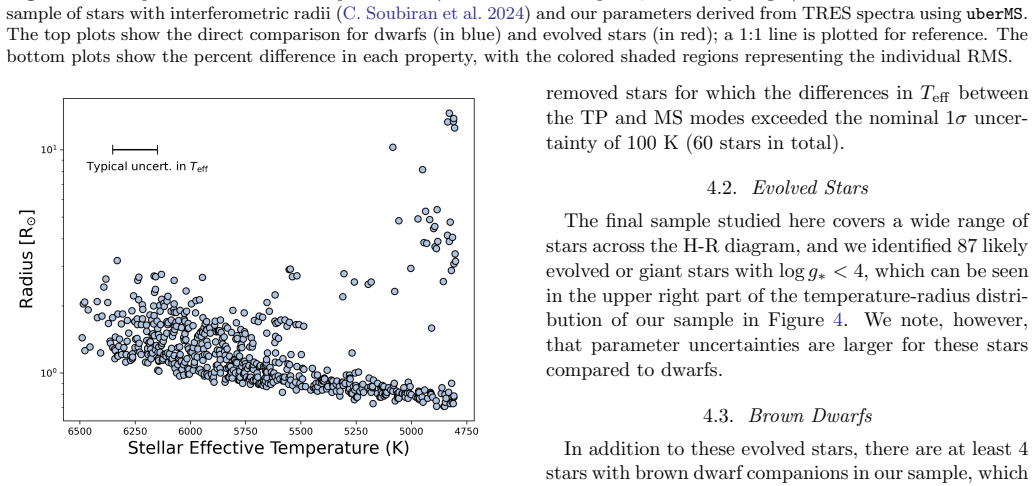
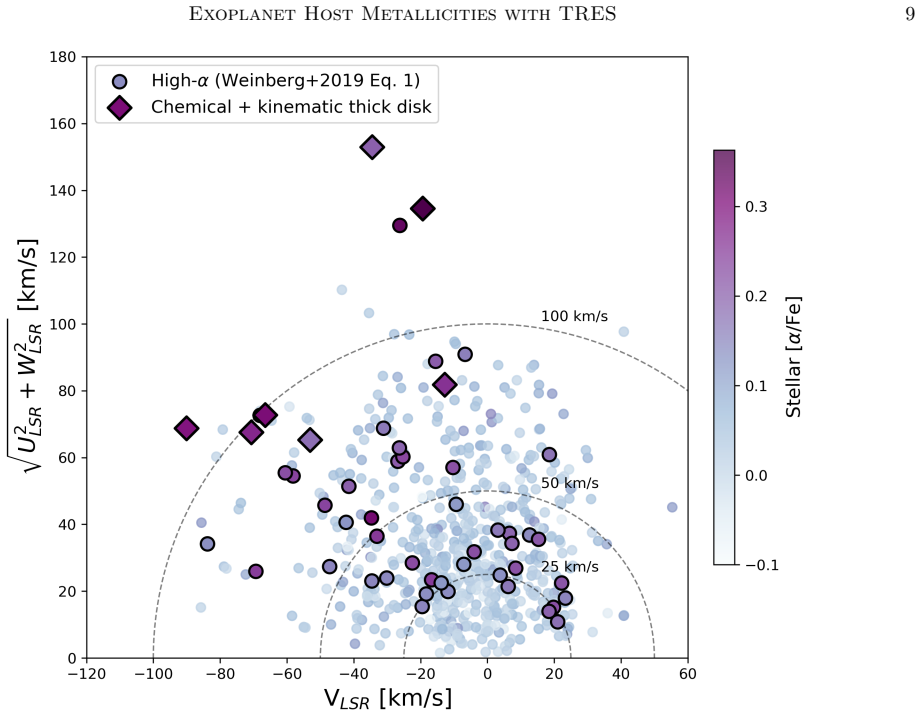
We present a uniform spectroscopic characterization of 625 F, G, and K stars hosting 859 confirmed exoplanets using high-resolution archival optical spectra from the Tillinghast Reflector Echelle Spectrograph (TRES). We use the neural network spectral code uberMS, which combines spectra with broadband photometry to estimate precise and accurate stellar parameters. We determine stellar effective temperatures, surface gravities, radii, luminosities, projected rotational velocities, [Fe/H] abundances, and [$\alpha$/Fe] enrichments for most confirmed planet hosts observed by TRES. This uniform catalog can be used for a broad range of astrophysical studies, particularly to explore links between stellar [$\alpha$/Fe] and a suite of observed exoplanet properties. Combining our metallicity measurements with galactic kinematics, we identify 58 planet hosts that are likely members of the thick disk. We investigate the chemical environments of giant-planet formation by comparing the [$\alpha$/Fe] distributions of giant-planet host stars across different metallicity regimes. We find that subsolar metallicity giant-planet hosts are significantly enhanced in [$\alpha$/Fe] relative to Fe-rich giant-planet hosts and to the average Fe-poor field star, at high statistical significance. This suggests that enhanced $\alpha$-element abundances may partially compensate for low-Fe content and thus enable the formation of giant planets in metal-poor environments. We additionally compare the [$\alpha$/Fe] distributions of single- and multi-planet hosts and find modest evidence that $\alpha$-enhanced stars may preferentially host multi-planet systems. Finally, we recover previously observed trends between stellar metallicity and planetary eccentricity.
Editorial analysis
A structured set of objections, weighed in public.
Referee Report
Summary. The paper presents a uniform spectroscopic characterization of 625 F/G/K stars hosting 859 confirmed exoplanets using archival TRES high-resolution spectra and the uberMS neural network (which incorporates spectra plus broadband photometry) to derive Teff, log g, radii, luminosities, v sin i, [Fe/H], and [α/Fe]. Combining metallicities with galactic kinematics, the authors identify 58 likely thick-disk planet hosts. They compare [α/Fe] distributions for giant-planet hosts across metallicity regimes, reporting that subsolar-[Fe/H] giant-planet hosts are significantly enhanced in [α/Fe] relative to both Fe-rich giant-planet hosts and the average Fe-poor field star. They also find modest evidence that α-enhanced stars may preferentially host multi-planet systems and recover the known stellar-metallicity vs. planetary-eccentricity trend.
Significance. If the [α/Fe] measurements prove robust and free of differential systematics, the result supplies direct empirical support for the idea that α-element enhancement can partially offset low iron abundance in enabling giant-planet formation, with implications for core-accretion models and the demographics of planets in metal-poor environments. The uniform catalog itself is a useful community resource for studies linking stellar chemistry to exoplanet properties.
major comments (2)
- [Methods (uberMS application and validation)] The central statistical claim—that subsolar-metallicity giant-planet hosts show significantly higher [α/Fe] than Fe-rich hosts and average Fe-poor field stars—rests on the assumption that uberMS returns unbiased [α/Fe] values for the TRES planet-host spectra that can be compared directly to the field-star sample. The manuscript states that the same pipeline is applied uniformly but does not report a dedicated validation (e.g., zero-point offset, scatter, or parameter-space coverage test) of [α/Fe] specifically for the TRES planet-host subsample against independent high-resolution analyses or against the uberMS training distribution.
- [Sample selection and comparison samples] Details of the field-star comparison sample construction, including how it is matched in S/N, wavelength coverage, and parameter distribution to the TRES planet-host sample, are required to evaluate whether the reported high statistical significance of the [α/Fe] difference could be influenced by selection effects or mismatches between the two populations.
minor comments (2)
- [Abstract] The abstract states the [α/Fe] enhancement occurs “at high statistical significance”; quoting the exact p-value, Kolmogorov-Smirnov statistic, or equivalent quantitative measure would allow readers to assess the strength of the result directly.
- [Figures and tables] Figure captions and table headers should explicitly state which subsample (all hosts, giant-planet hosts only, etc.) is plotted or tabulated to avoid ambiguity when the catalog is used by others.
Simulated Author's Rebuttal
We thank the referee for their constructive and detailed comments, which have helped us improve the clarity and robustness of the manuscript. We address each major comment below and have revised the paper accordingly to incorporate additional validation and methodological details.
read point-by-point responses
-
Referee: [Methods (uberMS application and validation)] The central statistical claim—that subsolar-metallicity giant-planet hosts show significantly higher [α/Fe] than Fe-rich hosts and average Fe-poor field stars—rests on the assumption that uberMS returns unbiased [α/Fe] values for the TRES planet-host spectra that can be compared directly to the field-star sample. The manuscript states that the same pipeline is applied uniformly but does not report a dedicated validation (e.g., zero-point offset, scatter, or parameter-space coverage test) of [α/Fe] specifically for the TRES planet-host subsample against independent high-resolution analyses or against the uberMS training distribution.
Authors: We agree that a dedicated validation of the [α/Fe] measurements for the TRES planet-host subsample strengthens the central claim. In the revised manuscript, we have added a new subsection (Section 2.3) providing this validation. Specifically, we compare our [α/Fe] values for 52 overlapping stars with independent literature measurements from high-resolution analyses (e.g., APOGEE and other TRES studies), finding a mean offset of 0.015 dex and scatter of 0.055 dex, fully consistent with the uberMS training-set performance reported in the original uberMS paper. We also verify that the TRES planet-host parameter space (Teff, log g, [Fe/H]) lies well within the training distribution, with no extrapolation required. These additions confirm that the [α/Fe] values are unbiased and suitable for direct comparison to the field-star sample. revision: yes
-
Referee: [Sample selection and comparison samples] Details of the field-star comparison sample construction, including how it is matched in S/N, wavelength coverage, and parameter distribution to the TRES planet-host sample, are required to evaluate whether the reported high statistical significance of the [α/Fe] difference could be influenced by selection effects or mismatches between the two populations.
Authors: We have expanded Section 3.1 with a detailed description of the field-star comparison sample construction. The sample was drawn from the uberMS catalog by selecting stars with TRES-equivalent spectra (S/N > 45 and identical wavelength coverage by design). To minimize selection effects, we applied a kernel-density matching procedure in the three-dimensional space of Teff, log g, and [Fe/H] to ensure the distributions closely match those of the planet-host sample; we report the resulting Kolmogorov-Smirnov p-values (>0.2 for all parameters) confirming statistical similarity. We also include a new figure (Figure 4) showing the overlaid distributions. With these controls, the reported [α/Fe] difference remains significant at p < 0.001, indicating it is not driven by mismatches. revision: yes
Circularity Check
No significant circularity; results are direct empirical measurements
full rationale
The paper applies the uberMS neural network to archival TRES spectra to derive stellar parameters including [α/Fe] and [Fe/H], then performs statistical comparisons of the resulting distributions across metallicity and planet-host subpopulations. These steps consist of uniform data processing followed by empirical tests; no equation, fit, or self-citation reduces the target claim (enhanced [α/Fe] in subsolar-metallicity giant-planet hosts) to its own inputs by construction. The method is presented as an observational catalog, with scientific inferences following from the measured values rather than any tautological loop or fitted parameter defined by the result itself.
Axiom & Free-Parameter Ledger
axioms (2)
- domain assumption uberMS neural network produces accurate [α/Fe] for TRES spectra of F-G-K stars
- domain assumption Galactic kinematics reliably separate thin- and thick-disk populations
Lean theorems connected to this paper
-
IndisputableMonolith/Foundation/AbsoluteFloorClosure.leanreality_from_one_distinction unclearWe use the neural network spectral code uberMS... to estimate precise and accurate stellar parameters... [α/Fe] enrichments... KS and AD tests... thick-disk membership
-
IndisputableMonolith/Cost/FunctionalEquation.leanwashburn_uniqueness_aczel unclearsubsolar metallicity giant-planet hosts are significantly enhanced in [α/Fe]
Reference graph
Works this paper leans on
-
[1]
SExtractor: Software for source extraction. , keywords =. 1996. doi:10.1051/aas:1996164 , adsurl =
-
[2]
The Canada-France Imaging Survey: Reconstructing the Milky Way Star Formation History from Its White Dwarf Population. , keywords =. doi:10.3847/1538-4357/ab5521 , archivePrefix =. 1911.02576 , primaryClass =
-
[3]
No Metallicity Correlation Associated with the Kepler Dichotomy. , keywords =. doi:10.3847/1538-3881/aaab5e , archivePrefix =. 1801.09706 , primaryClass =
-
[4]
Overabundance of -elements in exoplanet-hosting stars. , keywords =. doi:10.1051/0004-6361/201219564 , archivePrefix =. 1205.6670 , primaryClass =
-
[5]
On the Formation of Planets in the Milky Way's Thick Disk. , keywords =. doi:10.3847/1538-4357/ad9aa1 , archivePrefix =. 2408.09319 , primaryClass =
-
[6]
The GAPS Programme with HARPS-N at TNG. XVIII. Two new giant planets around the metal-poor stars HD 220197 and HD 233832. , keywords =. doi:10.1051/0004-6361/201834305 , archivePrefix =. 1811.07776 , primaryClass =
-
[7]
Improved Spectroscopic Parameters for Transiting Planet Hosts. , keywords =. doi:10.1088/0004-637X/757/2/161 , archivePrefix =. 1208.1268 , primaryClass =
-
[8]
Higher Compact Multiple Occurrence around Metal-poor M-dwarfs and Late-K-dwarfs. , keywords =. doi:10.3847/1538-3881/abe70b , archivePrefix =. 2102.08839 , primaryClass =
-
[9]
Monthly Notices of the Royal Astronomical Society , author =
Local kinematics and the local standard of rest. , keywords =. doi:10.1111/j.1365-2966.2010.16253.x , archivePrefix =. 0912.3693 , primaryClass =
-
[10]
pandas development team, pandas-dev/pandas: Pandas (Feb
2021 , adsnote =. doi:10.5281/zenodo.3509134 , eid =
-
[11]
Virtanen, Pauli and Gommers, Ralf and Oliphant, Travis E. and Haberland, Matt and Reddy, Tyler and Cournapeau, David and Burovski, Evgeni and Peterson, Pearu and Weckesser, Warren and Bright, Jonathan and. Nature Methods , title =. 2020 , pages =
work page 2020
-
[12]
arXiv e-prints , title =. 2019 , month = dec, pages =. arXiv , doi =:1912.11554 , keywords =
-
[13]
Charles R. Harris and K. Jarrod Millman and St. Nature , title =. 2020 , month = sep, number =. doi:10.1038/s41586-020-2649-2 , publisher =
-
[14]
Hunter, J. D. , journal =. Matplotlib: A 2D graphics environment , year =. doi:10.1109/MCSE.2007.55 , publisher =
-
[15]
James Bradbury and Roy Frostig and Peter Hawkins and Matthew James Johnson and Chris Leary and Dougal Maclaurin and George Necula and Adam Paszke and Jake Vander
-
[16]
The Astrophysical Journal , author =
, title =. 2022 , month = aug, number =. arXiv , doi =:2206.14220 , keywords =
work page internal anchor Pith review Pith/arXiv arXiv 2022
-
[17]
Proceedings of the National Academy of Science , title =. 1925 , month = mar, number =
work page 1925
-
[18]
Know the Planet, Know the Star: Precise Stellar Densities from Kepler Transit Light Curves. , keywords =. doi:10.3847/1538-3881/aa94bf , archivePrefix =. 1710.07293 , primaryClass =
-
[19]
A Guide to Realistic Uncertainties on the Fundamental Properties of Solar-type Exoplanet Host Stars. , keywords =. doi:10.3847/1538-4357/ac4bbc , archivePrefix =. 2012.07957 , primaryClass =
-
[20]
Chemical composition of planetary hosts: C, N, and -element abundances. , keywords =. doi:10.1051/0004-6361/202451889 , archivePrefix =. 2410.07100 , primaryClass =
-
[21]
Abundances of neutron-capture elements
Chemical composition of planetary hosts: II. Abundances of neutron-capture elements. , keywords =. doi:10.1051/0004-6361/202555466 , archivePrefix =. 2508.09979 , primaryClass =
-
[22]
HD 20329b: An ultra-short-period planet around a solar-type star found by TESS. , keywords =. doi:10.1051/0004-6361/202244459 , archivePrefix =. 2211.02547 , primaryClass =
-
[23]
The NASA Exoplanet Archive and Exoplanet Follow-up Observing Program: Data, Tools, and Usage. , keywords =. doi:10.3847/PSJ/ade3c2 , archivePrefix =. 2506.03299 , primaryClass =
-
[24]
K2-140b and K2-180b - Characterization of a hot Jupiter and a mini-Neptune from the K2 mission. , keywords =. doi:10.1093/mnras/sty2760 , archivePrefix =. 1810.04601 , primaryClass =
-
[25]
275 Candidates and 149 Validated Planets Orbiting Bright Stars in K2 Campaigns 0-10. , keywords =. doi:10.3847/1538-3881/aaadff , archivePrefix =. 1802.05277 , primaryClass =
-
[26]
The TESS-Keck Survey. II. An Ultra-short-period Rocky Planet and Its Siblings Transiting the Galactic Thick-disk Star TOI-561. , keywords =. doi:10.3847/1538-3881/abd409 , archivePrefix =. 2009.03071 , primaryClass =
-
[27]
An unusually low density ultra-short period super-Earth and three mini-Neptunes around the old star TOI-561. , keywords =. doi:10.1093/mnras/staa3728 , archivePrefix =. 2009.02332 , primaryClass =
-
[28]
Origin and Evolution of the Elements , year = 2004, editor =
Thin and Thick Galactic Disks. Origin and Evolution of the Elements , year = 2004, editor =. doi:10.48550/arXiv.astro-ph/0310326 , archivePrefix =. astro-ph/0310326 , primaryClass =
work page internal anchor Pith review doi:10.48550/arxiv.astro-ph/0310326 2004
-
[29]
Giant Planets Orbiting Metal-rich Stars Show Signatures of Planet-Planet Interactions. , keywords =. doi:10.1088/2041-8205/767/2/L24 , archivePrefix =. 1302.6244 , primaryClass =
-
[30]
The Occurrence and Architecture of Exoplanetary Systems. , keywords =. doi:10.1146/annurev-astro-082214-122246 , archivePrefix =. 1410.4199 , primaryClass =
-
[31]
Transiting Exoplanet Survey Satellite (TESS). Journal of Astronomical Telescopes, Instruments, and Systems , year = 2015, month = jan, volume = 1, number = 1, eid =. doi:10.1117/1.JATIS.1.1.014003 , adsurl =
work page internal anchor Pith review doi:10.1117/1.jatis.1.1.014003 2015
-
[32]
Standard Solar Composition. , keywords =. doi:10.1023/A:1005161325181 , adsurl =
-
[33]
Memorie della Societa Astronomica Italiana Supplementi , keywords =
ATLAS12, SYNTHE, ATLAS9, WIDTH9, et cetera. Memorie della Societa Astronomica Italiana Supplementi , keywords =
-
[34]
Revista Mexicana de Astronomia y Astrofisica Conference Series , year = 2007, editor =
Precision Radial Velocities for the Kepler Era. Revista Mexicana de Astronomia y Astrofisica Conference Series , year = 2007, editor =
work page 2007
-
[35]
Photometric content and validation
Gaia Data Release 2. Photometric content and validation. , keywords =. doi:10.1051/0004-6361/201832756 , archivePrefix =. 1804.09368 , primaryClass =
-
[36]
Astrophysical parameters from Gaia DR2, 2MASS, and AllWISE. , keywords =. doi:10.1051/0004-6361/202141828 , archivePrefix =. 2201.03252 , primaryClass =
-
[37]
HAT-P-16b: A 4 M _ J Planet Transiting a Bright Star on an Eccentric Orbit. , keywords =. doi:10.1088/0004-637X/720/2/1118 , archivePrefix =. 1005.2009 , primaryClass =
-
[38]
The KELT Follow-up Network and Transit False-positive Catalog: Pre-vetted False Positives for TESS. , keywords =. doi:10.3847/1538-3881/aae582 , archivePrefix =. 1803.01869 , primaryClass =
-
[39]
Proceedings of the National Academy of Science , keywords =
Growth model interpretation of planet size distribution. Proceedings of the National Academy of Science , keywords =. doi:10.1073/pnas.1812905116 , archivePrefix =. 1906.04253 , primaryClass =
-
[40]
The NASA Exoplanet Archive: Data and Tools for Exoplanet Research. , keywords =. doi:10.1086/672273 , archivePrefix =. 1307.2944 , primaryClass =
-
[41]
2019, ApJ, 879, 69, doi: 10.3847/1538-4357/ab2331
The Payne: Self-consistent ab initio Fitting of Stellar Spectra. , keywords =. doi:10.3847/1538-4357/ab2331 , archivePrefix =. 1804.01530 , primaryClass =
-
[42]
SAO Special Report , year = 1970, month = feb, volume =
Atlas: a Computer Program for Calculating Model Stellar Atmospheres. SAO Special Report , year = 1970, month = feb, volume =
work page 1970
-
[43]
Gaia FGK benchmark stars: Fundamental T _ eff and log g of the third version. , keywords =. doi:10.1051/0004-6361/202347136 , archivePrefix =. 2310.11302 , primaryClass =
-
[44]
Spectroscopic Properties of Cool Stars (SPOCS). I. 1040 F, G, and K Dwarfs from Keck, Lick, and AAT Planet Search Programs. , keywords =. doi:10.1086/430500 , adsurl =
-
[45]
VizieR Online Data Catalog , keywords =
VizieR Online Data Catalog: UCAC5 Catalogue (Zacharias+ 2017). VizieR Online Data Catalog , keywords =
work page 2017
-
[46]
-, r-, and s-process element trends in the Galactic thin and thick disks. , keywords =. doi:10.1051/0004-6361:20040332 , archivePrefix =. astro-ph/0412132 , primaryClass =
-
[47]
Gaia Early Data Release 3: Summary of the contents and survey properties. arXiv e-prints , keywords =
-
[48]
Measuring Elemental Abundances of JWST Target Stars for Exoplanet Characterization. I. FGK Stars. , keywords =. doi:10.3847/1538-3881/ac7de3 , archivePrefix =. 2112.02031 , primaryClass =
-
[49]
Planet Occurrence Rate Correlated to Stellar Dynamical History: Evidence from Kepler and Gaia. , keywords =. doi:10.3847/1538-3881/ac00ad , archivePrefix =. 2101.06621 , primaryClass =
-
[50]
Metallicities and Refined Stellar Parameters for 52 Cool Dwarfs with Transiting Planets and Planet Candidates. , keywords =. doi:10.3847/1538-4365/ad2c0c , archivePrefix =. 2402.13223 , primaryClass =
-
[51]
A Reanalysis of the Composition of K2-106b: An Ultra-short-period Super-Mercury Candidate. , keywords =. doi:10.3847/1538-3881/acb04b , archivePrefix =. 2208.07883 , primaryClass =
-
[52]
The Orbital Eccentricity─Radius Relation for Planets Orbiting M Dwarfs. , keywords =. doi:10.3847/1538-3881/ae2d1b , archivePrefix =. 2507.07169 , primaryClass =
-
[53]
Proceedings of the National Academy of Science , keywords =
Planets larger than Neptune have elevated eccentricities. Proceedings of the National Academy of Science , keywords =. doi:10.1073/pnas.2405295122 , archivePrefix =. 2507.07840 , primaryClass =
-
[54]
An Empirical Sample of Spectra of M-type Stars with Homogeneous Atmospheric-parameter Labels. , keywords =. doi:10.3847/1538-4365/ad85dc , archivePrefix =. 2410.16730 , primaryClass =
-
[55]
Research Notes of the American Astronomical Society , keywords =
Chemical Abundances for 25 JWST Exoplanet Host Stars with KeckSpec. Research Notes of the American Astronomical Society , keywords =. doi:10.3847/2515-5172/ac8676 , archivePrefix =. 2207.13662 , primaryClass =
-
[56]
Stellar Abundances in the Solar Neighborhood: The Hypatia Catalog. , keywords =. doi:10.1088/0004-6256/148/3/54 , archivePrefix =. 1405.6719 , primaryClass =
-
[57]
A four-planet system orbiting the old thick disk star TOI-1203. arXiv e-prints , keywords =. doi:10.48550/arXiv.2509.10136 , archivePrefix =. 2509.10136 , primaryClass =
-
[58]
Constraining planet structure and composition from stellar chemistry: trends in different stellar populations. , keywords =. doi:10.1051/0004-6361/201731359 , archivePrefix =. 1711.00777 , primaryClass =
-
[59]
The Star-Planet Connection. I. Using Stellar Composition to Observationally Constrain Planetary Mineralogy for the 10 Closest Stars. , keywords =. doi:10.3847/1538-4357/aaa5b4 , archivePrefix =. 1709.08630 , primaryClass =
-
[60]
Proceedings of the National Academy of Science , year = 1980, month = dec, volume =
Chemical Composition of Earth, Venus, and Mercury. Proceedings of the National Academy of Science , year = 1980, month = dec, volume =. doi:10.1073/pnas.77.12.6973 , adsurl =
-
[61]
Elemental Compositions of Two Extrasolar Rocky Planetesimals. , keywords =. doi:10.1088/0004-637X/783/2/79 , archivePrefix =. 1401.4252 , primaryClass =
-
[62]
A Peculiarity of Metal-Poor Stars with Planets? , author =. 2008 , month = may, journal =. doi:10.1051/0004-6361:20079141 , urldate =
-
[63]
A compositional link between rocky exoplanets and their host stars. Science , keywords =. doi:10.1126/science.abg8794 , archivePrefix =. 2102.12444 , primaryClass =
-
[64]
Scaling the Earth: A Sensitivity Analysis of Terrestrial Exoplanetary Interior Models. , keywords =. doi:10.3847/0004-637X/819/1/32 , archivePrefix =. 1510.07582 , primaryClass =
-
[65]
A Gap in the Densities of Small Planets Orbiting M Dwarfs: Rigorous Statistical Confirmation Using the Open-source Code RhoPop. , keywords =. doi:10.3847/PSJ/ad26f5 , archivePrefix =. 2403.13961 , primaryClass =
-
[66]
On the Probability That a Rocky Planet's Composition Reflects Its Host Star. , keywords =. doi:10.3847/PSJ/abcaa8 , archivePrefix =. 2011.08893 , primaryClass =
-
[67]
Chemical fingerprints of formation in rocky super-Earths' data. , keywords =. doi:10.1093/mnras/staa2615 , archivePrefix =. 2010.06480 , primaryClass =
-
[68]
Can we constrain the interior structure of rocky exoplanets from mass and radius measurements?. , keywords =. doi:10.1051/0004-6361/201424915 , archivePrefix =. 1502.03605 , primaryClass =
-
[69]
, year = 2012, month = jun, volume =
An abundance of small exoplanets around stars with a wide range of metallicities. , year = 2012, month = jun, volume =. doi:10.1038/nature11121 , adsurl =
-
[70]
Revisiting the Relationship Between Rocky Exoplanet and Stellar Compositions: Reduced Evidence for a Super-Mercury Population. , keywords =. doi:10.3847/1538-3881/ad82eb , archivePrefix =. 2409.08361 , primaryClass =
-
[71]
The Kepler Dichotomy among the M Dwarfs: Half of Systems Contain Five or More Coplanar Planets. , keywords =. doi:10.3847/0004-637X/816/2/66 , archivePrefix =. 1410.4192 , primaryClass =
-
[72]
The California-Kepler Survey. VI. Kepler Multis and Singles Have Similar Planet and Stellar Properties Indicating a Common Origin. , keywords =. doi:10.3847/1538-3881/aae70a , archivePrefix =. 1808.03010 , primaryClass =
-
[73]
A Comparison of the Composition of Planets in Single-planet and Multiplanet Systems Orbiting M dwarfs. , keywords =. doi:10.3847/1538-3881/aced9a , archivePrefix =. 2307.13034 , primaryClass =
-
[74]
The First Evidence of a Host Star Metallicity Cutoff in the Formation of Super-Earth Planets. , keywords =. doi:10.3847/1538-3881/ad6570 , archivePrefix =. 2407.13821 , primaryClass =
-
[75]
, title =. 2012 , month = jun, number =. arXiv , doi =:1203.0611 , keywords =
-
[76]
Three-dimensional extinction maps: Inverting inter-calibrated extinction catalogues. , keywords =. doi:10.1051/0004-6361/202243319 , archivePrefix =. 2205.09087 , primaryClass =
-
[77]
Revealing a Universal Planet-Metallicity Correlation for Planets of Different Sizes Around Solar-type Stars. , keywords =. doi:10.1088/0004-6256/149/1/14 , archivePrefix =. 1310.7830 , primaryClass =
-
[78]
The Hottest Neptunes Orbit Metal-rich Stars. , keywords =. doi:10.3847/1538-3881/ada143 , archivePrefix =. 2412.13245 , primaryClass =
-
[79]
The California-Kepler Survey. IV. Metal-rich Stars Host a Greater Diversity of Planets. , keywords =. doi:10.3847/1538-3881/aaa54c , archivePrefix =. 1712.04042 , primaryClass =
-
[80]
The Planet-Metallicity Correlation. , keywords =. doi:10.1086/428383 , adsurl =
discussion (0)
Sign in with ORCID, Apple, or X to comment. Anyone can read and Pith papers without signing in.