Recognition: 2 theorem links
· Lean TheoremTracing Radio AGN-Driven Quenching in Post-Starburst Galaxies at Cosmic Noon
Pith reviewed 2026-05-13 02:42 UTC · model grok-4.3
The pith
Post-starburst galaxies show brief weak radio AGN at cosmic noon
A machine-rendered reading of the paper's core claim, the machinery that carries it, and where it could break.
Core claim
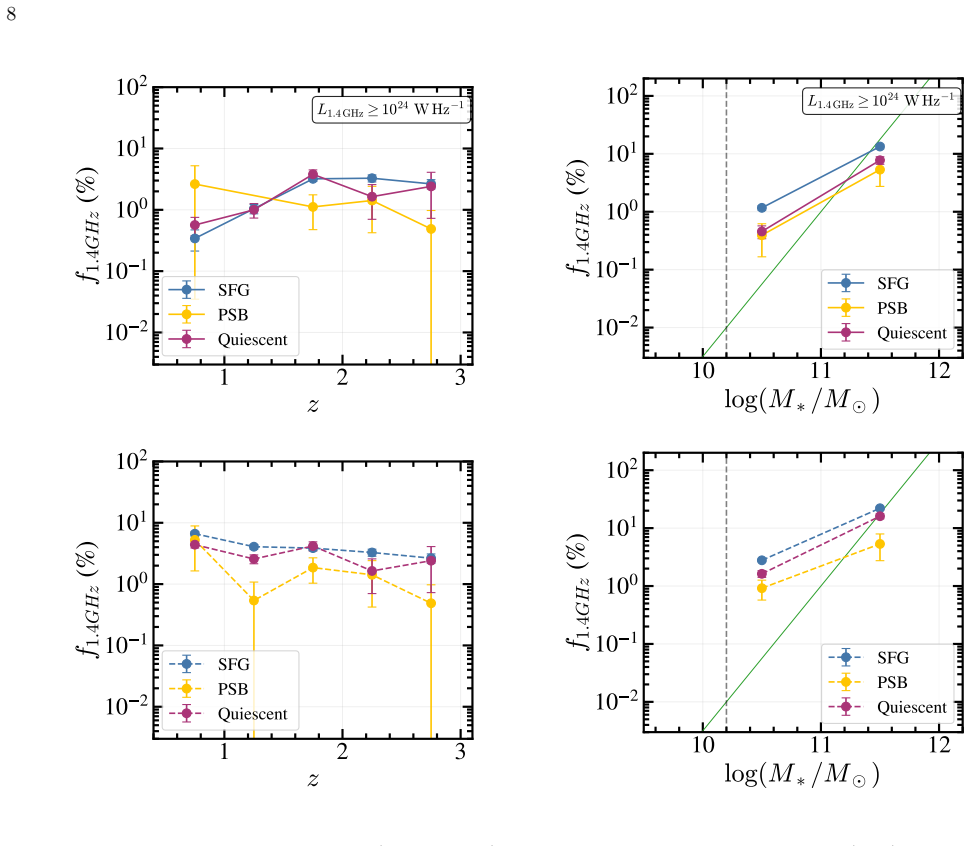
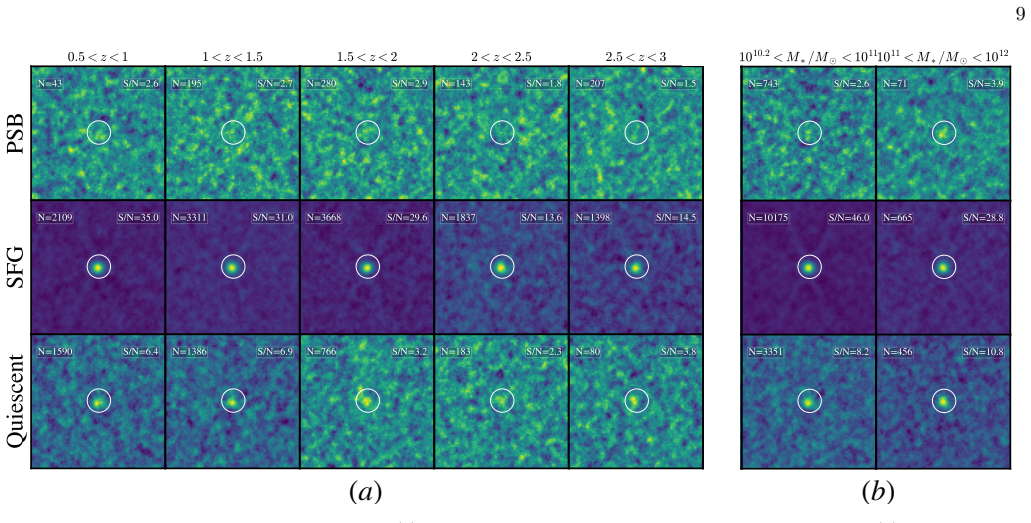
Cross-matching VLA 1.4 GHz data with UKIDSS UDS post-starburst candidates gives a mean detection fraction of 0.8 percent above 10^24 W Hz^-1, rising to 5 plus or minus 2 percent for stellar masses above 10^11 solar masses. Detected post-starburst galaxies show radio luminosities a median factor of 37 above star-formation expectations and remain compact at less than or equal to 15 kpc, while quiescent galaxies reach radio-loud levels with extended morphologies. Stacking the undetected massive post-starburst systems produces a 3.9 sigma signal, supporting the presence of low-level AGN.
What carries the argument
Radio detection fraction together with the factor-of-37 luminosity excess over star-formation predictions and source compactness to isolate weak AGN activity in post-starburst galaxies versus stronger AGN in quiescent systems.
If this is right
- Massive post-starburst galaxies have radio detection fractions comparable to those of massive quiescent galaxies but lower than those of massive star-forming galaxies.
- Radio luminosities of detected post-starburst galaxies exceed star-formation expectations by a median factor of 37, indicating AGN origin.
- Detected post-starburst galaxies host compact radio sources suggestive of weak jets, unlike the extended radio-loud structures in quiescent galaxies.
- Stacking of undetected massive post-starburst galaxies yields a weak radio signal consistent with low-level AGN activity.
- Radio AGN activity in post-starburst galaxies follows a short duty cycle, with radio-driven maintenance-mode feedback likely becoming more important at older ages.
Where Pith is reading between the lines
- The compact scale of the radio sources implies feedback operates inside the galaxy rather than on larger halo scales during this phase.
- If the short duty cycle is confirmed, it could help explain why some galaxies transition to quiescence faster than long-lived AGN models predict.
- Deeper radio observations of larger post-starburst samples would test whether the stacked signal grows stronger or remains marginal.
- Extending the same radio analysis to lower-redshift post-starburst galaxies could reveal whether the weak-jet phase persists or changes with cosmic time.
Load-bearing premise
The radio luminosity excess is produced by AGN rather than residual star formation, dust, or other contaminants, and photometric selection cleanly isolates genuine post-starburst galaxies.
What would settle it
Deeper radio imaging or spectroscopic follow-up showing that the excess luminosities match pure star-formation models or that many photometrically selected post-starburst candidates are actually ongoing star-formers.
Figures




read the original abstract
We present a radio continuum study of photometrically selected cosmic noon (0.5<z<3) post-starburst galaxies (PSBs) in the UKIDSS Deep Survey (UDS) field to assess if radio-mode Active Galactic Nuclei (AGN) are linked to the quenching of star formation at cosmic noon. Our cross-matching using the deep Very Large Array (VLA) imaging at 1.4 GHz results in a mean radio detection fraction ($f_{det}$) of only 0.8$\%$ for PSBs above a radio luminosity threshold of $L_{\rm 1.4 GHz} \geq 10^{24}$ W Hz$^{-1}$, increasing to 5$\pm2\%$ for massive PSBs with stellar masses M$_*>10^{11}$M$_\odot$. Massive PSBs have a comparable detection fraction to that of massive quiescent galaxies ($f_{det}=8\pm1\%$), and both classes have lower fractions than that of massive star-forming galaxies ($f_{det}=13\pm1\%$) in the same field. The radio luminosities of detected PSBs, ${\rm L}_{1.4}\sim 10^{22.8}-10^{24.9}$W/Hz, exceed those from star formation by a median factor of 37 indicative of a possible AGN origin. Their compact morphologies ($\lesssim15$ kpc at $z_{med}=1.5$) suggest low-luminosity AGN with less powerful jets. Stacking the undetected PSBs reveals a weak radio detection ($3.9\sigma$) in the highest mass bin (M$_*>10^{11}$M$_\odot$). In contrast, 1.4 GHz detected quiescent galaxies have radio luminosities reaching radio-loud levels, and a higher prevalence of extended morphologies indicative of large-scale jetted AGN. The AGN contribution is also detected in stacked measurements of quiescent galaxies. Overall, our results support a short radio AGN duty cycle for PSBs, characterized by weak radio jets, suggesting radio-driven maintenance mode feedback may become important at older ages.
Editorial analysis
A structured set of objections, weighed in public.
Referee Report
Summary. The manuscript reports a radio continuum study of photometrically selected post-starburst galaxies (PSBs) at 0.5<z<3 in the UDS field using deep VLA 1.4 GHz imaging. It finds low radio detection fractions (0.8% overall, rising to 5±2% for M*>10^11 M⊙), radio luminosities exceeding star-formation expectations by a median factor of 37, compact morphologies (≲15 kpc), and a 3.9σ stacked detection in the highest-mass bin. These are compared to higher detection fractions and more extended radio structures in quiescent galaxies, supporting the interpretation of a short radio AGN duty cycle in PSBs characterized by weak jets, with radio-driven maintenance-mode feedback becoming relevant at later evolutionary stages.
Significance. If the radio excess is robustly attributable to AGN rather than residual star formation or selection effects, the work provides useful empirical constraints on the timing and strength of radio-mode AGN activity during the post-starburst phase at cosmic noon. The uniform field selection, morphological distinctions, and stacking results add observational value to models of episodic quenching and feedback. The purely observational nature with explicit thresholds and no circular parameter fitting is a strength.
major comments (2)
- [Abstract] Abstract: The central inference of a short radio AGN duty cycle rests on attributing the median factor-of-37 radio luminosity excess (and the low detection fractions) to weak AGN jets rather than residual star formation, dust, or photometric interlopers. The abstract qualifies this as 'indicative of a possible AGN origin' but provides no quantitative assessment of radio-SFR calibration scatter at 0.5<z<3 or PSB selection purity (e.g., via spectroscopy), which is load-bearing for the duty-cycle claim.
- [Results and Discussion] Results and Discussion: The reported detection fractions (0.8% overall, 5±2% for massive PSBs vs. 8±1% for quiescent galaxies) and the 3.9σ stack are presented without detailed error propagation or tests for Malmquist bias in the luminosity threshold (L_1.4 GHz ≥ 10^24 W Hz^{-1}), weakening the statistical basis for claiming a distinct short duty cycle relative to quiescent systems.
minor comments (2)
- [Abstract] Abstract: The redshift range is given as 0.5<z<3 but the median redshift (z_med=1.5) and exact distribution of the PSB sample could be stated more explicitly for context.
- [Results] The manuscript would benefit from a brief table summarizing detection fractions, median luminosities, and morphological classifications across PSB, quiescent, and star-forming subsamples for direct comparison.
Simulated Author's Rebuttal
We thank the referee for their constructive and detailed comments, which have helped us improve the clarity and rigor of our analysis. We have revised the manuscript to incorporate quantitative assessments in the abstract and to add explicit error propagation and bias discussions in the results section. Our point-by-point responses follow.
read point-by-point responses
-
Referee: [Abstract] Abstract: The central inference of a short radio AGN duty cycle rests on attributing the median factor-of-37 radio luminosity excess (and the low detection fractions) to weak AGN jets rather than residual star formation, dust, or photometric interlopers. The abstract qualifies this as 'indicative of a possible AGN origin' but provides no quantitative assessment of radio-SFR calibration scatter at 0.5<z<3 or PSB selection purity (e.g., via spectroscopy), which is load-bearing for the duty-cycle claim.
Authors: We agree that the abstract would benefit from explicit quantification to support the duty-cycle interpretation. In the revised version, we have updated the abstract to state that the radio-SFR calibration at 0.5<z<3 exhibits a typical scatter of ~0.4 dex (citing Delhaize et al. 2017 and similar works), such that the observed median excess of 37 (~1.57 dex) remains >3 times the scatter even in the most conservative case. We have also added a reference to spectroscopic validation studies (e.g., Wild et al. 2016) showing ~70-80% purity for our photometric PSB selection, with interlopers unlikely to produce the observed radio excess or compact morphologies. These additions preserve the original inference while addressing the load-bearing concerns. revision: yes
-
Referee: [Results and Discussion] Results and Discussion: The reported detection fractions (0.8% overall, 5±2% for massive PSBs vs. 8±1% for quiescent galaxies) and the 3.9σ stack are presented without detailed error propagation or tests for Malmquist bias in the luminosity threshold (L_1.4 GHz ≥ 10^24 W Hz^{-1}), weakening the statistical basis for claiming a distinct short duty cycle relative to quiescent systems.
Authors: We thank the referee for highlighting this statistical gap. We have revised the results section to include full error propagation using binomial statistics, yielding updated uncertainties of 0.8^{+0.4}_{-0.3}% overall and 5±2% for massive PSBs (with similar updates for the quiescent comparison sample). The 3.9σ stacked detection now includes bootstrap resampling errors for confirmation. For Malmquist bias, we have added an explicit test: varying the luminosity threshold by ±0.2 dex produces no significant change in the relative detection fractions between PSBs and quiescent galaxies, as both populations are drawn from the same field and subject to identical selection. This supports the robustness of the short duty-cycle claim while acknowledging the threshold's role. revision: yes
Circularity Check
No significant circularity: purely observational comparisons with explicit thresholds
full rationale
The paper reports direct measurements of radio detection fractions, luminosities, and stacking results in photometrically selected PSBs versus quiescent and star-forming galaxies. All quantities are computed from cross-matched VLA data using stated luminosity thresholds (L_1.4GHz >= 10^24 W Hz^-1) and mass bins, with radio excess compared to standard SF calibrations applied uniformly. No equations, fitted parameters, or self-citations reduce the duty-cycle interpretation to a tautology or input by construction. The central claim remains an empirical inference from the data rather than a self-referential derivation.
Axiom & Free-Parameter Ledger
free parameters (2)
- Stellar mass threshold for massive subsample =
10^11 M_sun
- Radio luminosity threshold for detection fraction =
10^24 W Hz^-1
axioms (2)
- domain assumption Radio luminosity significantly above the star-formation expectation indicates AGN activity
- domain assumption Photometric color and redshift selection reliably identifies post-starburst galaxies
Lean theorems connected to this paper
-
IndisputableMonolith/Foundation/RealityFromDistinction.leanreality_from_one_distinction unclearPCA supercolor classification … radio detection fraction … stacking … IRRC … jet-power scaling (Cavagnolo et al. 2010)
-
IndisputableMonolith/Cost/FunctionalEquation.leanwashburn_uniqueness_aczel unclearL_{1.4} excess over SF expectations … maintenance-mode feedback
Reference graph
Works this paper leans on
-
[1]
Alatalo, K., Cales, S. L., Appleton, P. N., et al. 2014, ApJL, 794, L13, doi: 10.1088/2041-8205/794/1/L13
-
[2]
Almaini, O., Wild, V., Maltby, D. T., et al. 2017, MNRAS, 472, 1401, doi: 10.1093/mnras/stx1957
-
[3]
2025, MNRAS, 539, 3568, doi: 10.1093/mnras/staf659
Almaini, O., Wild, V., Maltby, D., et al. 2025, MNRAS, 539, 3568, doi: 10.1093/mnras/staf659
-
[4]
C., Ciesla, L., Ilbert, O., et al
Arango-Toro, R. C., Ciesla, L., Ilbert, O., et al. 2023, A&A, 675, A126, doi: 10.1051/0004-6361/202345848
-
[5]
Arnaudova, M. I., Smith, D. J. B., Hardcastle, M. J., et al. 2025, MNRAS, 542, 2245, doi: 10.1093/mnras/staf1347
-
[6]
Arnouts, S., Walcher, C. J., Le F` evre, O., et al. 2007, A&A, 476, 137, doi: 10.1051/0004-6361:20077632
-
[7]
2013, PhD thesis, University of Edinburgh
Arumugam, V. 2013, PhD thesis, University of Edinburgh
work page 2013
-
[8]
Ashby, M. L. N., Willner, S. P., Fazio, G. G., et al. 2013, ApJ, 769, 80, doi: 10.1088/0004-637X/769/1/80 Astropy Collaboration, Robitaille, T. P., Tollerud, E. J., et al. 2013, A&A, 558, A33, doi: 10.1051/0004-6361/201322068 Astropy Collaboration, Price-Whelan, A. M., Sip˝ ocz, B. M., et al. 2018, AJ, 156, 123, doi: 10.3847/1538-3881/aabc4f
-
[9]
Baldi, R. D., Capetti, A., & Massaro, F. 2018, A&A, 609, A1, doi: 10.1051/0004-6361/201731333
-
[10]
D., Laor, A., Behar, E., et al
Baldi, R. D., Laor, A., Behar, E., et al. 2022, MNRAS, 510, 1043, doi: 10.1093/mnras/stab3445
-
[11]
K., Glazebrook K., Brinkmann J., Ivezi \'c Z ., Lupton R
Baldry, I. K., Glazebrook, K., Brinkmann, J., et al. 2004, ApJ, 600, 681, doi: 10.1086/380092
-
[12]
Baron, D., Netzer, H., French, K. D., et al. 2023, MNRAS, 524, 2741, doi: 10.1093/mnras/stad1792
-
[13]
Barro, G., Faber, S. M., P´ erez-Gonz´ alez, P. G., et al. 2013, ApJ, 765, 104, doi: 10.1088/0004-637X/765/2/104
-
[14]
Becker, R. H., White, R. L., & Helfand, D. J. 1995, ApJ, 450, 559, doi: 10.1086/176166
-
[15]
F., Wolf, C., Meisenheimer, K., et al
Bell, E. F., Wolf, C., Meisenheimer, K., et al. 2004, ApJ, 608, 752, doi: 10.1086/420778
-
[16]
Belli, S., Newman, A. B., & Ellis, R. S. 2019, ApJ, 874, 17, doi: 10.3847/1538-4357/ab07af
-
[17]
Belli, S., Park, M., Davies, R. L., et al. 2024, Nature, 630, 54, doi: 10.1038/s41586-024-07412-1
-
[18]
Best, P. N., & Heckman, T. M. 2012, MNRAS, 421, 1569, doi: 10.1111/j.1365-2966.2012.20414.x
-
[19]
Best, P. N., Kauffmann, G., Heckman, T. M., & Ivezi´ c,ˇZ. 2005, MNRAS, 362, 9, doi: 10.1111/j.1365-2966.2005.09283.x Bˆ ırzan, L., Rafferty, D. A., Nulsen, P. E. J., et al. 2012, MNRAS, 427, 3468, doi: 10.1111/j.1365-2966.2012.22083.x
-
[20]
Blandford, R., Meier, D., & Readhead, A. 2019, ARA&A, 57, 467, doi: 10.1146/annurev-astro-081817-051948
-
[21]
Bradshaw, E. J., Almaini, O., Hartley, W. G., et al. 2013, MNRAS, 433, 194, doi: 10.1093/mnras/stt715
-
[22]
Brammer, G. B., van Dokkum, P. G., & Coppi, P. 2008, ApJ, 686, 1503, doi: 10.1086/591786
-
[23]
Bridle, A. H., & Schwab, F. R. 1999, in Astronomical Society of the Pacific Conference Series, Vol. 180, Synthesis Imaging in Radio Astronomy II, ed. G. B
work page 1999
-
[24]
2017, A&A, 606, A98, doi: 10.1051/0004-6361/201730932
Brienza, M., Godfrey, L., Morganti, R., et al. 2017, A&A, 606, A98, doi: 10.1051/0004-6361/201730932
-
[25]
2020, A&A, 638, A29, doi: 10.1051/0004-6361/202037457
Brienza, M., Morganti, R., Harwood, J., et al. 2020, A&A, 638, A29, doi: 10.1051/0004-6361/202037457
-
[26]
Bruzual, G., & Charlot, S. 2003, MNRAS, 344, 1000, doi: 10.1046/j.1365-8711.2003.06897.x
-
[27]
2025, ApJ, 981, 25, doi: 10.3847/1538-4357/adaeaf Calistro Rivera, G., Williams, W
Bugiani, L., Belli, S., Park, M., et al. 2025, ApJ, 981, 25, doi: 10.3847/1538-4357/adaeaf Calistro Rivera, G., Williams, W. L., Hardcastle, M. J., et al. 2017, MNRAS, 469, 3468, doi: 10.1093/mnras/stx1040
-
[28]
Carnall, A. C., McLure, R. J., Dunlop, J. S., et al. 2023, Nature, 619, 716, doi: 10.1038/s41586-023-06158-6
-
[29]
Dusty Star-Forming Galaxies at High Redshift
Casey, C. M., Narayanan, D., & Cooray, A. 2014, PhR, 541, 45, doi: 10.1016/j.physrep.2014.02.009
work page Pith review doi:10.1016/j.physrep.2014.02.009 2014
-
[30]
Casey, C. M., Zavala, J. A., Manning, S. M., et al. 2021, ApJ, 923, 215, doi: 10.3847/1538-4357/ac2eb4
-
[31]
Cavagnolo, K. W., McNamara, B. R., Nulsen, P. E. J., et al. 2010, ApJ, 720, 1066, doi: 10.1088/0004-637X/720/2/1066
-
[32]
2018, A&A, 620, A192, doi: 10.1051/0004-6361/201833935
Ceraj, L., Smolˇ ci´ c, V., Delvecchio, I., et al. 2018, A&A, 620, A192, doi: 10.1051/0004-6361/201833935
-
[33]
Clausen, M., Whitaker, K. E., Momcheva, I., et al. 2024, ApJ, 971, 99, doi: 10.3847/1538-4357/ad528a
-
[34]
Condon, J. J. 1992, ARA&A, 30, 575, doi: 10.1146/annurev.aa.30.090192.003043
-
[35]
Cook, R. H. W., Davies, L. J. M., Rhee, J., et al. 2024, MNRAS, 531, 708, doi: 10.1093/mnras/stae1215
-
[36]
Croton, D. J., Springel, V., White, S. D. M., et al. 2006, MNRAS, 365, 11, doi: 10.1111/j.1365-2966.2005.09675.x
-
[37]
Dasyra, K. M., Paraschos, G. F., Combes, F., et al. 2024, ApJ, 977, 156, doi: 10.3847/1538-4357/ad89ba Dav´ e, R., Angl´ es-Alc´ azar, D., Narayanan, D., et al. 2019, MNRAS, 486, 2827, doi: 10.1093/mnras/stz937
-
[38]
L., Belli, S., Park, M., et al
Davies, R. L., Belli, S., Park, M., et al. 2024, MNRAS, 528, 4976, doi: 10.1093/mnras/stae327 de Vries, W. H., Hodge, J. A., Becker, R. H., White, R. L., & Helfand, D. J. 2007, AJ, 134, 457, doi: 10.1086/518866
-
[39]
2017, A&A, 602, A4, doi: 10.1051/0004-6361/201629430 22
Delhaize, J., Smolˇ ci´ c, V., Delvecchio, I., et al. 2017, A&A, 602, A4, doi: 10.1051/0004-6361/201629430 22
-
[40]
Data Release 1 of the Dark Energy Spectroscopic Instrument
Delvecchio, I., Daddi, E., Sargent, M. T., et al. 2021, A&A, 647, A123, doi: 10.1051/0004-6361/202039647 DESI Collaboration, Karim, M. A., Adame, A. G., et al. 2025, arXiv e-prints, arXiv:2503.14745, doi: 10.48550/arXiv.2503.14745 D’Eugenio, F., P´ erez-Gonz´ alez, P. G., Maiolino, R., et al. 2024, Nature Astronomy, 8, 1443, doi: 10.1038/s41550-024-02345-...
work page internal anchor Pith review Pith/arXiv arXiv doi:10.1051/0004-6361/202039647 2021
-
[41]
Donley, J. L., Rieke, G. H., Rigby, J. R., & P´ erez-Gonz´ alez, P. G. 2005, ApJ, 634, 169, doi: 10.1086/491668
-
[42]
2013, MNRAS, 433, 3297, doi: 10.1093/mnras/stt997
Dubois, Y., Gavazzi, R., Peirani, S., & Silk, J. 2013, MNRAS, 433, 3297, doi: 10.1093/mnras/stt997
-
[43]
J., Schawinski, K., Slosar, A., et al
Dunne, L., Ivison, R. J., Maddox, S., et al. 2009, MNRAS, 394, 3, doi: 10.1111/j.1365-2966.2008.13900.x
-
[44]
Dutta, R., Sharma, P., Sarkar, K. C., & Stone, J. M. 2024, ApJ, 973, 148, doi: 10.3847/1538-4357/ad67d7
-
[45]
Fabian, A. C. 2012, ARA&A, 50, 455, doi: 10.1146/annurev-astro-081811-125521 F¨ orster Schreiber, N. M., & Wuyts, S. 2020, ARA&A, 58, 661, doi: 10.1146/annurev-astro-032620-021910
work page internal anchor Pith review doi:10.1146/annurev-astro-081811-125521 2012
-
[46]
French, K. D. 2021, PASP, 133, 072001, doi: 10.1088/1538-3873/ac0a59
-
[47]
French, K. D., Earl, N., Novack, A. B., et al. 2023, ApJ, 950, 153, doi: 10.3847/1538-4357/acd249
-
[48]
D., Yang, Y., Zabludoff, A., et al
French, K. D., Yang, Y., Zabludoff, A., et al. 2015, ApJ, 801, 1, doi: 10.1088/0004-637X/801/1/1
-
[49]
2008, ApJS, 176, 1, doi: 10.1086/527321
Furusawa, H., Kosugi, G., Akiyama, M., et al. 2008, ApJS, 176, 1, doi: 10.1086/527321
-
[50]
2014, A&A, 562, A23, doi: 10.1051/0004-6361/201322790
Garilli, B., Guzzo, L., Scodeggio, M., et al. 2014, A&A, 562, A23, doi: 10.1051/0004-6361/201322790
-
[51]
J., Schawinski, K., Slosar, A., et al
Georgakakis, A., Nandra, K., Yan, R., et al. 2008, MNRAS, 385, 2049, doi: 10.1111/j.1365-2966.2008.12962.x
-
[52]
Monthly Notices of the Royal Astronomical Society , author =
Goto, T. 2007, MNRAS, 377, 1222, doi: 10.1111/j.1365-2966.2007.11674.x
-
[53]
E., Setton, D., Bezanson, R., et al
Greene, J. E., Setton, D., Bezanson, R., et al. 2020, ApJL, 899, L9, doi: 10.3847/2041-8213/aba534 Grossov´ a, R., Werner, N., Massaro, F., et al. 2022, ApJS, 258, 30, doi: 10.3847/1538-4365/ac366c
-
[54]
2014, A&A, 566, A108, doi: 10.1051/0004-6361/201321489
Guzzo, L., Scodeggio, M., Garilli, B., et al. 2014, A&A, 566, A108, doi: 10.1051/0004-6361/201321489
-
[55]
Hale, C. L., Heywood, I., Jarvis, M. J., et al. 2025, MNRAS, 536, 2187, doi: 10.1093/mnras/stae2528
-
[56]
Hardcastle, M. J., & Croston, J. H. 2020, NewAR, 88, 101539, doi: 10.1016/j.newar.2020.101539
-
[57]
Harris, C. R., Millman, K. J., van der Walt, S. J., et al. 2020, Nature, 585, 357, doi: 10.1038/s41586-020-2649-2
-
[58]
Harrison, C. M. 2017, Nature Astronomy, 1, 0165, doi: 10.1038/s41550-017-0165
-
[59]
Harrison, C. M., & Ramos Almeida, C. 2024, Galaxies, 12, 17, doi: 10.3390/galaxies12020017
-
[60]
2025, arXiv e-prints, arXiv:2506.22287, doi: 10.48550/arXiv.2506.22287
Harvey, Z., Krishna, S., Wild, V., Tojeiro, R., & Hewett, P. 2025, arXiv e-prints, arXiv:2506.22287, doi: 10.48550/arXiv.2506.22287
-
[61]
Harwood, J. J. 2017, MNRAS, 466, 2888, doi: 10.1093/mnras/stw3318
-
[62]
Heckman, T. M., & Best, P. N. 2014, ARA&A, 52, 589, doi: 10.1146/annurev-astro-081913-035722
work page internal anchor Pith review doi:10.1146/annurev-astro-081913-035722 2014
-
[63]
Helou, G., Soifer, B. T., & Rowan-Robinson, M. 1985, ApJL, 298, L7, doi: 10.1086/184556
-
[64]
Hodge, J. A., Becker, R. H., White, R. L., & de Vries, W. H. 2008, AJ, 136, 1097, doi: 10.1088/0004-6256/136/3/1097
-
[65]
Hopkins, P. F. 2012, MNRAS, 420, L8, doi: 10.1111/j.1745-3933.2011.01179.x
-
[66]
Hopkins, P. F., Hernquist, L., Cox, T. J., & Kereˇ s, D. 2008, ApJS, 175, 356, doi: 10.1086/524362
work page internal anchor Pith review doi:10.1086/524362 2008
-
[67]
Hunter, J. D. 2007, Computing in Science & Engineering, 9, 90, doi: 10.1109/MCSE.2007.55
-
[68]
J., Schawinski, K., Slosar, A., et al
Ibar, E., Cirasuolo, M., Ivison, R., et al. 2008, Monthly Notices of the Royal Astronomical Society, 386, 953, doi: 10.1111/j.1365-2966.2008.13077.x
-
[69]
2025, A&A, 697, A196, doi: 10.1051/0004-6361/202452888
Igo, Z., & Merloni, A. 2025, A&A, 697, A196, doi: 10.1051/0004-6361/202452888
-
[70]
Ivison, R. J., Chapman, S. C., Faber, S. M., et al. 2007, ApJL, 660, L77, doi: 10.1086/517917
-
[71]
2012, A&A, 541, A62, doi: 10.1051/0004-6361/201219052
Brinchmann, J. 2012, A&A, 541, A62, doi: 10.1051/0004-6361/201219052
-
[73]
Jarvis, M. E., Harrison, C. M., Mainieri, V., et al. 2021, MNRAS, 503, 1780, doi: 10.1093/mnras/stab549
-
[74]
J., Taylor, R., Agudo, I., & et al
Jarvis, M. J., Taylor, R., Agudo, I., & et al. 2016, in Proceedings of MeerKAT Science: On the Pathway to the SKA, 6, doi: 10.22323/1.277.0006
-
[75]
Jarvis, M. J., Bonfield, D. G., Bruce, V. A., et al. 2013, MNRAS, 428, 1281, doi: 10.1093/mnras/sts118
-
[76]
Jin, G., Kauffmann, G., Best, P. N., Shenoy, S., & Ma lek, K. 2025, A&A, 694, A309, doi: 10.1051/0004-6361/202451974
-
[77]
2025, arXiv e-prints, arXiv:2506.09136, doi: 10.48550/arXiv.2506.09136
Kaviraj, S. 2025, arXiv e-prints, arXiv:2506.09136, doi: 10.48550/arXiv.2506.09136
-
[78]
Kennicutt, Jr., R. C. 1998, ARA&A, 36, 189, doi: 10.1146/annurev.astro.36.1.189
work page internal anchor Pith review doi:10.1146/annurev.astro.36.1.189 1998
-
[79]
Kimball, A. E., Kellermann, K. I., Condon, J. J., Ivezi´ c,ˇZ., & Perley, R. A. 2011, ApJL, 739, L29, doi: 10.1088/2041-8205/739/1/L29 23
-
[80]
2021, A&A, 647, A32, doi: 10.1051/0004-6361/202039648
Kipper, R., Tamm, A., Tempel, E., de Propris, R., & Ganeshaiah Veena, P. 2021, A&A, 647, A32, doi: 10.1051/0004-6361/202039648
-
[81]
D., Hasinger, G., Brightman, M., et al
Kocevski, D. D., Hasinger, G., Brightman, M., et al. 2018, ApJS, 236, 48, doi: 10.3847/1538-4365/aab9b4
discussion (0)
Sign in with ORCID, Apple, or X to comment. Anyone can read and Pith papers without signing in.