Recognition: 2 theorem links
· Lean TheoremDecomposing Evolutionary Mixture-of-LoRA Architectures: The Routing Lever, the Lifecycle Penalty, and a Substrate-Conditional Boundary
Pith reviewed 2026-05-13 03:34 UTC · model grok-4.3
The pith
Router rewrite alone accounts for the full attributed gain in an evolutionary mixture-of-LoRA system while the lifecycle imposes a net penalty and search succeeds only with pre-aligned adapters.
A machine-rendered reading of the paper's core claim, the machinery that carries it, and where it could break.
Core claim
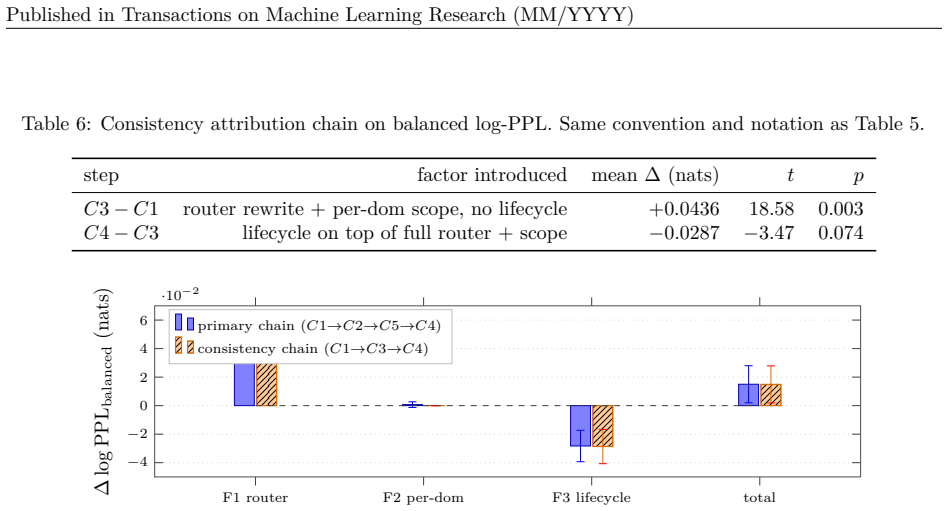
On the widened-1536 substrate the router rewrite carries the entire +0.0426 nat balanced log-PPL improvement attributed to the full evolutionary system versus the static B3 baseline, while the headline full-system contrast itself reaches only +0.015 nats and fails to reach statistical significance at n=3. The lifecycle operations impose a net drag of approximately -0.028 nats. The per-domain evaluation scope is null at seed resolution. An auxiliary alpha=0 inheritance test is sign-inconsistent, a base-perturbation probe refutes a genomic-context interpretation, and a controllable synthetic sandbox locates a substrate-conditional regime boundary: evolutionary routing search is load-bearing if
What carries the argument
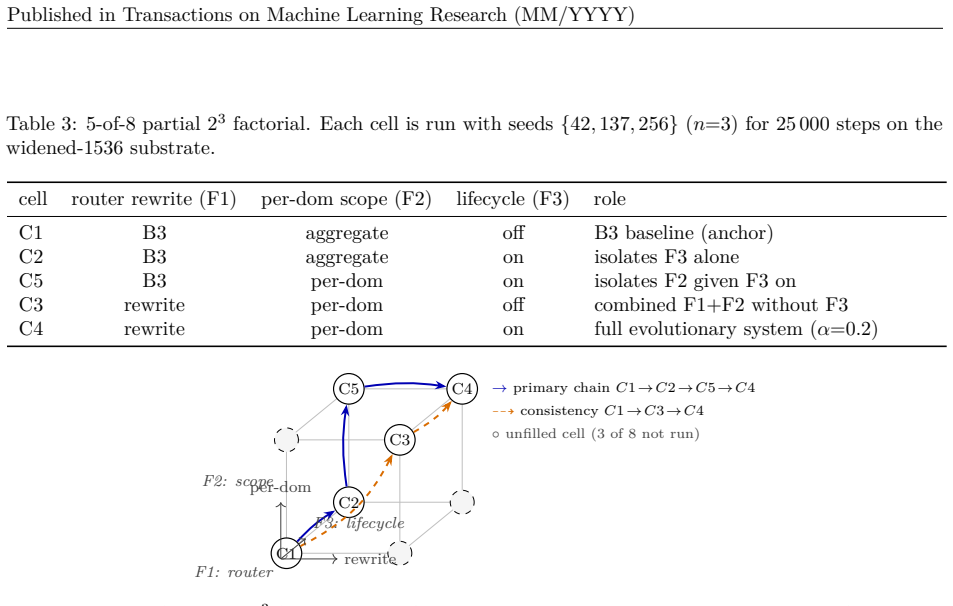
A 5-of-8 partial 2^3 factorial design that isolates the router rewrite, lifecycle operations and evaluation scope, augmented by a controllable synthetic sandbox that isolates the substrate-conditional boundary for evolutionary routing.
If this is right
- Only the router rewrite needs to be retained to capture the reported improvement without incurring the lifecycle penalty.
- Disabling the lifecycle operations would raise performance relative to the full evolutionary system.
- Evolutionary routing search should be used only when adapters are pre-aligned to the target task.
- The per-domain leave-one-out evaluation scope can be removed without affecting measured performance.
- The headline gain of the full evolutionary system over the static baseline is too small and noisy to be treated as reliable at the reported sample size.
Where Pith is reading between the lines
- Future mixture-of-adapters work should concentrate design effort on routing mechanisms rather than evolutionary dynamics.
- The identified regime boundary implies that evolutionary routing will underperform simpler gradient methods on most new tasks unless pre-alignment is first solved.
- The small seed count and partial design limit the strength of any claim that the lifecycle is generally harmful; larger replications are required.
- The refutation of genomic-context suggests that the mutation and inheritance steps do not usefully preserve task-relevant information across generations.
Load-bearing premise
A 5-of-8 partial 2^3 factorial design with only three random seeds supplies reliable attribution of effects to the individual factors on the widened-1536 substrate.
What would settle it
A complete eight-cell factorial experiment run with at least ten seeds per cell on the same substrate, or the same contrasts measured on a different model width or dataset, that checks whether the router rewrite still isolates the full positive delta and the lifecycle remains negative.
Figures


read the original abstract
We decompose an evolutionary mixture-of-LoRA system on a from-scratch ~150M-parameter widened-D substrate (D=1536, V=32000; D/V approx 0.048; the "widened-1536" substrate) into three factors -- a router rewrite (parallel sigmoid gate with learnable per-adapter floor and bounded temperature anneal, fed post-stack hidden states rather than token-embedding means), a per-domain leave-one-out evaluation scope, and a lifecycle of death plus alpha-blend inheritance plus SVD mutation plus slot reallocation -- and report a 5-of-8 partial 2^3 factorial run at n=3 seeds and 25000 adaptation steps per cell. The attribution chain is sharp on this substrate: the router rewrite carries the entire +0.0426 nat balanced log-PPL improvement (Delta = log PPL_ref - log PPL_test, positive = improvement; t=12.86, p=0.006) attributed to "the full evolutionary system vs the static B3 baseline"; the headline full-system-vs-B3 balanced contrast itself is +0.015 nats, t=1.94, p=0.19 at n=3 and does not clear alpha=0.05. The per-domain evaluation scope is null at seed-resolution, and the lifecycle is a net drag of approx -0.028 nats (t=-4.46,p=0.047 in the primary chain). An auxiliary alpha=0 inheritance counterfactual at n=3 seeds is sign-inconsistent at the headline metric and underpowered for either an equivalence or load-bearing conclusion (corrected from an earlier arithmetic-mean aggregator that erroneously cleared inheritance; see Appendix B.11). A base-perturbation probe directionally refutes a "genomic-context" reframe of the lifecycle role. A controllable synthetic sandbox locates a substrate-conditional regime boundary: evolutionary search on the routing channel is load-bearing only when adapters are pre-aligned to the task; in every other regime tested it underperforms, ties, or actively degrades the gradient solution.
Editorial analysis
A structured set of objections, weighed in public.
Referee Report
Summary. The manuscript decomposes an evolutionary mixture-of-LoRA system on the widened-1536 substrate (~150M params, D=1536) into three factors—router rewrite (parallel sigmoid gate with learnable per-adapter floor and bounded temperature anneal), per-domain leave-one-out scope, and lifecycle (death, alpha-blend inheritance, SVD mutation, slot reallocation)—via a 5-of-8 partial 2^3 factorial at n=3 seeds and 25000 steps per cell. It reports that the router rewrite accounts for the entire +0.0426 nat balanced log-PPL improvement (t=12.86, p=0.006) over static B3, while the full-system contrast is +0.015 nats (t=1.94, p=0.19, non-significant), the scope is null, and the lifecycle is a net drag of -0.028 nats (t=-4.46, p=0.047). An alpha=0 inheritance counterfactual and a controllable synthetic sandbox are used to identify a substrate-conditional boundary where evolutionary routing search is load-bearing only when adapters are pre-aligned.
Significance. If the decomposition and boundary hold, the result would clarify the conditions under which evolutionary search adds value to adapter systems, specifically isolating routing as the dominant lever and providing a falsifiable regime boundary via the synthetic sandbox. The work strengthens reproducibility through explicit reporting of seed counts, step counts, and statistical contrasts (t-statistics, p-values) on held-out metrics, and includes an auxiliary counterfactual that directly tests inheritance assumptions.
major comments (2)
- [results on the primary attribution chain] The primary attribution chain reports the router main effect as carrying the entire +0.0426 nat gain (t=12.86, p=0.006) while the full evolutionary system vs. static B3 contrast is only +0.015 nats (t=1.94, p=0.19) and fails to reach alpha=0.05. This discrepancy, arising from the 5-of-8 partial factorial cells, indicates that the isolation of the router effect may be sensitive to unmodeled interactions or seed variance and requires explicit justification of how the decomposition supports the 'entire improvement' claim when the overall system contrast does not.
- [experimental design and statistical analysis] The experimental design uses n=3 seeds per cell in the partial 2^3 factorial on the widened-1536 substrate. With this replication level, main-effect t-statistics (e.g., router t=12.86, lifecycle t=-4.46) have limited power to separate signal from seed-to-seed variance or aliased two-factor interactions, particularly when the headline full-system contrast is already non-significant; this weakens the reliability of attributing effects to individual factors.
minor comments (2)
- [methods] The exact formula for balanced log-PPL and the definition of Delta (log PPL_ref - log PPL_test) should be stated explicitly in the methods to ensure unambiguous interpretation of the reported nats values.
- [Appendix B.11] The correction to the inheritance counterfactual in Appendix B.11 (from arithmetic-mean aggregator) is noted, but a short summary of the prior error and its quantitative impact on the sign-inconsistent result would improve transparency.
Simulated Author's Rebuttal
We thank the referee for their thorough review and for highlighting important aspects of our experimental design and attribution analysis. We provide point-by-point responses to the major comments below.
read point-by-point responses
-
Referee: [results on the primary attribution chain] The primary attribution chain reports the router main effect as carrying the entire +0.0426 nat gain (t=12.86, p=0.006) while the full evolutionary system vs. static B3 contrast is only +0.015 nats (t=1.94, p=0.19) and fails to reach alpha=0.05. This discrepancy, arising from the 5-of-8 partial factorial cells, indicates that the isolation of the router effect may be sensitive to unmodeled interactions or seed variance and requires explicit justification of how the decomposition supports the 'entire improvement' claim when the overall system contrast does not.
Authors: The main effect of the router rewrite in the partial factorial design is estimated by averaging the contrast between router-on and router-off conditions across the other factor levels. This yields the +0.0426 nat effect size, which matches the magnitude of the improvement we attribute to the router component. The full-system contrast, however, corresponds to the specific cell where all factors are enabled (router + scope + lifecycle), and the observed +0.015 nat (non-significant) reflects the net effect including the negative main effect of the lifecycle factor (-0.028 nat) and any interactions. We interpret this as evidence that the lifecycle component introduces a drag that offsets part of the router gain in the combined system. The decomposition supports isolating the router as the primary positive lever, but we acknowledge that the full-system result does not reach significance and will revise the manuscript to explicitly note the role of interactions and to qualify the 'entire improvement' phrasing to 'the router main effect accounts for a gain of +0.0426 nat, which is partially offset in the full system by the lifecycle drag'. revision: partial
-
Referee: [experimental design and statistical analysis] The experimental design uses n=3 seeds per cell in the partial 2^3 factorial on the widened-1536 substrate. With this replication level, main-effect t-statistics (e.g., router t=12.86, lifecycle t=-4.46) have limited power to separate signal from seed-to-seed variance or aliased two-factor interactions, particularly when the headline full-system contrast is already non-significant; this weakens the reliability of attributing effects to individual factors.
Authors: We agree that n=3 seeds per cell limits statistical power and increases the risk that main effects could be influenced by seed variance or aliased interactions in the partial factorial. The reported t-statistics and p-values are computed from the available data, and we have been transparent about the non-significance of the full-system contrast. To address this, we will add a discussion in the manuscript on the limitations of the current replication level and note that future work should increase the number of seeds to better resolve interactions. The current results are presented as exploratory decomposition on this substrate, with the synthetic sandbox providing additional support for the boundary condition. revision: partial
Circularity Check
No significant circularity; purely empirical attribution
full rationale
The paper reports results from a 5-of-8 partial 2^3 factorial experiment on a widened-1536 substrate, with all central claims consisting of direct measurements of balanced log-PPL deltas, t-statistics, and p-values on held-out metrics. No mathematical derivations, first-principles predictions, or load-bearing self-citations are present; the attribution of the +0.0426 nat router effect is a statistical contrast from the factorial cells rather than a quantity defined by or reduced to fitted parameters inside the paper. The analysis is self-contained against external benchmarks.
Axiom & Free-Parameter Ledger
free parameters (2)
- per-adapter floor
- bounded temperature anneal
axioms (2)
- domain assumption Balanced log-PPL is an unbiased and comparable measure of model quality across domains
- domain assumption The leave-one-out per-domain evaluation scope isolates the effect of the router and lifecycle without domain leakage
Lean theorems connected to this paper
-
IndisputableMonolith/Cost/FunctionalEquation.leanwashburn_uniqueness_aczel unclear?
unclearRelation between the paper passage and the cited Recognition theorem.
the router rewrite carries the entire +0.0426 nat balanced log-PPL improvement... lifecycle is a net drag of ≈−0.028 nats
-
IndisputableMonolith/Foundation/RealityFromDistinction.leanreality_from_one_distinction unclear?
unclearRelation between the paper passage and the cited Recognition theorem.
substrate-conditional regime boundary: evolutionary search on the routing channel is load-bearing only when adapters are pre-aligned
What do these tags mean?
- matches
- The paper's claim is directly supported by a theorem in the formal canon.
- supports
- The theorem supports part of the paper's argument, but the paper may add assumptions or extra steps.
- extends
- The paper goes beyond the formal theorem; the theorem is a base layer rather than the whole result.
- uses
- The paper appears to rely on the theorem as machinery.
- contradicts
- The paper's claim conflicts with a theorem or certificate in the canon.
- unclear
- Pith found a possible connection, but the passage is too broad, indirect, or ambiguous to say the theorem truly supports the claim.
Reference graph
Works this paper leans on
-
[1]
MixLoRA: Enhancing Large Language Models Fine-Tuning with LoRA-based Mixture of Experts , author =. 2024 , eprint =
work page 2024
-
[2]
LoRA: Low-Rank Adaptation of Large Language Models , author =. 2021 , eprint =
work page 2021
-
[3]
Switch Transformers: Scaling to Trillion Parameter Models with Simple and Efficient Sparsity , author =. 2021 , eprint =
work page 2021
-
[4]
ST-MoE: Designing Stable and Transferable Sparse Expert Models , author =. 2022 , eprint =
work page 2022
-
[5]
Evolution Strategies as a Scalable Alternative to Reinforcement Learning , author =. 2017 , eprint =
work page 2017
-
[6]
Nature Machine Intelligence , volume =
Designing Neural Networks through Neuroevolution , author =. Nature Machine Intelligence , volume =. 2019 , publisher =
work page 2019
-
[7]
ES Is More Than Just a Traditional Finite-Difference Approximator , author =. 2018 , eprint =
work page 2018
-
[8]
Population Based Training of Neural Networks , author =. 2017 , eprint =
work page 2017
-
[9]
EvoJAX: Hardware-Accelerated Neuroevolution , author =. 2022 , eprint =
work page 2022
- [10]
-
[11]
Mixture-of-Experts with Expert Choice Routing , author =. 2022 , eprint =
work page 2022
-
[12]
Large Language Models Cannot Self-Correct Reasoning Yet , author =. 2024 , eprint =
work page 2024
-
[13]
Nested Learning: The Illusion of Deep Learning Architectures , author =. 2025 , eprint =
work page 2025
-
[14]
Improving Reproducibility in Machine Learning Research (A Report from the NeurIPS 2019 Reproducibility Program) , author =. 2020 , eprint =
work page 2019
- [15]
-
[16]
Evolution Strategies at Scale: LLM Fine-Tuning Beyond Reinforcement Learning , author =. 2025 , eprint =
work page 2025
- [17]
-
[18]
ESSA: Evolutionary Strategies for Scalable Alignment , author =. 2025 , eprint =
work page 2025
-
[19]
The Blessing of Dimensionality in
Qiyao Liang and Jinyeop Song and Yizhou Liu and Jeff Gore and others , year =. The Blessing of Dimensionality in. 2602.00170 , archivePrefix =
-
[20]
Heterogeneous Swarms: Jointly Optimizing Model Roles and Weights for Multi-
Shangbin Feng and Zifeng Wang and Palash Goyal and Yike Wang and others , year =. Heterogeneous Swarms: Jointly Optimizing Model Roles and Weights for Multi-. 2502.04510 , archivePrefix =
-
[21]
Evolutionary Optimization of Model Merging Recipes , author =. 2024 , eprint =
work page 2024
-
[22]
Agent skill acquisition for large language models via CycleQD.arXiv preprint arXiv:2410.14735, 2024
So Kuroki and Taishi Nakamura and Takuya Akiba and Yujin Tang , year =. Agent Skill Acquisition for Large Language Models via. 2410.14735 , archivePrefix =
-
[23]
Competition and Attraction Improve Model Fusion , author =. 2025 , eprint =
work page 2025
-
[24]
arXiv preprint arXiv:2501.06252 , year=
Qi Sun and Edoardo Cetin and Yujin Tang , year =. Transformer-Squared: Self-adaptive. 2501.06252 , archivePrefix =
-
[25]
Evolutionary Strategies lead to Catastrophic Forgetting in
Immanuel Abdi and Akshat Gupta and Micah Mok and Alexander Lu and others , year =. Evolutionary Strategies lead to Catastrophic Forgetting in. 2601.20861 , archivePrefix =
-
[26]
Ramchand Kumaresan , year =. 2603.22755 , archivePrefix =
discussion (0)
Sign in with ORCID, Apple, or X to comment. Anyone can read and Pith papers without signing in.