Recognition: no theorem link
A Stable Distance Persistence Homology for Dynamic Bayesian Network Clustering
Pith reviewed 2026-05-13 00:51 UTC · model grok-4.3
The pith
Persistent homology on a thresholded dynamic graph produces stable barcodes that track how clusters of dependent variables merge and dissolve in a DBN.
A machine-rendered reading of the paper's core claim, the machinery that carries it, and where it could break.
Core claim
To each dynamic Bayesian network we associate a time-varying graph called a Dynamic Bayesian Graph by assigning to each edge a strength that measures variation in its conditional dependence across parent configurations and retaining edges whose strength exceeds a chosen threshold. This DBG fits inside the dynamic graph framework, so persistent homology produces a barcode that is stable: small perturbations in the conditional probability tables of the DBN lead to small changes in the resulting barcode. The barcode records the merging and disappearance of connected groups of strongly dependent variables over time.
What carries the argument
The Dynamic Bayesian Graph (DBG), a time-varying graph obtained by thresholding edges according to the variation in conditional dependence across parent configurations, which embeds the DBN into the dynamic graph setting where existing persistence stability theorems apply directly.
Load-bearing premise
The DBG construction obtained by thresholding edges according to variation in conditional dependence across parent configurations fits inside the dynamic graph framework so that existing persistent homology stability results apply directly.
What would settle it
A concrete DBN together with an explicit small perturbation to one or more entries of its conditional probability tables such that the bottleneck distance between the resulting barcodes exceeds any fixed multiple of the perturbation size, or a DBG that fails to satisfy the axioms of the dynamic graph framework.
Figures


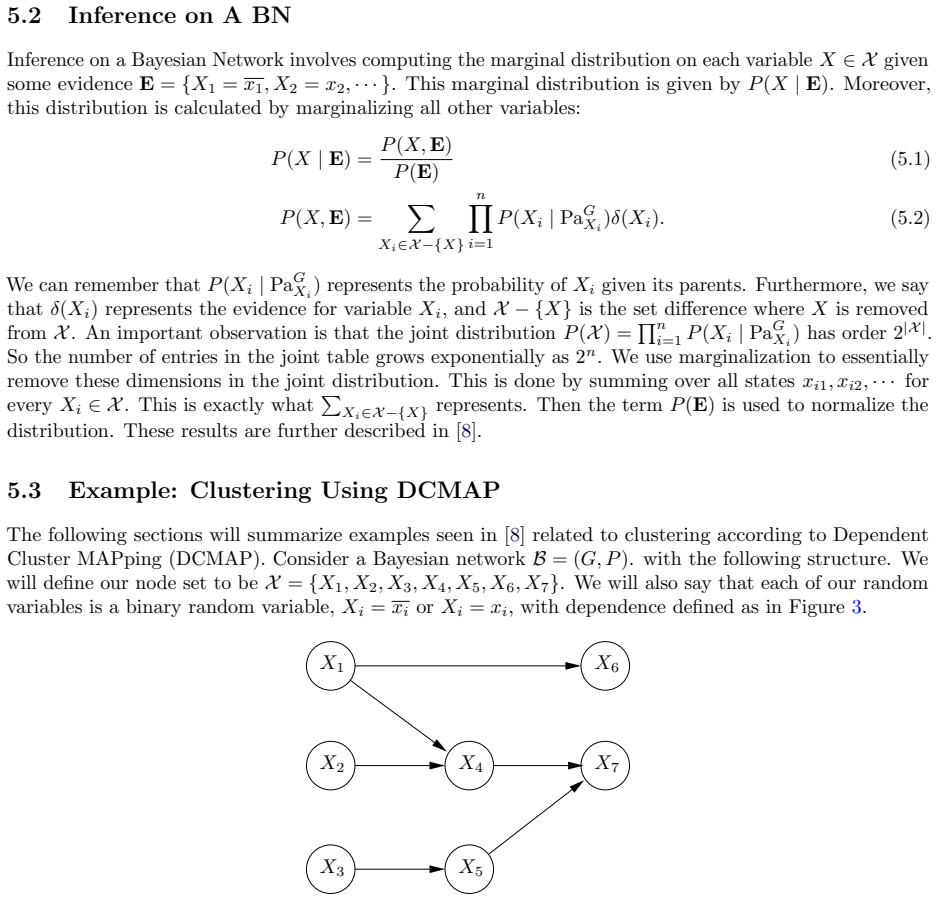


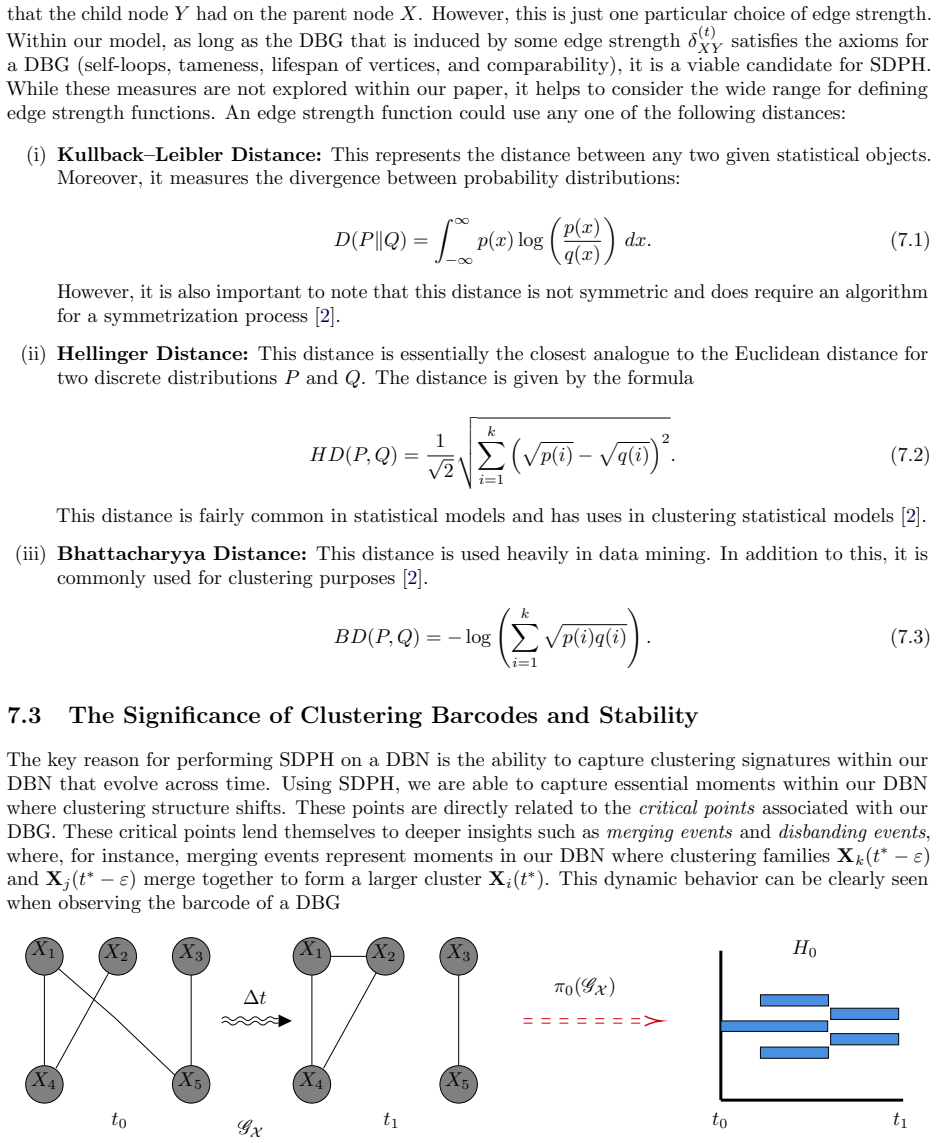
read the original abstract
Dynamic Bayesian networks (DBNs) are a widely used framework for modeling systems whose probabilistic structure evolves over time. Standard inference methods focus on local conditional distributions and can miss larger-scale patterns in how dependencies between variables organize and change over time. We introduce a topological approach to this problem. To each DBN we associate a time-varying graph, called a Dynamic Bayesian Graph (DBG), by assigning to each edge a strength that measures variation in its conditional dependence across parent configurations, and retaining edges whose strength exceeds a chosen threshold. We show that this construction fits within the dynamic graph framework of Kim and M\'emoli, enabling the use of tools from topological data analysis. Applying persistent homology to a DBG produces a barcode, which records the merging and disappearance of connected groups of strongly dependent variables over time. We prove that this barcode is stable: small perturbations in the conditional probability tables of the DBN lead to small changes in the resulting barcode. This yields a principled and noise-resistant summary of how dependency structure evolves in a dynamic Bayesian network.
Editorial analysis
A structured set of objections, weighed in public.
Referee Report
Summary. The manuscript introduces Dynamic Bayesian Graphs (DBGs) derived from Dynamic Bayesian Networks (DBNs) by assigning edge strengths based on variation in conditional dependence across parent configurations and retaining edges above a threshold. This time-varying graph is embedded into the dynamic graph framework of Kim and Mémoli, allowing persistent homology to produce barcodes that track the birth and death of connected components of strongly dependent variables over time. The central claim is a stability theorem asserting that small perturbations to the conditional probability tables of the DBN induce only small changes in the resulting barcodes.
Significance. If the stability result holds after verifying the framework hypotheses, the work supplies a noise-resistant topological summary of evolving global dependency structure in DBNs, complementing local inference methods. The reuse of an existing dynamic-graph persistent-homology theory is efficient provided the embedding is justified; the approach could support clustering or change-point detection in time-series probabilistic models.
major comments (2)
- [DBG construction and stability proof (abstract and § on embedding)] The stability transfer rests on the DBG satisfying the continuity or bounded-variation hypotheses of the Kim-Mémoli framework. However, edge retention is defined by a hard threshold on a variation-in-conditional-dependence statistic computed from the CPTs; this indicator function is discontinuous in CPT space, so arbitrarily small perturbations can flip edges on or off. The manuscript does not show that the resulting 0-1 time-varying graph still obeys the required conditions or replace the threshold by a filtration parameter.
- [Stability theorem statement] The abstract asserts that 'we prove that this barcode is stable' by fitting inside the Kim-Mémoli framework, yet the text provides no explicit verification that the DBG map from CPTs to dynamic graphs meets all hypotheses of the external stability theorems (e.g., Lipschitz continuity of the graph-valued function or control on the number of edge changes). The free threshold parameter is introduced but its effect on the stability constant is not quantified.
minor comments (2)
- [DBG definition] The precise definition of the 'variation in conditional dependence' measure used for edge strength should be stated as an explicit formula (with parent-configuration summation) rather than described only in prose.
- [Notation] Notation for the time index, the threshold value, and the resulting barcode should be introduced consistently in a single preliminary section to improve readability.
Simulated Author's Rebuttal
We thank the referee for the careful reading and constructive comments, which identify key points where the presentation and technical details of the DBG construction and stability result can be strengthened. We address the major comments point by point below, indicating the revisions we will incorporate.
read point-by-point responses
-
Referee: [DBG construction and stability proof (abstract and § on embedding)] The stability transfer rests on the DBG satisfying the continuity or bounded-variation hypotheses of the Kim-Mémoli framework. However, edge retention is defined by a hard threshold on a variation-in-conditional-dependence statistic computed from the CPTs; this indicator function is discontinuous in CPT space, so arbitrarily small perturbations can flip edges on or off. The manuscript does not show that the resulting 0-1 time-varying graph still obeys the required conditions or replace the threshold by a filtration parameter.
Authors: We agree that the hard threshold renders the DBG map discontinuous at points where the variation statistic equals the threshold, allowing small CPT perturbations to flip edges and potentially violate the continuity or bounded-variation hypotheses of Kim and Mémoli. The manuscript does not contain an explicit verification that the 0-1 graphs satisfy these conditions in general. To address this, we will revise the construction by replacing the fixed threshold with a filtration parameter over the strength values. This embeds the time-varying graph into a filtered dynamic graph, ensuring the hypotheses hold and allowing persistent homology to be applied in a manner compatible with the stability theorems. The revised version will include a new subsection explaining this change and its effect on the topological summary. revision: yes
-
Referee: [Stability theorem statement] The abstract asserts that 'we prove that this barcode is stable' by fitting inside the Kim-Mémoli framework, yet the text provides no explicit verification that the DBG map from CPTs to dynamic graphs meets all hypotheses of the external stability theorems (e.g., Lipschitz continuity of the graph-valued function or control on the number of edge changes). The free threshold parameter is introduced but its effect on the stability constant is not quantified.
Authors: The referee is correct that the manuscript lacks a dedicated, explicit verification of the hypotheses (such as Lipschitz continuity of the map or bounds on edge changes) and does not quantify the threshold's influence on the stability constant. While the abstract summarizes the result obtained via the embedding, the body does not spell out the verification. In the revision we will add a subsection that (i) verifies the hypotheses for the revised filtered construction, including a bound on the number of edge changes away from threshold crossings, and (ii) derives an explicit dependence of the stability constant on the filtration parameter. This will make the stability claim fully rigorous and transparent. revision: yes
Circularity Check
No circularity: stability transferred from external Kim-Mémoli framework
full rationale
The paper defines the DBG by thresholding a variation-in-conditional-dependence measure computed from CPTs, asserts that the resulting time-varying graph lies inside the dynamic-graph framework of Kim and Mémoli (distinct external authors), and invokes their existing persistent-homology stability theorems to obtain the barcode stability result. No load-bearing step reduces to a self-citation, no parameter is fitted on a data subset and then renamed as a prediction, and the derivation chain does not equate the claimed stability to its own inputs by construction. The free threshold is a modeling choice but does not force the stability statement tautologically. Any question of whether the hard-threshold DBG actually satisfies the continuity hypotheses of Kim-Mémoli is a matter of correctness of the embedding claim, not circularity.
Axiom & Free-Parameter Ledger
free parameters (1)
- edge retention threshold
axioms (1)
- domain assumption The DBG obtained by thresholding edge strengths fits inside the dynamic graph framework of Kim and Mémoli
invented entities (2)
-
Dynamic Bayesian Graph (DBG)
no independent evidence
-
edge strength measure
no independent evidence
Reference graph
Works this paper leans on
-
[1]
Albrecht and Subramanian Ramamoorthy
Stefano V. Albrecht and Subramanian Ramamoorthy. Exploiting causality for selective belief filtering in dynamic Bayesian networks.J. Artificial Intelligence Res., 55:1135–1178, 2016. ISSN 1076-9757,1943-
work page 2016
-
[2]
URLhttps://doi.org/10.1613/jair.5044
doi: 10.1613/jair.5044. URLhttps://doi.org/10.1613/jair.5044
-
[3]
Clustering multivariate time series using dynamic bayesian networks
Jos´ e Pedro de Almeida Gabriel Vieira Borges. Clustering multivariate time series using dynamic bayesian networks. Master’s thesis, Instituto Superior T´ ecnico, Universidade de Lisboa, October 2020. URL https://fenix.tecnico.ulisboa.pt/departamentos/deec/dissertacao/1691203502343992. Accessed: 2026-05-07
-
[4]
Woojin Kim and Facundo M´ emoli. Stable signatures for dynamic graphs and dynamic metric spaces via zigzag persistence.Foundations of Computational Mathematics, 21:1587–1636, 2021
work page 2021
-
[5]
Adaptive Computation and Machine Learning
Daphne Koller and Nir Friedman.Probabilistic graphical models. Adaptive Computation and Machine Learning. MIT Press, Cambridge, MA, 2009. ISBN 978-0-262-01319-2. Principles and techniques
work page 2009
-
[6]
S. L. Lauritzen and D. J. Spiegelhalter. Local computations with probabilities on graphical structures and their application to expert systems.J. Roy. Statist. Soc. Ser. B, 50(2):157–224, 1988. ISSN 0035-9246. URL http://links.jstor.org/sici?sici=0035-9246(1988)50:2<157:LCWPOG>2.0.CO; 2-Z&origin=MSN. With discussion
work page 1988
-
[7]
Manuele Leonelli and Jim Q. Smith. The diameter of a stochastic matrix: A new measure for sensitivity analysis in Bayesian networks.International Journal of Approximate Reasoning, 185:109470, 2025. doi: 10.1016/j.ijar.2025.109470
-
[8]
Improved high dimensional discrete Bayesian network inference using triplet region construction.J
Peng Lin, Martin Neil, and Norman Fenton. Improved high dimensional discrete Bayesian network inference using triplet region construction.J. Artificial Intelligence Res., 69:231–295, 2020. ISSN 1076-9757,1943-5037
work page 2020
-
[9]
Optimal clustering with dependent costs in bayesian networks.Available at SSRN 5043099, 2025
Paul Pao-Yen Wu, Fabrizio Ruggeri, and Kerrie Mengersen. Optimal clustering with dependent costs in bayesian networks.Available at SSRN 5043099, 2025. Will Bales,Department of Mathematics & Statistics, Loyola University Chicago E-mail address, W. Bales:wbales@luc.edu Carmen Rovi,Department of Mathematics & Statistics, Loyola University Chicago E-mail addr...
work page 2025
discussion (0)
Sign in with ORCID, Apple, or X to comment. Anyone can read and Pith papers without signing in.