Recognition: no theorem link
Variable stars in the field of the Galactic globular cluster M71
Pith reviewed 2026-05-13 01:39 UTC · model grok-4.3
The pith
New photometry and Gaia motions uncover 21 unreported variable stars in M71 while fixing its age near 13 billion years.
A machine-rendered reading of the paper's core claim, the machinery that carries it, and where it could break.
Core claim
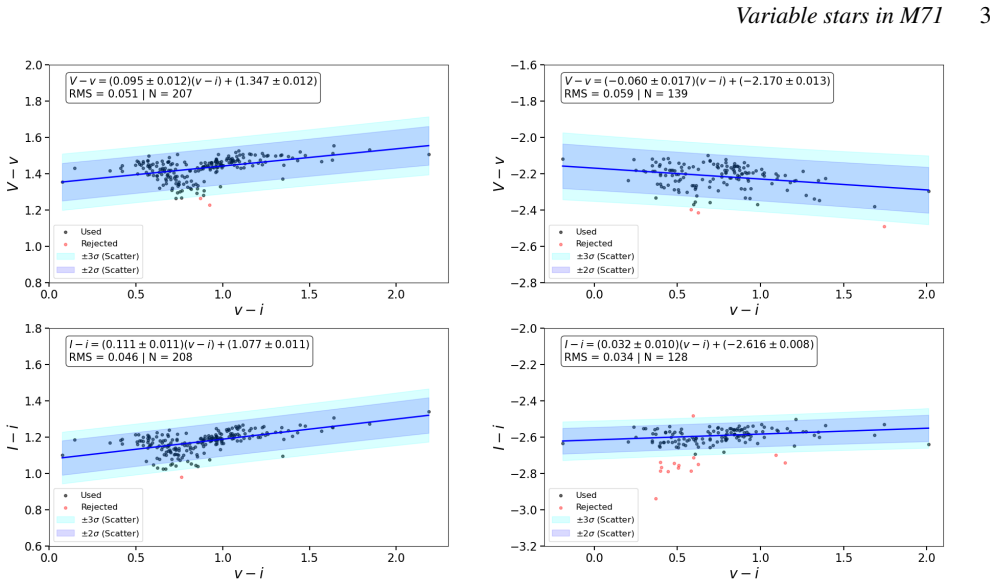
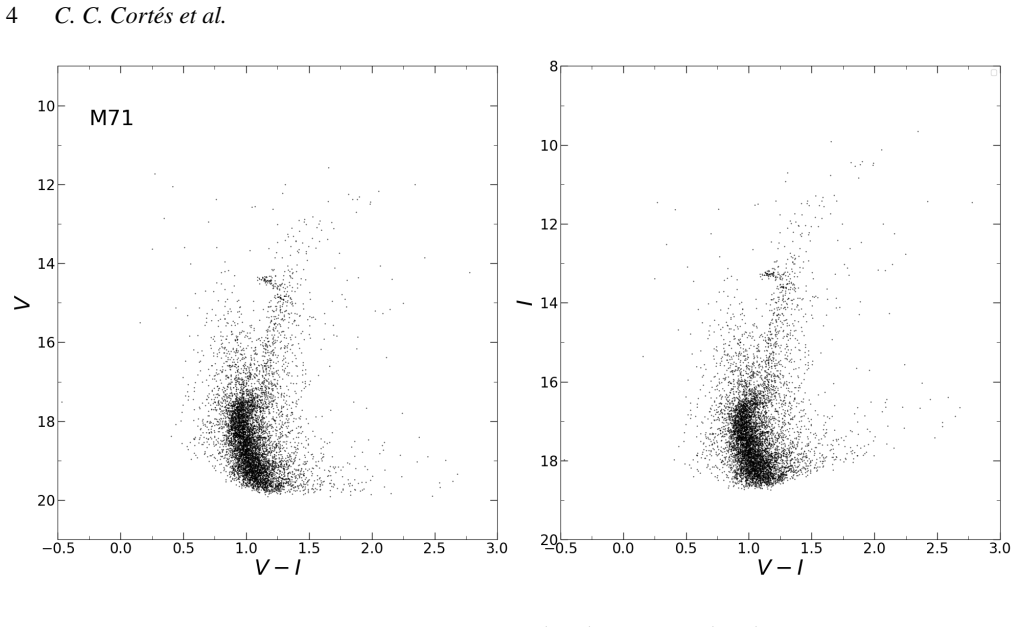
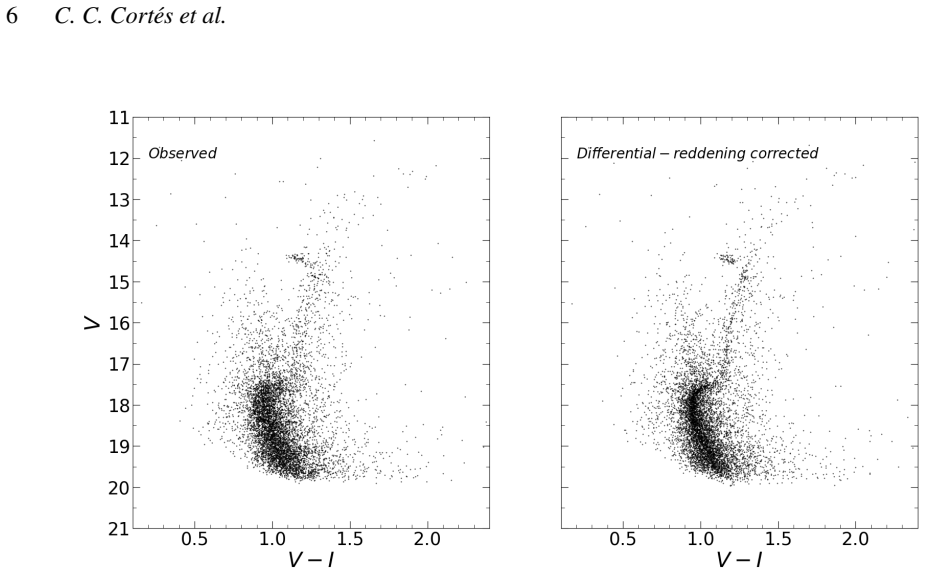
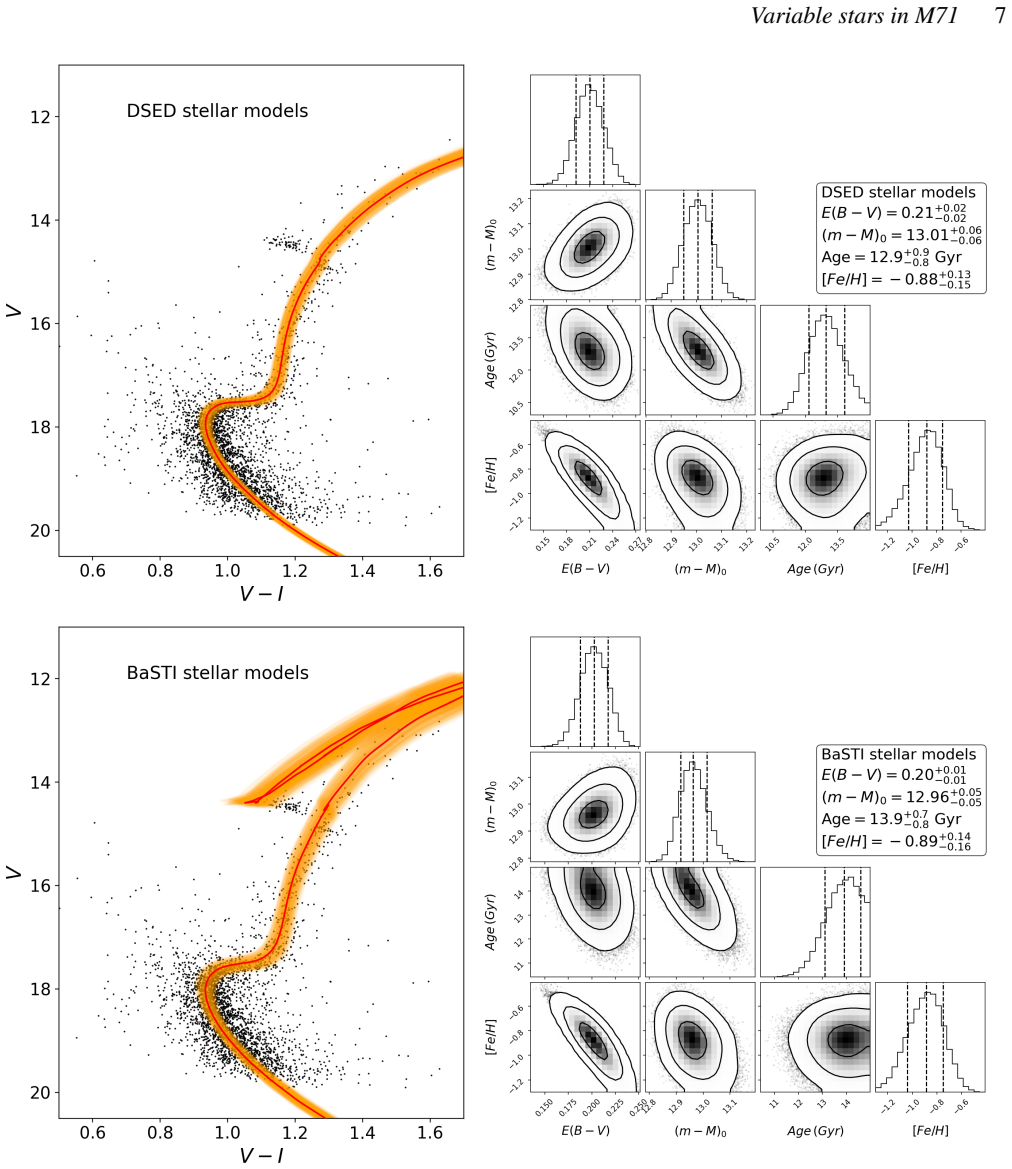
Through Johnson-Kron-Cousins VI photometry processed with difference image analysis, the study identifies 21 variable stars absent from prior catalogs of variables in globular clusters. Membership is assigned using Gaia DR3 proper motions, and a differential reddening map is applied to the field. The decontaminated CMD is matched to isochrones yielding an age of 12.9 Gyr with uncertainties, [Fe/H] of -0.88, E(B-V) of 0.21, and distance modulus of 13.01. Variable detection employs string-length scans refined by phase dispersion minimization alongside Lomb-Scargle periodograms with significance tests. Classifications, periods, amplitudes, and light curves are provided for the new variables.
What carries the argument
The central mechanism is proper-motion filtering to isolate cluster members combined with a differential reddening correction that enables precise isochrone fitting to the cleaned CMD for parameter estimation and reliable variable classification.
If this is right
- M71 now has a more complete variable star census that includes both members and field interlopers with assigned probabilities.
- The derived cluster parameters confirm M71 as a typical metal-rich disk globular cluster.
- The provided light curves and classifications allow for follow-up studies on pulsation modes or evolutionary stages.
- This methodology reduces contamination issues in low-latitude clusters for future variable searches.
- The age and distance values can be used in models of Galactic globular cluster system dynamics.
Where Pith is reading between the lines
- These new variables might include types that test binary evolution or mass transfer in dense cluster cores if classified as such.
- The refined parameters could be cross-checked with spectroscopic surveys to validate the reddening correction.
- Extending the time baseline of observations might reveal longer-period variables missed in this dataset.
- Similar analyses on other clusters could reveal patterns in variable populations across metallicity gradients in the Galaxy.
Load-bearing premise
The isochrone models must accurately reflect the true age, metallicity, and distance of M71 without major systematic biases from the physics assumptions or the reddening map.
What would settle it
Independent spectroscopic measurements of the cluster's metallicity or a parallax-based distance from future Gaia releases that differ by more than the stated uncertainties from [Fe/H] = -0.88 or (m-M)0 = 13.01 would falsify the parameter estimates.
Figures





read the original abstract
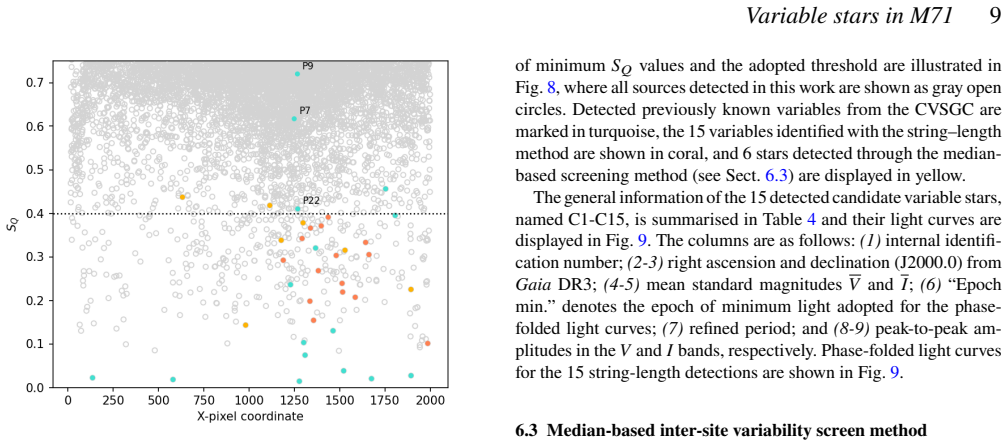
M71 is a nearby, metal-rich globular cluster at low Galactic latitude, where field contamination and spatially variable extinction complicate colour-magnitude diagrams (CMDs) and the identification of cluster member variable stars. Our aims are (i) to construct a homogeneous census of variable stars in M71 by refining their periods and classifications and identifying new candidates, and (ii) to derive a decontaminated, differentially dereddened CMD to constrain its physical properties. We obtained Johnson-Kron-Cousins $VI$ time-series CCD photometry and reduced it using difference image analysis. Cluster membership was established from \textit{Gaia}~DR3 proper motions, and a differential-reddening correction was applied across the field of view. The resulting CMD, cleaned of field stars, was compared with tailored isochrones to estimate age ($12.9^{+0.9}_{-0.8}$ Gyr), metallicity ([Fe/H] =$-0.88^{+0.13}_{-0.15}$), mean reddening ($E(B-V)$ = $0.21 \pm 0.02$), and distance modulus ($(m-M)_{0}$ = $13.01 \pm 0.06$). Variable stars were identified using two complementary approaches: a periodogram-free string-length scan refined with phase dispersion minimisation, and a robust inter-site screening based on median statistics combined with a generalised Lomb-Scargle significance criterion. We identified 21 variable stars not previously reported in the Catalog of Variable Stars in Globular Clusters and provided their periods, amplitudes, classifications, membership status, and light curves. This combined strategy yields a consistent picture of M71, expanding its known variable-star population and confirming parameters typical of metal-rich Galactic disk globular clusters.
Editorial analysis
A structured set of objections, weighed in public.
Referee Report
Summary. The manuscript reports on the identification of variable stars in the globular cluster M71 using Johnson-Kron-Cousins VI time-series photometry processed with difference image analysis. It employs Gaia DR3 proper motions for membership determination and applies a differential reddening correction to construct a cleaned CMD, which is then fitted with isochrones to derive the cluster's age (12.9 Gyr), metallicity (-0.88), reddening (0.21), and distance modulus (13.01). Using two methods—a string-length scan refined by phase dispersion minimisation and a generalised Lomb-Scargle periodogram—the authors identify 21 previously unreported variable stars, providing their periods, amplitudes, classifications, membership status, and light curves.
Significance. If the new identifications hold, this expands the known variable-star population in a metal-rich globular cluster at low latitude, supporting studies of stellar evolution and pulsation in dense, contaminated fields. The dual complementary detection methods and Gaia-based decontamination are clear strengths that improve reliability over single-method approaches. The derived parameters with quoted uncertainties align with expectations for disk globular clusters and offer a consistent reference.
major comments (2)
- Variable detection section (methods for string-length scan + PDM and GLS): no injection-recovery tests, false-alarm probabilities, or completeness/purity metrics are reported despite the crowded, low-latitude field. This directly affects the reliability of the central claim of 21 new variables and their classifications/membership.
- CMD analysis and isochrone fitting section: the differential-reddening correction and parameter estimation (age 12.9 Gyr, [Fe/H]=-0.88, etc.) quote uncertainties but do not quantify propagation of systematics from the reddening map or isochrone library choice, which could impact variable-star membership assignments.
minor comments (2)
- Light-curve figures: periods and amplitudes should be explicitly labeled on each panel or in captions for direct comparison with the tabulated values.
- Notation: ensure consistent use of 'DIA' versus full 'difference image analysis' on first use in the text.
Simulated Author's Rebuttal
We thank the referee for the constructive and positive review of our manuscript. We address each major comment point by point below, clarifying aspects of our analysis and indicating revisions made to the manuscript.
read point-by-point responses
-
Referee: Variable detection section (methods for string-length scan + PDM and GLS): no injection-recovery tests, false-alarm probabilities, or completeness/purity metrics are reported despite the crowded, low-latitude field. This directly affects the reliability of the central claim of 21 new variables and their classifications/membership.
Authors: We acknowledge that formal injection-recovery tests and quantitative completeness/purity metrics were not reported in the original submission. Our detection strategy relied on two complementary, independent methods (string-length scan refined by phase dispersion minimisation, and generalised Lomb-Scargle periodogram) with the requirement that candidates be recovered by both, followed by visual inspection of light curves. In the revised manuscript we have added explicit false-alarm probability thresholds for the GLS detections (adopting FAP < 0.01) and a brief discussion of the expected false-positive rate given the number of stars and period range searched. A limited injection test on a representative subset of the field has also been performed and its results summarised; a full end-to-end injection-recovery campaign on the entire DIA dataset is computationally prohibitive but we now state this limitation explicitly. These additions improve transparency without altering the reported 21 new variables, all of which remain confirmed by the dual-method cross-check and literature cross-matching. revision: partial
-
Referee: CMD analysis and isochrone fitting section: the differential-reddening correction and parameter estimation (age 12.9 Gyr, [Fe/H]=-0.88, etc.) quote uncertainties but do not quantify propagation of systematics from the reddening map or isochrone library choice, which could impact variable-star membership assignments.
Authors: We appreciate the referee drawing attention to systematic uncertainties. We clarify that membership for the variable stars (including the 21 new candidates) is assigned exclusively from Gaia DR3 proper motions and is therefore independent of the CMD fitting, differential-reddening map, or isochrone choice. The isochrone fit was used only to derive global cluster parameters and to illustrate the cleaned CMD. In the revised version we have (i) compared the adopted PARSEC isochrones with an alternative library (MIST) and quantified the resulting shifts in derived parameters, (ii) propagated the uncertainty in the differential-reddening correction by repeating the fit with the reddening map scaled by its reported error, and (iii) explicitly stated the contribution of these systematics to the final parameter uncertainties. These changes address the concern while leaving the membership assignments and the list of new variables unchanged. revision: yes
Circularity Check
No significant circularity; derivation relies on external data and independent algorithms
full rationale
The paper derives cluster parameters (age, metallicity, reddening, distance) by fitting standard isochrone libraries to a CMD cleaned via Gaia DR3 proper motions and a differential-reddening map; these steps use external inputs and models without self-referential fitting. Variable-star detection applies string-length + PDM and GLS algorithms directly to the DIA photometry, with classifications and membership assigned from observed light curves and Gaia data. No equation or claim reduces by construction to its own inputs, no self-citation chain bears the central result, and no fitted parameter is relabeled as a prediction. The analysis is self-contained against external benchmarks.
Axiom & Free-Parameter Ledger
free parameters (4)
- Age =
12.9 Gyr
- [Fe/H] =
-0.88
- E(B-V) =
0.21
- (m-M)_0 =
13.01
axioms (3)
- domain assumption Gaia DR3 proper motions reliably separate cluster members from field stars
- domain assumption Differential reddening can be mapped and corrected accurately across the observed field
- domain assumption Standard isochrone libraries reproduce the observed CMD of a metal-rich globular cluster
Reference graph
Works this paper leans on
-
[1]
Abundance variations in the globular cluster M71 (NGC 6838). , keywords =. doi:10.1051/0004-6361:200809405 , archivePrefix =. 0806.2629 , primaryClass =
-
[2]
Astropy Collaboration and Price-Whelan, Adrian M. and Sip. The Astropy Project: Building an Open-science Project and Status of the v2.0 Core Package , journal =. 2018 , doi =
work page 2018
-
[3]
, archivePrefix = "arXiv", eprint =
Exploring the variable stars in the globular cluster NGC 5024 (M53): new RR Lyrae and SX Phoenicis stars*. , keywords =. doi:10.1111/j.1365-2966.2011.19201.x , archivePrefix =. 1106.1880 , primaryClass =
-
[4]
, year = 1971, month = aug, volume =
A Photometric Study of the Metal-Rich Globular Cluster M71. , year = 1971, month = aug, volume =. doi:10.1086/151047 , adsurl =
-
[5]
Accurate distances to Galactic globular clusters through a combination of Gaia EDR3, HST, and literature data. , keywords =. doi:10.1093/mnras/stab1474 , archivePrefix =. 2105.09526 , primaryClass =
-
[6]
A new algorithm for difference image analysis. , keywords =. doi:10.1111/j.1745-3933.2008.00464.x , archivePrefix =. 0802.1273 , primaryClass =
-
[7]
, archivePrefix = "arXiv", eprint =
CCD time-series photometry of the globular cluster NGC 6981: variable star census and physical parameter estimates. , keywords =. doi:10.1111/j.1365-2966.2011.18213.x , archivePrefix =. 1012.5652 , primaryClass =
-
[8]
Difference image analysis: extension to a spatially varying photometric scale factor and other considerations. , keywords =. doi:10.1093/mnras/sts184 , archivePrefix =. 1210.2926 , primaryClass =
-
[9]
Journal of the Royal Astronomical Society of Canada , year = 1970, month = Dec, volume =
A Photoelectric Study of Magnetic Variable Stars. Journal of the Royal Astronomical Society of Canada , year = 1970, month = Dec, volume =
work page 1970
-
[10]
Extraction of globular clusters members with Gaia DR2 astrometry. , keywords =. doi:10.1093/mnras/stz1879 , archivePrefix =. 1907.02612 , primaryClass =
-
[11]
Proper Motions and Structural Parameters of the Galactic Globular Cluster M71. , keywords =. doi:10.3847/1538-4357/aa5ca5 , archivePrefix =. 1701.07834 , primaryClass =
-
[12]
An Extremely Low-mass He White Dwarf Orbiting the Millisecond Pulsar J1342+2822B in the Globular Cluster M3. , keywords =. doi:10.3847/1538-4357/ab0e6b , archivePrefix =. 1903.03345 , primaryClass =
-
[13]
Digging for Relics of the Past: The Ancient and Obscured Bulge Globular Cluster NGC 6256. , keywords =. doi:10.3847/1538-4357/ab88b3 , archivePrefix =. 2004.06131 , primaryClass =
-
[14]
PSR J1641+3627F: A Low-mass He White Dwarf Orbiting a Possible High-mass Neutron Star in the Globular Cluster M13. , keywords =. doi:10.3847/1538-4357/abc345 , archivePrefix =. 2010.09740 , primaryClass =
-
[15]
The chemo-dynamical groups of Galactic globular clusters. , keywords =. doi:10.1093/mnras/stac1145 , archivePrefix =. 2202.00591 , primaryClass =
-
[16]
The Relationship between Infrared, Optical, and Ultraviolet Extinction. , keywords =. doi:10.1086/167900 , adsurl =
-
[17]
Intrinsic iron spread and a new metallicity scale for globular clusters. , keywords =. doi:10.1051/0004-6361/200913003 , archivePrefix =. 0910.0675 , primaryClass =
-
[18]
General considerations and new transformations for broad-band systems
Synthetic stellar photometry - I. General considerations and new transformations for broad-band systems. , keywords =. doi:10.1093/mnras/stu1476 , archivePrefix =. 1407.6095 , primaryClass =
-
[19]
Variable Stars in Galactic Globular Clusters. , keywords =. doi:10.1086/323719 , archivePrefix =. astro-ph/0108024 , primaryClass =
-
[20]
, archivePrefix = "arXiv", eprint =
SX Phoenicis period-luminosity relations and the blue straggler connection. , keywords =. doi:10.1111/j.1365-2966.2011.19697.x , adsurl =
-
[21]
Variability in NGC 3201 Giant Stars , journal =
Cort. Variability in NGC 3201 Giant Stars , journal =. 2023 , volume =
work page 2023
-
[22]
Photometry, proper motions, and membership in the globular cluster M 71. , keywords =. doi:10.1086/113709 , adsurl =
-
[23]
Digging into the Galactic Bulge: Stellar Population and Structure of the Poorly Studied Cluster NGC 6316. , keywords =. doi:10.3847/1538-4357/aca9ce , archivePrefix =. 2212.03649 , primaryClass =
-
[24]
A photometric in-depth look at the core-collapsed globular cluster NGC 6284. , keywords =. doi:10.1051/0004-6361/202347547 , archivePrefix =. 2310.17503 , primaryClass =
-
[25]
On the Absolute Age of the Metal-rich Globular M71 (NGC 6838). I. Optical Photometry. , keywords =. doi:10.1088/0004-6256/150/2/51 , archivePrefix =. 1506.01180 , primaryClass =
-
[26]
The Dartmouth Stellar Evolution Database. , keywords =. doi:10.1086/589654 , archivePrefix =. 0804.4473 , primaryClass =
-
[27]
A period-finding method for sparse randomly spaced observations or ''How long is a piece of string ?''. , keywords =. doi:10.1093/mnras/203.4.917 , adsurl =
-
[28]
and Lang, Dustin and Goodman, Jonathan , title =
emcee: The MCMC Hammer. , keywords =. doi:10.1086/670067 , archivePrefix =. 1202.3665 , primaryClass =
-
[29]
The Journal of Open Source Software , keywords =
emcee v3: A Python ensemble sampling toolkit for affine-invariant MCMC. The Journal of Open Source Software , keywords =. doi:10.21105/joss.01864 , archivePrefix =. 1911.07688 , primaryClass =
-
[30]
Summary of the content and survey properties
Gaia Data Release 3. Summary of the content and survey properties. , keywords =
-
[31]
First results of a photometric and astrometric study of the globular cluster M 71 (NGC 6838). , keywords =. doi:10.1051/aas:2000209 , adsurl =
-
[32]
Isochrone fitting of Galactic globular clusters - II. NGC 6205 (M13). , keywords =. doi:10.1093/mnras/staa1694 , archivePrefix =. 2008.10200 , primaryClass =
-
[33]
The ages of the globular clusters M 71 and 47 Tuc from Str \"o mgren uvby photometry. Evidence for high ages. , keywords =. doi:10.1051/0004-6361:20020790 , adsurl =
-
[34]
The Astronomical Journal , author =
A Catalog of Parameters for Globular Clusters in the Milky Way. , keywords =. doi:10.1086/118116 , adsurl =
-
[35]
and Mosteller, Frederick and Tukey, John W
Hoaglin, David C. and Mosteller, Frederick and Tukey, John W. , title =
-
[36]
Understanding Robust and Exploratory Data Analysis , publisher =
-
[37]
Deep CCD Photometry and Variable Stars in the Metal-Rich Globular Cluster M71. , keywords =. doi:10.1086/116075 , adsurl =
-
[38]
Statistics, Data Mining, and Machine Learning in Astronomy , publisher =
Ivezi. Statistics, Data Mining, and Machine Learning in Astronomy , publisher =. 2014 , note =
work page 2014
-
[39]
Discovery of an SX Phoenicis Type Pulsating Component in the Algol-Type Semidetached Eclipsing Binary QU Sagittae in M71. , keywords =. doi:10.1086/500263 , adsurl =
-
[40]
Measuring Consistent Masses for 25 Milky Way Globular Clusters. , keywords =. doi:10.1088/0004-6256/149/2/53 , archivePrefix =. 1411.1763 , primaryClass =
-
[41]
A search for photometric variability towards M71 with the Near-Infrared Transiting ExoplanetS Telescope. , keywords =. doi:10.1093/mnras/stt2449 , archivePrefix =. 1312.5880 , primaryClass =
-
[42]
Global fitting of globular cluster age indicators. , keywords =. doi:10.1051/0004-6361:20065133 , adsurl =
-
[43]
New Faint Variable Stars in the Outer Regions of the Metal-rich Globular Cluster M71. , keywords =. doi:10.1086/301297 , adsurl =
-
[44]
Updated BaSTI Stellar Evolution Models and Isochrones. II. -enhanced Calculations. , keywords =. doi:10.3847/1538-4357/abd4d5 , archivePrefix =. 2012.10085 , primaryClass =
-
[45]
Variable Stars in the Fornax dSph Galaxy. II. Pulsating Stars below the Horizontal Branch. , keywords =. doi:10.1086/591241 , archivePrefix =. 0806.4453 , primaryClass =
-
[47]
Prudil, Z. and Arellano Ferro, A. , title =. , year =. doi:10.1093/mnras/stae2335 , adsurl =
-
[48]
and Croux, Christophe , title =
Rousseeuw, Peter J. and Croux, Christophe , title =. Journal of the American Statistical Association , year =
-
[49]
and Croux, Christophe , title =
Rousseeuw, Peter J. and Croux, Christophe , title =. Journal of the American Statistical Association , volume =. 1993 , doi =
work page 1993
-
[50]
W UMA-Type Binary Stars in Globular Clusters. , keywords =. doi:10.1086/301417 , archivePrefix =. astro-ph/0001152 , primaryClass =
-
[51]
A Panchromatic View of the Bulge Globular Cluster NGC 6569. , keywords =. doi:10.3847/1538-4357/ab07c4 , archivePrefix =. 1902.05558 , primaryClass =
-
[52]
Publications of the David Dunlap Observatory , year = 1973, month = jan, volume =
A third catalogue of variable stars in globular clusters comprising 2119 entries. Publications of the David Dunlap Observatory , year = 1973, month = jan, volume =
work page 1973
-
[53]
Period determination using phase dispersion minimization. , keywords =. doi:10.1086/156444 , adsurl =
-
[54]
Homogeneous Photometry for Star Clusters and Resolved Galaxies. II. Photometric Standard Stars. , keywords =. doi:10.1086/316595 , archivePrefix =. astro-ph/0004144 , primaryClass =
-
[55]
Primordial Main sequence Binary Stars in the Globular Cluster M71. , keywords =. doi:10.1086/117194 , adsurl =
-
[56]
Zhang, Tian and Ramakrishnan, Raghu and Livny, Miron , title =. SIGMOD Rec. , month = jun, pages =. 1996 , issue_date =. doi:10.1145/235968.233324 , abstract =
-
[57]
Proceedings of the 1996 ACM SIGMOD International Conference on Management of Data , pages =
Zhang, Tian and Ramakrishnan, Raghu and Livny, Miron , title =. Proceedings of the 1996 ACM SIGMOD International Conference on Management of Data , pages =. 1996 , isbn =. doi:10.1145/233269.233324 , abstract =
-
[59]
Zechmeister, M. and K. The generalised Lomb--Scargle periodogram: A new formalism for the floating-mean and Keplerian periodograms , journal =. 2009 , volume =. doi:10.1051/0004-6361:200811296 , adsurl =
-
[60]
Photometric Analysis of Variable Stars in NGC 6397 , journal =
Cort. Photometric Analysis of Variable Stars in NGC 6397 , journal =. 2026 , volume =
work page 2026
-
[61]
Gaia EDR3 view on galactic globular clusters. , keywords =. doi:10.1093/mnras/stab1475 , archivePrefix =. 2102.09568 , primaryClass =
-
[62]
Society for Astronomical Sciences Annual Symposium , year = 2006, month = may, volume =
The International Variable Star Index (VSX). Society for Astronomical Sciences Annual Symposium , year = 2006, month = may, volume =
work page 2006
-
[63]
The Cepheid Distance Scale. , keywords =. doi:10.1086/132911 , adsurl =
-
[64]
Zwicky Transient Facility and Globular Clusters: The Period-Luminosity and Period-Wesenheit Relations for Type II Cepheids. , keywords =. doi:10.3847/1538-3881/ac87a4 , archivePrefix =. 2208.03404 , primaryClass =
-
[65]
Zwicky Transient Facility and Globular Clusters: The Period-Luminosity and Period-Wesenheit Relations for SX Phoenicis Variables in the gri Band. , keywords =. doi:10.3847/1538-3881/acc461 , archivePrefix =. 2303.07554 , primaryClass =
-
[66]
The Pan-STARRS1 Photometric System. , keywords =. doi:10.1088/0004-637X/750/2/99 , archivePrefix =. 1203.0297 , primaryClass =
discussion (0)
Sign in with ORCID, Apple, or X to comment. Anyone can read and Pith papers without signing in.