Recognition: no theorem link
SHIA: A Direct SysML-Hardware Interface Architecture for Model-Centric Verification
Pith reviewed 2026-05-13 01:34 UTC · model grok-4.3
The pith
SysML models can directly stimulate, observe, and verify physical hardware behavior through a bidirectional server link without any model transformations.
A machine-rendered reading of the paper's core claim, the machinery that carries it, and where it could break.
Core claim
SHIA realizes a direct bidirectional connection between an executable SysML model in IBM Rhapsody and physical hardware via a SysML-side server and a Raspberry Pi-based hardware server. In the end-to-end logic gate demonstration, the integrated system exchanged messages correctly in both directions with zero discrepancy between SysML-generated and hardware-generated outputs.
What carries the argument
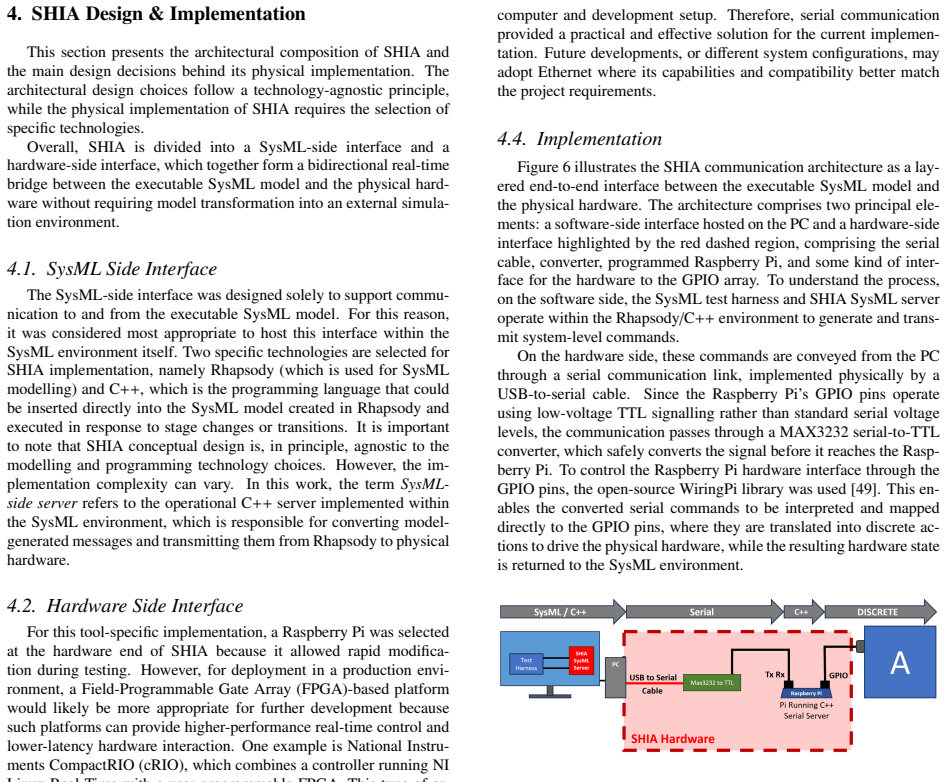
The SysML Hardware Interface Architecture (SHIA), a pair of servers that establish bidirectional message exchange between the executable SysML model and hardware without transformation chains.
If this is right
- Hardware verification can be driven directly by the executable system model rather than by derived simulations.
- The system model remains the authoritative reference for both structure and observed behavior throughout testing.
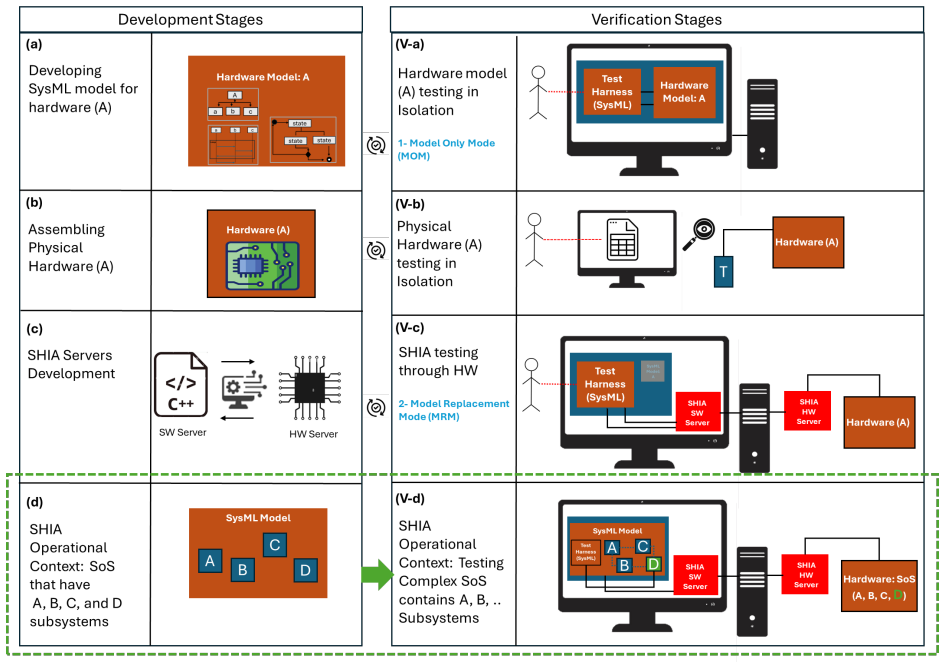
- Verification of individual components and full integration can occur while the model stays in the loop.
- The digital thread from architecture to hardware realization shortens by removing transformation steps.
Where Pith is reading between the lines
- The approach could be tested on systems larger than a single logic gate to check whether the interface scales without added synchronization overhead.
- Similar direct links might apply to other executable modeling languages if their tool environments support embedded server code.
- Adoption would reduce reliance on separate co-simulation platforms for MBSE hardware projects.
Load-bearing premise
A direct server-based interface can be maintained reliably across different hardware platforms and SysML tools without introducing synchronization errors or custom protocol problems.
What would settle it
A discrepancy appearing in output comparison or a failed message exchange when the same interface is applied to a multi-component system on different hardware would show the direct link does not hold.
Figures







read the original abstract
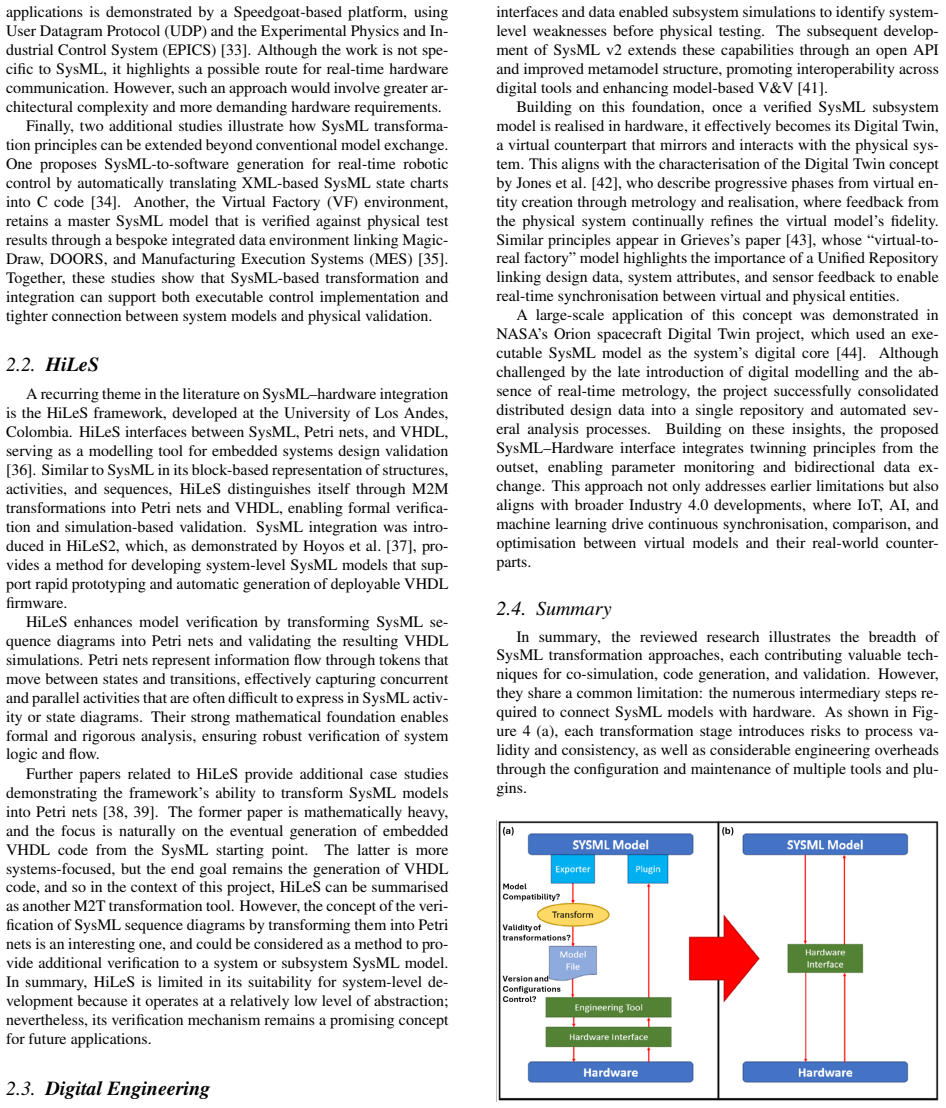
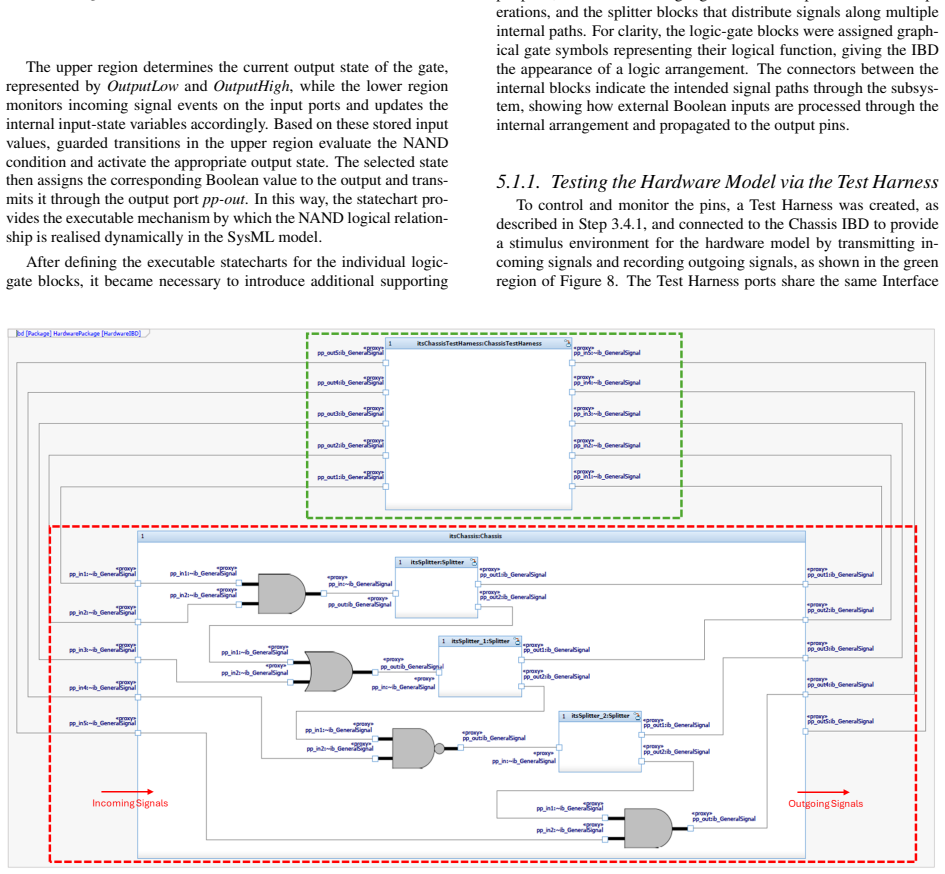
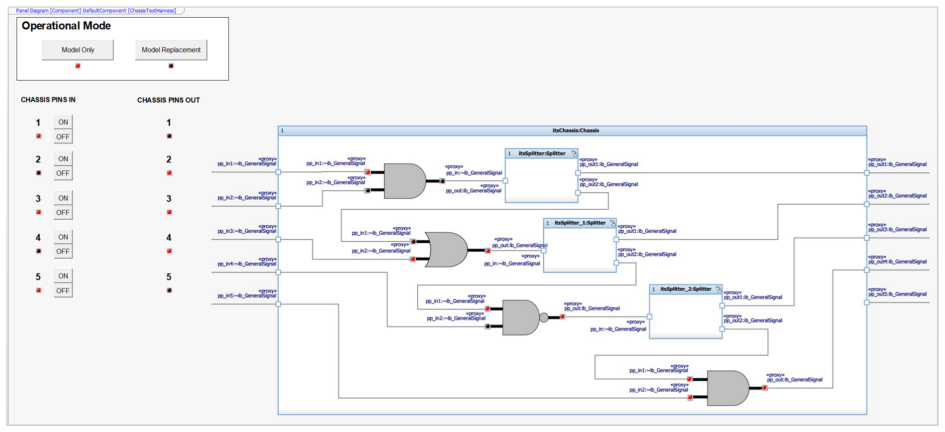
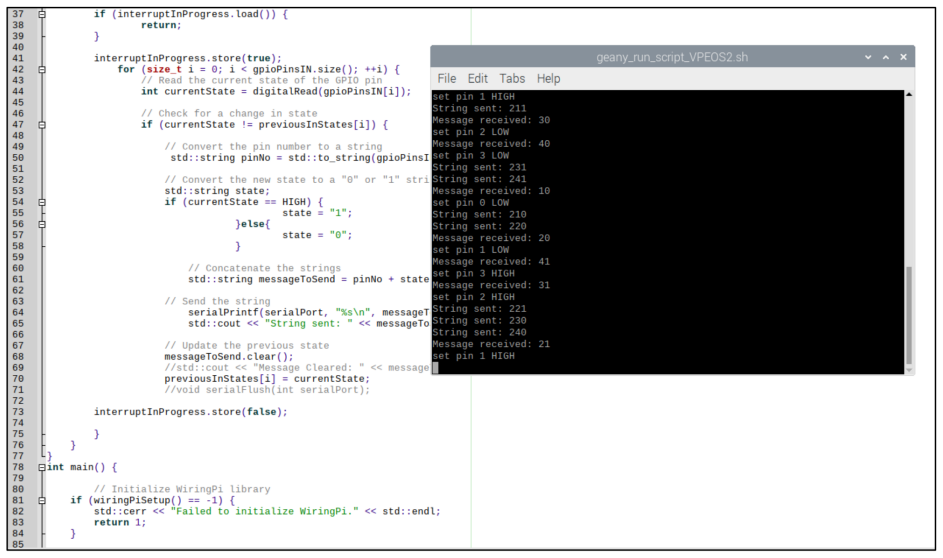
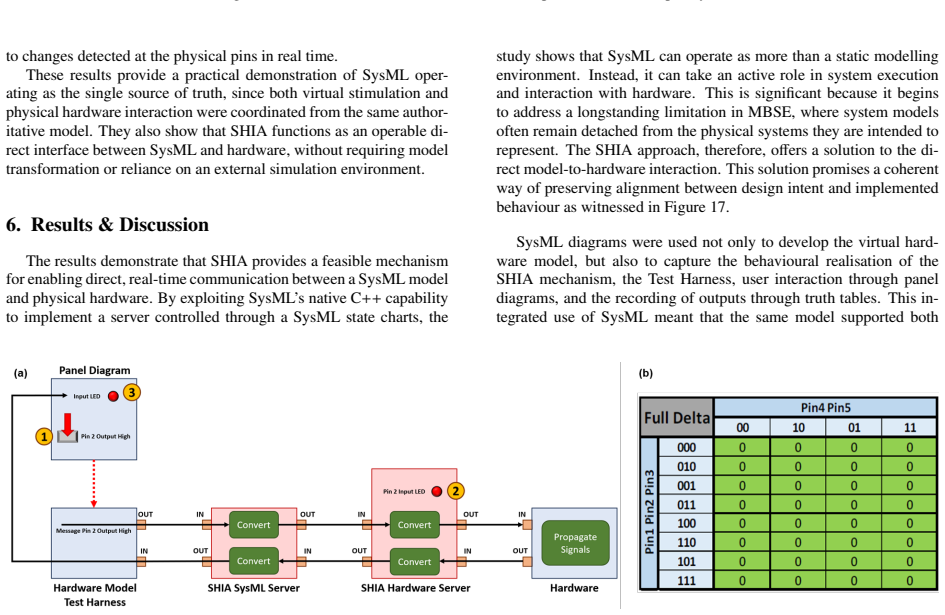
Model-Based Systems Engineering (MBSE) is widely treated as the backbone of digital engineering, with languages such as the Systems Modeling Language (SysML) providing the means to capture system structure, behaviour, and verification intent. Yet once verification moves to hardware, the system model is routinely left behind. Domain-specific simulation environments, model transformations, and bespoke tool integrations take over, and the model that began as the authoritative reference drifts out of sync with the implementation it was meant to govern. This paper introduces the SysML Hardware Interface Architecture (SHIA), which keeps an executable SysML model directly inside the verification loop, exchanging messages with physical hardware without intermediate transformation chains, co-simulation platforms, or broker-mediated plugins. SHIA is realised through a SysML side server, written in embedded C++ within IBM Rhapsody, and a hardware side server running on a Raspberry Pi, together establishing a bidirectional link between the digital model and the physical system. A logic gate case study demonstrates the approach end-to-end, from hardware model construction and prototype assembly to test harness design, behavioural statechart control, and staged verification of each component before integration. The integrated system exchanged messages correctly in both directions, and Karnaugh map comparison between the SysML-generated and hardware-generated outputs showed zero discrepancy. The result shows that, when paired with a suitable interface, SysML need not remain a static description that informs downstream tools; it can serve as the executable layer through which hardware behaviour is stimulated, observed, and verified. The work demonstrates a route to model-governed verification and a shorter digital thread between system architecture and the hardware that realises it.
Editorial analysis
A structured set of objections, weighed in public.
Referee Report
Summary. The manuscript introduces the SysML Hardware Interface Architecture (SHIA), which uses custom servers (embedded C++ in IBM Rhapsody on the model side and a Raspberry Pi on the hardware side) to enable direct bidirectional message exchange between an executable SysML model and physical hardware. It demonstrates the approach end-to-end via a logic-gate case study, reporting correct message exchange in both directions and zero output discrepancy as confirmed by Karnaugh-map comparison, with the goal of keeping the SysML model inside the verification loop without intermediate transformations or co-simulation.
Significance. If the direct-interface approach generalizes, it would be a useful contribution to model-based systems engineering by shortening the digital thread and reducing model drift during hardware verification. The explicit end-to-end prototype with exact matching on a simple case provides a concrete, reproducible demonstration of feasibility using standard tools.
major comments (2)
- [Case Study] Case Study section: the demonstration is restricted to a single basic logic gate. No tests or measurements are reported for concurrent statechart behaviors, multiple signals, message queuing, clock skew, or protocol stability under load, which are required to substantiate the central claim that SHIA reliably keeps the model inside the verification loop for general SysML models.
- [Architecture and Implementation] Architecture and Implementation sections: the paper describes the two servers but supplies no details on the custom protocol, error handling, timing, or synchronization mechanisms. This omission is load-bearing for assessing whether the bidirectional link avoids drift or errors beyond the narrow prototype.
minor comments (2)
- [Abstract] The abstract states that 'staged verification of each component' was performed, but the main text does not enumerate or detail these stages, reducing clarity on the verification process.
- [Introduction] Consider adding a brief related-work subsection contrasting SHIA with existing co-simulation or broker-based MBSE-hardware integrations to better situate the contribution.
Simulated Author's Rebuttal
We thank the referee for the constructive feedback and for recognizing the potential of SHIA to shorten the digital thread in model-based systems engineering. We respond to each major comment below and describe the revisions we will incorporate.
read point-by-point responses
-
Referee: [Case Study] Case Study section: the demonstration is restricted to a single basic logic gate. No tests or measurements are reported for concurrent statechart behaviors, multiple signals, message queuing, clock skew, or protocol stability under load, which are required to substantiate the central claim that SHIA reliably keeps the model inside the verification loop for general SysML models.
Authors: We agree that the case study is limited to a single logic gate and does not include tests for concurrent statecharts, multiple signals, queuing, clock skew, or load stability. The manuscript presents the logic-gate prototype as an end-to-end feasibility demonstration rather than a comprehensive validation across all SysML behaviors. In revision we will add an explicit limitations subsection that acknowledges these gaps and outlines how the architecture could be extended to statechart concurrency and multi-signal scenarios. We maintain that the zero-discrepancy result on the implemented prototype supports the core claim of direct model-hardware exchange, while generalization to arbitrary SysML models remains future work. revision: partial
-
Referee: [Architecture and Implementation] Architecture and Implementation sections: the paper describes the two servers but supplies no details on the custom protocol, error handling, timing, or synchronization mechanisms. This omission is load-bearing for assessing whether the bidirectional link avoids drift or errors beyond the narrow prototype.
Authors: We acknowledge that the current manuscript lacks sufficient detail on the custom protocol, error handling, timing assumptions, and synchronization. In the revised version we will insert a dedicated subsection that specifies the message format (including headers and payloads), error-detection method (checksum plus retransmission), timing model (Rhapsody execution cycle versus Raspberry Pi loop), and synchronization via request-acknowledge handshakes. These additions will allow readers to evaluate drift avoidance beyond the reported prototype. revision: yes
Circularity Check
No circularity: empirical demonstration of implemented architecture
full rationale
The paper presents a descriptive account of the SHIA architecture, its implementation via custom servers in Rhapsody and on Raspberry Pi, and an end-to-end case study on a single logic gate. The central result (correct bidirectional message exchange with zero discrepancy via Karnaugh map comparison) is obtained directly from the physical integration and testing process rather than from any equations, fitted parameters, predictions, or self-citations that reduce the outcome to prior inputs by construction. No derivation chain exists; the work is self-contained as an engineering demonstration.
Axiom & Free-Parameter Ledger
Reference graph
Works this paper leans on
- [1]
-
[2]
E. R. Carroll, R. J. Malins, Systematic literature review: How is model-based systems engineering justified?, INCOSE Website (2016)
work page 2016
- [3]
- [4]
-
[5]
J. Cederbladh, A. Cicchetti, J. Suryadevara, Early validation and verification of system behaviour in model-based systems engi- neering: A systematic literature review, ACM Transactions on Software Engineering and Methodology 33 (3) (2024) 1–67
work page 2024
- [6]
-
[7]
W. D. Miller, et al., The future of systems engineering: Real- izing the systems engineering vision 2035., in: TE, 2022, pp. 739–747
work page 2035
- [8]
-
[9]
P. De Saqui-Sannes, R. A. Vingerhoeds, C. Garion, X. Thiri- oux, A taxonomy of mbse approaches by languages, tools and methods, IEEE Access 10 (2022) 120936–120950
work page 2022
-
[10]
M. Hause, et al., The sysml modelling language, in: Fifteenth European systems engineering conference, V ol. 9, 2006, pp. 1– 12
work page 2006
-
[11]
URLhttps://www.3ds.com/products/catia/ no-magic/sysml-plugin
Dassault Systèmes, No magic sysml plugin, accessed: 2026-03- 23 (2026). URLhttps://www.3ds.com/products/catia/ no-magic/sysml-plugin
work page 2026
-
[12]
URLhttps://www.ibm.com/products/ engineering-rhapsody
IBM, Ibm engineering rhapsody, accessed: 2026-03-23 (2026). URLhttps://www.ibm.com/products/ engineering-rhapsody
work page 2026
- [13]
-
[14]
F. Mihali ˇc, M. Trunti ˇc, A. Hren, Hardware-in-the-loop simula- tions: A historical overview of engineering challenges, Elec- tronics 11 (15) (2022) 2462
work page 2022
-
[15]
F. Tao, Q. Qi, L. Wang, A. Nee, Digital twins and cyber– physical systems toward smart manufacturing and industry 4.0: Correlation and comparison, Engineering 5 (4) (2019) 653–661
work page 2019
-
[16]
M. Bacic, On hardware-in-the-loop simulation, in: Proceedings of the 44th IEEE Conference on Decision and Control, IEEE, 2005, pp. 3194–3198
work page 2005
-
[17]
Q. Liu, J. Leng, D. Yan, D. Zhang, L. Wei, A. Yu, R. Zhao, H. Zhang, X. Chen, Digital twin-based designing of the config- uration, motion, control, and optimization model of a flow-type smart manufacturing system, Journal of Manufacturing Systems 58 (2021) 52–64
work page 2021
-
[18]
J. Huang, A. Gheorghe, H. Handley, P. Pazos, A. Pinto, S. Ko- vacic, A. Collins, C. Keating, A. Sousa-Poza, G. Rabadi, et al., Towards digital engineering: the advent of digital systems engi- neering, International Journal of System of Systems Engineer- ing 10 (3) (2020) 234–261
work page 2020
-
[19]
C. Nigischer, S. Bougain, R. Riegler, H. P. Stanek, M. Grafinger, Multi-domain simulation utilizing sysml: state of the art and future perspectives, Procedia CIRP 100 (2021) 319–324
work page 2021
-
[20]
M. V . P. Pessoa, L. F. Pires, J. L. R. Moreira, C. Wu, Model- based digital threads for socio-technical systems, in: Ma- chine learning for smart environments/cities: An IoT approach, Springer, 2022, pp. 27–52
work page 2022
-
[21]
O. S. Sprock, et al., Bridging model-based systems engineer- ing, digital twins, and cyber-physical manufacturing systems: A foundational framework for operational excellence, Interna- tional Multidisciplinar Journal of Emerging Technologies and Applications 1 (1) (2026) 61–96
work page 2026
-
[22]
R. S. Kalawsky, J. O’Brien, S. Chong, C. Wong, H. Jia, H. Pan, P. R. Moore, Bridging the gaps in a model-based system engi- neering workflow by encompassing hardware-in-the-loop simu- lation, IEEE systems Journal 7 (4) (2013) 593–605
work page 2013
-
[23]
J. Kiesbye, D. Messmann, M. Preisinger, G. Reina, D. Nagy, F. Schummer, M. Mostad, T. Kale, M. Langer, Hardware-in- the-loop and software-in-the-loop testing of the move-ii cubesat, Aerospace 6 (12) (2019) 130
work page 2019
- [24]
- [25]
-
[26]
Speedgoat, Solutions,https://www.speedgoat.com/ solutions, accessed: 14 Oct 2025 (2025)
work page 2025
-
[27]
B. Chabibi, A. Anwar, M. Nassar, Towards a model integration from sysml to matlab/simulink., J. Softw. 13 (12) (2018) 630– 645
work page 2018
-
[28]
N. Jankevicius, OMG SysPhS: Integrating SysML, Simulink, Modelica and FMI, Presentation, INCOSE International Work- shop, Torrance, CA, 27 January 2020, accessed: 2026-03-23 (2020). URLhttps://omgwiki.org/MBSE/lib/exe/fetch.php? media=mbse:smswg:smswg_20:omg_sysphs_-_sysml_ simulink_modelica_fmi_incose.pdf
work page 2020
-
[29]
rep., Object Management Group, accessed: 14 Oct 2025 (2021)
Object Management Group (OMG), Sysml extension for physi- cal interaction and signal flow simulation (sysphs), version 1.1, Tech. rep., Object Management Group, accessed: 14 Oct 2025 (2021). URLhttps://www.omg.org/spec/SysPhS/1.1/ 17
work page 2025
- [30]
-
[31]
rep., Modelica Association Project FMI, accessed: 14 Oct 2025 (2023)
Modelica Association, Functional mock-up interface specifica- tion, version 3.0, Tech. rep., Modelica Association Project FMI, accessed: 14 Oct 2025 (2023). URLhttps://fmi-standard.org/docs/3.0/
work page 2025
-
[32]
B. Wang, J. S. Baras, Hybridsim: A modeling and co-simulation toolchain for cyber-physical systems, in: 2013 IEEE/ACM 17th International Symposium on Distributed Simulation and Real Time Applications, IEEE, 2013, pp. 33–40
work page 2013
-
[33]
L. Rossa, M. Brendike, et al., Epics integration for rapid con- trol prototyping hardware from speedgoat, in: 19th International Conference on Accelerator and Large Experimental Physics Control Systems (ICALEPCS’23), Cape Town, South Africa, 09-13 October 2023, JACOW Publishing, Geneva, Switzerland, 2024, pp. 1317–1321
work page 2023
- [34]
-
[35]
G. Wang, S. Pavalkis, A model-based v&v test strategy based on emerging system modeling techniques, in: INCOSE Inter- national Symposium, V ol. 29, Wiley Online Library, 2019, pp. 771–787
work page 2019
- [36]
- [37]
-
[38]
A. Gutierrez, H. Chamorro, J. F. Jimenez, Hardware-in-the-loop based sysml for model and control design of interleaved boost converters, in: 2014 IEEE 15th Workshop on Control and Mod- eling for Power Electronics (COMPEL), IEEE, 2014, pp. 1–6
work page 2014
-
[39]
A. Gutierrez, H. Chamorro, J. Jimenez, L. F. L. Villa, C. Alonso, Hardware-in-the-loop simulation of pv systems in micro-grids using sysml models, in: 2015 IEEE 16th Workshop on Control and Modeling for Power Electronics (COMPEL), IEEE, 2015, pp. 1–5
work page 2015
-
[40]
M. Güdemann, S. Kegel, F. Ortmeier, O. Poenicke, K. Richter, Sysml in digital engineering, in: Proceedings of the First Inter- national Workshop on Digital Engineering, 2010, pp. 1–8
work page 2010
- [41]
- [42]
-
[43]
Grieves, Digital twin: manufacturing excellence through vir- tual factory replication
M. Grieves, Digital twin: manufacturing excellence through vir- tual factory replication. 2014, White Paper (2022)
work page 2014
-
[44]
G. J. Pierce, J. D. Heeren, T. R. Hill, Orion sysml model, dig- ital twin, and lessons learned for artemis i, in: INCOSE Inter- national Symposium, V ol. 33, Wiley Online Library, 2023, pp. 290–304
work page 2023
-
[45]
NI, Compactrio systems (crio),https://www.ni.com/en/ shop/compactrio.html, accessed: 2026-04-09 (2026)
work page 2026
-
[46]
NI, Specifications explained: Compactdaq and com- pactrio chassis and controllers,https://www.ni.com/ en/support/documentation/supplemental/17/ specifications-explained--cdaq-and-crio-chassis/ /-and-controllers.html, accessed: 2026-04-09 (2025)
work page 2026
-
[47]
NI, Introduction to ni linux real-time, https://www.ni.com/en/shop/linux/ introduction-to-ni-linux-real-time.html, accessed: 2026-04-09 (2025)
work page 2026
-
[48]
M. Gugerty, R. Jenkins, D. Dolezilek, Case study comparison of serial and ethernet digital communications technologies for transfer of relay quantities, in: proceedings of the 33rd Annual Western Protective Relay Conference, Spokane, W A, 2006
work page 2006
-
[49]
WiringPi, Wiringpi: Gpio interface library for raspberry pi,https://github.com/WiringPi/WiringPi, accessed: 2026-04-09 (2026)
work page 2026
-
[50]
WiringPi, WiringPi-Python,https://github.com/ WiringPi/WiringPi-Python, gitHub repository, archived on 31 October 2023, accessed 18 March 2026 (2023)
work page 2023
- [51]
- [52]
discussion (0)
Sign in with ORCID, Apple, or X to comment. Anyone can read and Pith papers without signing in.