Recognition: 2 theorem links
· Lean TheoremCritical Slow Growth in Averaged Meta-Fibonacci Recursions
Pith reviewed 2026-05-13 02:21 UTC · model grok-4.3
The pith
Averaging turns meta-Fibonacci recursions into regular sequences that grow like the square root of n at the critical parameter.
A machine-rendered reading of the paper's core claim, the machinery that carries it, and where it could break.
Core claim
For the critical parameter value α=1, the recursion is globally well-defined for all m≥1, has an exact triangular block structure with each k occurring exactly k consecutive times, and satisfies Q_{1,m}(n)∼√(2n). For α>1 any linear growth rate must equal 1−α^{-1}.
What carries the argument
The floor-averaged meta-Fibonacci recursion Q_{α,m}(n) = 1 + floor(α * (1/m) sum of m prior terms), which at α=1 forces the triangular block structure.
If this is right
- The sequence consists only of positive integers for every n when α=1.
- The number of terms up to and including the last occurrence of k is exactly the triangular number k(k+1)/2.
- Any linear growth phase for α>1 must have slope precisely 1−α^{-1}.
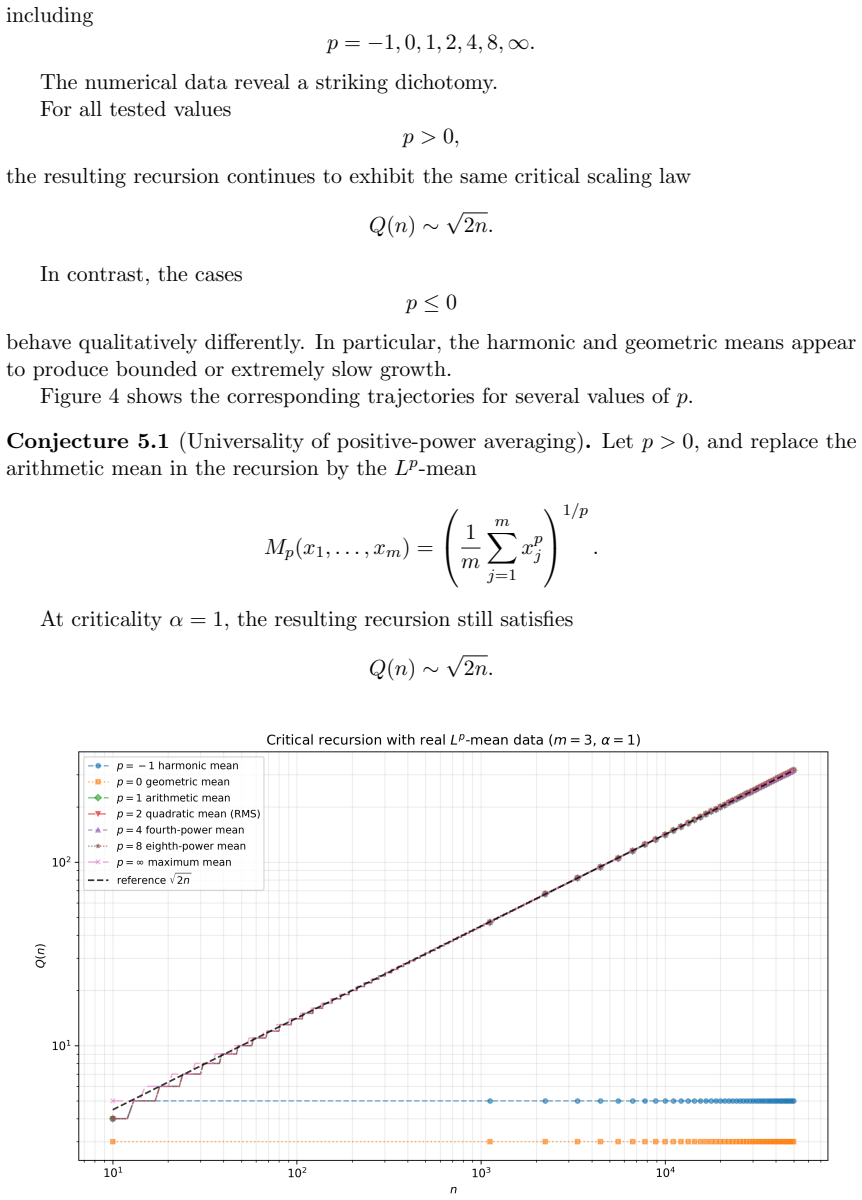
- Numerical results indicate that linear growth occurs and that similar regularization holds for other averaging operators such as positive-power L^p means.
Where Pith is reading between the lines
- The explicit block structure allows the entire sequence to be written in closed form by concatenating the runs without iterative evaluation.
- The regularization effect may apply to other self-referential recursions that currently lack stable asymptotics.
- The sqrt(2n) growth links the construction to quadratic counting problems such as the inverse of triangular numbers.
Load-bearing premise
The averaging formula always produces a well-defined positive integer at every step without undefined references or non-positive values.
What would settle it
Compute the first several thousand terms for fixed m and α=1 and check whether constant runs have lengths exactly equal to their value and whether the position where k first appears matches the triangular number k(k+1)/2.
Figures


read the original abstract
We introduce a family of averaged meta-Fibonacci recursions $$ Q_{\alpha,m}(n) = 1+ \left\lfloor \alpha \frac1m \sum_{j=1}^m Q_{\alpha,m}(n-Q_{\alpha,m}(n-j)) \right\rfloor , $$ with initial conditions $$ Q_{\alpha,m}(1)=\cdots=Q_{\alpha,m}(m)=1. $$ Unlike classical Hofstadter-type recursions, the averaging mechanism produces highly regular large-scale behavior. For the critical parameter value $\alpha=1$, we prove global well-definedness for all $m\ge1$, establish an exact triangular block structure, and show that the value $k$ occurs exactly $k$ consecutive times. As a consequence, $$ Q_{1,m}(n)\sim \sqrt{2n}. $$ For the supercritical regime $\alpha>1$, we derive an asymptotic slope constraint showing that any positive linear growth rate, if it exists, must equal $$ 1-\alpha^{-1}. $$ Numerical experiments support the existence of a linear-growth phase and suggest a broader universality phenomenon for generalized averaging operators, including positive-power $L^p$-means. These results indicate that averaging induces a robust regularization mechanism for self-referential recursive systems, leading to stable slow-growth dynamics and nontrivial phase structure.
Editorial analysis
A structured set of objections, weighed in public.
Referee Report
Summary. The manuscript introduces the family of averaged meta-Fibonacci recursions Q_{α,m}(n) = 1 + floor(α * (1/m) ∑_{j=1}^m Q_{α,m}(n - Q_{α,m}(n-j))), with initial conditions Q_{α,m}(1)=⋯=Q_{α,m}(m)=1. For the critical value α=1 it proves global well-definedness for every m≥1, establishes an exact triangular block structure in which each integer k appears in exactly k consecutive positions, and deduces the asymptotic Q_{1,m}(n)∼√(2n). For α>1 it derives the necessary condition that any positive linear growth rate must equal 1−α^{-1}, and presents numerical evidence for the existence of a linear-growth regime together with a suggested universality under generalized L^p averaging operators.
Significance. If the stated proofs are correct, the work supplies a concrete regularization mechanism that converts potentially chaotic meta-Fibonacci recursions into sequences with stable, explicitly describable slow-growth or linear asymptotics. The exact block-counting argument for α=1 yields a parameter-free derivation of the √(2n) law, which is a notable strength. The conditional slope constraint for α>1 is likewise derived directly from the recursion without fitting parameters to the target result. These features would be of interest to researchers studying self-referential recursions and discrete dynamical systems.
major comments (2)
- [Critical case (α=1) well-definedness and block-structure proof] The inductive argument establishing global well-definedness and the triangular block structure for α=1 (the central claim of the critical-case section) must explicitly verify that the floor-average operation maps a completed block of k’s into the next block without producing non-positive or non-integer values at the transition points; the current outline leaves the interaction between the floor function and the exact count of preceding terms unexpanded.
- [Supercritical regime and slope constraint] The derivation of the slope constraint 1−α^{-1} (supercritical regime) correctly shows necessity under the assumption that lim Q(n)/n exists and is positive, but the manuscript does not prove existence of the limit; the numerical support is therefore load-bearing for the claim that a linear-growth phase occurs, yet the range of n, m, and observed deviation from the predicted slope are not quantified.
minor comments (2)
- [Definition and initial conditions] The notation for the averaging window m and the parameter α is consistent, but the initial-condition statement should explicitly note that the first m terms are set to 1 independently of α.
- [Numerical experiments and universality] The discussion of universality for positive-power L^p means is suggestive; a brief remark on whether the slope constraint generalizes verbatim to p≠1 would clarify the scope of the claimed phenomenon.
Simulated Author's Rebuttal
We thank the referee for the careful reading, positive evaluation, and specific suggestions for improvement. We address each major comment below and will revise the manuscript accordingly to strengthen the exposition.
read point-by-point responses
-
Referee: [Critical case (α=1) well-definedness and block-structure proof] The inductive argument establishing global well-definedness and the triangular block structure for α=1 (the central claim of the critical-case section) must explicitly verify that the floor-average operation maps a completed block of k’s into the next block without producing non-positive or non-integer values at the transition points; the current outline leaves the interaction between the floor function and the exact count of preceding terms unexpanded.
Authors: We agree that the current outline of the inductive argument would benefit from a more explicit verification of the floor-average transitions. Although the block-structure argument relies on the exact multiplicity (each k appearing precisely k times) to control the averaged sum, the manuscript does not spell out the arithmetic at the block boundaries in sufficient detail. In the revision we will insert a short lemma that computes the precise value of the averaged sum when the window straddles the end of a completed block of k’s and the start of the next block, confirming that the floor operation yields exactly the integer k+1 and that all intermediate values remain positive integers. revision: yes
-
Referee: [Supercritical regime and slope constraint] The derivation of the slope constraint 1−α^{-1} (supercritical regime) correctly shows necessity under the assumption that lim Q(n)/n exists and is positive, but the manuscript does not prove existence of the limit; the numerical support is therefore load-bearing for the claim that a linear-growth phase occurs, yet the range of n, m, and observed deviation from the predicted slope are not quantified.
Authors: The referee is correct that the slope constraint is derived under the hypothesis that a positive linear growth rate exists; the manuscript makes no claim to prove existence of the limit. The numerical evidence is therefore essential for suggesting that a linear-growth regime is attained. In the revised version we will augment the numerical section with explicit statements of the ranges of n and m examined, together with quantitative measures (maximum and average relative deviation from 1−α^{-1}) observed across those runs, thereby making the supporting evidence fully transparent. revision: yes
Circularity Check
Derivation self-contained from recursion definition
full rationale
The central claims for α=1 follow directly from the given recursion and initial conditions Q(1)=...=Q(m)=1. The paper establishes global well-definedness and the exact triangular block structure (k appears exactly k consecutive times) by induction on n, using the floor-and-average operator to preserve the pattern without deviation. The asymptotic Q(n)∼√(2n) is then obtained by summing the block lengths (sum_{k=1}^K k ≈ K^2/2 = n). For α>1 the slope constraint 1−α^{-1} is derived as a necessary condition by assuming linear growth Q(n)∼cn and substituting into the recursion, yielding an algebraic identity that forces c=1−1/α; no parameters are fitted to the target asymptotic. No self-citations appear in the load-bearing steps, and the argument relies only on the explicit recursion rather than external theorems or prior results by the same author.
Axiom & Free-Parameter Ledger
free parameters (2)
- α
- m
axioms (2)
- domain assumption The recursion produces a well-defined positive integer sequence for every n
- standard math Standard properties of the floor function and finite averages
Lean theorems connected to this paper
-
IndisputableMonolith/Cost/FunctionalEquation.leanwashburn_uniqueness_aczel unclearTheorem 3.1 ... Q1,m(n)=k for m+k(k-1)/2 ≤ n ≤ m+k(k+1)/2-1 ... Q1,m(n)∼√(2n)
-
IndisputableMonolith/Foundation/ArithmeticFromLogic.leanLogicNat induction echoesdouble-induction argument controlling the recursive arguments block by block
Reference graph
Works this paper leans on
-
[1]
B. Balamohan, A. Kuznetsov, and Stephen Tanny. On the behavior of a variant of hofstadter’s q-sequence.Journal of Integer Sequences, 10(7):Article 07.7.1, 2007
work page 2007
-
[2]
John Callaghan, John J. III Chew, and Stephen M. Tanny. On the behavior of a family of meta-fibonacci sequences.SIAM Journal on Discrete Mathematics, 18(4):794–824, 2005
work page 2005
-
[3]
Morphic words and nested recurrence relations
Marc Celaya and Frank Ruskey. Morphic words and nested recurrence relations. Theoretical Computer Science, 520:35–39, 2014
work page 2014
-
[4]
Benoit Cloitre. Almost golomb sequences.arXiv preprint, 2026. arXiv:2604.02404
work page internal anchor Pith review Pith/arXiv arXiv 2026
-
[5]
Beatty solutions of almost Golomb equations
Benoit Cloitre. Beatty solutions of almost golomb equations.arXiv preprint, 2026. arXiv:2604.10822
work page internal anchor Pith review Pith/arXiv arXiv 2026
- [6]
-
[7]
Finding linear-recurrent solutions to hofstadter-like recurrences using symbolic computation, 2016
Nathan Fox. Finding linear-recurrent solutions to hofstadter-like recurrences using symbolic computation, 2016
work page 2016
-
[8]
Quasipolynomial solutions to the hofstadter q-recurrence.Integers, 16:A68, 2016
Nathan Fox. Quasipolynomial solutions to the hofstadter q-recurrence.Integers, 16:A68, 2016
work page 2016
-
[9]
Jason Higham and Stephen M. Tanny. More well-behaved meta-fibonacci sequences. Congressus Numerantium, 98:3–17, 1993
work page 1993
-
[10]
Hofstadter.G¨ odel, Escher, Bach: An Eternal Golden Braid
Douglas R. Hofstadter.G¨ odel, Escher, Bach: An Eternal Golden Braid. Basic Books, 1979
work page 1979
-
[11]
Abraham Isgur, Vitaly Kuznetsov, and Stephen M. Tanny. A combinatorial approach for solving certain nested recursions with non-slow solutions.arXiv preprint, 2012. 18
work page 2012
-
[12]
Stephen M. Tanny. A well-behaved cousin of the hofstadter sequence.Discrete Mathematics, 105(1–3):227–239, 1992. 19
work page 1992
discussion (0)
Sign in with ORCID, Apple, or X to comment. Anyone can read and Pith papers without signing in.