Recognition: 2 theorem links
· Lean TheoremGeneralized Andr\'asfai graphs and special Betti diagrams of edge ideals
Pith reviewed 2026-05-13 02:51 UTC · model grok-4.3
The pith
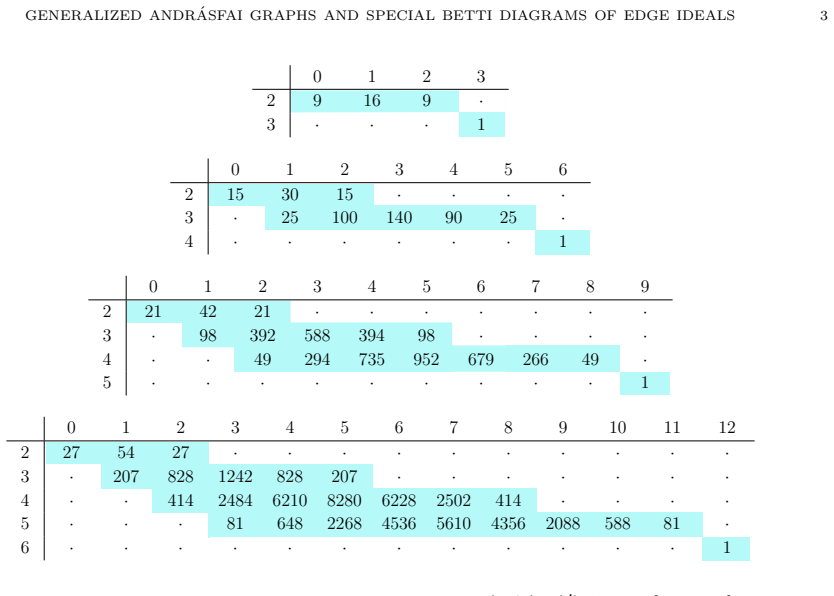
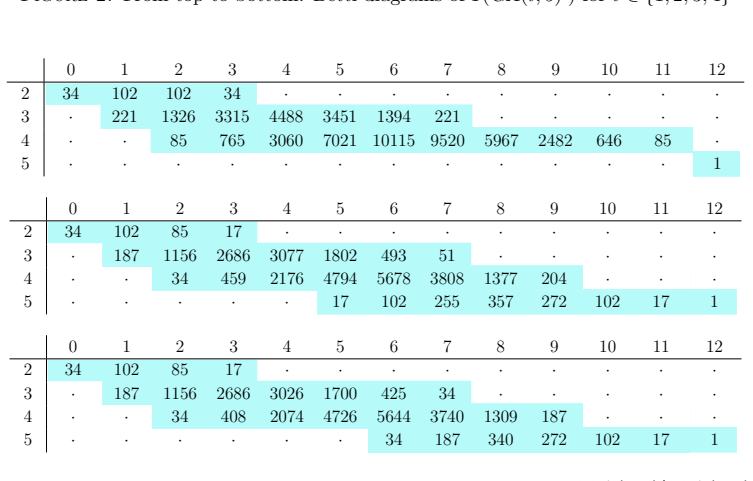
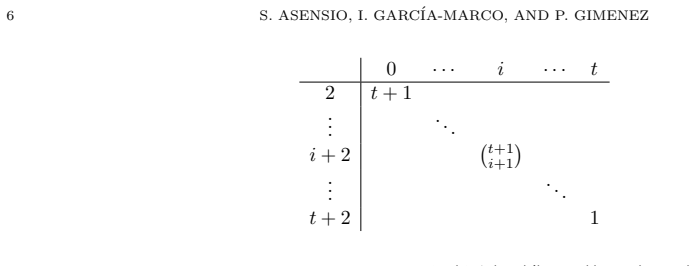
Removing a suitable Hamiltonian cycle from generalized Andrásfai graphs GA(t,k) yields edge ideals with regularity t+2, projective dimension t(k-2), and a generalized special Betti diagram.
A machine-rendered reading of the paper's core claim, the machinery that carries it, and where it could break.
Core claim
when removing a suitable Hamiltonian cycle from GA(t,k), the resulting edge ideal has regularity t+2, projective dimension t(k-2) and a Betti diagram exhibiting a generalized version of the same special shape.
Load-bearing premise
That the newly defined family GA(t,k) admits a suitable Hamiltonian cycle for every t ≥ 1 and k ≥ 2 such that the combinatorial structure after removal produces exactly the claimed regularity, dimension, and Betti diagram shape.
Figures



read the original abstract
Edge ideals of graphs were introduced by Villarreal in 1990, and have been the subject of many studies since then. In the same year, Fr\"oberg characterized edge ideals with regularity 2 in combinatorial terms. This result was generalized by Fern\'andez-Ramos and Gimenez to regularity 3 for bipartite graphs. A key ingredient in these results is the particular shape of the Betti diagrams of the edge ideals of the graphs obtained after removing a Hamiltonian cycle from either a complete graph $ K_k$ or a complete bipartite graph $K_{k,k}$. In this work, we consider the family of Generalized Andr\'asfai graphs ${\rm GA}(t,k)$ with $t\geq 1 $ and $k \geq 2$. This family extends the families of complete graphs, since $K_{k+1} = {\rm GA}(1,k)$, and complete bipartite $k$-regular graphs, since $K_{k,k} = {\rm GA}(2,k)$. We show that the results known for $ K_k$ and $ K_{k,k}$ can be naturally extended to this family. More precisely, when removing a suitable Hamiltonian cycle from ${\rm GA}(t,k)$, the resulting edge ideal has regularity $t+2$, projective dimension $t(k-2)$ and a Betti diagram exhibiting a generalized version of the same special shape.
Editorial analysis
A structured set of objections, weighed in public.
Referee Report
Summary. The paper defines the family of Generalized Andrásfai graphs GA(t,k) for t ≥ 1 and k ≥ 2, extending K_{k+1} = GA(1,k) and K_{k,k} = GA(2,k). It proves that removing a suitable Hamiltonian cycle from GA(t,k) yields an edge ideal with regularity t+2, projective dimension t(k-2), and a Betti diagram of generalized special shape, extending prior results on regularity 2 (Fröberg) and regularity 3 for bipartite graphs (Fernández-Ramos-Gimenez).
Significance. If the claims hold, the work supplies an explicit parameterized family of graphs whose edge ideals have fully determined homological invariants, allowing systematic construction of examples with prescribed regularity and Betti shapes beyond the classical complete and complete-bipartite cases. This strengthens the combinatorial-algebraic dictionary for monomial ideals and may support further classification results.
major comments (2)
- [Definition of GA(t,k) and main theorem] The existence of a suitable Hamiltonian cycle in GA(t,k) for arbitrary t ≥ 1, k ≥ 2 is load-bearing for the central claim; the manuscript must supply an explicit construction or inductive proof that the cycle removal produces exactly regularity t+2 and projective dimension t(k-2) (see the statement following the definition of GA(t,k) and the main theorem on Betti diagrams).
- [Main theorem on Betti diagrams] The explicit computation of the Betti diagram after cycle removal, showing the generalized special shape, requires a self-contained argument or table of generators in each bidegree; without it the extension from the t=1 and t=2 cases remains unverified (main theorem on Betti diagrams).
minor comments (2)
- Add a small explicit example (e.g., t=1, k=3 and t=2, k=3) with the resulting Betti table to illustrate the generalized shape.
- [Definition of GA(t,k)] Clarify the precise edge set in the definition of GA(t,k) to make the Hamiltonian-cycle construction immediately verifiable from the combinatorial description.
Simulated Author's Rebuttal
We thank the referee for the careful reading and constructive comments on our manuscript. The feedback correctly identifies points where additional explicit details would strengthen the presentation of the constructions and homological computations. We address each major comment below and will incorporate revisions accordingly.
read point-by-point responses
-
Referee: The existence of a suitable Hamiltonian cycle in GA(t,k) for arbitrary t ≥ 1, k ≥ 2 is load-bearing for the central claim; the manuscript must supply an explicit construction or inductive proof that the cycle removal produces exactly regularity t+2 and projective dimension t(k-2) (see the statement following the definition of GA(t,k) and the main theorem on Betti diagrams).
Authors: We agree that an explicit construction is necessary for the central claims. The manuscript defines GA(t,k) recursively, extending the known Hamiltonian cycles for the base cases t=1 (complete graphs) and t=2 (complete bipartite graphs). In the revised version we will add an inductive construction of the cycle for general t and k, together with a direct combinatorial argument showing that its removal from the edge ideal produces exactly the stated regularity t+2 and projective dimension t(k-2). revision: yes
-
Referee: The explicit computation of the Betti diagram after cycle removal, showing the generalized special shape, requires a self-contained argument or table of generators in each bidegree; without it the extension from the t=1 and t=2 cases remains unverified (main theorem on Betti diagrams).
Authors: The main theorem generalizes the Betti-diagram shape from the t=1 and t=2 cases using the recursive structure of GA(t,k). To make the argument fully self-contained we will include, in the revision, an explicit computation of the minimal generators in each bidegree (via a mapping-cone argument or direct resolution) together with a table of Betti numbers for representative small values of t and k that illustrates the generalized special shape. revision: yes
Circularity Check
No circularity; new graph family and invariants derived independently
full rationale
The paper defines the new family GA(t,k) independently as a combinatorial extension of K_{k+1} and K_{k,k}, then proves the stated regularity, projective dimension, and generalized Betti diagram shape after Hamiltonian cycle removal via direct combinatorial arguments. Prior results (including the self-citation to Fernández-Ramos and Gimenez for the t=2 case) supply background context but are not invoked to force the new claims by definition or by fitting. No step reduces a claimed prediction to an input parameter, renames a known result, or relies on a self-citation chain for uniqueness. The derivation remains self-contained and externally verifiable through the explicit graph construction and edge ideal computations.
Axiom & Free-Parameter Ledger
axioms (1)
- standard math Standard results on edge ideals, regularity, and Betti diagrams from commutative algebra and graph theory (Fröberg 1990, Fernández-Ramos-Gimenez).
invented entities (1)
-
Generalized Andrásfai graphs GA(t,k)
no independent evidence
Lean theorems connected to this paper
-
IndisputableMonolith/Foundation/RealityFromDistinction.leanreality_from_one_distinction unclearwhen removing a suitable Hamiltonian cycle from GA(t,k), the resulting edge ideal has regularity t+2, projective dimension t(k-2) and a Betti diagram exhibiting a generalized version of the same special shape
-
IndisputableMonolith/Cost/FunctionalEquation.leanwashburn_uniqueness_aczel unclearthe family of Generalized Andrásfai graphs GA(t,k) ... extends ... complete graphs ... and complete bipartite k-regular graphs
Reference graph
Works this paper leans on
-
[1]
B´ ela Andr´ asfai. Graphentheoretische extremalprobleme.Acta Mathematica Academiae Scientiarum Hungaricae, 15:413–438, 1964
work page 1964
-
[2]
Extremal Betti numbers and applications to monomial ideals
Dave Bayer, Hara Charalambous, and Sorin Popescu. Extremal Betti numbers and applications to monomial ideals. Journal of Algebra, 221(2):497–512, 1999
work page 1999
-
[3]
Angsuman Das, Sucharita Biswas, and Manideepa Saha. Generalized Andr´ asfai graphs.Discussiones Mathematicae - General Algebra and Applications, 42:449–462, 2022
work page 2022
-
[4]
John A. Eagon and Victor Reiner. Resolutions of Stanley-Reisner rings and Alexander duality.Journal of Pure and Applied Algebra, 130(3):265–275, 1998
work page 1998
-
[5]
Princeton University Press, 1952
Samuel Eilenberg and Norman Steenrod.Foundations of Algebraic Topology. Princeton University Press, 1952
work page 1952
-
[6]
Restricting linear syzygies: algebra and geometry
David Eisenbud, Mark Lee Green, Klaus Hulek, and Sorin Popescu. Restricting linear syzygies: algebra and geometry. Compositio Mathematica, 141:1460–1478, 2004
work page 2004
-
[7]
Minimal resolutions of some monomial ideals.Journal of Algebra, 129(1):1–25, 1990
Shalom Eliahou and Michel Kervaire. Minimal resolutions of some monomial ideals.Journal of Algebra, 129(1):1–25, 1990
work page 1990
-
[8]
Alexander Engstr¨ om. Complexes of directed trees and independence complexes.Discrete Mathematics, 309(10):3299– 3309, 2009
work page 2009
-
[9]
Alexander Engstr¨ om. Chromatic numbers from edge ideals: Graph classes with vanishing syzygies are polynomially χ-bounded.Preprint, arXiv:2512.21800 [math.CO], 2025. 20 S. ASENSIO, I. GARC ´IA-MARCO, AND P. GIMENEZ
work page internal anchor Pith review Pith/arXiv arXiv 2025
-
[10]
´Oscar Fern´ andez-Ramos and Philippe Gimenez. First nonlinear syzygies of ideals associated to graphs.Communica- tions in Algebra, 37(6):1921–1933, 2009
work page 1921
-
[11]
´Oscar Fern´ andez-Ramos and Philippe Gimenez. Regularity 3 in edge ideals associated to bipartite graphs.Journal of Algebraic Combinatorics, 39:919–937, 2014
work page 2014
-
[12]
Francisco, Huy T` ai H` a, and Adam Van Tuyl
Christopher A. Francisco, Huy T` ai H` a, and Adam Van Tuyl. Colorings of hypergraphs, perfect graphs, and associated primes of powers of monomial ideals.Journal of Algebra, 331(1):224–242, 2011
work page 2011
-
[13]
On Stanley-Reisner rings.Banach Center Publications, 26(2):57–70, 1990
Ralf Fr¨ oberg. On Stanley-Reisner rings.Banach Center Publications, 26(2):57–70, 1990
work page 1990
-
[14]
Splittable ideals and the resolutions of monomial ideals.Journal of Algebra, 309(1):405–425, 2007
Huy T` ai H` a and Adam Van Tuyl. Splittable ideals and the resolutions of monomial ideals.Journal of Algebra, 309(1):405–425, 2007
work page 2007
-
[15]
Monomial ideals, edge ideals of hypergraphs, and their graded Betti numbers
Huy T` ai H` a and Adam Van Tuyl. Monomial ideals, edge ideals of hypergraphs, and their graded Betti numbers. Journal of Algebraic Combinatorics, 27:215–245, 2008
work page 2008
-
[16]
Correction to: Monomial ideals, edge ideals of hypergraphs, and their graded Betti numbers [J
Huy T` ai H` a and Adam Van Tuyl. Correction to: Monomial ideals, edge ideals of hypergraphs, and their graded Betti numbers [J. ALGEBRAIC COMBIN. 27 (2008), NO. 2, 215-245].Journal of Algebraic Combinatorics, 58(1):325–328, October 2022
work page 2008
-
[17]
J¨ urgen Herzog and Takayuki Hibi.Monomial Ideals, volume 260 ofGraduate Texts in Mathematics. Springer, London, 2011
work page 2011
-
[18]
Melvin Hochster. Cohen-Macaulay rings, combinatorics, and simplicial complexes.Ring Theory, II, (Proceedings of the Second Conference, University of Oklahoma, Norman, Oklahoma, 1975), pages 171–223, 1975
work page 1975
-
[19]
PhD thesis, University of Sheffield, 2004
Sean Jacques.Betti numbers of graph ideals. PhD thesis, University of Sheffield, 2004
work page 2004
-
[20]
A characterization of edge ideals with reg(R/I(G)) = 3.Preprint, arXiv:2603.23321 [math.AC], 2026
Akane Kanno. A characterization of edge ideals with reg(R/I(G)) = 3.Preprint, arXiv:2603.23321 [math.AC], 2026
-
[21]
Mordechai Katzman. Characteristic-independence of Betti numbers of graph ideals.Journal of Combinatorial Theory, Series A, 113(3):435–454, 2006
work page 2006
-
[22]
Ezra Miller and Bernd Sturmfels.Combinatorial Commutative Algebra, volume 227 ofGraduate Texts in Mathemat- ics. Springer, New York, 2005
work page 2005
-
[23]
On the linear strand of an edge ideal.Communications in Algebra, 35(3):821–832, 2007
Mike Roth and Adam Van Tuyl. On the linear strand of an edge ideal.Communications in Algebra, 35(3):821–832, 2007
work page 2007
-
[24]
Rafael H. Villarreal. Cohen-Macaulay graphs.Manuscripta Mathematica, 66:277–293, 1990
work page 1990
-
[25]
Rafael H. Villarreal.Monomial Algebras. Chapman & Hall/CRC Monographs and Research Notes in Mathematics. CRC Press, Boca Raton, FL, 3rd edition, 2026. Instituto de Investigaci´on en Matem´aticas (IMUVa), Universidad de Valladolid, Valladolid, Spain Email address:sara.asensio@uva.es Instituto de Matem ´aticas y Aplicaciones (IMAULL), Secci ´on de Matem´ati...
work page 2026
discussion (0)
Sign in with ORCID, Apple, or X to comment. Anyone can read and Pith papers without signing in.