Recognition: no theorem link
Continuous mass ablation of planets engulfed in stellar envelopes
Pith reviewed 2026-05-13 01:20 UTC · model grok-4.3
The pith
Planets engulfed by stars dissolve through continuous mass ablation instead of sudden destruction at one depth.
A machine-rendered reading of the paper's core claim, the machinery that carries it, and where it could break.
Core claim
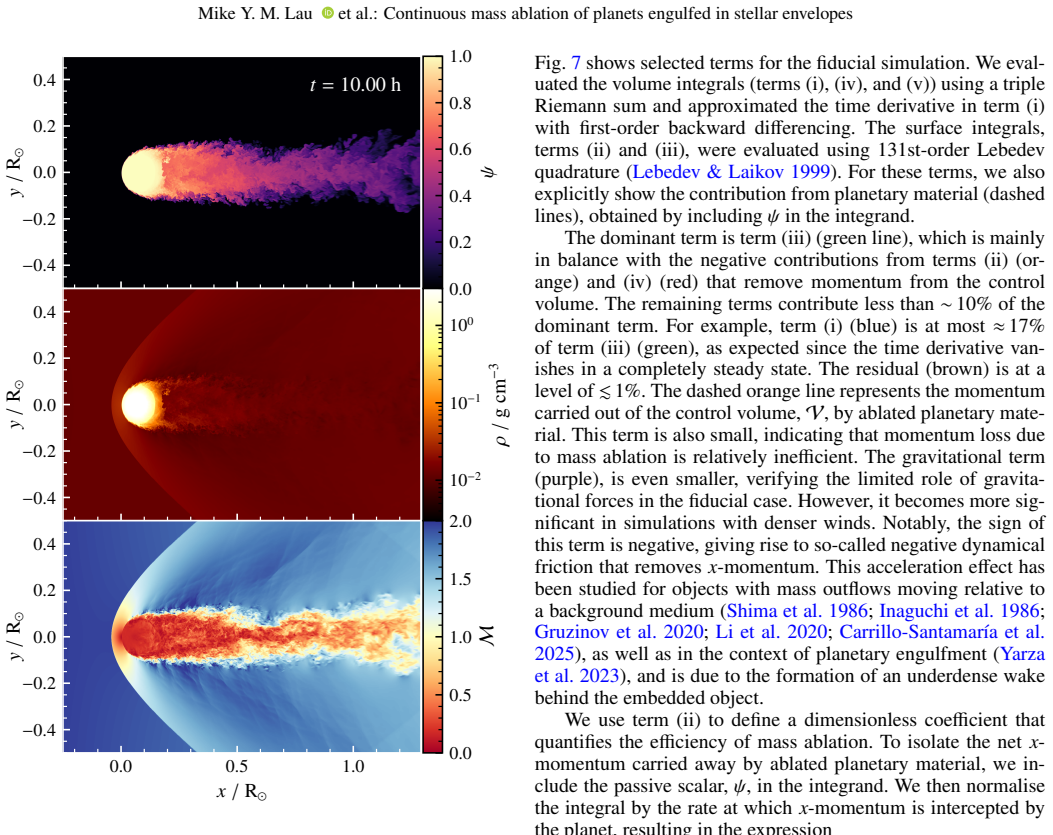
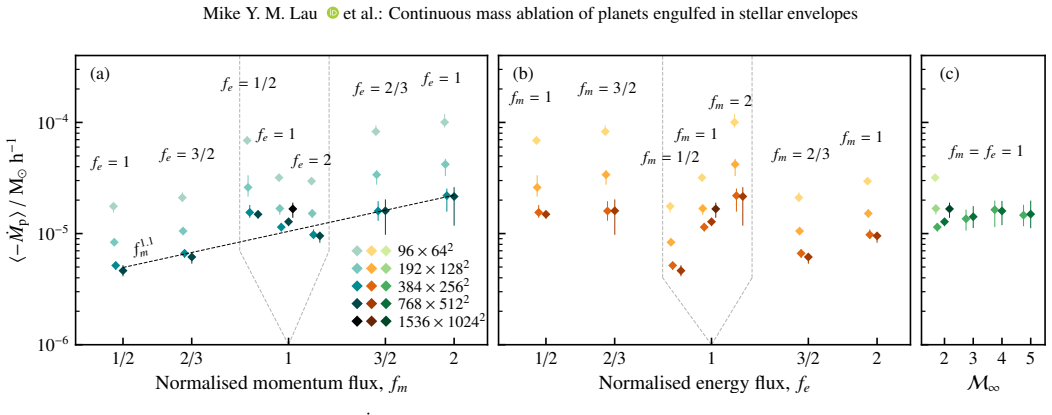
In three-dimensional hydrodynamical simulations that resolve the gaseous structure of a Jupiter-like planet in a wind-tunnel setup representing stellar envelope conditions, a continuous mass-ablation process operates throughout engulfment. The ablation rate scales nearly linearly with wind momentum flux and shows little dependence on Mach number, consistent with Kelvin-Helmholtz instability growth at the planet surface. Pressure-drag coefficients of 0.44-0.56 and ablation efficiencies of 0.054-0.11 are measured; when these are used in a numerically integrated inspiral, the planet dissolves completely within the convective envelope and enriches the stellar surface in lithium.
What carries the argument
The wind-tunnel hydrodynamical simulation that resolves the planet's gaseous body, allowing direct capture of Kelvin-Helmholtz instabilities that drive ongoing surface ablation.
If this is right
- The measured drag and ablation coefficients supply ready prescriptions for large-scale parameter studies of engulfment.
- Continuous ablation permits complete planetary dissolution inside the convective envelope.
- Dissolution releases planetary material that can produce observable lithium enrichment at the stellar surface.
- Chemical enrichment signatures may appear across a wider range of stellar masses and evolutionary stages than models assuming threshold destruction predict.
Where Pith is reading between the lines
- Stellar evolution codes that treat engulfment as an instantaneous event should be revised to include gradual mass loss.
- Enhanced lithium detections in red-giant atmospheres could trace this continuous ablation channel in more systems than previously modeled.
- The weak Mach-number dependence implies the ablation process remains effective across varying envelope densities and velocities.
Load-bearing premise
The simplified wind-tunnel flow with a resolved gaseous planet accurately captures the three-dimensional, time-dependent interaction that occurs during actual inspiral through a realistic stellar envelope.
What would settle it
A simulation or observation in which planetary mass loss halts at a specific depth set by ram pressure or tidal forces rather than continuing steadily as the planet spirals inward.
Figures






read the original abstract
Most stars host short-period planets that are expected to be engulfed during post-main-sequence expansion. The dissolution of engulfed planets has been proposed as a possible mechanism for producing stars enriched in lithium and refractory elements. We perform three-dimensional hydrodynamical simulations of a Jupiter-like planet engulfed within a stellar envelope using the Seven-League Hydro code. Unlike previous studies that represent the planet as a point mass or rigid sphere, we adopt a wind-tunnel setup that resolves the planet's gaseous structure. We find that a continuous mass-ablation process operates during planetary engulfment, contrary to the common assumption that destruction occurs at a specific depth due to ram pressure, tidal forces, or thermal evaporation. The ablation rate scales nearly linearly with the wind momentum flux and is largely insensitive to the Mach number, consistent with an analytical model based on Kelvin-Helmholtz instability developing at the planetary surface. We define efficiency coefficients for drag and ablation, finding pressure-drag coefficients of 0.44-0.56 and smaller ablation efficiencies of 0.054-0.11. Applying these coefficients to a numerically integrated inspiral through a stellar profile, we find that continuous ablation could lead to complete dissolution of the planet within the convective envelope, producing observable lithium enrichment at the stellar surface. Our results provide prescriptions for drag and mass loss that enable large parameter-space studies of planetary engulfment and suggest that chemical enrichment may occur over a broader range of stellar parameters than previously thought.
Editorial analysis
A structured set of objections, weighed in public.
Referee Report
Summary. The manuscript reports 3D hydrodynamical wind-tunnel simulations (using the Seven-League Hydro code) of a resolved gaseous Jupiter-like planet in uniform stellar-envelope flow. It finds continuous surface ablation driven by Kelvin-Helmholtz instability rather than abrupt destruction at a critical depth, with ablation rate scaling nearly linearly with wind momentum flux and insensitive to Mach number. Drag and ablation efficiency coefficients (0.44-0.56 and 0.054-0.11) are extracted and inserted into a separate 1D orbital-inspiral integrator through a stellar profile, yielding predictions of complete planetary dissolution and surface lithium enrichment.
Significance. If the reported linear scaling and constant efficiencies hold under realistic conditions, the work supplies practical, parameterizable prescriptions for drag and mass loss that enable population-level studies of post-main-sequence planetary engulfment. The explicit comparison to an analytic KH model and the demonstration of continuous rather than threshold destruction are concrete strengths that could broaden the predicted range of chemical-enrichment signatures.
major comments (2)
- [Inspiral integration and application to stellar profile] The central claim that continuous ablation leads to complete dissolution rests on efficiencies measured in fixed-planet, uniform-flow wind-tunnel runs being inserted unchanged into the inspiral integrator. No simulation is presented in which the background density and velocity evolve self-consistently on the local dynamical time while the planet ablates and its orbit decays; this extrapolation is load-bearing for the lithium-enrichment prediction.
- [Hydrodynamic simulation setup and results] The wind-tunnel boundary conditions impose steady uniform inflow at constant Mach and momentum flux. The manuscript does not quantify how the measured efficiencies would change under the radially varying density, velocity, and pressure gradients encountered during actual inspiral (e.g., near the convective-radiative boundary), which directly affects whether the linear scaling remains valid throughout the envelope.
minor comments (2)
- [Abstract] The abstract states ablation efficiencies of 0.054-0.11 but does not indicate the precise range of momentum fluxes or Mach numbers over which these values were averaged; a brief table or sentence linking the quoted range to the simulation grid would improve clarity.
- [Figures and captions] Figure captions and axis labels should explicitly state whether the reported drag and ablation efficiencies are time-averaged or instantaneous, and over what interval, to allow direct comparison with the analytic KH model.
Simulated Author's Rebuttal
We thank the referee for their constructive and detailed review. The comments correctly identify the key modeling assumptions in our work. We respond point by point below and indicate the revisions we will make.
read point-by-point responses
-
Referee: The central claim that continuous ablation leads to complete dissolution rests on efficiencies measured in fixed-planet, uniform-flow wind-tunnel runs being inserted unchanged into the inspiral integrator. No simulation is presented in which the background density and velocity evolve self-consistently on the local dynamical time while the planet ablates and its orbit decays; this extrapolation is load-bearing for the lithium-enrichment prediction.
Authors: We agree that a fully self-consistent 3D simulation in which the background stellar profile evolves simultaneously with the planet's ablation and orbital decay would constitute a stronger test. Such calculations remain computationally prohibitive at the required resolution and timescale separation. Our 1D integrator is intended as a parameterization that propagates the locally measured efficiencies to estimate global outcomes. In the revised manuscript we will expand the discussion of this extrapolation, explicitly state the assumptions, and qualify the lithium-enrichment result as conditional on the efficiencies remaining approximately constant under envelope gradients. We will also add a simple timescale comparison between local KH growth and inspiral to support the separation of scales. revision: partial
-
Referee: The wind-tunnel boundary conditions impose steady uniform inflow at constant Mach and momentum flux. The manuscript does not quantify how the measured efficiencies would change under the radially varying density, velocity, and pressure gradients encountered during actual inspiral (e.g., near the convective-radiative boundary), which directly affects whether the linear scaling remains valid throughout the envelope.
Authors: The uniform-flow setup is chosen to isolate the local planet-wind interaction at a representative depth. Because the planet radius is much smaller than the local pressure scale height throughout most of the convective envelope, the uniform approximation is expected to be reasonable. We nevertheless accept that the manuscript does not quantify the effect of gradients. In the revision we will add an analytic estimate, based on the KH model already presented, of how a background density gradient modifies the ablation rate, together with a short discussion of possible additional effects near the convective-radiative interface. This will clarify the domain of applicability of the reported linear scaling. revision: partial
Circularity Check
No significant circularity; efficiencies measured from direct simulations and applied externally
full rationale
The paper's core result (continuous ablation during engulfment) is obtained from 3D hydrodynamical wind-tunnel simulations that resolve the planet's gaseous structure. Drag (0.44-0.56) and ablation (0.054-0.11) efficiency coefficients are direct outputs of those runs at fixed Mach and momentum flux. These measured values are then inserted into a separate inspiral integrator through a 1D stellar profile. No equation or step in the provided text reduces the central claim to a self-definition, a fitted input renamed as prediction, or a self-citation chain. The KH-based analytical model is invoked only for consistency, not as the load-bearing derivation. The derivation chain is therefore self-contained against external benchmarks.
Axiom & Free-Parameter Ledger
free parameters (2)
- pressure-drag coefficient =
0.44-0.56
- ablation efficiency coefficient =
0.054-0.11
axioms (1)
- domain assumption Kelvin-Helmholtz instability at the planet-wind interface sets the ablation rate scaling
Reference graph
Works this paper leans on
-
[1]
Aguilera-Gómez, C., Chanamé, J., Pinsonneault, M. H., & Carlberg, J. K. 2016, ApJ, 829, 127
work page 2016
-
[2]
Alexander, J. B. 1967, The Observatory, 87, 238
work page 1967
- [3]
- [4]
-
[5]
2024, A&A, 683, A97 Andrássy, R
Andrassy, R., Leidi, G., Higl, J., et al. 2024, A&A, 683, A97 Andrássy, R. & Spruit, H. C. 2013, A&A, 559, A122
work page 2024
- [6]
- [7]
-
[8]
Brown, J. A., Sneden, C., Lambert, D. L., & Dutchover, Jr., E. 1989, ApJS, 71, 293
work page 1989
-
[9]
Burbidge, E. M., Burbidge, G. R., Fowler, W. A., & Hoyle, F. 1957, Reviews of Modern Physics, 29, 547 Carrillo-Santamaría, J., López-Cámara, D., De Colle, F., Moreno Méndez, E., & Sánchez-Salcedo, F. J. 2025, MNRAS, 540, 2952
work page 1957
- [10]
-
[11]
R., Ruchti, G., Masseron, T., et al
Casey, A. R., Ruchti, G., Masseron, T., et al. 2016, MNRAS, 461, 3336
work page 2016
- [12]
-
[13]
1961, Hydrodynamic and hydromagnetic stability
Chandrasekhar, S. 1961, Hydrodynamic and hydromagnetic stability
work page 1961
- [14]
-
[15]
Colella, P. & Woodward, P. R. 1984, Journal of Computational Physics, 54, 174
work page 1984
-
[16]
1928, Mathematische Annalen, 100, 32
Courant, R., Friedrichs, K., & Lewy, H. 1928, Mathematische Annalen, 100, 32
work page 1928
-
[17]
De, K., MacLeod, M., Karambelkar, V ., et al. 2023, Nature, 617, 55
work page 2023
- [18]
-
[19]
Edelmann, P. V . F. 2014, Dissertation, Technische Universität München
work page 2014
-
[20]
Edelmann, P. V . F., Horst, L., Berberich, J. P., et al. 2021, A&A, 652, A53
work page 2021
-
[21]
Fehlberg, E. 1969, Low-order Classical Runge-Kutta Formulas with Stepsize Control and Their Application to Some Heat Transfer Problems, Technical Report NASA TR R-315, National Aeronautics and Space Administration (NASA)
work page 1969
-
[22]
Fressin, F., Torres, G., Charbonneau, D., et al. 2013, ApJ, 766, 81
work page 2013
-
[23]
Gagnier, D., Leidi, G., Vetter, M., Andrassy, R., & Röpke, F. K. 2026, A&A, 707, A1
work page 2026
- [24]
-
[25]
Gould, A., Dorsher, S., Gaudi, B. S., & Udalski, A. 2006, Acta Astron., 56, 1
work page 2006
-
[26]
Gruzinov, A., Levin, Y ., & Matzner, C. D. 2020, MNRAS, 492, 2755 Article number, page 13 of 18 A&A proofs:manuscript no. planet
work page 2020
-
[27]
Hirai, R., Sato, T., Podsiadlowski, P., Vigna-Gómez, A., & Mandel, I. 2020, MN- RAS, 499, 1154
work page 2020
-
[28]
Horst, L., Edelmann, P. V . F., Andrássy, R., et al. 2020, A&A, 641, A18
work page 2020
-
[29]
Horst, L., Hirschi, R., Edelmann, P. V . F., Andrassy, R., & Roepke, F. K. 2021, A&A, 653, A55
work page 2021
- [30]
-
[31]
Hoyle, F. & Lyttleton, R. A. 1939, Proceedings of the Cambridge Philosophical Society, 35, 405
work page 1939
- [32]
-
[33]
Hubbard, W. B. 1984, Planetary interiors (Van Nostrand Reinhold)
work page 1984
- [34]
- [35]
-
[36]
1950, Memoirs of the College of Science, University of Kyoto, Series A, 26, 207
Kawamura, T. 1950, Memoirs of the College of Science, University of Kyoto, Series A, 26, 207
work page 1950
-
[37]
Kramer, M., Schneider, F. R. N., Ohlmann, S. T., et al. 2020, A&A, 642, A97
work page 2020
-
[38]
Landau, L. D. 1944, Dokl. Akad. Nauk. SSSR, 44, 339
work page 1944
-
[39]
Landau, L. D. & Lifshitz, E. M. 1959, Fluid mechanics
work page 1959
-
[40]
Lebedev, V . I. & Laikov, D. N. 1999, Doklady Akademii Nauk, 366, 741
work page 1999
-
[41]
Leidi, G., Andrassy, R., Higl, J., Edelmann, P. V . F., & Röpke, F. K. 2023, A&A, 679, A132
work page 2023
-
[42]
Leidi, G., Andrassy, R., Barsukow, W., et al. 2024, A&A, 686, A34
work page 2024
- [43]
-
[44]
Phlegethon: a fully compressible magnetohydrodynamic code for simulations in stellar astrophysics
Leidi, G., Holas, A., Vitovsky, K., et al. 2026, arXiv e-prints, arXiv:2604.12672
work page internal anchor Pith review Pith/arXiv arXiv 2026
-
[45]
Li, X., Chang, P., Levin, Y ., Matzner, C. D., & Armitage, P. J. 2020, MNRAS, 494, 2327
work page 2020
- [46]
-
[47]
Lobb, R. K. 1964, in The High Temperature Aspects of Hypersonic Flow, ed. W. C. Nelson (Oxford: Pergamon Press), 519–527
work page 1964
-
[48]
Loth, E., Tyler Daspit, J., Jeong, M., Nagata, T., & Nonomura, T. 2021, AIAA Journal, 59, 3261
work page 2021
-
[49]
MacLeod, M., Antoni, A., Murguia-Berthier, A., Macias, P., & Ramirez-Ruiz, E. 2017, ApJ, 838, 56
work page 2017
-
[50]
MacLeod, M., Cantiello, M., & Soares-Furtado, M. 2018, ApJ, 853, L1
work page 2018
- [51]
-
[52]
Occurrence, mass distribution and orbital properties of super-Earths and Neptune-mass planets
Mayor, M., Marmier, M., Lovis, C., et al. 2011, arXiv e-prints, arXiv:1109.2497
-
[53]
D., Giannios, D., & Spiegel, D
Metzger, B. D., Giannios, D., & Spiegel, D. S. 2012, MNRAS, 425, 2778
work page 2012
-
[54]
2013, Dissertation, Technische Universität München
Miczek, F. 2013, Dissertation, Technische Universität München
work page 2013
-
[55]
Miczek, F., Röpke, F. K., & Edelmann, P. V . F. 2015, A&A, 576, A50
work page 2015
-
[56]
Miller, D. G. & Bailey, A. B. 1979, Journal of Fluid Mechanics, 93, 449 O’Connor, C. E., Bildsten, L., Cantiello, M., & Lai, D. 2023, ApJ, 950, 128
work page 1979
- [57]
-
[58]
Ostriker, E. C. 1999, ApJ, 513, 252
work page 1999
-
[59]
Privitera, G., Meynet, G., Eggenberger, P., et al. 2016, A&A, 593, A128
work page 2016
-
[60]
J., Glanz, H., Bildsten, L., Perets, H
Prust, L. J., Glanz, H., Bildsten, L., Perets, H. B., & Röpke, F. K. 2024, ApJ, 966, 103
work page 2024
-
[61]
Sandquist, E., Taam, R. E., Lin, D. N. C., & Burkert, A. 1998, ApJ, 506, L65
work page 1998
-
[62]
Sandquist, E. L., Dokter, J. J., Lin, D. N. C., & Mardling, R. A. 2002, ApJ, 572, 1012
work page 2002
- [63]
- [64]
-
[65]
Silverman, B. W. 1986, Density estimation for statistics and data analysis
work page 1986
-
[66]
Soares-Furtado, M., Cantiello, M., MacLeod, M., & Ness, M. K. 2021, AJ, 162, 273
work page 2021
-
[67]
Stevenson, D. J. 1991, ARA&A, 29, 163
work page 1991
-
[68]
Syrovatskii, S. I. 1954, Zhurnal Eksperimental’noi i Teoreticheskoi Fiziki, 27, 121, in Russian
work page 1954
-
[69]
Thun, D., Kuiper, R., Schmidt, F., & Kley, W. 2016, A&A, 589, A10
work page 2016
-
[70]
Toro, E. F., Spruce, M., & Speares, W. 1994, Shock Waves, 4, 25 van der V orst, H. A. 1992, SIAM Journal on Scientific and Statistical Computing, 13, 631
work page 1994
- [71]
- [72]
- [73]
- [74]
-
[75]
B., Murguia-Berthier, A., et al
Yarza, R., Razo-López, N. B., Murguia-Berthier, A., et al. 2023, ApJ, 954, 176 Article number, page 14 of 18 Mike Y . M. Lau et al.: Continuous mass ablation of planets engulfed in stellar envelopes Appendix A: Grid stretching functions The computational coordinates are mapped from a logically Cartesian space to physical space using normalised power-law s...
work page 2023
discussion (0)
Sign in with ORCID, Apple, or X to comment. Anyone can read and Pith papers without signing in.