Recognition: 2 theorem links
· Lean TheoremMaking Abstraction Concrete: A Design Space and Interaction Model of Abstraction in Interactive Systems
Pith reviewed 2026-05-13 01:18 UTC · model grok-4.3
The pith
A survey of 457 papers yields a six-dimensional design space for abstraction techniques that reframes the gulfs of execution and evaluation in interactive systems.
A machine-rendered reading of the paper's core claim, the machinery that carries it, and where it could break.
Core claim
The central claim is that abstraction techniques across interactive systems can be captured in a design space organized along six dimensions, synthesized from a survey of 457 papers. This space provides a lens for reframing the gulfs of execution and evaluation, and for explicitly describing the cognitive and design processes by which users and systems bridge and navigate the abstraction gap between concrete representations and abstract models.
What carries the argument
The six-dimensional design space of abstraction techniques, which supports an interaction model for identifying and bridging the abstraction gap between system representations and user understanding.
If this is right
- Designers can select and combine abstraction techniques more systematically by consulting the six dimensions.
- The gulfs of execution and evaluation become analyzable in terms of specific abstraction mismatches.
- Systems can incorporate explicit support for users moving between concrete instances and abstract structures.
- Existing HCI models and theories can be unified under a shared account of abstraction.
- New interactive systems can be built that deliberately reduce the effort required to navigate abstraction gaps.
Where Pith is reading between the lines
- The framework could be tested by applying the six dimensions to classify abstractions in emerging interfaces such as augmented reality tools.
- It suggests a way to diagnose usability problems that stem from poor alignment between system abstractions and diverse user backgrounds.
- Tool builders might create interfaces that let designers visualize and adjust abstraction levels along the identified dimensions.
Load-bearing premise
That surveying 457 papers produces an exhaustive and generalizable six-dimensional design space that captures every relevant abstraction technique in interactive systems.
What would settle it
Discovery of an interactive system whose abstraction techniques cannot be placed into any of the six dimensions would show the design space is incomplete.
Figures


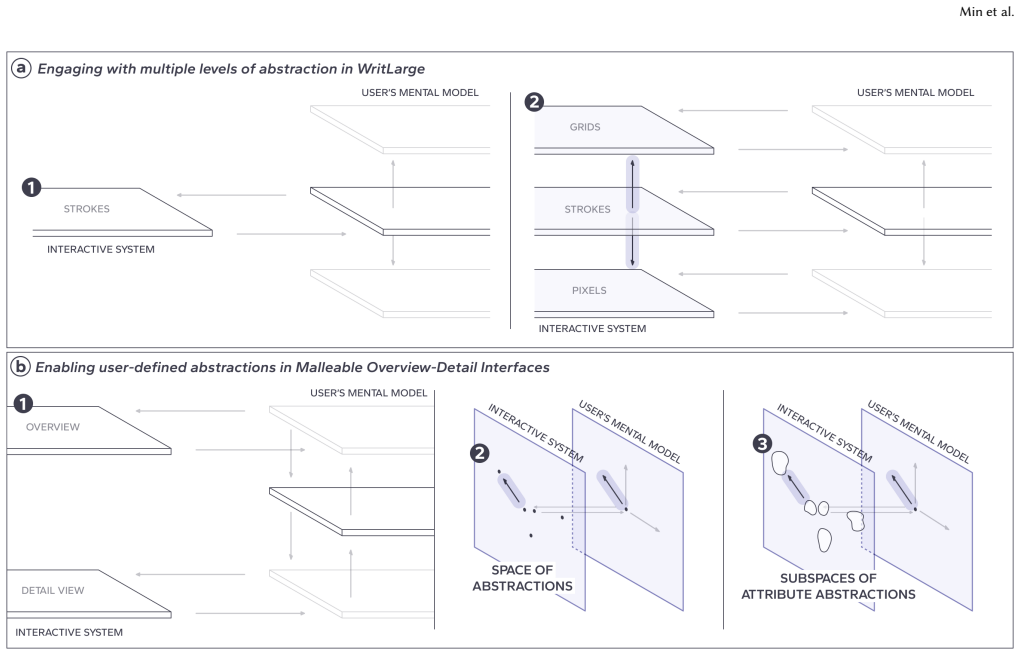
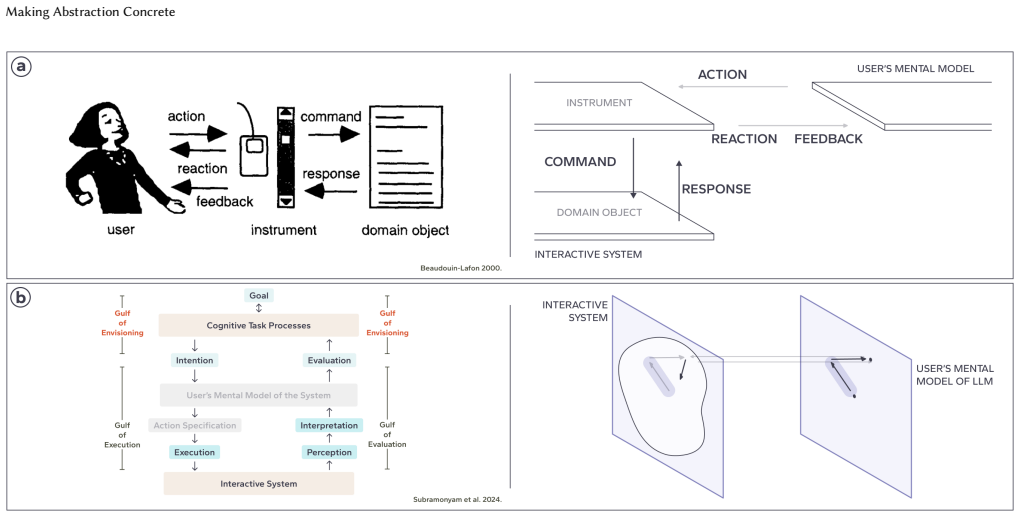
read the original abstract
The principle of abstraction guides the design of interactive systems, yet we lack a conceptual framework to understand how it shapes interaction design. Existing models, such as the gulfs of execution and evaluation, do not explicitly model abstractions in the system or in users' mental models, and therefore lack actionable guidance for designing abstractions. To investigate how abstractions are employed in interactive systems, we surveyed 457 papers and synthesized a design space of abstraction techniques along six dimensions. We use this design space to reframe the gulfs through a lens of abstraction, explicitly articulate the cognitive and design processes by which users and systems bridge and navigate the abstraction gap, and demonstrate how this model integrates existing perspectives and surfaces new opportunities for future systems.
Editorial analysis
A structured set of objections, weighed in public.
Referee Report
Summary. The paper claims that a survey of 457 papers on abstraction in interactive systems yields a six-dimensional design space of abstraction techniques; this space is then used to reframe the gulfs of execution and evaluation, to articulate the cognitive and design processes by which users and systems bridge abstraction gaps, and to integrate existing perspectives while identifying new research opportunities.
Significance. If the survey is methodologically sound and the six dimensions are shown to be both exhaustive and non-redundant, the work would supply a concrete, actionable framework that extends classic HCI models (e.g., Norman’s gulfs) with explicit treatment of abstraction. The scale of the review (457 papers) and the explicit linkage to design practice are strengths that could guide future system-building and empirical studies.
major comments (2)
- [Abstract and §3] Abstract and §3 (Survey and Synthesis): The central claim that the six-dimensional design space is derived from a survey of 457 papers is load-bearing, yet the manuscript provides no description of search strategy, databases, keywords, date range, inclusion/exclusion criteria, how abstraction instances were identified and coded, inter-coder reliability, or the inductive process that produced exactly six dimensions. Without these details the claim that the space is generalizable rather than illustrative cannot be evaluated.
- [§4] §4 (Reframing the Gulfs): The reframing of the gulfs of execution and evaluation is presented as a direct consequence of the six-dimensional space, but the mapping from specific dimensions to gulf-bridging mechanisms is described only at a high level; concrete examples from the surveyed corpus that demonstrate how each dimension alters gulf size or navigation are needed to substantiate the integration claim.
minor comments (2)
- [Figures and Tables] Figure 2 and Table 1: Ensure every dimension is illustrated with at least one concrete system example drawn from the 457-paper corpus and that the figure legend explicitly states the source papers.
- [Throughout] Throughout: Define each of the six dimensions operationally on first use so that readers can apply the space to new systems without ambiguity.
Simulated Author's Rebuttal
We thank the referee for their detailed and constructive comments. We address each major point below and commit to revisions that will strengthen the methodological transparency and empirical grounding of the work.
read point-by-point responses
-
Referee: [Abstract and §3] Abstract and §3 (Survey and Synthesis): The central claim that the six-dimensional design space is derived from a survey of 457 papers is load-bearing, yet the manuscript provides no description of search strategy, databases, keywords, date range, inclusion/exclusion criteria, how abstraction instances were identified and coded, inter-coder reliability, or the inductive process that produced exactly six dimensions. Without these details the claim that the space is generalizable rather than illustrative cannot be evaluated.
Authors: We agree that the absence of explicit methodological details in §3 limits the ability to assess the rigor and generalizability of the six-dimensional space. In the revised version we will insert a new subsection (3.1 Survey Methodology) that reports: the databases queried (ACM DL, IEEE Xplore, SpringerLink, Google Scholar), the Boolean search strings and keywords used, the date range, the inclusion/exclusion criteria applied to the initial 1,248 hits, the two-stage screening process, the coding scheme and unit of analysis for abstraction instances, inter-coder reliability (Cohen’s κ = 0.87 on a 10 % sample), and the inductive thematic analysis steps that converged on exactly six dimensions. These additions will allow readers to evaluate whether the design space is systematically derived from the corpus. revision: yes
-
Referee: [§4] §4 (Reframing the Gulfs): The reframing of the gulfs of execution and evaluation is presented as a direct consequence of the six-dimensional space, but the mapping from specific dimensions to gulf-bridging mechanisms is described only at a high level; concrete examples from the surveyed corpus that demonstrate how each dimension alters gulf size or navigation are needed to substantiate the integration claim.
Authors: We accept that the current §4 discussion remains largely conceptual. We will augment the section with a new table and accompanying prose that, for each of the six dimensions, cites two to three concrete papers from the 457-paper corpus and shows how the particular abstraction technique changes either the size of the gulf or the cognitive operations required to bridge it. These examples will be drawn directly from the coded instances and will make the claimed integration with Norman’s gulfs explicit and verifiable. revision: yes
Circularity Check
No circularity in literature survey and conceptual synthesis
full rationale
The paper's core contribution is an inductive synthesis of a six-dimensional design space drawn from a survey of 457 external papers, followed by reframing of existing concepts such as the gulfs of execution and evaluation. This process relies on independent literature rather than any self-referential equations, fitted parameters renamed as predictions, or load-bearing self-citations. No derivation step reduces by construction to the paper's own inputs; the model is presented as an organizational lens applied to prior work, which is standard and non-circular for HCI survey papers. The analysis remains self-contained against external benchmarks.
Axiom & Free-Parameter Ledger
axioms (1)
- domain assumption The principle of abstraction guides the design of interactive systems
Lean theorems connected to this paper
-
IndisputableMonolith/Foundation/RealityFromDistinction.leanreality_from_one_distinction unclearWe surveyed 457 papers and synthesized a design space of abstraction techniques along six dimensions... propose Abstraction Spaces... Gulf of Abstraction... undershoots and overshoots... space of abstractions
-
IndisputableMonolith/Cost/FunctionalEquation.leanwashburn_uniqueness_aczel unclearAbstraction Spaces adds... the Gulf of Abstraction... Abstraction Overshoots and Undershoots... The Space of Abstractions
Reference graph
Works this paper leans on
-
[1]
J. Abello and J. Korn. 2002. MGV: a system for visualizing massive multidigraphs. IEEE Transactions on Visualization and Computer Graphics8, 1 (2002), 21–38. doi:10.1109/2945.981849
-
[2]
James Abello, Frank van Ham, and Neeraj Krishnan. 2006. ASK-GraphView: A Large Scale Graph Visualization System.IEEE Transactions on Visualization and Computer Graphics12, 5 (Sept. 2006), 669–676. doi:10.1109/tvcg.2006.120
-
[3]
1977.A pattern language: towns, buildings, construction
Christopher Alexander. 1977.A pattern language: towns, buildings, construction. Oxford university press
work page 1977
-
[4]
Tyler Angert, Miroslav Suzara, Jenny Han, Christopher Pondoc, and Hariharan Subramonyam. 2023. Spellburst: A Node-based Interface for Exploratory Cre- ative Coding with Natural Language Prompts. InProceedings of the 36th Annual ACM Symposium on User Interface Software and Technology (UIST ’23). ACM, 1–22. doi:10.1145/3586183.3606719
-
[5]
Ian Arawjo, Anthony DeArmas, Michael Roberts, Shrutarshi Basu, and Tapan Parikh. 2022. Notational Programming for Notebook Environments: A Case Study with Quantum Circuits. InProceedings of the 35th Annual ACM Symposium on User Interface Software and Technology (UIST ’22). ACM, 1–20. doi:10.1145/ 3526113.3545619
-
[6]
Myers, Erik Andersen, and François Guimbretière
Ian Arawjo, Cheng-Yao Wang, Andrew C. Myers, Erik Andersen, and François Guimbretière. 2017. Teaching Programming with Gamified Semantics. InPro- ceedings of the 2017 CHI Conference on Human Factors in Computing Systems (CHI ’17). ACM, 4911–4923. doi:10.1145/3025453.3025711
-
[7]
Arendt, Nasheen Nur, Zhuanyi Huang, Gabriel Fair, and Wenwen Dou
Dustin L. Arendt, Nasheen Nur, Zhuanyi Huang, Gabriel Fair, and Wenwen Dou
-
[8]
InProceedings of the 25th International Conference on Intelligent User Interfaces (IUI ’20)
Parallel embeddings: a visualization technique for contrasting learned representations. InProceedings of the 25th International Conference on Intelligent User Interfaces (IUI ’20). ACM, 259–274. doi:10.1145/3377325.3377514
-
[9]
Kaufman, Wilmot Li, and Karan Singh
Rahul Arora, Rubaiat Habib Kazi, Danny M. Kaufman, Wilmot Li, and Karan Singh. 2019. MagicalHands: Mid-Air Hand Gestures for Animating in VR. In Proceedings of the 32nd Annual ACM Symposium on User Interface Software and Technology (UIST ’19). ACM, 463–477. doi:10.1145/3332165.3347942
-
[10]
Yannick Assogba, Irene Ros, Joan DiMicco, and Matt McKeon. 2011. Many bills: engaging citizens through visualizations of congressional legislation. In Proceedings of the SIGCHI Conference on Human Factors in Computing Systems (CHI ’11). ACM, 433–442. doi:10.1145/1978942.1979004
-
[11]
Jeronimo Barbosa, Marcelo M. Wanderley, and Stephane Huot. 2018. ZenStates: Easy-to-Understand Yet Expressive Specifications for Creative Interactive En- vironments. In2018 IEEE Symposium on Visual Languages and Human-Centric Computing (VL/HCC). IEEE, 167–175. doi:10.1109/vlhcc.2018.8506491
-
[12]
Michel Beaudouin-Lafon. 2000. Instrumental interaction: an interaction model for designing post-WIMP user interfaces. InProceedings of the SIGCHI Conference on Human Factors in Computing Systems(The Hague, The Netherlands)(CHI ’00). Association for Computing Machinery, New York, NY, USA, 446–453. doi:10. 1145/332040.332473 Making Abstraction Concrete
-
[13]
Michel Beaudouin-Lafon, Susanne Bødker, and Wendy E. Mackay. 2021. Genera- tive Theories of Interaction.ACM Transactions on Computer-Human Interaction 28, 6 (Nov. 2021), 1–54. doi:10.1145/3468505
-
[14]
Michel Beaudouin-Lafon and Wendy E. Mackay. 2000. Reification, polymor- phism and reuse: three principles for designing visual interfaces. InProceed- ings of the Working Conference on Advanced Visual Interfaces(Palermo, Italy) (A VI ’00). Association for Computing Machinery, New York, NY, USA, 102–109. doi:10.1145/345513.345267
-
[15]
Matthew T Beaudouin-Lafon, Jane L E, and Haijun Xia. 2023. Color Field: Developing Professional Vision by Visualizing the Effects of Color Filters. In Proceedings of the 36th Annual ACM Symposium on User Interface Software and Technology (UIST ’23). ACM, 1–16. doi:10.1145/3586183.3606828
-
[16]
Samuel Beck, Nina Doerr, Kuno Kurzhals, Alexander Riedlinger, Fabian Schmierer, Michael Sedlmair, and Steffen Koch. 2024. ChoreoVis: Planning and Assessing Formations in Dance Choreographies.Computer Graphics Forum 43, 3 (June 2024). doi:10.1111/cgf.15104
-
[17]
Benjamin B. Bederson and James D. Hollan. 1994. Pad++: a zooming graphical interface for exploring alternate interface physics. InProceedings of the 7th annual ACM symposium on User interface software and technology - UIST ’94 (UIST ’94). ACM Press, 17–26. doi:10.1145/192426.192435
-
[18]
A. Begel and S.L. Graham. [n. d.]. Spoken Programs. In2005 IEEE Symposium on Visual Languages and Human-Centric Computing (VL/HCC’05). IEEE, 99–106. doi:10.1109/vlhcc.2005.58
-
[19]
Richard A Bolt. 1980. “Put-that-there” Voice and gesture at the graphics interface. InProceedings of the 7th annual conference on Computer graphics and interactive techniques. 262–270
work page 1980
-
[20]
Oisin Boydell and Barry Smyth. 2007. From social bookmarking to social summarization: an experiment in community-based summary generation. In Proceedings of the 12th international conference on Intelligent user interfaces (IUI07). ACM, 42–51. doi:10.1145/1216295.1216311
-
[21]
Virginia Braun and Victoria Clarke. 2006. Using thematic anal- ysis in psychology.Qualitative Research in Psychology3, 2 (2006), 77–101. arXiv:https://doi.org/10.1191/1478088706qp063oa doi:10.1191/1478088706qp063oa
-
[22]
1966.Toward a Theory of Instruction
Jerome Seymour Bruner. 1966.Toward a Theory of Instruction. Harvard Paper- back Series, Vol. 59. Belknap Press of Harvard University Press, Cambridge, MA
work page 1966
-
[23]
1974.Toward a theory of instruction
Jerome Seymour Bruner. 1974.Toward a theory of instruction. Harvard university press
work page 1974
-
[24]
Sébastien Bubeck, Varun Chandrasekaran, Ronen Eldan, Johannes Gehrke, Eric Horvitz, Ece Kamar, Peter Lee, Yin Tat Lee, Yuanzhi Li, Scott Lundberg, et al
-
[25]
Sparks of Artificial General Intelligence: Early experiments with GPT-4
Sparks of artificial general intelligence: Early experiments with gpt-4. arXiv preprint arXiv:2303.12712(2023)
work page internal anchor Pith review Pith/arXiv arXiv 2023
-
[26]
E. Cakmak, H. Schäfer, J. Buchmüller, J. Fuchs, T. Schreck, A. Jordan, and D. Keim. 2020. MotionGlyphs: Visual Abstraction of Spatio-Temporal Networks in Collective Animal Behavior.Computer Graphics Forum39, 3 (June 2020), 63–75. doi:10.1111/cgf.13963
-
[27]
Tommaso Calò and Luigi De Russis. 2025. DeepFlow: A Flow-Based Visual Programming Tool for Deep Learning Development. InProceedings of the 30th International Conference on Intelligent User Interfaces (IUI ’25). ACM, 504–518. doi:10.1145/3708359.3712109
-
[28]
Yining Cao, Yiyi Huang, Anh Truong, Hijung Valentina Shin, and Haijun Xia
-
[29]
InProceedings of the 2025 CHI Conference on Human Factors in Computing Systems
Compositional Structures as Substrates for Human-AI Co-creation Envi- ronment: A Design Approach and A Case Study. InProceedings of the 2025 CHI Conference on Human Factors in Computing Systems. 1–25
work page 2025
-
[30]
Yining Cao, Peiling Jiang, and Haijun Xia. 2025. Generative and Malleable User Interfaces with Generative and Evolving Task-Driven Data Model. In Proceedings of the 2025 CHI Conference on Human Factors in Computing Systems (CHI ’25). ACM, 1–20. doi:10.1145/3706598.3713285
-
[31]
Luca Cardelli and Peter Wegner. 1985. On understanding types, data abstraction, and polymorphism.ACM Computing Surveys (CSUR)17, 4 (1985), 471–523
work page 1985
-
[32]
Matthew Chalmers, Robert Ingram, and Christoph Pfranger. 1996. Adding imageability features to information displays. InProceedings of the 9th annual ACM symposium on User interface software and technology - UIST ’96 (UIST ’96). ACM Press, 33–39. doi:10.1145/237091.237096
-
[33]
Zhang, Jonathan Bragg, Andrew Head, Kyle Lo, Doug Downey, and Daniel S
Joseph Chee Chang, Amy X. Zhang, Jonathan Bragg, Andrew Head, Kyle Lo, Doug Downey, and Daniel S. Weld. 2023. CiteSee: Augmenting Citations in Scientific Papers with Persistent and Personalized Historical Context. InPro- ceedings of the 2023 CHI Conference on Human Factors in Computing Systems (CHI ’23). ACM, 1–15. doi:10.1145/3544548.3580847
-
[34]
Haidong Chen, Wei Chen, Honghui Mei, Zhiqi Liu, Kun Zhou, Weifeng Chen, Wentao Gu, and Kwan-Liu Ma. 2014. Visual Abstraction and Exploration of Multi-class Scatterplots.IEEE Transactions on Visualization and Computer Graphics20, 12 (Dec. 2014), 1683–1692. doi:10.1109/tvcg.2014.2346594
-
[35]
Weihao Chen, Chun Yu, Huadong Wang, Zheng Wang, Lichen Yang, Yukun Wang, Weinan Shi, and Yuanchun Shi. 2023. From Gap to Synergy: Enhancing Contextual Understanding through Human-Machine Collaboration in Personal- ized Systems. InProceedings of the 36th Annual ACM Symposium on User Interface Software and Technology (UIST ’23). ACM, 1–15. doi:10.1145/35861...
-
[37]
Kai-Yin Cheng, Sheng-Jie Luo, Bing-Yu Chen, and Hao-Hua Chu. 2009. Smart- Player: user-centric video fast-forwarding. InProceedings of the SIGCHI Con- ference on Human Factors in Computing Systems (CHI ’09). ACM, 789–798. doi:10.1145/1518701.1518823
-
[38]
Fanny Chevalier, Pierre Dragicevic, Anastasia Bezerianos, and Jean-Daniel Fekete. 2010. Using text animated transitions to support navigation in docu- ment histories. InProceedings of the SIGCHI Conference on Human Factors in Computing Systems(Atlanta, Georgia, USA)(CHI ’10). Association for Comput- ing Machinery, New York, NY, USA, 683–692. doi:10.1145/1...
-
[39]
Fanny Chevalier, Pierre Dragicevic, and Christophe Hurter. 2012. Histomages: fully synchronized views for image editing. InProceedings of the 25th annual ACM symposium on User interface software and technology (UIST ’12). ACM, 281–286. doi:10.1145/2380116.2380152
-
[40]
Jiin Choi, Seung Won Lee, and Kyung Hoon Hyun. 2025. GenPara: Enhancing the 3D Design Editing Process by Inferring Users’ Regions of Interest with Text-Conditional Shape Parameters. InProceedings of the 2025 CHI Conference on Human Factors in Computing Systems (CHI ’25). ACM, 1–21. doi:10.1145/ 3706598.3713502
-
[41]
Bern Jordan, Jonathan Lazar, and Niklas Elmqvist
Pramod Chundury, Yasmin Reyazuddin, J. Bern Jordan, Jonathan Lazar, and Niklas Elmqvist. 2024. TactualPlot: Spatializing Data as Sound Using Sensory Substitution for Touchscreen Accessibility.IEEE Transactions on Visualization and Computer Graphics30, 1 (Jan. 2024), 836–846. doi:10.1109/tvcg.2023.3326937
-
[42]
Mackay, and Michel Beaudouin-Lafon
Marianela Ciolfi Felice, Nolwenn Maudet, Wendy E. Mackay, and Michel Beaudouin-Lafon. 2016. Beyond Snapping: Persistent, Tweakable Alignment and Distribution with StickyLines. InProceedings of the 29th Annual Sym- posium on User Interface Software and Technology (UIST ’16). ACM, 133–144. doi:10.1145/2984511.2984577
-
[43]
Andy Cockburn, Amy Karlson, and Benjamin B Bederson. 2009. A review of overview+ detail, zooming, and focus+ context interfaces.ACM Computing Surveys (CSUR)41, 1 (2009), 1–31
work page 2009
-
[44]
Adam Coscia, Langdon Holmes, Wesley Morris, Joon Suh Choi, Scott Crossley, and Alex Endert. 2024. iScore: Visual Analytics for Interpreting How Language Models Automatically Score Summaries. InProceedings of the 29th International Conference on Intelligent User Interfaces (IUI ’24). ACM, 787–802. doi:10.1145/ 3640543.3645142
-
[45]
Erick Cuenca, Arnaud Sallaberry, Florence Y. Wang, and Pascal Poncelet. 2018. MultiStream: A Multiresolution Streamgraph Approach to Explore Hierarchical Time Series.IEEE Transactions on Visualization and Computer Graphics24, 12 (Dec. 2018), 3160–3173. doi:10.1109/tvcg.2018.2796591
-
[46]
Eduard Gröller, and Stefan Bruckner
Alexandra Diehl, Rodrigo Pelorosso, Juan Ruiz, Renato Pajarola, M. Eduard Gröller, and Stefan Bruckner. 2021. Hornero: Thunderstorms Characterization using Visual Analytics.Computer Graphics Forum40, 3 (June 2021), 299–310. doi:10.1111/cgf.14308
-
[47]
Edsger W Dijkstra. 1972. The humble programmer.Commun. ACM15, 10 (1972), 859–866
work page 1972
-
[48]
N. Elmqvist, Y. Riche, N. Henry-Riche, and J.-D. Fekete. 2010. Mélange: Space Folding for Visual Exploration.IEEE Transactions on Visualization and Computer Graphics16, 3 (May 2010), 468–483. doi:10.1109/tvcg.2009.86
-
[49]
Douglas C Engelbart. 2023. Augmenting human intellect: A conceptual frame- work. InAugmented education in the global age. Routledge, 13–29
work page 2023
-
[50]
Emily R Fyfe and Mitchell J Nathan. 2019. Making “concreteness fading” more concrete as a theory of instruction for promoting transfer.Educational Review 71, 4 (2019), 403–422
work page 2019
-
[51]
Erich Gamma, Richard Helm, Ralph Johnson, John Vlissides, and Design Pat- terns. 1995. Elements of reusable object-oriented software.Design Patterns1 (1995), 417
work page 1995
-
[52]
Tong Ge, Bongshin Lee, and Yunhai Wang. 2021. CAST: Authoring Data-Driven Chart Animations. InProceedings of the 2021 CHI Conference on Human Factors in Computing Systems (CHI ’21). ACM, 1–15. doi:10.1145/3411764.3445452
-
[53]
InProceedings of the 2024 CHI Conference on Human Factors in Computing Systems
Katy Ilonka Gero, Chelse Swoopes, Ziwei Gu, Jonathan K. Kummerfeld, and Elena L. Glassman. 2024. Supporting Sensemaking of Large Language Model Outputs at Scale. InProceedings of the CHI Conference on Human Factors in Computing Systems (CHI ’24). ACM, 1–21. doi:10.1145/3613904.3642139
-
[54]
Camille Gobert and Michel Beaudouin-Lafon. 2022. i-LaTeX: Manipulating Transitional Representations between LaTeX Code and Generated Documents. InCHI Conference on Human Factors in Computing Systems (CHI ’22). ACM, 1–16. doi:10.1145/3491102.3517494
-
[55]
Eduard Groller, Ivan Viola, and Tobias Isenberg
Sarkis Halladjian, David Kouril, Haichao Miao, M. Eduard Groller, Ivan Viola, and Tobias Isenberg. 2022. Multiscale Unfolding: Illustratively Visualizing the Whole Genome at a Glance.IEEE Transactions on Visualization and Computer Graphics28, 10 (Oct. 2022), 3456–3470. doi:10.1109/tvcg.2021.3065443 Min et al
-
[56]
Eduard Groller, Ivan Viola, and Tobias Isenberg
Sarkis Halladjian, Haichao Miao, David Kouril, M. Eduard Groller, Ivan Viola, and Tobias Isenberg. 2020. Scale Trotter: Illustrative Visual Travels Across Negative Scales.IEEE Transactions on Visualization and Computer Graphics26, 1 (Jan. 2020), 654–664. doi:10.1109/tvcg.2019.2934334
-
[57]
Tracy Hammond and Randall Davis. 2010. Creating the perception-based LADDER sketch recognition language. InProceedings of the 8th ACM Conference on Designing Interactive Systems (DIS ’10). ACM, 141–150. doi:10.1145/1858171. 1858197
-
[58]
Björn Hartmann, Sean Follmer, Antonio Ricciardi, Timothy Cardenas, and Scott R. Klemmer. 2010. d.note: revising user interfaces through change tracking, annotations, and alternatives. InProceedings of the SIGCHI Conference on Human Factors in Computing Systems (CHI ’10). ACM, 493–502. doi:10.1145/1753326. 1753400
-
[59]
Jeremy Hartmann, Christian Holz, Eyal Ofek, and Andrew D. Wilson. 2019. RealityCheck: Blending Virtual Environments with Situated Physical Reality. In Proceedings of the 2019 CHI Conference on Human Factors in Computing Systems (CHI ’19). ACM, 1–12. doi:10.1145/3290605.3300577
-
[60]
Samuel Ichiyé Hayakawa. 1967. Language in Thought and Action.The Florida English Journal3, 2 (1967), 1–12
work page 1967
-
[61]
Devamardeep Hayatpur, Brian Hempel, Richard Lin, and Haijun Xia. 2025. The Shapes of Abstraction in Data Structure Diagrams. InProceedings of the 2025 CHI Conference on Human Factors in Computing Systems (CHI ’25). ACM, 1–12. doi:10.1145/3706598.3713723
-
[62]
Devamardeep Hayatpur, Daniel Wigdor, and Haijun Xia. 2023. CrossCode: Multi-level Visualization of Program Execution. InProceedings of the 2023 CHI Conference on Human Factors in Computing Systems (CHI ’23). ACM, 1–13. doi:10.1145/3544548.3581390
-
[63]
Michael A. Hedderich, Natalie N. Bazarova, Wenting Zou, Ryun Shim, Xinda Ma, and Qian Yang. 2024. A Piece of Theatre: Investigating How Teachers Design LLM Chatbots to Assist Adolescent Cyberbullying Education. InProceedings of the CHI Conference on Human Factors in Computing Systems (CHI ’24). ACM, 1–17. doi:10.1145/3613904.3642379
-
[64]
Jeffrey Heer, Maneesh Agrawala, and Wesley Willett. 2008. Generalized se- lection via interactive query relaxation. InProceedings of the SIGCHI Con- ference on Human Factors in Computing Systems (CHI ’08). ACM, 959–968. doi:10.1145/1357054.1357203
-
[65]
Florian Heimerl, Qi Han, Steffen Koch, and Thomas Ertl. 2016. CiteRivers: Visual Analytics of Citation Patterns.IEEE Transactions on Visualization and Computer Graphics22, 1 (Jan. 2016), 190–199. doi:10.1109/tvcg.2015.2467621
-
[66]
Brian Hempel and Ravi Chugh. 2016. Semi-Automated SVG Programming via Di- rect Manipulation. InProceedings of the 29th Annual Symposium on User Interface Software and Technology (UIST ’16). ACM, 379–390. doi:10.1145/2984511.2984575
-
[67]
Brian Hempel, Justin Lubin, and Ravi Chugh. 2019. Sketch-n-Sketch: Output- Directed Programming for SVG. InProceedings of the 32nd Annual ACM Sym- posium on User Interface Software and Technology (UIST ’19). ACM, 281–292. doi:10.1145/3332165.3347925
-
[68]
William C. Hill, James D. Hollan, Dave Wroblewski, and Tim McCandless. 1992. Edit wear and read wear. InProceedings of the SIGCHI Conference on Human Factors in Computing Systems(Monterey, California, USA)(CHI ’92). Association for Computing Machinery, New York, NY, USA, 3–9. doi:10.1145/142750.142751
-
[69]
Yanwei Huang, Yurun Yang, Xinhuan Shu, Ran Chen, Di Weng, and Yingcai Wu. 2024. Table Illustrator: Puzzle-based interactive authoring of plain tables. InProceedings of the CHI Conference on Human Factors in Computing Systems (CHI ’24). ACM, 1–18. doi:10.1145/3613904.3642415
-
[70]
Edwin L Hutchins, James D Hollan, and Donald A Norman. 1986. Direct manipulation interfaces. InUser centered system design. CRC Press, 87–124
work page 1986
-
[71]
Takeo Igarashi and Ken Hinckley. 2000. Speed-dependent automatic zooming for browsing large documents. InProceedings of the 13th annual ACM symposium on User interface software and technology - UIST ’00 (UIST ’00). ACM Press, 139–148. doi:10.1145/354401.354435
-
[72]
Jennifer Jacobs, Joel Brandt, Radomír Mech, and Mitchel Resnick. 2018. Ex- tending Manual Drawing Practices with Artist-Centric Programming Tools. In Proceedings of the 2018 CHI Conference on Human Factors in Computing Systems (CHI ’18). ACM, 1–13. doi:10.1145/3173574.3174164
-
[73]
Jennifer Jacobs, Sumit Gogia, Radomír M ˘ech, and Joel R. Brandt. 2017. Sup- porting Expressive Procedural Art Creation through Direct Manipulation. In Proceedings of the 2017 CHI Conference on Human Factors in Computing Systems (CHI ’17). ACM, 6330–6341. doi:10.1145/3025453.3025927
-
[74]
Yoshee Jain, Mehmet Arif Demirtas, and Kathryn Irene Cunningham. 2025. PLAID: Supporting Computing Instructors to Identify Domain-Specific Pro- gramming Plans at Scale. InProceedings of the 2025 CHI Conference on Hu- man Factors in Computing Systems (CHI ’25). ACM, 1–21. doi:10.1145/3706598. 3713832
-
[75]
Peiling Jiang, Li Feng, Fuling Sun, Parakrant Sarkar, Haijun Xia, and Can Liu
-
[76]
Proceedings of the ACM on Human-Computer Interaction7, ISS (Oct
1D-Touch: NLP-Assisted Coarse Text Selection via a Semi-Direct Gesture. Proceedings of the ACM on Human-Computer Interaction7, ISS (Oct. 2023), 463–482. doi:10.1145/3626483
-
[77]
Peiling Jiang, Jude Rayan, Steven P. Dow, and Haijun Xia. 2023. Graphologue: Exploring Large Language Model Responses with Interactive Diagrams. In Proceedings of the 36th Annual ACM Symposium on User Interface Software and Technology (UIST ’23). ACM, 1–20. doi:10.1145/3586183.3606737
-
[78]
Vaiva Kalnikaite, Abigail Sellen, Steve Whittaker, and David Kirk. 2010. Now let me see where i was: understanding how lifelogs mediate memory. InProceedings of the SIGCHI Conference on Human Factors in Computing Systems (CHI ’10). ACM, 2045–2054. doi:10.1145/1753326.1753638
-
[79]
Hong, Nikolas Martelaro, and Aniket Kittur
Hyeonsu B Kang, David Chuan-En Lin, Yan-Ying Chen, Matthew K. Hong, Nikolas Martelaro, and Aniket Kittur. 2025. BioSpark: Beyond Analogi- cal Inspiration to LLM-augmented Transfer. InProceedings of the 2025 CHI Conference on Human Factors in Computing Systems (CHI ’25). ACM, 1–29. doi:10.1145/3706598.3714053
-
[80]
Hyeonsu B Kang, Tongshuang Wu, Joseph Chee Chang, and Aniket Kittur. 2023. Synergi: A Mixed-Initiative System for Scholarly Synthesis and Sensemaking. InProceedings of the 36th Annual ACM Symposium on User Interface Software and Technology (UIST ’23). ACM, 1–19. doi:10.1145/3586183.3606759
-
[81]
Daphna Kaplan, Mirela Ben Chen, and Yoav Sterman. 2025. ConTextural: A Toolpath-Based Texture Editing Tool for Extrusion 3D Printers. InProceedings of the 2025 CHI Conference on Human Factors in Computing Systems (CHI ’25). ACM, 1–16. doi:10.1145/3706598.3713753
discussion (0)
Sign in with ORCID, Apple, or X to comment. Anyone can read and Pith papers without signing in.