Recognition: 2 theorem links
· Lean TheoremTransonic accretion and the analogue gravity in multi-component elliptical galaxies hosting pseudo-Schwarzschild black holes
Pith reviewed 2026-05-13 02:20 UTC · model grok-4.3
The pith
The galactic potential in elliptical galaxies strongly affects critical points, shock locations, and acoustic surface gravity in transonic accretion flows for all tested pseudo-Schwarzschild black hole potentials.
A machine-rendered reading of the paper's core claim, the machinery that carries it, and where it could break.
Core claim
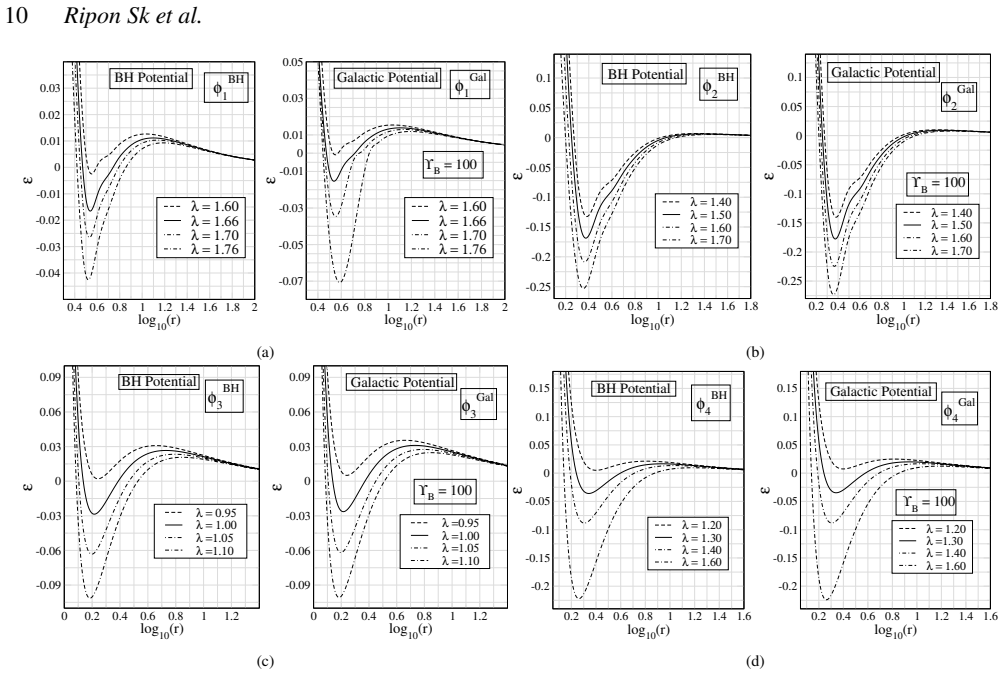
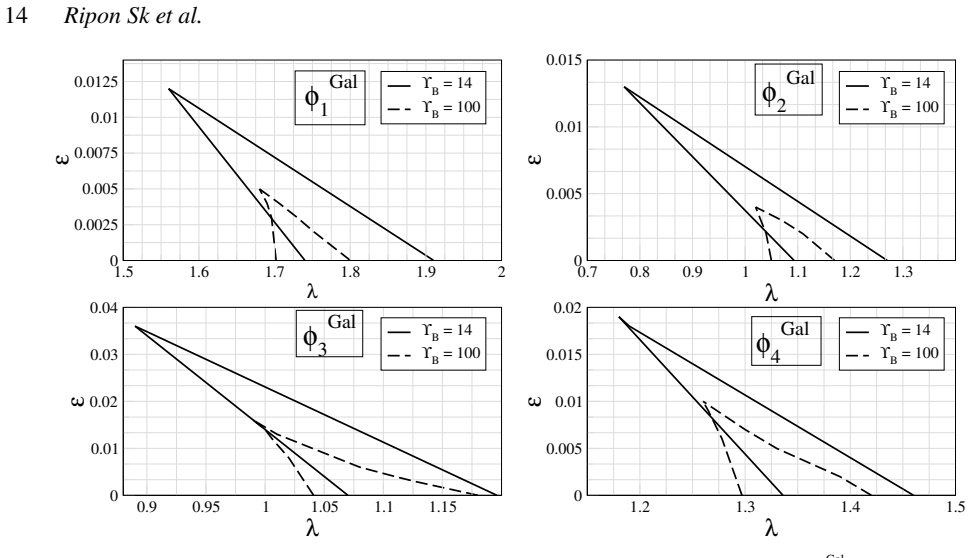
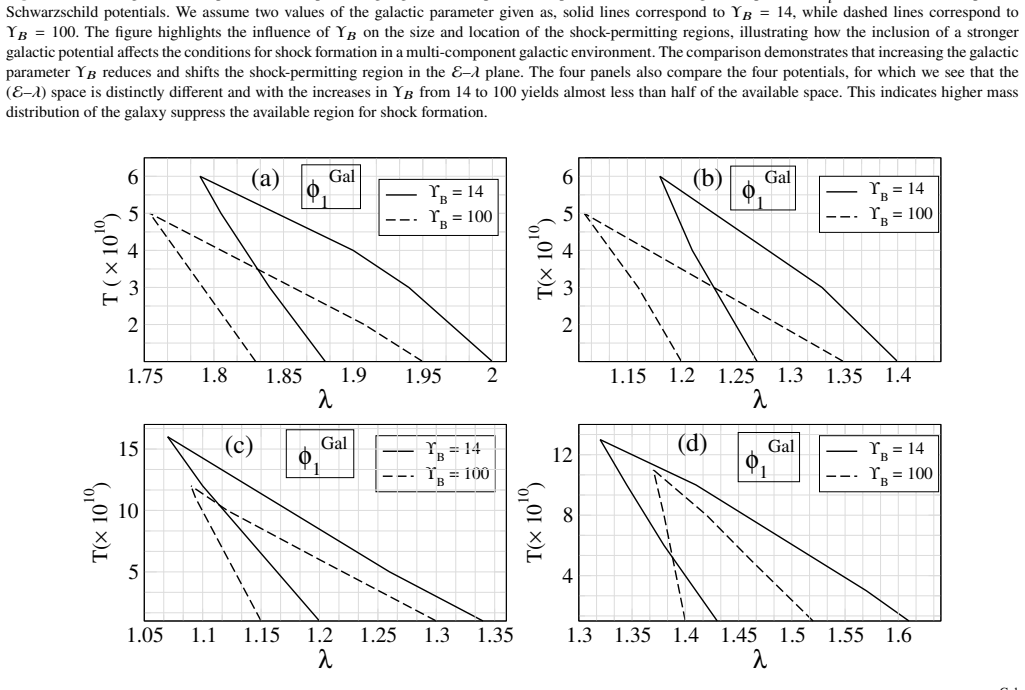
Through the analysis of transonic behaviour and eigenvalue-based critical point classification in the vertical equilibrium geometry, the work demonstrates that for all selected black hole potentials, the multi-component galactic potential profoundly influences the locations of critical points, the shock-allowed parameter space, shock-location, shock-driven flow variables, and acoustic surface gravity.
What carries the argument
The vertical equilibrium disc model with a static multi-component galactic potential (stellar, dark matter, hot gas) and various pseudo-Schwarzschild black hole potentials.
Load-bearing premise
The vertical equilibrium disc model combined with pseudo-Schwarzschild potentials and a static multi-component galactic potential sufficiently captures the essential dynamics of real, low-angular-momentum accretion flows.
What would settle it
Comparing the predicted shock locations and critical point positions from this model against results from three-dimensional general relativistic hydrodynamic simulations of accretion in a multi-component galactic potential.
Figures




read the original abstract
Low-angular-momentum, axisymmetric, inviscid accretion flows onto a black hole have been studied using the vertical equilibrium disc model, considering multiple pseudo-Schwarzschild potentials and two thermodynamic equations of state. A multi-component galactic potential-representing stellar, dark matter, and hot-gas contributions-is incorporated to assess environmental effects on the accretion dynamics. In our earlier work, it is found that the effect of multi-component galactic potential on the accretion flow onto a rotating black hole under similar framework of analysis, significantly varies over different standard disc models, being most pronounced in the vertical equilibrium (VE) disc model. Thus it may be interesting to find whether such variation occur for different choices of pseudo potentials too. To begin with, in this work we consider accretion flow onto a non-rotating blackhole with VE geometry. Through the analysis of transonic behaviour and eigenvalue-based critical point classification, we demonstrate that, for all selected black hole potentials, the galactic potential profoundly influences the locations of critical points, the shock-allowed parameter space, shock-location, shock-driven flow variables, and acoustic surface gravity.
Editorial analysis
A structured set of objections, weighed in public.
Referee Report
Summary. The manuscript studies low-angular-momentum, axisymmetric, inviscid accretion onto non-rotating black holes in the vertical-equilibrium disc model. It employs several pseudo-Schwarzschild potentials and two equations of state, augments the effective potential with a static multi-component galactic term (stellar + dark matter + hot gas), and analyzes transonic critical points via eigenvalue classification, shock existence, post-shock variables, and acoustic surface gravity. The central claim is that the galactic potential profoundly modifies all of these quantities for every black-hole potential examined.
Significance. If the numerical results are robust, the work supplies a controlled demonstration that galactic-scale potentials cannot be neglected in models of low-angular-momentum accretion in elliptical galaxies. By repeating the analysis across multiple pseudo-potentials and both polytropic and isothermal closures, the authors provide an internal consistency check that the reported shifts are not artifacts of a single choice. The extension from the authors’ earlier rotating-BH study to the non-rotating VE case is a natural and useful increment.
major comments (1)
- [Abstract] Abstract and §3 (or equivalent results section): the repeated assertion that the galactic potential “profoundly influences” critical-point locations, shock parameter space, shock location, and acoustic surface gravity for “all selected black hole potentials” is the load-bearing claim, yet the abstract supplies no numerical measure of the shift (e.g., fractional change in r_c or r_sh) relative to the no-galactic-potential baseline. Without such quantification or a table comparing the two cases, the strength of the influence remains unverified.
minor comments (2)
- The title advertises “analogue gravity” but the abstract only mentions acoustic surface gravity in passing; a brief sentence linking the computed surface gravity to analogue-horizon properties would clarify the connection.
- Notation for the multi-component galactic potential (stellar, DM, hot-gas terms) should be defined once in the text and used consistently; the abstract introduces the components but does not label them.
Simulated Author's Rebuttal
We thank the referee for the positive assessment of the work and the recommendation for minor revision. We address the single major comment below.
read point-by-point responses
-
Referee: [Abstract] Abstract and §3 (or equivalent results section): the repeated assertion that the galactic potential “profoundly influences” critical-point locations, shock parameter space, shock location, and acoustic surface gravity for “all selected black hole potentials” is the load-bearing claim, yet the abstract supplies no numerical measure of the shift (e.g., fractional change in r_c or r_sh) relative to the no-galactic-potential baseline. Without such quantification or a table comparing the two cases, the strength of the influence remains unverified.
Authors: We agree that explicit numerical quantification strengthens the central claim. The manuscript already contains figures (e.g., Figs. 1–4) that illustrate the shifts in critical-point locations, shock positions, and acoustic surface gravity when the multi-component galactic potential is included versus the baseline case for each pseudo-Schwarzschild potential and both equations of state. However, we acknowledge that a direct side-by-side numerical comparison is not tabulated and that the abstract lacks specific fractional changes. In the revised manuscript we will (i) insert a compact comparison table in §3 listing r_c, r_sh, post-shock variables, and acoustic surface gravity with and without the galactic term for representative parameter values, and (ii) add one or two quantitative statements (e.g., “shifts of 15–40 % in r_c and up to 60 % in r_sh”) to the abstract. These additions will make the magnitude of the influence immediately verifiable while preserving the existing visual and analytical results. revision: yes
Circularity Check
No significant circularity; results from independent numerical solutions
full rationale
The paper's derivation proceeds via standard transonic flow equations in the vertical-equilibrium framework, constructing an effective potential that adds the multi-component galactic term to established pseudo-Schwarzschild potentials, then solving for critical-point locations, eigenvalue classification, shock parameter space, and acoustic surface gravity through direct numerical integration. The sole self-reference to prior rotating-BH work is confined to the introduction as motivation for selecting the VE geometry; it supplies no fitted parameters, no uniqueness theorem, and no load-bearing input that the current non-rotating calculations reduce to. All reported influences are therefore new outputs of the augmented equations rather than algebraic or statistical re-statements of earlier results.
Axiom & Free-Parameter Ledger
axioms (3)
- domain assumption Vertical equilibrium holds for the disc geometry throughout the flow.
- domain assumption Pseudo-Schwarzschild potentials provide an adequate approximation to the spacetime geometry near a non-rotating black hole.
- domain assumption The multi-component galactic potential can be treated as static and spherically symmetric.
Lean theorems connected to this paper
-
IndisputableMonolith/Cost/FunctionalEquation.leanwashburn_uniqueness_aczel unclearWe adopt the vertical equilibrium disc model... Φ_Gal_i(r) = Φ_BH_i(r) + Φ_star(r) + Φ_gas(r) + Φ_DM(r)... critical point conditions... Ω² = QR − PS... acoustic surface gravity κ
-
IndisputableMonolith/Foundation/RealityFromDistinction.leanreality_from_one_distinction uncleareigenvalue-based critical point classification... saddle-center bifurcations
Reference graph
Works this paper leans on
-
[1]
Hot Gas in and around Elliptical Galaxies. , keywords =. doi:10.1146/annurev.astro.41.090401.094542 , archivePrefix =. astro-ph/0309553 , primaryClass =
-
[2]
Powerful AGN jets and unbalanced cooling in the hot atmosphere of IC 4296. , keywords =. doi:10.1093/mnras/stz1728 , archivePrefix =. 1903.03198 , primaryClass =
-
[3]
, year = 1952, month = jan, volume =
On spherically symmetrical accretion. , year = 1952, month = jan, volume =. doi:10.1093/mnras/112.2.195 , adsurl =
-
[4]
Accretion Power in Astrophysics: Third Edition
-
[5]
Low-radiative-efficiency accretion in the nuclei of elliptical galaxies. , keywords =. doi:10.1046/j.1365-8711.2000.03134.x , archivePrefix =. astro-ph/9905053 , primaryClass =
-
[6]
Rotation-induced bistability of transonic accretion onto a black hole. , keywords =. doi:10.1086/158924 , adsurl =
- [7]
-
[9]
Standing Rankine-Hugoniot shocks in accretion and wind flows in Kerr geometry. , keywords =
-
[12]
Properties of spherical galaxies and clusters with an NFW density profile. , keywords =. doi:10.1046/j.1365-8711.2001.04007.x , archivePrefix =. astro-ph/0002395 , primaryClass =
-
[14]
Spherical steady accretion flows: Dependence on the cosmological constant, exact isothermal solutions, and applications to cosmology. , keywords =. doi:10.1103/PhysRevD.88.084056 , archivePrefix =. 1309.1252 , primaryClass =
-
[15]
Bondi accretion onto cosmological black holes. , keywords =. doi:10.1103/PhysRevD.87.044007 , archivePrefix =. 1211.3618 , primaryClass =
-
[20]
Black holes in binary systems. Observational appearance. , year = 1973, month = jan, volume =
work page 1973
-
[21]
, year = 1972, month = oct, volume =
Accretion Disc Models for Compact X-Ray Sources. , year = 1972, month = oct, volume =
work page 1972
-
[24]
The Cooling Flow to Accretion Flow Transition. , keywords =. doi:10.1086/308171 , archivePrefix =. astro-ph/9908199 , primaryClass =
-
[25]
General relativistic polytropes with a repulsive cosmological constant. , keywords =. doi:10.1103/PhysRevD.94.103513 , archivePrefix =. 1611.05327 , primaryClass =
-
[26]
Spectral Properties of NGC 4151 and the Estimation of Black Hole Mass Using TCAF Solution. , keywords =. doi:10.3847/1538-4357/ab1d62 , archivePrefix =. 1905.02147 , primaryClass =
-
[27]
Monthly Notices of the Royal Astronomical Society , volume =
Nandi, Prantik and Chatterjee, Arka and Chakrabarti, Sandip K and Dutta, Broja G , title = ". Monthly Notices of the Royal Astronomical Society , volume =. 2021 , month =. doi:10.1093/mnras/stab1699 , url =
-
[28]
Changing Accretion Geometry of Seyfert 1 Mrk 335 with NuSTAR: A Comparative Study. Galaxies , keywords =. doi:10.3390/galaxies9020021 , archivePrefix =. 2103.16793 , primaryClass =
-
[29]
Variable mass accretion and failed wind explain changing-look phenomena in NGC 1365. , keywords =. doi:10.1051/0004-6361/202243084 , archivePrefix =. 2204.02133 , primaryClass =
-
[30]
Journal of Astrophysics and Astronomy , keywords =
Study of accretion flows around an ultraluminous X-ray source M82 X-1 using NuSTAR data. Journal of Astrophysics and Astronomy , keywords =. doi:10.1007/s12036-022-09881-0 , archivePrefix =. 2208.05634 , primaryClass =
-
[31]
and Das, Santabrata and Maity, Debaprasad and Nandi, Anuj
Dihingia, I. and Das, Santabrata and Maity, Debaprasad and Nandi, Anuj. Shocks in relativistic viscous accretion flows around Kerr black holes. Mon. Not. Roy. Astron. Soc. 2019. doi:10.1093/mnras/stz1933. arXiv:1903.02856
- [43]
-
[44]
Atlas de Galaxias Australes
-
[45]
, year = 1953, month = jan, volume =
On the distribution of mass and luminosity in elliptical galaxies. , year = 1953, month = jan, volume =. doi:10.1093/mnras/113.2.134 , adsurl =
-
[46]
1990, ApJ, 356, 359, doi: 10.1086/168845
An Analytical Model for Spherical Galaxies and Bulges. , keywords =. doi:10.1086/168845 , adsurl =
-
[47]
Simulations of X-ray clusters. , keywords =. doi:10.1093/mnras/275.3.720 , archivePrefix =. astro-ph/9408069 , primaryClass =
-
[48]
The Structure of Cold Dark Matter Halos. , keywords =. doi:10.1086/177173 , archivePrefix =. astro-ph/9508025 , primaryClass =
-
[52]
The polytropic approximation and X-ray scaling relations: constraints on gas and dark matter profiles for galaxy groups and clusters. , keywords =. doi:10.1111/j.1365-2966.2012.20648.x , archivePrefix =. 1111.5573 , primaryClass =
-
[54]
Observational Evidence from Supernovae for an Accelerating Universe and a Cosmological Constant
Riess, Adam G. and Filippenko, Alexei V. and Challis, Peter and Clocchiatti, Alejandro and Diercks, Alan and Garnavich, Peter M. and Gilliland, Ron L. and Hogan, Craig J. and Jha, Saurabh and Kirshner, Robert P. and Leibundgut, B. and Phillips, M. M. and Reiss, David and Schmidt, Brian P. and Schommer, Robert A. and Smith, R. Chris and Spyromilio, J. and ...
work page internal anchor Pith review doi:10.1086/300499 1998
-
[55]
Measurements of and from 42 High-Redshift Supernovae. , keywords =. doi:10.1086/307221 , archivePrefix =. astro-ph/9812133 , primaryClass =
work page internal anchor Pith review Pith/arXiv arXiv doi:10.1086/307221
-
[56]
Seven-Year Wilkinson Microwave Anisotropy Probe (WMAP) Observations: Cosmological Interpretation
Seven-year Wilkinson Microwave Anisotropy Probe (WMAP) Observations: Cosmological Interpretation. , keywords =. doi:10.1088/0067-0049/192/2/18 , archivePrefix =. 1001.4538 , primaryClass =
-
[57]
Classical and Quantum Gravity , abstract =
Stuchlík, Zdeněk and Slaný, Petr and Kovář, Jiří , title =. Classical and Quantum Gravity , abstract =. 2009 , month =. doi:10.1088/0264-9381/26/21/215013 , url =
-
[58]
Journal of Cosmology and Astroparticle Physics , abstract =
Zdeněk Stuchlík and Jan Schee , title =. Journal of Cosmology and Astroparticle Physics , abstract =. 2011 , month =. doi:10.1088/1475-7516/2011/09/018 , url =
-
[59]
Transonic disk accretion onto black holes. , keywords =. doi:10.1086/158231 , adsurl =
- [60]
-
[61]
Constraints for Transonic Black Hole Accretion. , keywords =. doi:10.1086/167012 , adsurl =
-
[65]
Large-Scale Properties in Turbulent Spherically Symmetric Accretion. , keywords =. doi:10.1086/430197 , archivePrefix =. astro-ph/0309259 , primaryClass =
-
[72]
Numerical Simulations of Rotating Accretion Flows near a Black Hole. Computational Astrophysics; 12th Kingston Meeting on Theoretical Astrophysics , year = 1997, editor =. doi:10.48550/arXiv.astro-ph/9702054 , archivePrefix =. astro-ph/9702054 , primaryClass =
work page internal anchor Pith review doi:10.48550/arxiv.astro-ph/9702054 1997
-
[77]
Standing shocks in magnetized advection accretion flows onto a rotating black hole. , keywords =. doi:10.1093/mnras/sty2071 , archivePrefix =. 1807.11417 , primaryClass =
-
[83]
Numerical Simulations of Standing Shocks in Accretion Flows around Black Holes: A Comparative Study. , keywords =. doi:10.1086/177877 , archivePrefix =. astro-ph/9605116 , primaryClass =
- [85]
-
[86]
General Relativity and the Pseudo-Newtonian Potential. , keywords =. doi:10.1093/pasj/56.4.681 , adsurl =
-
[89]
Non-axisymmetric instabilities in shocked accretion flows with differential rotation. , keywords =. doi:10.1051/0004-6361:20031080 , archivePrefix =. astro-ph/0307047 , primaryClass =
-
[90]
doi:10.1111/j.1365-2966.2005.09360.x , eprint =
Non-axisymmetric instabilities in shocked adiabatic accretion flows. , keywords =. doi:10.1111/j.1365-2966.2005.09750.x , archivePrefix =. astro-ph/0511211 , primaryClass =
-
[91]
Chinese Physics Letters , year = 2004, month = dec, volume =
Standing Rankine Hugoniot Shocks in Black Hole Accretion Discs. Chinese Physics Letters , year = 2004, month = dec, volume =. doi:10.1088/0256-307X/21/12/064 , adsurl =
-
[92]
Transonic accretion flow in a thin disk around a black hole. III - Analytic considerations. , keywords =
-
[93]
Transonic accretion flow in a thin disk around a black hole. II. , keywords =
-
[94]
Das, and Sankhasubhra Nag , title =
Neven Bilić, Arpita Choudhury, Tapas K. Das, and Sankhasubhra Nag , title =. Classical and Quantum Gravity , volume =
-
[95]
General Relativistic Hydrodynamic Simulations and Linear Analysis of the Standing Accretion Shock Instability around a Black Hole. , keywords =. doi:10.1086/590325 , archivePrefix =. 0808.4141 , primaryClass =
-
[96]
The Standing Accretion Shock Instability in the Disk Around the Kerr Black Hole. , keywords =. doi:10.1088/0004-637X/696/2/2026 , archivePrefix =. 0901.4053 , primaryClass =
- [97]
-
[98]
Vertical Equilibrium Model for Accretion Flow: An Exact General Relativistic Self-consistent Analysis. , keywords =. doi:10.3847/1538-4357/ac9f15 , adsurl =
-
[99]
International Journal of Modern Physics D , keywords =
Influence of the geometric configuration of accretion flow on the black hole spin dependence of relativistic acoustic geometry. International Journal of Modern Physics D , keywords =. doi:10.1142/S0218271818500232 , archivePrefix =. 1705.00173 , primaryClass =
-
[101]
Journal of Physics B Atomic Molecular Physics , keywords =
The theory of Hawking radiation in laboratory analogues. Journal of Physics B Atomic Molecular Physics , keywords =. doi:10.1088/0953-4075/45/16/163001 , archivePrefix =. 1508.02569 , primaryClass =
-
[102]
New Journal of Physics , year = 2012, month = may, volume =
Analytical theory of Hawking radiation in dispersive media. New Journal of Physics , year = 2012, month = may, volume =. doi:10.1088/1367-2630/14/5/053003 , adsurl =
-
[103]
Living Reviews in Relativity , keywords =
Analogue Gravity. Living Reviews in Relativity , keywords =. doi:10.12942/lrr-2005-12 , archivePrefix =. gr-qc/0505065 , primaryClass =
-
[104]
Stability of stationary, spherical accretion onto a Schwarzschild black hole. , keywords =. doi:10.1086/157707 , adsurl =
- [106]
-
[108]
Dynamics of particles around a pseudo-Newtonian Kerr black hole with halos , publisher =. 2012 , journal =
work page 2012
-
[111]
Annales d'Astrophysique , year = 1948, month = jan, volume =
Recherches sur les Nebuleuses Extragalactiques. Annales d'Astrophysique , year = 1948, month = jan, volume =
work page 1948
-
[112]
The fundamental plane of early-type galaxies: non-homology of the spatial structure. , keywords =
-
[116]
Hot Coronae around Early-Type Galaxies. , keywords =. doi:10.1086/163218 , adsurl =
- [117]
-
[119]
Detectability of gas-rich E/IMRI's in LISA band: observable signature of transonic accretion flow. , keywords =. doi:10.1093/mnras/stad3132 , archivePrefix =. 2307.12144 , primaryClass =
-
[126]
An introduction to the study of stellar structure
-
[127]
Jordan, D. W. and Smith, P. , title =. 1999 , publisher =
work page 1999
- [128]
-
[139]
Contraction of Dark Matter Galactic Halos Due to Baryonic Infall. , keywords =. doi:10.1086/163867 , adsurl =
-
[140]
Dark Matter Annihilation at the Galactic Center. , keywords =. doi:10.1103/PhysRevLett.83.1719 , archivePrefix =. astro-ph/9906391 , primaryClass =
-
[141]
Dark-matter distributions around massive black holes: A general relativistic analysis , author =. Phys. Rev. D , volume =. 2013 , month =. doi:10.1103/PhysRevD.88.063522 , url =
-
[142]
Analytical properties of Einasto dark matter haloes. , keywords =. doi:10.1051/0004-6361/201118543 , archivePrefix =. 1202.5242 , primaryClass =
-
[143]
, year = 1997, month = dec, volume = 490, pages =
A Universal Density Profile from Hierarchical Clustering. , keywords =. doi:10.1086/304888 , archivePrefix =. astro-ph/9611107 , primaryClass =
-
[144]
Afshordi N., Paczy \'n ski B., 2003, @doi [ ] 10.1086/375559 , https://ui.adsabs.harvard.edu/abs/2003ApJ...592..354A 592, 354
-
[145]
Artemova I. V., Bjoernsson G., Novikov I. D., 1996, @doi [ ] 10.1086/177084 , https://ui.adsabs.harvard.edu/abs/1996ApJ...461..565A 461, 565
-
[146]
Becker P. A., Kazanas D., 2001, @doi [ ] 10.1086/318257 , https://ui.adsabs.harvard.edu/abs/2001ApJ...546..429B 546, 429
-
[147]
Bhattacharjee J. K., Bhattacharya A., Das T. K., Ray A. K., 2009, @doi [ ] 10.1111/j.1365-2966.2009.14977.x , https://ui.adsabs.harvard.edu/abs/2009MNRAS.398..841B 398, 841
-
[148]
Bili \'c N., Choudhary A., Das T. K., Nag S., 2014, @doi [Classical and Quantum Gravity] 10.1088/0264-9381/31/3/035002 , https://ui.adsabs.harvard.edu/abs/2014CQGra..31c5002B 31, 035002
-
[149]
Bohr T., Dimon P., Putkaradze V., 1993, @doi [Journal of Fluid Mechanics] 10.1017/S0022112093002289 , https://ui.adsabs.harvard.edu/abs/1993JFM...254..635B 254, 635
-
[150]
Brown B. A., Bregman J. N., 2001, @doi [ ] 10.1086/318353 , https://ui.adsabs.harvard.edu/abs/2001ApJ...547..154B 547, 154
-
[151]
2010, MNRAS, 408, 2115, doi: 10.1111/j.1365-2966.2010.17291.x
Capelo P. R., Natarajan P., Coppi P. S., 2010, @doi [ ] 10.1111/j.1365-2966.2010.16962.x , https://ui.adsabs.harvard.edu/abs/2010MNRAS.407.1148C 407, 1148
discussion (0)
Sign in with ORCID, Apple, or X to comment. Anyone can read and Pith papers without signing in.