Recognition: 2 theorem links
· Lean TheoremTuniQ: Autotuning Compilation Passes for Quantum Workloads at Scale for Effectiveness and Efficiency
Pith reviewed 2026-05-13 02:43 UTC · model grok-4.3
The pith
TuniQ uses reinforcement learning to dynamically select quantum compilation passes according to the circuit, backend, and noise profile.
A machine-rendered reading of the paper's core claim, the machinery that carries it, and where it could break.
Core claim
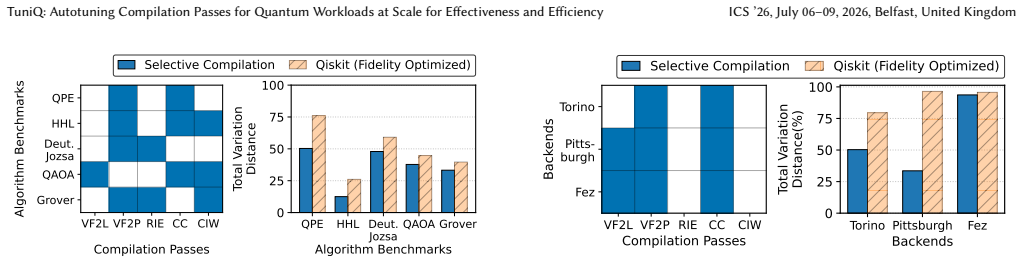
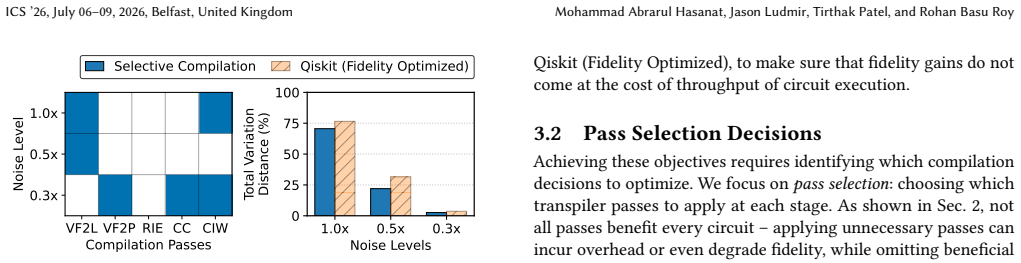
TuniQ trains a reinforcement learning agent to pick the sequence of compilation passes that best matches the current circuit, target backend, and observed noise. It uses a dual-encoder to represent both the circuit and the hardware state at each stage, shaped rewards to assign credit across the multi-stage pipeline, and dynamic action masking to restrict choices to valid passes only. On diverse workloads run on IBM Quantum Cloud processors, the resulting circuits exhibit higher fidelity than those produced by the standard Qiskit transpiler, require less compilation time, maintain the improvement when moved to new backends, and show widening gains on circuits approaching utility scale.
What carries the argument
The reinforcement learning policy that selects compilation passes at each pipeline stage, supported by a dual-encoder for joint circuit-and-hardware representation, shaped rewards for cross-stage credit, and dynamic action masking to enforce valid actions.
If this is right
- Quantum circuits achieve higher output fidelity on real hardware without manual pass tuning.
- Compilation finishes faster, allowing more rapid development cycles for quantum programs.
- The performance edge increases as circuit size grows toward utility scale.
- The same trained policy works on different quantum processors without retraining.
Where Pith is reading between the lines
- The same adaptive selection idea could be applied to other quantum compilers that currently rely on fixed pass orders.
- In hybrid HPC systems the reduced compilation overhead would free more processor time for actual quantum execution.
- The dual-encoder and shaped-reward design might transfer to classical compiler autotuning where hardware characteristics also vary.
- Periodic retraining on fresh calibration data would be a practical safeguard if hardware noise drifts.
Load-bearing premise
That the policy trained on the evaluated circuits, backends, and noise conditions will continue to deliver higher fidelity and lower compilation time on new circuits and on hardware whose noise profile changes over time.
What would settle it
Measure fidelity and compilation time on a fresh set of circuits run on a backend not seen during training; if the TuniQ circuits show no fidelity gain or no time reduction relative to the fixed Qiskit sequence, the central claim does not hold.
Figures





read the original abstract
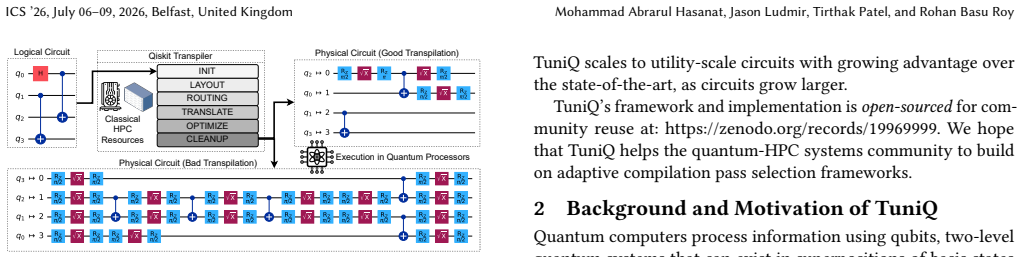
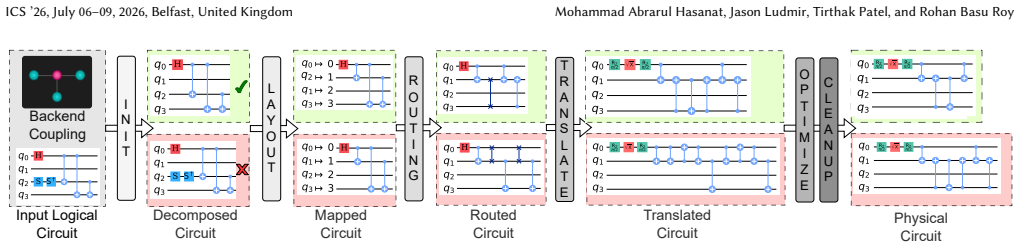
Quantum processors are being integrated into HPC ecosystems as co-processors, where compilation of quantum circuits into hardware-executable form determines both output fidelity and runtime. Current compilers use a fixed pass sequence and ignore the fact that optimal pass selection varies with circuit, hardware, and noise conditions. We present TuniQ, a reinforcement learning-based system that selects compilation passes at each pipeline stage, adapting to circuit, backend, and current noise profile. TuniQ introduces several novel design components like a dual-encoder for stage-aware representation, shaped rewards for cross-stage credit assignment, and dynamic action masking for valid compilation. Evaluated across diverse quantum workloads on multiple IBM Quantum Cloud processors, TuniQ improves fidelity and reduces compilation time over the state-of-the-art IBM Qiskit transpiler, generalizes across backends without retraining, and scales strongly to utility-scale circuits with growing advantage.
Editorial analysis
A structured set of objections, weighed in public.
Referee Report
Summary. The manuscript presents TuniQ, a reinforcement learning system for autotuning quantum circuit compilation passes. It adapts pass selection at each pipeline stage to the specific circuit, backend, and noise profile using a dual-encoder for stage-aware representations, shaped rewards for cross-stage credit assignment, and dynamic action masking to ensure valid compilations. The central claims are that TuniQ achieves higher output fidelity and lower compilation time than the IBM Qiskit transpiler on hardware evaluations across multiple IBM Quantum Cloud processors, generalizes to new backends without retraining, and exhibits growing performance advantages as circuits scale to utility size.
Significance. If the empirical results and generalization properties hold under rigorous scrutiny, the work would be significant for quantum compilation research. It directly addresses the variability of optimal pass sequences across circuits and hardware, which is a practical bottleneck for quantum-HPC integration. The introduction of the dual-encoder, shaped-reward mechanism, and action masking constitutes concrete technical contributions to applying RL in this domain. Hardware-based evaluation on real IBM processors and the scaling observations are strengths that, if properly documented with statistical controls, could inform subsequent compiler design.
major comments (2)
- [Abstract] The generalization claim (abstract) that the learned RL policy transfers across backends without retraining is load-bearing for the scaling and utility-scale advantage assertions. No description of the training circuit distribution, explicit out-of-distribution hold-out sets, or ablation studies that perturb noise profiles or connectivity patterns is provided to quantify degradation on unseen instances.
- [Evaluation] The fidelity and runtime improvement claims over Qiskit rest on hardware evaluations whose methodology is not fully specified (abstract). Details on the number of independent runs, statistical tests, exact baseline pass sequences, reward shaping coefficients, and controls for RL training stochasticity are required to establish that the reported gains are not artifacts of the chosen evaluation circuits or noise conditions.
minor comments (2)
- The abstract would benefit from inclusion of concrete quantitative deltas (e.g., average fidelity gain and compilation time reduction percentages) rather than qualitative statements.
- Ensure consistent terminology for the novel components (dual-encoder, shaped rewards, dynamic action masking) when they are first introduced in the main text.
Simulated Author's Rebuttal
We thank the referee for their constructive feedback and detailed comments on our manuscript. We have carefully addressed each major point below and revised the manuscript to provide the requested methodological details and empirical support. These changes strengthen the presentation of our results without altering the core contributions.
read point-by-point responses
-
Referee: [Abstract] The generalization claim (abstract) that the learned RL policy transfers across backends without retraining is load-bearing for the scaling and utility-scale advantage assertions. No description of the training circuit distribution, explicit out-of-distribution hold-out sets, or ablation studies that perturb noise profiles or connectivity patterns is provided to quantify degradation on unseen instances.
Authors: We agree that the generalization claim requires explicit empirical backing to support the scaling assertions. In the revised manuscript we have added a dedicated subsection in the evaluation section that (i) fully specifies the training circuit distribution (circuit families, size ranges, sampling procedure, and total count), (ii) reports performance on explicit out-of-distribution hold-out sets whose structures, depths, and gate sets differ from the training distribution, and (iii) includes ablation experiments that systematically perturb noise profiles (T1/T2 variations) and connectivity patterns (alternative coupling maps). These additions quantify degradation on unseen instances and confirm that the policy retains its advantages when transferred to new backends without retraining. The abstract has been updated to reference the new results. revision: yes
-
Referee: [Evaluation] The fidelity and runtime improvement claims over Qiskit rest on hardware evaluations whose methodology is not fully specified (abstract). Details on the number of independent runs, statistical tests, exact baseline pass sequences, reward shaping coefficients, and controls for RL training stochasticity are required to establish that the reported gains are not artifacts of the chosen evaluation circuits or noise conditions.
Authors: We appreciate the referee’s emphasis on methodological transparency. The revised manuscript now contains an expanded “Evaluation Methodology” subsection that reports: the number of independent runs (10 runs with distinct random seeds for both RL training and hardware evaluation), the statistical tests performed (paired t-tests and Wilcoxon signed-rank tests with p-values), the exact Qiskit baseline pass sequences (optimization level 3 with the precise pass list), the reward-shaping coefficients together with their justification, and controls for RL stochasticity (multiple training seeds with variance and confidence intervals reported). These additions demonstrate that the observed fidelity and runtime gains are robust across evaluation circuits and noise conditions. revision: yes
Circularity Check
No circularity: empirical RL performance claims rest on external benchmarks, not self-referential definitions or fitted predictions.
full rationale
The paper describes an RL system (dual-encoder, shaped rewards, dynamic masking) whose headline results are fidelity and runtime gains versus the fixed Qiskit transpiler on measured IBM backends. No equations, uniqueness theorems, or ansatzes are invoked; the derivation chain consists of standard RL training followed by direct empirical comparison. Claims of cross-backend generalization and scaling are presented as observed outcomes on the evaluated distribution rather than reductions to the training inputs by construction. Self-citations, if present, are not load-bearing for any central result. The work is therefore self-contained against external benchmarks and receives the default non-circularity finding.
Axiom & Free-Parameter Ledger
free parameters (1)
- RL training hyperparameters and reward shaping coefficients
axioms (1)
- domain assumption Reinforcement learning can learn effective policies for selecting quantum compilation passes under varying circuit, backend, and noise conditions
invented entities (3)
-
Dual-encoder for stage-aware representation
no independent evidence
-
Shaped rewards for cross-stage credit assignment
no independent evidence
-
Dynamic action masking for valid compilation
no independent evidence
Lean theorems connected to this paper
-
IndisputableMonolith/Cost/FunctionalEquation.leanwashburn_uniqueness_aczel unclearTuniQ introduces a dual-encoder architecture... shaped rewards for cross-stage credit assignment, and dynamic action masking
-
IndisputableMonolith/Foundation/RealityFromDistinction.leanreality_from_one_distinction unclearTuniQ improves fidelity and reduces compilation time over the state-of-the-art IBM Qiskit transpiler
Reference graph
Works this paper leans on
-
[1]
[n. d.]. NVIDIA CUDA-Q — developer.nvidia.com. https://developer.nvidia.com/ cuda-q
-
[2]
IBM Quantum System Two: the era of quantum utility is here | IBM Quantum Computing Blog — ibm.com
2023. IBM Quantum System Two: the era of quantum utility is here | IBM Quantum Computing Blog — ibm.com. https://www.ibm.com/quantum/blog/ quantum-roadmap-2033
work page 2023
-
[3]
Takuya Akiba, Shotaro Sano, Toshihiko Yanase, Takeru Ohta, and Masanori Koyama. 2019. Optuna: A next-generation hyperparameter optimization frame- work. InProceedings of the 25th ACM SIGKDD international conference on knowl- edge discovery & data mining. 2623–2631
work page 2019
-
[4]
Yuri Alexeev, Maximilian Amsler, Marco Antonio Barroca, Sanzio Bassini, Torey Battelle, Daan Camps, David Casanova, Young Jay Choi, Frederic T Chong, ICS ’26, July 06–09, 2026, Belfast, United Kingdom Mohammad Abrarul Hasanat, Jason Ludmir, Tirthak Patel, and Rohan Basu Roy Charles Chung, et al . 2024. Quantum-centric supercomputing for materials science:...
work page 2026
-
[5]
Sashwat Anagolum, Narges Alavisamani, Poulami Das, Moinuddin Qureshi, and Yunong Shi. 2024. Élivágar: Efficient quantum circuit search for classification. In Proceedings of the 29th ACM International Conference on Architectural Support for Programming Languages and Operating Systems, Volume 2. 336–353
work page 2024
-
[6]
Marcin Andrychowicz, Anton Raichuk, Piotr Stańczyk, Manu Orsini, Sertan Girgin, Raphael Marinier, Léonard Hussenot, Matthieu Geist, Olivier Pietquin, Marcin Michalski, et al. 2020. What matters in on-policy reinforcement learning? a large-scale empirical study.arXiv preprint arXiv:2006.05990(2020)
-
[7]
Frank Arute, Kunal Arya, Ryan Babbush, Dave Bacon, Joseph C Bardin, Rami Barends, Rupak Biswas, Sergio Boixo, Fernando GSL Brandao, David A Buell, et al
-
[8]
Nature574, 7779 (2019), 505–510
Quantum supremacy using a programmable superconducting processor. Nature574, 7779 (2019), 505–510
work page 2019
-
[9]
Thomas Beck, Alessandro Baroni, Ryan Bennink, Gilles Buchs, Eduardo An- tonio Coello Pérez, Markus Eisenbach, Rafael Ferreira da Silva, Muralikrish- nan Gopalakrishnan Meena, Kalyan Gottiparthi, Peter Groszkowski, et al. 2024. Integrating quantum computing resources into scientific hpc ecosystems.Future Generation Computer Systems161 (2024), 11–25
work page 2024
-
[10]
Kishor Bharti, Richard Helsen, and Ryan Babbush. 2022. Noisy Intermediate-Scale Quantum Algorithms.Reviews of Modern Physics94, 1 (2022), 015004
work page 2022
-
[11]
Jacob Biamonte, Peter Wittek, Nicola Pancotti, Patrick Rebentrost, Nathan Wiebe, and Seth Lloyd. 2017. Quantum machine learning.Nature549, 7671 (2017), 195–202
work page 2017
-
[12]
Sergey Bravyi, Oliver Dial, Jay M Gambetta, Darío Gil, and Zaira Nazario. 2022. The future of quantum computing with superconducting qubits.Journal of Applied Physics132, 16 (2022)
work page 2022
-
[13]
Marco Cerezo, Andrew Arrasmith, Ryan Babbush, Simon C Benjamin, Suguru Endo, Keisuke Fujii, Jarrod R McClean, Kosuke Mitarai, Xiao Yuan, Lukasz Cincio, and Patrick Coles. 2021. Variational Quantum Algorithms.Nature Reviews Physics 3, 9 (2021), 625–644
work page 2021
-
[14]
Christopher Chamberland, Guanyu Zhu, Theodore J Yoder, Jared B Hertzberg, and Andrew W Cross. 2020. Topological and subsystem codes on low-degree graphs with flag qubits.Physical Review X10, 1 (2020), 011022
work page 2020
-
[15]
Srikar Chundury, Amir Shehata, Seongmin Kim, Muralikrishnan Gopalakrish- nan Meena, Chao Lu, Kalyana Gottiparthi, Eduardo Antonio Coello Perez, Frank Mueller, and In-Saeng Suh. 2025. Scaling Hybrid Quantum–HPC Applications with the Quantum Framework. InProceedings of the SC’25 Workshops of the Inter- national Conference for High Performance Computing, Net...
work page 2025
-
[16]
2024.QFw: A Quantum Framework for Large-scale HPC Ecosystems
Srikar Chundury, Amir Shehata, Thomas Naughton III, Seongmin Kim, Frank Mueller, and In-Saeng Suh. 2024.QFw: A Quantum Framework for Large-scale HPC Ecosystems. Technical Report. Oak Ridge National Laboratory (ORNL), Oak Ridge, TN (United States)
work page 2024
-
[17]
Srikar Chundury, Zhihao Xu, Amir Shehata, Seongmin Kim, Frank Mueller, and In- Saeng Suh. 2025. Quantum Simulators and Applications on Quantum Framework. In2025 IEEE International Conference on Quantum Computing and Engineering (QCE), Vol. 2. IEEE, 522–523
work page 2025
-
[18]
Luigi P Cordella, Pasquale Foggia, Carlo Sansone, and Mario Vento. 2004. A (sub) graph isomorphism algorithm for matching large graphs.IEEE transactions on pattern analysis and machine intelligence26, 10 (2004), 1367–1372
work page 2004
-
[19]
Poulami Das, Eric Kessler, and Yunong Shi. 2023. The imitation game: Lever- aging copycats for robust native gate selection in nisq programs. In2023 IEEE International Symposium on High-Performance Computer Architecture (HPCA). IEEE, 787–801
work page 2023
-
[20]
Edward Farhi, Jeffrey Goldstone, and Sam Gutmann. 2014. A Quantum Approxi- mate Optimization Algorithm.arXiv preprint arXiv:1411.4028(2014)
work page internal anchor Pith review Pith/arXiv arXiv 2014
- [21]
-
[22]
Rong Fu, Zhongling Su, Han-Sen Zhong, Xiti Zhao, Jianyang Zhang, Feng Pan, Pan Zhang, Xianhe Zhao, Ming-Cheng Chen, Chao-Yang Lu, et al. 2024. Surpass- ing Sycamore: Achieving Energetic Superiority Through System-Level Circuit Simulation. InSC24: International Conference for High Performance Computing, Networking, Storage and Analysis. IEEE, 1–20
work page 2024
-
[23]
Emmanouil Giortamis, Francisco Romao, Nathaniel Tornow, Dmitry Lugovoy, and Pramod Bhatotia. 2025. Qonductor: A Cloud Orchestrator for Quantum Computing. InProceedings of the International Conference for High Performance Computing, Networking, Storage and Analysis. 728–745
work page 2025
- [24]
-
[25]
Tuomas Haarnoja, Aurick Zhou, Kristian Hartikainen, George Tucker, Sehoon Ha, Jie Tan, Vikash Kumar, Henry Zhu, Abhishek Gupta, Pieter Abbeel, et al. 2018. Soft actor-critic algorithms and applications.arXiv preprint arXiv:1812.05905 (2018)
work page internal anchor Pith review arXiv 2018
-
[26]
Nikolaus Hansen and Andreas Ostermeier. 2001. Completely derandomized self-adaptation in evolution strategies.Evolutionary computation9, 2 (2001), 159–195
work page 2001
-
[27]
Vojtěch Havlíček, Antonio D Córcoles, Kristan Temme, Aram W Harrow, Abhinav Kandala, Jerry M Chow, and Jay M Gambetta. 2019. Supervised Learning with Quantum-Enhanced Feature Spaces.Nature567, 7747 (2019), 209–212
work page 2019
- [28]
-
[29]
Humble, Alexander McCaskey, Dmitry I
Travis S. Humble, Alexander McCaskey, Dmitry I. Lyakh, Meenambika Gowr- ishankar, Albert Frisch, and Thomas Monz. 2021. Quantum Computers for High-Performance Computing.IEEE Micro41, 5 (2021), 15–23. doi:10.1109/MM. 2021.3099140
work page doi:10.1109/mm 2021
-
[30]
Travis S Humble, Alexander McCaskey, Dmitry I Lyakh, Meenambika Gowris- hankar, Albert Frisch, and Thomas Monz. 2021. Quantum computers for high- performance computing.IEEE Micro41, 5 (2021), 15–23
work page 2021
-
[31]
Yuqian Huo, Daniel Leeds, Jason Ludmir, Nicholas S DiBrita, and Tirthak Patel
-
[32]
Anchor: Reducing Temporal and Spatial Output Performance Variability on Quantum Computers.Proceedings of the ACM on Measurement and Analysis of Computing Systems9, 3 (2025), 1–27
work page 2025
- [33]
-
[34]
Ali Javadi-Abhari, Matthew Treinish, Kevin Krsulich, Christopher J Wood, Jake Lishman, Julien Gacon, Simon Martiel, Paul D Nation, Lev S Bishop, An- drew W Cross, et al . 2024. Quantum computing with Qiskit.arXiv preprint arXiv:2405.08810(2024)
work page internal anchor Pith review Pith/arXiv arXiv 2024
-
[35]
Ali Javadi-Abhari, Matthew Treinish, Kevin Krsulich, Christopher J. Wood, Jake Lishman, Julien Gacon, Simon Martiel, Paul D. Nation, Lev S. Bishop, Andrew W. Cross, Blake R. Johnson, and Jay M. Gambetta. 2024. Quantum computing with Qiskit. arXiv:2405.08810 [quant-ph] doi:10.48550/arXiv.2405.08810
work page internal anchor Pith review Pith/arXiv arXiv doi:10.48550/arxiv.2405.08810 2024
-
[36]
Yanjun Ji, Sebastian Brandhofer, and Ilia Polian. 2022. Calibration-Aware Transpilation for Variational Quantum Optimization. In2022 IEEE Interna- tional Conference on Quantum Computing and Engineering (QCE). 204–214. doi:10.1109/QCE53715.2022.00040
-
[37]
Youngseok Kim, Andrew Eddins, Sajant Anand, Ken Xuan Wei, Ewout Van Den Berg, Sami Rosenblatt, Hasan Nayfeh, Yantao Wu, Michael Zaletel, Kristan Temme, et al. 2023. Evidence for the utility of quantum computing before fault tolerance.Nature618, 7965 (2023), 500–505
work page 2023
-
[38]
Paul V Klimov, Julian Kelly, Zijun Chen, Matthew Neeley, Anthony Megrant, Brian Burkett, Rami Barends, Kunal Arya, Ben Chiaro, Yu Chen, et al . 2018. Fluctuations of energy-relaxation times in superconducting qubits.Physical review letters121, 9 (2018), 090502
work page 2018
-
[39]
Jens Koch, Terri M Yu, Jay Gambetta, Andrew A Houck, David I Schuster, Jo- hannes Majer, Alexandre Blais, Michel H Devoret, Steven M Girvin, and Robert J Schoelkopf. 2007. Charge-insensitive qubit design derived from the Cooper pair box.Physical Review A—Atomic, Molecular, and Optical Physics76, 4 (2007), 042319
work page 2007
-
[40]
Philip Krantz, Morten Kjaergaard, Fei Yan, Terry P Orlando, Simon Gustavsson, and William D Oliver. 2019. A quantum engineer’s guide to superconducting qubits.Applied physics reviews6, 2 (2019)
work page 2019
-
[41]
Gushu Li, Yufei Ding, and Yuan Xie. 2019. Tackling the qubit mapping problem for NISQ-era quantum devices. InProceedings of the twenty-fourth international conference on architectural support for programming languages and operating systems. 1001–1014
work page 2019
-
[42]
Gushu Li, Anbang Wu, Yunong Shi, Ali Javadi-Abhari, Yufei Ding, and Yuan Xie
-
[43]
Paulihedral: A Generalized Block-wise Compiler Optimization Framework for Quantum Simulation Kernels. InProceedings of the 27th ACM International Conference on Architectural Support for Programming Languages and Operating Systems. 554–569
-
[44]
Zikun Li, Jinjun Peng, Yixuan Mei, Sina Lin, Yi Wu, Oded Padon, and Zhihao Jia. 2024. Quarl: A learning-based quantum circuit optimizer.Proceedings of the ACM on Programming Languages8, OOPSLA1 (2024), 555–582
work page 2024
-
[45]
Thomas Lubinski, Sonika Johri, Paul Varosy, Jeremiah Coleman, Luning Zhao, Jason Necaise, Charles H Baldwin, Karl Mayer, and Timothy Proctor. 2023. Application-oriented performance benchmarks for quantum computing.IEEE Transactions on Quantum Engineering4 (2023), 1–32
work page 2023
-
[46]
Atulya Mahesh and Frank Mueller. 2025. CONQURE: A co-execution environment for quantum and classical resources. In2025 IEEE International Conference on Quantum Computing and Engineering (QCE), Vol. 2. IEEE, 41–45
work page 2025
-
[47]
Swastik Mittal, Atulya Mahesh, and Frank Mueller. 2025. OpenMP-Q: Quantum Task Offloading in OpenMP. InInternational Workshop on OpenMP. Springer, 81–95
work page 2025
-
[48]
Volodymyr Mnih, Adria Puigdomenech Badia, Mehdi Mirza, Alex Graves, Tim- othy Lillicrap, Tim Harley, David Silver, and Koray Kavukcuoglu. 2016. Asyn- chronous methods for deep reinforcement learning. InInternational conference on machine learning. PmLR, 1928–1937
work page 2016
-
[49]
Volodymyr Mnih, Koray Kavukcuoglu, David Silver, Alex Graves, Ioannis Antonoglou, Daan Wierstra, and Martin Riedmiller. 2013. Playing atari with deep TuniQ: Autotuning Compilation Passes for Quantum Workloads at Scale for Effectiveness and Efficiency ICS ’26, July 06–09, 2026, Belfast, United Kingdom reinforcement learning.arXiv preprint arXiv:1312.5602(2013)
work page internal anchor Pith review Pith/arXiv arXiv 2013
-
[50]
Prakash Murali, Jonathan M Baker, Ali Javadi-Abhari, Frederic T Chong, and Margaret Martonosi. 2019. Noise-Adaptive Compiler Mappings for Noisy Intermediate-Scale Quantum Computers. InProceedings of the Twenty-Fourth International Conference on Architectural Support for Programming Languages and Operating Systems. ACM, 1015–1029
work page 2019
-
[51]
Yunseong Nam, Neil J. Ross, Yuan Su, Andrew M. Childs, and Dmitri Maslov. 2018. Automated optimization of large quantum circuits with continuous parameters. npj Quantum Information4, 1 (10 May 2018), 23. doi:10.1038/s41534-018-0072-4
-
[52]
Hoa T Nguyen, Muhammad Usman, and Rajkumar Buyya. 2024. Qfaas: A server- less function-as-a-service framework for quantum computing.Future Generation Computer Systems154 (2024), 281–300
work page 2024
-
[53]
Tirthak Patel, Daniel Silver, and Devesh Tiwari. 2022. Charter: Identifying the most-critical gate operations in quantum circuits via amplified gate reversibility. InSC22: International Conference for High Performance Computing, Networking, Storage and Analysis. IEEE, 1–16
work page 2022
-
[54]
Taylor Lee Patti, Thien Nguyen, Justin Gage Lietz, Alex J McCaskey, and Brucek Khailany. 2025. Augmenting Simulated Noisy Quantum Data Collection by Orders of Magnitude Using Pre-Trajectory Sampling with Batched Execution. InProceedings of the International Conference for High Performance Computing, Networking, Storage and Analysis. 762–773
work page 2025
-
[55]
Alberto Peruzzo, Jarrod McClean, Peter Shadbolt, Man-Hong Yung, Xiao-Qi Zhou, Peter J Love, Alán Aspuru-Guzik, and Jeremy L O’brien. 2014. A variational eigenvalue solver on a photonic quantum processor.Nature communications5, 1 (2014), 4213
work page 2014
-
[56]
John Preskill. 2018. Quantum computing in the NISQ era and beyond.Quantum 2 (2018), 79
work page 2018
-
[57]
Nils Quetschlich, Lukas Burgholzer, and Robert Wille. 2023. Compiler optimiza- tion for quantum computing using reinforcement learning. In2023 60th ACM/IEEE Design Automation Conference (DAC). IEEE, 1–6
work page 2023
-
[58]
Nils Quetschlich, Lukas Burgholzer, and Robert Wille. 2023. MQT Bench: Bench- marking software and design automation tools for quantum computing.Quantum 7 (2023), 1062
work page 2023
-
[59]
Antonin Raffin, Ashley Hill, Adam Gleave, Anssi Kanervisto, Maximilian Ernestus, and Noah Dormann. 2021. Stable-baselines3: Reliable reinforcement learning implementations.Journal of machine learning research22, 268 (2021), 1–8
work page 2021
-
[60]
Gokul Subramanian Ravi, Kaitlin Smith, Jonathan M Baker, Tejas Kannan, Nathan Earnest, Ali Javadi-Abhari, Henry Hoffmann, and Frederic T Chong. 2023. Nav- igating the dynamic noise landscape of variational quantum algorithms with qismet. InProceedings of the 28th ACM International Conference on Architectural Support for Programming Languages and Operating...
work page 2023
-
[61]
John Schulman, Philipp Moritz, Sergey Levine, Michael Jordan, and Pieter Abbeel
-
[62]
High-dimensional continuous control using generalized advantage estima- tion.arXiv preprint arXiv:1506.02438(2015)
work page internal anchor Pith review Pith/arXiv arXiv 2015
-
[63]
John Schulman, Filip Wolski, Prafulla Dhariwal, Alec Radford, and Oleg Klimov
-
[64]
Proximal policy optimization algorithms.arXiv preprint arXiv:1707.06347 (2017)
work page internal anchor Pith review Pith/arXiv arXiv 2017
-
[65]
Ruslan Shaydulin, Changhao Li, Shouvanik Chakrabarti, Matthew DeCross, Dy- lan Herman, Niraj Kumar, Jeffrey Larson, Danylo Lykov, Pierre Minssen, Yue Sun, et al. 2024. Evidence of scaling advantage for the quantum approximate optimization algorithm on a classically intractable problem.Science Advances10, 22 (2024), eadm6761
work page 2024
-
[66]
Daniel Silver, Aditya Ranjan, Rakesh Achutha, Tirthak Patel, and Devesh Ti- wari. 2024. LexiQL: Quantum Natural Language Processing on NISQ Machines. InProceedings of the International Conference for High-Performance Computing, Networking, Storage and Analysis
work page 2024
-
[67]
Seyon Sivarajah, Silas Dilkes, Alexander Cowtan, Will Simmons, Alec Edgington, and Ross Duncan. 2021. t| ket>: a retargetable compiler for NISQ devices.Quantum Science & Technology6, 1 (2021), 014003
work page 2021
-
[68]
Yasunari Suzuki, Yoshiaki Kawase, Yuya Masumura, Yuria Hiraga, Masahiro Nakadai, Jiabao Chen, Ken M Nakanishi, Kosuke Mitarai, Ryosuke Imai, Shiro Tamiya, et al. 2021. Qulacs: a fast and versatile quantum circuit simulator for research purpose.Quantum5 (2021), 559
work page 2021
-
[69]
Aleksandra Świerkowska, Jorge Echavarria, Laura Schulz, and Martin Schulz
-
[70]
In2024 IEEE International Conference on Quantum Computing and Engineering (QCE), Vol
Achieving pareto-optimality in quantum circuit compilation via a multi- objective heuristic optimization approach. In2024 IEEE International Conference on Quantum Computing and Engineering (QCE), Vol. 2. IEEE, 306–310
-
[71]
Swamit S Tannu and Moinuddin K Qureshi. 2019. Not All Qubits are Created Equal: A Case for Variability-Aware Policies for NISQ-Era Quantum Computers. InProceedings of the Twenty-Fourth International Conference on Architectural Support for Programming Languages and Operating Systems. ACM, 987–999
work page 2019
-
[72]
Mark Towers, Ariel Kwiatkowski, Jordan Terry, John U Balis, Gianluca De Cola, Tristan Deleu, Manuel Goulão, Andreas Kallinteris, Markus Krimmel, Arjun KG, et al. 2024. Gymnasium: A standard interface for reinforcement learning environments.arXiv preprint arXiv:2407.17032(2024)
work page internal anchor Pith review Pith/arXiv arXiv 2024
-
[73]
Finn Voichick, Liyi Li, Robert Rand, and Michael Hicks. 2023. Qunity: A unified language for quantum and classical computing.Proceedings of the ACM on Programming Languages7, POPL (2023), 921–951
work page 2023
-
[74]
Ming Wang and Frank Mueller. 2024. Rate adjustable bivariate bicycle codes for quantum error correction. In2024 IEEE International Conference on Quantum Computing and Engineering (QCE), Vol. 2. IEEE, 412–413
work page 2024
-
[75]
Meng Wang, Swamit Tannu, and Prashant J Nair. 2025. Accelerating Simulation of Quantum Circuits under Noise via Computational Reuse. InProceedings of the 52nd Annual International Symposium on Computer Architecture. 1539–1553
work page 2025
-
[76]
Samson Wang, Enrico Fontana, Marco Cerezo, Kunal Sharma, Akira Sone, Lukasz Cincio, and Patrick J Coles. 2021. Noise-induced barren plateaus in variational quantum algorithms.Nature communications12, 1 (2021), 6961
work page 2021
-
[77]
Ellis Wilson, Frank Mueller, Lindsay Bassman, and Costin Iancu. 2021. Empirical Evaluation of Circuit Approximations on Noisy Quantum Devices. InProceedings of the International Conference for High Performance Computing, Networking, Storage and Analysis. 1–15
work page 2021
-
[78]
Ellis Wilson, Sudhakar Singh, and Frank Mueller. 2020. Just-in-time quantum cir- cuit transpilation reduces noise. In2020 IEEE international conference on quantum computing and engineering (QCE). IEEE, 345–355
work page 2020
-
[79]
Amanda Xu, Abtin Molavi, Swamit Tannu, and Aws Albarghouthi. 2025. Optimiz- ing quantum circuits, fast and slow. InProceedings of the 30th ACM International Conference on Architectural Support for Programming Languages and Operating Systems, Volume 1. 777–793
work page 2025
-
[80]
Mingkuan Xu, Shiyi Cao, Xupeng Miao, Umut A Acar, and Zhihao Jia. 2024. Atlas: Hierarchical partitioning for quantum circuit simulation on gpus. InSC24: International Conference for High Performance Computing, Networking, Storage and Analysis. IEEE, 1–17
work page 2024
discussion (0)
Sign in with ORCID, Apple, or X to comment. Anyone can read and Pith papers without signing in.