Recognition: no theorem link
On minimal collections of sequences for testing continuity
Pith reviewed 2026-05-13 02:17 UTC · model grok-4.3
The pith
Minimal test sets of convergent sequences exist for detecting discontinuities at a point under natural hypotheses.
A machine-rendered reading of the paper's core claim, the machinery that carries it, and where it could break.
Core claim
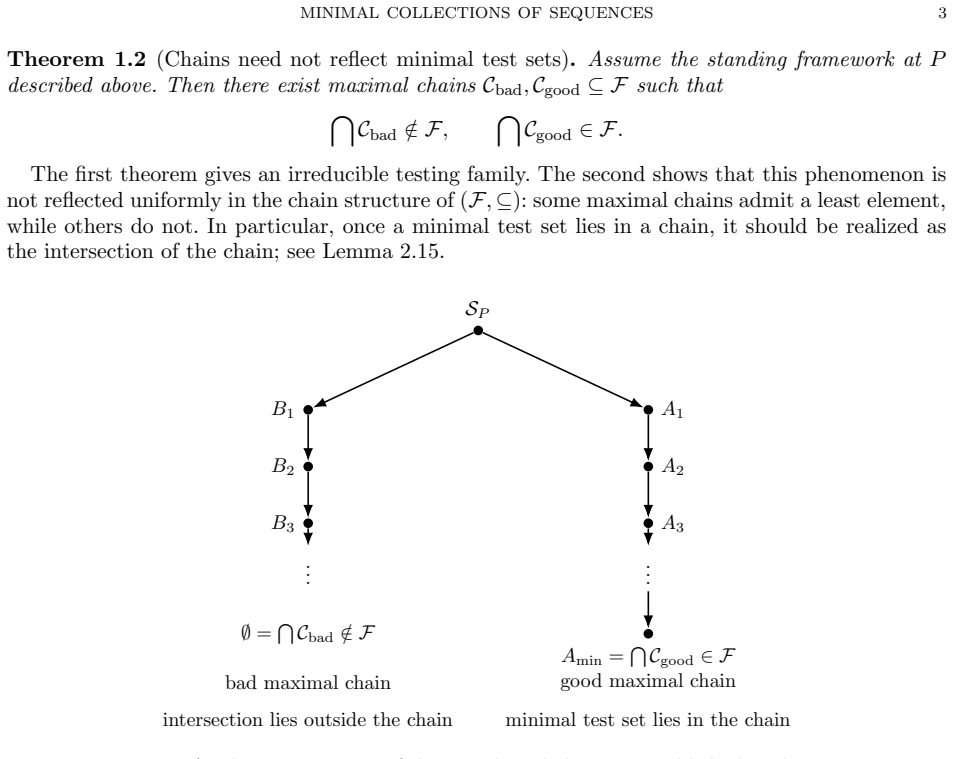
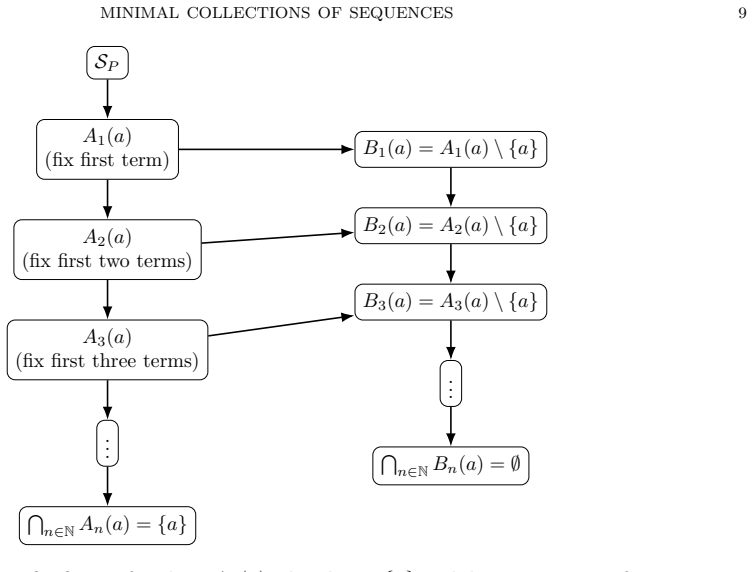
Under natural hypotheses at P, the poset of test sets has a minimal element. Maximal chains in this poset may or may not have a least element. On the sequential fan, the construction produces a minimal test set whose cardinality is strictly smaller than that of the full family of convergent sequences.
What carries the argument
The poset of test sets: subfamilies of sequences converging to P that detect every discontinuity at P, ordered by inclusion.
Load-bearing premise
The unspecified natural hypotheses at the point P are satisfied.
What would settle it
A point P satisfying the natural hypotheses for which no minimal test set exists would falsify the main existence claim.
Figures

read the original abstract
We study test sets: subfamilies of sequences converging to a point P that still suffice to detect every discontinuity of real-valued functions at P. Ordered by inclusion, these test sets form a poset. Under natural hypotheses at P, we prove that this poset has a minimal element. We also analyze its maximal chains, showing that some have a least element, while others do not. Finally, on the sequential fan we give a concrete realization in which the minimal test set produced by our construction has strictly smaller cardinality than the full family of convergent sequences.
Editorial analysis
A structured set of objections, weighed in public.
Referee Report
Summary. The manuscript studies the poset of test sets (subfamilies of sequences converging to a point P that suffice to detect all discontinuities of real-valued functions at P), ordered by inclusion. Under natural hypotheses at P, it claims to prove that this poset has minimal elements, analyzes its maximal chains (showing some have a least element while others do not), and gives a concrete construction on the sequential fan in which a minimal test set has strictly smaller cardinality than the full family of convergent sequences.
Significance. If the central claims hold with explicit hypotheses, the work would offer a new order-theoretic perspective on minimal sufficient families for continuity testing in sequential spaces, potentially aiding both theoretical topology and practical discontinuity detection. The sequential-fan example provides a falsifiable, concrete cardinality reduction that strengthens the contribution; the maximal-chain analysis adds structural insight.
major comments (1)
- [Abstract] Abstract (and presumably the statement of the main theorem): The 'natural hypotheses at P' are never defined or listed. The existence proof for minimal elements requires these hypotheses to guarantee that every chain of test sets has a lower bound that remains a test set (so that Zorn's lemma or an equivalent minimality argument applies). Without an explicit list, it is impossible to verify whether the hypotheses hold at points of interest or merely restate the conclusion, rendering the central claim unverifiable.
Simulated Author's Rebuttal
We thank the referee for their careful reading and constructive feedback. We address the single major comment below.
read point-by-point responses
-
Referee: [Abstract] Abstract (and presumably the statement of the main theorem): The 'natural hypotheses at P' are never defined or listed. The existence proof for minimal elements requires these hypotheses to guarantee that every chain of test sets has a lower bound that remains a test set (so that Zorn's lemma or an equivalent minimality argument applies). Without an explicit list, it is impossible to verify whether the hypotheses hold at points of interest or merely restate the conclusion, rendering the central claim unverifiable.
Authors: We agree that the abstract does not contain an explicit enumerated list of the hypotheses. The manuscript introduces the relevant conditions on the point P in the introduction and develops them fully in Section 2 (including the requirement that intersections of chains of test sets remain test sets, which licenses the application of Zorn's lemma). To improve immediate verifiability, we will revise the abstract and the statement of the main theorem to include a concise, explicit list of these hypotheses. The proof itself will remain unchanged. revision: yes
Circularity Check
No circularity; direct existence proof in order theory with no reductions to inputs or self-citations.
full rationale
The paper proves existence of a minimal element in the poset of test sets (subfamilies of sequences to P sufficient to detect discontinuities) under natural hypotheses at P, analyzes maximal chains, and gives a concrete smaller-cardinality example on the sequential fan. No equations, fitted parameters, or self-citations appear that reduce any claimed prediction or minimal element to a definition or prior result by construction. The argument is a standard order-theoretic existence proof (likely via Zorn or chain bounds) that remains independent of its inputs; the hypotheses are external to the derivation rather than smuggled in via self-reference. This matches the default expectation of a non-circular math paper.
Axiom & Free-Parameter Ledger
axioms (2)
- domain assumption Natural hypotheses at point P that guarantee the poset of test sets has minimal elements
- standard math Standard axioms of topology and order theory for sequences converging to a point
Reference graph
Works this paper leans on
-
[1]
Engelking, General Topology, 2nd ed., Sigma Series in Pure Mathematics, Vol
R. Engelking, General Topology, 2nd ed., Sigma Series in Pure Mathematics, Vol. 6, Heldermann Verlag, Berlin, 1989
work page 1989
-
[2]
S. P. Franklin, Spaces in which sequences suffice, Fundamenta Mathematicae 57 (1965), 107--115
work page 1965
-
[3]
S. P. Franklin and B. V. Smith Thomas, On the metrizability of \(k_ \)-spaces, Pacific Journal of Mathematics 72 (1977), no. 2, 399--402
work page 1977
-
[4]
Hru s \' a k, Almost disjoint families and topology, in Recent Progress in General Topology III (K
M. Hru s \' a k, Almost disjoint families and topology, in Recent Progress in General Topology III (K. P. Hart, J. van Mill, P. Simon, eds.), Atlantis Press, Paris, 2014, 601--638
work page 2014
-
[5]
T. Jech, Set Theory: The Third Millennium Edition, revised and expanded, Springer Monographs in Mathematics, Springer, Berlin--Heidelberg, 2003
work page 2003
discussion (0)
Sign in with ORCID, Apple, or X to comment. Anyone can read and Pith papers without signing in.