Recognition: no theorem link
More Than Meets the Eye: A Semantics-Aware Traffic Augmentation Framework for Generalizable Website Fingerprinting
Pith reviewed 2026-05-13 02:01 UTC · model grok-4.3
The pith
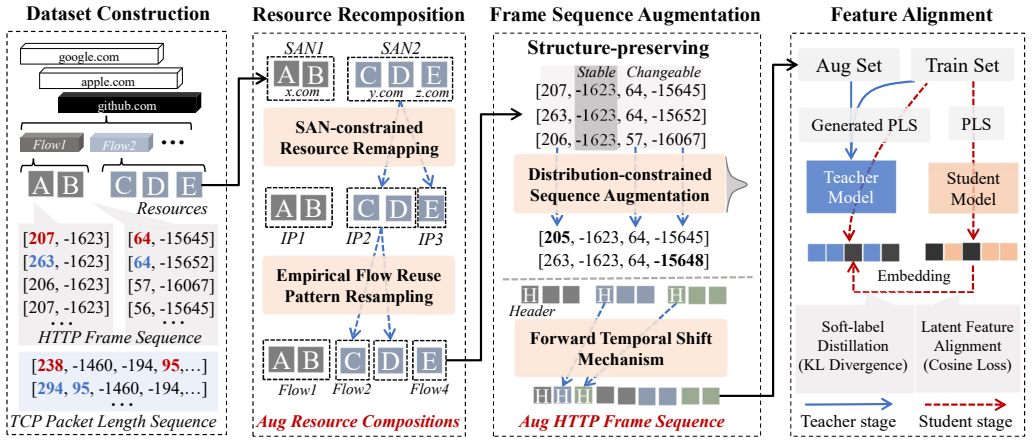
SATA augments website traffic with protocol-rule semantics and cross-layer alignment to generate realistic patterns missing from training data.
A machine-rendered reading of the paper's core claim, the machinery that carries it, and where it could break.
Core claim
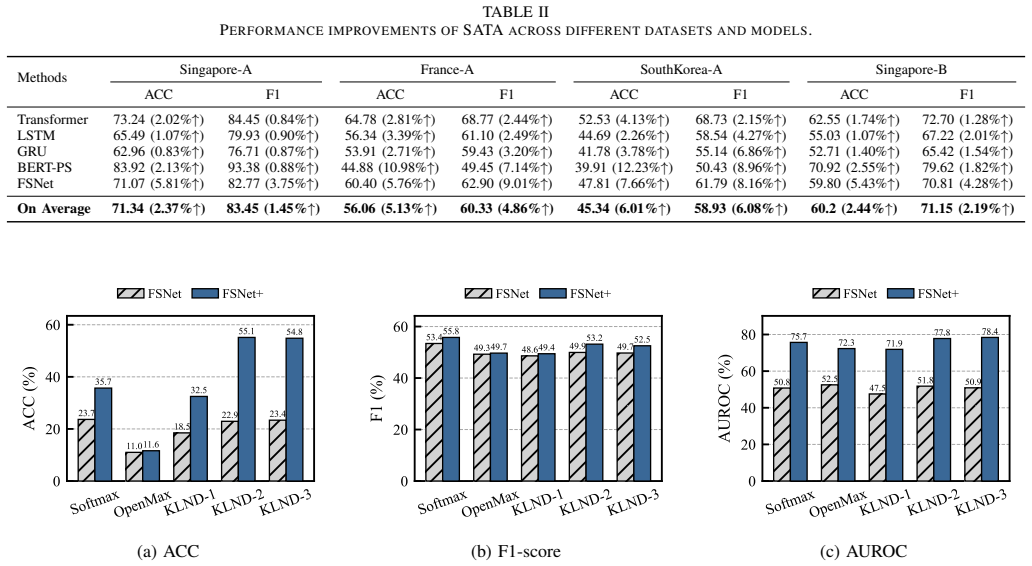
The central claim is that protocol-rule-based semantic augmentation of application-layer frame sequences, followed by knowledge-distillation alignment between those sequences and packet-length sequences, produces traffic patterns absent from the training distribution yet genuinely present in test data; when mainstream models are trained on the resulting augmented set, accuracy and AUROC rise substantially, especially in open-world settings where the reported gains reach 90.81 percent accuracy and 48.37 percent AUROC.
What carries the argument
SATA's two-stage process of protocol-constrained semantic augmentation of frame sequences followed by knowledge-distillation alignment to packet-length sequences.
If this is right
- Models trained on SATA-augmented traces identify websites more reliably when test conditions differ in location or time from training.
- The generated patterns fill gaps in the training distribution while obeying the same protocol constraints as real traffic.
- Cross-layer alignment reduces the mismatch between semantic resource choices and the packet features a classifier actually sees.
- Mainstream deep-learning fingerprinting systems gain accuracy and AUROC without requiring new labeled real-world collections.
Where Pith is reading between the lines
- The same rule-based augmentation plus distillation pattern could be tested on other traffic-classification tasks that suffer geographic or temporal shifts.
- If the synthetic traces prove indistinguishable from real ones in statistical tests, data-collection budgets for robust models could shrink.
- The cross-layer alignment step suggests a general recipe for fusing high-level protocol semantics with low-level observable features in any multi-layer network analysis.
Load-bearing premise
Protocol-rule augmentation produces novel traffic patterns that match genuine real-world variability without introducing unrealistic artifacts.
What would settle it
Check whether the exact frame-sequence and packet-length combinations created by SATA actually occur in fresh, unaugmented test traces collected under the same protocols; if they do not, or if removing the distillation step erases the performance lift, the central claim fails.
Figures





read the original abstract
Deep learning-based website fingerprinting has emerged as an effective technique for inferring the websites users visit. Although existing methods achieve strong performance on closed-world datasets, they often fail to generalize to real-world environments, especially under geographic and temporal shifts. This limitation fundamentally stems from the coupled effects of two key challenges: application-layer resource composition variability and observable feature instability induced by cross-layer encapsulation. Intertwined, these factors induce systematic shifts between underlying application semantics and observable traffic features. To address the above challenges, we propose SATA , a semantics-aware traffic augmentation framework. Specifically, SATA first performs application-layer semantic augmentation based on protocol rules, expanding the resource composition patterns within each flow and frame sequence patterns under protocol constraints. Based on these augmented frame sequences, we further introduce a cross-layer feature alignment mechanism via knowledge distillation. It aligns frame sequence with packet-length sequence features, enabling cross-layer feature alignment between enhanced semantics and observable sequences. Extensive experiments show that SATA successfully generates traffic patterns that are absent from the training set but genuinely exist in the test set, and significantly improves the performance of mainstream models across diverse and complex scenarios. In particular, in open-world settings, SATA improves ACC by 90.81% and AUROC by 48.37%. The source code of the prototype system is available at https://anonymous.4open.science/r/SATA-B6C2/.
Editorial analysis
A structured set of objections, weighed in public.
Referee Report
Summary. The paper proposes SATA, a semantics-aware traffic augmentation framework for website fingerprinting. It first applies application-layer semantic augmentation using protocol rules to expand resource compositions and frame sequence patterns within flows, then employs knowledge distillation for cross-layer feature alignment between enhanced frame sequences and observable packet-length sequences. The central claim is that this generates novel traffic patterns absent from training but genuinely present in test distributions, yielding large performance gains for mainstream models, especially in open-world settings (ACC improved by 90.81%, AUROC by 48.37%).
Significance. If the empirical results hold under rigorous controls, this could meaningfully advance generalizable website fingerprinting by directly targeting semantic variability and cross-layer instability, two persistent barriers to real-world deployment. The open-source code link is a strength for reproducibility.
major comments (2)
- [Abstract] Abstract: The load-bearing claim that SATA 'successfully generates traffic patterns that are absent from the training set but genuinely exist in the test set' lacks any reference to verification procedures (e.g., overlap metrics, distribution tests, or artifact checks), leaving open the risk that rule-based augmentation introduces non-representative artifacts rather than genuine test-set variability.
- [Abstract] The reported open-world gains (90.81% ACC, 48.37% AUROC) are presented without details on experimental controls, baseline comparisons, statistical testing, or ablations of the augmentation versus distillation components; this undermines attribution of improvements to the proposed mechanisms.
Simulated Author's Rebuttal
We thank the referee for the constructive comments, which help clarify the presentation of our contributions. We address each major comment point by point below and indicate the revisions we will make.
read point-by-point responses
-
Referee: [Abstract] Abstract: The load-bearing claim that SATA 'successfully generates traffic patterns that are absent from the training set but genuinely exist in the test set' lacks any reference to verification procedures (e.g., overlap metrics, distribution tests, or artifact checks), leaving open the risk that rule-based augmentation introduces non-representative artifacts rather than genuine test-set variability.
Authors: We agree that the abstract's brevity omits explicit mention of verification. The manuscript details these procedures in Section 4.3 (including Jaccard overlap, KL-divergence between augmented and test distributions, and manual artifact inspection on sampled flows), which confirm that generated patterns align with genuine test-set variability under protocol constraints. We will revise the abstract to include a concise reference to these verification steps and their positive outcomes. revision: yes
-
Referee: [Abstract] The reported open-world gains (90.81% ACC, 48.37% AUROC) are presented without details on experimental controls, baseline comparisons, statistical testing, or ablations of the augmentation versus distillation components; this undermines attribution of improvements to the proposed mechanisms.
Authors: The abstract summarizes headline results; full experimental controls, baseline comparisons (against DF, Tik-Tok, and others), statistical significance testing, and component ablations appear in Section 5. These ablations isolate the contributions of semantic augmentation and cross-layer distillation. We will update the abstract to briefly note the experimental controls and key ablation findings that support attribution to the proposed mechanisms. revision: yes
Circularity Check
No circularity: empirical augmentation and distillation pipeline evaluated on held-out data
full rationale
The paper presents SATA as a rule-based semantic augmentation method followed by knowledge distillation for cross-layer alignment, with performance gains demonstrated via experiments on held-out closed- and open-world datasets. No equations, fitted parameters, or self-citations are invoked to derive the claimed improvements; the central results (e.g., 90.81% ACC and 48.37% AUROC gains) are reported as direct empirical outcomes from applying the pipeline to external test distributions. The derivation chain consists of protocol-constrained augmentation steps and a distillation objective, none of which reduce by construction to quantities defined within the paper's own fitted values or prior self-references. This is a standard self-contained empirical contribution.
Axiom & Free-Parameter Ledger
axioms (2)
- domain assumption Application-layer protocol rules can be applied to expand resource composition and frame sequences in a way that produces traffic patterns genuinely present in real test distributions.
- domain assumption Knowledge distillation between frame-sequence and packet-length-sequence representations produces cross-layer alignment that improves generalization under geographic and temporal shifts.
Reference graph
Works this paper leans on
-
[1]
Tls 1.3 in practice: How tls 1.3 contributes to the internet,
H. Lee, D. Kim, and Y . Kwon, “Tls 1.3 in practice: How tls 1.3 contributes to the internet,” in Proceedings of the Web Conference 2021, 2021, pp. 70–79
work page 2021
-
[2]
P. E. Hoffman and P. McManus, “DNS Queries over HTTPS (DoH),” RFC 8484, Oct. 2018. [Online]. Available: https://www.rfc-editor.org/ info/rfc8484
work page 2018
-
[3]
Usage Profiles for DNS over TLS and DNS over DTLS,
S. Dickinson, D. K. Gillmor, and T. Reddy.K, “Usage Profiles for DNS over TLS and DNS over DTLS,” RFC 8310, Mar. 2018. [Online]. Available: https://www.rfc-editor.org/info/rfc8310
work page 2018
-
[4]
DNS over Dedicated QUIC Connections,
C. Huitema, S. Dickinson, and A. Mankin, “DNS over Dedicated QUIC Connections,” RFC 9250, May 2022. [Online]. Available: https://www.rfc-editor.org/info/rfc9250
work page 2022
-
[5]
E. Rescorla, K. Oku, N. Sullivan, and C. A. Wood, “TLS Encrypted Client Hello,” RFC 9849, Mar. 2026. [Online]. Available: https://www.rfc-editor.org/info/rfc9849
work page 2026
-
[6]
Content delivery networks: State of the art, trends, and future roadmap,
B. Zolfaghari, G. Srivastava, S. Roy, H. R. Nemati, F. Afghah, T. Koshiba, A. Razi, K. Bibak, P. Mitra, and B. K. Rai, “Content delivery networks: State of the art, trends, and future roadmap,” ACM Comput. Surv., vol. 53, no. 2, Apr. 2020. [Online]. Available: https://doi.org/10.1145/3380613
-
[7]
Machine learning-powered encrypted network traffic analysis: A com- prehensive survey,
M. Shen, K. Ye, X. Liu, L. Zhu, J. Kang, S. Yu, Q. Li, and K. Xu, “Machine learning-powered encrypted network traffic analysis: A com- prehensive survey,”IEEE Communications Surveys & Tutorials, vol. 25, no. 1, pp. 791–824, 2022
work page 2022
-
[8]
A survey on encrypted network traffic analysis applications, techniques, and countermeasures,
E. Papadogiannaki and S. Ioannidis, “A survey on encrypted network traffic analysis applications, techniques, and countermeasures,” ACM Computing Surveys (CSUR), vol. 54, no. 6, pp. 1–35, 2021
work page 2021
-
[9]
Sok: Decoding the enigma of encrypted network traffic classifiers,
N. Wickramasinghe, A. Shaghaghi, G. Tsudik, and S. Jha, “Sok: Decoding the enigma of encrypted network traffic classifiers,” in 2025 IEEE Symposium on Security and Privacy (SP). IEEE, 2025, pp. 1825– 1843
work page 2025
-
[10]
The sweet danger of sugar: Debunking representation learning for encrypted traffic classification,
Y . Zhao, G. Dettori, M. Boffa, L. Vassio, and M. Mellia, “The sweet danger of sugar: Debunking representation learning for encrypted traffic classification,” in Proceedings of the ACM SIGCOMM 2025 Conference, 2025, pp. 296–310
work page 2025
-
[11]
A. Sharma and A. H. Lashkari, “A survey on encrypted network traffic: A comprehensive survey of identification/classification techniques, chal- lenges, and future directions,” Computer Networks, vol. 257, p. 110984, 2025
work page 2025
-
[12]
Unmasking the internet: A survey of fine-grained network traffic analysis,
Y . Feng, J. Li, J. Mirkovic, C. Wu, C. Wang, H. Ren, J. Xu, and Y . Liu, “Unmasking the internet: A survey of fine-grained network traffic analysis,” IEEE Communications Surveys & Tutorials, 2025
work page 2025
-
[13]
Realistic website fingerprinting by augmenting network traces,
A. Bahramali, A. Bozorgi, and A. Houmansadr, “Realistic website fingerprinting by augmenting network traces,” in Proceedings of the 2023 ACM SIGSAC Conference on Computer and Communications Security, 2023, pp. 1035–1049
work page 2023
-
[14]
k-fingerprinting: A robust scalable web- site fingerprinting technique,
J. Hayes and G. Danezis, “k-fingerprinting: A robust scalable web- site fingerprinting technique,” in 25th USENIX Security Symposium (USENIX Security 16), 2016, pp. 1187–1203
work page 2016
-
[15]
Deep fingerprinting: Undermining website fingerprinting defenses with deep learning,
P. Sirinam, M. Imani, M. Juarez, and M. Wright, “Deep fingerprinting: Undermining website fingerprinting defenses with deep learning,” in Proceedings of the 2018 ACM SIGSAC conference on computer and communications security, 2018, pp. 1928–1943
work page 2018
-
[16]
Flowprint: Semi-supervised mobile-app fingerprinting on encrypted network traf- fic,
T. Van Ede, R. Bortolameotti, A. Continella, J. Ren, D. J. Dubois, M. Lindorfer, D. Choffnes, M. Van Steen, and A. Peter, “Flowprint: Semi-supervised mobile-app fingerprinting on encrypted network traf- fic,” in Network and distributed system security symposium (NDSS), vol. 27, 2020
work page 2020
-
[17]
J. Qu, X. Ma, J. Li, X. Luo, L. Xue, J. Zhang, Z. Li, L. Feng, and X. Guan, “An{Input-Agnostic}hierarchical deep learning frame- 16 (a) Indexed Header Field (b) Literal Header Field Fig. 18. Wireshark-based analysis of HTTP/2 header compression, illustrating the impact ofHPACKstates on frame size. Fig. 19. Concurrent transmission of continuousHEADERSframe...
work page 2023
-
[18]
Detection of tor network obfuscated traffic using bidirectional generative adversarial network,
B. AlOmar, Z. Trabelsi, and S. Alrabaee, “Detection of tor network obfuscated traffic using bidirectional generative adversarial network,” Computer Networks, p. 111586, 2025
work page 2025
-
[19]
Netdiffusion: Network data augmentation through protocol-constrained traffic generation,
X. Jiang, S. Liu, A. Gember-Jacobson, A. N. Bhagoji, P. Schmitt, F. Bronzino, and N. Feamster, “Netdiffusion: Network data augmentation through protocol-constrained traffic generation,” Proceedings of the ACM on Measurement and Analysis of Computing Systems, vol. 8, no. 1, pp. 1–32, 2024
work page 2024
-
[20]
W. Zhu, X. Ma, Y . Jin, and R. Wang, “Iletc: Incremental learning for encrypted traffic classification using generative replay and exemplar,” Computer Networks, vol. 224, p. 109602, 2023
work page 2023
-
[21]
P. Sun, X. Yun, S. Li, T. Yin, C. Si, and J. Xie, “Advtg: An adversarial traffic generation framework to deceive dl-based malicious traffic de- tection models,” in Proceedings of the ACM on Web Conference 2025, 2025, pp. 3147–3159
work page 2025
-
[22]
C. Hajaj, P. Aharon, R. Dubin, and A. Dvir, “The art of time-bending: Data augmentation and early prediction for efficient traffic classifica- tion,” Expert Systems with Applications, vol. 252, p. 124166, 2024
work page 2024
-
[23]
A. Schoen, G. Blanc, P.-F. Gimenez, Y . Han, F. Majorczyk, and L. Me, “A tale of two methods: Unveiling the limitations of gan and the rise of bayesian networks for synthetic network traffic generation,” in 2024 IEEE European Symposium on Security and Privacy Workshops (EuroS&PW), 2024, pp. 273–286
work page 2024
-
[24]
Domain general- ization: A survey,
K. Zhou, Z. Liu, Y . Qiao, T. Xiang, and C. C. Loy, “Domain general- ization: A survey,” IEEE Transactions on Pattern Analysis and Machine Intelligence, vol. 45, no. 4, pp. 4396–4415, 2023
work page 2023
-
[25]
N ¨uwa: Enhancing network traffic analysis with pre-trained side-channel feature imputation,
F. Zhao, W. Li, H. Bao, Z. Li, G. Zhou, W. Wang, and F. Liu, “N ¨uwa: Enhancing network traffic analysis with pre-trained side-channel feature imputation,” IEEE Transactions on Networking, 2025
work page 2025
-
[26]
Enhancing encrypted internet traffic classification through advanced data aug- mentation techniques,
Y . Zion, P. Aharon, R. Dubin, A. Dvir, and C. Hajaj, “Enhancing encrypted internet traffic classification through advanced data aug- mentation techniques,” in ICC 2025-IEEE International Conference on Communications. IEEE, 2025, pp. 1–6
work page 2025
-
[27]
R. Xie, J. Cao, E. Dong, M. Xu, K. Sun, Q. Li, L. Shen, and M. Zhang, “Rosetta: Enabling robust{TLS}encrypted traffic classification in diverse network environments with{TCP-Aware}traffic augmentation,” in 32nd USENIX Security Symposium (USENIX Security 23), 2023, pp. 625–642
work page 2023
-
[28]
A few shots traffic classification with mini-flowpic augmentations,
E. Horowicz, T. Shapira, and Y . Shavitt, “A few shots traffic classification with mini-flowpic augmentations,” in Proceedings of the 22nd ACM internet measurement conference, 2022, pp. 647–654
work page 2022
-
[29]
Evolution and challenges of dns- based cdns,
Z. Wang, J. Huang, and S. Rose, “Evolution and challenges of dns- based cdns,” Digital Communications and Networks, vol. 4, no. 4, pp. 235–243, 2018
work page 2018
-
[30]
Akamai dns: Providing authoritative answers to the world’s queries,
K. Schomp, O. Bhardwaj, E. Kurdoglu, M. Muhaimen, and R. K. Sitaraman, “Akamai dns: Providing authoritative answers to the world’s queries,” in Proceedings of the Annual conference of the ACM Special Interest Group on Data Communication on the applications, technologies, architectures, and protocols for computer communication, 2020, pp. 465–478
work page 2020
-
[31]
Hypertext Transfer Protocol Version 2 (HTTP/2),
M. Belshe, R. Peon, and M. Thomson, “Hypertext Transfer Protocol Version 2 (HTTP/2),” RFC 7540, May 2015. [Online]. Available: https://www.rfc-editor.org/info/rfc7540
work page 2015
-
[32]
HPACK: Header Compression for HTTP/2,
R. Peon and H. Ruellan, “HPACK: Header Compression for HTTP/2,” RFC 7541, May 2015. [Online]. Available: https://www.rfc-editor.org/ info/rfc7541
work page 2015
-
[33]
Transmission Control Protocol (TCP),
W. Eddy, “Transmission Control Protocol (TCP),” RFC 9293, Aug
-
[34]
Available: https://www.rfc-editor.org/info/rfc9293
[Online]. Available: https://www.rfc-editor.org/info/rfc9293
-
[35]
The Transport Layer Security (TLS) Protocol Version 1.2,
E. Rescorla and T. Dierks, “The Transport Layer Security (TLS) Protocol Version 1.2,” RFC 5246, Aug. 2008. [Online]. Available: https://www.rfc-editor.org/info/rfc5246
work page 2008
-
[36]
Appscanner: Automatic fingerprinting of smartphone apps from encrypted network traffic,
V . F. Taylor, R. Spolaor, M. Conti, and I. Martinovic, “Appscanner: Automatic fingerprinting of smartphone apps from encrypted network traffic,” in 2016 IEEE European Symposium on Security and Privacy (EuroS&P). IEEE, 2016, pp. 439–454
work page 2016
-
[37]
Encrypted traffic classification of decentralized applications on ethereum using feature fusion,
M. Shen, J. Zhang, L. Zhu, K. Xu, X. Du, and Y . Liu, “Encrypted traffic classification of decentralized applications on ethereum using feature fusion,” in Proceedings of the International Symposium on Quality of Service, 2019, pp. 1–10
work page 2019
-
[38]
X. Lin, G. Xiong, G. Gou, Z. Li, J. Shi, and J. Yu, “Et-bert: A contextualized datagram representation with pre-training transformers for encrypted traffic classification,” in Proceedings of the ACM Web Conference 2022, 2022, pp. 633–642
work page 2022
-
[39]
Ptu: Pre-trained model for network traffic understanding,
L. Peng, X. Xie, S. Huang, Z. Wang, and Y . Cui, “Ptu: Pre-trained model for network traffic understanding,” in 2024 IEEE 32nd International Conference on Network Protocols (ICNP). IEEE, 2024, pp. 1–12
work page 2024
-
[40]
Netmamba: Efficient network traffic classification via pre-training unidirectional mamba,
T. Wang, X. Xie, W. Wang, C. Wang, Y . Zhao, and Y . Cui, “Netmamba: Efficient network traffic classification via pre-training unidirectional mamba,” in 2024 IEEE 32nd International Conference on Network Protocols (ICNP). IEEE, 2024, pp. 1–11
work page 2024
-
[41]
Miett: Multi-instance encrypted traffic transformer for encrypted traffic classification,
X.-Y . Chen, L. Han, D.-C. Zhan, and H.-J. Ye, “Miett: Multi-instance encrypted traffic transformer for encrypted traffic classification,” in Proceedings of the AAAI Conference on Artificial Intelligence, vol. 39, no. 15, 2025, pp. 15 922–15 929
work page 2025
-
[42]
Trafficformer: an efficient pre-trained model for traffic data,
G. Zhou, X. Guo, Z. Liu, T. Li, Q. Li, and K. Xu, “Trafficformer: an efficient pre-trained model for traffic data,” in 2025 IEEE Symposium on Security and Privacy (SP). IEEE, 2025, pp. 1844–1860
work page 2025
-
[43]
W. Peng, L. Cui, W. Cai, W. Wang, X. Cui, Z. Hao, and X. Yun, “Bottom aggregating, top separating: An aggregator and separator network for encrypted traffic understanding,” IEEE Transactions on Information Forensics and Security, 2025
work page 2025
-
[44]
R. Zhao, M. Zhan, X. Deng, Y . Wang, Y . Wang, G. Gui, and Z. Xue, “Yet another traffic classifier: A masked autoencoder based traffic transformer 17 with multi-level flow representation,” in Proceedings of the AAAI Conference on Artificial Intelligence, vol. 37, no. 4, 2023, pp. 5420– 5427
work page 2023
-
[45]
Atvitsc: A novel encrypted traffic classification method based on deep learning,
Y . Liu, X. Wang, B. Qu, and F. Zhao, “Atvitsc: A novel encrypted traffic classification method based on deep learning,” IEEE Transactions on Information Forensics and Security, 2024
work page 2024
-
[46]
H. Zhang, L. Yu, X. Xiao, Q. Li, F. Mercaldo, X. Luo, and Q. Liu, “Tfe-gnn: A temporal fusion encoder using graph neural networks for fine-grained encrypted traffic classification,” inProceedings of the ACM web conference 2023, 2023, pp. 2066–2075
work page 2023
-
[47]
Z. Li, H. Zhao, J. Zhao, Y . Jiang, and F. Bu, “Sat-net: A staggered attention network using graph neural networks for encrypted traffic classification,”Journal of Network and Computer Applications, vol. 233, p. 104069, 2025
work page 2025
-
[48]
X. Han, G. Xu, M. Zhang, Z. Yang, Z. Yu, W. Huang, and C. Meng, “De- gnn: Dual embedding with graph neural network for fine-grained en- crypted traffic classification,” Computer Networks, vol. 245, p. 110372, 2024
work page 2024
-
[49]
H. Zhang, H. Yue, X. Xiao, L. Yu, Q. Li, Z. Ling, and Y . Zhang, “Rev- olutionizing encrypted traffic classification with mh-net: A multi-view heterogeneous graph model,” in Proceedings of the AAAI Conference on Artificial Intelligence, vol. 39, no. 1, 2025, pp. 1048–1056
work page 2025
-
[50]
Fs-net: A flow se- quence network for encrypted traffic classification,
C. Liu, L. He, G. Xiong, Z. Cao, and Z. Li, “Fs-net: A flow se- quence network for encrypted traffic classification,” in IEEE INFOCOM 2019-IEEE Conference On Computer Communications. IEEE, 2019, pp. 1171–1179
work page 2019
-
[51]
Ggfast: Automating generation of flexible network traffic classifiers,
J. Piet, D. Nwoji, and V . Paxson, “Ggfast: Automating generation of flexible network traffic classifiers,” in Proceedings of the ACM SIGCOMM 2023 Conference, 2023, pp. 850–866
work page 2023
-
[52]
Length matters: Fast internet encrypted traffic service classification based on multi-pdu lengths,
Z. Chen, G. Cheng, B. Jiang, S. Tang, S. Guo, and Y . Zhou, “Length matters: Fast internet encrypted traffic service classification based on multi-pdu lengths,” in 2020 16th International Conference on Mobility, Sensing and Networking (MSN). IEEE, 2020, pp. 531–538
work page 2020
-
[53]
Z. Chen, G. Cheng, Z. Xu, S. Guo, Y . Zhou, and Y . Zhao, “Length matters: Scalable fast encrypted internet traffic service classification based on multiple protocol data unit length sequence with composite deep learning,” Digital Communications and Networks, vol. 8, no. 3, pp. 289–302, 2022
work page 2022
-
[54]
Online multimedia traffic classification from the qos perspective using deep learning,
Z. Wu, Y .-n. Dong, X. Qiu, and J. Jin, “Online multimedia traffic classification from the qos perspective using deep learning,” Computer Networks, vol. 204, p. 108716, 2022
work page 2022
-
[55]
Metc-mvae: Mobile encrypted traffic classification with masked variational autoencoders,
W. Cai, Z. Li, P. Fu, C. Hou, G. Xiong, and G. Gou, “Metc-mvae: Mobile encrypted traffic classification with masked variational autoencoders,” in 2022 IEEE 24th Int Conf on High Performance Computing & Communications; 8th Int Conf on Data Science & Systems; 20th Int Conf on Smart City; 8th Int Conf on Dependability in Sensor, Cloud & Big Data Systems & Ap...
work page 2022
-
[56]
Robustness matters: Pre-training can enhance the performance of encrypted traffic analysis,
L. Yang, L. Liu, J.-J. Huang, J. Shi, S. Fu, Y . Wang, and J. Su, “Robustness matters: Pre-training can enhance the performance of encrypted traffic analysis,” IEEE Transactions on Information Forensics and Security, vol. 20, pp. 10 588–10 603, 2025
work page 2025
-
[57]
Rltree: Website fingerprinting through resource loading tree,
C. Li, L. Nie, and L. Zhao, “Rltree: Website fingerprinting through resource loading tree,” in International Conference on Network and System Security. Springer, 2021, pp. 3–16
work page 2021
-
[58]
Z. Chen, G. Cheng, Z. Wei, D. Niu, and N. Fu, “Classify traffic rather than flow: Versatile multi-flow encrypted traffic classification with flow clustering,” IEEE Transactions on Network and Service Management, vol. 21, no. 2, pp. 1446–1466, 2023
work page 2023
-
[59]
Detecting tunneled flood- ing traffic via deep semantic analysis of packet length patterns,
C. Fu, Q. Li, M. Shen, and K. Xu, “Detecting tunneled flood- ing traffic via deep semantic analysis of packet length patterns,” in Proceedings of the 2024 on ACM SIGSAC Conference on Computer and Communications Security, 2024, pp. 3659–3673
work page 2024
-
[60]
Udfs: Lightweight representation-driven robust network traffic classification,
Y . Xian, X. Zeng, M. Huang, A. Zhou, X. Cui, P. Liu, and L. Cui, “Udfs: Lightweight representation-driven robust network traffic classification,” arXiv preprint arXiv:2509.11157, 2025
-
[61]
W. Dong, J. Yu, X. Lin, G. Gou, and G. Xiong, “Deep learning and pre- training technology for encrypted traffic classification: A comprehensive review,”Neurocomputing, vol. 617, p. 128444, 2025
work page 2025
-
[62]
Nginx: the high-performance web server and reverse proxy,
W. Reese, “Nginx: the high-performance web server and reverse proxy,” Linux Journal, vol. 2008, no. 173, p. 2, 2008
work page 2008
-
[63]
M. Thomson and C. Benfield, “HTTP/2,” RFC 9113, Jun. 2022. [Online]. Available: https://www.rfc-editor.org/info/rfc9113
work page 2022
-
[64]
The TCP Maximum Segment Size and Related Topics,
“The TCP Maximum Segment Size and Related Topics,” RFC 879, Nov. 1983. [Online]. Available: https://www.rfc-editor.org/info/rfc879
work page 1983
-
[65]
Internet X.509 Public Key Infrastructure Certificate and Certificate Revocation List (CRL) Profile,
S. Boeyen, S. Santesson, T. Polk, R. Housley, S. Farrell, and D. Cooper, “Internet X.509 Public Key Infrastructure Certificate and Certificate Revocation List (CRL) Profile,” RFC 5280, May 2008. [Online]. Available: https://www.rfc-editor.org/info/rfc5280
work page 2008
-
[66]
Sequential quadratic programming methods,
P. E. Gill and E. Wong, “Sequential quadratic programming methods,” in Mixed integer nonlinear programming. Springer, 2011, pp. 147–224
work page 2011
-
[67]
Knowledge distillation: A survey,
J. Gou, B. Yu, S. J. Maybank, and D. Tao, “Knowledge distillation: A survey,” International journal of computer vision, vol. 129, no. 6, pp. 1789–1819, 2021
work page 2021
-
[68]
Deep learning and zero-day traffic classification: Lessons learned from a commercial-grade dataset,
L. Yang, A. Finamore, F. Jun, and D. Rossi, “Deep learning and zero-day traffic classification: Lessons learned from a commercial-grade dataset,” IEEE Transactions on Network and Service Management, vol. 18, no. 4, pp. 4103–4118, 2021
work page 2021
-
[69]
Robust open-set classification for encrypted traffic fingerprinting,
T. Dahanayaka, Y . Ginige, Y . Huang, G. Jourjon, and S. Seneviratne, “Robust open-set classification for encrypted traffic fingerprinting,” Computer Networks, vol. 236, p. 109991, 2023. 18
work page 2023
discussion (0)
Sign in with ORCID, Apple, or X to comment. Anyone can read and Pith papers without signing in.