Recognition: no theorem link
VidSplat: Gaussian Splatting Reconstruction with Geometry-Guided Video Diffusion Priors
Pith reviewed 2026-05-13 01:56 UTC · model grok-4.3
The pith
VidSplat reconstructs complete 3D scenes from sparse inputs or single images by iteratively synthesizing consistent novel views with geometry-guided video diffusion.
A machine-rendered reading of the paper's core claim, the machinery that carries it, and where it could break.
Core claim
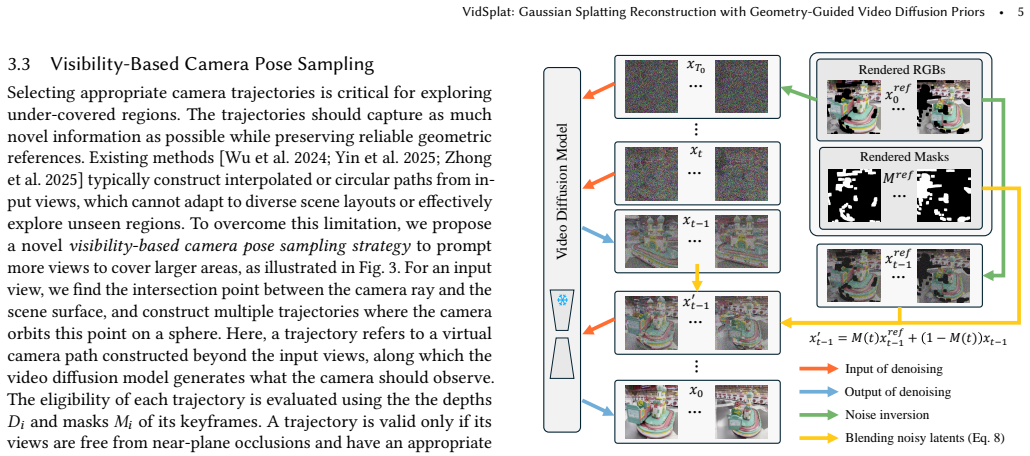
VidSplat is a training-free framework that integrates video diffusion priors into Gaussian Splatting reconstruction. It employs a stage-wise denoising strategy that adaptively guides the diffusion process toward underlying geometry by conditioning on rendered RGB and mask images from the current model. An accompanying iterative mechanism samples camera trajectories to explore unobserved areas, synthesizes novel views, and supplements the training set through confidence-weighted refinement. The result is robust reconstruction that maintains performance even when inputs are reduced to a single image.
What carries the argument
Stage-wise denoising strategy that uses rendered RGB and mask images from the current Gaussian Splatting model to guide video diffusion outputs toward 3D-consistent geometry.
If this is right
- Full scene geometry can be recovered even when input views cover only a small fraction of the object.
- Reconstruction succeeds from a single image by generating multiple consistent additional views.
- Iterative camera sampling progressively fills unobserved regions without manual view planning.
- Confidence-weighted addition of synthesized views improves model quality without amplifying errors.
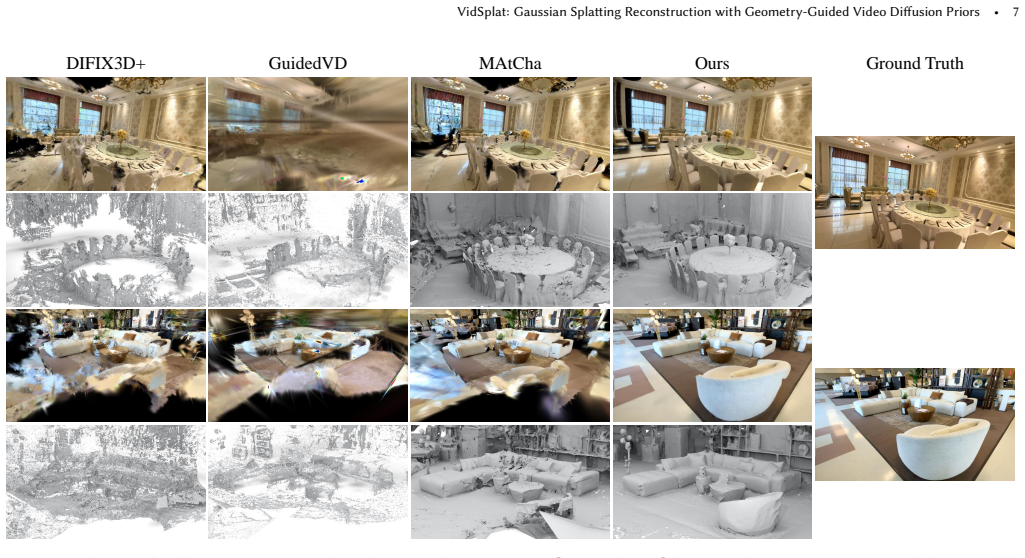
- Performance on standard sparse-view benchmarks exceeds prior methods that do not use generative priors.
Where Pith is reading between the lines
- The same guidance principle could be tested with other video or image diffusion models to see if stronger priors further reduce hallucinations in complex scenes.
- The iterative loop might be adapted for dynamic scenes if the video model is conditioned on motion cues from the current reconstruction.
- Consumer devices with limited cameras could produce usable 3D models if the iteration count is reduced through faster sampling.
- Similar conditioning on rendered geometry could be applied to other 3D tasks such as surface normal estimation or semantic labeling.
Load-bearing premise
The denoising strategy steered only by current RGB and mask renders will produce novel views that stay geometrically consistent with the scene and avoid introducing inconsistencies or hallucinations.
What would settle it
Apply the method to a scene with full ground-truth multi-view coverage, generate the novel views for unobserved angles, and measure their 3D consistency against the true geometry; large errors or mismatches would show the guidance fails.
Figures






read the original abstract
Gaussian Splatting has achieved remarkable progress in multi-view surface reconstruction, yet it exhibits notable degradation when only few views are available. Although recent efforts alleviate this issue by enhancing multi-view consistency to produce plausible surfaces, they struggle to infer unseen, occluded, or weakly constrained regions beyond the input coverage. To address this limitation, we present VidSplat, a training-free generative reconstruction framework that leverages powerful video diffusion priors to iteratively synthesize novel views that compensate for missing input coverage, and thereby recover complete 3D scenes from sparse inputs. Specifically, we tackle two key challenges that enable the effective integration of generation and reconstruction. First, for 3D consistent generation, we elaborate a training-free, stage-wise denoising strategy that adaptively guides the denoising direction toward the underlying geometry using the rendered RGB and mask images. Second, to enhance the reconstruction, we develop an iterative mechanism that samples camera trajectories, explores unobserved regions, synthesizes novel views, and supplements training through confidence weighted refinement. VidSplat performs robustly to sparse input and even a single image. Extensive experiments on widely used benchmarks demonstrate our superior performance in sparse-view scene reconstruction.
Editorial analysis
A structured set of objections, weighed in public.
Referee Report
Summary. The paper introduces VidSplat, a training-free framework for sparse-view 3D scene reconstruction that augments Gaussian Splatting with video diffusion priors. It proposes a stage-wise denoising strategy that uses rendered RGB and mask images from the current 3DGS reconstruction to guide the diffusion process toward geometrically consistent novel views, combined with an iterative loop that samples camera trajectories, synthesizes missing views, and performs confidence-weighted updates to the reconstruction. The central claims are robustness to extremely sparse inputs (including single images) and superior performance over prior methods on standard benchmarks.
Significance. If the integration of the geometry-guided denoising and iterative refinement proves reliable, the work could meaningfully advance sparse-view reconstruction by showing how off-the-shelf video diffusion models can compensate for missing coverage without task-specific fine-tuning. The training-free design and explicit handling of unobserved regions via generative priors represent a promising direction, provided the consistency guarantees hold.
major comments (2)
- [Abstract and method description of stage-wise denoising] The load-bearing claim in the abstract (and elaborated in the method) is that the training-free stage-wise denoising strategy, conditioned only on rendered RGB and masks from the current reconstruction, reliably steers the video diffusion model to produce 3D-consistent novel views. For single-image or very sparse inputs, the initial 3DGS reconstruction necessarily contains large holes and inaccurate depth in unobserved regions; nothing in the described conditioning prevents the prior from synthesizing plausible but mutually inconsistent content across sampled trajectories. This inconsistency can then be baked into the confidence-weighted update and compound over iterations. A concrete analysis or ablation demonstrating that the adaptive guidance enforces multi-view geometric consistency (e.g., via explicit 3D-aware regularization or cross-trajectory checks) is required to support the 're
- [Experiments section (referenced in abstract)] The abstract asserts 'extensive experiments on widely used benchmarks demonstrate our superior performance,' yet the provided text contains no quantitative tables, ablation studies on the denoising guidance, error analysis for single-image cases, or implementation details on how the mask/RGB conditioning is injected into the diffusion process. Without these, it is impossible to verify whether the mechanisms actually deliver the claimed robustness.
minor comments (2)
- [Abstract] The abstract could briefly name the specific video diffusion backbone and the exact benchmarks used to give readers immediate context.
- [Method] Notation for the confidence-weighted update and the precise form of the stage-wise guidance (e.g., how the rendered images modulate the denoising steps) should be formalized with equations for reproducibility.
Simulated Author's Rebuttal
We thank the referee for the constructive feedback on our work. We address each major comment below, clarifying our approach and outlining the revisions we will make to strengthen the presentation and supporting evidence.
read point-by-point responses
-
Referee: [Abstract and method description of stage-wise denoising] The load-bearing claim in the abstract (and elaborated in the method) is that the training-free stage-wise denoising strategy, conditioned only on rendered RGB and masks from the current reconstruction, reliably steers the video diffusion model to produce 3D-consistent novel views. For single-image or very sparse inputs, the initial 3DGS reconstruction necessarily contains large holes and inaccurate depth in unobserved regions; nothing in the described conditioning prevents the prior from synthesizing plausible but mutually inconsistent content across sampled trajectories. This inconsistency can then be baked into the confidence-weighted update and compound over iterations. A concrete analysis or ablation demonstrating that the adaptive guidance enforces multi-view geometric consistency (e.g., via explicit 3D-aware regularization)
Authors: We appreciate the referee highlighting the critical need to substantiate the consistency claims. Our stage-wise denoising progressively conditions the video diffusion model on rendered RGB and masks from the evolving 3DGS reconstruction, which we designed to anchor generations to the current geometry estimate and reduce drift across iterations. The confidence-weighted update is intended to limit propagation of inconsistent content. However, we agree that an explicit ablation or quantitative analysis of multi-view geometric consistency (such as cross-trajectory reprojection error or 3D consistency metrics) was not presented with sufficient detail. In the revised manuscript we will add this analysis, including ablations isolating the adaptive guidance and cross-trajectory checks, to directly support the claims. revision: yes
-
Referee: [Experiments section (referenced in abstract)] The abstract asserts 'extensive experiments on widely used benchmarks demonstrate our superior performance,' yet the provided text contains no quantitative tables, ablation studies on the denoising guidance, error analysis for single-image cases, or implementation details on how the mask/RGB conditioning is injected into the diffusion process. Without these, it is impossible to verify whether the mechanisms actually deliver the claimed robustness.
Authors: We apologize for any impression that the experimental support was missing. The full manuscript contains quantitative tables on standard benchmarks (DTU, LLFF, and others), ablations on the denoising strategy and confidence weighting, single-image error analysis, and implementation details on mask/RGB conditioning injection. To directly address the referee's concern, we will expand the experiments section in the revision with additional targeted ablations on the guidance mechanism, clearer cross-references from the abstract, and expanded implementation specifics to make verification straightforward. revision: yes
Circularity Check
No significant circularity; derivation relies on external priors and iterative updates
full rationale
The paper presents VidSplat as a training-free framework that integrates an external video diffusion model with 3D Gaussian Splatting via a stage-wise denoising strategy (guided by rendered RGB/masks) and an iterative trajectory-sampling + confidence-weighted refinement loop. No equations or steps reduce by construction to fitted parameters, self-definitions, or self-citation chains. The central claims (robustness to sparse/single-image inputs) are positioned as empirical outcomes of this integration rather than tautological renamings or predictions forced by the inputs themselves. Self-citations, if present, are not load-bearing for the uniqueness or correctness of the method. This is the normal case of an independent algorithmic contribution evaluated on external benchmarks.
Axiom & Free-Parameter Ledger
axioms (2)
- domain assumption Video diffusion models can be steered toward 3D-consistent novel views using rendered RGB and mask images from an evolving reconstruction
- domain assumption Iterative sampling of camera trajectories and addition of synthesized views will reliably fill unobserved regions without degrading the reconstruction
Reference graph
Works this paper leans on
-
[1]
Stable Video Diffusion: Scaling Latent Video Diffusion Models to Large Datasets
Wiley Online Library, e70086. Andreas Blattmann, Tim Dockhorn, Sumith Kulal, Daniel Mendelevitch, Maciej Kilian, Dominik Lorenz, Yam Levi, Zion English, Vikram Voleti, Adam Letts, et al. 2023a. Stable video diffusion: Scaling latent video diffusion models to large datasets.arXiv preprint arXiv:2311.15127(2023). Andreas Blattmann, Robin Rombach, Huan Ling,...
work page internal anchor Pith review Pith/arXiv arXiv 2023
-
[2]
Chao Chen, Yu-Shen Liu, and Zhizhong Han
MeshSplat: Generalizable Sparse-View Surface Recon- struction via Gaussian Splatting.arXiv preprint arXiv:2508.17811(2025). Chao Chen, Yu-Shen Liu, and Zhizhong Han
-
[3]
NeuralTPS: Learning Signed Dis- tance Functions without Priors from Single Sparse Point Clouds.IEEE Transactions on Pattern Analysis and Machine Intelligence47, 1 (2025), 565–582. Danpeng Chen, Hai Li, Weicai Ye, Yifan Wang, Weijian Xie, Shangjin Zhai, Nan Wang, Haomin Liu, Hujun Bao, and Guofeng Zhang
work page 2025
-
[4]
Prafulla Dhariwal and Alexander Nichol
PGSR: Planar-based gaussian splatting for efficient and high-fidelity surface reconstruction.IEEE Transactions on Visualization and Computer Graphics31, 9 (2024), 6100–6111. Prafulla Dhariwal and Alexander Nichol
work page 2024
-
[5]
Diffusion models beat gans on image synthesis.Advances in Neural Information Processing Systems34 (2021), 8780–8794. Yikang Ding, Jiwen Liu, Wenyuan Zhang, Zekun Wang, Wentao Hu, Liyuan Cui, Ming- ming Lao, Yingchao Shao, Hui Liu, Xiaohan Li, et al
work page 2021
-
[6]
Kling-Avatar: Grounding SIGGRAPH Conference Papers ’26, July 19–23, 2026, Los Angeles, CA, USA. 10•Jimin Tang et al. Multimodal Instructions for Cascaded Long-Duration Avatar Animation Synthesis. arXiv preprint arXiv:2509.09595(2025). Juntong Fang, Zequn Chen, Weiqi Zhang, Donglin Di, Xuancheng Zhang, Chengmin Yang, and Yu-Shen Liu
-
[7]
Wan-s2v: Audio-driven cinematic video generation.arXiv preprint arXiv:2508.18621, 2025
FlowR: Flowing from sparse to dense 3D reconstructions. InProceedings of the IEEE/CVF International Conference on Computer Vision. 27702–27712. Xin Gao, Li Hu, Siqi Hu, Mingyang Huang, Chaonan Ji, Dechao Meng, Jinwei Qi, Pen- chong Qiao, Zhen Shen, Yafei Song, et al. 2025b. Wan-S2V: Audio-driven cinematic video generation.arXiv preprint arXiv:2508.18621(2...
-
[8]
Hao He, Yinghao Xu, Yuwei Guo, Gordon Wetzstein, Bo Dai, Hongsheng Li, and Ceyuan Yang
Binocular-guided 3D gaussian splatting with view consistency for sparse view synthesis.Advances in Neural Information Processing Systems37 (2024), 68595–68621. Hao He, Yinghao Xu, Yuwei Guo, Gordon Wetzstein, Bo Dai, Hongsheng Li, and Ceyuan Yang. 2025a. CameraCtrl: Enabling camera control for video diffusion models. In International Conference on Learnin...
work page 2024
-
[9]
Denoising diffusion probabilistic models.Advances in Neural Information Processing Systems33 (2020), 6840–6851. Chen Hou and Zhibo Chen
work page 2020
-
[10]
Binbin Huang, Zehao Yu, Anpei Chen, Andreas Geiger, and Shenghua Gao
Metric3D v2: A Versatile Monocular Geometric Foundation Model for Zero-shot Metric Depth and Surface Normal Estimation.IEEE Transactions on Pattern Analysis and Machine Intelligence(2024). Binbin Huang, Zehao Yu, Anpei Chen, Andreas Geiger, and Shenghua Gao. 2024b. 2D Gaussian Splatting for Geometrically Accurate Radiance Fields. InACM SIGGRAPH 2024 confe...
work page 2024
-
[11]
3D Gaussian Splatting for Real-Time Radiance Field Rendering.ACM Trans. Graph. 42, 4 (2023), 139–1. Arno Knapitsch, Jaesik Park, Qian-Yi Zhou, and Vladlen Koltun
work page 2023
-
[12]
Hanyang Kong, Xingyi Yang, and Xinchao Wang
Tanks and Temples: Benchmarking Large-Scale Scene Reconstruction.ACM Transactions on Graphics36, 4 (2017). Hanyang Kong, Xingyi Yang, and Xinchao Wang
work page 2017
-
[13]
HunyuanVideo: A Systematic Framework For Large Video Generative Models
Hunyuanvideo: A systematic framework for large video generative models.arXiv preprint arXiv:2412.03603(2024). Jiabao Lei, Jiapeng Tang, and Kui Jia
work page internal anchor Pith review Pith/arXiv arXiv 2024
-
[14]
InProceedings of the IEEE/CVF Conference on Computer Vision and Pattern Recognition
RGBD2: Generative scene synthesis via incremental view inpainting using rgbd diffusion models. InProceedings of the IEEE/CVF Conference on Computer Vision and Pattern Recognition. 8422–8434. Qing Li, Huifang Feng, Xun Gong, and Yu-Shen Liu. 2025a. VA-GS: Enhancing the Geometric Representation of Gaussian Splatting via View Alignment. InThirty- Ninth Confe...
work page 2025
-
[15]
Retr: Modeling rendering via trans- former for generalizable neural surface reconstruction.Advances in Neural Informa- tion Processing Systems36 (2024). Lu Ling, Yichen Sheng, Zhi Tu, Wentian Zhao, Cheng Xin, Kun Wan, Lantao Yu, Qianyu Guo, Zixun Yu, Yawen Lu, et al
work page 2024
-
[16]
Tao Lu, Mulin Yu, Linning Xu, Yuanbo Xiangli, Limin Wang, Dahua Lin, and Bo Dai
3DGS-Enhancer: Enhancing unbounded 3D gaussian splatting with view-consistent 2D diffusion priors.Advances in Neural Information Processing Systems37 (2024), 133305–133327. Tao Lu, Mulin Yu, Linning Xu, Yuanbo Xiangli, Limin Wang, Dahua Lin, and Bo Dai
work page 2024
-
[17]
InProceedings of the Computer Vision and Pattern Recognition Conference
You See it, You Got it: Learning 3d creation on pose-free videos at scale. InProceedings of the Computer Vision and Pattern Recognition Conference. 2016–2029. Ben Mildenhall, Pratul P Srinivasan, Matthew Tancik, Jonathan T Barron, Ravi Ra- mamoorthi, and Ren Ng
work page 2016
-
[18]
International Conference on Learning Representations(2026)
G4Splat: Geometry-Guided Gaussian Splatting with Generative Prior. International Conference on Learning Representations(2026). Simon Niklaus and Feng Liu
work page 2026
-
[19]
Kevin Raj, Christopher Wewer, Raza Yunus, Eddy Ilg, and Jan Eric Lenssen
OmniSync: Towards universal lip syn- chronization via diffusion transformers.Advances in Neural Information Processing Systems(2025). Kevin Raj, Christopher Wewer, Raza Yunus, Eddy Ilg, and Jan Eric Lenssen
work page 2025
-
[20]
Spurfies: Sparse Surface Reconstruction using Local Geometry Priors.International Conference on 3D Vision (3DV)(2024). Julian Straub, Thomas Whelan, Lingni Ma, Yufan Chen, Erik Wijmans, Simon Green, Jakob J Engel, Raul Mur-Artal, Carl Ren, Shobhit Verma, et al
work page 2024
-
[21]
The Replica Dataset: A Digital Replica of Indoor Spaces
The Replica dataset: A digital replica of indoor spaces.arXiv preprint arXiv:1906.05797(2019). Team Wan, Ang Wang, Baole Ai, Bin Wen, Chaojie Mao, Chen-Wei Xie, Di Chen, Feiwu Yu, Haiming Zhao, Jianxiao Yang, et al
work page internal anchor Pith review Pith/arXiv arXiv 1906
-
[22]
Wan: Open and Advanced Large-Scale Video Generative Models
Wan: Open and advanced large-scale video generative models.arXiv preprint arXiv:2503.20314(2025). Jianyuan Wang, Minghao Chen, Nikita Karaev, Andrea Vedaldi, Christian Rupprecht, and David Novotny
work page internal anchor Pith review Pith/arXiv arXiv 2025
-
[23]
InPro- ceedings of the Computer Vision and Pattern Recognition Conference
VGGT: Visual geometry grounded transformer. InPro- ceedings of the Computer Vision and Pattern Recognition Conference. 5294–5306. Shuzhe Wang, Vincent Leroy, Yohann Cabon, Boris Chidlovskii, and Jerome Revaud. 2024a. DUSt3R: Geometric 3d vision made easy. InProceedings of the IEEE/CVF Conference on Computer Vision and Pattern Recognition. 20697–20709. Zho...
work page 2024
-
[24]
GSFix3D: Diffusion-Guided Repair of Novel Views in Gaussian Splatting.International Conference on 3D Vision SIGGRAPH Conference Papers ’26, July 19–23, 2026, Los Angeles, CA, USA. VidSplat: Gaussian Splatting Reconstruction with Geometry-Guided Video Diffusion Priors•11 (3DV)(2026). Haoyu Wu, Alexandros Graikos, and Dimitris Samaras
work page 2026
-
[25]
arXiv preprint arXiv:2508.09667 , year=
GSFixer: Improving 3d gaussian splat- ting with reference-guided video diffusion priors.arXiv preprint arXiv:2508.09667 (2025). Mae Younes, Amine Ouasfi, and Adnane Boukhayma
-
[26]
InEuropean Conference on Computer Vision
SparseCraft: Few-shot neural reconstruction through stereopsis guided geometric linearization. InEuropean Conference on Computer Vision. Springer, 37–56. Jiwen Yu, Yiran Qin, Xintao Wang, Pengfei Wan, Di Zhang, and Xihui Liu. 2025a. GameFactory: Creating new games with generative interactive videos.Proceedings of the IEEE/CVF International Conference on C...
work page 2025
-
[27]
InProceedings of the IEEE/CVF International Conference on Computer Vision
TrajectoryCrafter: Redirecting camera trajectory for monocular videos via diffusion models. InProceedings of the IEEE/CVF International Conference on Computer Vision. Wangbo Yu, Jinbo Xing, Li Yuan, Wenbo Hu, Xiaoyu Li, Zhipeng Huang, Xiangjun Gao, Tien-Tsin Wong, Ying Shan, and Yonghong Tian. 2025b. ViewCrafter: Taming video diffusion models for high-fid...
work page 2025
-
[28]
Waver: Wave your way to lifelike video generation,
Neural Signed Distance Function Inference through Splatting 3D Gaussians Pulled on Zero-Level Set. In Advances in Neural Information Processing Systems. Wenyuan Zhang, Jimin Tang, Weiqi Zhang, Yi Fang, Yu-Shen Liu, and Zhizhong Han. 2025b. MaterialRefGS: Reflective Gaussian Splatting with Multi-view Consistent Material Inference.Advances in Neural Informa...
-
[29]
InProceedings of the Computer Vision and Pattern Recognition Conference
Taming Video Diffusion Prior with Scene-Grounding Guidance for 3D Gaussian Splatting from Sparse Inputs. InProceedings of the Computer Vision and Pattern Recognition Conference. 6133–6143. Junsheng Zhou, Zhifan Yang, Liang Han, Wenyuan Zhang, Kanle Shi, Shenkun Xu, and Yushen Liu. 2026a. 4C4D: 4 Camera 4D Gaussian Splatting. InProceedings of the Computer ...
work page 2026
-
[30]
InEuropean Conference on Computer Vision
FSGS: Real-time few- shot view synthesis using gaussian splatting. InEuropean Conference on Computer Vision. Springer, 145–163. SIGGRAPH Conference Papers ’26, July 19–23, 2026, Los Angeles, CA, USA
work page 2026
discussion (0)
Sign in with ORCID, Apple, or X to comment. Anyone can read and Pith papers without signing in.