Recognition: 1 theorem link
· Lean TheoremQuantitative comparison of heat flow, guarded-heater and AC Harman methods for thermoelectric module efficiency
Pith reviewed 2026-05-13 00:45 UTC · model grok-4.3
The pith
Heat flow and guarded heater methods agree on thermoelectric module efficiency up to 70 K while AC Harman underestimates by 30 percent.
A machine-rendered reading of the paper's core claim, the machinery that carries it, and where it could break.
Core claim
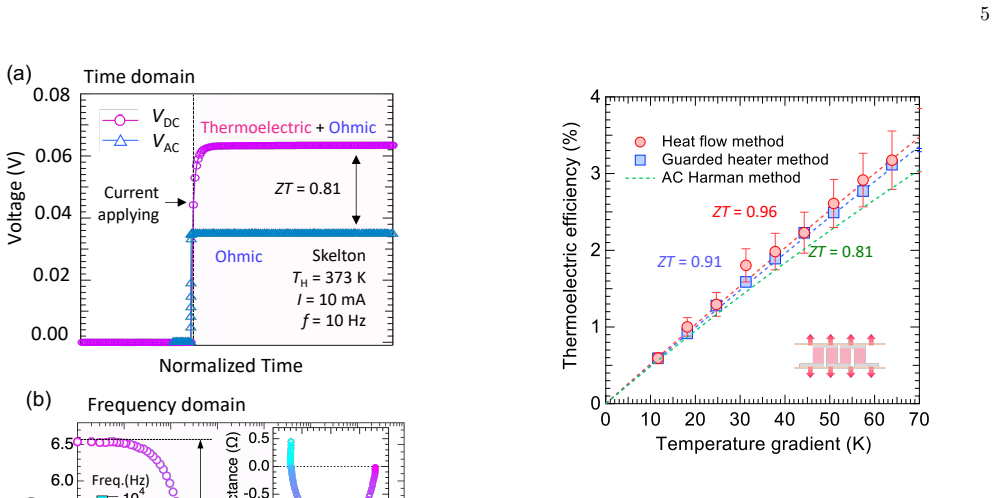
The conversion efficiencies obtained using the heat flow and guarded heater methods showed good agreement within experimental uncertainty for temperature differences up to 70 K. In contrast, the AC Harman method underestimated the conversion efficiency by approximately 30 percent. This underestimation was attributed to boundary-condition effects and radiative heat dissipation, which significantly reduce the effective temperature difference developed across the module in the Harman configuration.
What carries the argument
Finite-element simulations of radiative heat dissipation and substrate-dependent boundary conditions, validated against measurements on commercial Bi2Te3 modules with different substrate materials.
If this is right
- The AC Harman method remains viable for rapid performance screening once modeling and correction strategies account for radiative and boundary losses.
- Quantitative agreement between heat flow and guarded heater methods provides a reliable benchmark for module-level efficiency up to 70 K temperature difference.
- Accurate efficiency evaluation requires explicit treatment of radiative heat losses and substrate boundary conditions in non-ideal thermal setups.
- The comparison supplies data to support development of standardized protocols for thermoelectric module metrology.
Where Pith is reading between the lines
- Modules whose substrates reduce radiative emission or improve thermal contact uniformity could shrink the observed discrepancy in AC Harman tests.
- In-situ temperature sensing inside the module during AC Harman operation would provide an independent check on the simulation corrections.
- Comparable heat-loss corrections may be needed when adapting the AC Harman approach to other dynamic or small-scale thermoelectric characterizations.
- Repeating the comparison at temperature differences above 70 K or with modules of different leg geometries would test whether the 30 percent offset persists.
Load-bearing premise
The finite-element simulations fully capture the radiative heat dissipation and substrate-dependent boundary conditions in the AC Harman configuration without additional unmodeled losses.
What would settle it
An experiment that directly measures the internal temperature gradient across the module while it operates in the AC Harman configuration and compares the result to the simulated effective temperature difference.
Figures


read the original abstract
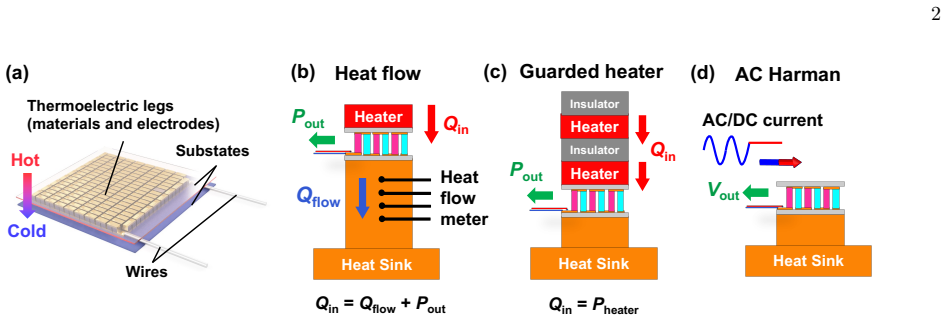
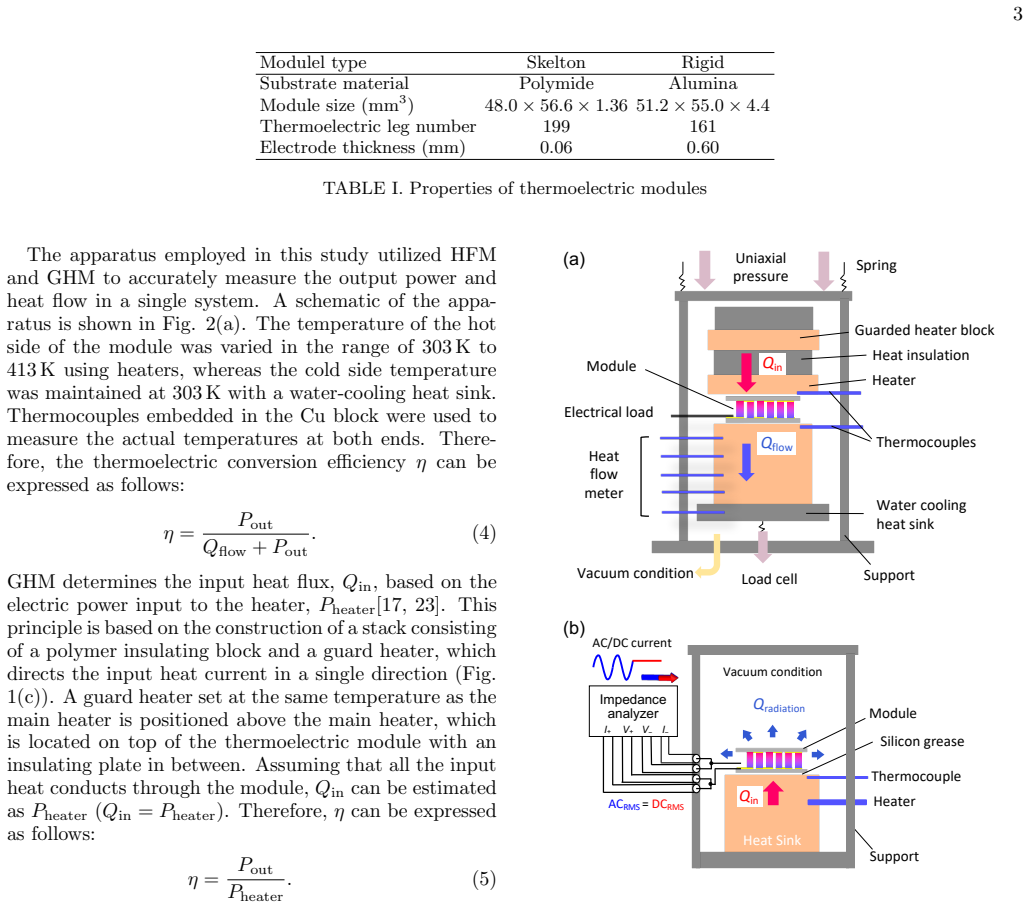
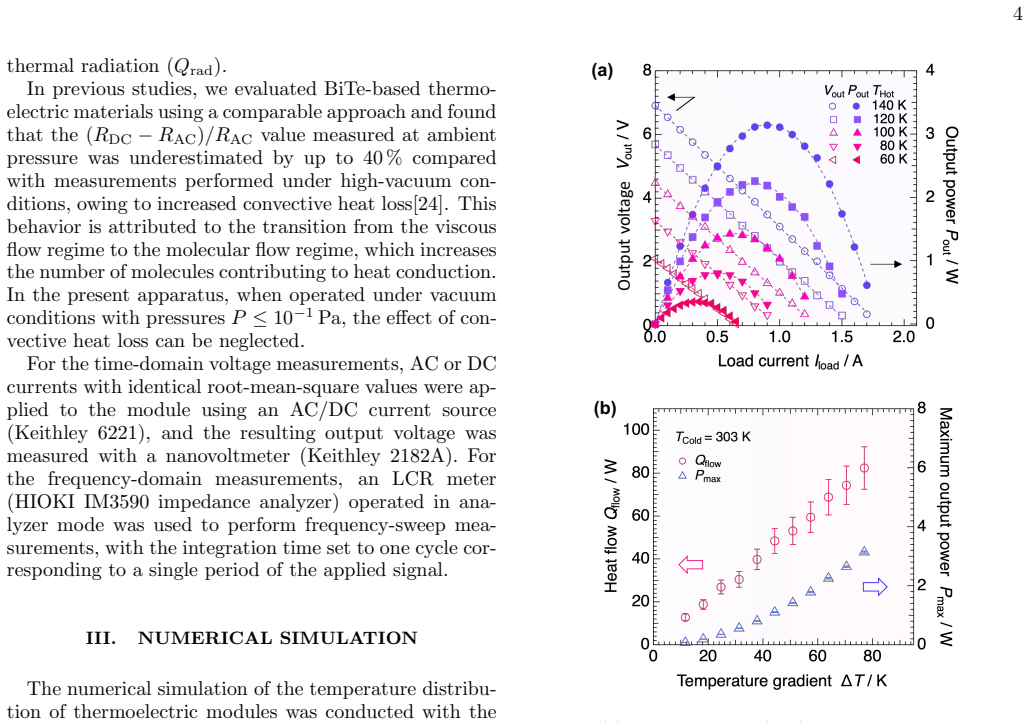
The evaluation of thermoelectric conversion efficiency remains challenging owing to the lack of internationally standardized measurement protocols. Commonly used techniques -- including the heat flow, guarded heater, and AC Harman methods -- differ fundamentally in their operating principles and sensitivity to heat losses. In this study, we benchmark three module-level efficiency measurement techniques -- the heat-flow, guarded heater, and AC Harman methods -- using commercial Bi$_2$Te$_3$-based modules with different substrates materials. The conversion efficiencies obtained using the heat flow and guarded heater methods showed good agreement within experimental uncertainty for temperature differences up to 70 K. In contrast, the AC Harman method underestimated the conversion efficiency by approximately 30 %. Through systematic measurements on modules with different substrates and detailed finite element simulations, this underestimation was attributed to boundary-condition effects and radiative heat dissipation, which significantly reduce the effective temperature difference developed across the module in the Harman configuration. These results highlight the limitations of the AC Harman method for quantitative conversion-efficiency evaluation under non-ideal thermal environments and emphasize the necessity of accounting for radiative and substrate-related heat losses. Nevertheless, with appropriate modeling and correction, strategies, the AC Harman method remains a viable tool for rapid performance screening. Our results provide a quantitative benchmark of major measurement techniques and contribute to clarify best practices for module-level thermoelectric metrology and guide method selection, fully supporting future efforts toward methodological standardization.
Editorial analysis
A structured set of objections, weighed in public.
Referee Report
Summary. The manuscript benchmarks three methods for measuring the conversion efficiency of commercial Bi2Te3-based thermoelectric modules: the heat-flow method, the guarded-heater method, and the AC Harman method. Experiments on modules with different substrate materials show that the heat-flow and guarded-heater methods agree within experimental uncertainty for temperature differences up to 70 K. The AC Harman method underestimates efficiency by approximately 30%, which is attributed to boundary-condition effects and radiative heat dissipation that reduce the effective temperature difference across the module. This attribution is supported by systematic measurements and finite-element simulations; the paper concludes that the AC Harman method remains viable for rapid screening if appropriate modeling and corrections are applied, and calls for better standardization in module-level thermoelectric metrology.
Significance. If the central claims hold, the work supplies a quantitative empirical benchmark across three common techniques, which is valuable given the absence of international standards for thermoelectric module efficiency. The experimental agreement between two independent methods, combined with FEM reproduction of the Harman discrepancy across multiple modules, provides concrete guidance on method selection and the importance of accounting for radiative and substrate-dependent losses. These results directly support ongoing standardization efforts and clarify practical limitations of the AC Harman approach under non-ideal conditions.
major comments (2)
- [§5 (Finite-element modeling)] §5 (Finite-element modeling of the AC Harman configuration): The quantitative attribution of the ~30% efficiency underestimation to radiative dissipation and boundary conditions rests on the FEM results. However, the manuscript provides no direct experimental validation of the simulated temperature profiles or heat fluxes against measurements performed in the actual AC Harman geometry (e.g., no comparison of measured vs. modeled ΔT distributions or substrate temperatures). Without such a check, it remains unclear whether unmodeled effects (contact resistances, emissivity uncertainty, or residual convection) are fully absent, which is load-bearing for the claim that 'appropriate modeling and correction' can restore quantitative accuracy.
- [§4.2 (Efficiency comparison)] §4.2 (Efficiency comparison and uncertainty): The statement that heat-flow and guarded-heater efficiencies 'showed good agreement within experimental uncertainty' is central, yet the propagation of all uncertainty sources (including thermocouple calibration, heat-leak corrections, and substrate thermal resistance) into the final efficiency values is not shown explicitly. This makes it difficult to assess whether the observed agreement is robust or could be affected by correlated systematic errors.
minor comments (2)
- [Abstract] Abstract: The sentence 'contribute to clarify best practices' contains a grammatical error and should read 'contribute to clarifying best practices'.
- [Figures] Figure captions (e.g., those showing efficiency vs. ΔT): Ensure consistent labeling of the three methods and the two substrate types across all panels to avoid reader confusion when comparing data sets.
Simulated Author's Rebuttal
We thank the referee for the constructive and detailed comments. We address each major point below, providing clarifications and indicating where revisions will be made to strengthen the manuscript.
read point-by-point responses
-
Referee: [§5 (Finite-element modeling)] §5 (Finite-element modeling of the AC Harman configuration): The quantitative attribution of the ~30% efficiency underestimation to radiative dissipation and boundary conditions rests on the FEM results. However, the manuscript provides no direct experimental validation of the simulated temperature profiles or heat fluxes against measurements performed in the actual AC Harman geometry (e.g., no comparison of measured vs. modeled ΔT distributions or substrate temperatures). Without such a check, it remains unclear whether unmodeled effects (contact resistances, emissivity uncertainty, or residual convection) are fully absent, which is load-bearing for the claim that 'appropriate modeling and correction' can restore quantitative accuracy.
Authors: We acknowledge the value of direct experimental validation of the internal temperature profiles. However, inserting additional thermocouples or sensors into the AC Harman setup to measure ΔT distributions would necessarily alter the thermal boundary conditions, introduce new parasitic heat paths, and invalidate the very configuration being modeled. Our FEM simulations were instead validated indirectly through quantitative reproduction of the measured efficiency discrepancy (∼30%) across multiple modules with different substrates and over the full range of temperature differences, using independently determined material properties and emissivities. To address the referee's concern, we will add a new subsection in §5 that explicitly discusses model assumptions, quantifies the sensitivity to emissivity and contact resistance, and explains why residual convection is negligible under the vacuum conditions used. This will clarify the basis for our claim that appropriate corrections can restore accuracy while acknowledging the absence of direct profile measurements. revision: partial
-
Referee: [§4.2 (Efficiency comparison)] §4.2 (Efficiency comparison and uncertainty): The statement that heat-flow and guarded-heater efficiencies 'showed good agreement within experimental uncertainty' is central, yet the propagation of all uncertainty sources (including thermocouple calibration, heat-leak corrections, and substrate thermal resistance) into the final efficiency values is not shown explicitly. This makes it difficult to assess whether the observed agreement is robust or could be affected by correlated systematic errors.
Authors: We agree that an explicit uncertainty budget is necessary to demonstrate the robustness of the agreement between the heat-flow and guarded-heater methods. Although the manuscript reports combined uncertainties, the full propagation chain was not detailed. In the revised manuscript we will add a dedicated subsection (or appendix) that tabulates all uncertainty sources—thermocouple calibration, heat-leak corrections, substrate thermal resistance, power measurement, and temperature stability—together with their individual contributions and the quadrature summation used to obtain the final efficiency uncertainties. This will allow readers to evaluate potential correlations and confirm that the observed agreement lies within the stated experimental uncertainty. revision: yes
Circularity Check
No circularity; claims rest on independent experiments and standard FEM
full rationale
The paper benchmarks three distinct experimental methods (heat flow, guarded heater, AC Harman) on commercial Bi2Te3 modules, reporting direct agreement between the first two and a ~30% underestimation by the third. The attribution to boundary conditions and radiation is obtained from standard finite-element heat-transfer modeling rather than from any fitted parameter or self-referential equation. No derivation step reduces a prediction to its own input by construction, no uniqueness theorem is imported from prior self-work, and no ansatz is smuggled via self-citation. The chain is therefore self-contained against external benchmarks.
Axiom & Free-Parameter Ledger
axioms (1)
- domain assumption Finite-element modeling accurately represents radiative heat transfer and thermal boundary conditions when material properties and geometry are known
Lean theorems connected to this paper
-
IndisputableMonolith/Foundation/RealityFromDistinction.leanreality_from_one_distinction unclearThe conversion efficiencies obtained using the heat flow and guarded heater methods showed good agreement... AC Harman method underestimated... attributed to boundary-condition effects and radiative heat dissipation... finite element simulations
Reference graph
Works this paper leans on
- [1]
-
[2]
L. E. Bell, Science321, 1457 (2008)
work page 2008
-
[3]
T.-R. Wei, M. Guan, J. Yu, T. Zhu, L. Chen, and X. Shi, Joule2, 2183 (2018)
work page 2018
-
[4]
C. G. C. Carducci, M. Spadavecchia, and F. Attivissimo, Energy Conversion and Management223, 113325 (2020)
work page 2020
- [5]
-
[6]
H. Wang, W. Porter, H. Bottner, J. Konig, L. Chen, S. Bai, T. Tritt, A. Mayolet, J. Senawiratne, C. Smith, F. Harris, P. Girbert, J. L. J.W. Sharp, H. Kleinke, and L. Kiss, J. Electron. Mater.42, 654 (2013)
work page 2013
-
[7]
H. Wang, S. Bai, L. Chen, A. Cuenat, G. Joshi, H. Kleinke, J. Konig, H. Lee, J. Martin, M.-W. Oh, W. Porter, Z. Ren, J. Salvador, J. Sharp, P. Taylor, A. Thompson, and Y. Tseng, J. Electron. Mater.44, 482 (2015)
work page 2015
- [8]
-
[9]
H. Wang, R. McCarty, J. R. Salvador, A. Yamamoto, and J. K¨ onig, J. Electron. Mater.43, 2274 (2014)
work page 2014
-
[10]
P. Ziolkowski, P. Blaschkewitz, B. Ryu, S. Park, and E. M¨ uller, Materials15, 1627 (2022)
work page 2022
-
[11]
P. Ziolkowski, R. Chetty, P. Blaschkewitz, M. Ohta, A. Yamamoto, and E. M¨ uller, Energy Technology8 (2020)
work page 2020
-
[12]
P. Ziolkowski, P. Blaschkewitz, and E. M¨ uller, Measure- ment177, 109247 (2021)
work page 2021
-
[13]
P. Ziolkowski, P. Blaschkewitz, and E. M¨ uller, Measure- ment167, 108273 (2021)
work page 2021
- [14]
- [15]
-
[16]
H. Iwasaki, S. ya Yokoyama, T. Tsukui, M. Koyano, H. Hori, and S. Sano, Jpn. J. Appl. Phys.42, 3703 (2003)
work page 2003
-
[17]
L. Rauscher, H. Kaibe, H. Ishimabushi, S. Sano, E. Muller, and D. Platzek, Proceedings ICT’03. 22nd International Conference on Thermoelectrics (IEEE Cat. No.03TH8726) , 508 (2003)
work page 2003
-
[18]
H. Takazawa, H. Obara, Y. Okada, K. Kobayashi, T. On- ishi, and T. Kajikawa, 2006 25th International Confer- ence on Thermoelectrics , 189 (2006)
work page 2006
-
[19]
R. D. Pierce and R. J. Stevens, J. Electron. Mater.44, 1796 (2015)
work page 2015
-
[20]
K. Zhu, S. Bai, H. S. Kim, and W. Liu, Chinese Physics B31, 048502 (2022)
work page 2022
-
[21]
H. He, Z. Fang, C. Niu, Y. Wu, and M. Rong, Energy Convers. Manag.241, 114314 (2021)
work page 2021
- [22]
-
[23]
L. Rauscher, S. Fujimoto, H. T. Kaibe, and S. Sano, Measurement Science and Technology16, 1054 (2005)
work page 2005
- [24]
- [25]
-
[26]
H. Yang, Y. Li, C. Yu, W. Zhou, Q. Zhang, H. Hu, P. Sun, J. Wu, X. Tan, G. Liu, K. Song, and J. Jiang, Appl. Thermal. Enginneering245, 122815 (2024)
work page 2024
- [27]
- [28]
-
[29]
L. Cai, P. Li, Q. Luo, H. Yan, P. Zhai, and P. Gao, Journal of Power Sources477, 228713 (2020)
work page 2020
-
[30]
S. Qing, H. Yuan, W. Chen, A. Rezania, L. Rosendahl, and S. Tang, Applied Thermal Engineering243, 122643 (2024)
work page 2024
-
[31]
C.-Y. Yoo, H. Yoon, and S. H. Park, Journal of Elec- tronic Materials48, 1833 (2019)
work page 2019
- [32]
- [33]
-
[34]
E. Sandoz-Rosado and R. J. Stevens, Journal of Elec- tronic Materials38, 1239 (2009)
work page 2009
-
[35]
Bjørk, Journal of Electronic Materials44, 2869 (2015)
R. Bjørk, Journal of Electronic Materials44, 2869 (2015)
work page 2015
- [36]
-
[37]
G. Xu, Y. Duan, X. Chen, T. Ming, and X. Huanga, Appl. Thermal. Enginneering169, 114933 (2020)
work page 2020
-
[38]
P. H. Ngan, N. Van Nong, L. T. Hung, B. Balke, L. Han, E. M. J. Hedegaard, S. Linderoth, and N. Pryds, Journal of Electronic Materials45, 594 (2015). 10
work page 2015
- [39]
- [40]
-
[41]
Y. Li, H. Yang, C. Yu, W. Zhou, Q. Zhang, H. Hu, P. Sun, J. Wu, X. Tan, K. Song, G. Liu, and J. Jiang, Energies 17, 1036 (2024)
work page 2024
- [42]
-
[43]
X. Hu, A. Yamamoto, M. Ohta, and H. Nishiate, Rev. Sci. Instrum.86, 045103 (2015)
work page 2015
- [44]
-
[45]
D. M. Rowe and G. Min, Journal of Power Sources73, 193 (1998)
work page 1998
- [46]
-
[47]
M. T. Dunham, M. T. Barako, S. LeBlanc, M. Asheghi, B. Chen, and K. E. Goodson, Energy93, 2006 (2015)
work page 2006
- [48]
-
[49]
Q. Zuo, Y. Xie, W. Chen, X. Zhu, Y. Tang, Y. Xie, H. Zhang, and Y. Ma, Applied Thermal Engineering 226, 120330 (2023)
work page 2023
-
[50]
A. Montecucco, J. Siviter, and A. R. Knox, Applied Energy123, 47 (2014)
work page 2014
-
[51]
H. S. Kim, W. Liu, G. Chen, C.-W. Chu, and Z. Ren, Proceedings of the National Academy of Sciences112, 8205 (2015)
work page 2015
-
[52]
H. Armstrong, M. Boese, C. Carmichael, H. Dimich, D. Seay, N. Sheppard, and M. Beekman, Journal of Elec- tronic Materials46, 6 (2016)
work page 2016
-
[53]
H. S. Kim, W. Liu, and Z. Ren, Energy and Environ- mental Science10, 69 (2017)
work page 2017
-
[54]
G. J. Snyder and A. H. Snyder, Energy and Environmen- tal Science10, 2280 (2017)
work page 2017
-
[55]
B. Ryu, J. Chung, E.-A. Choi, P. Ziolkowski, E. M¨ uller, and S. Park, Applied Physics Letters116(2020)
work page 2020
- [56]
discussion (0)
Sign in with ORCID, Apple, or X to comment. Anyone can read and Pith papers without signing in.