Recognition: 2 theorem links
· Lean TheoremDeep Probabilistic Unfolding for Quantized Compressive Sensing
Pith reviewed 2026-05-13 01:14 UTC · model grok-4.3
The pith
A closed-form likelihood gradient projection respects true quantization physics within deep unfolding for compressive sensing.
A machine-rendered reading of the paper's core claim, the machinery that carries it, and where it could break.
Core claim
By deriving a closed-form, numerically stable likelihood gradient projection inside an unfolding framework, the model respects the true quantization physics of compressive sensing and converts the hard quantization constraint into soft probabilistic guidance. An efficient dual-domain Mamba module is added to dynamically capture and fuse multi-scale local and global features while modeling interactions between distant but correlated regions, yielding state-of-the-art reconstruction performance.
What carries the argument
The closed-form likelihood gradient projection that supplies soft probabilistic guidance from true quantization physics, together with the dual-domain Mamba module that fuses multi-scale local and global features.
If this is right
- Reconstructions align more closely with physical quantization effects instead of relying on L2 approximation.
- Multi-scale correlations across distant image regions are modeled through dynamic feature fusion.
- Overall accuracy and efficiency improve for quantized compressive sensing tasks.
- Real-world deployment of quantized compressive sensing becomes more practical due to higher performance.
Where Pith is reading between the lines
- The same closed-form projection technique could be adapted to other inverse problems that involve discretization.
- Mamba-based dual-domain fusion may transfer to additional image reconstruction settings that require both local detail and long-range context.
- Iterative stability of the projection supports scaling to deeper unfolding networks.
Load-bearing premise
The closed-form likelihood gradient projection stays accurate and stable across unfolding iterations while the dual-domain Mamba module captures required multi-scale correlations without artifacts.
What would settle it
Reconstruction error or numerical instability appearing when the model is tested on varying quantization bit depths or different sensing matrices, relative to standard L2-projection baselines.
Figures

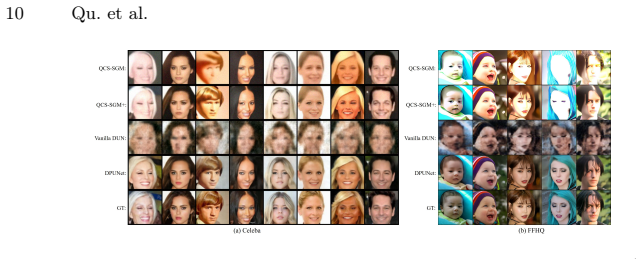


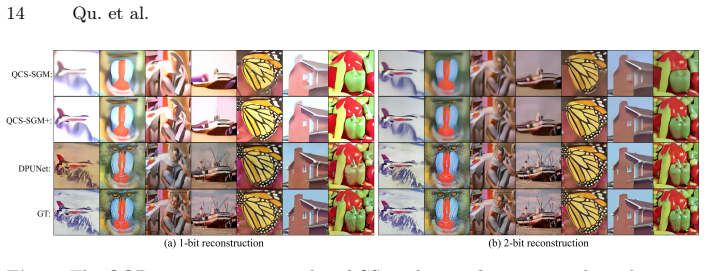
read the original abstract
We propose a deep probabilistic unfolding model to address the classical quantized compressive sensing problem that leverages an unfolding framework to enhance the reconstruction accuracy and efficiency. Unlike previous unfolding methods that apply L2 projection to measurements, we derive a closed-form, numerically stable likelihood gradient projection, which allows the model to respect the true quantization physics, turning the hard quantization constraint into a soft probabilistic guidance. Furthermore, an efficient, dual-domain Mamba module is specifically designed to dynamically capture and fuse the multi-scale local and global features, ensuring the interactions between the distant but correlated regions. Extensive experiments demonstrate the state-of-the-art performance of the proposed method over previous works, which is capable of promoting the application of quantized compressive sensing in real life.
Editorial analysis
A structured set of objections, weighed in public.
Referee Report
Summary. The paper proposes a deep probabilistic unfolding model for quantized compressive sensing. It derives a closed-form, numerically stable likelihood gradient projection to replace L2 projections, converting hard quantization constraints into soft probabilistic guidance within the unfolding iterations. A dual-domain Mamba module is introduced to capture and fuse multi-scale local and global features. Extensive experiments are reported to demonstrate state-of-the-art reconstruction performance over prior methods.
Significance. If the closed-form derivation is correct and the projection remains stable, the approach could meaningfully advance quantized CS by better respecting quantization physics rather than relying on heuristic projections, with the Mamba integration offering efficiency gains for multi-scale correlations. This has potential for practical sensing applications if the SOTA claims hold under rigorous validation.
major comments (2)
- [Method (derivation of likelihood gradient projection)] The central claim of a closed-form, numerically stable likelihood gradient projection (abstract and method) requires explicit verification that it does not accumulate errors or become unstable across unfolding iterations. No iteration-wise error monitoring, finite-difference gradient comparisons, or ablations on iteration count/bit-depth are described, which is load-bearing for the claim that the model respects true quantization physics without drift.
- [Experiments and ablation studies] The dual-domain Mamba module's ability to capture multi-scale correlations without artifacts or extra distributional assumptions is asserted but not load-bearing tested via controlled ablations (e.g., vs. standard attention or CNN baselines) in the experiments section; this underpins the efficiency and SOTA claims.
minor comments (2)
- [Abstract] The abstract claims 'state-of-the-art performance' but should include specific quantitative metrics (e.g., PSNR/SSIM gains) and dataset details for immediate clarity.
- [Method] Notation for the projection operator and likelihood gradient should be defined more explicitly with equation numbers to aid reproducibility.
Simulated Author's Rebuttal
We thank the referee for the constructive and insightful comments. We address each major point below and will revise the manuscript to incorporate additional verification and ablation studies as outlined.
read point-by-point responses
-
Referee: [Method (derivation of likelihood gradient projection)] The central claim of a closed-form, numerically stable likelihood gradient projection (abstract and method) requires explicit verification that it does not accumulate errors or become unstable across unfolding iterations. No iteration-wise error monitoring, finite-difference gradient comparisons, or ablations on iteration count/bit-depth are described, which is load-bearing for the claim that the model respects true quantization physics without drift.
Authors: We thank the referee for emphasizing the importance of empirical verification for the stability claim. The closed-form likelihood gradient projection is derived to ensure numerical stability by replacing direct L2 operations with a bounded probabilistic update that respects quantization intervals without matrix inversion. While the paper presents the derivation and overall performance, we acknowledge the absence of the requested diagnostics. In the revised manuscript, we will add iteration-wise error monitoring, finite-difference gradient comparisons, and ablations across iteration counts and bit-depths to demonstrate that errors do not accumulate and the projection remains faithful to quantization physics. revision: yes
-
Referee: [Experiments and ablation studies] The dual-domain Mamba module's ability to capture multi-scale correlations without artifacts or extra distributional assumptions is asserted but not load-bearing tested via controlled ablations (e.g., vs. standard attention or CNN baselines) in the experiments section; this underpins the efficiency and SOTA claims.
Authors: We agree that controlled ablations are essential to validate the dual-domain Mamba module's contributions. The current experiments demonstrate overall SOTA results, but we will strengthen the manuscript by adding targeted ablations in the revised version: replacing the Mamba blocks with standard attention and CNN baselines while keeping other components fixed, and reporting reconstruction quality, runtime, and parameter efficiency. Feature map visualizations will also be included to illustrate multi-scale fusion without artifacts or additional assumptions. revision: yes
Circularity Check
No circularity: closed-form derivation starts from quantization likelihood
full rationale
The paper's central step is deriving a closed-form numerically stable likelihood gradient projection directly from the quantization likelihood function, which converts the hard constraint into soft probabilistic guidance inside the unfolding iterations. This is presented as a first-principles derivation rather than a fit to data or a self-citation. No equations reduce by construction to fitted parameters, prior self-cited results, or renamed empirical patterns. The dual-domain Mamba module is an architectural choice for feature fusion, not a load-bearing mathematical claim that collapses to inputs. The derivation chain remains independent of the target reconstruction performance, consistent with the reader's assessment of no obvious reduction.
Axiom & Free-Parameter Ledger
free parameters (1)
- neural network weights and Mamba parameters
axioms (1)
- domain assumption The quantization process admits a likelihood function whose gradient projection is closed-form and numerically stable.
Lean theorems connected to this paper
-
IndisputableMonolith/Cost/FunctionalEquation.leanwashburn_uniqueness_aczel unclearderive a closed-form, numerically stable likelihood gradient projection... Mills ratio... Gaussian CDF differences
-
IndisputableMonolith/Foundation/ArithmeticFromLogic.leanLogicNat uncleardual-domain Mamba block... spatial and spectral state-space modeling
Reference graph
Works this paper leans on
-
[1]
IEEE Transactions on Signal Processing67(20), 5297–5308 (2019)
Ameri, A., Bose, A., Li, J., Soltanalian, M.: One-bit radar processing with time- varying sampling thresholds. IEEE Transactions on Signal Processing67(20), 5297–5308 (2019)
work page 2019
-
[2]
In: 2008 42nd Annual Conference on Information Sciences and Systems
Boufounos, P.T., Baraniuk, R.G.: 1-bit compressive sensing. In: 2008 42nd Annual Conference on Information Sciences and Systems. pp. 16–21. IEEE (2008) Deep Probabilistic Unfolding for Quantized Compressive Sensing 15
work page 2008
-
[3]
In: Compressed Sensing and its Applications: MATHEON Workshop 2013
Boufounos,P.T.,Jacques,L.,Krahmer,F.,Saab,R.:Quantizationandcompressive sensing. In: Compressed Sensing and its Applications: MATHEON Workshop 2013. pp. 193–237. Springer (2015)
work page 2013
-
[4]
In: 2016 IEEE First International Conference on Internet-of-Things Design and Implementation (IoTDI)
Cao, D.Y., Yu, K., Zhuo, S.G., Hu, Y.H., Wang, Z.: On the implementation of compressive sensing on wireless sensor network. In: 2016 IEEE First International Conference on Internet-of-Things Design and Implementation (IoTDI). pp. 229–
work page 2016
-
[5]
IEEE Trans- actions on Image Processing31, 5412–5426 (2022)
Chen, B., Zhang, J.: Content-aware scalable deep compressed sensing. IEEE Trans- actions on Image Processing31, 5412–5426 (2022)
work page 2022
-
[6]
IEEE Transactions on Image Processing23(8), 3618–3632 (2014)
Dong, W., Shi, G., Li, X., Ma, Y., Huang, F.: Compressive sensing via nonlocal low-rank regularization. IEEE Transactions on Image Processing23(8), 3618–3632 (2014)
work page 2014
-
[7]
IEEE Signal Pro- cessing Magazine25(2), 83–91 (2008)
Duarte, M.F., Davenport, M.A., Takhar, D., Laska, J.N., Sun, T., Kelly, K.F., Baraniuk, R.G.: Single-pixel imaging via compressive sampling. IEEE Signal Pro- cessing Magazine25(2), 83–91 (2008)
work page 2008
-
[8]
In: Proceedings of the IEEE/CVF Conference on Computer Vision and Pattern Recognition
Guo, Z., Gan, H.: Cpp-net: Embracing multi-scale feature fusion into deep unfold- ing cp-ppa network for compressive sensing. In: Proceedings of the IEEE/CVF Conference on Computer Vision and Pattern Recognition. pp. 25086–25095 (2024)
work page 2024
-
[9]
IEEE Transactions on Signal and Information Processing over Networks5(1), 15– 30 (2018)
Kafle, S., Gupta, V., Kailkhura, B., Wimalajeewa, T., Varshney, P.K.: Joint spar- sity pattern recovery with 1-b compressive sensing in distributed sensor networks. IEEE Transactions on Signal and Information Processing over Networks5(1), 15– 30 (2018)
work page 2018
-
[10]
arXiv preprint arXiv:2502.12762 (2025)
Kafle, S., Joseph, G., Varshney, P.K.: One-bit compressed sensing using generative models. arXiv preprint arXiv:2502.12762 (2025)
-
[11]
IEEE Transactions on Signal Processing72, 3792–3804 (2022)
Kafle, S., Wimalajeewa, T., Varshney, P.K.: Noisy one-bit compressed sensing with side-information. IEEE Transactions on Signal Processing72, 3792–3804 (2022)
work page 2022
-
[12]
IEEE Signal Processing Letters19(10), 607–610 (2012)
Kamilov, U.S., Bourquard, A., Amini, A., Unser, M.: One-bit measurements with adaptive thresholds. IEEE Signal Processing Letters19(10), 607–610 (2012)
work page 2012
-
[13]
Progressive Growing of GANs for Improved Quality, Stability, and Variation
Karras, T., Aila, T., Laine, S., Lehtinen, J.: Progressive growing of gans for im- proved quality, stability, and variation. arXiv preprint arXiv:1710.10196 (2017)
work page internal anchor Pith review Pith/arXiv arXiv 2017
-
[14]
In: Proceedings of the IEEE International Confer- ence on Image Processing (ICIP) (2010)
Kim, Y., Nadar, M.S., Bilgin, A.: Compressed sensing using a gaussian scale mix- tures model in wavelet domain. In: Proceedings of the IEEE International Confer- ence on Image Processing (ICIP) (2010)
work page 2010
-
[15]
In: ProceedingsoftheIEEE/CVFConferenceonComputerVisionandPatternRecog- nition (CVPR)
Kulkarni, K., Lohit, S., Turaga, P., Kerviche, R., Ashok, A.: Reconnet: Non- iterative reconstruction of images from compressively sensed measurements. In: ProceedingsoftheIEEE/CVFConferenceonComputerVisionandPatternRecog- nition (CVPR). pp. 449–458 (2016)
work page 2016
-
[16]
IEEE Signal Processing Letters22(7), 857–861 (2014)
Li, F., Fang, J., Li, H., Huang, L.: Robust one-bit bayesian compressed sensing with sign-flip errors. IEEE Signal Processing Letters22(7), 857–861 (2014)
work page 2014
-
[17]
In: Proceedings of the Computer Vision and Pattern Recognition Conference
Liao, C., Shen, Y., Li, D., Wang, Z.: Using powerful prior knowledge of diffusion model in deep unfolding networks for image compressive sensing. In: Proceedings of the Computer Vision and Pattern Recognition Conference. pp. 18000–18010 (2025)
work page 2025
-
[18]
In: Proceedings of the IEEE international conference on computer vision
Liu, Z., Luo, P., Wang, X., Tang, X.: Deep learning face attributes in the wild. In: Proceedings of the IEEE international conference on computer vision. pp. 3730– 3738 (2015)
work page 2015
-
[19]
In: International Conference on Learning Representations
Meng, X., Kabashima, Y.: Quantized compressed sensing with score-based genera- tive models. In: International Conference on Learning Representations. pp. 23487– 23516 (2023)
work page 2023
-
[20]
In: Proceedings of the AAAI Conference on Artifi- cial Intelligence
Meng,X., Kabashima, Y.: Qcs-sgm+: Improved quantized compressed sensing with score-based generative models. In: Proceedings of the AAAI Conference on Artifi- cial Intelligence. vol. 38, pp. 14341–14349 (2024) 16 Qu. et al
work page 2024
-
[21]
International Journal of Computer Vision131(11), 2933–2958 (2023)
Meng, Z., Yuan, X., Jalali, S.: Deep unfolding for snapshot compressive imaging. International Journal of Computer Vision131(11), 2933–2958 (2023)
work page 2023
-
[22]
In: Advances in Neural Information Processing Systems (NeurIPS)
Metzler, C., Mousavi, A., Baraniuk, R.: Learned d-amp: Principled neural network based compressive image recovery. In: Advances in Neural Information Processing Systems (NeurIPS). vol. 30 (2017)
work page 2017
-
[23]
IEEE Transactions on Information Theory62(9), 5117–5144 (2016)
Metzler, C.A., Maleki, A., Baraniuk, R.G.: From denoising to compressed sensing. IEEE Transactions on Information Theory62(9), 5117–5144 (2016)
work page 2016
-
[24]
In: 2016 IEEE Global Conference on Signal and Information Processing (GlobalSIP)
Musa, O., Hannak, G., Goertz, N.: Generalized approximate message passing for one-bit compressed sensing with awgn. In: 2016 IEEE Global Conference on Signal and Information Processing (GlobalSIP). pp. 1428–1432. IEEE (2016)
work page 2016
-
[25]
Oh, Y., Lee, N., Jeon, Y.S., Poor, H.V.: Communication-efficient federated learning viaquantizedcompressedsensing.IEEETransactionsonWirelessCommunications 22(2), 1087–1100 (2022)
work page 2022
-
[26]
IEEE Transactions on Information Theory 59(1), 482–494 (2012)
Plan, Y., Vershynin, R.: Robust 1-bit compressed sensing and sparse logistic regres- sion: A convex programming approach. IEEE Transactions on Information Theory 59(1), 482–494 (2012)
work page 2012
-
[27]
arXiv preprint arXiv:2501.01262 (2025)
Qin, M., Feng, Y., Wu, Z., Zhang, Y., Yuan, X.: Detail matters: Mamba-inspired joint unfolding network for snapshot spectral compressive imaging. arXiv preprint arXiv:2501.01262 (2025)
-
[28]
Optics and Lasers in Engineering155, 107053 (2022)
Qu, G., Meng, X., Yin, Y., Yang, X.: A demosaicing method for compressive color single-pixel imaging based on a generative adversarial network. Optics and Lasers in Engineering155, 107053 (2022)
work page 2022
-
[29]
In: Proceedings of the IEEE/CVF Conference on Computer Vision and Pattern Recognition
Qu, G., Wang, P., Yuan, X.: Dual-scale transformer for large-scale single-pixel imaging. In: Proceedings of the IEEE/CVF Conference on Computer Vision and Pattern Recognition. pp. 25327–25337 (2024)
work page 2024
-
[30]
IEEE Journal of Selected Topics in Signal Processing pp
Qu,G.,Zheng,S.,Qin,M.,Yuan,X.:Bmvc+:Anenhancedblockmodulationvideo compression codec for large-scale image compression. IEEE Journal of Selected Topics in Signal Processing pp. 1–12 (2025).https://doi.org/10.1109/JSTSP. 2025.3634288
-
[31]
IEEE Transactions on Image Processing31, 6991–7005 (2022)
Shen, M., Gan, H., Ning, C., Hua, Y., Zhang, T.: Transcs: a transformer-based hybrid architecture for image compressed sensing. IEEE Transactions on Image Processing31, 6991–7005 (2022)
work page 2022
-
[32]
In: 2013 IEEE China Summit and International Confer- ence on Signal and Information Processing
Shen, Y., Fang, J., Li, H.: One-bit compressive sensing and source localization in wireless sensor networks. In: 2013 IEEE China Summit and International Confer- ence on Signal and Information Processing. pp. 379–383. IEEE (2013)
work page 2013
-
[33]
In: Proceedings of the 29th ACM international conference on multimedia
Song, J., Chen, B., Zhang, J.: Memory-augmented deep unfolding network for compressive sensing. In: Proceedings of the 29th ACM international conference on multimedia. pp. 4249–4258 (2021)
work page 2021
-
[34]
Advances in neural information processing systems32(2019)
Song, Y., Ermon, S.: Generative modeling by estimating gradients of the data distribution. Advances in neural information processing systems32(2019)
work page 2019
-
[35]
In: 2017 3rd IEEE International Conference on Computer and Communications (ICCC)
Tang, W., Xu, W., Zhang, X., Lin, J.: A low-cost channel feedback scheme in mmwave massive mimo system. In: 2017 3rd IEEE International Conference on Computer and Communications (ICCC). pp. 89–93. IEEE (2017)
work page 2017
-
[36]
Neural computation23(7), 1661–1674 (2011)
Vincent, P.: A connection between score matching and denoising autoencoders. Neural computation23(7), 1661–1674 (2011)
work page 2011
-
[37]
Optics Letters48(18), 4813–4816 (2023)
Wang, P., Wang, L., Qiao, M., Yuan, X.: Full-resolution and full-dynamic-range coded aperture compressive temporal imaging. Optics Letters48(18), 4813–4816 (2023)
work page 2023
-
[38]
Wang, P., Wang, L., Qu, G., Wang, X., Zhang, Y., Yuan, X.: Proximal algorithm unrolling: Flexible and efficient reconstruction networks for single-pixel imaging. Deep Probabilistic Unfolding for Quantized Compressive Sensing 17 In: Proceedings of the IEEE/CVF Conference on Computer Vision and Pattern Recognition (CVPR). pp. 411–421 (June 2025)
work page 2025
-
[39]
In: Proceedings of the IEEE/CVF International Conference on Computer Vision
Wang, P., Wang, L., Yuan, X.: Deep optics for video snapshot compressive imaging. In: Proceedings of the IEEE/CVF International Conference on Computer Vision. pp. 10646–10656 (2023)
work page 2023
-
[40]
In: European Conference on Computer Vision
Wang, P., Zhang, Y., Wang, L., Yuan, X.: Hierarchical separable video transformer for snapshot compressive imaging. In: European Conference on Computer Vision. pp. 104–122. Springer (2024)
work page 2024
-
[41]
In: Advances in Neural Infor- mation Processing Systems (NeurIPS) (2025)
Wang, X., He, Z., Wang, P., Wang, L., Hu, Y., Yuan, X.: Spectral compressive imaging via chromaticity-intensity decomposition. In: Advances in Neural Infor- mation Processing Systems (NeurIPS) (2025)
work page 2025
-
[42]
IEEE Transactions on Signal Processing60(7), 3868–3875 (2012)
Yan, M., Yang, Y., Osher, S.: Robust 1-bit compressive sensing using adaptive outlier pursuit. IEEE Transactions on Signal Processing60(7), 3868–3875 (2012)
work page 2012
-
[43]
IEEE Transactions on Signal Processing (2025)
Yang, M.H., Huang, L.C.: Enhancing 1-bit compressive sensing with support esti- mation in noisy wireless sensor networks. IEEE Transactions on Signal Processing (2025)
work page 2025
-
[44]
IEEE Transactions on Signal Processing61(11), 2815–2824 (2013)
Yang, Z., Xie, L., Zhang, C.: Variational bayesian algorithm for quantized com- pressed sensing. IEEE Transactions on Signal Processing61(11), 2815–2824 (2013)
work page 2013
-
[45]
IEEE Signal Processing Magazine38(2), 65–88 (2021).https://doi.org/10.1109/MSP.2020.3023869
Yuan, X., Brady, D.J., Katsaggelos, A.K.: Snapshot compressive imaging: The- ory, algorithms, and applications. IEEE Signal Processing Magazine38(2), 65–88 (2021).https://doi.org/10.1109/MSP.2020.3023869
-
[46]
IEEE Sensors Journal16(22), 8091–8102 (2016).https://doi.org/10.1109/JSEN.2016.2609201
Yuan, X., Jiang, H., Huang, G., Wilford, P.A.: Slope: Shrinkage of local overlapping patches estimator for lensless compressive imaging. IEEE Sensors Journal16(22), 8091–8102 (2016).https://doi.org/10.1109/JSEN.2016.2609201
-
[47]
Optics Express26(2), 1962–1977 (Jan 2018)
Yuan, X., Pu, Y.: Parallel lensless compressive imaging via deep convolutional neural networks. Optics Express26(2), 1962–1977 (Jan 2018)
work page 1962
-
[48]
In: Proceedings of the IEEE/CVF Conference on Computer Vision and Pattern Recognition (CVPR)
Zhang, J., Ghanem, B.: Ista-net: Interpretable optimization-inspired deep network for image compressive sensing. In: Proceedings of the IEEE/CVF Conference on Computer Vision and Pattern Recognition (CVPR). pp. 1828–1837 (2018)
work page 2018
-
[49]
Advanced Imaging1(2), 021002 (2024)
Zheng,S.,Xue,Y.,Tahir,W.,Wang,Z.,Zhang,H.,Meng,Z.,Qu,G.,Ma,S.,Yuan, X.: Block-modulating video compression: an ultralow complexity image compres- sion encoder for resource-limited platforms. Advanced Imaging1(2), 021002 (2024)
work page 2024
-
[50]
Deformable DETR: Deformable Transformers for End-to-End Object Detection
Zhu, X., Su, W., Lu, L., Li, B., Wang, X., Dai, J.: Deformable detr: Deformable transformers for end-to-end object detection. arXiv preprint arXiv:2010.04159 (2020)
work page internal anchor Pith review Pith/arXiv arXiv 2010
-
[51]
IEEE Signal Processing Letters17(2), 149–152 (2009)
Zymnis, A., Boyd, S., Candes, E.: Compressed sensing with quantized measure- ments. IEEE Signal Processing Letters17(2), 149–152 (2009)
work page 2009
discussion (0)
Sign in with ORCID, Apple, or X to comment. Anyone can read and Pith papers without signing in.