Recognition: 2 theorem links
· Lean TheoremExploiting independence constraints for efficient estimation of bounds on causal effects in the presence of unmeasured confounding
Pith reviewed 2026-05-13 01:33 UTC · model grok-4.3
The pith
Exploiting conditional independences from a causal graph improves efficiency of semiparametric estimators for bounds on causal effects under unmeasured confounding.
A machine-rendered reading of the paper's core claim, the machinery that carries it, and where it could break.
Core claim
We propose an influence function projection approach that exploits the conditional independence constraints implied by the graph to improve the efficiency of semiparametric estimators of upper and lower bounds on the average causal effect under a given sensitivity analysis model. Our approach applies across multiple sensitivity analysis frameworks and causal estimands, thereby connecting knowledge of graphical structure with the sensitivity analysis literature.
What carries the argument
Influence function projection onto graph-implied conditional independence constraints to reduce variance in bound estimators.
If this is right
- Estimators of causal bounds achieve strictly lower asymptotic variance while preserving the same identification assumptions.
- The projection method extends to multiple existing sensitivity analysis frameworks and a range of causal estimands.
- Graphical knowledge improves finite-sample performance of bound estimators in non-point-identified settings.
- Real-data examples demonstrate gains for labor training effects and medical outcome studies affected by unmeasured confounding.
Where Pith is reading between the lines
- Partial knowledge of a causal graph may still deliver efficiency gains for bounds even if some edges remain uncertain.
- The same projection idea could be tested on other non-identified parameters such as mediated effects or time-varying interventions.
- Combining the method with high-dimensional covariate adjustment or machine learning nuisance estimators could further reduce variance in large datasets.
Load-bearing premise
The causal graph is known or correctly hypothesized so its conditional independences are valid and can be used for the projection.
What would settle it
A simulation study with a correctly specified graph and known sensitivity model in which the projected estimators show no reduction in variance compared to the unprojected versions, or in which the bounds shift away from the values obtained without projection.
Figures
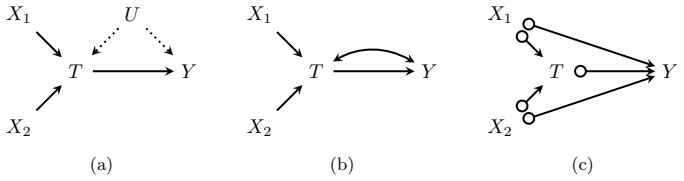
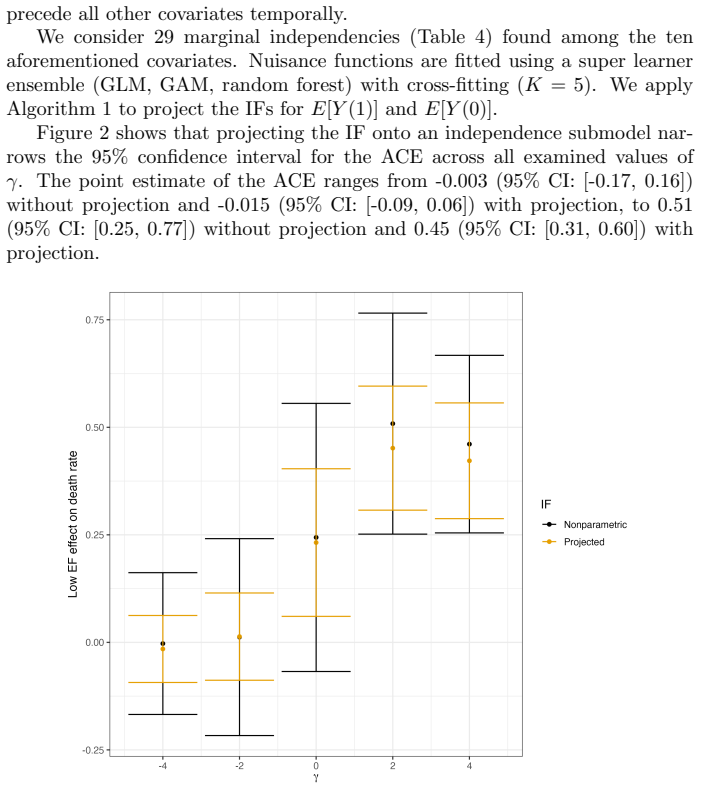

read the original abstract
Causal graphs may inform covariate adjustment for estimating causal effects and improve estimation efficiency by exploiting the graphical structure. In many applications, however, the target causal parameter may not be point-identified due to the presence of unmeasured confounding. Sensitivity analysis methods address this challenge by characterizing bounds on the causal parameter under varying assumptions about the magnitude or form of unmeasured confounding. We focus on semiparametric efficient estimation of causal effects in non-identifiable settings, assuming a known (or hypothesized) causal graph. We propose an influence function projection approach that exploits the conditional independence constraints implied by the graph to improve the efficiency of semiparametric estimators of upper and lower bounds on the average causal effect under a given sensitivity analysis model. Our approach applies across multiple sensitivity analysis frameworks and causal estimands, thereby connecting knowledge of graphical structure with the sensitivity analysis literature. We illustrate our approach through simulations and real data examples thought to be affected by unmeasured confounding, including the effect of labor training program on post-intervention earnings, and the effect of low ejection fraction on heart failure death.
Editorial analysis
A structured set of objections, weighed in public.
Referee Report
Summary. The paper proposes an influence function projection approach that exploits conditional independence constraints implied by a known causal graph to improve the efficiency of semiparametric estimators for upper and lower bounds on the average causal effect under sensitivity analysis models for unmeasured confounding. The method is presented as applicable across multiple sensitivity frameworks and causal estimands, with supporting simulations and real-data examples including labor training programs and heart failure outcomes.
Significance. If the efficiency claims hold, the work would meaningfully connect graphical causal models with the partial identification and sensitivity analysis literature, enabling more efficient bound estimation in observational studies where unmeasured confounding is present but graph structure is available. Credit is due for the general framework that applies across sensitivity models, the provision of simulation studies, and the inclusion of two real-data illustrations.
minor comments (3)
- The abstract states that the approach 'applies across multiple sensitivity analysis frameworks' but does not name the specific models considered (e.g., Rosenbaum-type or other common forms); this should be stated explicitly in the introduction to set reader expectations.
- Notation for the influence functions, projection operators, and the sensitivity parameters should be introduced more gradually, with a dedicated notation table or early subsection, to improve accessibility for readers outside core semiparametric theory.
- In the simulation section, the data-generating processes and the exact sensitivity parameters used should be described in sufficient detail (including code or pseudocode) to support reproducibility of the reported efficiency gains.
Simulated Author's Rebuttal
We thank the referee for the positive assessment of our manuscript, the recognition of its contributions in connecting graphical causal models with partial identification and sensitivity analysis, and the recommendation for minor revision. We appreciate the credit given for the general framework, simulations, and real-data examples.
Circularity Check
No significant circularity detected
full rationale
The paper's central contribution is a methodological proposal for an influence function projection estimator that incorporates conditional independence constraints from a known causal graph to gain efficiency when estimating bounds on causal effects under a sensitivity analysis model. This construction draws on standard semiparametric theory for influence functions and on graphical models for the independence constraints; neither the target bounds nor the efficiency gains are shown to reduce by definition or by construction to fitted parameters, self-referential definitions, or unverified self-citations. The derivation remains self-contained once the external prerequisites (correct graph and correctly specified sensitivity model) are granted, with no load-bearing steps that collapse the claimed results into the inputs.
Axiom & Free-Parameter Ledger
axioms (2)
- domain assumption A causal graph is known or hypothesized that correctly encodes the relevant conditional independence constraints among observed variables.
- domain assumption A sensitivity analysis model is given that defines the form of unmeasured confounding and the resulting bounds.
Lean theorems connected to this paper
-
IndisputableMonolith/Foundation/RealityFromDistinction.leanreality_from_one_distinction unclearTheorem 2: ϕeffij.S(Z) = ϕ(Z) − E[ϕ(Z)|Xi,Xj,XS] + E[ϕ(Z)|Xi,XS] + E[ϕ(Z)|Xj,XS] − E[ϕ(Z)|XS]
-
IndisputableMonolith/Cost/FunctionalEquation.leanwashburn_uniqueness_aczel unclearAlgorithm 1 (Alternating Projection) on independence constraints
Reference graph
Works this paper leans on
-
[1]
Annals of Statistics , volume=
Bounds on the conditional and average treatment effect with unobserved confounding factors , author=. Annals of Statistics , volume=
- [2]
-
[3]
Artificial Intelligence , volume=
On the completeness of orientation rules for causal discovery in the presence of latent confounders and selection bias , author=. Artificial Intelligence , volume=. 2008 , publisher=
work page 2008
-
[4]
The Annals of Statistics , pages=
Learning high-dimensional directed acyclic graphs with latent and selection variables , author=. The Annals of Statistics , pages=. 2012 , publisher=
work page 2012
-
[5]
excerpts reprinted (1990) in English , author=
Sur les applications de la thar des probabilities aux experiences agaricales: Essay des principle. excerpts reprinted (1990) in English , author=. Statistical Science , volume=
work page 1990
- [6]
- [7]
-
[8]
Proceedings of the Twenty-Sixth Conference on Uncertainty in Artificial Intelligence , pages=
On the validity of covariate adjustment for estimating causal effects , author=. Proceedings of the Twenty-Sixth Conference on Uncertainty in Artificial Intelligence , pages=
-
[9]
Identification of joint interventional distributions in recursive semi-Markovian causal models , author=. AAAI , pages=
-
[10]
Proceedings of the Twenty-Second Conference on Uncertainty in Artificial Intelligence , pages=
Pearl's calculus of intervention is complete , author=. Proceedings of the Twenty-Second Conference on Uncertainty in Artificial Intelligence , pages=
-
[11]
Journal of Machine Learning Research , volume=
Semiparametric inference for causal effects in graphical models with hidden variables , author=. Journal of Machine Learning Research , volume=
-
[12]
arXiv preprint arXiv:1302.4983 , year=
Causal inference in the presence of latent variables and selection bias , author=. arXiv preprint arXiv:1302.4983 , year=
-
[13]
Journal of the Royal Statistical Society Series B: Statistical Methodology , volume=
Graphical criteria for efficient total effect estimation via adjustment in causal linear models , author=. Journal of the Royal Statistical Society Series B: Statistical Methodology , volume=. 2022 , publisher=
work page 2022
-
[14]
Journal of Machine Learning Research , volume=
Efficient adjustment sets for population average causal treatment effect estimation in graphical models , author=. Journal of Machine Learning Research , volume=
-
[15]
Journal of the Royal Statistical Society: Series B (Methodological) , volume=
Assessing sensitivity to an unobserved binary covariate in an observational study with binary outcome , author=. Journal of the Royal Statistical Society: Series B (Methodological) , volume=. 1983 , publisher=
work page 1983
-
[16]
Sensitivity analysis without assumptions , author=. Epidemiology , volume=. 2016 , publisher=
work page 2016
- [17]
-
[18]
Statistical models in epidemiology, the environment, and clinical trials , pages=
Sensitivity analysis for selection bias and unmeasured confounding in missing data and causal inference models , author=. Statistical models in epidemiology, the environment, and clinical trials , pages=. 2000 , publisher=
work page 2000
-
[19]
Semiparametric theory and missing data , author=. 2006 , publisher=
work page 2006
-
[20]
Semiparametric sensitivity analysis: unmeasured confounding in observational studies , author=. Biometrics , volume=. 2024 , publisher=
work page 2024
-
[21]
Journal of Applied Statistics , volume=
Sensitivity analysis of unmeasured confounding in causal inference based on exponential tilting and super learner , author=. Journal of Applied Statistics , volume=. 2023 , publisher=
work page 2023
-
[22]
Journal of the American Statistical Association , volume=
Adjusting for nonignorable drop-out using semiparametric nonresponse models , author=. Journal of the American Statistical Association , volume=. 1999 , publisher=
work page 1999
-
[23]
Statistical applications in genetics and molecular biology , volume=
Super learner , author=. Statistical applications in genetics and molecular biology , volume=. 2007 , publisher=
work page 2007
-
[24]
Handbook of Statistical Methods for Precision Medicine , pages=
Semiparametric doubly robust targeted double machine learning: a review , author=. Handbook of Statistical Methods for Precision Medicine , pages=. 2024 , publisher=
work page 2024
-
[25]
Long story short: Omitted variable bias in causal machine learning , author=. 2022 , institution=
work page 2022
-
[26]
Survival analysis of heart failure patients: A case study , author=. PloS one , volume=. 2017 , publisher=
work page 2017
-
[27]
arXiv preprint arXiv:2108.13395 , year=
A practical guide to causal discovery with cohort data , author=. arXiv preprint arXiv:2108.13395 , year=
- [28]
-
[29]
International journal of data science and analytics , volume=
Scoring Bayesian networks of mixed variables , author=. International journal of data science and analytics , volume=. 2018 , publisher=
work page 2018
-
[30]
The American Economic Review , pages=
Evaluating the econometric evaluations of training programs with experimental data , author=. The American Economic Review , pages=. 1986 , publisher=
work page 1986
-
[31]
Journal of the American statistical Association , volume=
Causal effects in nonexperimental studies: Reevaluating the evaluation of training programs , author=. Journal of the American statistical Association , volume=. 1999 , publisher=
work page 1999
-
[32]
International Conference on Machine Learning , pages=
Riesznet and forestriesz: Automatic debiased machine learning with neural nets and random forests , author=. International Conference on Machine Learning , pages=. 2022 , organization=
work page 2022
-
[33]
dml.sensemakr: Sensitivity Analysis for Debiased Machine Learning , author =. 2025 , note =
work page 2025
-
[34]
The Econometrics Journal , volume =
Chernozhukov, Victor and Chetverikov, Denis and Demirer, Mert and Duflo, Esther and Hansen, Christian and Newey, Whitney and Robins, James , title =. The Econometrics Journal , volume =
-
[35]
Post-selection inference for causal effects after causal discovery , author=. Biometrika , pages=. 2026 , publisher=
work page 2026
-
[36]
Journal of the American statistical Association , volume=
Estimating optimal transformations for multiple regression and correlation , author=. Journal of the American statistical Association , volume=. 1985 , publisher=
work page 1985
-
[37]
Efficient and adaptive estimation for semiparametric models , author=. 1993 , publisher=
work page 1993
-
[38]
Journal of the American Statistical Association , volume=
A distributional approach for causal inference using propensity scores , author=. Journal of the American Statistical Association , volume=. 2006 , publisher=
work page 2006
-
[39]
The 22nd international conference on artificial intelligence and statistics , pages=
Interval estimation of individual-level causal effects under unobserved confounding , author=. The 22nd international conference on artificial intelligence and statistics , pages=. 2019 , organization=
work page 2019
-
[40]
Journal of the American Statistical Association , volume=
Sharp sensitivity analysis for inverse propensity weighting via quantile balancing , author=. Journal of the American Statistical Association , volume=. 2023 , publisher=
work page 2023
-
[41]
Characterization of parameters with a mixed bias property , author=. Biometrika , volume=. 2021 , publisher=
work page 2021
-
[42]
Proceedings of the Second Prague Symposium on Asymptotic Statistics , volume=
On the nonparametric estimation of functionals , author=. Proceedings of the Second Prague Symposium on Asymptotic Statistics , volume=. 1979 , organization=
work page 1979
-
[43]
The Annals of Statistics , pages=
On asymptotically efficient estimation in semiparametric models , author=. The Annals of Statistics , pages=. 1986 , publisher=
work page 1986
-
[44]
Estimating integrated squared density derivatives: sharp best order of convergence estimates , author=. Sankhy. 1988 , publisher=
work page 1988
discussion (0)
Sign in with ORCID, Apple, or X to comment. Anyone can read and Pith papers without signing in.