Recognition: no theorem link
Generative climate downscaling enables high-resolution compound risk assessment by preserving multivariate dependencies
Pith reviewed 2026-05-13 02:21 UTC · model grok-4.3
The pith
A diffusion-based multivariate generative framework recovers inter-variable correlations in climate downscaling even at 50 times higher resolution.
A machine-rendered reading of the paper's core claim, the machinery that carries it, and where it could break.
Core claim
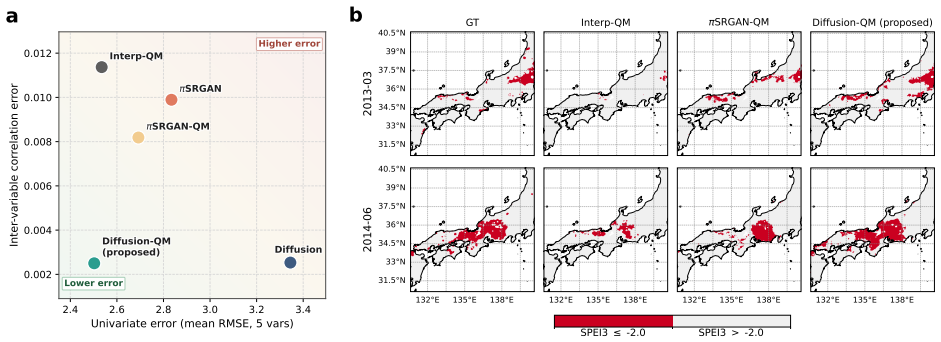
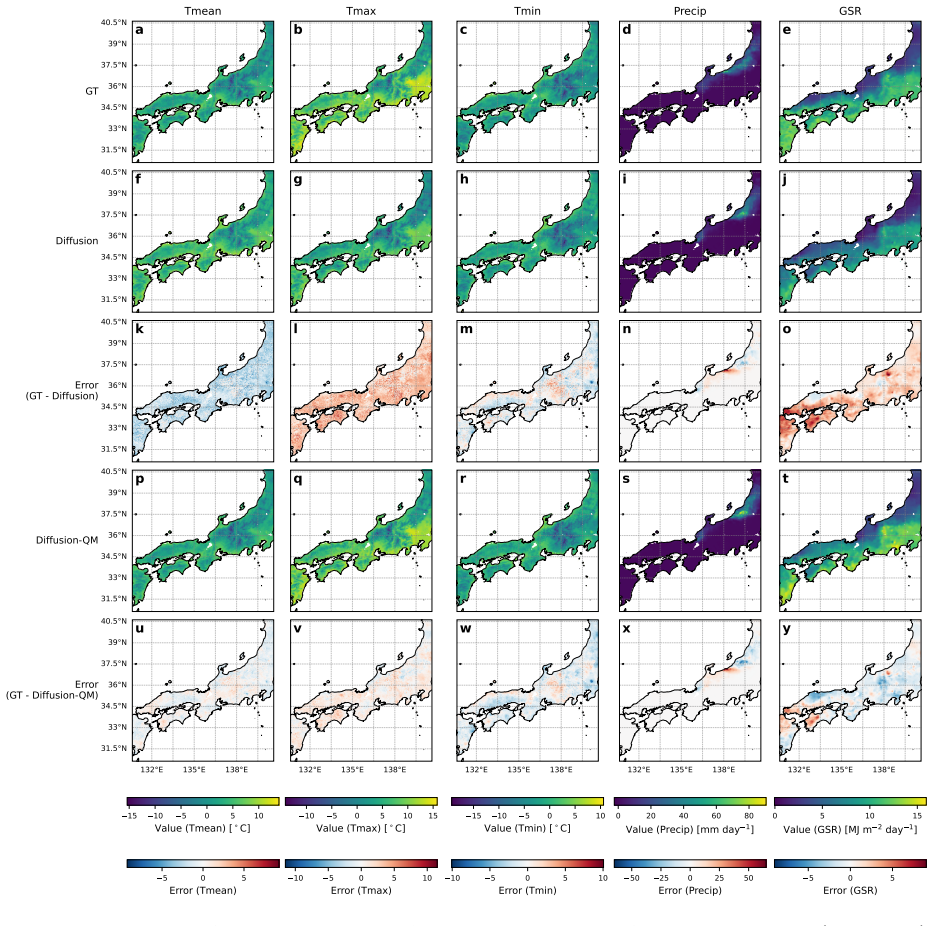
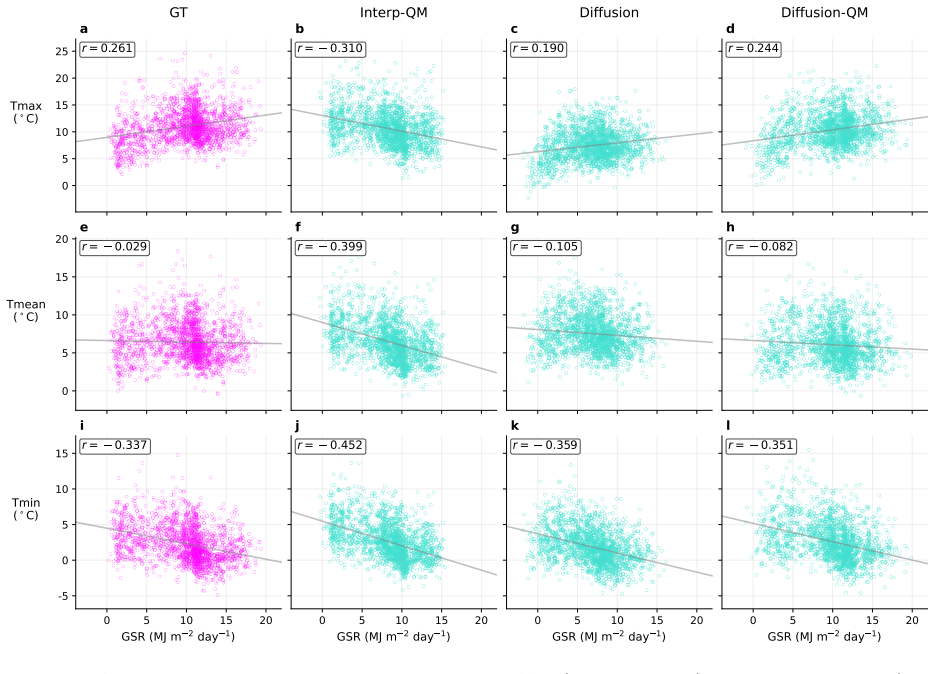
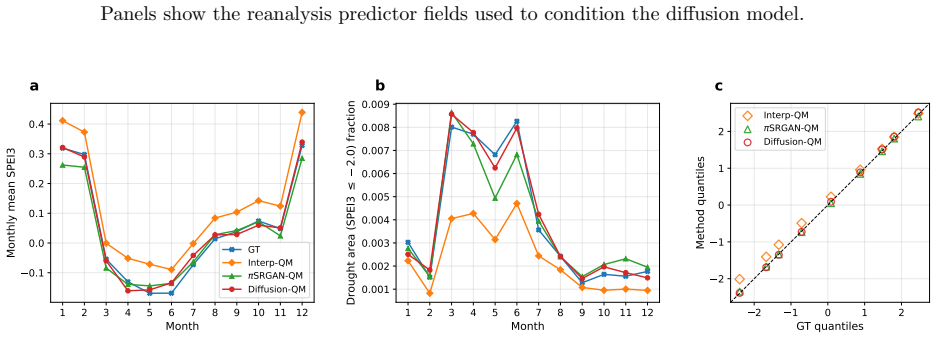
A diffusion-based multivariate generative framework, combined with bias correction, recovers degraded inter-variable correlations even under a 50× increase in linear resolution. When applied to five meteorological variables over Japan, the framework reduces inter-variable correlation errors by more than fourfold relative to existing baselines while improving both univariate and spatial accuracy, leading to more accurate detection of severe drought.
What carries the argument
diffusion-based multivariate generative framework combined with bias correction, which learns and reconstructs joint distributions across variables during resolution enhancement
If this is right
- More reliable detection of compound hazards such as severe drought at fine spatial scales.
- Improved assessment of risks involving simultaneous extremes like heat stress and wildfire.
- Greater usability of global projections for regional planning and decision-making.
- Reduced errors in inter-variable relationships by over four times compared to single-variable downscaling baselines.
Where Pith is reading between the lines
- If the learned dependencies generalize, the method could support consistent compound-risk mapping under different future emission scenarios.
- Extension to additional variables or other regions would test whether the recovery of correlations holds beyond the Japan domain tested.
- The approach might combine with physics-based regional models to further constrain spatial patterns while retaining multivariate fidelity.
Load-bearing premise
The multivariate dependencies learned from historical reanalysis or observations remain representative under future climate conditions without introducing spurious correlations.
What would settle it
Direct comparison of joint distributions and compound event frequencies in the generated high-resolution fields against independent high-resolution observations or reanalysis would show whether preserved correlations match real-system behavior.
Figures

read the original abstract
Physics-based climate projections using general circulation models are essential for assessing future risks, but their coarse resolution limits regional decision-making. Statistical downscaling can efficiently add detail, yet many methods treat variables independently, degrading inter-variable relationships that govern compound hazards such as heat stress, drought, and wildfire. Here we show that a diffusion-based multivariate generative framework, combined with bias correction, recovers degraded inter-variable correlations even under a 50$\times$ increase in linear resolution. When applied to five meteorological variables over Japan, the framework reduces inter-variable correlation errors by more than fourfold relative to existing baselines while improving both univariate and spatial accuracy, leading to more accurate detection of severe drought. These results demonstrate that multivariate generative downscaling improves the reliability of compound risk assessment under large resolution gaps.
Editorial analysis
A structured set of objections, weighed in public.
Referee Report
Summary. The manuscript introduces a diffusion-based multivariate generative framework combined with bias correction for statistical downscaling of climate projections. It claims that this approach recovers degraded inter-variable correlations for five meteorological variables over Japan even under a 50× linear resolution increase, reducing correlation errors by more than fourfold relative to baselines, while also improving univariate and spatial accuracy and yielding more accurate detection of severe droughts.
Significance. If the results hold under appropriate validation, the work would be significant for enabling reliable high-resolution compound risk assessment in climate science. By preserving multivariate dependencies that independent downscaling methods often degrade, the generative approach directly addresses a key limitation in evaluating joint hazards such as drought, heat stress, and wildfire, offering an efficient alternative to dynamical downscaling for large resolution gaps.
major comments (1)
- [Results and validation experiments] The performance claims (e.g., >4× correlation error reduction) are demonstrated on historical reanalysis/observations within the training distribution over Japan. However, the central application is to future GCM outputs for risk assessment, yet no explicit test of generalization under non-stationary climate conditions (such as altered temperature-precipitation or humidity-wind covariances) is provided. This assumption is load-bearing for the claimed utility in compound risk assessment.
minor comments (2)
- The abstract refers to 'existing baselines' without naming them; specify the comparison methods (e.g., in the abstract or introduction) to allow immediate assessment of the claimed improvements.
- Consider including statistical significance or uncertainty estimates (e.g., error bars across multiple runs or cross-validation folds) alongside the reported correlation reductions and drought detection metrics.
Simulated Author's Rebuttal
We thank the referee for their positive assessment of the work's significance and for the constructive comment on validation. We address the point below.
read point-by-point responses
-
Referee: [Results and validation experiments] The performance claims (e.g., >4× correlation error reduction) are demonstrated on historical reanalysis/observations within the training distribution over Japan. However, the central application is to future GCM outputs for risk assessment, yet no explicit test of generalization under non-stationary climate conditions (such as altered temperature-precipitation or humidity-wind covariances) is provided. This assumption is load-bearing for the claimed utility in compound risk assessment.
Authors: We agree that explicit testing under non-stationary conditions would further support the application to future projections. Our validation uses historical reanalysis and observations to enable direct, controlled comparison with ground truth for both univariate and multivariate metrics. The method combines bias correction (to align GCM marginals) with a generative model trained to reproduce observed joint distributions, which is a standard assumption in statistical downscaling. In the revised manuscript we will add a new subsection discussing the stationarity assumption, its implications for compound risk assessment, and results from two additional analyses: (1) application of the trained model to historical GCM outputs with comparison to observations, and (2) a sensitivity experiment in which low-resolution inputs are perturbed to simulate altered covariances before downscaling. These additions will clarify the robustness of the approach without altering the core claims. revision: yes
Circularity Check
No significant circularity in the generative downscaling derivation
full rationale
The paper describes a diffusion-based multivariate generative model combined with bias correction for climate downscaling. No equations or steps in the provided abstract and context reduce the reported performance (e.g., correlation recovery or error reduction) to quantities defined by construction from the same fitted inputs or self-citations. The framework is presented as an independent generative approach trained on historical data and evaluated for generalization, with no self-definitional loops, fitted inputs renamed as predictions, or load-bearing self-citations that collapse the central claim. The derivation chain remains self-contained against external benchmarks.
Axiom & Free-Parameter Ledger
axioms (1)
- domain assumption The joint statistical structure of meteorological variables observed in historical data remains a valid target for generative modeling under future climate states
Reference graph
Works this paper leans on
-
[1]
Taylor, K. E., Stouffer, R. J. & Meehl, G. A. An overview of cmip5 and the experiment design. Bulletin of the American Meteorological Society93, 485 – 498 (2012)
work page 2012
-
[2]
C.et al.The scenario model intercomparison project (scenariomip) for cmip6
O’Neill, B. C.et al.The scenario model intercomparison project (scenariomip) for cmip6. Geoscientific Model Development9, 3461–3482 (2016). 17 Table 5:HR variables and preprocessing transformations used in this study. Variable Description Unit Transform Parameters GSR Global solar radiation MJ m −2 day−1 fscale xmin = 0, x max = 60 Precip Precipitation mm...
work page 2016
-
[3]
Giorgi, F. & Bates, G. T. The climatological skill of a regional model over complex terrain. Monthly Weather Review117, 2325–2347 (1989)
work page 1989
-
[4]
D´ equ´ e, M.et al.Global high resolution versus limited area model climate change projections over Europe: quantifying confidence level from PRUDENCE results.Climate Dynamics25, 653–670 (2005)
work page 2005
-
[5]
Kawase, H.et al.Downscaling of the climatic change in the mei-yu rainband in east asia by a pseudo climate simulation method.Sola4, 73–76 (2008)
work page 2008
-
[6]
Wilby, R.et al.Guidelines for use of climate scenarios developed from statis-tical downscaling methods. Supporting material of the Inter-governmental Panel on Climate Change, available from the DDC of IPCC TGCIA (2004)
work page 2004
-
[7]
Von Storch, H., Zorita, E. & Cubasch, U. Downscaling of global climate change estimates to regional scales: an application to iberian rainfall in wintertime.Journal of Climate6, 1161–1171 (1993)
work page 1993
-
[8]
Piani, C., Haerter, J. & Coppola, E. Statistical bias correction for daily precipitation in regional climate models over europe.Theoretical and applied climatology99, 187–192 (2010)
work page 2010
-
[9]
Iizumi, T., Nishimori, M., Dairaku, K., Adachi, S. A. & Yokozawa, M. Evaluation and in- tercomparison of downscaled daily precipitation indices over japan in present-day climate: Strengths and weaknesses of dynamical and bias correction-type statistical downscaling meth- ods.Journal of Geophysical Research: Atmospheres116(2011)
work page 2011
-
[10]
International Organization for Standardization. ISO 7243: Ergonomics of the thermal envi- ronment — assessment of heat stress using the WBGT (wet bulb globe temperature) index (2017)
work page 2017
-
[11]
Vicente-Serrano, S. M., Beguer´ ıa, S. & L´ opez-Moreno, J. I. A multiscalar drought index sensitive to global warming: the standardized precipitation evapotranspiration index.Journal of climate23, 1696–1718 (2010). 20
work page 2010
-
[12]
Van Wagner, C. E. Development and structure of the canadian forest fire weather index system. Forestry Technical Report 35, Canadian Forestry Service, Petawawa National Forestry Institute, Chalk River, Ontario, Canada (1987)
work page 1987
-
[13]
Wilby, R. L., Dawson, C. W. & Barrow, E. M. Sdsm—a decision support tool for the assessment of regional climate change impacts.Environmental Modelling & Software17, 145–157 (2002)
work page 2002
-
[14]
Chen, H., Guo, J., Xiong, W., Guo, S. & Xu, C.-Y. Downscaling GCMs using the smooth support vector machine method to predict daily precipitation in the hanjiang basin.Advances in Atmospheric Sciences27, 274–284 (2010)
work page 2010
-
[15]
Davy, R. J., Woods, M. J., Russell, C. J. & Coppin, P. A. Statistical downscaling of wind variability from meteorological fields.Boundary-layer meteorology135, 161–175 (2010)
work page 2010
-
[16]
Wood, A. W., Leung, L. R., Sridhar, V. & Lettenmaier, D. P. Hydrologic implications of dynamical and statistical approaches to downscaling climate model outputs.Climatic change 62, 189–216 (2004)
work page 2004
-
[17]
Cannon, A. J., Sobie, S. R. & Murdock, T. Q. Bias correction of GCM precipitation by quantile mapping: How well do methods preserve changes in quantiles and extremes?Journal of Climate28, 6938 – 6959 (2015)
work page 2015
-
[18]
Cannon, A. J. Multivariate quantile mapping bias correction: an n-dimensional probabil- ity density function transform for climate model simulations of multiple variables.Climate dynamics50, 31–49 (2018)
work page 2018
-
[19]
B´ ardossy, A. & Pegram, G. Multiscale spatial recorrelation of rcm precipitation to produce unbiased climate change scenarios over large areas and small.Water Resources Research48 (2012)
work page 2012
-
[20]
Fran¸ cois, B., Vrac, M., Cannon, A. J., Robin, Y. & Allard, D. Multivariate bias corrections of climate simulations: which benefits for which losses?Earth System Dynamics11, 537–562 (2020)
work page 2020
-
[21]
Sun, Y.et al.Deep learning in statistical downscaling for deriving high spatial resolution gridded meteorological data: A systematic review.ISPRS Journal of Photogrammetry and Remote Sensing208, 14–38 (2024)
work page 2024
-
[22]
Oyama, N., Ishizaki, N. N., Koide, S. & Yoshida, H. Deep generative model super-resolves spatially correlated multiregional climate data.Scientific Reports13, 5992 (2023)
work page 2023
-
[23]
Leinonen, J., Hamann, U., Nerini, D., Germann, U. & Franch, G. Latent diffusion models for generative precipitation nowcasting with accurate uncertainty quantification.arXiv preprint arXiv:2304.12891(2023)
-
[24]
Ling, F.et al.Diffusion model-based probabilistic downscaling for 180-year east asian climate reconstruction.npj Climate and Atmospheric Science7, 131 (2024)
work page 2024
-
[25]
Mardani, M.et al.Residual corrective diffusion modeling for km-scale atmospheric downscal- ing.Communications Earth & Environment6, 124 (2025)
work page 2025
-
[26]
Hess, P., Aich, M., Pan, B. & Boers, N. Fast, scale-adaptive and uncertainty-aware downscaling of earth system model fields with generative machine learning.Nature Machine Intelligence 1–11 (2025). 21
work page 2025
-
[27]
Lopez-Gomez, I.et al.Dynamical-generative downscaling of climate model ensembles.Pro- ceedings of the National Academy of Sciences122, e2420288122 (2025)
work page 2025
-
[28]
Journal of the Meteorological Society of Japan
Kobayashi, S.et al.The JRA-55 reanalysis: General specifications and basic characteristics. Journal of the Meteorological Society of Japan. Ser. II93, 5–48 (2015)
work page 2015
-
[29]
Ohno, H., Sasaki, K., Ohara, G. & Nakazono, K. Development of grid square air temperature and precipitation data compiled from observed, forecasted, and climatic normal data.Climate in Biosphere16, 71–79 (2016)
work page 2016
-
[30]
Dhariwal, P. & Nichol, A. Diffusion models beat GANs on image synthesis.Advances in neural information processing systems34, 8780–8794 (2021)
work page 2021
-
[31]
Ho, J. & Salimans, T. Classifier-free diffusion guidance. InNeurIPS 2021 Workshop on Deep Generative Models and Downstream Applications(2021)
work page 2021
-
[32]
Diffusion with offset noise.https://www.crosslabs.org/blog/ diffusion-with-offset-noise(2023)
Guttenberg, N. Diffusion with offset noise.https://www.crosslabs.org/blog/ diffusion-with-offset-noise(2023)
work page 2023
- [33]
-
[34]
Hargreaves, G. H. & Samani, Z. A. Reference crop evapotranspiration from temperature. Applied Engineering in Agriculture1, 96–99 (1985)
work page 1985
-
[35]
Rombach, R., Blattmann, A., Lorenz, D., Esser, P. & Ommer, B. High-resolution image syn- thesis with latent diffusion models. InProceedings of the IEEE/CVF conference on computer vision and pattern recognition, 10684–10695 (2022)
work page 2022
-
[36]
Li, T. & He, K. Back to basics: Let denoising generative models denoise.arXiv preprint arXiv:2511.13720(2025)
work page internal anchor Pith review Pith/arXiv arXiv 2025
-
[37]
Rombach, R. & Esser, P. Stable diffusion v1-5.https://huggingface.co/ stable-diffusion-v1-5/stable-diffusion-v1-5(2022)
work page 2022
-
[38]
Salimans, T. & Ho, J. Progressive distillation for fast sampling of diffusion models.arXiv preprint arXiv:2202.00512(2022)
work page internal anchor Pith review Pith/arXiv arXiv 2022
-
[39]
Ho, J., Jain, A. & Abbeel, P. Denoising diffusion probabilistic models.Advances in neural information processing systems33, 6840–6851 (2020)
work page 2020
- [40]
-
[41]
Kingma, D. P. Auto-encoding variational bayes.arXiv preprint arXiv:1312.6114(2013)
work page internal anchor Pith review Pith/arXiv arXiv 2013
-
[42]
Higgins, I.et al.beta-VAE: Learning basic visual concepts with a constrained variational framework (2017)
work page 2017
-
[43]
InInternational Conference on Learning Representations(2017)
Gulrajani, I.et al.PixelVAE: A latent variable model for natural images. InInternational Conference on Learning Representations(2017). 22
work page 2017
-
[44]
Van Den Oord, A., Vinyals, O.et al.Neural discrete representation learning.Advances in neural information processing systems30(2017)
work page 2017
-
[45]
Larsen, A. B. L., Sønderby, S. K., Larochelle, H. & Winther, O. Autoencoding beyond pixels using a learned similarity metric. InInternational conference on machine learning, 1558–1566 (2016)
work page 2016
-
[46]
Arkhipkin, V.et al.Kandinsky-3: Text-to-image diffusion model.https://huggingface.co/ kandinsky-community/kandinsky-3(2023)
work page 2023
-
[47]
Krizhevsky, A., Sutskever, I. & Hinton, G. E. Imagenet classification with deep convolutional neural networks.Advances in neural information processing systems25(2012)
work page 2012
-
[48]
InAdvances in Neural Information Processing Systems, vol
Vaswani, A.et al.Attention is all you need. InAdvances in Neural Information Processing Systems, vol. 30 (2017)
work page 2017
-
[49]
Loshchilov, I. & Hutter, F. Decoupled weight decay regularization. InInternational Conference on Learning Representations(2019)
work page 2019
-
[50]
Pascanu, R., Mikolov, T. & Bengio, Y. On the difficulty of training recurrent neural networks. InInternational Conference on Machine Learning(2013)
work page 2013
-
[51]
Dupuis, ´E. xsdba: Statistical downscaling and bias adjustment library.https://github.com/ Ouranosinc/xsdba(2025)
work page 2025
-
[52]
Beguer´ ıa, S. & Vicente-Serrano, S. M.SPEI: Calculation of the Standardized Precipitation- Evapotranspiration Index(2023).https://spei.csic.es
work page 2023
-
[53]
´ etude comparative de la distribution florale dans une portion des alpes et du jura
Jaccard, P. ´ etude comparative de la distribution florale dans une portion des alpes et du jura. Bulletin de la Soci´ et´ e Vaudoise des Sciences Naturelles37, 547–579 (1901). 23
work page 1901
discussion (0)
Sign in with ORCID, Apple, or X to comment. Anyone can read and Pith papers without signing in.