Recognition: no theorem link
Interacting Binary Stars as Progenitors for Interacting Supernovae
Pith reviewed 2026-05-13 01:08 UTC · model grok-4.3
The pith
Late-stage mass transfer in binary stars can account for the dense circumstellar material around roughly 13 percent of core-collapse supernovae.
A machine-rendered reading of the paper's core claim, the machinery that carries it, and where it could break.
Core claim
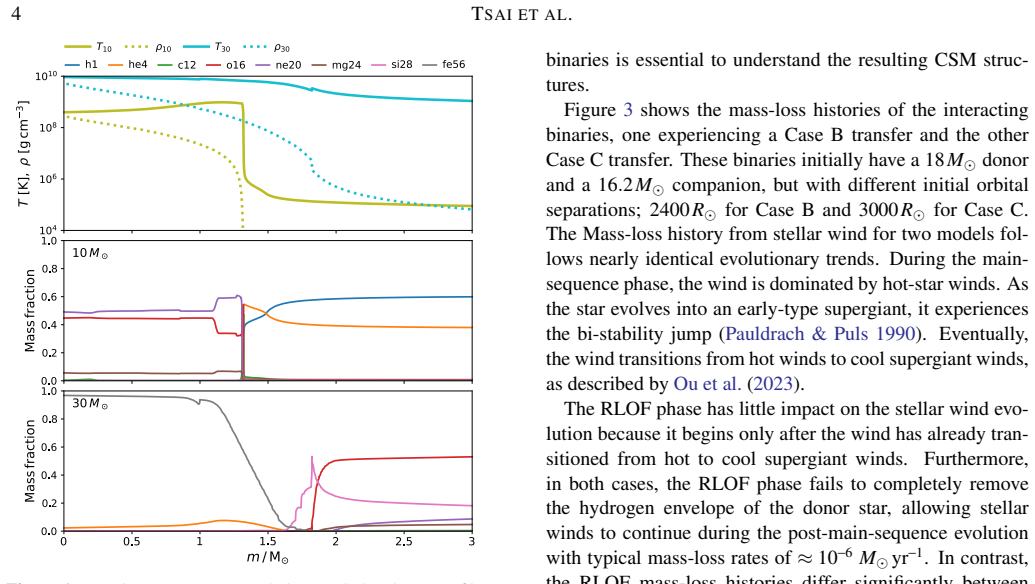
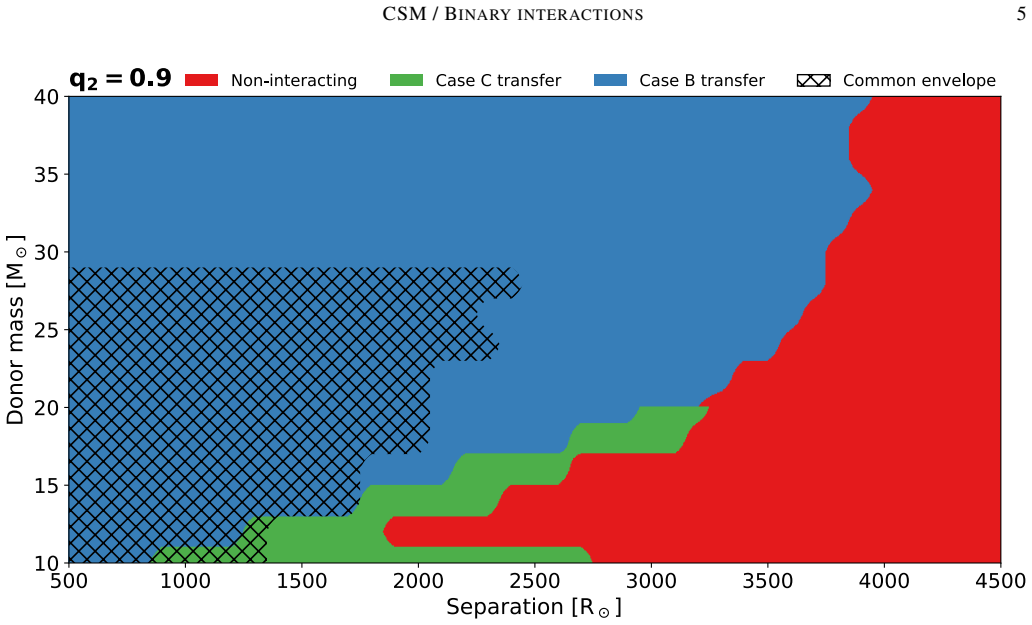
Our systematic study of binary stellar evolution models demonstrates that Case C mass transfer, initiated after core helium ignition, can naturally produce the dense, nearby circumstellar media inferred in interacting supernovae. Across a grid of binary models, donors of 10-20 solar masses in binaries with separations of approximately 1000-2700 solar radii undergo late-stage Roche-lobe overflow within ~10^3 yr prior to core collapse, ejecting ~0.01-0.2 solar masses and forming CSM extending to ~10^16-10^18 cm. Our results suggest that the Case C mass transfer may account for ~13% of all core-collapse supernova progenitors. A subset of these Case C binaries produces CSM properties that are in
What carries the argument
Case C mass transfer after core helium ignition in MESA binary models, which triggers Roche-lobe overflow at the precise pre-collapse timescale to build compact CSM.
If this is right
- Case C transfer operates at the right time and scale to shape the immediate pre-supernova environment without ad hoc eruptive mechanisms.
- Late-stage binary interaction provides a robust channel for the dense CSM that powers interacting supernovae.
- Approximately 13 percent of CCSN progenitors experience this interaction, making it a significant rather than rare channel.
- A subset of the models yields CSM properties that match those inferred for specific events such as SN 2014C.
Where Pith is reading between the lines
- Pre-explosion imaging or spectroscopy could reveal recent binary-driven mass loss in a corresponding fraction of supernova progenitors.
- The contribution may vary with binary separation distributions or metallicity, providing a prediction for different galaxy types.
- This mechanism could contribute to the observed diversity in supernova interaction strengths and light-curve shapes.
Load-bearing premise
The MESA binary evolution models accurately reproduce the timing, rate, and total mass of Case C Roche-lobe overflow without major uncertainties from convection treatment, mass-loss prescriptions, or common-envelope physics.
What would settle it
A survey finding that the actual fraction of core-collapse supernovae exhibiting dense CSM ejected within the last 1000 years differs substantially from 13 percent would test the predicted rate.
Figures


read the original abstract
Dense, compact circumstellar media (CSM) are required to power strongly interacting supernovae, yet their physical origin remains uncertain. We present a systematic study of binary stellar evolution models computed with MESA, demonstrating that Case C mass transfer, initiated after core helium ignition, can naturally produces the dense, nearby CSM inferred in interacting events. Across a grid of binary models, we find that donors of 10--20 solar masses in binaries with separations of approximately 1000--2700 solar radius undergo late-stage Roche-lobe overflow within ~10^3 yr prior to core collapse, ejecting ~0.01--0.2 solar masses and forming CSM extending to ~10^16--10^18 cm. Our results suggest that the Case C mass transfer may account for ~13% of all core-collapse supernova (CCSN) progenitors, rather than representing a rare channel. A subset of these Case C binaries produces CSM properties that are quantitatively in agreement with those inferred for interacting supernovae such as SN 2014C. In contrast to earlier binary interactions or single-star mass loss, Case C transfer operates at the right time and scale to shape the immediate pre-supernova environment without requiring ad hoc eruptive mechanisms. Our results identify late-stage binary interaction as a robust and physically motivated channel for producing the dense CSM that powers interacting supernovae.
Editorial analysis
A structured set of objections, weighed in public.
Referee Report
Summary. The manuscript computes a grid of MESA binary stellar evolution models to show that Case C mass transfer (post core-He ignition Roche-lobe overflow) in 10-20 M⊙ donors with orbital separations of 1000-2700 R⊙ can eject 0.01-0.2 M⊙ of material within ~10^3 yr before core collapse, forming dense CSM at 10^16-10^18 cm. It concludes that this channel may contribute ~13% of all core-collapse supernova progenitors and that a subset of models quantitatively matches the CSM inferred for events like SN 2014C, providing a standard binary evolution pathway without ad hoc eruptions.
Significance. If the results hold, this identifies a robust, physically motivated mechanism for the dense CSM powering interacting supernovae through late-stage binary interaction. The systematic grid approach and identification of specific mass and separation ranges represent a strength in exploring this channel. However, the lack of parameter sensitivity tests limits the robustness of the 13% fraction and the claimed quantitative agreement.
major comments (3)
- [Results section (grid outcomes and fraction calculation)] The reported ~13% fraction of CCSN progenitors from Case C transfer is derived from counting successful models in the chosen grid without reported uncertainties, convergence tests on grid spacing, or weighting by initial mass function and binary population statistics; this makes the percentage sensitive to the specific parameter choices and undermines the claim that it 'may account for ~13%' as a general result.
- [Results section (CSM properties and SN 2014C comparison)] The quantitative agreement with SN 2014C CSM properties (radial extent and density) is stated for a subset of models, but no specific comparison table or metrics (e.g., chi-squared or direct parameter matching) are provided, and the models' sensitivity to convective overshooting and wind mass-loss rates (which can shift RLOF timing by >10^3 yr and mass by factors of 2-5) is not explored, directly affecting the validity of the match.
- [Methods section (MESA setup and physics choices)] No validation of the MESA binary models against observed binary populations or convergence tests for key physics like semiconvection efficiency and mass-loss prescriptions during post-He ignition are presented, despite these being load-bearing for the timing and amount of Case C RLOF central to the paper's conclusions.
minor comments (3)
- [Abstract] The abstract states 'naturally produces' but the models rely on standard MESA physics; consider rephrasing for precision.
- [Figures] Figure showing the CSM radial profiles could benefit from error bands or multiple parameter variations for clarity.
- [References] Missing citations to recent works on binary supernova progenitors or MESA validation studies.
Simulated Author's Rebuttal
We thank the referee for the constructive comments and for recognizing the potential importance of the Case C mass transfer channel identified in our grid of MESA models. We address each major comment below, indicating where revisions have been made to improve clarity, robustness, and documentation.
read point-by-point responses
-
Referee: [Results section (grid outcomes and fraction calculation)] The reported ~13% fraction of CCSN progenitors from Case C transfer is derived from counting successful models in the chosen grid without reported uncertainties, convergence tests on grid spacing, or weighting by initial mass function and binary population statistics; this makes the percentage sensitive to the specific parameter choices and undermines the claim that it 'may account for ~13%' as a general result.
Authors: We agree that the ~13% figure is obtained simply by counting the fraction of models in our chosen grid that produce the required late-stage Case C mass transfer and CSM. The grid is not weighted by an IMF or full binary population statistics, and no formal uncertainties or grid-convergence tests are reported. In the revised manuscript we have clarified that this is an indicative estimate for the explored 10-20 M⊙ donor and 1000-2700 R⊙ separation range rather than a precise population fraction. We have added a short discussion of this limitation and a simple Salpeter-IMF-weighted estimate over the donor-mass range that yields a comparable order-of-magnitude result. We maintain that the phrasing 'may account for ~13%' is appropriate given the scope of the study. revision: partial
-
Referee: [Results section (CSM properties and SN 2014C comparison)] The quantitative agreement with SN 2014C CSM properties (radial extent and density) is stated for a subset of models, but no specific comparison table or metrics (e.g., chi-squared or direct parameter matching) are provided, and the models' sensitivity to convective overshooting and wind mass-loss rates (which can shift RLOF timing by >10^3 yr and mass by factors of 2-5) is not explored, directly affecting the validity of the match.
Authors: We have added a comparison table in the revised results section that lists the ejected mass, radial extent, and characteristic density for the subset of models and directly juxtaposes them with the values inferred for SN 2014C. We have also run additional models varying the convective overshooting parameter by ±0.1 and the wind mass-loss rate by factors of 2. These tests show that while the exact RLOF timing can shift, the ejected mass remains within 0.01-0.2 M⊙ and the CSM radial extent and density still overlap with the SN 2014C inferences for several models. The sensitivity analysis and updated comparison are now documented in the methods and results sections. revision: yes
-
Referee: [Methods section (MESA setup and physics choices)] No validation of the MESA binary models against observed binary populations or convergence tests for key physics like semiconvection efficiency and mass-loss prescriptions during post-He ignition are presented, despite these being load-bearing for the timing and amount of Case C RLOF central to the paper's conclusions.
Authors: We have expanded the methods section to reference prior literature in which similar MESA binary setups have been compared to observed post-interaction binaries. We have also added explicit convergence tests varying the semiconvection efficiency (α_sc = 0.01-0.1) and post-He ignition wind prescriptions. These tests confirm that the occurrence of Case C RLOF within the quoted mass and separation windows, as well as the ejected mass range, remains robust. The new tests and references are included in the revised manuscript. revision: yes
Circularity Check
No significant circularity in forward modeling chain
full rationale
The derivation consists of forward integration of standard MESA binary evolution physics over an explicit grid of initial masses and separations. The reported ~13% fraction of CCSN progenitors and the quantitative CSM matches (e.g., to SN 2014C) are direct counts and outputs from the simulated models rather than quantities fitted to the target observations or defined in terms of themselves. No self-citation is invoked to justify core assumptions, no ansatz is smuggled, and no uniqueness theorem or renaming of known results occurs. The chain is self-contained against external benchmarks and does not reduce any prediction to its inputs by construction.
Axiom & Free-Parameter Ledger
axioms (1)
- domain assumption Standard MESA prescriptions for Roche-lobe overflow, convective mixing, and wind mass loss are sufficiently accurate for late-stage binary evolution
Reference graph
Works this paper leans on
-
[1]
Charalampopoulos, P., Kotak, R., Sollerman, J., et al. 2025, A&A, 700, A138
work page 2025
-
[2]
Chevalier, R. A. 2014, in IAU Symposium, V ol. 296, Supernova Environmental Impacts, ed. A. Ray & R. A. McCray, 95 CSM / BINARY INTERACTIONS11
work page 2014
- [3]
-
[4]
Chevalier, R. A., & Irwin, C. M. 2011, ApJL, 729, L6 de Jager, C., Nieuwenhuijzen, H., & van der Hucht, K. A. 1988, A&AS, 72, 259
work page 2011
-
[5]
Eggleton, P. P. 1983, ApJ, 268, 368
work page 1983
-
[6]
Ercolino, A., Jin, H., Langer, N., & Dessart, L. 2024, A&A, 685, A58
work page 2024
-
[7]
2020, Royal Society Open Science, 7, 200467
Fraser, M. 2020, Royal Society Open Science, 7, 200467
work page 2020
- [8]
-
[9]
Henyey, L., Vardya, M. S., & Bodenheimer, P. 1965, ApJ, 142, 841
work page 1965
-
[10]
Hillenkamp, E., Baer-Way, R., Chandra, P., et al. 2026, ApJ, 1001, 111
work page 2026
-
[11]
2024, Supernova Remnants III: An Odyssey in Space after Stellar Death, 92
Holas, A., Röpke, F., Jones, S., Hirschi, R., & Keegans, J. 2024, Supernova Remnants III: An Odyssey in Space after Stellar Death, 92
work page 2024
- [12]
-
[13]
2013, A&A Rv, 21, 59 Jacobson-Galán, W
Ivanova, N., Justham, S., Chen, X., et al. 2013, A&A Rv, 21, 59 Jacobson-Galán, W. V ., Dessart, L., Margutti, R., et al. 2023, ApJL, 954, L42
work page 2013
-
[14]
Kouwenhoven, M. B. N., Goodwin, S. P., Parker, R. J., et al. 2010, MNRAS, 404, 1835
work page 2010
- [15]
- [16]
- [17]
- [18]
-
[19]
Maeda, K., & Moriya, T. J. 2022, ApJ, 927, 25
work page 2022
-
[20]
Maeda, K., Hattori, T., Milisavljevic, D., et al. 2015, ApJ, 807, 35
work page 2015
- [21]
-
[22]
Margutti, R., Kamble, A., Milisavljevic, D., et al. 2017, ApJ, 835, 140
work page 2017
-
[23]
S., Vargas-Salazar, I., & Kratter, K
Moe, M., Oey, M. S., Vargas-Salazar, I., & Kratter, K. M. 2025, ApJ, 991, 182
work page 2025
-
[24]
J., Maeda, K., Taddia, F., et al
Moriya, T. J., Maeda, K., Taddia, F., et al. 2013, MNRAS, 435, 1520
work page 2013
-
[25]
Nagao, T., Kuncarayakti, H., Maeda, K., et al. 2026, A&A, 708, A294
work page 2026
-
[26]
Nakaoka, T., Kawabata, K. S., Maeda, K., et al. 2018, ApJ, 859, 78
work page 2018
- [27]
-
[28]
Nugis, T., & Lamers, H. J. G. L. M. 2000, A&A, 360, 227
work page 2000
- [29]
- [30]
-
[31]
Ou, P.-S., Chen, K.-J., Chu, Y .-H., & Tsai, S.-H. 2023, ApJ, 944, 34
work page 2023
-
[32]
Ouchi, R., & Maeda, K. 2017, ApJ, 840, 90 —. 2019, ApJ, 877, 92 Paczy´nski, B. 1971, ARA&A, 9, 183
work page 2017
-
[33]
Pastorello, A., Smartt, S. J., Mattila, S., et al. 2007, Nature, 447, 829
work page 2007
-
[34]
Pauldrach, A. W. A., & Puls, J. 1990, A&A, 237, 409
work page 1990
- [35]
- [36]
- [37]
- [38]
- [39]
-
[40]
M., Nagao, T., Gottumukkala, R., et al
Reynolds, T. M., Nagao, T., Gottumukkala, R., et al. 2025, A&A, 702, A212
work page 2025
-
[41]
Sana, H., de Mink, S. E., de Koter, A., et al. 2012, Science, 337, 444
work page 2012
- [42]
- [43]
-
[44]
2017, Interacting Supernovae: Types IIn and Ibn, ed
Smith, N. 2017, Interacting Supernovae: Types IIn and Ibn, ed. A. W. Alsabti & P. Murdin (Cham: Springer International Publishing), 403
work page 2017
-
[45]
Smith, N., & Arnett, W. D. 2014, ApJ, 785, 82
work page 2014
-
[46]
Smith, N., & Owocki, S. P. 2006, ApJL, 645, L45
work page 2006
- [47]
-
[48]
Tsai, S.-H., Chen, K.-J., Whalen, D., Ou, P.-S., & Woods, T. E. 2023, ApJ, 951, 84
work page 2023
-
[49]
Vink, J. S., de Koter, A., & Lamers, H. J. G. L. M. 2000, A&A, 362, 295 —. 2001, A&A, 369, 574
work page 2000
-
[50]
Wei, D., Schneider, F. R. N., Podsiadlowski, P., et al. 2024, in IAU
work page 2024
-
[51]
Yaron, O., Perley, D. A., Gal-Yam, A., et al. 2017, Nature Physics, 13, 510
work page 2017
-
[52]
2017, ApJ, 840, 10 12 TSAI ET AL
Yoon, S.-C., Dessart, L., & Clocchiatti, A. 2017, ApJ, 840, 10 12 TSAI ET AL. Figure 5.Same as Figure 2, but for a mass ratio ofq 2 = 0.6. Compared to theq 2 = 0.9 case, the overall distribution of mass-transfer types remains similar, with Case C transfer still confined toM1 ≲20M ⊙. These results indicate that the overall landscape of mass transfer is rel...
work page 2017
discussion (0)
Sign in with ORCID, Apple, or X to comment. Anyone can read and Pith papers without signing in.