Recognition: 2 theorem links
· Lean TheoremStepped Frequency Division Multiplexing: A Jump-Free Continuous-Time AFDM Waveform
Pith reviewed 2026-05-13 01:08 UTC · model grok-4.3
The pith
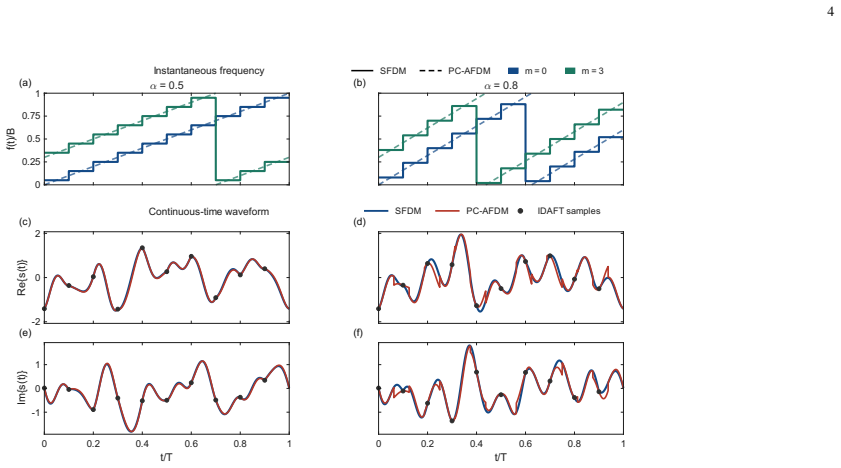
Stepped frequency division multiplexing produces a continuous-time AFDM waveform free of internal jumps by fixing frequency at the midpoint of each wrapped chirp.
A machine-rendered reading of the paper's core claim, the machinery that carries it, and where it could break.
Core claim
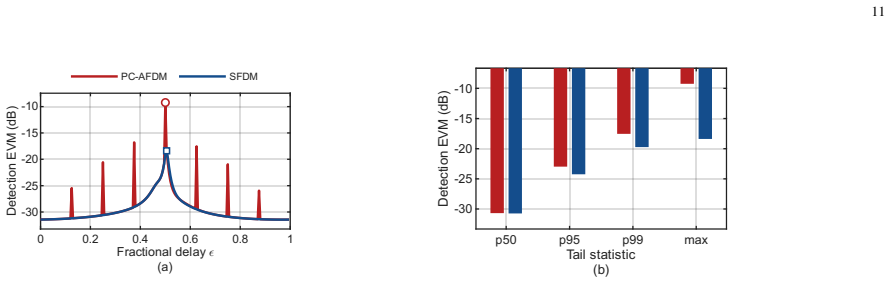
The paper claims that, under continuous phase accumulation without additional phase correction, the midpoint choice is the unique sample-preserving choice for arbitrary chirp-rate parameters. This construction yields a waveform continuous within each AFDM block that reduces out-of-band emission while preserving the inverse discrete affine Fourier transform output sequence, the standard AFDM modulation matrix, guard-interval structure, and receiver processing. Under fractional-delay propagation, it also mitigates the receiver sensitivity that occurs when delayed samples fall near the discontinuities of the piecewise-continuous version.
What carries the argument
Stepped frequency division multiplexing (SFDM), which sets the instantaneous frequency to the midpoint of the wrapped chirp within each sampling interval while continuously accumulating phase across interval boundaries.
If this is right
- The waveform becomes continuous within each AFDM block.
- Out-of-band emission is reduced.
- The standard AFDM modulation matrix, guard-interval structure, and receiver processing remain unchanged.
- Receiver sensitivity to fractional-delay propagation is mitigated.
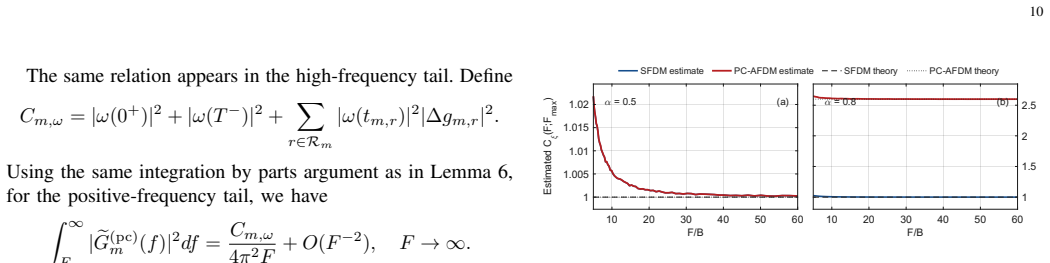
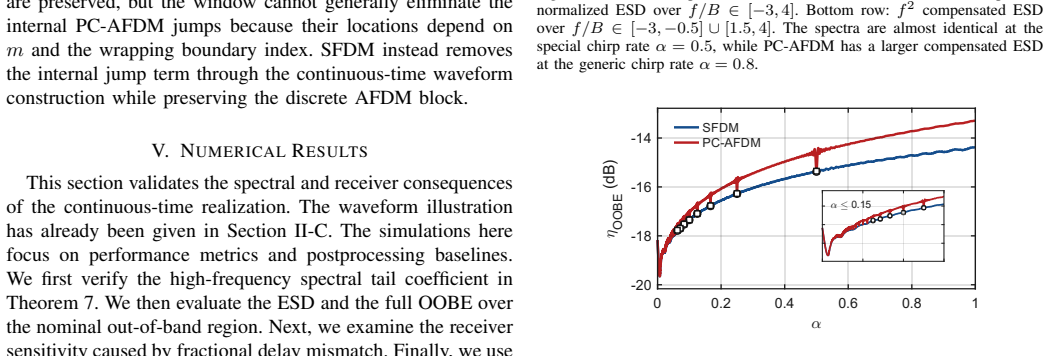
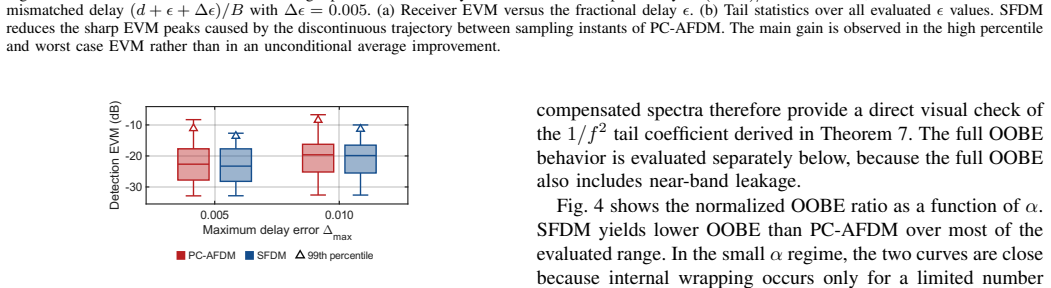
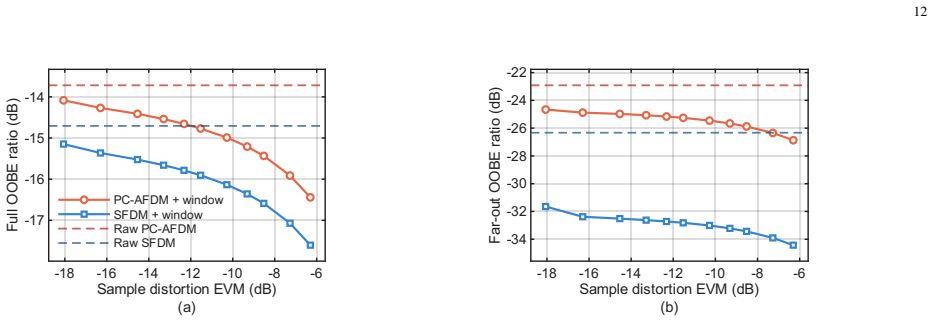
- Numerical verification confirms the theoretical tail coefficients and shows OOBE reduction plus improved robustness in high-percentile and worst-case regimes.
Where Pith is reading between the lines
- SFDM could allow AFDM systems to operate under tighter spectral masks without extra filtering hardware.
- The same midpoint-frequency principle might be applied to other chirp-based block waveforms to reduce their spectral leakage.
- Hardware implementations could test whether real-time phase accumulation remains stable when sampling clocks have small jitter.
- The construction suggests that discontinuities in many frequency-modulated block transmissions can be removed by choosing an interior point of each wrapped segment rather than an endpoint.
Load-bearing premise
Continuous phase accumulation across sampling-interval boundaries can be maintained without introducing unintended distortions to the signal spectrum or the receiver's data recovery, even when propagation adds fractional delays.
What would settle it
Measure the spectrum of the generated SFDM waveform and verify whether the high-frequency tail coefficients match the paper's theoretical predictions, or test bit-error rates at high percentiles under fractional-delay channels to check whether performance improves relative to standard piecewise-continuous AFDM.
Figures

read the original abstract
Affine frequency division multiplexing (AFDM) has emerged as a promising modulation scheme for doubly selective channels, but its canonical continuous-time realization, referred to herein as piecewise continuous AFDM (PC-AFDM), has been observed to exhibit high out-of-band emission (OOBE) whose mechanism has not been analytically characterized. This paper shows that the underlying cause is frequency wrapping, which introduces internal envelope jumps between AFDM sampling instants and generates a high-frequency spectral tail distinct from ordinary block truncation. To eliminate these discontinuities without altering the inverse discrete affine Fourier transform (IDAFT) output sequence, we propose stepped frequency division multiplexing (SFDM). In SFDM, the instantaneous frequency is kept constant at the midpoint of the wrapped chirp within each sampling interval, while the phase is continuously accumulated across interval boundaries. We prove that, under continuous phase accumulation and without additional phase correction, the midpoint choice is the unique sample-preserving choice for arbitrary chirp-rate parameter. The resulting waveform is continuous within each AFDM block, reduces OOBE, and preserves the standard AFDM modulation matrix, guard-interval structure, and receiver processing. Moreover, under fractional-delay propagation, SFDM mitigates the receiver sensitivity that arises when delayed sampling points fall near wrapping-induced discontinuities in PC-AFDM. Numerical results verify the theoretical tail coefficients, demonstrate OOBE reduction, and show improved receiver robustness in the high-percentile and worst-case regimes. These findings establish SFDM as a spectrally cleaner and more reliable physical layer for AFDM systems.
Editorial analysis
A structured set of objections, weighed in public.
Referee Report
Summary. The manuscript proposes Stepped Frequency Division Multiplexing (SFDM) to address high out-of-band emission (OOBE) in piecewise continuous Affine Frequency Division Multiplexing (PC-AFDM). It attributes the OOBE to frequency wrapping that creates internal envelope jumps between sampling instants. SFDM keeps the instantaneous frequency constant at the midpoint of each wrapped chirp segment while accumulating phase continuously across interval boundaries. The paper claims to prove that, under continuous phase accumulation and without extra phase correction, this midpoint choice is the unique sample-preserving selection for arbitrary chirp-rate parameters. The resulting waveform is asserted to be continuous within each AFDM block, to reduce OOBE, and to preserve the standard IDAFT modulation matrix, guard-interval structure, and receiver processing. Benefits are also claimed under fractional-delay propagation by mitigating receiver sensitivity near discontinuities. Numerical results are said to verify theoretical tail coefficients, demonstrate OOBE reduction, and show improved robustness in high-percentile and worst-case regimes.
Significance. If the uniqueness proof and the claimed OOBE reduction hold, the work would supply a spectrally cleaner continuous-time realization of AFDM that integrates directly with existing discrete AFDM processing. Preservation of the modulation matrix and receiver chain is a practical strength. The analytical link between wrapping-induced jumps and the high-frequency spectral tail, together with the parameter-free midpoint construction for arbitrary chirp rates, would constitute a useful contribution to waveform design for doubly selective channels.
major comments (1)
- Abstract: The central claim that the midpoint choice is the unique sample-preserving option under continuous phase accumulation (without additional correction) for arbitrary chirp-rate parameters is asserted but not derived. No proof steps, explicit assumptions, or key equations are supplied, so it is impossible to verify whether the construction indeed eliminates jumps while preserving the IDAFT output sequence and standard AFDM structures.
Simulated Author's Rebuttal
We thank the referee for the careful reading and for recognizing the potential significance of SFDM as a continuous-time AFDM realization that preserves existing modulation and receiver structures while reducing OOBE. We address the single major comment below.
read point-by-point responses
-
Referee: Abstract: The central claim that the midpoint choice is the unique sample-preserving option under continuous phase accumulation (without additional correction) for arbitrary chirp-rate parameters is asserted but not derived. No proof steps, explicit assumptions, or key equations are supplied, so it is impossible to verify whether the construction indeed eliminates jumps while preserving the IDAFT output sequence and standard AFDM structures.
Authors: The abstract is a high-level summary and, by standard convention, does not contain full derivations or equations. The complete proof that the midpoint selection is the unique sample-preserving choice under continuous phase accumulation without additional correction, for arbitrary chirp-rate parameters, is provided in Section III of the manuscript. That section states the assumptions explicitly, derives the uniqueness result via the continuous-phase constraint, and shows that the resulting waveform eliminates the wrapping-induced envelope jumps while exactly preserving the IDAFT output sequence, the modulation matrix, guard-interval structure, and all receiver processing. We are prepared to add a brief pointer to Section III in the abstract if the referee considers it useful. revision: no
Circularity Check
No significant circularity detected
full rationale
The abstract presents an independent waveform construction (SFDM) with a claimed uniqueness proof for the midpoint choice under continuous phase accumulation, preserving the IDAFT matrix and guard structure for arbitrary chirp-rate. No equations, fitted parameters, self-citations, or derivation steps are provided in the available text, so no load-bearing step can be shown to reduce by construction to its inputs. The central claim is a mathematical proof rather than a renaming or ansatz smuggling, making the derivation self-contained against external benchmarks.
Axiom & Free-Parameter Ledger
free parameters (1)
- chirp-rate parameter
axioms (1)
- domain assumption Continuous phase accumulation across interval boundaries is valid and requires no additional correction term.
invented entities (1)
-
Stepped Frequency Division Multiplexing (SFDM)
no independent evidence
Lean theorems connected to this paper
-
IndisputableMonolith/Cost/FunctionalEquation.leanwashburn_uniqueness_aczel unclearWe prove that, under continuous phase accumulation and without additional phase correction, the midpoint choice is the unique sample-preserving choice for arbitrary chirp-rate parameter.
-
IndisputableMonolith/Foundation/ArithmeticFromLogic.leanLogicNat recovery unclearThe resulting waveform is continuous within each AFDM block, reduces OOBE, and preserves the standard AFDM modulation matrix, guard-interval structure, and receiver processing.
Reference graph
Works this paper leans on
-
[1]
Orthogonal time-frequency signaling over doubly dispersive channels,
K. Liu, T. Kadous, and A. M. Sayeed, “Orthogonal time-frequency signaling over doubly dispersive channels,”IEEE Trans. Inf. Theory, vol. 50, no. 11, pp. 2583–2603, 2004
work page 2004
-
[2]
Fundamentals of time-varying communica- tion channels,
G. Matz and F. Hlawatsch, “Fundamentals of time-varying communica- tion channels,” inWireless Communications over Rapidly Time-Varying Channels, F. Hlawatsch and G. Matz, Eds. Oxford, U.K.: Academic Press, 2011, pp. 1–63
work page 2011
-
[3]
Federated edge learning with misaligned over-the-air computation,
Y . Shao, D. G ¨und¨uz, and S. C. Liew, “Federated edge learning with misaligned over-the-air computation,”IEEE Trans. Wireless Commun., vol. 21, no. 6, pp. 3951–3964, 2021
work page 2021
-
[4]
Oversampled orthogonal frequency division multiplexing in doubly selective fading channels,
J. Wu and Y . R. Zheng, “Oversampled orthogonal frequency division multiplexing in doubly selective fading channels,”IEEE Trans. Commun., vol. 59, no. 3, pp. 815–822, 2011
work page 2011
-
[5]
Orthogonal time frequency space modu- lation,
R. Hadani, S. Rakib, M. Tsatsanis, A. Monk, A. J. Goldsmith, A. F. Molisch, and R. Calderbank, “Orthogonal time frequency space modu- lation,” inIEEE WCNC, 2017
work page 2017
-
[6]
Interference can- cellation and iterative detection for orthogonal time frequency space modulation,
P. Raviteja, K. T. Phan, Y . Hong, and E. Viterbo, “Interference can- cellation and iterative detection for orthogonal time frequency space modulation,”IEEE Trans. Wireless Commun., vol. 17, no. 10, pp. 6501– 6515, 2018
work page 2018
-
[7]
Orthogonal chirp division multiplexing,
X. Ouyang and J. Zhao, “Orthogonal chirp division multiplexing,”IEEE Trans. Commun., vol. 64, no. 9, pp. 3946–3957, 2016
work page 2016
-
[8]
Doppler-resilient orthogonal signal-division multiplexing for underwater acoustic communication,
T. Ebihara and G. Leus, “Doppler-resilient orthogonal signal-division multiplexing for underwater acoustic communication,”IEEE J. Ocean. Eng., vol. 41, no. 2, pp. 408–427, 2016
work page 2016
-
[9]
AFDM: A full diversity next generation waveform for high mobility communications,
A. Bemani, N. Ksairi, and M. Kountouris, “AFDM: A full diversity next generation waveform for high mobility communications,” inIEEE ICC Workshops, 2021
work page 2021
-
[10]
Affine frequency division multiplexing for next generation wire- less communications,
——, “Affine frequency division multiplexing for next generation wire- less communications,”IEEE Trans. Wireless Commun., vol. 22, no. 11, pp. 8214–8229, 2023
work page 2023
-
[11]
H. S. Rou, G. T. F. de Abreu, J. Choi, D. Gonz ´alez G., M. Kountouris, Y . L. Guan, and O. Gonsa, “From orthogonal time-frequency space to affine frequency-division multiplexing: A comparative study of next- generation waveforms for integrated sensing and communications in doubly dispersive channels,”IEEE Signal Process. Mag., vol. 41, no. 5, pp. 71–86, 2024
work page 2024
-
[12]
Agile affine frequency division multiplexing,
Y . Cao and Y . Shao, “Agile affine frequency division multiplexing,”arXiv preprint arXiv:2512.14424, 2025
-
[13]
Delay-Doppler Domain Channel Estimation: What if Sparsity is Unknown?
Z. Yang, Y . Shao, F. Hou, and S. Ma, “Delay-doppler domain channel estimation: What if sparsity is unknown?”arXiv:2605.00049, 2026
work page internal anchor Pith review Pith/arXiv arXiv 2026
-
[14]
Joint channel, data, and radar parameter estimation for AFDM systems in doubly-dispersive channels,
K. R. R. Ranasinghe, H. Seok Rou, G. Thadeu Freitas de Abreu, T. Takahashi, and K. Ito, “Joint channel, data, and radar parameter estimation for AFDM systems in doubly-dispersive channels,”IEEE Trans. Wireless Commun., vol. 24, no. 2, pp. 1602–1619, 2025
work page 2025
-
[15]
Integrated sensing and com- munications with affine frequency division multiplexing,
A. Bemani, N. Ksairi, and M. Kountouris, “Integrated sensing and com- munications with affine frequency division multiplexing,”IEEE Wireless Commun. Lett., vol. 13, no. 5, pp. 1255–1259, 2024
work page 2024
-
[16]
Ambiguity function analysis of AFDM signals for integrated sensing and communications,
H. Yin, Y . Tang, Y . Ni, Z. Wang, G. Chen, J. Xiong, K. Yang, M. Kountouris, Y . L. Guan, and Y . Zeng, “Ambiguity function analysis of AFDM signals for integrated sensing and communications,”IEEE J. Sel. Areas Commun., vol. 44, pp. 196–211, 2026
work page 2026
-
[17]
Matched filtering-based channel estimation for AFDM systems in doubly selective channels,
X. Li, Z. Liu, Z. Zhou, and P. Fan, “Matched filtering-based channel estimation for AFDM systems in doubly selective channels,”IEEE Trans. Wireless Commun., vol. 25, pp. 15 597–15 610, 2026
work page 2026
-
[18]
A generalized spectral shaping method for OFDM signals,
L. Diez, J. A. Cort ´es, F. J. Ca ˜nete, E. Martos-Naya, and S. Iranzo, “A generalized spectral shaping method for OFDM signals,”IEEE Trans. Commun., vol. 67, no. 5, pp. 3540–3551, 2019
work page 2019
-
[19]
Reduction of out-of-band radiation in OFDM systems by insertion of cancellation carriers,
S. Brandes, I. Cosovic, and M. Schnell, “Reduction of out-of-band radiation in OFDM systems by insertion of cancellation carriers,”IEEE Commun. Lett., vol. 10, no. 6, pp. 420–422, 2006
work page 2006
-
[20]
J. van de Beek and F. Berggren, “N-continuous OFDM,”IEEE Commun. Lett., vol. 13, no. 1, pp. 1–3, 2009
work page 2009
-
[21]
A theory of semantic communication,
Y . Shao, Q. Cao, and D. G ¨und¨uz, “A theory of semantic communication,” IEEE Trans. Mobile Comp., vol. 23, no. 12, pp. 12 211–12 228, 2024
work page 2024
-
[22]
Sidelobes suppression in OFDM- based spectrum sharing systems using adaptive symbol transition,
H. A. Mahmoud and H. Arslan, “Sidelobes suppression in OFDM- based spectrum sharing systems using adaptive symbol transition,”IEEE Commun. Lett., vol. 12, no. 2, pp. 133–135, 2008
work page 2008
-
[23]
Out-of-band emission suppression techniques based on a generalized OFDM framework,
Z. You, J. Fang, and I.-T. Lu, “Out-of-band emission suppression techniques based on a generalized OFDM framework,”EURASIP J. Adv. Signal Process., vol. 2014, no. 1, p. 74, 2014
work page 2014
-
[24]
Splitting the unit delay: FIR/all pass filters design,
T. Laakso, V . Valimaki, M. Karjalainen, and U. Laine, “Splitting the unit delay: FIR/all pass filters design,”IEEE Signal Process. Mag., vol. 13, no. 1, pp. 30–60, 1996
work page 1996
-
[25]
Interpolation in digital modems. i. fundamentals,
F. Gardner, “Interpolation in digital modems. i. fundamentals,”IEEE Trans. Commun., vol. 41, no. 3, pp. 501–507, 1993
work page 1993
-
[26]
A. V . Oppenheim, A. S. Willsky, and S. H. Nawab,Signals & systems. Pearson Educaci ´on, 1997
work page 1997
-
[27]
R. N. Bracewell and R. N. Bracewell,The Fourier transform and its applications. McGraw-hill New York, 1986, vol. 31999
work page 1986
discussion (0)
Sign in with ORCID, Apple, or X to comment. Anyone can read and Pith papers without signing in.