Recognition: no theorem link
A New Timing Signature of Black Hole Spin: Time-Delay Asymmetry in Kerr Accretion Flows
Pith reviewed 2026-05-14 20:45 UTC · model grok-4.3
The pith
Black hole spin produces a nonzero timing asymmetry in photon arrivals from opposite sides of the spin axis.
A machine-rendered reading of the paper's core claim, the machinery that carries it, and where it could break.
Core claim
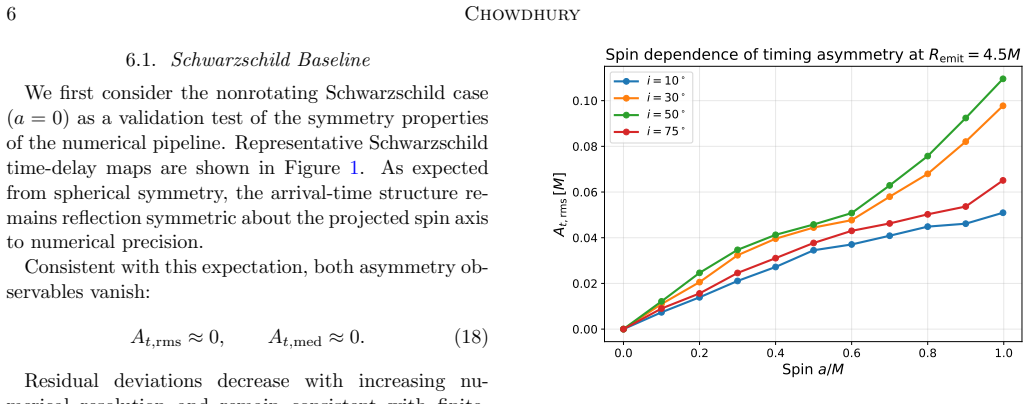
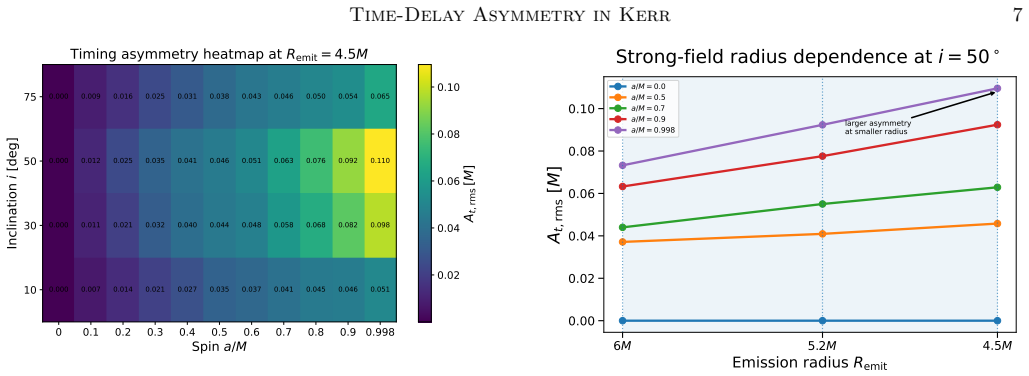
In the Kerr spacetime, rotation of the black hole breaks the reflection symmetry of null geodesics across the projected spin axis, causing photons emitted from mirror-paired locations to arrive at the observer with systematically different travel times. This produces a measurable mirror-paired timing asymmetry A_t that vanishes in the Schwarzschild limit and increases with the spin parameter, depending on observer inclination and emission radius.
What carries the argument
The mirror-paired timing asymmetry A_t constructed from time-delay maps obtained via backward ray tracing in Kerr spacetime.
If this is right
- The asymmetry A_t increases with black hole spin.
- Signals are largest for emission near the black hole at intermediate to high inclinations.
- Converting A_t to physical units gives timing offsets of seconds to hours for supermassive black holes.
- The observable provides directional timing information from Kerr photon propagation.
- It has implications for strong-gravity timing studies and X-ray reverberation mapping.
Where Pith is reading between the lines
- This asymmetry could serve as an independent probe of black hole spin in systems where other methods are uncertain.
- Standard reverberation mapping analyses may need to account for this directional effect in spinning black holes.
- High-cadence observations of specific accretion flows could test the predicted dependence on inclination and radius.
- The effect might help distinguish general relativity predictions from alternative gravity theories in strong fields.
Load-bearing premise
Emission originates from a narrow range of radii in a geometrically thin disk, and turbulence, magnetic fields, or extended emission do not erase the directional timing difference.
What would settle it
Detection of zero asymmetry in timing data from a confirmed high-spin black hole viewed at high inclination with inner-disk emission would falsify the predicted nonzero A_t.
Figures



read the original abstract
We introduce a new general-relativistic timing observable that measures the breaking of reflection symmetry in photon arrival times caused by black hole spin. Using backward ray tracing in the Kerr spacetime, we construct time-delay maps across the observer image plane and define a mirror-paired asymmetry based on photons arriving from opposite sides of the projected spin axis. In the Schwarzschild limit ($a=0$), the asymmetry vanishes to numerical precision, providing a stringent validation test of the method. For rotating black holes, Kerr rotation breaks the left-right propagation symmetry of null geodesics, producing systematic differences between prograde and retrograde photon trajectories and resulting in a nonzero mirror-paired timing asymmetry, $A_t$. We find that $A_t$ increases with spin and depends strongly on observer inclination and emission radius, with the largest signals arising from emission close to the black hole and from intermediate to high inclinations. Converting the dimensionless asymmetry into physical units yields timing offsets ranging from seconds to hours for representative supermassive black hole systems. Unlike traditional timing analyses based on spatially integrated signals, the observable introduced here isolates directional information encoded in Kerr photon propagation and provides a physically motivated timing signature of black hole rotation. We discuss the implications of this effect for strong-gravity timing studies and X-ray reverberation mapping.
Editorial analysis
A structured set of objections, weighed in public.
Referee Report
Summary. The manuscript introduces a new general-relativistic timing observable, the mirror-paired timing asymmetry A_t, constructed from backward ray tracing of null geodesics in the Kerr metric. Time-delay maps are built across the observer image plane, and A_t is defined to quantify differences in photon arrival times from opposite sides of the projected spin axis. The authors report that A_t vanishes to numerical precision for a=0, while for nonzero spin it is nonzero, grows with increasing a, and depends strongly on observer inclination and emission radius, with the largest values arising near the black hole at intermediate-to-high inclinations. Physical time offsets are estimated in the range of seconds to hours for representative supermassive black holes, and implications for X-ray reverberation mapping are discussed.
Significance. If the central result holds, the work supplies a directional timing signature that isolates the breaking of left-right symmetry by Kerr frame-dragging, providing a physically motivated complement to spatially integrated reverberation signals. The clean null result in the Schwarzschild limit constitutes a useful validation of the ray-tracing implementation.
major comments (2)
- [§3] §3 (results on emission-radius dependence): A_t is shown only for fixed narrow emission radii; given the reported strong radial dependence, the manuscript must demonstrate the emissivity-weighted integral of A_t over a realistic thin-disk profile (ISCO to tens of r_g) to establish whether the net asymmetry survives dilution and remains observationally relevant.
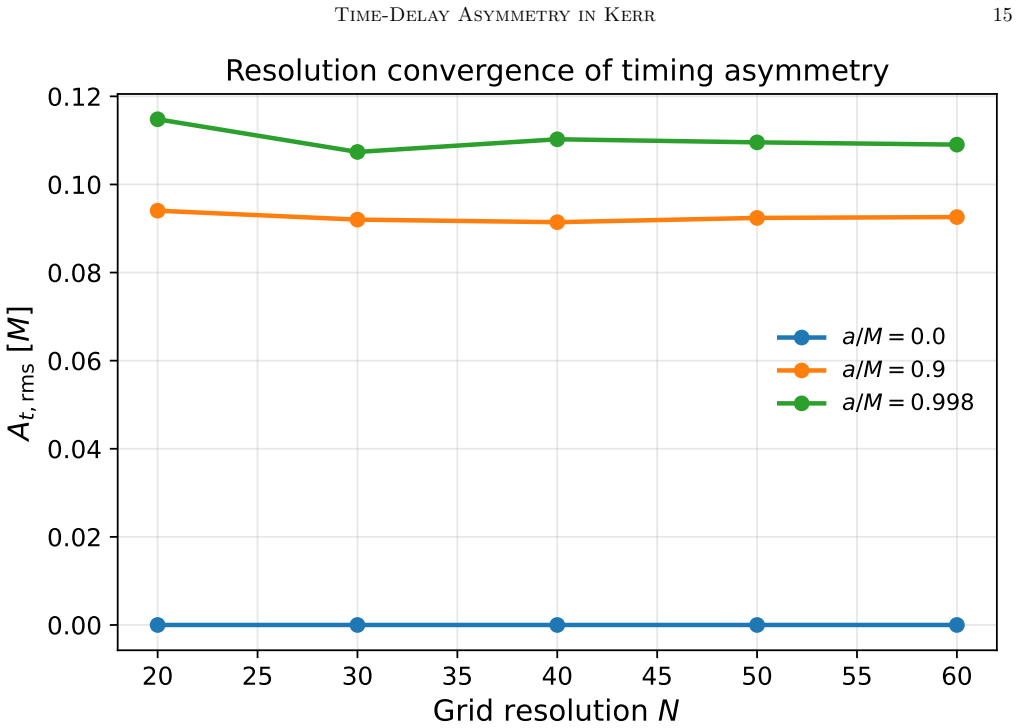
- [§2] §2 (numerical method): The statement that the asymmetry vanishes 'to numerical precision' for a=0 is presented without quantitative error estimates, ray-tracing resolution convergence tests, or explicit checks for numerical artifacts in the Kerr (a>0) cases.
minor comments (2)
- [Abstract] Abstract: the conversion of dimensionless A_t into physical time delays (seconds to hours) is stated without a table or specific examples for chosen black-hole masses, spins, and inclinations.
- [§5] §5 (discussion): additional references to existing Kerr ray-tracing and reverberation-mapping literature would better situate the novelty of the directional asymmetry relative to prior timing observables.
Simulated Author's Rebuttal
We thank the referee for the constructive report and positive assessment of the work. We address each major comment below and will revise the manuscript to incorporate the requested additions.
read point-by-point responses
-
Referee: [§3] §3 (results on emission-radius dependence): A_t is shown only for fixed narrow emission radii; given the reported strong radial dependence, the manuscript must demonstrate the emissivity-weighted integral of A_t over a realistic thin-disk profile (ISCO to tens of r_g) to establish whether the net asymmetry survives dilution and remains observationally relevant.
Authors: We agree that an emissivity-weighted integral is necessary to assess whether the asymmetry remains observationally relevant after radial dilution. In the revised manuscript we will add a new subsection and figure that computes the disk-integrated A_t using a standard thin-disk emissivity profile (e.g., r^{-3} or Novikov-Thorne) from the ISCO to 50 r_g. Preliminary calculations indicate that the inner-disk weighting preserves a detectable net signal at intermediate-to-high inclinations, but the full results will be presented. revision: yes
-
Referee: [§2] §2 (numerical method): The statement that the asymmetry vanishes 'to numerical precision' for a=0 is presented without quantitative error estimates, ray-tracing resolution convergence tests, or explicit checks for numerical artifacts in the Kerr (a>0) cases.
Authors: We acknowledge that quantitative validation was omitted. The revised manuscript will include (i) explicit residual values of A_t for a=0 at multiple resolutions, (ii) convergence tests varying both the number of rays per pixel and the image-plane grid spacing, and (iii) direct comparisons of photon arrival-time maps between a=0 and low-a Kerr runs to confirm the absence of spurious artifacts. These tests will be reported in §2 with accompanying tables or figures. revision: yes
Circularity Check
No circularity: asymmetry computed directly from Kerr geodesic integration
full rationale
The central observable A_t is obtained by numerical backward ray tracing of null geodesics in the Kerr metric, with the mirror-paired asymmetry defined on the resulting time-delay maps. The paper explicitly validates that A_t vanishes to numerical precision when a=0, confirming the computation is not forced by construction. No parameters are fitted to data and then relabeled as predictions, no self-citations supply load-bearing uniqueness theorems, and no ansatz is smuggled in; the result follows from the standard Kerr line element and geodesic equations without reduction to the paper's own inputs.
Axiom & Free-Parameter Ledger
axioms (2)
- standard math The Kerr metric accurately describes the spacetime of a rotating black hole
- standard math Photon paths follow null geodesics
Reference graph
Works this paper leans on
-
[1]
and Krolik, Julian H
Schnittman, Jeremy D. and Krolik, Julian H. , title =. The Astrophysical Journal , volume =. 2010 , doi =
2010
-
[2]
, title =
Cunningham, Charles T. , title =. The Astrophysical Journal , volume =. 1975 , doi =
1975
-
[3]
The Astrophysical Journal , volume =
Laor, Ari , title =. The Astrophysical Journal , volume =. 1991 , doi =
1991
-
[4]
and Young, Andrew J
Reynolds, Christopher S. and Young, Andrew J. and Begelman, Mitchell C. and Fabian, Andrew C. , title =. The Astrophysical Journal , volume =. 1999 , doi =
1999
-
[5]
and Cackett, E
Uttley, P. and Cackett, E. M. and Fabian, A. C. and Kara, E. and Wilkins, D. R. , title =. The Astronomy and Astrophysics Review , volume =. 2014 , doi =
2014
-
[6]
, title =
Reynolds, Christopher S. , title =. Annual Review of Astronomy and Astrophysics , volume =. 2021 , doi =
2021
-
[7]
Wilkins, D. R. and Fabian, A. C. , title =. Monthly Notices of the Royal Astronomical Society , volume =. 2013 , doi =
2013
-
[8]
Wilkins, D. R. and Fabian, A. C. , title =. Monthly Notices of the Royal Astronomical Society , volume =. 2012 , doi =
2012
-
[9]
and McHardy, I
Emmanoulopoulos, D. and McHardy, I. M. and Papadakis, I. E. , title =. Monthly Notices of the Royal Astronomical Society , volume =. 2014 , doi =
2014
-
[10]
Monthly Notices of the Royal Astronomical Society , volume =
Beckwith, Kris and Done, Chris , title =. Monthly Notices of the Royal Astronomical Society , volume =. 2005 , doi =
2005
-
[11]
and Press, William H
Bardeen, James M. and Press, William H. and Teukolsky, Saul A. , title =. The Astrophysical Journal , volume =. 1972 , doi =
1972
-
[12]
, title =
Miller, Jon M. , title =. Annual Review of Astronomy and Astrophysics , volume =. 2007 , doi =
2007
-
[13]
, title =
Kerr, Roy P. , title =. Physical Review Letters , volume =. 1963 , doi =
1963
-
[14]
and Calvani, M
Fanton, C. and Calvani, M. and de Felice, F. and Cadez, A. , title =. Publications of the Astronomical Society of Japan , volume =. 1997 , doi =
1997
-
[15]
GYOTO: a New General Relativistic Ray-Tracing Code , journal =
Vincent, Fr. GYOTO: a New General Relativistic Ray-Tracing Code , journal =. 2011 , doi =
2011
-
[16]
The Mass of the Black Hole in Cygnus X-1
Orosz, Jerome A. and McClintock, Jeffrey E. and Aufdenberg, Jason P. and Remillard, Ronald A. and Reid, Mark J. and Narayan, Ramesh and Gou, Lijun , title =. The Astrophysical Journal , volume =. 2011 , doi =. 1106.3689 , archivePrefix =
work page internal anchor Pith review Pith/arXiv arXiv 2011
-
[17]
First M87 Event Horizon Telescope Results. V. Physical Origin of the Asymmetric Ring , journal =
-
[18]
First M87 Event Horizon Telescope Results. VI. The Shadow and Mass of the Central Black Hole , journal =. 2019 , doi =. 1906.11243 , archivePrefix =
work page internal anchor Pith review Pith/arXiv arXiv 2019
-
[19]
A Geometric Distance Measurement to the Galactic Center Black Hole with 0.3\ journal =. 2019 , doi =. 1904.05721 , archivePrefix =
-
[20]
The Astrophysical Journal , volume =
Netzer, Hagai , title =. The Astrophysical Journal , volume =. 2003 , doi =
2003
-
[21]
A Parallax Distance to the Microquasar GRS 1915+105 and a Revised Estimate of its Black Hole Mass
Reid, Mark J. and others , title =. The Astrophysical Journal , volume =. 2014 , doi =. 1409.2453 , archivePrefix =
work page internal anchor Pith review Pith/arXiv arXiv 2014
-
[22]
A Reverberation-Based Mass for the Central Black Hole in NGC 4151
Bentz, Misty C. and others , title =. The Astrophysical Journal , volume =. 2006 , doi =. astro-ph/0607085 , archivePrefix =
work page internal anchor Pith review Pith/arXiv arXiv 2006
-
[23]
van den Bosch, Remco C. E. and others , title =. Nature , volume =. 2012 , doi =. 1211.6429 , archivePrefix =
work page internal anchor Pith review Pith/arXiv arXiv 2012
-
[24]
Off-shell single-top-quark production in the Standard Model Effective Field Theory
Ge, Xue and Zhao, Bi-Xuan and Bian, Wei-Hao and Green, Richard , title =. The Astronomical Journal , volume =. 2019 , doi =. 1903.11023 , archivePrefix =
work page internal anchor Pith review Pith/arXiv arXiv 2019
-
[25]
Spontaneous Symmetry Breaking and Nambu-Goldstone Bosons in Quantum Many-Body Systems
Neumayer, Nadine , title =. Publications of the Astronomical Society of Australia , volume =. 2010 , doi =. 1001.5212 , archivePrefix =
work page internal anchor Pith review Pith/arXiv arXiv 2010
-
[26]
DarkSUSY - A numerical package for supersymmetric dark matter calculations
Devereux, Nick and Ford, Holland and Tsvetanov, Zolt and Jacoby, George , title =. The Astronomical Journal , volume =. 2003 , doi =. astro-ph/0211238 , archivePrefix =
work page internal anchor Pith review Pith/arXiv arXiv 2003
-
[27]
Final results of the EDELWEISS-I dark matter search with cryogenic heat-and-ionization Ge detectors
Paltani, S. and Türler, M. , title =. Astronomy & Astrophysics , volume =. 2005 , doi =. astro-ph/0503265 , archivePrefix =
work page internal anchor Pith review Pith/arXiv arXiv 2005
-
[28]
Cosmic Rays and Neutrinos from GRBs: Predictions versus Acceleration Modeling
Tadhunter, Clive and Marconi, Alessandro and Axon, David and Robinson, Andrew and Jackson, Neal and Villar-Martín, Montserrat , title =. Monthly Notices of the Royal Astronomical Society , volume =. 2003 , doi =. astro-ph/0302231 , archivePrefix =
work page internal anchor Pith review Pith/arXiv arXiv 2003
-
[29]
and Holz, Daniel E
Gralla, Samuel E. and Holz, Daniel E. and Wald, Robert M. , title =. Phys. Rev. D , volume =
-
[30]
Cackett, Edward M. et al. , title =. Space Science Reviews , volume =
-
[31]
The Astrophysical Journal , year =
Chowdhury, Shakibul , title =. The Astrophysical Journal , year =
discussion (0)
Sign in with ORCID, Apple, or X to comment. Anyone can read and Pith papers without signing in.