Recognition: unknown
Charge Transport Capacity as a Probe of Resonances in Models of Many-Body Localization
Pith reviewed 2026-05-10 02:44 UTC · model grok-4.3
The pith
Charge transport capacity grows with system size in localized models because many-body resonances become more likely.
A machine-rendered reading of the paper's core claim, the machinery that carries it, and where it could break.
Core claim
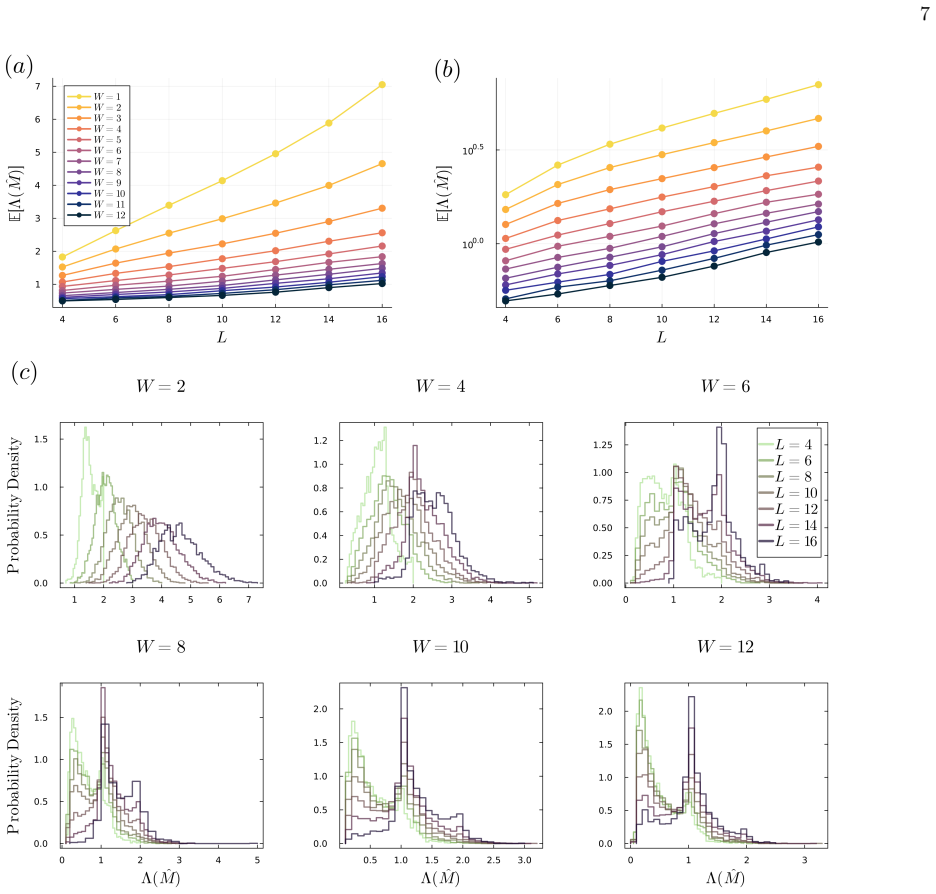
In the interacting Anderson model the disorder-averaged charge transport capacity remains small but increases with L at a rate that becomes independent of W for large W. This increase occurs because, as L grows, many-body resonances capable of transporting more charge across the cut become more likely. A perturbative model for the weakly interacting regime shows that these charge-transport resonances are sensitive to charge configurations over a spatial region whose size is fixed by the resonance range itself, and that at strong disorder such resonances are exponentially suppressed in their size for sufficiently large L.
What carries the argument
Charge transport capacity (CTC), defined as an upper bound on the total charge that can ever be transported across a central cut, used to detect the presence and size distribution of many-body resonances.
If this is right
- At strong enough disorder, for large L the many-body resonances become exponentially suppressed in size, allowing the MBL phase to remain controlled.
- The unsettled growth of short-ranged resonances with L at accessible sizes accounts for the numerical drift toward thermalization observed in simulations.
- For strong disorder, measures of average charge transport indicate that typical product states can transfer only O(1) charge across the cut.
- The effective spatial range of the resonances is set by their own size rather than by disorder strength, producing the observed disorder-independent growth at moderate L.
Where Pith is reading between the lines
- If the resonance growth does not saturate at larger L, the MBL phase could eventually be destabilized even at strong disorder.
- Applying the same CTC probe to other localized phases or to quasiperiodic models could reveal whether resonance growth is generic.
- Improved numerical methods that reach substantially larger L would directly test the predicted crossover from power-law-like to exponentially suppressed resonance statistics.
- The finding suggests that finite-size drifts in MBL diagnostics may be systematically reduced by focusing on quantities insensitive to short-range resonances.
Load-bearing premise
The perturbative model for weakly interacting resonances correctly reproduces the L-dependence and disorder independence seen in the full numerics at accessible sizes, and the observed growth will eventually slow or change character at much larger L.
What would settle it
Computation of the disorder-averaged CTC at system sizes several times larger than those currently reachable, to test whether the growth rate decreases and whether the L-independence of the rate at strong W persists or breaks as predicted by exponential suppression.
Figures







read the original abstract
The fate of Many-Body Localization (MBL) in the thermodynamic limit remains elusive, partly because numerical studies suffer from unexplained finite-size effects. We introduce and numerically study the charge transport capacity (CTC) -- a quantity that upper bounds the number of particles that can ever be transported across a central cut of a 1D lattice. For ergodic systems, the CTC is linear with the system size $L$, while we expect it to be $O(1)$ for localized models. Surprisingly, in the interacting Anderson model for numerically accessible $L$, the disorder-averaged CTC is small, but grows with $L$ at an increasing rate. Moreover, this growth rate appears to be independent of the disorder strength $W$ at very large $W$. We find that, for these system sizes, this growth occurs because, as $L$ increases, many-body resonances that transport more charge across the cut become more likely. Using a perturbative model for the weakly interacting regime, we provide an understanding of the microscopic origins of the growth of these charge transport resonances (CTRs). We find that the CTRs are sensitive to charge configurations over a spatial region whose size is set by the range of the resonance, not by $W$, and that numerics cannot access system sizes where their behavior will converge. However, this effective model is consistent with a regime of strong disorder where, for large $L$, resonances are exponentially suppressed in their size. Finally, we study measures of average charge transport and suggest that for strong enough disorder, average product states can only transfer $O(1)$ charge. Our work suggests that the unsettled growth of short-ranged many-body resonances with $L$ contributes to the numerical drift towards thermalization at numerically accessible system sizes, and provides an understanding of how they can remain controlled or eventually destabilize the MBL phase.
Editorial analysis
A structured set of objections, weighed in public.
Referee Report
Summary. The paper introduces the charge transport capacity (CTC), an observable that upper-bounds the number of particles that can be transported across a central cut in a 1D lattice. In the interacting Anderson model, exact diagonalization and time-evolution numerics for accessible L show that the disorder-averaged CTC is small but grows with L at a rate that becomes independent of disorder strength W at large W. This growth is attributed to an increasing likelihood of many-body charge transport resonances (CTRs). A perturbative model for the weakly interacting regime is used to trace the microscopic origin of the CTRs, showing that they depend on charge configurations over a spatial range set by the resonance size rather than W. The model is consistent with eventual exponential suppression of resonances at large L and strong W, although the convergent regime lies beyond numerically accessible sizes. The authors conclude that the unsettled growth of short-ranged resonances explains the numerical drift toward thermalization and discuss implications for the stability of the MBL phase.
Significance. If the central observations hold, the work supplies a concrete, transport-based diagnostic for the finite-size effects that have complicated MBL numerics. The CTC furnishes a rigorous upper bound on charge transport, and the perturbative treatment of weakly interacting resonances offers a microscopic account of why short-ranged many-body resonances proliferate with L while remaining potentially controllable at stronger disorder. Credit is due for the explicit acknowledgment that numerics cannot reach the regime where resonance behavior converges and for combining direct numerical evidence with an analytical model rather than relying on either alone. The suggestion that average product states transport only O(1) charge at sufficiently strong disorder, if substantiated, would provide a falsifiable prediction for future studies.
major comments (2)
- [perturbative model and large-W numerics] The central claim that resonances remain exponentially suppressed for large L at strong disorder rests on the perturbative model (abstract and the section presenting the weakly interacting analysis). Because that model is derived under weak-interaction assumptions, it is not obvious how its prediction of exponential suppression in resonance size extends to the large-W regime where the W-independent CTC growth is observed numerically; a quantitative mapping or bound connecting the two regimes would be needed to make the extrapolation load-bearing rather than suggestive.
- [numerical results and discussion of CTRs] The statement that 'numerics cannot access system sizes where their behavior will converge' (abstract) is acknowledged, yet the reported L-growth of CTC at large W is presented as evidence that short-ranged resonances drive the drift toward thermalization. Without an estimate of the crossover length scale at which suppression would set in, or a scaling collapse that isolates the resonance contribution from other finite-size effects, the interpretation that the observed growth is a transient that will saturate remains an extrapolation whose robustness cannot be assessed from the data shown.
minor comments (2)
- [introduction] The precise mathematical definition of the CTC (upper bound on transported particles across a cut) should be stated as an equation in the introduction or methods section rather than described only in prose, to allow readers to verify the claimed linearity for ergodic systems and O(1) expectation for localized systems.
- [perturbative model] Notation for the resonance range and its relation to W should be clarified; the text states that the effective region size is set by the resonance range 'not by W,' but it is unclear whether this is a derived result or an assumption in the perturbative construction.
Simulated Author's Rebuttal
We thank the referee for their careful reading, positive assessment of the work's significance, and constructive major comments. We respond point by point below, indicating revisions where appropriate to address the concerns while preserving the manuscript's core claims.
read point-by-point responses
-
Referee: [perturbative model and large-W numerics] The central claim that resonances remain exponentially suppressed for large L at strong disorder rests on the perturbative model (abstract and the section presenting the weakly interacting analysis). Because that model is derived under weak-interaction assumptions, it is not obvious how its prediction of exponential suppression in resonance size extends to the large-W regime where the W-independent CTC growth is observed numerically; a quantitative mapping or bound connecting the two regimes would be needed to make the extrapolation load-bearing rather than suggestive.
Authors: We appreciate the referee highlighting the need for clearer connection between regimes. The perturbative model is derived under weak interactions, but at large W the effective interaction is small relative to disorder, placing the system in the regime where resonances are rare and perturbation theory applies. The model's central result—that resonance probability depends on charge configurations over a spatial range set by resonance size, independent of W—directly accounts for the W-independent CTC growth seen in numerics. While a fully quantitative mapping between weak-interaction analytics and strong-disorder numerics is not provided, the consistency is not merely suggestive: the model predicts exponential suppression in resonance size for large L, aligning with the expectation that CTC saturates to O(1) at sufficiently strong disorder. In the revised manuscript we will add an explicit paragraph in the discussion section clarifying the regime of validity and the reasoning for extending the suppression prediction to large W. revision: partial
-
Referee: [numerical results and discussion of CTRs] The statement that 'numerics cannot access system sizes where their behavior will converge' (abstract) is acknowledged, yet the reported L-growth of CTC at large W is presented as evidence that short-ranged resonances drive the drift toward thermalization. Without an estimate of the crossover length scale at which suppression would set in, or a scaling collapse that isolates the resonance contribution from other finite-size effects, the interpretation that the observed growth is a transient that will saturate remains an extrapolation whose robustness cannot be assessed from the data shown.
Authors: We agree that the interpretation involves extrapolation beyond accessible sizes, as already stated in the abstract and main text. The W-independent growth of CTC with L is presented as direct numerical evidence that short-ranged many-body resonances have not converged at current L, contributing to apparent drift toward thermalization; the perturbative model then supplies the microscopic mechanism and the expectation of eventual saturation. We do not include a crossover length estimate or scaling collapse because no such scale emerges from the data up to the largest L studied, and the model does not yield a precise numerical value for the onset of suppression. In the revised version we will adjust the discussion to frame the saturation more explicitly as a model-supported hypothesis rather than a firm prediction from numerics alone, and we will note the absence of a quantitative crossover as a limitation to be addressed by future work. revision: yes
Circularity Check
No significant circularity in the derivation chain
full rationale
The paper's central numerical observations of CTC growth with L (and its apparent W-independence at large W) are obtained directly from exact diagonalization and time-evolution simulations on the interacting Anderson model; these quantities are not derived from or fitted by the subsequent perturbative model. The perturbative model is introduced only to supply a microscopic interpretation of the resonances responsible for the observed growth and to show consistency with eventual exponential suppression at large L, without feeding back into or presupposing the reported L-dependence. No self-definitional reductions, fitted inputs relabeled as predictions, or load-bearing self-citations appear in the argument; the derivation remains self-contained against the external numerical benchmarks.
Axiom & Free-Parameter Ledger
axioms (2)
- domain assumption CTC is linear in L for ergodic systems and O(1) for localized systems
- domain assumption Many-body resonances are the dominant mechanism causing CTC growth at accessible L
invented entities (2)
-
Charge Transport Capacity (CTC)
no independent evidence
-
Charge Transport Resonances (CTRs)
no independent evidence
Forward citations
Cited by 2 Pith papers
-
Chaos Emerge with Exceptional Points in Reset-Driven Floquet Dynamics
Tuning a chaos parameter drives an exceptional-point transition in reset-driven Floquet channel spectra from real eigenvalues in an ergodic regime to complex pairs in a chaotic regime, distinguishing multiple dynamica...
-
Resonance Proliferation Across Localization Transitions
A flow equation for the resonance density exponent θ(w) derived in the SJA predicts resonance proliferation driving delocalization, with θ(w)>0 for localized phases and instability signaling thermalization, matching n...
Reference graph
Works this paper leans on
-
[1]
An upper bound on the charge transport capacity Here, we prove thatΛ( ˆM)≤L, providing a strict upper bound on how the CTC can grow in the ther- modynamic limit. Using simply that both the spectra of ˆNR and[ ˆNR]diag are bounded between0andL/2, it can be derived that the spectrum of the difference ˆM= ˆNR −[ ˆNR]diag is bounded between−L/2andL/2. More pr...
-
[2]
Let ˆUbe the inversion operator
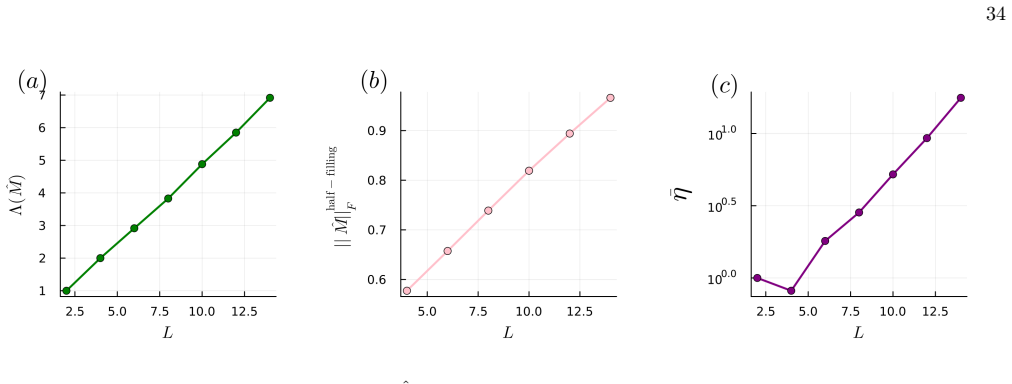
Charge transport capacity in inversion symmetric systems We will show that for anyˆHwith inversion andU(1) symmetry, we haveΛ(ˆM) =L/2in the half-filling sector, and that the eigenvalues ofˆMacross all filling sectors are the half-integers in[−L/4, L/4]. Let ˆUbe the inversion operator. Consider a Hamil- tonian with inversion symmetry, such that[ ˆH, ˆU] ...
-
[3]
In the half-filling sector, the eigenvalues of ˆMrange from−L/4toL/4in integer steps, whereas across all sectors, the eigenvalues range from−L/4toL/4inhalf-integer steps
This givesΛ( ˆM) =L/2. In the half-filling sector, the eigenvalues of ˆMrange from−L/4toL/4in integer steps, whereas across all sectors, the eigenvalues range from−L/4toL/4inhalf-integer steps
-
[4]
We first test these properties for a Hamiltonian sam- pled from the GOE with Hilbert space dimension L L/2 , restricting to the half-filling sector
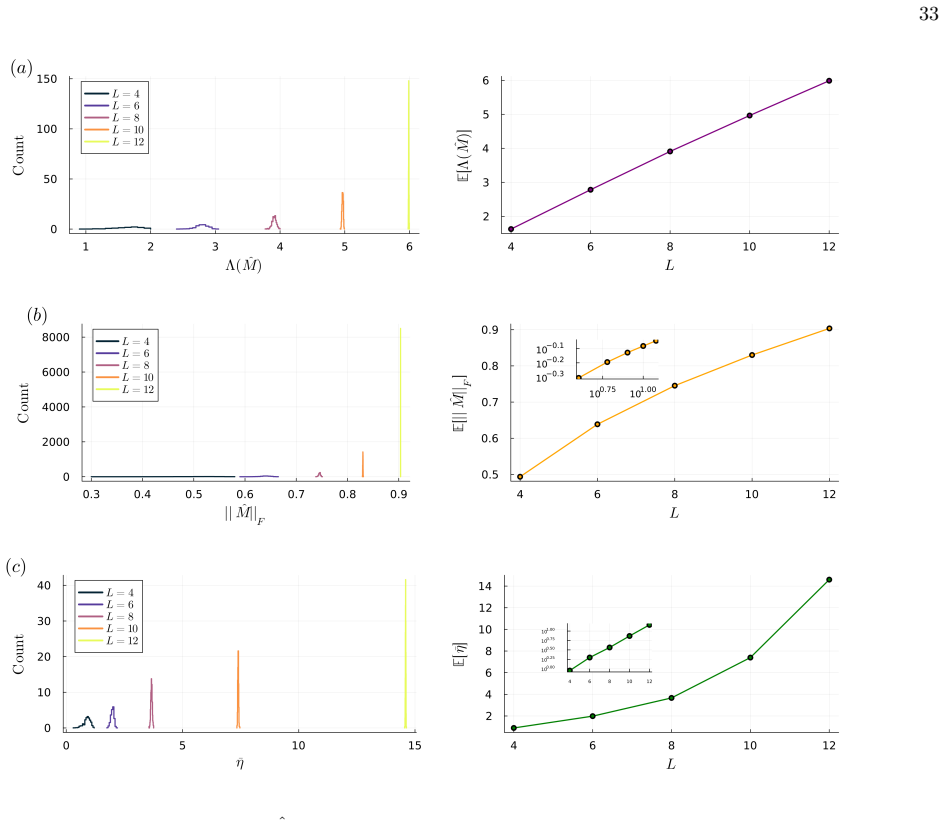
Properties of ˆMand related quantities in thermalizing systems Here, we provide numerical evidence of the following two properties of the charge transport capacity operator ˆMin thermalizing systems: thatΛ( ˆM)generically scales as≈L/2, and that∥ ˆM∥ F ∼ √ L. We first test these properties for a Hamiltonian sam- pled from the GOE with Hilbert space dimens...
-
[5]
In particular,[ ˆNR]diag will depend on the chosen basis for the degenerate subspace, which can affectˆM
Degenerate systems and ˆM There are subtleties which arise when one definesˆM= ˆNR −[ ˆNR]diag for a Hamiltonian in a system with degen- eracies. In particular,[ ˆNR]diag will depend on the chosen basis for the degenerate subspace, which can affectˆM. One simple thought experiment is to take the Hamilto- nian ˆH= PL i=1 ˆni. ThisHamiltonianclearlyhasprodu...
-
[6]
We then dis- cuss in detail a possible application of this generalization to problems of inversion-symmetric localization
Charge transport capacity on other subregions and in inversion symmetric models Here, we discuss generalizing the charge transport ca- pacity operator to an arbitrary geometry. We then dis- cuss in detail a possible application of this generalization to problems of inversion-symmetric localization. Consider a latticeLand a subsystemA⊂ Land its complementA...
-
[7]
In this model, the on-site potentialsh j are chosen independently from a uniform distribution Unif[−W, W], whereW∈Rdenotes the disorder strength
Non-interacting Anderson Model Now discuss the behavior of ˆMin the 1D Ander- son model, the paradigmatic setting for single-particle localization. In this model, the on-site potentialsh j are chosen independently from a uniform distribution Unif[−W, W], whereW∈Rdenotes the disorder strength. It is a well-known result that in 1D, for any fi- nite disorder...
-
[8]
Non-interacting quasiperiodic model The scaling of the charge transport capacity withLis also useful as a diagnostic of localization transitions. We will demonstrate this by studyingˆMin the quasiperiodic Aubry-André model [72], with onsite potentials hj =hcos [2πk(j+δ)].(B6) Here,kis some irrational number, andδis a phase shift. For this model, fixingt= ...
-
[9]
This choice does not affect the behavior of Λ( ˆM)as long askis irrational. Furthermore, to avoid commensuration issues, we adopt the standard practice and perform calculations for different phase shifts be- tween0≤δ≤1/k, in uniform steps, and compute the distributions ofΛ( ˆM)over these phase shifts. Here, we useE ϕ[·]to denote averaging over phase shift...
-
[10]
mobility edge
Non-interacting Generalized Aubry-André Model Finally, we study the CTC numerically in the Gener- alized Aubry-André (GAA) model, a model realizing a mobility edge in 1D. Here, we take Eq. (B1) with the onsite potentials hj = 2λ cos(2πk(j+ϕ)) 1−αcos(2πk(j+ϕ)) .(B7) This model has a mobility edgeEgiven by αE= sgn(λ)||t| − |λ||,(B8) which separates localize...
-
[11]
18, we show the analysis of| |ϕ max⟩ | · | |ϕmin⟩ |
In Fig. 18, we show the analysis of| |ϕ max⟩ | · | |ϕmin⟩ |. In panels (a)-(d) we have the probability distributions of| |ϕmax⟩ | · | |ϕmin⟩ |over 2000 disor- der realizations. In panel (e), we show the disorder averaged| |ϕ max⟩ | · | |ϕmin⟩ |as a function ofL
2000
-
[12]
19, we show a comparison of the CTC with predictions of quench dynamics starting from |ϕmin⟩as an initial state
In Fig. 19, we show a comparison of the CTC with predictions of quench dynamics starting from |ϕmin⟩as an initial state. This is the counterpart to Fig. 4(a) of the main text, while here, we present data for additional disorder strengths and system sizesL= 12andL= 14
-
[13]
20, we show the fraction of disorder realiza- tions with| |ϕmax⟩ | · | |ϕmin⟩ |>0.9as a function of the CTC
In Fig. 20, we show the fraction of disorder realiza- tions with| |ϕmax⟩ | · | |ϕmin⟩ |>0.9as a function of the CTC. Notably, we observe that atΛ(ˆM)≈2, the fraction of instances with| |ϕmax⟩ | · | |ϕmin⟩ |> 0.9is more than half of the total disorder re- alizations forW= 9,12, and close to1/2for W= 8,10. As discussed in Sec. IVC, observing | |ϕmax⟩ | · | ...
2000
-
[14]
center of mass
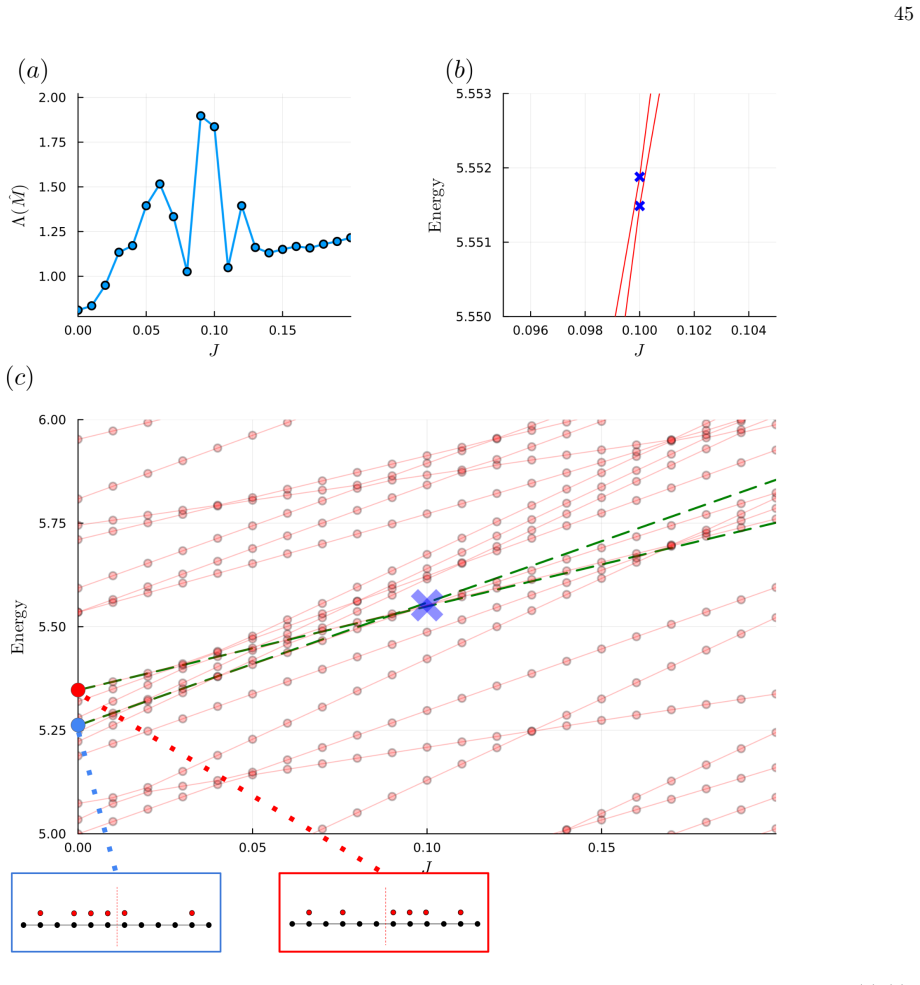
It must be noted that out of theO(2 L−4)possible background configurations (the exact number is70for 42 Figure 19. Density heat maps comparing the CTC (x-axis) withmax t |⟨ ˆNR(t)− ˆNR(0)⟩|in a quench dynamics simulation (y-axis) in the strong disorder regime and forJ= 0.1. The quench evolves|ϕ min⟩as an initial state, to timest∈[0,10 5]in steps of∆t= 10....
2000
-
[15]
P. W. Anderson, Absence of Diffusion in Certain Random Lattices, Physical Review109, 1492 (1958)
1958
-
[16]
Lagendijk, B
A. Lagendijk, B. V. Tiggelen, and D. S. Wiersma, Fifty 48 Figure 25. The analysis of the distance at which charge is transported in the CTRs that transfer the most charge. Panel (a): the disorder-averaged dipole momentp, defined in Eq. (G4), as a function ofL. Panel (b): the disorder-averaged transport distance∆x, Eq. (G3), as a function ofL. The colored ...
2000
-
[17]
I. V. Gornyi, A. D. Mirlin, and D. G. Polyakov, Interact- ing Electrons in Disordered Wires: Anderson Localiza- tion and Low- T Transport, Physical Review Letters95, 206603 (2005)
2005
-
[18]
Basko, I
D. Basko, I. Aleiner, and B. Altshuler, Metal–insulator transition in a weakly interacting many-electron system with localized single-particle states, Annals of Physics 321, 1126 (2006)
2006
-
[19]
J. Z. Imbrie, On Many-Body Localization for Quan- tum Spin Chains, Journal of Statistical Physics163, 998 (2016)
2016
-
[20]
J. Z. Imbrie, Diagonalization and Many-Body Localiza- tion for a Disordered Quantum Spin Chain, Physical Re- view Letters117, 027201 (2016)
2016
-
[21]
Oganesyan and D
V. Oganesyan and D. A. Huse, Localization of interact- ing fermions at high temperature, Physical Review B75, 155111 (2007)
2007
-
[22]
Žnidarič, T
M. Žnidarič, T. Prosen, and P. Prelovšek, Many-body localization in the Heisenberg XXZ magnet in a random field, Physical Review B77, 064426 (2008)
2008
-
[23]
Pal and D
A. Pal and D. A. Huse, Many-body localization phase transition, Physical Review B82, 174411 (2010)
2010
-
[24]
J. H. Bardarson, F. Pollmann, and J. E. Moore, Un- bounded Growth of Entanglement in Models of Many- Body Localization, Physical Review Letters109, 017202 (2012)
2012
-
[25]
Bauer and C
B. Bauer and C. Nayak, Area laws in a many-body lo- calized state and its implications for topological order, Journal of Statistical Mechanics: Theory and Experi- ment2013, P09005 (2013)
2013
-
[26]
De Luca and A
A. De Luca and A. Scardicchio, Ergodicity breaking in a model showing many-body localization, EPL (Euro- physics Letters)101, 37003 (2013)
2013
-
[27]
J. A. Kjäll, J. H. Bardarson, and F. Pollmann, Many- Body Localization in a Disordered Quantum Ising Chain, Physical Review Letters113, 107204 (2014)
2014
-
[28]
S. Bera, H. Schomerus, F. Heidrich-Meisner, and J. H. Bardarson, Many-Body Localization Characterized from a One-Particle Perspective, Physical Review Letters115, 046603 (2015)
2015
-
[29]
Bar Lev, G
Y. Bar Lev, G. Cohen, and D. R. Reichman, Absence of Diffusion in an Interacting System of Spinless Fermions on a One-Dimensional Disordered Lattice, Physical Re- view Letters114, 100601 (2015)
2015
-
[30]
Serbyn, Z
M. Serbyn, Z. Papić, and D. A. Abanin, Criterion for Many-Body Localization-Delocalization Phase Transi- tion, Physical Review X5, 041047 (2015)
2015
-
[31]
Khemani, S
V. Khemani, S. Lim, D. Sheng, and D. A. Huse, Criti- cal Properties of the Many-Body Localization Transition, Physical Review X7, 021013 (2017)
2017
-
[32]
E. V. H. Doggen, F. Schindler, K. S. Tikhonov, A. D. Mirlin, T. Neupert, D. G. Polyakov, and I. V. Gornyi, Many-body localization and delocalization in large quan- tum chains, Physical Review B98, 174202 (2018)
2018
-
[33]
N. Macé, F. Alet, and N. Laflorencie, Multifractal Scal- ings Across the Many-Body Localization Transition, Physical Review Letters123, 180601 (2019)
2019
-
[34]
Sierant, M
P. Sierant, M. Lewenstein, and J. Zakrzewski, Polynomi- ally Filtered Exact Diagonalization Approach to Many- Body Localization, Physical Review Letters125, 156601 (2020)
2020
-
[35]
Morningstar, L
A. Morningstar, L. Colmenarez, V. Khemani, D. J. Luitz, and D. A. Huse, Avalanches and many-body resonances in many-body localized systems, Physical Review B105, 174205 (2022)
2022
-
[36]
Colbois, F
J. Colbois, F. Alet, and N. Laflorencie, Interaction- Driven Instabilities in the Random-Field XXZ Chain, Physical Review Letters133, 116502 (2024)
2024
-
[37]
Schreiber, S
M. Schreiber, S. S. Hodgman, P. Bordia, H. P. Lüschen, M. H. Fischer, R. Vosk, E. Altman, U. Schneider, and I. Bloch, Observation of many-body localization of inter- acting fermions in a quasirandom optical lattice, Science 349, 842 (2015)
2015
-
[38]
Smith, A
J. Smith, A. Lee, P. Richerme, B. Neyenhuis, P. W. Hess, P. Hauke, M. Heyl, D. A. Huse, and C. Mon- roe, Many-body localization in a quantum simulator with programmable random disorder, Nature Physics12, 907 (2016)
2016
-
[39]
J.-y. Choi, S. Hild, J. Zeiher, P. Schauß, A. Rubio- Abadal, T. Yefsah, V. Khemani, D. A. Huse, I. Bloch, 49 and C. Gross, Exploring the many-body localization transition in two dimensions, Science352, 1547 (2016)
2016
-
[40]
H. P. Lüschen, P. Bordia, S. Scherg, F. Alet, E. Alt- man, U. Schneider, and I. Bloch, Observation of Slow Dynamics near the Many-Body Localization Transition in One-Dimensional Quasiperiodic Systems, Physical Re- view Letters119, 260401 (2017)
2017
-
[41]
Lukin, M
A. Lukin, M. Rispoli, R. Schittko, M. E. Tai, A. M. Kauf- man, S. Choi, V. Khemani, J. Léonard, and M. Greiner, Probing entanglement in a many-body–localized system, Science364, 256 (2019)
2019
-
[42]
Rispoli, A
M. Rispoli, A. Lukin, R. Schittko, S. Kim, M. E. Tai, J. Léonard, and M. Greiner, Quantum critical behaviour at the many-body localization transition, Nature573, 385 (2019)
2019
-
[43]
Q. Guo, C. Cheng, Z.-H. Sun, Z. Song, H. Li, Z. Wang, W. Ren, H. Dong, D. Zheng, Y.-R. Zhang, R. Mondaini, H. Fan, and H. Wang, Observation of energy-resolved many-body localization, Nature Physics17, 234 (2021)
2021
-
[44]
Chiaro, C
B. Chiaro, C. Neill, A. Bohrdt, M. Filippone, F. Arute, K. Arya, R. Babbush, D. Bacon, J. Bardin, R. Barends, S. Boixo, D. Buell, B. Burkett, Y. Chen, Z. Chen, R. Collins, A. Dunsworth, E. Farhi, A. Fowler, B. Foxen, C. Gidney, M. Giustina, M. Harrigan, T. Huang, S. Isakov, E. Jeffrey, Z. Jiang, D. Kafri, K. Kechedzhi, J. Kelly, P. Klimov, A. Korotkov, F....
2022
-
[45]
Léonard, S
J. Léonard, S. Kim, M. Rispoli, A. Lukin, R. Schittko, J. Kwan, E. Demler, D. Sels, and M. Greiner, Probing the onset of quantum avalanches in a many-body localized system, Nature Physics19, 481 (2023)
2023
-
[46]
Nandkishore and D
R. Nandkishore and D. A. Huse, Many-Body Localiza- tion and Thermalization in Quantum Statistical Mechan- ics, Annual Review of Condensed Matter Physics6, 15 (2015)
2015
-
[47]
Alet and N
F. Alet and N. Laflorencie, Many-body localization: An introduction and selected topics, Comptes Rendus Physique Quantum simulation / Simulation quantique, 19, 498 (2018)
2018
-
[48]
D. A. Abanin, E. Altman, I. Bloch, and M. Serbyn,Col- loquium: Many-body localization, thermalization, and entanglement, Reviews of Modern Physics91, 021001 (2019)
2019
-
[49]
Sierant, M
P. Sierant, M. Lewenstein, A. Scardicchio, L. Vidmar, and J. Zakrzewski, Many-body localization in the age of classical computing, Reports on Progress in Physics88, 026502 (2025)
2025
-
[50]
Šuntajs, J
J. Šuntajs, J. Bonča, T. Prosen, and L. Vidmar, Quan- tum chaos challenges many-body localization, Physical Review E102, 062144 (2020)
2020
-
[51]
Šuntajs, J
J. Šuntajs, J. Bonča, T. Prosen, and L. Vidmar, Ergod- icity breaking transition in finite disordered spin chains, Physical Review B102, 064207 (2020)
2020
-
[52]
Sels and A
D. Sels and A. Polkovnikov, Dynamical obstruction to localization in a disordered spin chain, Physical Review E104, 054105 (2021)
2021
-
[53]
R. K. Panda, A. Scardicchio, M. Schulz, S. R. Taylor, and M. Žnidarič, Can we study the many-body localisa- tion transition?, EPL (Europhysics Letters)128, 67003 (2020)
2020
-
[54]
P.Sierant, D.Delande,andJ.Zakrzewski,ThoulessTime Analysis of Anderson and Many-Body Localization Tran- sitions, Physical Review Letters124, 186601 (2020)
2020
-
[55]
D. A. Abanin, J. H. Bardarson, G. De Tomasi, S. Gopalakrishnan, V. Khemani, S. A. Parameswaran, F. Pollmann, A. C. Potter, M. Serbyn, and R. Vasseur, Distinguishing localization from chaos: Challenges in finite-size systems, Annals of Physics427, 168415 (2021)
2021
-
[56]
P.SierantandJ.Zakrzewski,Challengestoobservationof many-body localization, Physical Review B105, 224203 (2022)
2022
-
[57]
Crowley and A
P. Crowley and A. Chandran, A constructive theory of the numerically accessible many-body localized to ther- mal crossover, SciPost Physics12, 201 (2022)
2022
-
[58]
De Roeck and F
W. De Roeck and F. Huveneers, Stability and instabil- ity towards delocalization in many-body localization sys- tems, Physical Review B95, 155129 (2017)
2017
-
[59]
Thiery, F
T. Thiery, F. Huveneers, M. Müller, and W. De Roeck, Many-Body Delocalization as a Quantum Avalanche, Physical Review Letters121, 140601 (2018)
2018
-
[60]
Sels, Bath-induced delocalization in interacting dis- ordered spin chains, Physical Review B106, L020202 (2022)
D. Sels, Bath-induced delocalization in interacting dis- ordered spin chains, Physical Review B106, L020202 (2022)
2022
-
[61]
Kiefer-Emmanouilidis, R
M. Kiefer-Emmanouilidis, R. Unanyan, M. Fleischhauer, and J. Sirker, Evidence for Unbounded Growth of the Number Entropy in Many-Body Localized Phases, Phys- ical Review Letters124, 243601 (2020)
2020
-
[62]
Aceituno Chávez, C
D. Aceituno Chávez, C. Artiaco, T. Klein Kvorning, L. Herviou, and J. H. Bardarson, Ultraslow Growth of Number Entropy in anℓ-Bit Model of Many-Body Lo- calization, Physical Review Letters133, 126502 (2024)
2024
-
[63]
D. J. Luitz and Y. B. Lev, Absence of slow particle trans- port in the many-body localized phase, Physical Review B102, 100202 (2020)
2020
-
[64]
Ghosh and M
R. Ghosh and M. Žnidarič, Resonance-induced growth of number entropy in strongly disordered systems, Physical Review B105, 144203 (2022)
2022
-
[65]
Weisse, R
A. Weisse, R. Gerstner, and J. Sirker, Operator growth in disordered spin chains: Indications for the absence of many-body localization, Physical Review Research7, 033018 (2025)
2025
-
[66]
Colbois, F
J. Colbois, F. Alet, and N. Laflorencie, Statistics of sys- temwide correlations in the random-field XXZ chain: Im- portance of rare events in the many-body localized phase, Physical Review B110, 214210 (2024)
2024
-
[67]
Biroli, A
G. Biroli, A. K. Hartmann, and M. Tarzia, Large- deviation analysis of rare resonances for the many-body localization transition, Physical Review B110, 014205 (2024)
2024
-
[68]
Gopalakrishnan, M
S. Gopalakrishnan, M. Müller, V. Khemani, M. Knap, E. Demler, and D. A. Huse, Low-frequency conductivity in many-body localized systems, Physical Review B92, 104202 (2015)
2015
-
[69]
Agarwal, E
K. Agarwal, E. Altman, E. Demler, S. Gopalakrishnan, D. A. Huse, and M. Knap, Rare-region effects and dy- namics near the many-body localization transition, An- nalen der Physik529, 1600326 (2017)
2017
-
[70]
J. A. Kjäll, Many-body localization and level repulsion, Physical Review B97, 035163 (2018)
2018
-
[71]
B. Villalonga and B. K. Clark, Eigenstates hybridize on 50 all length scales at the many-body localization transition (2020), arXiv:2005.13558
-
[72]
S. J. Garratt, S. Roy, and J. T. Chalker, Local resonances and parametric level dynamics in the many-body local- ized phase, Physical Review B104, 184203 (2021)
2021
-
[73]
S.J.GarrattandS.Roy,Resonantenergyscalesandlocal observables in the many-body localized phase, Physical Review B106, 054309 (2022)
2022
-
[74]
D. M. Long, P. J. Crowley, V. Khemani, and A. Chan- dran, Phenomenology of the Prethermal Many-Body Lo- calized Regime, Physical Review Letters131, 106301 (2023)
2023
-
[75]
H. Ha, A. Morningstar, and D. A. Huse, Many-Body Res- onances in the Avalanche Instability of Many-Body Lo- calization, Physical Review Letters130, 250405 (2023)
2023
-
[76]
Laflorencie, J
N. Laflorencie, J. Colbois, and F. Alet, Cat states car- rying long-range correlations in the many-body localized phase, Physical Review B112, 224207 (2025)
2025
-
[77]
Long-range resonances in quasiperiodic many-body localization
A. Padhan, J. Colbois, F. Alet, and N. Laflorencie, Long- rangeresonancesinquasiperiodicmany-bodylocalization (2025), arXiv:2510.24704
work page internal anchor Pith review Pith/arXiv arXiv 2025
-
[78]
J.K.Jiang, F.M.Surace,andO.I.Motrunich,Quasicon- servation laws and suppressed transport in weakly inter- acting localized models, Physical Review B112, 184201 (2025)
2025
-
[79]
W. De Roeck, L. Giacomin, F. Huveneers, and O. Prosniak, Absence of normal heat conduction in strongly disordered interacting quantum chains (2024), arXiv:2408.04338v2
-
[80]
Hauschild, F
J. Hauschild, F. Heidrich-Meisner, and F. Pollmann, Domain-wall melting as a probe of many-body localiza- tion, Physical Review B94, 161109 (2016)
2016
discussion (0)
Sign in with ORCID, Apple, or X to comment. Anyone can read and Pith papers without signing in.