Recognition: 2 theorem links
· Lean TheoremSelf-similar dendrites with finite boundary and P-sprouts
Pith reviewed 2026-05-13 04:28 UTC · model grok-4.3
The pith
A finite graph called the sprout encodes the topology of self-similar dendrites with finite boundaries.
A machine-rendered reading of the paper's core claim, the machinery that carries it, and where it could break.
Core claim
Each self-similar dendrite K with a finite self-similar boundary defines a finite acyclic edge-labeled bipartite graph G, called the sprout of K, and this graph G determines the combinatorial properties of the dendrite K and its topological structure.
What carries the argument
The sprout G, a finite acyclic edge-labeled bipartite graph derived from the self-similar boundary of the dendrite.
If this is right
- The topology of any such dendrite can be reconstructed directly from its sprout graph.
- Combinatorial invariants of the dendrite become readable as graph-theoretic properties of the sprout.
- Classification of self-similar dendrites with finite boundaries reduces to enumeration of admissible sprout graphs.
- Topological equivalence between two such dendrites can be decided by comparing their sprouts.
Where Pith is reading between the lines
- Algorithms could generate all admissible dendrites by enumerating small sprout graphs and checking which ones produce valid self-similar realizations.
- The same reduction might extend to other classes of self-similar continua once a suitable notion of sprout is defined for them.
- One could test the framework by constructing explicit examples from given small graphs and verifying that the resulting sets satisfy the self-similarity and boundary conditions.
- The approach supplies a discrete skeleton that could be used to compute metric properties such as Hausdorff dimension from the graph alone.
Load-bearing premise
Every self-similar dendrite with finite self-similar boundary admits a well-defined finite sprout graph whose combinatorial data suffices to reconstruct the topology.
What would settle it
A concrete self-similar dendrite with finite boundary whose topology cannot be recovered from its associated sprout graph, or two topologically distinct dendrites that produce identical sprouts.
Figures

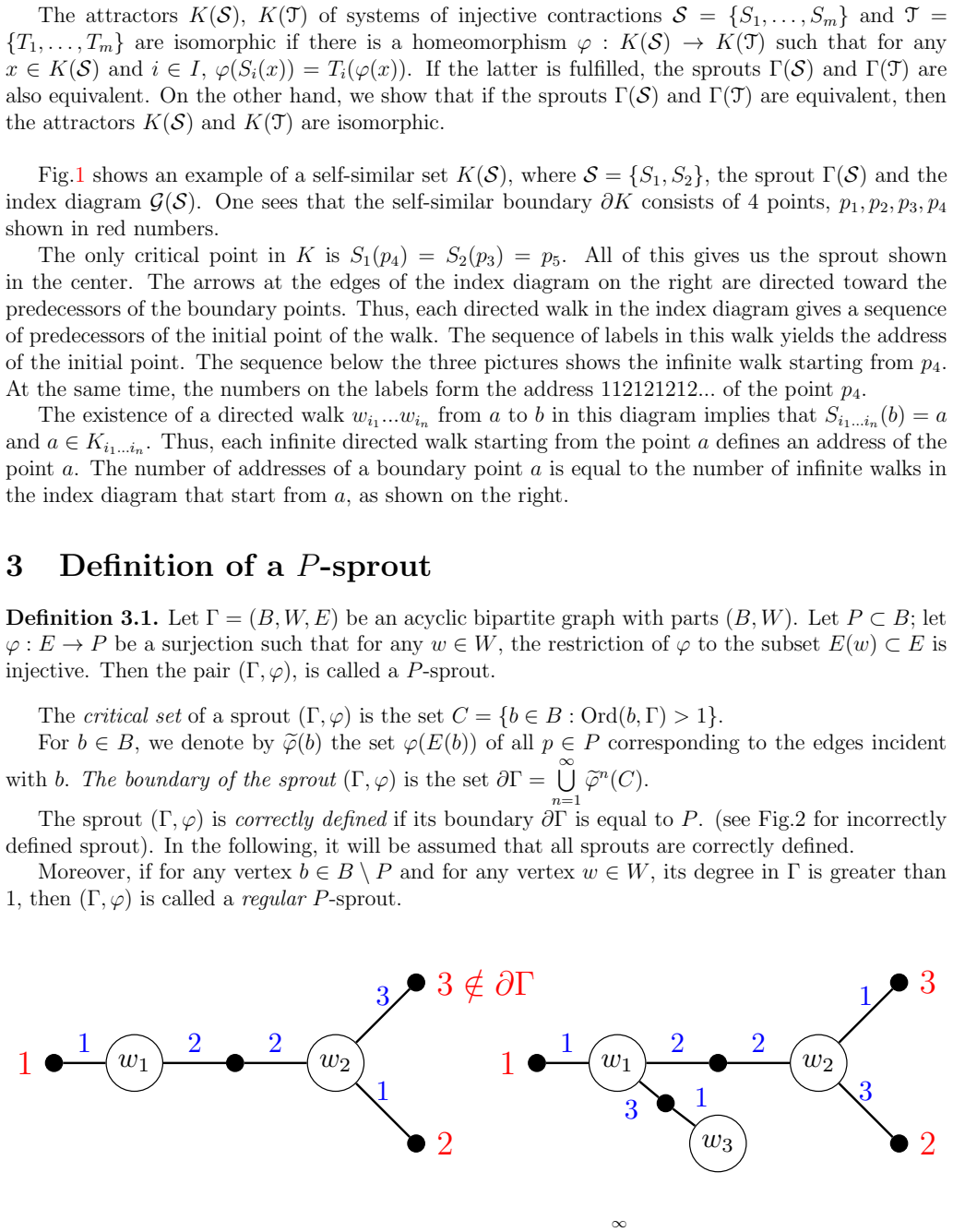
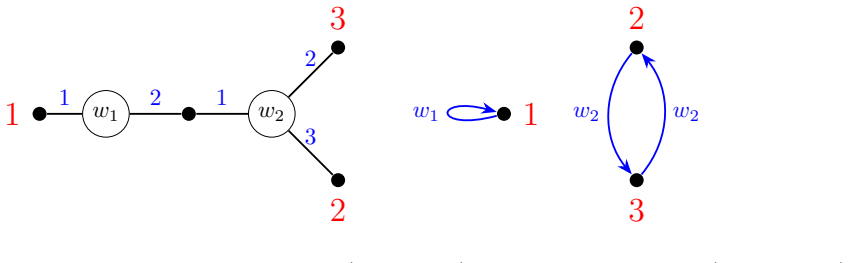


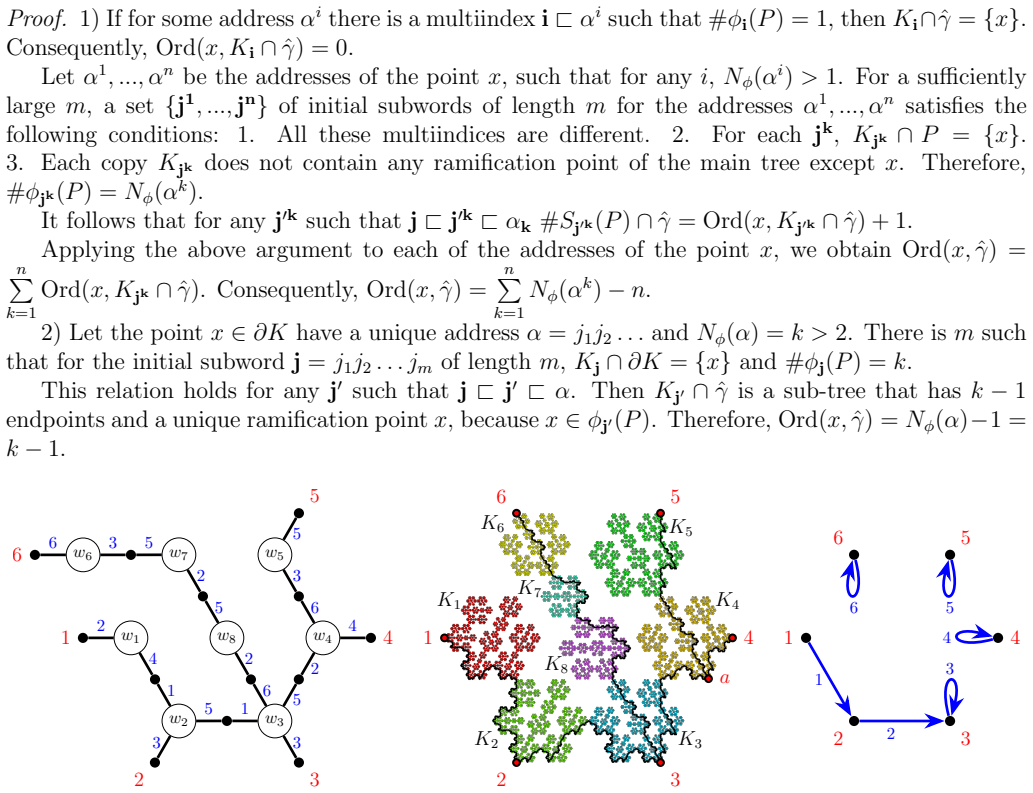


read the original abstract
Each self-similar dendrite K with a finite self-similar boundary defines a finite acyclic edge-labeled bipartite graph G, called the sprout of K. The paper shows that the sprout G determines the combinatorial properties of the dendrite K and its topological structure.
Editorial analysis
A structured set of objections, weighed in public.
Referee Report
Summary. The manuscript defines the sprout G of each self-similar dendrite K possessing a finite self-similar boundary as a finite acyclic edge-labeled bipartite graph. It establishes that the combinatorial data of G determines the combinatorial properties of K and suffices to reconstruct its topological structure.
Significance. If the construction and reconstruction are fully rigorous, the result supplies a finite combinatorial model for an infinite topological object, which could streamline classification, computation of invariants, and comparison of self-similar dendrites in metric geometry. The explicit use of acyclicity and bipartiteness to encode branching and attachment is a clear strength.
minor comments (3)
- The definition of the sprout graph (likely in §2) should include an explicit statement of the label alphabet and the precise rule by which edges receive labels from the self-similarity data.
- An illustrative example computing G for a concrete dendrite (e.g., the Wazewski universal dendrite or a simple iterated function system) would strengthen the reconstruction claim.
- The manuscript should clarify whether the bipartition of G corresponds to a canonical partition of the dendrite's vertices or edges, and state this explicitly in the reconstruction theorem.
Simulated Author's Rebuttal
We thank the referee for the positive assessment of our manuscript and for recommending minor revision. The referee's summary correctly identifies the core contribution: the sprout G as a finite acyclic edge-labeled bipartite graph that encodes the combinatorial and topological structure of the self-similar dendrite K with finite self-similar boundary. We are pleased that the potential utility for classification and invariant computation is noted.
Circularity Check
No significant circularity; standard construction and reconstruction
full rationale
The paper constructs the sprout G directly from the self-similar dendrite K with finite boundary as a finite acyclic edge-labeled bipartite graph, then proves that the combinatorial data of G encodes and reconstructs the topological structure of K. This is a definitional invariant plus reconstruction theorem, not a reduction where a claimed prediction equals its inputs by construction, a fitted parameter is relabeled as a prediction, or a load-bearing step collapses to an unverified self-citation. The argument is self-contained against the stated assumptions of self-similarity and finite boundary, with no ansatz smuggling or renaming of known results as new derivations.
Axiom & Free-Parameter Ledger
axioms (1)
- domain assumption Self-similar dendrites with finite self-similar boundaries exist and admit a canonical finite acyclic edge-labeled bipartite graph (the sprout).
invented entities (1)
-
Sprout graph G
no independent evidence
Lean theorems connected to this paper
-
IndisputableMonolith/Foundation/AlexanderDuality.leanalexander_duality_circle_linking unclearEach self-similar dendrite K with a finite self-similar boundary defines a finite acyclic edge-labeled bipartite graph Γ, called the sprout of K. The paper shows that the sprout Γ determines the combinatorial properties of the dendrite K and its topological structure.
-
IndisputableMonolith/Foundation/ArithmeticFromLogic.leanLogicNat ≃ Nat recovery unclearIf the systems S and ˜S have isomorphic P-sprouts Γ and ˜Γ, then their attractors K and ˜K are isomorphic (Theorem 4.5).
Reference graph
Works this paper leans on
-
[1]
K. Allabergenova, M. Samuel, A. Tetenov, Intersections of the pieces of self-similar dendrites in the plane, Chaos, Solitons & Fractals,182(2024), 114805. 2 14 x x y1 y2 y3 x1 1 x1 2 x1 3 x1 1 x1 2 x1 3 x2 1 x2 2 x2 3 Figure 8: Applying the result to an example in Fig.7. Ω(x) ={ 3},{y 1, y2, y3} ⊂∂K,{x 1 1, x1 2, x1 3}= ∂K3,{x 2 1, x2 2, x2 3}=∂K 33. 3 2 ...
work page 2024
-
[2]
K. Allabergenova, M. Kadirova, On self-similar dendrites in Hilbert space,Results in Nonlinear Analysis,8:1 (2025), 184–192. 2, 11
work page 2025
-
[3]
Bandt, Elementary fractal geometry
Ch. Bandt, Elementary fractal geometry. 4. Automata-generated topological spaces,Communications in Mathe- matics33:2:4 (2025), 1–33. 1
work page 2025
-
[4]
Ch. Bandt and K. Keller, Self–Similar Sets 2. A Simple Approach to the Topological Structure of Fractals, Mathematische Nachrichten154:1 (1991), 27–39. 1
work page 1991
-
[5]
Ch. Bandt and J. Stahnke. Self-similar sets 6. Interior distance on deterministic fractals Preprint, 1990. 1
work page 1990
-
[6]
J. Bang-Jensen and G. Gutin,Digraphs: Theory, Algorithms and Applications, Springer, 2009. 9
work page 2009
-
[7]
A. K. Barua, S. Li, X.Li and P. Leo, Asymptotic and exact self-similar evolution of growing dendrite,International Journal of Numerical Analysis & Modeling,19:6 (2022), 777–792. 2
work page 2022
-
[8]
J. J.Charatonik, W. J.Charatonik, DendritesAportaciones Mat. Comun.,22(1998), 227–253. 1
work page 1998
-
[9]
D. Drozdov, M. Samuel and A. Tetenov, On deformation of polygonal dendrites preserving the intersection graph, The Art of Discrete and Applied Mathematics,4(2021), 2–7. 2, 5
work page 2021
-
[10]
D. A. Drozdov and A. V. Tetenov, On the dendrite property of fractal cubesAdvances in the Theory of Nonlinear Analysis and Its Application8:1 (2024), 73–80
work page 2024
-
[11]
D. Drozdov and A. Tetenov, On the classification of fractal square dendritesAdvances in the Theory of Nonlinear Analysis and Its Application7:3 (2023), 19–96
work page 2023
-
[12]
D. Drozdov, Self-similar forests on fractal squaresSiberian Electronic Mathematical Reports22:1 (2025), 385–394
work page 2025
-
[13]
Hata M.On the structure of self-similar sets// Japan Journal of Applied Mathematics, 1985. V. 2, P. 381–414. 1, 3
work page 1985
-
[14]
A. Douady and J. H. Hubbard,Exploring the mandelbrot set. the orsay notes, Publ. Math. Orsay (1984)
work page 1984
-
[15]
Higgins,Techniques of semigroup theory, Oxford University Press, 1992
P. Higgins,Techniques of semigroup theory, Oxford University Press, 1992
work page 1992
-
[16]
Hutchinson, Fractals and self-similarity,Indiana Univ
J. Hutchinson, Fractals and self-similarity,Indiana Univ. Math. J.30:5 (1981), 713-747. 1, 2
work page 1981
-
[17]
Kameyama, Julia sets and self-similar sets,Topology and its Applications,54.1-3(1993), 241-251
A. Kameyama, Julia sets and self-similar sets,Topology and its Applications,54.1-3(1993), 241-251. 1
work page 1993
-
[18]
Kigami,Analysis on Fractals, Cambridge University Press, Number 143, 2001
J. Kigami,Analysis on Fractals, Cambridge University Press, Number 143, 2001. 1
work page 2001
-
[19]
J. Kigami, Harmonic Calculus on Limits of Networks and Its Application to Dendrites,Journal of Functional Analysis128:1 (1995), 48–86. 1
work page 1995
-
[20]
Kuratowski,Topology, Volumes 1 and 2, Academic Press and PWN, New York, 1966
K. Kuratowski,Topology, Volumes 1 and 2, Academic Press and PWN, New York, 1966. 3, 9
work page 1966
-
[21]
Mazurkiewicz, Sur les continus homogenes,Fund
S. Mazurkiewicz, Sur les continus homogenes,Fund. Math.5(1924), 137-146. 1
work page 1924
-
[22]
Mekhontsev,IFStile, software, 2026
D. Mekhontsev,IFStile, software, 2026. Available from:https://ifstile.com. 14
work page 2026
-
[23]
Menger, Kurventheorie, Teubner Verlag, Leipzig and Berlin 1932 (reprinted by Chelsea Publ
K. Menger, Kurventheorie, Teubner Verlag, Leipzig and Berlin 1932 (reprinted by Chelsea Publ. Co., Bronx, NY 1967)
work page 1932
-
[24]
E. W. Miller, Solution of the Zarankiewicz problem, Bull. Amer. Math. Soc.38 (1932), 831-834. 1
work page 1932
-
[25]
Moran, Dynamical boundary of a self-similar set,Fundamenta Mathematicae160.1(1999), 1-14
M. Moran, Dynamical boundary of a self-similar set,Fundamenta Mathematicae160.1(1999), 1-14. 1
work page 1999
-
[26]
H. Rao and S.-Q. Zhang, Space-filling curves of self-similar sets (III): SkeletonsFractals28:2 (2020), 2050028 3
work page 2020
- [27]
-
[28]
R. S. Strichartz, Isoperimetric estimates on Sierpinski gasket type fractals,Trans. Amer. Math. Soc.351(1999), 1705–1752
work page 1999
- [29]
-
[30]
A. Tetenov, I. Yudin and M. Kadirova, Finiteness properties for self-similar continuaDiscrete and Continuous Dynamical Systems — Series S(2025). doi: 10.3934/dcdss.2025057 3, 6, 8
-
[31]
T. Wazewski, Sur les courbes de Jordan ne renfermant aucune courbe simple ferme.e de Jordan, Annales de la Societe Polonaise de Mathematique 2 (1923), 49-170. 1 16
work page 1923
discussion (0)
Sign in with ORCID, Apple, or X to comment. Anyone can read and Pith papers without signing in.