Recognition: 2 theorem links
· Lean TheoremStochastically perturbed billiards: fingerprints of chaos and universality classes
Pith reviewed 2026-05-13 04:20 UTC · model grok-4.3
The pith
Small stochastic perturbations preserve uniform measures in chaotic billiards but map integrable ones to the Evans model with non-uniform boundary densities.
A machine-rendered reading of the paper's core claim, the machinery that carries it, and where it could break.
Core claim
Under small stochastic perturbations of the reflection law, billiards with chaotic dynamics retain their key statistical features including uniform spatial measures, whereas integrable billiards correspond to the Evans stochastic billiard where the outgoing angle is uniformly random in (-π/2, π/2), yielding a typically non-uniform stationary spatial measure along the boundary that differs from any chaotic case.
What carries the argument
The direct mapping, for sufficiently weak noise, of perturbed integrable billiards onto the Evans stochastic billiard model whose uniform angle distribution fixes the non-uniform boundary measure.
If this is right
- Chaotic billiards retain ergodicity and uniform boundary measures under small stochastic reflections.
- Integrable billiards lose regularity and acquire a position-dependent stationary density.
- The boundary measure itself becomes a practical test for the presence of chaos versus integrability.
- The response to noise defines distinct universality classes separating chaotic from integrable tables.
Where Pith is reading between the lines
- The same perturbation technique could serve as a probe for hidden regularity in other bounded dynamical systems.
- Non-uniform boundary densities would imply observable position-dependent collision rates in laboratory realizations such as microwave resonators or optical traps.
- Larger perturbation strengths may produce crossover regimes between the two classes that remain outside the present analysis.
Load-bearing premise
The stochastic perturbation must remain small enough for integrable billiards to map directly onto the Evans model without intermediate regimes or higher-order corrections.
What would settle it
Numerical sampling of collision points in a slightly perturbed circular or elliptical billiard that yields a uniform rather than varying density along the boundary would contradict the claimed mapping.
Figures

read the original abstract
Billiards tables - a minimal model for particles moving in a confined region - are known to present classical (and quantum) different features according to their shape, ranging from strongly chaotic to integrable dynamics. Here we consider the role of a stochastic perturbation of the elastic reflection law, and show that while chaotic billiards maintain their key statistical feature, the behaviour for integrable billiard tables is completely different: it can be linked, for tiny perturbations, to Evans stochastic billiard, where at each collision the reflected angle is a uniformly distributed stochastic variable on $(-\pi/2,\pi/2$). The resulting spatial stationary measure has peculiar aspects, like being typically non uniform along the boundary, differently from any chaotic billiard table.
Editorial analysis
A structured set of objections, weighed in public.
Referee Report
Summary. The manuscript examines stochastically perturbed billiards, claiming that chaotic tables retain their key statistical features under perturbation of the elastic reflection law, while integrable tables under tiny perturbations map onto the Evans stochastic billiard (uniform random reflection angle on (-π/2, π/2)), yielding a typically non-uniform spatial stationary measure along the boundary, unlike any chaotic case.
Significance. If the mapping and measure derivation hold, the work would identify distinct universality classes in the response to noise, providing a potential fingerprint of chaos versus integrability in billiard statistics. This could inform statistical mechanics of noisy confined systems.
major comments (2)
- [Abstract and integrable-billiard section] Abstract and the section linking integrable billiards to the Evans model: the assertion that tiny perturbations produce a direct link to the Evans model (uniform random angle) and a non-uniform boundary stationary measure lacks any derivation of the measure from the perturbed reflection law in the limit ε → 0, or analysis showing that finite (even small) ε does not introduce correlations or boundary-layer effects that could restore uniformity.
- [Stationary-measure section] The section on the spatial stationary measure: no scaling analysis, error bounds, or numerical verification protocol is supplied to confirm that the perturbation strength remains in the regime where the Evans mapping dominates without higher-order corrections, undermining the claim that the non-uniformity is a generic feature of the integrable class.
minor comments (1)
- [Introduction] The definition of the stochastic perturbation (including the precise distribution and the parameter ε) should be stated explicitly with its domain in the introduction to avoid ambiguity when comparing chaotic and integrable cases.
Simulated Author's Rebuttal
We thank the referee for the careful reading of our manuscript and the constructive comments. We address each major comment below and outline the revisions we will make to strengthen the presentation.
read point-by-point responses
-
Referee: [Abstract and integrable-billiard section] Abstract and the section linking integrable billiards to the Evans model: the assertion that tiny perturbations produce a direct link to the Evans model (uniform random angle) and a non-uniform boundary stationary measure lacks any derivation of the measure from the perturbed reflection law in the limit ε → 0, or analysis showing that finite (even small) ε does not introduce correlations or boundary-layer effects that could restore uniformity.
Authors: We agree that an explicit derivation of the limiting stationary measure from the perturbed reflection law would clarify the argument. In the revised manuscript we will add a step-by-step derivation showing how the uniform distribution on the reflection angle emerges for integrable tables as ε → 0. We will also include a brief analysis demonstrating that, for sufficiently small ε, boundary-layer effects and residual correlations remain negligible and do not restore uniformity, thereby preserving the distinction from the chaotic case. revision: yes
-
Referee: [Stationary-measure section] The section on the spatial stationary measure: no scaling analysis, error bounds, or numerical verification protocol is supplied to confirm that the perturbation strength remains in the regime where the Evans mapping dominates without higher-order corrections, undermining the claim that the non-uniformity is a generic feature of the integrable class.
Authors: We acknowledge that additional quantitative support for the validity regime is needed. In the revision we will incorporate a scaling analysis that identifies the range of ε in which the Evans mapping holds, together with error bounds on the deviation of the finite-ε measure from the limiting non-uniform distribution. We will also add numerical verification with a clear protocol that checks the persistence of non-uniformity for small but finite ε and confirms the absence of significant higher-order corrections. revision: yes
Circularity Check
No circularity: derivation relies on external Evans model and perturbation analysis
full rationale
The paper's key claim maps tiny stochastic perturbations in integrable billiards to the Evans model (uniform random reflection on (-π/2, π/2)) and derives a non-uniform boundary measure from that. This rests on an external reference and dynamical analysis rather than any self-definitional loop, fitted parameter renamed as prediction, or load-bearing self-citation chain. No equation or step in the abstract or described chain reduces the stationary measure to an input by construction; the perturbation-strength assumption is a modeling premise open to external verification, not a tautology.
Axiom & Free-Parameter Ledger
axioms (2)
- domain assumption Billiard dynamics follow elastic reflection laws modified by stochastic perturbation.
- domain assumption Stationary measures exist and can be compared between chaotic and integrable cases.
Lean theorems connected to this paper
-
IndisputableMonolith/Cost/FunctionalEquation.leanwashburn_uniqueness_aczel unclear?
unclearRelation between the paper passage and the cited Recognition theorem.
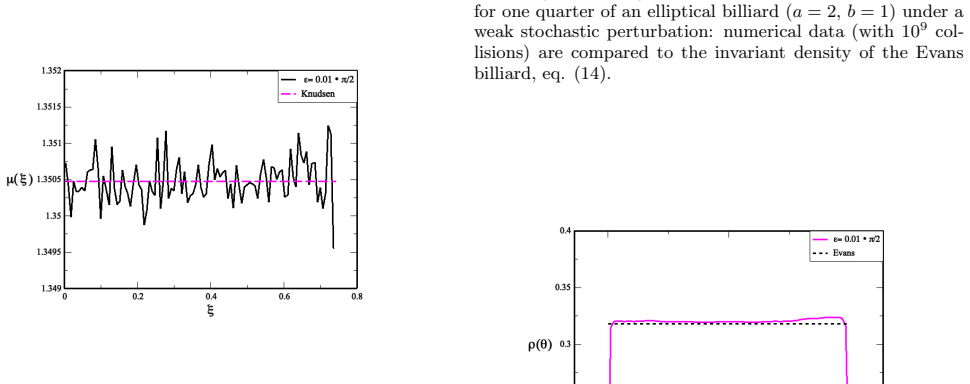
We introduce a transition kernel K(ξ, η)... the invariant density μ(s) satisfies μ(ξ) = ∫ μ(η) K(η, ξ) dη; furthermore if a density satisfies the detailed balance condition...
-
IndisputableMonolith/Foundation/RealityFromDistinction.leanreality_from_one_distinction unclear?
unclearRelation between the paper passage and the cited Recognition theorem.
for chaotic billiards the invariant density is very close to Knudsen case, while for integrable cases the density strongly resembles Evans billiards
What do these tags mean?
- matches
- The paper's claim is directly supported by a theorem in the formal canon.
- supports
- The theorem supports part of the paper's argument, but the paper may add assumptions or extra steps.
- extends
- The paper goes beyond the formal theorem; the theorem is a base layer rather than the whole result.
- uses
- The paper appears to rely on the theorem as machinery.
- contradicts
- The paper's claim conflicts with a theorem or certificate in the canon.
- unclear
- Pith found a possible connection, but the passage is too broad, indirect, or ambiguous to say the theorem truly supports the claim.
Reference graph
Works this paper leans on
-
[1]
Stochastically perturbed billiards: fingerprints of chaos and universality classes
billiard tables with a uniform scattering angle (again independent of the incoming angle), corresponding to a density pE(ψ) = 1 π ψ∈(−π/2, π/2),(3) were introduced. Evans proved that, both for continuous time dynamics, and the corresponding collision Markov chain, there exists a unique invariant probability mea- sure. Such a measure displays peculiar prop...
work page internal anchor Pith review Pith/arXiv arXiv 2026
-
[2]
All numerical data are obtained by 109 collisions
and ergodic lemon billiard (R1 = 1, R 2 = 1.5, d= 1.15), while significant deviations appear forR 1 =R 2 = 1, d= 0.01, close to the integrable case (circular billiard). All numerical data are obtained by 109 collisions. FIG. 2. (color online) Probability density along the boundary under a weak stochastic perturbation for the chaotic diamond billiard (R= √...
-
[3]
Tabachnikov,Billiards(Soci´ et´ e Math´ ematique de France, Paris, 1995)
S. Tabachnikov,Billiards(Soci´ et´ e Math´ ematique de France, Paris, 1995)
work page 1995
-
[4]
N. Chernov, and R. Markarian,Chaotic billiards(AMS, Providence RI, 2006)
work page 2006
-
[5]
A. Katok, and B. Hasselblatt,Introduction to the modern theory of dynamical systems(CUP, Cambridge, 1995)
work page 1995
-
[6]
L.A. Bunimovich, Mechanisms of chaos in billiards: dis- persing, defocusing and nothing else, Nonlinearity31, R78 (2018)
work page 2018
-
[7]
P` ene, Chaotic behavior in billiards, J.Math.Phys.66, 042712 (2025)
F. P` ene, Chaotic behavior in billiards, J.Math.Phys.66, 042712 (2025)
work page 2025
-
[8]
V. Kaloshin, and A. Sorrentino, On the integrability of Birkhoff billiards, Phil.Trans.R.Soc. A376, 20170419 (2018)
work page 2018
-
[9]
O. Bohigas, M.-J. Giannoni, and C. Smith, Characteriza- tion of chaotic quantum spectra and universality of level fluctuation laws, Phys.Rev.Lett.52, 1 (1984)
work page 1984
-
[10]
Haake,Quantum signatures of chaos(Springer, Berlin, 2001)
F. Haake,Quantum signatures of chaos(Springer, Berlin, 2001)
work page 2001
-
[11]
K. Nakamura, and T. Harayama,Quantum chaos and quantum dots(OUP, Oxford, 2003)
work page 2003
-
[12]
N.I. Chernov, and J.L. Lebowitz, Stationary nonequilib- rium states for boundary driven Hamiltonian systems, J.Stat.Phys.86, 953 (1997)
work page 1997
-
[13]
F. Bonetto, N.I. Chernov, and J.L. Lebowitz, (Global and 5 local) fluctuations of phase space contraction in deter- ministic stationary nonequilibrium, Chaos8, 823 (1998)
work page 1998
-
[14]
Knudsen,Kinetic theory of gases - some modern as- pects(Methuen, London, 1952)
M. Knudsen,Kinetic theory of gases - some modern as- pects(Methuen, London, 1952)
work page 1952
-
[15]
Chandrasekhar,Radiative transfer, (Dover, New York, 1960)
S. Chandrasekhar,Radiative transfer, (Dover, New York, 1960)
work page 1960
-
[16]
M.v. Smoluchowski, Zur kinetischen theorie der tran- spiration und diffusion verd¨ unnter gase, Annalen der Physik,338, 1559 (1910)
work page 1910
-
[17]
G. Arya, H.-C. Chang, and B.J. Maginn, Knudsen diffu- sivity of a hard sphere in a rough slit pore, Phys.Rev.Lett. 91, 026102 (2003)
work page 2003
-
[18]
F. Celestini, and F. Mortessagne, Cosine law at the atomic scale: towards realistic simulations of Knudsen diffusion, Phys.Rev. E77, 021202 (2008)
work page 2008
-
[19]
R. Feres, and G. Yablonsky, Knudsen’s cosine law and random billiards, Chem.Eng.Sci.59, 1541 (2004)
work page 2004
-
[20]
Feres, Random walks derived from billiards, Recent progress in dynamics54, 179 (2007)
R. Feres, Random walks derived from billiards, Recent progress in dynamics54, 179 (2007)
work page 2007
- [21]
-
[22]
Evans, Stochastic billiards on general tables, Ann.Appl.Probabil.11, 419 (2001)
S.N. Evans, Stochastic billiards on general tables, Ann.Appl.Probabil.11, 419 (2001)
work page 2001
-
[23]
R. Artuso, and D.J. Zamora, Cauchy universality and random billiards, Phys.Rev.Research6, L032029 (2024)
work page 2024
-
[24]
T. Ostapenko, F.J. Schwarzendahl, T.J. B¨ oddeker, C.T. Kreis, J. Cammann, M.G. Mazza, and O. B¨ aumchen, Curvature-guided motility of microalgae in geometric confinement, Phys.Rev.Lett.120, 068002 (2018)
work page 2018
-
[25]
S. Williams, R. Jeanneret, I. Tuval, and M. Polin, Confinement-induced accumulation and de-mixing of mi- croscopic active-passive mixtures, Nature Comm.13, 4776 (2022)
work page 2022
-
[26]
R. Di Leonardo, A. B´ uzas, L. Kelemen, D. T´ oth, S.Z. T´ oth, P. Ormos, and G. Vizsnyiczai, Active billiards: en- gineering boundary shape for the spatial control of con- fined active particles, PNAS122, e2426715122 (2015)
work page 2015
-
[27]
Razin, Entropy production of an active particle in a box, Phys.Rev
N. Razin, Entropy production of an active particle in a box, Phys.Rev. E102, 030103(R) (2020)
work page 2020
- [28]
-
[29]
T. Pietrangeli, R. Foffi, R. Stocker, C. Ybert, C. Cottin- Bizonne, and F. Detcheverry, Universal law for the dispersal of motile microorganisms in porous media, Phys.Rev.Lett.134, 188303 (2025)
work page 2025
-
[30]
R. Markarian, L.T. Rolla, V. Sidoravicius, F.A. Tal, and M.E. Vares, Stochastic perturbations of convex billiards, Nonlinearity26, 4425 (2015)
work page 2015
-
[31]
Chernov, Entropy, Lyapunov exponents, and mean free path for billiards, J.Stat.Phys.88, 1 (1977)
N. Chernov, Entropy, Lyapunov exponents, and mean free path for billiards, J.Stat.Phys.88, 1 (1977)
work page 1977
-
[32]
Chernov, New proof of Sinai’s formula for the entropy of hyperbolic billiard systems
N.I. Chernov, New proof of Sinai’s formula for the entropy of hyperbolic billiard systems. Appli- cation to Lorentz gases and Bunimovich stadium, Funct.Anal.Appl.25, 204 (1991)
work page 1991
- [33]
-
[34]
F´ etique, Explicit speed of convergence of the stochas- tic billiard in a convex set, in C
N. F´ etique, Explicit speed of convergence of the stochas- tic billiard in a convex set, in C. Donati-Martin et al (eds.)S´ eminaire de probabilit´ es L.(Springer, Switzer- land, 2019)
work page 2019
-
[35]
Y. Kifer, General random perturbations of hyperbolic and expanding transformations, J.Anal.Math.47, 111 (1986)
work page 1986
-
[36]
L.-S, Young, Stochastic stability of hyperbolic attractors, Ergod.Th. & Dynam.Sys.6, 311 (1986)
work page 1986
-
[37]
Troubetzkoy, Stochastic stability of dispersing bil- liards, Theor
S.E. Troubetzkoy, Stochastic stability of dispersing bil- liards, Theor. and Math.Phys.86, 151 (1991)
work page 1991
- [38]
-
[39]
Machta, Power law decay of correlations in billiard problems, J.Stat.Phys.32, 555 (1983)
J. Machta, Power law decay of correlations in billiard problems, J.Stat.Phys.32, 555 (1983)
work page 1983
-
[40]
E.J. Heller, and S. Tomsovic, Postmodern quantum me- chanics, Phys.Today46, 38 (1993)
work page 1993
-
[41]
S. Ree, and L.E. Reichl, Classical and quantum chaos in a circular billiard with a straight cut, Phys.Rev. E60, 1607 (1999)
work page 1999
-
[42]
J. Chen, L. Mohr, H.-K. Zhang, and P. Zhang, Ergodic- ity of the generalized lemon billiards, Chaos23, 043137 (2013)
work page 2013
-
[43]
L. Bunimovich, H.-K. Zhang, and P. Zhang, On another edge of defocusing: hyperbolicity of asymmetric lemon billiards, Commun.Math.Phys.341, 781 (2016)
work page 2016
- [44]
-
[45]
ˇC. Lozej, Stickiness in generic low-dimensional Hamil- tonian systems: a recurrence-time statistics approach, Phys.Rev. E 101, 052204 (2020)
work page 2020
-
[46]
R.V.A. Quirino, F.C.B. Leal, J.V.A. Vasconcelos, M.S. Palmero, A.R. de C. Romaguera, A.L.R. Barbosa, and T. Ara´ ujo Lima, Mixed-phase space of an active particle in experimental lemon billiards, Phys.Rev. E112, 044218 (2025)
work page 2025
-
[47]
X. Jin, and P. Zhang, Homoclinic and heteroclinic in- tersections for lemon billiards, Adv.Math.442, 109588 (2024)
work page 2024
-
[48]
Tabachnikov,Geometry and billiards, (AMS, Provi- dence, 2005)
S. Tabachnikov,Geometry and billiards, (AMS, Provi- dence, 2005)
work page 2005
-
[49]
S.-J. Chang, and R. Friedberg, Elliptical billiards and Poncelet’s theorem, J.Math.Phys.29, 1537 (1988)
work page 1988
-
[50]
V.F. Lazutkin, Existence of caustics for the billiard prob- lem in a convex domain, Izv.Akad.Nauk SSSR Ser.Mat. 37, 186 (1973)
work page 1973
-
[51]
See [20]: notice a misprint in the last equation or Remark 6.3
-
[52]
Notice that the density becomes constant in the circle limit (a=b)
-
[53]
Risken,The Fokker-Planck equation: methods of so- lution and applications, (Springer, Berlin, 1996)
H. Risken,The Fokker-Planck equation: methods of so- lution and applications, (Springer, Berlin, 1996)
work page 1996
-
[54]
A.-L. Cauchy,M´ emoire sur la rectification des courbes et la quadrature des surfaces courb´ ees(Gauthier-Villars, Paris, 1850)
-
[55]
Santal` o,Integral geometry and geometric probability (Addison-Wesley, Reading MA, 1976)
A. Santal` o,Integral geometry and geometric probability (Addison-Wesley, Reading MA, 1976)
work page 1976
-
[56]
Mazzolo, On the generalization of the average chord length, Ann.Nucl.Energy35, 503 (2008)
A. Mazzolo, On the generalization of the average chord length, Ann.Nucl.Energy35, 503 (2008)
work page 2008
-
[57]
S. Hidalgo-Caballero, A. Cassinelli, M. Labousse, and E. Fort, Mean arc theorem for exploring domains with randomly distributed arbitrary closed trajectories, Eur.Phys.J. Plus137, 501 (2022)
work page 2022
-
[58]
D.J. Zamora, and R. Artuso, Exploring run-and-tumble movement in confined settings through simulation, J.Chem.Phys.161, 114107 (2024)
work page 2024
discussion (0)
Sign in with ORCID, Apple, or X to comment. Anyone can read and Pith papers without signing in.