Recognition: no theorem link
Runtime Calibration as State-Trajectory Feedback Control in Quantum-Classical Workflows
Pith reviewed 2026-05-13 05:39 UTC · model grok-4.3
The pith
Treating calibration quality as a drifting state and using feedback control yields lower optimization gaps than static baselines in local and tight-loop regimes.
A machine-rendered reading of the paper's core claim, the machinery that carries it, and where it could break.
Core claim
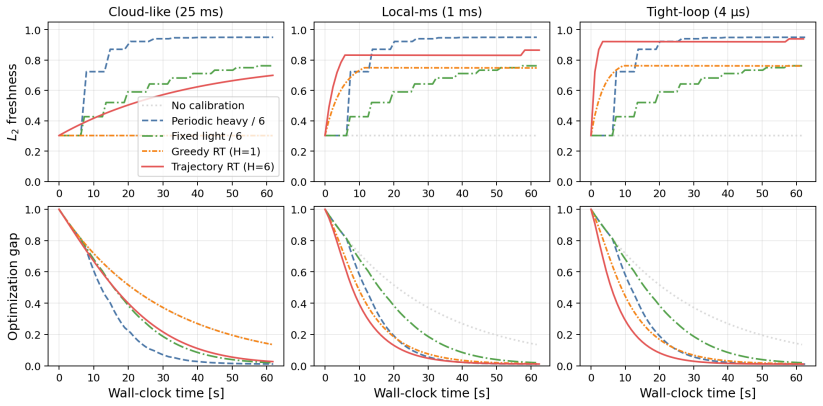
Representing calibration quality as a drifting equivalent-age state whose reset is a costly action, and evaluating policies by time-integrated optimization gap, shows that local-millisecond and tight-loop feedback regimes open a positive-gain region over open-loop baselines; the region grows with workload quality-sensitivity and initial calibration age, while the advantage of tight-loop integration appears mainly when multiple calibration targets must be handled within one control window.
What carries the argument
The drifting equivalent-age state as proxy for calibration quality, with costly reset actions scored by time-integrated optimization gap via a finite-horizon rollout controller.
If this is right
- Cloud-like feedback at 25 ms latency is generally uncompetitive with open-loop baselines.
- Local-millisecond (1 ms) and tight-loop (4 μs) regimes open a positive-gain region that grows with workload quality-sensitivity and initial calibration age.
- The performance gap between local-ms and tight-loop control remains modest for single-target recovery.
- Tight-loop integration provides a clear advantage only under capacity pressure when many calibration targets compete inside the same control window.
Where Pith is reading between the lines
- Hardware that supports local-millisecond recalibration loops could capture most of the reported gains without requiring full tight-loop integration.
- Variational workloads whose loss landscapes are highly sensitive to gate fidelity should prioritize local recalibration scheduling over cloud-based services.
- Extending the single-state drift model to multiple coupled parameters would test whether the policy ordering holds or requires richer state representations.
Load-bearing premise
Calibration quality can be faithfully represented as a single drifting equivalent-age state whose reset cost is known and whose effect on the optimization gap is additive and time-integrable.
What would settle it
A direct measurement showing that real parameter drifts involve multiple coupled variables or produce non-linear effects on the variational landscape that reverse the reported ordering between feedback and open-loop policies.
Figures



read the original abstract
In superconducting devices running variational workloads, gate and readout fidelities drift on hour timescales, while existing runtime schedulers treat backend quality as static. The temporal dimension of calibration remains unresolved. We formulate runtime calibration as a state-trajectory feedback-control problem under a fixed wall-clock budget, and investigate whether spending time on calibration now can improve the future optimization trajectory. Calibration quality proxy is represented as a drifting equivalent-age state, recovery action is modeled as costly state reset, and policies are evaluated by time-integrated optimization gap over the full execution window. Using a finite-horizon rollout controller, we compare feedback calibration against a strengthened family of open-loop baselines across three latency regimes: cloud-like (25 ms), local-millisecond (1 ms), and tight-loop (4 $\mathrm{\mu}$s). The results show a clear ordering: cloud-like feedback is generally uncompetitive, while local-ms and tight-loop regimes open a positive-gain region that grows with workload quality-sensitivity and initial calibration age. Crucially, the gap between local-ms and tight-loop control is modest for single-target recovery. The advantage of tight-loop integration emerges under capacity pressure, when many calibration targets must be processed within the same control window.
Editorial analysis
A structured set of objections, weighed in public.
Referee Report
Summary. The manuscript formulates runtime calibration decisions for variational quantum workloads on superconducting hardware as a state-trajectory feedback-control problem under a fixed wall-clock budget. Calibration quality is proxied by a single drifting equivalent-age state whose reset is a costly action; policies are evaluated by the time-integrated optimization gap. A finite-horizon rollout controller is compared against a family of open-loop baselines across three latency regimes (cloud-like 25 ms, local-ms 1 ms, tight-loop 4 μs). The central results are a policy ordering in which cloud-like feedback is uncompetitive while local-ms and tight-loop regimes open a positive-gain region whose size grows with workload quality-sensitivity and initial calibration age, with only modest gap between local-ms and tight-loop for single targets and a clear tight-loop advantage under capacity pressure.
Significance. If the scalar-state modeling assumptions hold, the work supplies a principled, quantitative framework for deciding when to insert calibration actions inside hybrid quantum-classical loops, directly addressing the temporal dimension of backend quality that current schedulers ignore. The explicit latency-regime comparison and the identification of conditions under which feedback yields net gain are useful contributions. The finite-horizon rollout formulation itself is a methodological strength that could be reused for other runtime decisions.
major comments (1)
- §2 (Modeling) and §4 (Controller and Evaluation): The entire reported policy ordering, positive-gain region, and latency-regime comparisons rest on the assumption that calibration quality is faithfully captured by a single scalar drifting equivalent-age state whose effect on the optimization gap is additive and time-integrable. Real superconducting drifts involve multiple coupled parameters (T1/T2, readout fidelity, crosstalk) whose joint impact on the variational landscape is typically non-linear and non-integrable in a simple age variable. Because all controllers and baselines are evaluated exclusively inside this scalar dynamics, any deviation from the assumed drift structure directly invalidates the quantitative claims; a sensitivity analysis to multi-parameter or non-linear drift models is required before the ordering can be treated as robust.
minor comments (2)
- The abstract and §3 refer to a 'strengthened family of open-loop baselines' without specifying their exact construction or parameter settings; these details should be stated explicitly so that the performance gap to the rollout controller can be reproduced.
- Figure captions and axis labels in the results section should include the numerical values of quality-sensitivity and initial-age parameters used for each curve to allow direct comparison with the text claims.
Simulated Author's Rebuttal
We thank the referee for the positive evaluation of the work's significance and for the constructive comment on the modeling assumptions. We respond to the major comment below.
read point-by-point responses
-
Referee: §2 (Modeling) and §4 (Controller and Evaluation): The entire reported policy ordering, positive-gain region, and latency-regime comparisons rest on the assumption that calibration quality is faithfully captured by a single scalar drifting equivalent-age state whose effect on the optimization gap is additive and time-integrable. Real superconducting drifts involve multiple coupled parameters (T1/T2, readout fidelity, crosstalk) whose joint impact on the variational landscape is typically non-linear and non-integrable in a simple age variable. Because all controllers and baselines are evaluated exclusively inside this scalar dynamics, any deviation from the assumed drift structure directly invalidates the quantitative claims; a sensitivity analysis to multi-parameter or non-linear drift models is required before the ordering can be treated as robust.
Authors: We agree that the reported policy ordering, positive-gain regions, and latency comparisons are derived under the single scalar drifting equivalent-age model defined in §2. This proxy was deliberately chosen to abstract calibration quality into a monotonic drifting state whose reset incurs a latency cost, thereby isolating the state-trajectory feedback-control formulation and enabling a clean finite-horizon rollout comparison against open-loop baselines. The additive, time-integrable impact on the optimization gap is an explicit modeling choice that yields a well-defined objective for the controller. The manuscript presents all quantitative results as conditional on this proxy. We acknowledge that real superconducting drifts are multi-parameter and can exhibit non-linear effects. In the revised manuscript we will add a dedicated paragraph to the Discussion section that (i) restates the scalar-state assumptions and their purpose, (ii) notes that the identified conditions for net gain (workload quality-sensitivity and initial calibration age) are expected to be qualitatively robust under monotonic drifts, and (iii) sketches a generalization path to vector-valued states. This partial revision clarifies the scope of the claims without altering the core results or requiring a full re-evaluation. revision: partial
Circularity Check
No circularity; simulation results are generated within an explicit scalar model without reduction to inputs by construction.
full rationale
The paper defines a drifting equivalent-age state as a modeling proxy for calibration quality, models recovery as a state reset with known cost, and evaluates policies (including a finite-horizon rollout controller) by time-integrated optimization gap across latency regimes. All reported orderings and gain regions are obtained by direct simulation inside this closed model. No equations, self-citations, or ansatzes are quoted that would make any prediction equivalent to its inputs by definition, nor is there evidence of fitted parameters being relabeled as predictions. The derivation chain is therefore self-contained as a comparative simulation study under stated assumptions, with no load-bearing circular steps.
Axiom & Free-Parameter Ledger
axioms (2)
- domain assumption Calibration quality can be represented as a single drifting equivalent-age state whose reset is a costly action.
- domain assumption Time-integrated optimization gap is the appropriate scalar metric for comparing policies over the full execution window.
invented entities (1)
-
drifting equivalent-age state
no independent evidence
Reference graph
Works this paper leans on
-
[1]
High-performance computing with quantum processing units,
K. A. Britt and T. S. Humble, “High-performance computing with quantum processing units,”J. Emerg. Technol. Comput. Syst., vol. 13, no. 3, Mar. 2017. [Online]. Available: https://doi.org/10.1145/3007651
-
[2]
Quantum computers for high-performance computing,
T. S. Humble, A. McCaskey, D. I. Lyakh, M. Gowrishankar, A. Frisch, and T. Monz, “Quantum computers for high-performance computing,” IEEE Micro, vol. 41, no. 5, pp. 15–23, 2021
work page 2021
-
[3]
A. Elsharkawy, X.-T. M. To, P. Seitz, Y . Chen, Y . Stade, M. Geiger, Q. Huang, X. Guo, M. A. Ansari, C. B. Mendl, D. Kranzlm ¨uller, and M. Schulz, “Integration of quantum accelerators with high performance computing—a review of quantum programming tools,” ACM Transactions on Quantum Computing, vol. 6, no. 3, Jul. 2025. [Online]. Available: https://doi.o...
-
[4]
A Quantum Approximate Optimization Algorithm
E. Farhi, J. Goldstone, and S. Gutmann, “A quantum approximate optimization algorithm,” 2014. [Online]. Available: https://arxiv.org/abs/ 1411.4028
work page internal anchor Pith review Pith/arXiv arXiv 2014
-
[5]
The variational quantum eigensolver: A review of methods and best practices,
J. Tilly, H. Chen, S. Cao, D. Picozzi, K. Setia, Y . Li, E. Grant, L. Wossnig, I. Rungger, G. H. Booth, and J. Tennyson, “The variational quantum eigensolver: A review of methods and best practices,” Physics Reports, vol. 986, pp. 1–128, 2022, the Variational Quantum Eigensolver: a review of methods and best practices. [Online]. Available: https://www.sci...
work page 2022
-
[6]
A quantum engineer’s guide to superconducting qubits,
P. Krantz, M. Kjaergaard, F. Yan, T. P. Orlando, S. Gustavsson, and W. D. Oliver, “A quantum engineer’s guide to superconducting qubits,” Applied Physics Reviews, vol. 6, no. 2, p. 021318, 06 2019. [Online]. Available: https://doi.org/10.1063/1.5089550
-
[7]
Quantum supremacy using a programmable superconducting processor,
F. Arute, K. Arya, R. Babbush, D. Bacon, J. C. Bardinet al., “Quantum supremacy using a programmable superconducting processor,”Nature, vol. 574, no. 7779, pp. 505–510, 2019
work page 2019
-
[8]
Error mitigation extends the computational reach of a noisy quantum processor,
A. Kandala, K. Temme, A. D. C ´orcoles, A. Mezzacapo, J. M. Chow, and J. M. Gambetta, “Error mitigation extends the computational reach of a noisy quantum processor,”Nature, vol. 567, no. 7749, p. 491–495, Mar
-
[9]
Available: http://dx.doi.org/10.1038/s41586-019-1040-7
[Online]. Available: http://dx.doi.org/10.1038/s41586-019-1040-7
-
[10]
Millisecond-scale calibration and benchmarking of superconducting qubits,
M. A. Marciniak, R. T. Birke, J. B. Severin, F. Berritta, D. Kjær, F. Nilsson, S. N. Themadath, S. Kallatt, J. L. Webb, K. Bentsen, T. Madsen, Z. Sun, S. Krøjer, C. W. Warren, J. Hastrup, and M. Kjaergaard, “Millisecond-scale calibration and benchmarking of superconducting qubits,” 2026. [Online]. Available: https://arxiv.org/abs/2602.11912
-
[11]
Cerezoet al., Variational quantum al- gorithms, Nat
M. Cerezo, A. Arrasmith, R. Babbush, S. C. Benjamin, S. Endo, K. Fujii, J. R. McClean, K. Mitarai, X. Yuan, L. Cincio, and P. J. Coles, “Variational quantum algorithms,”Nature Reviews Physics, vol. 3, no. 9, p. 625–644, Aug. 2021. [Online]. Available: http://dx.doi.org/10.1038/s42254-021-00348-9
-
[12]
Noise-induced barren plateaus in variational quantum algorithms,
S. Wang, E. Fontana, M. Cerezo, K. Sharma, A. Sone, L. Cincio, and P. J. Coles, “Noise-induced barren plateaus in variational quantum algorithms,”Nature Communications, vol. 12, no. 1, Nov. 2021. [Online]. Available: http://dx.doi.org/10.1038/s41467-021-27045-6
-
[13]
Qoncord: A multi-device job scheduling framework for variational quantum algorithms,
M. Wang, P. Das, and P. J. Nair, “Qoncord: A multi-device job scheduling framework for variational quantum algorithms,” in2024 57th IEEE/ACM International Symposium on Microarchitecture (MICRO), 2024, pp. 735– 749
work page 2024
-
[14]
Platform architecture for tight coupling of high-performance computing with quantum processors,
S. A. Caldwell, M. Khazraee, E. Agostini, T. Lassiter, C. Simpson, O. Kahalon, M. Kanuri, J.-S. Kim, S. Stanwyck, M. Li, J. Olle, C. Chamberland, B. Howe, B. Schmitt, J. G. Lietz, A. McCaskey, J. Ye, A. Li, A. B. Magann, C. I. Ostrove, K. Rudinger, R. Blume-Kohout, K. Young, N. E. Miller, Y . Xu, G. Huang, I. Siddiqi, J. Lange, C. Zimmer, and T. Humble, “...
-
[15]
L. Burgholzer, J. Echavarria, P. Hopf, Y . Stade, D. Rovara, L. Schmid, E. Kaya, B. Mete, M. N. Farooqi, M. Chung, M. De Pascale, L. Schulz, M. Schulz, and R. Wille, “The munich quantum software stack: Connecting end users, integrating diverse quantum technologies, accelerating hpc,” inProceedings of the Supercomputing Asia and International Conference on...
-
[16]
R. Wille, L. Schmid, Y . Stade, J. Echavarria, M. Schulz, L. Schulz, and L. Burgholzer, “Qdmi - quantum device management interface: Hardware-software interface for the munich quantum software stack,” in2024 IEEE International Conference on Quantum Computing and Engineering (QCE), vol. 02, 2024, pp. 573–574
work page 2024
-
[17]
D. Mishra, S. Vanecek, J. Echavarria, X. Deng, B. Mete, L. Schulz, and M. Schulz, “Towards a unified architectural representation in hpcqc: Extending sys-sage for quantum technologies,” inISC High Performance 2025 Research Paper Proceedings (40th International Conference), 2025, pp. 1–12
work page 2025
-
[18]
D. P. Bertsekas,Rollout, Policy Iteration, and Distributed Reinforcement Learning. Nashua, NH: Athena Scientific, 2020
work page 2020
-
[19]
Model predictive control: Theory and practice—a survey,
C. E. Garc ´ıa, D. M. Prett, and M. Morari, “Model predictive control: Theory and practice—a survey,”Automatica, vol. 25, no. 3, pp. 335–348,
-
[20]
Available: https://www.sciencedirect.com/science/article/ pii/0005109889900022
[Online]. Available: https://www.sciencedirect.com/science/article/ pii/0005109889900022
-
[21]
J. Rawlings, D. Mayne, and M. Diehl,Model Predictive Control: Theory, Computation, and Design, 2nd ed. Nob Hill Publishing, 01 2017
work page 2017
-
[22]
N. Wittler, F. Roy, K. Pack, M. Werninghaus, A. S. Roy, D. J. Egger, S. Filipp, F. K. Wilhelm, and S. Machnes, “Integrated tool set for control, calibration, and characterization of quantum devices applied to superconducting qubits,”Phys. Rev. Appl., vol. 15, p. 034080, Mar 2021. [Online]. Available: https://link.aps.org/doi/10.1103/PhysRevApplied.15. 034080
-
[23]
Physical qubit calibration on a directed acyclic graph,
J. Kelly, P. O’Malley, M. Neeley, H. Neven, and J. M. Martinis, “Physical qubit calibration on a directed acyclic graph,” 2018. [Online]. Available: https://arxiv.org/abs/1803.03226
-
[24]
Quantum computing with neutral atoms,
L. Henriet, L. Beguin, A. Signoles, T. Lahaye, A. Browaeys, G.-O. Reymond, and C. Jurczak, “Quantum computing with neutral atoms,”Quantum, vol. 4, p. 327, 2020. [Online]. Available: http://dx.doi.org/10.22331/q-2020-09-21-327
-
[25]
Trapped-ion quantum computing: Progress and challenges,
C. D. Bruzewicz, J. Chiaverini, R. McConnell, and J. M. Sage, “Trapped-ion quantum computing: Progress and challenges,”Applied Physics Reviews, vol. 6, no. 2, May 2019. [Online]. Available: http://dx.doi.org/10.1063/1.5088164
discussion (0)
Sign in with ORCID, Apple, or X to comment. Anyone can read and Pith papers without signing in.