Recognition: 2 theorem links
· Lean TheoremPositive Geometries from Cubic Surfaces
Pith reviewed 2026-05-13 05:06 UTC · model grok-4.3
The pith
Cubic surfaces define positive geometries in dimensions two, three, and four, each equipped with a positive arrangement and canonical form.
A machine-rendered reading of the paper's core claim, the machinery that carries it, and where it could break.
Core claim
We present a study of cubic surfaces from the novel perspective of positive geometry. Our positive geometries have dimension two (the surface minus its 27 lines), dimension three (its complement in 3-space), and dimension four (the moduli space). In each case we explore the positive arrangement, its combinatorial rank, and the canonical forms.
What carries the argument
The positive arrangement attached to the cubic surface minus its twenty-seven lines, together with the induced arrangements on the complement in three-space and on the moduli space, each supporting a canonical form.
If this is right
- Each of the three spaces carries a positive arrangement whose combinatorial rank is determined by the incidence geometry of the cubic surface.
- Canonical forms exist and can be written down for the two-, three-, and four-dimensional cases.
- The four-dimensional geometry on the moduli space encodes positivity conditions on the parameters of cubic surfaces.
- The construction supplies explicit algebraic examples of positive geometries of low dimension.
Where Pith is reading between the lines
- The same line configuration that defines the two-dimensional geometry could be used to test positivity conditions on the coefficients of the cubic equation.
- The canonical form on the moduli space might serve as a starting point for defining positive measures on families of cubic surfaces.
Load-bearing premise
That the surface minus its 27 lines, the complement in 3-space, and the moduli space each admit the structure of a positive geometry possessing a well-defined positive arrangement and canonical form.
What would settle it
An explicit point in one of the three spaces where every candidate set of positive coordinates fails to have uniform sign, or a direct computation showing that the proposed canonical form is not positive throughout the domain.
Figures






read the original abstract
We present a study of cubic surfaces from the novel perspective of positive geometry. Our positive geometries have dimension two (the surface minus its 27 lines), dimension three (its complement in 3-space), and dimension four (the moduli space). In each case we explore the positive arrangement, its combinatorial rank, and the canonical forms.
Editorial analysis
A structured set of objections, weighed in public.
Referee Report
Summary. The manuscript studies cubic surfaces from the perspective of positive geometry. It constructs three positive geometries: the cubic surface minus its 27 lines (dimension 2), the complement of the surface in affine 3-space (dimension 3), and the moduli space of cubic surfaces (dimension 4). For each, the authors define the positive arrangement, compute its combinatorial rank, and construct the associated canonical form, verifying that the forms have logarithmic singularities supported precisely on the arrangement and satisfy the residue recursion to lower-dimensional canonical forms.
Significance. If the constructions are correct, the work supplies new, explicit examples of positive geometries arising from classical objects in algebraic geometry. The verification that combinatorial ranks match the expected boundary strata and the consistency with the standard axioms for positive geometries (logarithmic poles on the arrangement and recursive residues) adds concrete instances that can be used to test general conjectures in the positive geometry program. The dimension-4 moduli-space example is particularly noteworthy as it connects a moduli space directly to the positive geometry framework.
minor comments (4)
- [Introduction] The abstract states that the positive arrangements are explored but does not indicate whether the arrangements are defined via the real points of the cubic surface or via a different positivity condition; a brief clarification in the introduction would help readers unfamiliar with the specific positivity notion used here.
- [§3] In the dimension-2 case, the claim that the canonical form has poles exactly along the 27 lines would be strengthened by an explicit local coordinate computation near one of the lines showing the residue is the expected lower-dimensional form.
- [§4] The combinatorial rank computation for the dimension-3 arrangement is stated to match the number of boundary strata, but the paper does not list the strata explicitly; adding a short table or enumeration would make the verification easier to check.
- [§5] Notation for the moduli space in dimension 4 is introduced without a reference to the standard GIT quotient or the space of cubic surfaces; a single sentence recalling the dimension and the group action would improve readability.
Simulated Author's Rebuttal
We thank the referee for their positive and accurate summary of our manuscript on positive geometries from cubic surfaces. The report correctly identifies our constructions in dimensions 2 (surface minus 27 lines), 3 (complement in affine 3-space), and 4 (moduli space), along with the positive arrangements, combinatorial ranks, and canonical forms satisfying logarithmic singularities and residue recursion. We appreciate the recognition of these as new explicit examples from classical algebraic geometry, particularly the dimension-4 case, and their potential to test broader conjectures. The recommendation for minor revision is noted; with no specific major comments raised, we will incorporate any minor clarifications or corrections in the revised version.
Circularity Check
No significant circularity detected
full rationale
The manuscript defines positive arrangements on the cubic surface minus its 27 lines, its complement in 3-space, and the moduli space, then constructs the associated canonical forms and verifies their combinatorial ranks match the expected boundary strata. These constructions follow the standard axioms for positive geometries (logarithmic singularities supported precisely on the arrangement, residue recursion to lower-dimensional canonical forms) without reducing any central claim to a self-definition, fitted input renamed as prediction, or load-bearing self-citation chain. No equations or derivations in the provided text exhibit the enumerated circularity patterns; the work is self-contained against external benchmarks for positive geometry.
Axiom & Free-Parameter Ledger
axioms (1)
- standard math Standard axioms of algebraic geometry over the complex numbers, including the existence of 27 lines on a smooth cubic surface.
Lean theorems connected to this paper
-
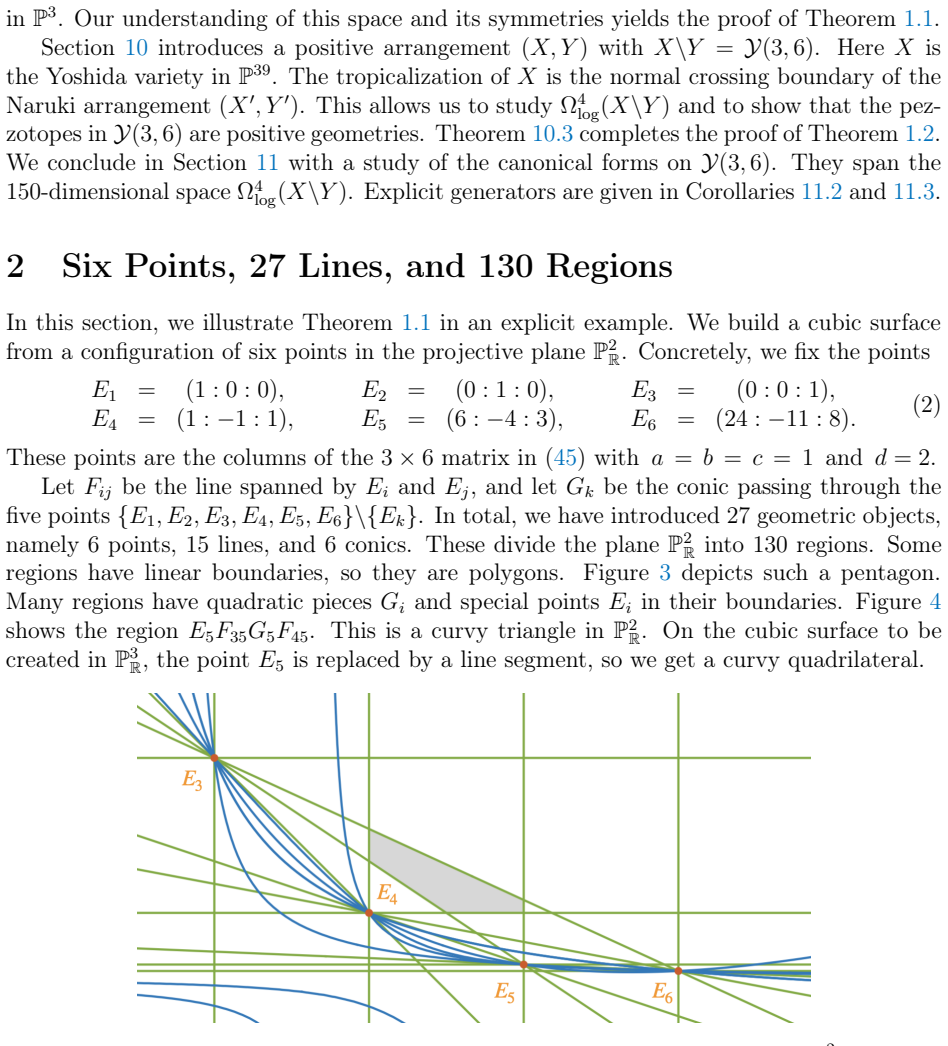
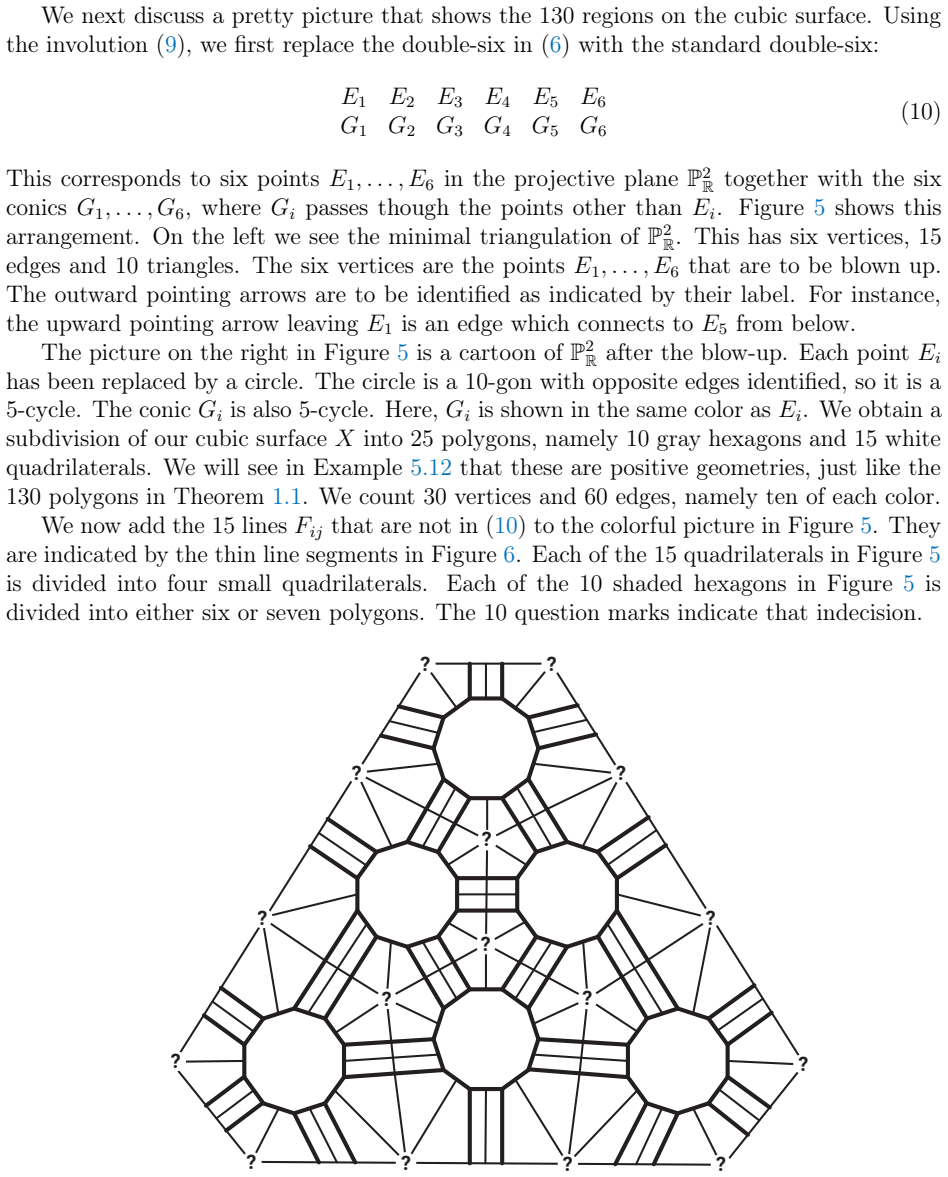
IndisputableMonolith/Foundation/AlexanderDuality.leanalexander_duality_circle_linking unclearTheorem 1.1 ... 130 curvy polygons ... canonical differential forms span Ω²_log(X∖Y) which has dimension 109.
Reference graph
Works this paper leans on
-
[1]
D. Antolini and N. Early:The chirotopal Grassmannian, Le Matematiche80(2025) 123–142
work page 2025
-
[2]
N. Arkani-Hamed, Y. Bai, S. He and G. Yan:Scattering forms and the positive geometry of kinematics, color and the worldsheet, J. High Energy Phys. (2018) 96
work page 2018
-
[3]
N. Arkani-Hamed, S. He and T. Lam:Stringy canonical forms, J.High Energy Phys. (2021) 69
work page 2021
-
[4]
N. Arkani-Hamed, Y. Bai and T. Lam:Positive geometries and canonical forms, J. High Energy Phys. (2017), no 11, 039
work page 2017
-
[5]
N. Arkani-Hamed and J. Trnka:The amplituhedron, J. High Energy Phys.2014(2014) 1–33
work page 2014
-
[6]
Brown:Multiple zeta values and periods of moduli spaces, Ann
F. Brown:Multiple zeta values and periods of moduli spaces, Ann. Sci. École Norm. Sup. (4) 42(2009) 371–489
work page 2009
-
[7]
F. Brown and C. Dupont:Positive geometries and canonical forms via mixed Hodge theory, Communications in Mathematical Physics406(2025) 267
work page 2025
-
[8]
Brüser:Polycons and a counterexample to Wachspress’ conjecture,arXiv:2603.18643
C. Brüser:Polycons and a counterexample to Wachspress’ conjecture,arXiv:2603.18643
-
[9]
V. Calvo Cortes and S. Telen:Positive charts of toric varieties,arXiv:2602.16414
-
[10]
I. Dolgachev:Corrado Segre and nodal cubic threefolds, Casnati, Gianfranco (ed.) et al., From classical to modern algebraic geometry. Corrado Segre’s mastership and legacy. Basel: Birkhäuser/Springer, Trends in the History of Science, 2016, pp. 429–450
work page 2016
- [11]
-
[12]
P. Hacking, S. Keel and J. Tevelev:Stable pair, tropical, and log canonical compactifications of moduli spaces of del Pezzo surfaces, Invent. Math.178(2009) 173–227
work page 2009
-
[13]
Hartshorne:Algebraic Geometry, Graduate Texts in Math.52, Springer, New York, 1977
R. Hartshorne:Algebraic Geometry, Graduate Texts in Math.52, Springer, New York, 1977
work page 1977
- [14]
-
[15]
B. Hollering, E. Pratt and D. Pavlov:Log canonical models and positive geometries, in progress
-
[16]
Klein:Über Flächen dritter Ordnung, Mathematische Annalen6(1873) 551-581
F. Klein:Über Flächen dritter Ordnung, Mathematische Annalen6(1873) 551-581
-
[17]
J. Koefler, D. Pavlov and R. Sinn:Positive genus pairs from amplituhedra,arXiv:2601.11142
-
[18]
Lam:An invitation to positive geometries, Proc
T. Lam:An invitation to positive geometries, Proc. Sympos. Pure Math.Open Problems in Algebraic Combinatorics(2024) 159–179
work page 2024
-
[19]
Lam:Moduli spaces in positive geometry, Le Matematiche80(2025) 17–101
T. Lam:Moduli spaces in positive geometry, Le Matematiche80(2025) 17–101
work page 2025
-
[20]
D. Maclagan and B. Sturmfels:Introduction to Tropical Geometry, Graduate Studies in Math- ematics, 161, American Mathematical Society, Providence, RI, 2015. 37
work page 2015
-
[21]
Naruki:Cross-ratio variety as a moduli space of cubic surfaces
I. Naruki:Cross-ratio variety as a moduli space of cubic surfaces. Appendix by Eduard Looi- jenga, Proc. Lond. Math. Soc.45(1982) 1–30
work page 1982
-
[22]
M. Panizzut, E. Sertöz and B. Sturmfels:An octanomial model for cubic surfaces, Le Matem- atiche75(2020) 517–536
work page 2020
-
[23]
K. Ranestad, B. Sturmfels and S. Telen:What is positive geometry?, Le Matematiche80 (2025) 3–16
work page 2025
-
[24]
Q. Ren, S. Sam and B. Sturmfels:Tropicalization of classical moduli spaces, Mathematics in Computer Science8(2014) 119–145
work page 2014
-
[25]
Q. Ren, K. Shaw and B. Sturmfels:Tropicalization of del Pezzo surfaces, Advacnces in Math- ematics300(2016) 156–189
work page 2016
-
[26]
Segre:The Non-Singular Cubic Surfaces, Oxford University Press, Oxford, 1942
B. Segre:The Non-Singular Cubic Surfaces, Oxford University Press, Oxford, 1942
work page 1942
-
[27]
J. Sekiguchi and M. Yoshida:W(E6)-action on the configuration space of six lines on the real projective plane, Kyushu J. Math.51(1997) 297–354
work page 1997
-
[28]
D. Speyer and B. Sturmfels:The tropical Grassmannian, Adv. Geom.4(2004) 389–411
work page 2004
-
[29]
B. Sturmfels and S. Telen:Likelihood equations and scattering amplitudes, Algebraic Statistics 12(2021) 167–186
work page 2021
-
[30]
Telen:Positive geometry of polytopes and polypols,arXiv:2506.05510
S. Telen:Positive geometry of polytopes and polypols,arXiv:2506.05510. Authors’ addresses: Simon Telen, MPI-MiS Leipzigsimon.telen@mis.mpg.de Bernd Sturmfels, MPI-MiS Leipzigbernd@mis.mpg.de 38
discussion (0)
Sign in with ORCID, Apple, or X to comment. Anyone can read and Pith papers without signing in.