Recognition: 2 theorem links
· Lean TheoremA geometry-aligned multi-fidelity framework for uncertainty quantification of wildfire spread
Pith reviewed 2026-05-13 03:27 UTC · model grok-4.3
The pith
Mapping low- and high-fidelity wildfire snapshots to a shared reference domain yields accurate full-field predictions and probability distributions at far lower cost.
A machine-rendered reading of the paper's core claim, the machinery that carries it, and where it could break.
Core claim
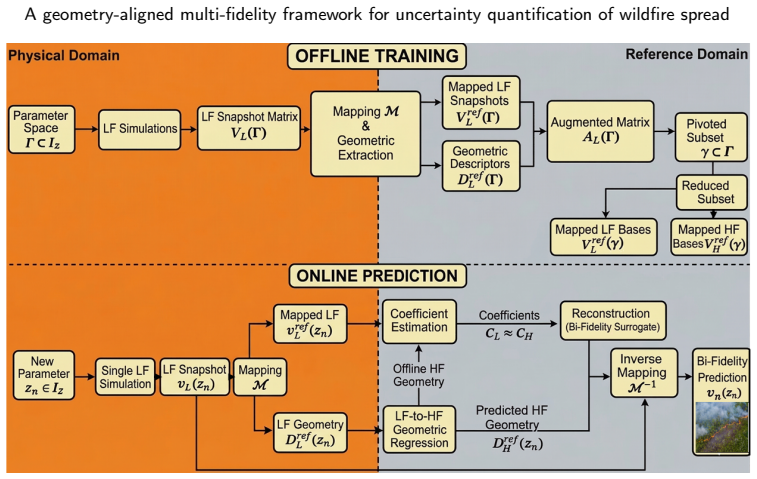
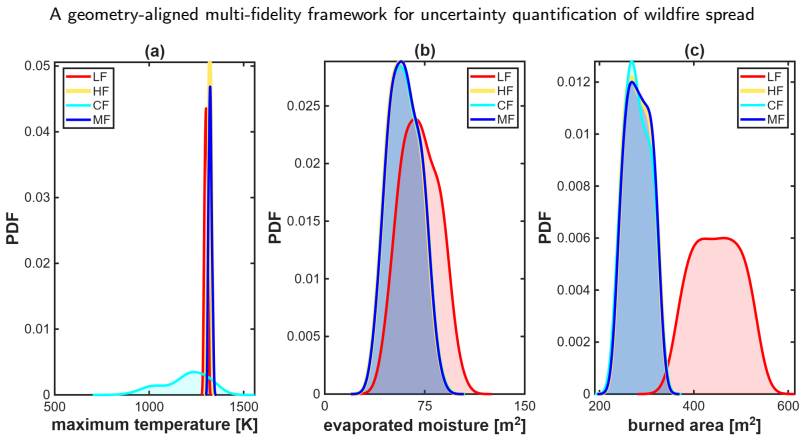
The central claim is that aligning the dominant front geometry of low- and high-fidelity wildfire solutions prior to basis selection and reconstruction enables bi-fidelity surrogates to achieve substantially lower reconstruction error for full-field temperature and fuel composition, to suppress Gibbs-type oscillations near steep gradients, and to recover high-fidelity probability density functions for key outputs of interest, while reducing online evaluation cost by roughly three orders of magnitude compared with direct high-fidelity simulation.
What carries the argument
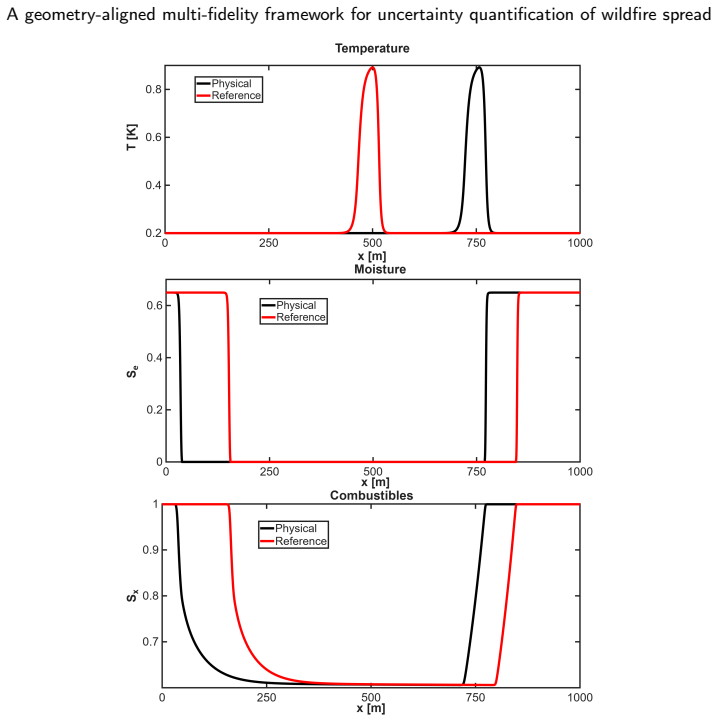
The geometry-aligned bi-fidelity surrogate that applies per-variable shift/stretch transforms in 1D and activity indicator-based affine alignment in 2D to map snapshots onto a common reference domain before performing basis selection and reconstruction.
If this is right
- The aligned surrogate reproduces full-field temperature and fuel composition with substantially lower error than unmapped bi-fidelity schemes.
- Gibbs-type oscillations near steep gradients in convection-dominated fronts are eliminated.
- High-fidelity probability density functions are recovered for maximum temperature, evaporated moisture, and burned area.
- After offline training, online predictions cost roughly three orders of magnitude less than direct high-fidelity evaluation.
- The framework becomes practical for many-query uncertainty quantification in wildfire risk assessment once the offline cost is amortized.
Where Pith is reading between the lines
- The alignment technique could extend to other convection-dominated moving-front problems such as combustion or fluid interfaces where low- and high-fidelity models differ primarily in resolution.
- For fires with merging or topologically complex fronts, the current affine mappings may require generalization to non-affine or topology-aware transforms to maintain accuracy.
- Amortizing the offline training over large ensembles makes the method suitable for generating regional risk maps over many uncertain ignition and weather scenarios.
- Comparison of the recovered probability distributions against observed wildfire statistics from past events would provide an independent test of predictive fidelity.
Load-bearing premise
The per-variable shift and stretch transforms together with the activity-indicator affine alignment accurately identify and map corresponding physical structures across fidelity levels without adding new approximation errors, particularly along convection-dominated fronts.
What would settle it
A side-by-side test on a 2D wildfire case with non-convex front topology in which the geometry-aligned surrogate produces equal or higher error and retains oscillations compared with the unmapped bi-fidelity method would refute the claimed advantage.
Figures




read the original abstract
Forward propagation of input uncertainties in physics-based wildfire models is computationally prohibitive, limiting the use of high-fidelity simulators in risk assessment workflows. This work introduces a geometry-aligned bi-fidelity surrogate framework that addresses the convection-dominated nature of wildfire spread by mapping low- and high-fidelity solution snapshots onto a common reference domain prior to basis selection and reconstruction. Unlike conventional bi-fidelity schemes, which combine spatially shifted snapshots and thus suffer from oscillations and excess basis requirements near sharp fronts, the proposed mapping aligns the dominant front geometry through per-variable shift/stretch transforms in 1D and an activity indicator-based affine alignment in 2D, so that reduced bases compare physically corresponding structures rather than displaced ones. Building on the ADfiRe physics-based simulator, we demonstrate the method on 1D and 2D test cases in which low- and high-fidelity models differ in mesh resolution and physical completeness. Across both settings, the geometry-aligned surrogate reproduces full-field temperature and fuel composition with substantially lower error than its unmapped counterpart, eliminates Gibbs-type oscillations near steep gradients, and recovers high-fidelity probability density functions for key quantities of interest (e.g., maximum temperature, evaporated moisture, and burned area). After offline training, online predictions are roughly three orders of magnitude cheaper than direct high-fidelity evaluation, making the framework a practical building block for many-query uncertainty quantification once the offline cost is amortized over enough queries. We discuss the conditions under which the geometric alignment is most effective, its limitations for non-convex or topologically complex fronts, and the path toward validation against real data.
Editorial analysis
A structured set of objections, weighed in public.
Referee Report
Summary. The paper introduces a geometry-aligned bi-fidelity surrogate framework for uncertainty quantification of wildfire spread. Low- and high-fidelity snapshots from the ADfiRe simulator are mapped to a common reference domain via per-variable shift/stretch transforms (1D) and activity-indicator affine alignment (2D) so that reduced bases operate on physically corresponding front structures rather than spatially displaced ones. On 1D and 2D test cases differing in mesh resolution and physical completeness, the aligned surrogate is claimed to reproduce full-field temperature and fuel composition with substantially lower error than the unmapped counterpart, eliminate Gibbs-type oscillations near steep gradients, recover high-fidelity PDFs for quantities of interest such as maximum temperature, evaporated moisture and burned area, and deliver online predictions three orders of magnitude cheaper than direct high-fidelity evaluation after offline training. Limitations for non-convex or topologically complex fronts are acknowledged.
Significance. If the alignment preserves physical correspondence and the reported error reductions and PDF recovery hold under quantitative scrutiny, the framework would offer a practical advance for many-query UQ in convection-dominated wildfire models. The geometric pre-processing step directly targets the oscillation and basis-size problems that arise when conventional multi-fidelity schemes combine misaligned sharp fronts. The three-order-of-magnitude online speedup and explicit discussion of applicability conditions are strengths that could support risk-assessment workflows once offline costs are amortized.
major comments (2)
- [Abstract] Abstract: the central claim that the geometry-aligned surrogate 'reproduces full-field temperature and fuel composition with substantially lower error' and 'eliminates Gibbs-type oscillations' is not accompanied by any quantitative error metrics (L2 norms, relative errors, or tabulated comparisons) or details of the unmapped baseline. Without these numbers the magnitude and robustness of the improvement cannot be assessed from the presented evidence.
- [Method for 2D alignment] Description of the 2D alignment: the claim that activity-indicator affine maps place low- and high-fidelity snapshots so that 'reduced bases compare physically corresponding structures' is load-bearing for the entire framework. In convection-dominated regimes, low-fidelity fronts can propagate at different speeds and curvatures; an affine transform may therefore register geometrically similar supports that correspond to non-equivalent physical times or locations. No post-alignment quantitative check (e.g., L2 residual between aligned fields or front-velocity discrepancy) is reported to confirm that the mapping preserves the necessary physical equivalence in the test cases.
minor comments (2)
- The abstract states that the method 'recovers high-fidelity probability density functions' but does not indicate the number of samples, the binning strategy, or any statistical test used to quantify PDF agreement; adding these details would strengthen the results section.
- The discussion of limitations for non-convex fronts is welcome; a brief illustrative example or additional figure showing failure modes would help readers judge when the geometric alignment remains reliable.
Simulated Author's Rebuttal
Thank you for the constructive and detailed review. The comments highlight important aspects of clarity and verification that we have addressed through targeted revisions to the manuscript.
read point-by-point responses
-
Referee: [Abstract] Abstract: the central claim that the geometry-aligned surrogate 'reproduces full-field temperature and fuel composition with substantially lower error' and 'eliminates Gibbs-type oscillations' is not accompanied by any quantitative error metrics (L2 norms, relative errors, or tabulated comparisons) or details of the unmapped baseline. Without these numbers the magnitude and robustness of the improvement cannot be assessed from the presented evidence.
Authors: We agree that the abstract would benefit from explicit quantitative metrics to allow readers to immediately gauge the scale of improvement. While the full L2 norms, relative errors, and direct comparisons to the unmapped baseline are already presented with tables and figures in Sections 4 and 5, we have revised the abstract to incorporate representative numerical values (e.g., percentage reductions in L2 error for temperature and fuel composition fields) and an explicit reference to the unmapped baseline. revision: yes
-
Referee: [Method for 2D alignment] Description of the 2D alignment: the claim that activity-indicator affine maps place low- and high-fidelity snapshots so that 'reduced bases compare physically corresponding structures' is load-bearing for the entire framework. In convection-dominated regimes, low-fidelity fronts can propagate at different speeds and curvatures; an affine transform may therefore register geometrically similar supports that correspond to non-equivalent physical times or locations. No post-alignment quantitative check (e.g., L2 residual between aligned fields or front-velocity discrepancy) is reported to confirm that the mapping preserves the necessary physical equivalence in the test cases.
Authors: We acknowledge the concern that an affine alignment based on activity indicators could map geometrically similar but physically non-equivalent front states in convection-dominated regimes. The alignment procedure is designed to register front supports at the snapshot level so that reduced bases operate on corresponding geometric features; the observed error reductions and PDF recovery provide indirect evidence of utility. To directly address the request for verification, we have added a post-alignment quantitative check in the revised methods section (Section 3.2), reporting the L2 residual between aligned low- and high-fidelity fields (shown to be on the order of discretization error) and an assessment of front-velocity discrepancies after mapping. revision: yes
Circularity Check
No significant circularity: new alignment construction validated empirically on test cases
full rationale
The paper defines an explicit geometry-aligned bi-fidelity surrogate via per-variable shift/stretch transforms (1D) and activity-indicator affine maps (2D) that are introduced as part of the method, not derived from or equivalent to the target outputs. Reduced bases are then constructed on the aligned snapshots, and performance (error reduction, oscillation elimination, PDF recovery) is shown through direct numerical comparisons against unmapped counterparts on 1D/2D wildfire test cases using the ADfiRe simulator. No load-bearing step reduces by construction to a fitted parameter, self-citation, or renamed input; the offline/online cost claims follow from the construction and amortization over queries rather than tautology. The framework is self-contained against external benchmarks with independent demonstration.
Axiom & Free-Parameter Ledger
axioms (1)
- domain assumption Wildfire spread is convection-dominated, so aligning dominant front geometry allows reduced bases to compare physically corresponding structures.
Lean theorems connected to this paper
-
IndisputableMonolith/Foundation/RealityFromDistinction.leanreality_from_one_distinction uncleareliminates Gibbs-type oscillations near steep gradients, and recovers high-fidelity probability density functions
Reference graph
Works this paper leans on
-
[1]
F. Tedim, V. Leone, M. Amraoui, C. Bouillon, M. R. Coughlan, G. M. Delogu, P. M. Fernandes, C. Ferreira, S. McCaffrey, T. K. McGee, J.Parente,D.Paton,M.G.Pereira,L.M.Ribeiro,D.X.Viegas,G.Xanthopoulos,DefiningExtremeWildfireEvents:Difficulties,Challenges, and Impacts, Fire 1 (1) (2018) 9.doi:https://doi.org/10.3390/fire1010009
-
[2]
J.T.Abatzoglou,C.A.Kolden,A.C.Cullen,etal.,Climatechangehasincreasedtheoddsofextremeregionalforestfireyearsglobally,Nature Communications 16 (2025) 6390.doi:https://doi.org/10.1038/s41467-025-61608-1
-
[3]
T. M. Giannaros, G. Papavasileiou, Changes in European fire weather extremes and related atmospheric drivers, Agricultural and Forest Meteorology 342 (2023) 109749.doi:https://doi.org/10.1016/j.agrformet.2023.109749
-
[4]
R. C. Rothermel, A Mathematical Model for Predicting Fire Spread in Wildland Fuels, Research Paper INT-115, U.S. Department of Agriculture, Intermountain Forest and Range Experiment Station, Ogden, UT (1972)
work page 1972
-
[5]
P. Fernandes, H. Botelho, F. Rego, C. Loureiro, Empirical modelling of surface fire behaviour in maritime pine stands, International Journal of Wildland Fire 18 (2009) 698–710.doi:10.1071/WF08023
-
[6]
W. Mell, M. A. Jenkins, J. Gould, P. Cheney, A physics-based approach to modelling grassland fires, International Journal of Wildland Fire 16 (1) (2007) 1–22.doi:10.1071/WF06002
-
[7]
D. Morvan, J.-L. Dupuy, Modeling the propagation of a wildfire through a mediterranean shrub using a multiphase formulation, Combustion and Flame 138 (3) (2004) 199–210.doi:10.1016/j.combustflame.2004.05.001
-
[8]
Pattern Recog- nition153, 110500 (2024).https://doi.org/https://doi.org/10.1016/j
K. Vogiatzoglou, C. Papadimitriou, K. Ampountolas, M. Chatzimanolakis, P. Koumoutsakos, V. Bontozoglou, An interpretable wildfire spreading model for real-time predictions, Journal of Computational Science 83 (2024) 102435.doi:https://doi.org/10.1016/j. jocs.2024.102435
work page doi:10.1016/j 2024
-
[9]
R. R. Linn, J. Reisner, J. J. Colman, J. Winterkamp, Studying wildfire behavior using firetec, International Journal of Wildland Fire 11 (4) (2002) 233–246.doi:10.1071/WF02007
-
[10]
D.Morvan,Physicalphenomenaandlengthscalesgoverningthebehaviourofwildfires:Acaseforphysicalmodelling,FireTechnology47(2) (2011) 437–460.doi:10.1007/s10694-010-0160-4
-
[11]
M. Finney, J. Cohen, J. Forthofer, S. Mcallister, M. Gollner, D. Gorham, K. Saito, N. Akafuah, B. Adam, J. English, Role of buoyant flame dynamics in wildfire spread, Proceedings of the National Academy of Sciences of the United States of America (07 2015).doi: 10.1073/pnas.1504498112
-
[12]
M. A. Finney, J. M. Forthofer, X. Liu, J. Burge, M. Ihme, F. Sha, Y.-F. Chen, J. Hickey, J. Anderson, Deep Learning for High-Resolution Wildfire Modeling, in: D. X. Viegas (Ed.), IX International Conference on Forest Fire Research, University of Coimbra, Coimbra, Portugal, 2022, pp. 136–141. Vogiatzoglou, et al.,: Page 19 of 21 A geometry-aligned multi-fi...
work page 2022
-
[13]
Meirovitch, Dynamics and control of structures, AIAA Journal 18 (10) (1980) 1242–1255
L. Meirovitch, Dynamics and control of structures, AIAA Journal 18 (10) (1980) 1242–1255
work page 1980
- [14]
-
[15]
A. Quarteroni, A. Manzoni, C. Vergara, The cardiovascular system: Mathematical modelling, numerical algorithms and clinical applications, Acta Numerica 26 (2017) 365–590
work page 2017
-
[16]
P.Koumoutsakos,Machine learningandpartialdifferential equations:benchmark,simplify,and discover,Data-CentricEngineering6(2025) e29
work page 2025
-
[17]
I. E. Lagaris, A. Likas, D. I. Fotiadis, Artificial neural networks for solving ordinary and partial differential equations, IEEE Transactions on Neural Networks 9 (5) (1998) 987–1000.doi:https://doi.org/10.1109/72.712178
-
[18]
M. Raissi, P. Perdikaris, G. E. Karniadakis, Physics-informed neural networks: A deep learning framework for solving forward and inverse problemsinvolvingnonlinearpartialdifferentialequations,JournalofComputationalPhysics378(2019)686–707.doi:https://doi.org/ 10.1016/j.jcp.2018.10.045
-
[20]
T. Apostolakis, K. Ampountolas, Physics-Inspired Neural Networks for Parameter Learning of Adaptive Cruise Control Systems, IEEE Transactions on Vehicular Technology 73 (10) (2024) 14291–14301.doi:https://doi.org/10.1109/TVT.2024.3399918
-
[21]
P. Karnakov, S. Litvinov, P. Koumoutsakos, Solving inverse problems in physics by optimizing a discrete loss: Fast and accurate learning without neural networks, PNAS Nexus 3 (1) (2024) pgae005.doi:https://doi.org/10.1093/pnasnexus/pgae005
-
[22]
P. Karnakov, S. Litvinov, P. Koumoutsakos, Flow reconstruction by multiresolution optimization of a discrete loss with automatic differentia- tion, European Physical Journal E 46 (2023) 59.doi:https://doi.org/10.1140/epje/s10189-023-00313-7
-
[23]
L.Amoudruz,S.Litvinov,C.Papadimitriou,P.Koumoutsakos,BayesianinferenceforPDE-basedinverseproblemsusingtheoptimizationof a discrete loss, Computer Methods in Applied Mechanics and Engineering 455 (2026) 118903.doi:10.1016/j.cma.2026.118903
-
[24]
A. Benali, A. R. Ervilha, A. C. Sa, P. M. Fernandes, R. M. Pinto, R. M. Trigo, J. M. Pereira, Deciphering the impact of uncertainty on the accuracyoflargewildfirespreadsimulations,ScienceoftheTotalEnvironment569–570(2016)73–85.doi:https://doi.org/10.1016/ j.scitotenv.2016.06.112
work page 2016
- [25]
-
[26]
P.Schwerdtner,F.Law,Q.Wang,C.Gazen,Y.-F.Chen,M.Ihme,B.Peherstorfer,Uncertaintyquantificationincoupledwildfire–atmosphere simulations at scale, PNAS Nexus 3 (12) (2024) pgae554.doi:https://doi.org/10.1093/pnasnexus/pgae554
-
[27]
M. M. Valero, L. Jofre, R. Torres, Multifidelity prediction in wildfire spread simulation: Modeling, uncertainty quantification and sensitivity analysis, Environmental Modelling & Software 141 (2021) 105050.doi:https://doi.org/10.1016/j.envsoft.2021.105050
-
[28]
K. Anderson, G. Reuter, M. D. Flannigan, Fire-growth modelling using meteorological data with random and systematic perturbations, International Journal of Wildland Fire 16 (2007) 174–182
work page 2007
-
[29]
M. G. Cruz, M. E. Alexander, Modelling the rate of fire spread and uncertainty associated with the onset and propagation of crown fires in conifer forest stands, International Journal of Wildland Fire 26 (2017) 413–426
work page 2017
-
[30]
A.Bachmann,B.Allgöwer,Uncertaintypropagationinwildlandfirebehaviourmodelling,InternationalJournalofGeographicalInformation Science 16 (2) (2002) 115–127.doi:https://doi.org/10.1080/13658810110099080
-
[31]
E. Jimenez, M. Y. Hussaini, S. Goodrick, Quantifying parametric uncertainty in the Rothermel model, International Journal of Wildland Fire 17 (5) (2008) 638–649.doi:https://doi.org/10.1071/WF07070
-
[32]
X. Yuan, N. Liu, X. Xie, D. X. Viegas, Physical model of wildland fire spread: Parametric uncertainty analysis, Combustion and Flame 217 (2020) 285–293.doi:https://doi.org/10.1016/j.combustflame.2020.03.034
-
[33]
X. Zhu, A. Narayan, D. Xiu, Computational aspects of stochastic collocation with multifidelity models, SIAM/ASA Journal on Uncertainty Quantification 2 (1) (2014) 444–463.doi:https://doi.org/10.1137/130949154
-
[34]
H. Gao, X. Zhu, J.-X. Wang, A bi-fidelity surrogate modeling approach for uncertainty propagation in three-dimensional hemodynamic simulations, Computer Methods in Applied Mechanics and Engineering 366 (2020) 113047.doi:https://doi.org/10.1016/j.cma. 2020.113047
-
[35]
H.Gao,J.-X.Wang,Abi-fidelityensembleKalmanmethodforPDE-constrainedinverseproblemsincomputationalmechanics,Computational Mechanics 67 (2021) 1115–1131.doi:https://doi.org/10.1007/s00466-021-01979-6
-
[36]
C. Greif, K. Urban, Decay of the Kolmogorov N-width for wave problems, Applied Mathematics Letters 96 (2019) 216–222.doi: 10.1016/j.aml.2019.05.013. URLhttps://doi.org/10.1016/j.aml.2019.05.013
-
[37]
F. Arbes, C. Greif, K. Urban, The Kolmogorov N-width for linear transport: exact representation and the influence of the data, Advances in Computational Mathematics 51 (13) (2025).doi:10.1007/s10444-025-10224-0
-
[38]
D. Gottlieb, C.-W. Shu, On the Gibbs phenomenon and its resolution, SIAM Review 39 (4) (1997) 644–668.doi:10.1137/ S0036144596301390
work page 1997
-
[39]
M. Ohlberger, S. Rave, Reduced basis methods: Success, limitations and future challenges (2016).arXiv:1511.02021. URLhttps://arxiv.org/abs/1511.02021
-
[40]
M. A. Mirhoseini, M. J. Zahr, Model reduction of convection-dominated partial differential equations via optimization-based implicit feature tracking, Journal of Computational Physics 473 (2023) 111739.doi:https://doi.org/10.1016/j.jcp.2022.111739
-
[41]
P. L. Andrews, The Rothermel Surface Fire Spread Model and Associated Developments: A Comprehensive Explanation, General Technical Report RMRS-GTR-371, U.S. Department of Agriculture, Forest Service, Rocky Mountain Research Station, Fort Collins, CO (2018). Vogiatzoglou, et al.,: Page 20 of 21 A geometry-aligned multi-fidelity framework for uncertainty qu...
work page 2018
- [42]
- [43]
-
[44]
A.Narayan,C.Gittelson,D.Xiu,Astochasticcollocationalgorithmwithmultifidelitymodels,SIAMJournalonScientificComputing36(2) (2014) A495–A521.doi:https://doi.org/10.1137/130929461
-
[45]
M. D. McKay, R. J. Beckman, W. J. Conover, A Comparison of Three Methods for Selecting Values of Input Variables in the Analysis of Output from a Computer Code, Technometrics 21 (2) (1979) 239–245.doi:10.1080/00401706.1979.10489755
-
[46]
J.Ching,J.Chen,TransitionalMarkovChainMonteCarloMethodforBayesianModelUpdating,ModelClassSelection,andModelAveraging, Journal of Engineering Mechanics 133 (7) (2007) 816–832.doi:10.1061/(ASCE)0733-9399(2007)133:7(816)
-
[47]
R. Y. Rubinstein, The cross-entropy method for combinatorial and continuous optimization, Methodology and Computing in Applied Probability 1 (2) (1999) 127–190.doi:10.1023/A:1010091220143
-
[48]
B. Echard, N. Gayton, M. Lemaire, AK-MCS: An Active Learning Reliability Method Combining Kriging and Monte Carlo Simulation, Structural Safety 33 (2) (2011) 145–154.doi:10.1016/j.strusafe.2011.01.002. Vogiatzoglou, et al.,: Page 21 of 21
discussion (0)
Sign in with ORCID, Apple, or X to comment. Anyone can read and Pith papers without signing in.