Recognition: 2 theorem links
· Lean TheoremStochastic control with self-exciting processes
Pith reviewed 2026-05-13 04:47 UTC · model grok-4.3
The pith
Stochastic control problems driven by self-exciting processes admit both a sufficient maximum principle and a necessary equivalence principle.
A machine-rendered reading of the paper's core claim, the machinery that carries it, and where it could break.
Core claim
For stochastic differential equations driven by self-exciting processes, a sufficient stochastic maximum principle holds. Martingale representations are derived for both the self-exciting process and its quadratic covariation. A necessary maximum principle is obtained in the form of an equivalence principle, and the conditions are verified in the case of log-utility maximization.
What carries the argument
Stochastic maximum principle for non-Markovian SDEs driven by self-exciting processes, derived with martingale representations of the driver and its covariation.
If this is right
- Optimality can be checked by verifying the maximum condition rather than solving a Hamilton-Jacobi-Bellman equation.
- The martingale expressions supply explicit dynamics for the adjoint processes needed in the maximum principle.
- The necessary condition yields a practical test for candidate controls in the self-exciting setting.
- Log-utility problems under self-exciting dynamics admit solutions characterized directly by the derived principle.
Where Pith is reading between the lines
- The same martingale technique may extend to control problems driven by other non-Markovian point processes with intensity feedback.
- In applications such as optimal stopping of clustered events, the principle supplies first-order conditions without requiring the full value function.
- Numerical schemes could solve the resulting forward-backward stochastic differential equations to approximate optimal controls in simulated self-exciting environments.
Load-bearing premise
The coefficients of the controlled SDE and the self-exciting process satisfy unspecified technical conditions that guarantee existence of solutions and validity of the martingale and adjoint derivations.
What would settle it
A concrete self-exciting control problem whose optimal control is known independently, yet fails to satisfy the derived necessary condition, would falsify the equivalence principle.
Figures
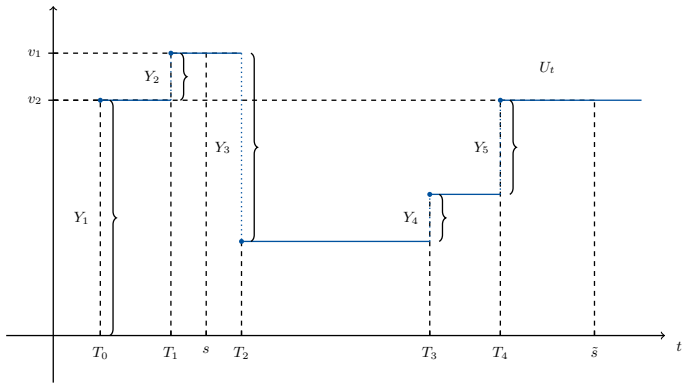
read the original abstract
We analyze the problem of stochastic optimal control of SDEs where the driver includes a self-exciting stochastic process. Due to the non-Markovian nature of the problem, we apply the stochastic maximum principle approach. We derive a sufficient stochastic maximum principle under this framework. We also derive an expression via martingales of both the self-exciting process and its quadratic covariation. Furthermore, we derive a necessary maximum (equivalence principle) for the self-exciting stochastic control problem. Finally, we look at an application to log-utility.
Editorial analysis
A structured set of objections, weighed in public.
Referee Report
Summary. The paper analyzes stochastic optimal control for SDEs whose driver includes a self-exciting process. Because the problem is non-Markovian, the authors use the stochastic maximum principle. They derive a sufficient SMP, martingale representations for both the self-exciting process and its quadratic covariation, a necessary equivalence principle, and an application to log-utility maximization.
Significance. If the derivations are placed on a rigorous footing, the work extends the stochastic maximum principle to a practically relevant class of non-Markovian drivers that appear in financial contagion and insurance models. The martingale representations for the process and its quadratic covariation constitute a concrete technical contribution that may simplify subsequent calculations. The log-utility example provides a useful illustration of applicability.
major comments (2)
- [Necessary equivalence principle] The derivation of the necessary equivalence principle (the section following the sufficient SMP) does not state the required regularity, integrability, or Lipschitz-type conditions on the SDE coefficients and on the intensity of the self-exciting process. These conditions are load-bearing: when the compensator depends on the control, the first-order variation and the martingale property used to obtain the necessary condition may fail without appropriate bounds.
- [Martingale representations] The martingale representations for the self-exciting process and its quadratic covariation are stated without accompanying integrability hypotheses or verification that the stochastic integrals remain martingales under the control-dependent intensity. This directly affects the validity of both the sufficient and necessary principles.
minor comments (1)
- [Abstract] The abstract asserts that derivations exist but supplies no indication of the proof strategy or the form of the self-exciting process; a single sentence clarifying the intensity function would improve readability.
Simulated Author's Rebuttal
We thank the referee for the careful reading and constructive comments on our manuscript. We agree that explicit regularity, integrability, and Lipschitz conditions are needed to rigorize the derivations, particularly given the control dependence in the intensity. We will revise the paper to include these assumptions and verifications, which will strengthen the foundation for both the sufficient and necessary principles.
read point-by-point responses
-
Referee: [Necessary equivalence principle] The derivation of the necessary equivalence principle (the section following the sufficient SMP) does not state the required regularity, integrability, or Lipschitz-type conditions on the SDE coefficients and on the intensity of the self-exciting process. These conditions are load-bearing: when the compensator depends on the control, the first-order variation and the martingale property used to obtain the necessary condition may fail without appropriate bounds.
Authors: We acknowledge that the necessary equivalence principle requires explicit assumptions to justify the first-order variation and martingale properties when the compensator is control-dependent. In the revised manuscript we will add a dedicated assumptions section specifying the required regularity (e.g., Lipschitz continuity of the drift, diffusion, and intensity coefficients), integrability (e.g., uniform integrability of the variation processes), and boundedness conditions on the intensity. These will ensure the first-order variation is well-defined and the relevant processes remain martingales, making the derivation rigorous. revision: yes
-
Referee: [Martingale representations] The martingale representations for the self-exciting process and its quadratic covariation are stated without accompanying integrability hypotheses or verification that the stochastic integrals remain martingales under the control-dependent intensity. This directly affects the validity of both the sufficient and necessary principles.
Authors: We agree that integrability hypotheses are essential for the martingale representations to hold under control-dependent intensities. In the revision we will state the precise integrability conditions (e.g., square-integrability of the integrands and bounded variation of the intensity) and include a brief verification that the stochastic integrals with respect to the self-exciting process and its quadratic covariation remain martingales. This will directly support the validity of both the sufficient and necessary stochastic maximum principles. revision: yes
Circularity Check
No circularity: standard SMP framework applied to new driver class with direct derivations
full rationale
The paper applies the established stochastic maximum principle to SDEs driven by self-exciting processes, deriving sufficient and necessary optimality conditions plus martingale representations for the process and its quadratic covariation. These steps follow from the process definitions and first-order variations under the non-Markovian setting, without reducing any claimed result to a fitted parameter, self-referential definition, or load-bearing self-citation chain. The log-utility application is a direct specialization. No equations or steps in the derivation chain are equivalent to their inputs by construction, and external benchmarks (standard SMP) provide independent support. The derivation remains self-contained.
Axiom & Free-Parameter Ledger
Lean theorems connected to this paper
-
IndisputableMonolith/Foundation/RealityFromDistinction.leanreality_from_one_distinction unclearWe derive a sufficient stochastic maximum principle... expression via martingales of both the self-exciting process and its quadratic covariation... necessary maximum (equivalence principle)
-
IndisputableMonolith/Cost/FunctionalEquation.leanwashburn_uniqueness_aczel unclearLemma 2 (U t and [U] t can be expressed via martingales)
Reference graph
Works this paper leans on
-
[1]
Nacira Agram and Bernt Øksendal. Stochastic fokker–planck equations for condi- tional mckean–vlasov jump diffusions and applications to optimal control.SIAM Journal on Control and Optimization, 61(3):1472–1493, 2023
work page 2023
-
[2]
Aqib Ahmed and Heidar Eyjolfsson. Pricing derivatives under self-exciting dynamics: A finite-difference and transform approach.arXiv preprint arXiv:2603.12602, 2026
-
[3]
Hawkes pro- cesses in finance.Market Microstructure and Liquidity, 1(01):1550005, 2015
Emmanuel Bacry, Iacopo Mastromatteo, and Jean-Fran¸ cois Muzy. Hawkes pro- cesses in finance.Market Microstructure and Liquidity, 1(01):1550005, 2015
work page 2015
-
[4]
Springer-Verlag, New York-Berlin,
Pierre Br´ emaud.Point processes and queues. Springer-Verlag, New York-Berlin,
-
[5]
Martingale dynamics, Springer Series in Statistics
-
[6]
Stochastic maximum principle with default.arXiv preprint arXiv:2001.01535, 2020
Khalida Bachir Cherif, Nacira Agram, and Kristina Dahl. Stochastic maximum principle with default.arXiv preprint arXiv:2001.01535, 2020
-
[7]
Samuel N Cohen and Robert James Elliott.Stochastic calculus and applications, volume 2. Springer, 2015
work page 2015
-
[8]
Self-exciting jump processes and their asymptotic behaviour.Stochastics, 94(8):1166–1185, 2022
Kristina Rognlien Dahl and Heidar Eyjolfsson. Self-exciting jump processes and their asymptotic behaviour.Stochastics, 94(8):1166–1185, 2022
work page 2022
-
[9]
Roxana Dumitrescu, Miryana Grigorova, Marie-Claire Quenez, and Agn` es Sulem. Bsdes with default jump. InThe Abel Symposium, pages 233–263. Springer, 2016
work page 2016
-
[10]
Badr Elmansouri and Mohamed El Otmani. Generalized bsdes driven by rcll martingales with stochastic monotone coefficients.Modern Stochastics: Theory and Applications, 11(1):109–128, 2023
work page 2023
-
[11]
Paul Embrechts, Thomas Liniger, and Lu Lin. Multivariate hawkes processes: an application to financial data.Journal of Applied Probability, 48(A):367–378, 2011
work page 2011
-
[12]
Heidar Eyjolfsson and Dag Tjøstheim. Self-exciting jump processes with appli- cations to energy markets.Annals of the Institute of Statistical Mathematics, 70:373–393, 2018. 19
work page 2018
-
[13]
Heidar Eyjolfsson and Dag Tjøstheim. Multivariate self-exciting jump processes with applications to financial data.Bernoulli, 29(3):2167 – 2191, 2023
work page 2023
-
[14]
Nils C Framstad, Bernt Øksendal, and Agnes Sulem. Sufficient stochastic max- imum principle for the optimal control of jump diffusions and applications to finance.Journal of optimization theory and applications, 121:77–98, 2004
work page 2004
-
[15]
Spectra of some self-exciting and mutually exciting point pro- cesses.Biometrika, 58(1):83–90, 1971
Alan G Hawkes. Spectra of some self-exciting and mutually exciting point pro- cesses.Biometrika, 58(1):83–90, 1971
work page 1971
-
[16]
Alan G Hawkes and David Oakes. A cluster process representation of a self- exciting process.Journal of applied probability, 11(3):493–503, 1974
work page 1974
-
[17]
Monique Jeanblanc, Michael Mania, Marina Santacroce, and Martin Schweizer. Mean-variance hedging via stochastic control and bsdes for general semimartin- gales.The Annals of Applied Probability, pages 2388–2428, 2012
work page 2012
-
[18]
Ananta K Majee. Stochastic optimal control of a doubly nonlinear pde driven by multiplicative l´ evy noise.Applied Mathematics & Optimization, 87(1):7, 2023
work page 2023
-
[19]
Spdes with space interactions and application to population modelling.ESAIM
K Makhlouf, Nacira Agram, Astrid Hilbert, and B Øksendal. Spdes with space interactions and application to population modelling.ESAIM. COCV, 29, 2023
work page 2023
-
[20]
George Mohler. Modeling and estimation of multi-source clustering in crime and security data.The Annals of Applied Statistics, pages 1525–1539, 2013
work page 2013
-
[21]
Bernt Øksendal and Agnes Sulem. Risk minimization in financial markets mod- eled by itˆ o-l´ evy processes.Afrika Matematika, 26(5):939–979, 2015
work page 2015
-
[22]
Existence and uniqueness results for bsde with jumps: the whole nine yards
Antonis Papapantoleon, Dylan Possama¨ ı, and Alexandros Saplaouras. Existence and uniqueness results for bsde with jumps: the whole nine yards. 2018
work page 2018
-
[23]
Shige Peng. Backward stochastic differential equations and applications to opti- mal control.Applied Mathematics and Optimization, 27(2):125–144, 1993
work page 1993
-
[24]
Springer-Verlag, Berlin, Heidelberg, second edition, 1992
Philip Protter.Stochastic Integration and Differential Equations. Springer-Verlag, Berlin, Heidelberg, second edition, 1992
work page 1992
-
[25]
Philip E. Protter.Stochastic integration and differential equations, volume 21 ofStochastic Modelling and Applied Probability. Springer-Verlag, Berlin, 2005. Second edition. Version 2.1, Corrected third printing
work page 2005
-
[26]
Expecting to be hip: Hawkes intensity processes for social media popularity
Marian-Andrei Rizoiu, Lexing Xie, Scott Sanner, Manuel Cebrian, Honglin Yu, and Pascal Van Hentenryck. Expecting to be hip: Hawkes intensity processes for social media popularity. InProceedings of the 26th international conference on world wide web, pages 735–744, 2017. 20
work page 2017
discussion (0)
Sign in with ORCID, Apple, or X to comment. Anyone can read and Pith papers without signing in.