Recognition: 2 theorem links
· Lean TheoremLow-Complexity Blind SNR Estimator for mmWave Multi-Antenna Communications
Pith reviewed 2026-05-13 04:30 UTC · model grok-4.3
The pith
A sorting procedure on beamspace components allows accurate blind SNR estimation from a single sample in mmWave multi-antenna systems.
A machine-rendered reading of the paper's core claim, the machinery that carries it, and where it could break.
Core claim
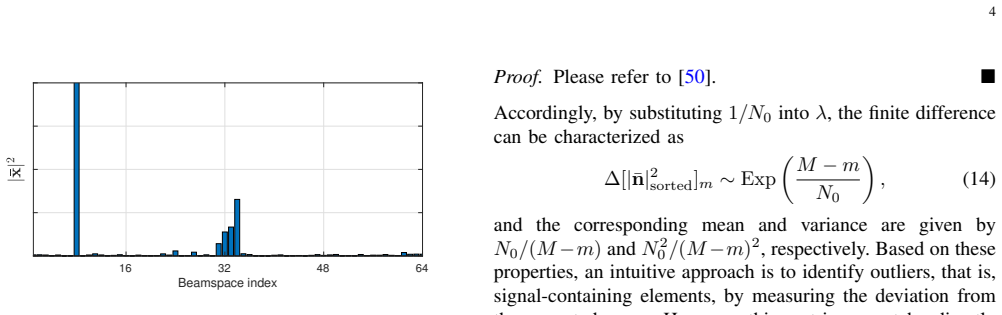
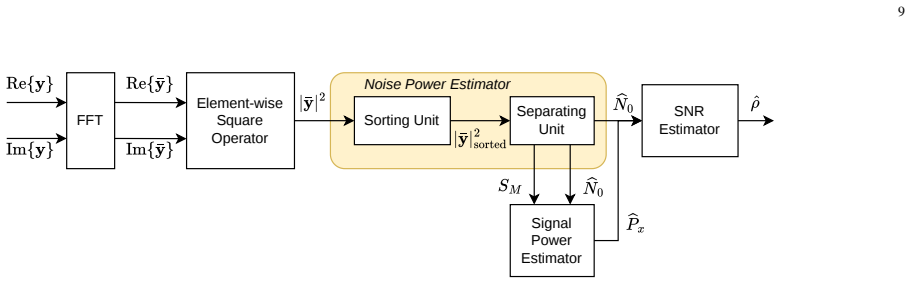
The paper establishes that the inherent sparsity of mmWave channels in the beamspace domain, together with the order statistics of noise power under Gaussian assumptions, enables a sorting-based finite-difference procedure to identify noise-dominant components from a single received signal vector. Average noise power is estimated from those components alone, and signal power together with SNR are obtained through direct arithmetic. This produces a low-complexity blind estimator that requires no pilot signals, iterative optimization, or multiple observations and that supports hardware realization with low latency.
What carries the argument
The sorting-based procedure combined with a finite-difference criterion that identifies noise-dominant components in the beamspace domain.
If this is right
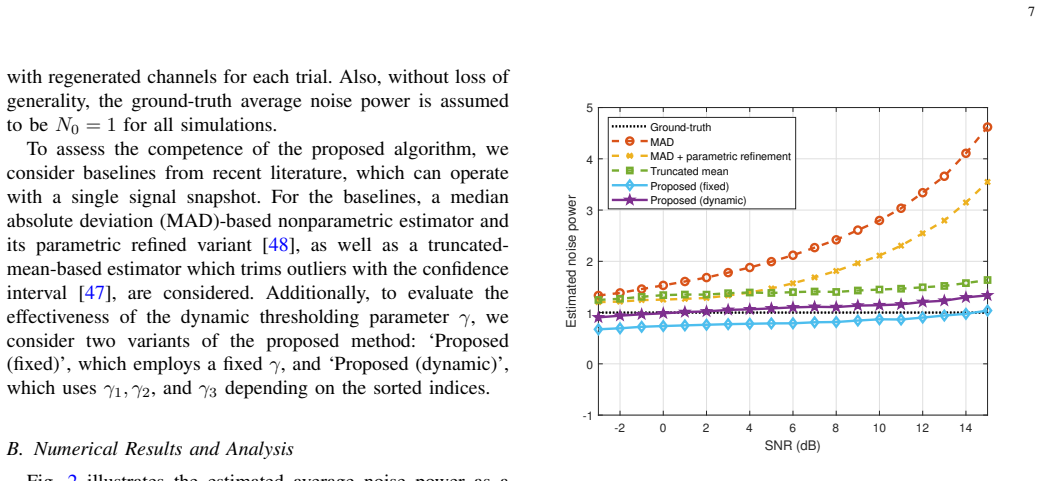
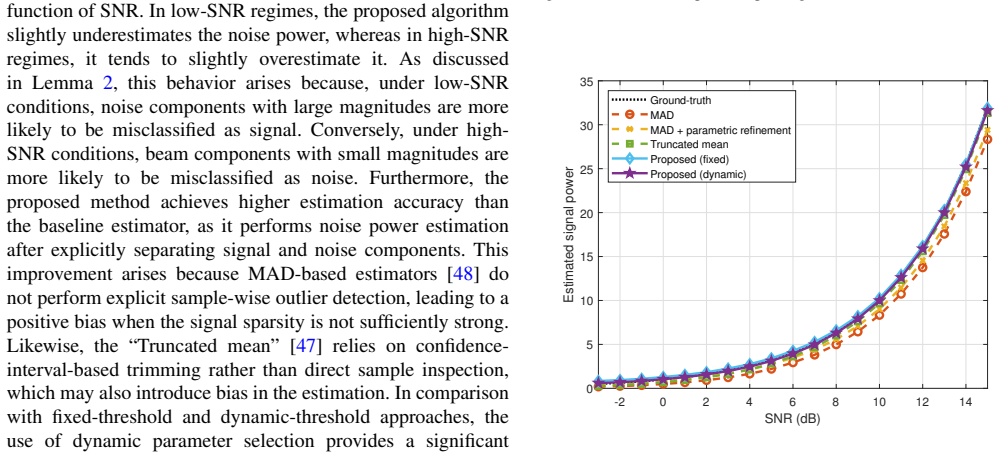
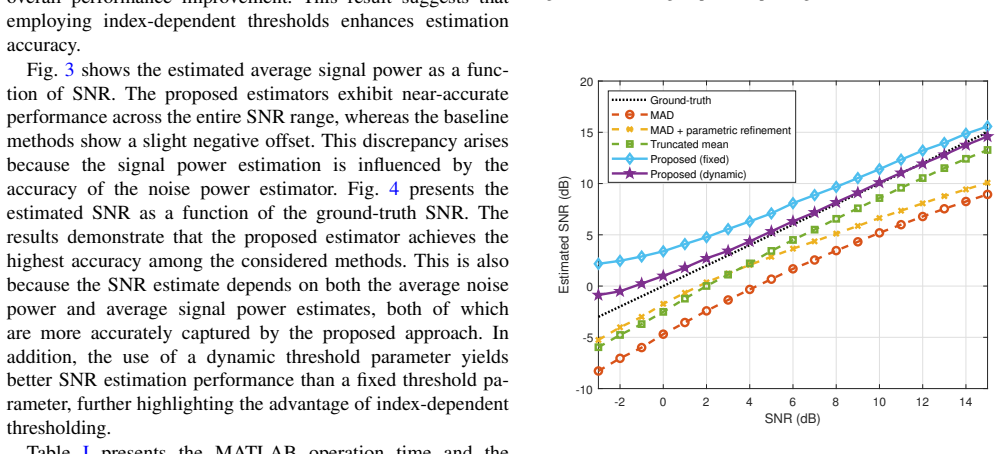
- The estimator achieves higher accuracy than existing single-sample methods in simulations of mmWave channels.
- A VLSI architecture for the algorithm exhibits low latency and sublinear growth in hardware resources as the number of antennas increases.
- Parameter estimation completes in less time than one symbol duration of conventional wireless systems.
- No pilot signals or multiple received observations are required for the noise, signal, and SNR values.
Where Pith is reading between the lines
- In fast-varying mmWave links the single-sample property could support SNR tracking at higher rates than methods that collect several observations.
- The same sorting logic might extend to other wireless settings that already use a sparse transform domain for channel representation.
- The demonstrated FPGA scaling suggests the estimator could fit into power-constrained baseband chips for large antenna arrays.
Load-bearing premise
The separation of noise-dominant components works only if mmWave channels are sparse enough in the beamspace domain for the sorting and finite-difference method to reliably distinguish them from signal components under Gaussian noise.
What would settle it
Running the estimator on received signals from a dense multipath environment that removes beamspace sparsity, then checking whether its accuracy remains higher than existing single-sample methods.
Figures


read the original abstract
In this paper, we propose a low-complexity blind estimator for the average noise power, average signal power, and signal-to-noise ratio (SNR) in millimeter-wave (mmWave) massive multi-antenna uplink systems. In particular, the proposed method is designed to operate using only a single received signal sample, without relying on pilot signals, iterative optimization, or multiple observations, and without requiring prior knowledge of the transmitted signal. By exploiting the inherent sparsity of mmWave channels in the beamspace domain, the estimator identifies noise-dominant components through a sorting-based procedure combined with a finite-difference criterion. This separation is further supported by the order statistics of noise power under Gaussian assumptions, enabling statistically grounded discrimination between signal and noise elements. The average noise power is estimated from the identified noise-only components, and the signal power and SNR are subsequently obtained through simple arithmetic operations. The proposed algorithm achieves low computational complexity and is well-suited for real-time implementation. To demonstrate its practical feasibility, a hardware-efficient very large-scale integration (VLSI) architecture is developed and implemented on a AMD-Xilinx Kintex UltraScale+ KCU116 Evaluation Kit, with corresponding field-programmable gate array (FPGA) results provided. The implementation exhibits low latency and sublinear scaling of hardware resource utilization with respect to the number of antennas, and enables parameter estimation within a duration shorter than a single symbol of conventional wireless systems. Simulation results verify that the proposed estimator achieves high estimation accuracy compared to existing single-sample-based methods.
Editorial analysis
A structured set of objections, weighed in public.
Referee Report
Summary. The paper proposes a low-complexity blind estimator for average noise power, average signal power, and SNR in mmWave massive multi-antenna uplink systems that operates on a single received signal sample without pilots or prior signal knowledge. It exploits beamspace sparsity to identify noise-dominant components via sorting combined with a finite-difference criterion justified by Gaussian order statistics, estimates noise power from those components, and obtains signal power and SNR via arithmetic. A VLSI architecture is implemented on an AMD-Xilinx Kintex UltraScale+ FPGA, demonstrating low latency and sublinear hardware resource scaling with antenna count. Simulations are claimed to show higher accuracy than existing single-sample methods.
Significance. If the core separation step holds under the stated assumptions, the single-sample blind estimator with accompanying FPGA implementation could offer a practical, low-complexity solution for real-time SNR estimation in mmWave massive MIMO systems where pilot overhead or multiple observations are undesirable. The hardware results provide concrete evidence of feasibility for deployment.
major comments (2)
- [Abstract and proposed estimator section] The finite-difference criterion for identifying noise-dominant beamspace components after sorting (described in the abstract and the proposed estimator section) lacks a derived closed-form threshold or analytical robustness guarantee for arbitrary sparsity levels, number of paths, or low-SNR regimes. This step is load-bearing for the noise-power estimate and subsequent SNR calculation; misclassification would bias both, and the method implicitly assumes the empirical difference statistic always yields a clean cut under Gaussian order statistics without proving the gap remains distinguishable from signal-induced jumps.
- [Simulation results section] No analytical error bounds or worst-case analysis are provided for the estimator (simulation results section); performance claims rest entirely on unspecified simulations under Gaussian/sparsity assumptions, which is insufficient to support the 'high estimation accuracy' and 'well-suited for real-time' assertions when the separation step can fail.
minor comments (2)
- [Abstract] The abstract refers to comparisons against 'existing single-sample-based methods' without naming the specific baselines; adding explicit references and a table of comparative metrics would improve clarity.
- [Hardware implementation section] The hardware implementation claims 'sublinear scaling' but would benefit from explicit tabulated resource numbers (LUTs, FFs, DSPs) versus antenna count to substantiate the claim.
Simulated Author's Rebuttal
We thank the referee for the constructive and detailed feedback on our manuscript. We address each major comment below with clarifications on the theoretical motivations and simulation support, while outlining targeted revisions to enhance the presentation of robustness and limitations.
read point-by-point responses
-
Referee: [Abstract and proposed estimator section] The finite-difference criterion for identifying noise-dominant beamspace components after sorting (described in the abstract and the proposed estimator section) lacks a derived closed-form threshold or analytical robustness guarantee for arbitrary sparsity levels, number of paths, or low-SNR regimes. This step is load-bearing for the noise-power estimate and subsequent SNR calculation; misclassification would bias both, and the method implicitly assumes the empirical difference statistic always yields a clean cut under Gaussian order statistics without proving the gap remains distinguishable from signal-induced jumps.
Authors: The finite-difference criterion is grounded in the order statistics of Gaussian noise, where sorted noise-only components exhibit approximately constant small differences, while signal components produce larger jumps; this motivation is detailed in the proposed estimator section. We acknowledge that an explicit closed-form threshold valid for all sparsity levels, path counts, and low-SNR regimes is not derived, as the approach relies on an empirical, data-driven cut. To address the concern, we will revise the manuscript to include expanded discussion of the conditions for gap distinguishability, additional analytical insights into the order-statistic behavior, and new simulation results specifically for low-SNR regimes and varying sparsity. revision: partial
-
Referee: [Simulation results section] No analytical error bounds or worst-case analysis are provided for the estimator (simulation results section); performance claims rest entirely on unspecified simulations under Gaussian/sparsity assumptions, which is insufficient to support the 'high estimation accuracy' and 'well-suited for real-time' assertions when the separation step can fail.
Authors: We agree that analytical error bounds or a full worst-case analysis would strengthen the theoretical claims. Deriving such bounds is non-trivial given the data-dependent nature of the sorting and separation step. The simulation results section specifies the Gaussian noise and beamspace sparsity assumptions along with the tested parameter ranges (SNR, antenna counts, path numbers), and demonstrates improved accuracy relative to prior single-sample methods. We will revise to add a dedicated subsection discussing potential misclassification scenarios, their impact on SNR estimates, and supplementary worst-case simulations to better qualify the 'high accuracy' and real-time suitability claims. revision: partial
Circularity Check
No significant circularity; derivation is direct arithmetic from sorted beamspace components.
full rationale
The estimator sorts beamspace power values, applies a finite-difference test to isolate noise-dominant entries under Gaussian order statistics, averages those entries for noise power, then subtracts from total power to obtain signal power and forms the SNR ratio. Each step is a one-way computation with no parameter fitted to a data subset and then re-used as a 'prediction,' no output defined in terms of itself, and no load-bearing self-citation or uniqueness theorem invoked to close the loop. The separation criterion rests on external sparsity and Gaussian assumptions rather than on the estimator's own output, so the claimed quantities are not equivalent to the inputs by construction.
Axiom & Free-Parameter Ledger
axioms (2)
- domain assumption mmWave channels exhibit inherent sparsity in the beamspace domain
- domain assumption Noise power components follow Gaussian statistics allowing reliable order-statistics discrimination
Lean theorems connected to this paper
-
IndisputableMonolith/Cost/FunctionalEquation.lean (J-cost uniqueness)washburn_uniqueness_aczel unclearthe proposed method... sorting-based procedure combined with a finite-difference criterion... statistically grounded discrimination between signal and noise elements
Reference graph
Works this paper leans on
-
[1]
Low-Complexity Blind Estimator of SNR and MSE for mmWave Multi-Antenna Communications,
H. Park and J.-W. Choi, “Low-Complexity Blind Estimator of SNR and MSE for mmWave Multi-Antenna Communications,” in2025 IEEE Globecom Workshops (GC Wkshps), 2025, pp. 1–6
work page 2025
-
[2]
Ericsson Mobility Report: Q4 2025 Update,
Ericsson, “Ericsson Mobility Report: Q4 2025 Update,” Tech. Rep., Nov. 2025, [Online] https://www.ericsson.com/en/mobility-report
work page 2025
-
[3]
6G Spectrum - Enabling the Future Mobile Life Beyond 2030,
——, “6G Spectrum - Enabling the Future Mobile Life Beyond 2030,” Ericsson, White Paper, 2024
work page 2030
-
[4]
Toward 6G Networks: Use Cases and Technologies,
M. Giordani, M. Polese, M. Mezzavilla, S. Rangan, and M. Zorzi, “Toward 6G Networks: Use Cases and Technologies,”IEEE Commun. Mag., vol. 58, no. 3, pp. 55–61, 2020
work page 2020
-
[5]
T. S. Rappaport, R. W. H. Jr., R. C. Daniels, and J. N. Murdock, Millimeter Wave Wireless Communications. Upper Saddle River, NJ, USA: Prentice Hall, 2015. 12
work page 2015
-
[6]
Combating the Distance Problem in the Millimeter Wave and Terahertz Frequency Bands,
I. F. Akyildiz, C. Han, and S. Nie, “Combating the Distance Problem in the Millimeter Wave and Terahertz Frequency Bands,”IEEE Commun. Mag., vol. 56, no. 6, pp. 102–108, 2018
work page 2018
-
[7]
Millimeter-wave massive MIMO: the next wireless revolution?
A. L. Swindlehurst, E. Ayanoglu, P. Heydari, and F. Capolino, “Millimeter-wave massive MIMO: the next wireless revolution?”IEEE Commun. Mag., vol. 52, no. 9, pp. 56–62, 2014
work page 2014
-
[8]
H. Park and J.-W. Choi, “Binary Hypothesis Testing-Based Low- Complexity Beamspace Channel Estimation for mmWave Massive MIMO Systems,”arXiv preprint arXiv:2508.01007, 2025
-
[9]
Finite-Alphabet MMSE Equalization for All-Digital Massive MU- MIMO mmWave Communication,
O. Casta ˜neda, S. Jacobsson, G. Durisi, T. Goldstein, and C. Studer, “Finite-Alphabet MMSE Equalization for All-Digital Massive MU- MIMO mmWave Communication,”IEEE J. Sel. Areas Commun., vol. 38, no. 9, pp. 2128–2141, 2020
work page 2020
-
[10]
Hybrid Precoding Baseband Processor for 64 × 64 Millimeter Wave MIMO Systems,
C.-C. Kao, C.-E. Chen, and C.-H. Yang, “Hybrid Precoding Baseband Processor for 64 × 64 Millimeter Wave MIMO Systems,”IEEE Trans. Circuits Syst. I, vol. 69, no. 4, pp. 1765–1773, 2022
work page 2022
-
[11]
Transmit power adaptation for multiuser OFDM systems,
J. Jang and K. B. Lee, “Transmit power adaptation for multiuser OFDM systems,”IEEE J. Sel. Areas Commun., vol. 21, no. 2, pp. 171–178, 2003
work page 2003
-
[12]
S. S. Borkotoky, S. L. Kottapalli, and M. B. Pursley, “Analytical Methods for Performance Evaluations of Adaptive Modulation and Coding in Cognitive Radio Systems That Employ Distance Statistics,”IEEE Trans. Cognit. Commun. Netw., vol. 5, no. 1, pp. 73–81, 2019
work page 2019
-
[13]
Efficient Beam Align- ment for Millimeter Wave Single-Carrier Systems With Hybrid MIMO Transceivers,
X. Song, S. Haghighatshoar, and G. Caire, “Efficient Beam Align- ment for Millimeter Wave Single-Carrier Systems With Hybrid MIMO Transceivers,”IEEE Trans. Wireless Commun., vol. 18, no. 3, pp. 1518– 1533, 2019
work page 2019
-
[14]
Queue-Aware Optimization-Based Scheduling for mmWave Multi-User MIMO Indoor Small Cell,
H. Park and J.-W. Choi, “Queue-Aware Optimization-Based Scheduling for mmWave Multi-User MIMO Indoor Small Cell,”IEEE Commun. Lett., vol. 29, no. 10, pp. 2303–2307, 2025
work page 2025
-
[15]
A Design Framework for All-Digital mmWave Massive MIMO With per-Antenna Nonlinearities,
M. Abdelghany, A. A. Farid, M. E. Rasekh, U. Madhow, and M. J. W. Rodwell, “A Design Framework for All-Digital mmWave Massive MIMO With per-Antenna Nonlinearities,”IEEE Trans. Wireless Com- mun., vol. 20, no. 9, pp. 5689–5701, 2021
work page 2021
-
[16]
NR; Physical layer procedures for data (3GPP TS 38.214),
3GPP, “NR; Physical layer procedures for data (3GPP TS 38.214),” 2026, version 19.3.0
work page 2026
-
[17]
NR; Physical channels and modulation (3GPP TS 38.211),
——, “NR; Physical channels and modulation (3GPP TS 38.211),” 2026, version 19.3.0
work page 2026
-
[18]
NR; Physical layer procedures for control (3GPP TS 38.213),
——, “NR; Physical layer procedures for control (3GPP TS 38.213),” 2026, version 19.3.0
work page 2026
-
[19]
S. Singh, S. Kumar, S. Majhi, U. Satija, and C. Yuen, “Blind Carrier Fre- quency Offset Estimation Techniques for Next-Generation Multicarrier Communication Systems: Challenges, Comparative Analysis, and Future Prospects,”IEEE Commun. Surveys Tuts., vol. 27, no. 1, pp. 1–36, 2025
work page 2025
-
[20]
J. Liu, H. Jiang, and X. Yuan, “Blind Massive Connectivity in mmWave MIMO: A Trilinear Factorization Approach via Hybrid Vector Message Passing,”IEEE Trans. Wireless Commun., vol. 24, no. 8, pp. 6613–6626, 2025
work page 2025
-
[21]
Mobility Support for Millimeter Wave Communications: Opportunities and Challenges,
J. Li, Y . Niu, H. Wu, B. Ai, S. Chen, Z. Feng, Z. Zhong, and N. Wang, “Mobility Support for Millimeter Wave Communications: Opportunities and Challenges,”IEEE Commun. Surveys Tuts., vol. 24, no. 3, pp. 1816– 1842, 2022
work page 2022
-
[22]
A Very-Low Pilot Scheme for mmWave Hybrid Massive MIMO-OFDM Systems,
F. Han, X. Wang, and H. Deng, “A Very-Low Pilot Scheme for mmWave Hybrid Massive MIMO-OFDM Systems,”IEEE Wireless Commun. Lett., vol. 10, no. 9, pp. 2061–2064, 2021
work page 2061
-
[23]
Blind SNR Estimation of Gaussian-Distributed Signals in Nakagami Fading Channels,
M. Hafez, T. Khattab, and H. M. H. Shalaby, “Blind SNR Estimation of Gaussian-Distributed Signals in Nakagami Fading Channels,”IEEE Trans. Wireless Commun., vol. 14, no. 7, pp. 3509–3518, 2015
work page 2015
-
[24]
S. Kojima, K. Maruta, Y . Feng, C.-J. Ahn, and V . Tarokh, “CNN-Based Joint SNR and Doppler Shift Classification Using Spectrogram Images for Adaptive Modulation and Coding,”IEEE Trans. Commun., vol. 69, no. 8, pp. 5152–5167, 2021
work page 2021
-
[25]
X. Gao, L. Dai, S. Han, C.-L. I, and R. W. Heath, “Energy-Efficient Hybrid Analog and Digital Precoding for MmWave MIMO Systems With Large Antenna Arrays,”IEEE J. Sel. Areas Commun., vol. 34, no. 4, pp. 998–1009, 2016
work page 2016
-
[26]
Power delay profile and noise variance estimation for OFDM,
T. Cui and C. Tellambura, “Power delay profile and noise variance estimation for OFDM,”IEEE Commun. Lett., vol. 10, no. 1, pp. 25– 27, 2006
work page 2006
-
[27]
Blind Estimation of Channel Order and SNR for OFDM Systems,
J. Tian, T. Zhou, T. Xu, H. Hu, and M. Li, “Blind Estimation of Channel Order and SNR for OFDM Systems,”IEEE Access, vol. 6, pp. 12 656– 12 664, 2018
work page 2018
-
[28]
C. Shin, R. W. Heath, and E. J. Powers, “Non-Redundant Precoding- Based Blind and Semi-Blind Channel Estimation for MIMO Block Transmission With a Cyclic Prefix,”IEEE Trans. Signal Process., vol. 56, no. 6, pp. 2509–2523, 2008
work page 2008
-
[29]
Blind Channel Estimation for Non- CP OFDM Systems Using Multiple Receive Antennas,
S. Wang and J. H. Manton, “Blind Channel Estimation for Non- CP OFDM Systems Using Multiple Receive Antennas,”IEEE Signal Process. Lett., vol. 16, no. 4, pp. 299–302, 2009
work page 2009
-
[30]
The joint estimation of signal and noise from the sum envelope,
T. Benedict and T. Soong, “The joint estimation of signal and noise from the sum envelope,”IEEE Trans. Inf. Theory, vol. 13, no. 3, pp. 447–454, 1967
work page 1967
-
[31]
An SNR estimation algorithm using fourth-order moments,
R. Matzner and F. Englberger, “An SNR estimation algorithm using fourth-order moments,” inProceedings of 1994 IEEE International Symposium on Information Theory, 1994, p. 119
work page 1994
-
[32]
Generalized Moment-Based Method for SNR Estimation,
M. Bakkali, A. Stephenne, and S. Affes, “Generalized Moment-Based Method for SNR Estimation,” in2007 IEEE Wireless Communications and Networking Conference, 2007, pp. 2226–2230
work page 2007
-
[33]
Non-Data-Aided SNR Estimation for Multiple Antenna Systems,
M. Mohammadkarimi, O. A. Dobre, and M. Z. Win, “Non-Data-Aided SNR Estimation for Multiple Antenna Systems,” in2016 IEEE Global Communications Conference (GLOBECOM), 2016, pp. 1–5
work page 2016
-
[34]
SNR Estima- tion for Multilevel Constellations Using Higher-Order Moments,
M. Alvarez-Diaz, R. Lopez-Valcarce, and C. Mosquera, “SNR Estima- tion for Multilevel Constellations Using Higher-Order Moments,”IEEE Trans. Signal Process., vol. 58, no. 3, pp. 1515–1526, 2010
work page 2010
-
[35]
Joint Estimation of the Ricean K-Factor and the SNR for SIMO Systems Using Higher Order Statistics,
I. Bousnina, F. Bellili, A. Samet, and S. Affes, “Joint Estimation of the Ricean K-Factor and the SNR for SIMO Systems Using Higher Order Statistics,” in2011 IEEE Global Telecommunications Conference - GLOBECOM 2011, 2011, pp. 1–5
work page 2011
-
[36]
SNR estimation for nonconstant mod- ulus constellations,
P. Gao and C. Tepedelenlioglu, “SNR estimation for nonconstant mod- ulus constellations,”IEEE Trans. Signal Process., vol. 53, no. 3, pp. 865–870, 2005
work page 2005
-
[37]
SNR and Noise Variance Estimation for MIMO Systems,
A. Das and B. D. Rao, “SNR and Noise Variance Estimation for MIMO Systems,”IEEE Trans. Signal Process., vol. 60, no. 8, pp. 3929–3941, 2012
work page 2012
-
[38]
EM Algorithm for Non-Data-Aided SNR Estimation of Linearly-Modulated Signals over SIMO Channels,
M. A. Boujelben, F. Bellili, S. Affes, and A. Stephenne, “EM Algorithm for Non-Data-Aided SNR Estimation of Linearly-Modulated Signals over SIMO Channels,” inGLOBECOM 2009 - 2009 IEEE Global Telecommunications Conference, 2009, pp. 1–6
work page 2009
-
[39]
Maximum likeli- hood SNR estimation over time-varying flat-fading SIMO channels,
F. Bellili, R. Meftehi, S. Affes, and A. St ´ephenne, “Maximum likeli- hood SNR estimation over time-varying flat-fading SIMO channels,” in 2014 IEEE International Conference on Acoustics, Speech and Signal Processing (ICASSP), 2014, pp. 6523–6527
work page 2014
-
[40]
——, “Maximum Likelihood SNR Estimation of Linearly-Modulated Signals Over Time-Varying Flat-Fading SIMO Channels,”IEEE Trans. Signal Process., vol. 63, no. 2, pp. 441–456, 2015
work page 2015
-
[41]
Error vector magnitude to SNR conversion for nondata-aided receivers,
H. A. Mahmoud and H. Arslan, “Error vector magnitude to SNR conversion for nondata-aided receivers,”IEEE Trans. Wireless Commun., vol. 8, no. 5, pp. 2694–2704, 2009
work page 2009
-
[42]
Joint SNR and Rician K-Factor Estimation Using Multimodal Network Over Mobile Fading Channels,
K. Tamura, S. Kojima, P. V . Trinh, S. Sugiura, and C.-J. Ahn, “Joint SNR and Rician K-Factor Estimation Using Multimodal Network Over Mobile Fading Channels,”IEEE Trans. Mach. Learn. Commun. Netw., vol. 2, pp. 766–779, 2024
work page 2024
-
[43]
Deep Learning-Based Signal-to-Noise Ratio Estimation Using Constellation Diagrams,
X. Xie, S. Peng, and X. Yang, “Deep Learning-Based Signal-to-Noise Ratio Estimation Using Constellation Diagrams,”Mobile Inf. Syst., vol. 2020, pp. 1–9, 2020
work page 2020
-
[44]
Y . Linn, “A Carrier-Independent Non-Data-Aided Real-Time SNR Esti- mator for M-PSK and D-MPSK Suitable for FPGAs and ASICs,”IEEE Trans. Circuits Syst. I, vol. 56, no. 7, pp. 1525–1538, 2009
work page 2009
-
[45]
Eigenvalue-Based Sensing and SNR Estimation for Cognitive Radio in Presence of Noise Correlation,
S. K. Sharma, S. Chatzinotas, and B. Ottersten, “Eigenvalue-Based Sensing and SNR Estimation for Cognitive Radio in Presence of Noise Correlation,”IEEE Trans. Veh. Technol., vol. 62, no. 8, pp. 3671–3684, 2013
work page 2013
-
[46]
Blind SINR Estimation for Massive MIMO Systems,
J. P. Gonz ´alez-Coma and D. Morales-Jim ´enez, “Blind SINR Estimation for Massive MIMO Systems,”IEEE Wireless Commun. Lett., vol. 13, no. 9, pp. 2492–2496, 2024
work page 2024
-
[47]
Low-Complexity Beamspace Channel Denoiser for mmWave Massive MIMO with Low-Resolution ADCs
H. Park, E. Kim, and J.-W. Choi, “Low-Complexity Channel Estima- tor for mmWave Massive MIMO with Low-Resolution ADCs,”arXiv preprint arXiv:2605.08855, 2026
work page internal anchor Pith review Pith/arXiv arXiv 2026
-
[48]
Low-Complexity Blind Parameter Estimation in Wireless Systems with Noisy Sparse Signals,
A. Gallyas-Sanhueza and C. Studer, “Low-Complexity Blind Parameter Estimation in Wireless Systems with Noisy Sparse Signals,”IEEE Trans. Wireless Commun., vol. 22, no. 10, pp. 7055–7071, 2023
work page 2023
-
[49]
QuaDRiGa: A 3- D Multi-Cell Channel Model With Time Evolution for Enabling Virtual Field Trials,
S. Jaeckel, L. Raschkowski, K. B ¨orner, and L. Thiele, “QuaDRiGa: A 3- D Multi-Cell Channel Model With Time Evolution for Enabling Virtual Field Trials,”IEEE Trans. Antennas Propag., vol. 62, no. 6, pp. 3242– 3256, 2014
work page 2014
-
[50]
On the theory of order statistics,
A. R ´enyi, “On the theory of order statistics,”Acta Mathematica Hun- garica, vol. 4, pp. 191–231, 1953
work page 1953
-
[51]
C. A. R. Hoare, “Quicksort,”The Computer Journal, vol. 5, no. 1, pp. 10–16, 1962
work page 1962
discussion (0)
Sign in with ORCID, Apple, or X to comment. Anyone can read and Pith papers without signing in.