Recognition: 2 theorem links
· Lean TheoremHM-Req: A Framework for Embedding Values within CPS Human Monitoring Requirements
Pith reviewed 2026-05-13 04:44 UTC · model grok-4.3
The pith
HM-Req framework uses a controlled natural language and value dashboard to embed stakeholder values into human monitoring requirements for cyber-physical systems.
A machine-rendered reading of the paper's core claim, the machinery that carries it, and where it could break.
Core claim
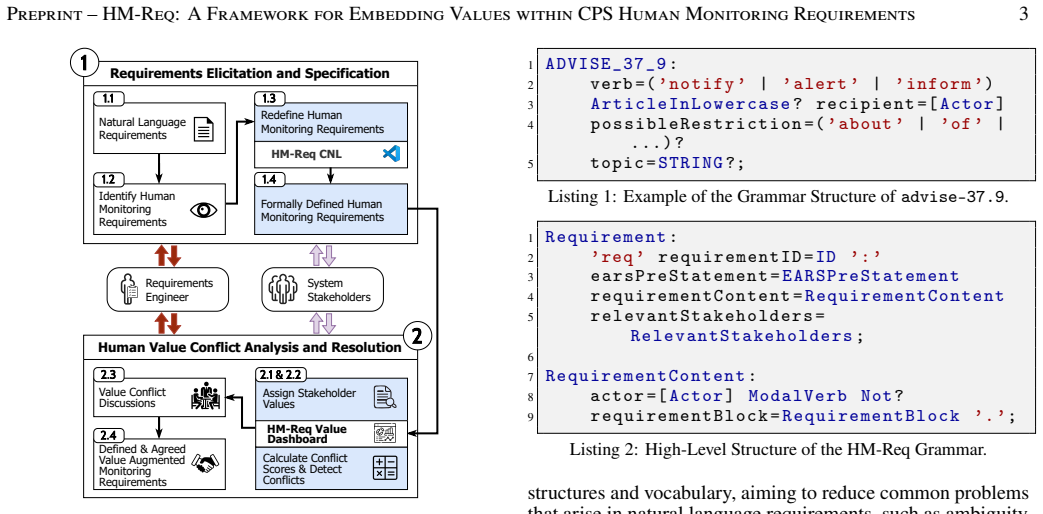
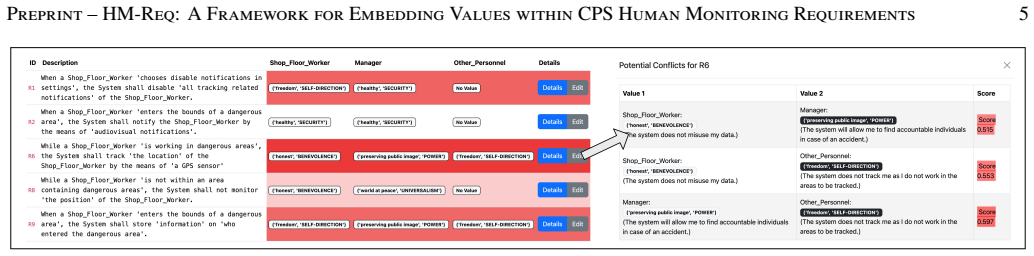
HM-Req is a requirements elicitation framework that includes a Controlled Natural Language for defining human monitoring requirements in CPS. These requirements are augmented with human values from relevant stakeholders and integrated into a Value Dashboard to detect potential conflicts that require further discussion and resolution. Validation results, applying the CNL to different datasets and conducting a survey and expert interview, confirm the CNL's ability to capture diverse human monitoring requirements and show HM-Req's usefulness for requirements elicitation activities.
What carries the argument
The HM-Req framework, built around a Controlled Natural Language for human monitoring requirements together with value augmentation and a Value Dashboard that surfaces conflicts.
Load-bearing premise
Stakeholder values can be systematically drawn out, recorded without distortion, and that conflicts flagged by the dashboard will actually trigger productive resolution talks instead of being ignored.
What would settle it
A fresh collection of human monitoring requirements from a CPS project where the CNL produces incomplete or ambiguous statements, or where the dashboard identifies value clashes that the team never resolves.
Figures


read the original abstract
Monitoring humans, for example, their movement or location, is essential for safe and efficient human-machine collaboration in Cyber-Physical Systems (CPS). This information allows CPS to ensure safety properties, adapt their behaviour dynamically, and coordinate with humans. To ensure that the design of a CPS respects ethical principles and the privacy of its stakeholders, system requirements, particularly those related to human monitoring, must reflect the human values of all involved stakeholders. However, human values are often underrepresented in Software Engineering -- particularly during requirements elicitation and system design, crucial phases when introducing ethically critical functionality. Stakeholder values are often implicit and conflicting, yet rarely systematically captured. Furthermore, unstructured natural language requirements introduce ambiguity and vagueness, complicating conflict resolution. To address these problems, we propose HM-Req, a novel requirements elicitation framework including a Controlled Natural Language (CNL) for defining human monitoring requirements. These requirements are then augmented with human values from relevant stakeholders and integrated into a Value Dashboard to detect potential conflicts that require further discussion and resolution. Validation results, applying the CNL to different datasets and conducting a survey and expert interview, confirms the CNL's ability to capture diverse human monitoring requirements and show HM-Req's usefulness for requirements elicitation activities.
Editorial analysis
A structured set of objections, weighed in public.
Referee Report
Summary. The paper proposes HM-Req, a requirements elicitation framework for Cyber-Physical Systems that uses a Controlled Natural Language (CNL) to specify human monitoring requirements, augments them with stakeholder values, and integrates them into a Value Dashboard to detect and resolve conflicts. Validation is described as applying the CNL to multiple datasets plus a survey and expert interview, which the authors claim confirms the CNL's ability to capture diverse requirements and demonstrates the framework's usefulness for elicitation activities.
Significance. If the validation evidence were strengthened with quantitative metrics and observable outcomes on value fidelity and conflict resolution, the work could address an important gap in embedding ethical and privacy values into CPS human-monitoring requirements, providing a structured alternative to ambiguous natural-language specifications.
major comments (2)
- [Abstract] Abstract: the claim that 'validation results... confirms the CNL's ability to capture diverse human monitoring requirements and show HM-Req's usefulness' is unsupported by any quantitative results, description of the conflict-detection logic inside the Value Dashboard, error rates, or inter-rater measures; without these, the evidence cannot substantiate the usefulness claim for elicitation activities.
- [Validation] Validation description: the activities test syntactic coverage and subjective usefulness but supply no observable data on whether stakeholder values are elicited and attached without material distortion or whether dashboard-flagged conflicts actually trigger productive resolution discussions rather than being ignored.
Simulated Author's Rebuttal
We thank the referee for the constructive and detailed feedback on our manuscript. The comments highlight important opportunities to strengthen the presentation of our validation activities and the Value Dashboard's mechanisms. We agree that the abstract claim requires qualification and that additional details on the dashboard logic and study limitations would improve clarity. We address each major comment below and indicate planned revisions.
read point-by-point responses
-
Referee: [Abstract] Abstract: the claim that 'validation results... confirms the CNL's ability to capture diverse human monitoring requirements and show HM-Req's usefulness' is unsupported by any quantitative results, description of the conflict-detection logic inside the Value Dashboard, error rates, or inter-rater measures; without these, the evidence cannot substantiate the usefulness claim for elicitation activities.
Authors: We agree that the abstract phrasing is overly strong given the validation details provided. In the revised manuscript we will rewrite the abstract to state that the CNL was applied to multiple datasets to demonstrate syntactic coverage of diverse requirements and that a survey plus expert interview provided initial evidence of perceived usefulness for elicitation. We will also add a concise description of the conflict-detection logic (rule-based matching of value annotations against requirement attributes) in the Value Dashboard section of the paper and reference it briefly in the abstract. Our study did not collect error rates or inter-rater reliability statistics because the primary goal was feasibility demonstration rather than statistical validation; we will explicitly note this scope limitation and propose quantitative follow-up studies. revision: partial
-
Referee: [Validation] Validation description: the activities test syntactic coverage and subjective usefulness but supply no observable data on whether stakeholder values are elicited and attached without material distortion or whether dashboard-flagged conflicts actually trigger productive resolution discussions rather than being ignored.
Authors: This assessment is accurate. The current validation shows that the CNL can express a range of human-monitoring requirements drawn from existing datasets and that participants in the survey and interview found the overall HM-Req process helpful for surfacing values. However, we do not provide direct observational measures of value-attachment fidelity or of whether flagged conflicts led to productive discussions. Such data would require a different experimental design (e.g., controlled elicitation sessions with pre/post measures or longitudinal observation). We will add a limitations subsection that acknowledges these gaps and outlines future work to evaluate fidelity and resolution outcomes. revision: yes
Circularity Check
No circularity: proposal and validation are independent of self-referential inputs
full rationale
The paper presents a requirements elicitation framework (HM-Req) consisting of a CNL for human monitoring requirements, value augmentation, and a Value Dashboard for conflict detection. Its central claim rests on empirical validation: applying the CNL to multiple datasets plus a survey and expert interview. No equations, parameters, or first-principles derivations appear. No step reduces a result to a fitted input, self-definition, or load-bearing self-citation chain. The validation activities are described as external checks on expressiveness and usefulness; they do not presuppose the target outcomes by construction. This is a standard non-circular proposal paper.
Axiom & Free-Parameter Ledger
axioms (1)
- domain assumption Human values relevant to monitoring can be elicited from stakeholders and attached to requirements without significant loss of meaning or introduction of new ambiguity.
invented entities (2)
-
HM-Req framework
no independent evidence
-
Value Dashboard
no independent evidence
Lean theorems connected to this paper
-
IndisputableMonolith/Cost/FunctionalEquation.leanwashburn_uniqueness_aczel unclearHM-Req CNL grammar rules (51 VerbNet classes, 87 verbs) + Value Conflict Score via normalized Euclidean distance on Schwartz SSA
-
IndisputableMonolith/Foundation/RealityFromDistinction.leanreality_from_one_distinction unclearSchwartz smallest-space analysis for stakeholder-value conflict detection
Reference graph
Works this paper leans on
-
[1]
EfficientandscalableruntimemonitoringforCyber-Physical System,
X. Zheng, C. Julien, R. Podorozhny, F. Cassez, and T. Rakotoariv- elo,“EfficientandscalableruntimemonitoringforCyber-Physical System,”IEEE Systems Journal, vol. 12, no. 2, pp. 1667–1678, 2016
work page 2016
-
[2]
M. Vierhauser and A. Egyed, “Runtime monitoring for systems of system: A closer look on opportunities for manufacturers in the context of industry 4.0,” inDigital Transformation: Core Technologies and Emerging Topics from a Computer Science Perspective, pp. 203–222, Springer, 2023
work page 2023
-
[3]
Acyberphysicalsystem (cps) approach for safe human-robot collaboration in a shared workplace,
N.Nikolakis,V.Maratos,andS.Makris,“Acyberphysicalsystem (cps) approach for safe human-robot collaboration in a shared workplace,”Robotics and Computer-Integrated Manufacturing, vol. 56, pp. 233–243, 2019
work page 2019
-
[4]
Towards a DSL to formal- ize multimodal requirements,
M. Gomez-Vazquez and J. Cabot, “Towards a DSL to formal- ize multimodal requirements,”arXiv preprint arXiv:2508.14631, 2025
-
[5]
Human-Machine Teaming with Small Unmanned Aerial Systems in a Mape-K Environment,
J. Cleland-Huang, T. Chambers, S. Zudaire, M. T. Chowdhury, A. Agrawal, and M. Vierhauser, “Human-Machine Teaming with Small Unmanned Aerial Systems in a Mape-K Environment,” ACM Transactions on Autonomous and Adaptive Systems, 2023
work page 2023
-
[6]
Multimodal sensor-based whole-body control for human–robot collaboration in industrial settings,
J. de Gea Fernández, D. Mronga, M. Günther, T. Knobloch, M. Wirkus, M. Schröer, M. Trampler, S. Stiene, E. Kirchner, V. Bargsten, T. Bänziger, J. Teiwes, T. Krüger, and F. Kirchner, “Multimodal sensor-based whole-body control for human–robot collaboration in industrial settings,”Robotics and Autonomous Systems, vol. 94, pp. 102–119, 2017
work page 2017
-
[7]
Monitoring service workers via com- puter: The effect on employees, productivity, and service,
R. Grant and C. Higgins, “Monitoring service workers via com- puter: The effect on employees, productivity, and service,”Na- tional Productivity Review, vol. 8, no. 2, pp. 101–113, 1989
work page 1989
-
[8]
A. Sartoriet al., “Monitoring and surveillance in the workplace: an overview of national and international instruments to protect employees,”Recent Labour Law Issues: A Multilevel Perspective, pp. 203–218, 2019. Preprint – HM-Req: A Framework for Embedding Values within CPS Human Monitoring Requirements11
work page 2019
-
[9]
A case for human values in software engineering,
J. Whittle, M. A. Ferrario, W. Simm, and W. Hussain, “A case for human values in software engineering,”IEEE Software, vol. 38, no. 1, pp. 106–113, 2021
work page 2021
-
[10]
Value stories: Putting human values into requirements engineering.,
C. Detweiler and M. Harbers, “Value stories: Putting human values into requirements engineering.,” inREFSQ Workshops, vol. 1138, pp. 2–11, 2014
work page 2014
-
[11]
The impact of considering human values during requirements engineering activities,
H. Perera, R. Hoda, R. A. Shams, A. Nurwidyantoro, M. Shahin, W. Hussain, and J. Whittle, “The impact of considering human values during requirements engineering activities,”arXiv preprint arXiv:2111.15293, 2021
-
[12]
IEEE standard model process for ad- dressing ethical concerns during system design,
IEEE Computer Society, “IEEE standard model process for ad- dressing ethical concerns during system design,”IEEE Std 7000- 2021, pp. 1–82, 2021
work page 2021
-
[13]
S. H. Schwartz, “Universals in the content and structure of values: Theoretical advances and empirical tests in 20 countries,” in Advances in Experimental Social Psychology, vol. 25, pp. 1–65, Elsevier, 1992
work page 1992
-
[14]
Asystematicliteraturereviewofkaosextensions,
E. Gonçalves, L. Monte, S. Souza, M. de Oliveira, and J. Araujo, “Asystematicliteraturereviewofkaosextensions,”inInternational Working Conference on Requirements Engineering: Foundation for Software Quality, pp. 166–180, Springer, 2025
work page 2025
-
[15]
F. Dalpiaz, X. Franch, and J. Horkoff, “istar 2.0 language guide,” arXiv preprint arXiv:1605.07767, 2016
-
[16]
Formal tropos: language and semantics,
A. Fuxman, R. Kazhamiakin, M. Pistore, and M. Roveri, “Formal tropos: language and semantics,”University of Trento and IRST, vol. 55, p. 123, 2003
work page 2003
-
[17]
Processing natural language re- quirements,
V. Ambriola and V. Gervasi, “Processing natural language re- quirements,” inProc. of the 12th IEEE International Conference Automated Software Engineering, pp. 36–45, IEEE, 1997
work page 1997
-
[18]
Reasoning about inconsistencies in natural language requirements,
V. Gervasi and D. Zowghi, “Reasoning about inconsistencies in natural language requirements,”ACM Transactions on Software Engineering and Methodology (TOSEM), vol. 14, no. 3, pp. 277– 330, 2005
work page 2005
-
[19]
Easy approach to requirements syntax (EARS),
A. Mavin, P. Wilkinson, A. Harwood, and M. Novak, “Easy approach to requirements syntax (EARS),” in2009 17th IEEE InternationalRequirementsEngineeringConference,pp.317–322, 2009
work page 2009
-
[20]
Kluge,»Schablonen für alle Fälle«
R. Kluge,»Schablonen für alle Fälle«. SOPHIST GmbH, 6 ed., 2024
work page 2024
-
[21]
A goal-based framework for contextual requirements modeling and analysis,
R. Ali, F. Dalpiaz, and P. Giorgini, “A goal-based framework for contextual requirements modeling and analysis,”Requirements Engineering, vol. 15, no. 4, pp. 439–458, 2010
work page 2010
-
[22]
A goal-based technique for requirements prioritization,
M. A. A. Elsood, H. A. Hefny, and E. S. Nasr, “A goal-based technique for requirements prioritization,” inProc. of the 9th International Conference on Informatics and Systems, pp. SW–18, IEEE, 2014
work page 2014
-
[23]
K. Pohl,Requirements Engineering. Springer-Verlag Berlin Hei- delberg, 2 ed., 2025
work page 2025
-
[24]
Spiekermann,Value-Based Engineering
S. Spiekermann,Value-Based Engineering. De Gruyter Textbook, Berlin, Boston: De Gruyter, 2023
work page 2023
-
[25]
Towards a Value-Complemented Framework for Enabling Human Monitor- ing in Cyber-Physical Systems,
Z. Pfister, M. Vierhauser, R. Wohlrab, and R. Breu, “Towards a Value-Complemented Framework for Enabling Human Monitor- ing in Cyber-Physical Systems,” inRequirements Engineering: Foundation for Software Quality(A. Hess and A. Susi, eds.), vol. 15588, pp. 3–12, Springer Nature Switzerland, 2025
work page 2025
-
[26]
An Overview of the Schwartz Theory of Basic Values,
S. Schwartz, “An Overview of the Schwartz Theory of Basic Values,”OnlineReadingsinPsychologyandCulture,vol.2,no.1, 2012
work page 2012
-
[27]
Domain-specific lan- guages: an annotated bibliography,
A. Van Deursen, P. Klint, and J. Visser, “Domain-specific lan- guages: an annotated bibliography,”ACM SIGPLAN Notices, vol. 35, no. 6, pp. 26–36, 2000
work page 2000
-
[28]
A survey and classification of controlled natural lan- guages,
T. Kuhn, “A survey and classification of controlled natural lan- guages,”Computational Linguistics, vol. 40, no. 1, pp. 121–170, 2014
work page 2014
- [29]
-
[30]
Senet: a semantic web for supporting automation of softwareengineeringtasks,
Y. Liu, J. Lin, J. Cleland-Huang, M. Vierhauser, J. Guo, and S. Lohar, “Senet: a semantic web for supporting automation of softwareengineeringtasks,”inProc.oftheIEEE7thInternational Workshop on Artificial Intelligence for Requirements Engineering, pp. 23–32, IEEE, 2020
work page 2020
-
[31]
On systematically building a controlled natural language for functionalrequirements,
A. Veizaga, M. Alferez, D. Torre, M. Sabetzadeh, and L. Briand, “On systematically building a controlled natural language for functionalrequirements,”EmpiricalSoftwareEngineering,vol.26, no. 4, p. 79, 2021
work page 2021
-
[32]
VerbNet.acomputationallexical resource for verbs.,
UniversityofColoradoBoulder,“VerbNet.acomputationallexical resource for verbs.,” 2006
work page 2006
-
[33]
ACTIVAGE user needs_requirements and services
P. Sala, P. A. Jimenez, and S. Nunziata, “ACTIVAGE user needs_requirements and services.”
-
[34]
The MobSTr dataset: Model-based safety assurance and traceability
J.-P. Steghöfer, B. Koopmann, J. S. Becker, I. Stierand, M. Zeller, M. Bonner, D. Schmelter, and S. Maro, “The MobSTr dataset: Model-based safety assurance and traceability.”
-
[35]
Software engineering repositories: Expanding the PROMISE database,
M. Lima, V.Valle, E. a.Costa, F. Lira, and B. Gadelha, “Software engineering repositories: Expanding the PROMISE database,” inProceedings of the XXXIII Brazilian Symposium on Software Engineering, SBES ’19, pp. 427–436, Association for Computing Machinery, 2019
work page 2019
-
[36]
Functional and NonFunctional requirements for VHCURES 3.0,
State of Vermont, “Functional and NonFunctional requirements for VHCURES 3.0,” 2018
work page 2018
-
[37]
WHO, “Digital adaptation kit for antenatal care: Operational requirements for implementing WHO recommendations in digital systems,” 2021
work page 2021
-
[38]
SupportingValue-Aware SoftwareEngineeringThroughTraceabilityandValueTactics,
R. Wohlrab, M. Herrmann, C. Lazik, M. Wyrich, I. Nunes, K.Schneider,L.Gren,andR.Heinrich,“SupportingValue-Aware SoftwareEngineeringThroughTraceabilityandValueTactics,”in Product-Focused Software Process Improvement. PROFES 2024., 2024
work page 2024
-
[39]
ApplyingHumanValuesTheoryto Software Engineering Practice: Lessons and Implications,
M.A.FerrarioandE.Winter,“ApplyingHumanValuesTheoryto Software Engineering Practice: Lessons and Implications,”IEEE TransactionsonSoftwareEngineering,vol.49,no.3,pp.973–990, 2023
work page 2023
-
[40]
L. Guttman, “A General Nonmetric Technique for Finding the Smallest Coordinate Space for a Configuration of Points,”Psy- chometrika, vol. 33, pp. 469–506, Dec. 1968
work page 1968
- [41]
-
[42]
PURE: A Dataset of Public Requirements Documents,
A. Ferrari, G. O. Spagnolo, and S. Gnesi, “PURE: A Dataset of Public Requirements Documents,” in2017 IEEE 25th Interna- tional Requirements Engineering Conference (RE), pp. 502–505, Sept. 2017
work page 2017
-
[43]
C. K. Sahu, R. Rai, M. Wiecek, and D. Gorsich, “ReqNet and ReqSim: A Network and Semantic Similarity Dataset of Re- quirements From the Tree Structure of System Requirement Specifications,”Journal of Computing and Information Science in Engineering, vol. 25, Mar. 2025
work page 2025
-
[44]
De- scription and Comparative Analysis of QuRE: A New Industrial Requirements Quality Dataset,
H. Femmer, F. Houdek, M. Unterbusch, and A. Vogelsang, “De- scription and Comparative Analysis of QuRE: A New Industrial Requirements Quality Dataset,” in2025 IEEE 33rd International RequirementsEngineeringConferenceWorkshops(REW),pp.23– 29, 2025
work page 2025
-
[45]
DataAugmentationforConflict and Duplicate Detection in Software Engineering Sentence Pairs,
G.Malik,M.Cevik,andA.Başar,“DataAugmentationforConflict and Duplicate Detection in Software Engineering Sentence Pairs,” inProceedings of the 33rd Annual International Conference on Preprint – HM-Req: A Framework for Embedding Values within CPS Human Monitoring Requirements12 Computer Science and Software Engineering, CASCON ’23, (USA), pp. 34–43, IBM Cor...
work page 2023
-
[46]
Dronology: An incubator for cyber-physical system research,
J. Cleland-Huang, M. Vierhauser, and S. Bayley, “Dronology: An incubator for cyber-physical system research,” 2018
work page 2018
-
[47]
S. Bird, E. Klein, and E. Loper,Natural language processing with Python: analyzingtextwiththenaturallanguagetoolkit. O’Reilly Media, Inc., 2009
work page 2009
-
[48]
NLTK, “Nltk_data/packages/corpora.” https://github.com/nltk/nltk_data/ tree/gh- pages/packages/corpora
-
[49]
Dronology A Software Engineering Research Environment using Unmanned Aerial Systems,
University of Notre Dame, “Dronology A Software Engineering Research Environment using Unmanned Aerial Systems,” 2018
work page 2018
-
[50]
G. Comanici, E. Bieber, M. Schaekermann, I. Pasupat, N. Sachdeva, I. Dhillon, M. Blistein, O. Ram, D. Zhang, and e. a. Rosen, “Gemini 2.5: Pushing the frontier with advanced rea- soning, multimodality, long context, and next generation agentic capabilities,” 2025
work page 2025
-
[51]
Technologyacceptancemodel: Tam,
F.D.Davisetal.,“Technologyacceptancemodel: Tam,”Al-Suqri, MN, Al-Aufi, AS: Information Seeking Behavior and Technology Adoption, vol. 205, no. 219, p. 5, 1989
work page 1989
-
[52]
Attempto Controlled Natural Language for Requirements Specifications,
N. E. Fuchs and R. Schwitter, “Attempto Controlled Natural Language for Requirements Specifications,” inProc. Seventh Intl. Logic Programming Symp. Workshop Logic Programming Environments, 1995
work page 1995
-
[53]
B. Jahić, N. Guelfi, and B. Ries, “Semkis-dsl: A domain-specific language to support requirements engineering of datasets and neural network recognition,”Information, vol. 14, no. 4, p. 213, 2023
work page 2023
-
[54]
Formal Requirements Elicitation with FRET,
D.Giannakopoulou,A.Mavridou,J.Rhein,T.Pressburger,J.Schu- mann, and N. Shi, “Formal Requirements Elicitation with FRET,” inInternational Working Conference on Requirements Engineer- ing: Foundation for Software Quality, (Pisa), 2020
work page 2020
-
[55]
Advancing the Study of Human Values in Software Engineering,
E. Winter, S. Forshaw, L. Hunt, and M. A. Ferrario, “Advancing the Study of Human Values in Software Engineering,” in2019 IEEE/ACM 12th International Workshop on Cooperative and Human Aspects of Software Engineering (CHASE), pp. 19–26, 2019
work page 2019
-
[56]
Human-Robot Interaction Design: Understanding UserNeedsandRequirements,
J. A. Adams, “Human-Robot Interaction Design: Understanding UserNeedsandRequirements,”ProceedingsoftheHumanFactors and Ergonomics Society Annual Meeting, vol. 49, no. 3, pp. 447– 451, 2005
work page 2005
-
[57]
The Next Generation of Human-Drone Partnerships: Co-Designing an Emergency Response System,
A. Agrawal, S. J. Abraham, B. Burger, C. Christine, L. Fraser, J. M. Hoeksema, S. Hwang, E. Travnik, S. Kumar, W. Scheirer, J. Cleland-Huang, M. Vierhauser, R. Bauer, and S. Cox, “The Next Generation of Human-Drone Partnerships: Co-Designing an Emergency Response System,” inProceedings of the 2020 CHI Conference on Human Factors in Computing Systems, CHI ...
work page 2020
-
[58]
M. R. Endsley,Designing for Situation Awareness: An Approach to User-Centered Design. CRC Press, 2 ed., 2016
work page 2016
-
[59]
Maintainingdriver attentiveness in shared-control autonomous driving,
R.Calinescu,N.Alasmari,andM.Gleirscher,“Maintainingdriver attentiveness in shared-control autonomous driving,” in2021 International Symposium on Software Engineering for Adaptive and Self-Managing Systems (SEAMS), pp. 90–96, 2021
work page 2021
discussion (0)
Sign in with ORCID, Apple, or X to comment. Anyone can read and Pith papers without signing in.