Recognition: no theorem link
Adaptive Multi-Round Allocation with Stochastic Arrivals
Pith reviewed 2026-05-13 06:08 UTC · model grok-4.3
The pith
A population-level surrogate value function depending only on remaining budget and frontier size makes multi-round stochastic allocation solvable via exact polynomial-time dynamic programming.
A machine-rendered reading of the paper's core claim, the machinery that carries it, and where it could break.
Core claim
We introduce a population-level surrogate value function that depends only on the remaining budget and frontier size. This surrogate enables an exact dynamic program via truncated probability generating functions, yielding a planning algorithm with polynomial complexity in the total budget. We further analyze robustness under model misspecification, proving a multi-round error bound that decomposes into a tight single-round frontier error and a population-level transition error.
What carries the argument
The population-level surrogate value function depending only on remaining budget and frontier size, which replaces the full high-dimensional stochastic frontier state inside the dynamic program and permits exact computation through truncated probability generating functions.
If this is right
- The single-round allocation problem admits an exact greedy solution based on marginal survival probabilities.
- The multi-round planning problem can be solved exactly in time polynomial in the total budget.
- The approximation error over multiple rounds decomposes into a single-round frontier error term and a population-level transition error term.
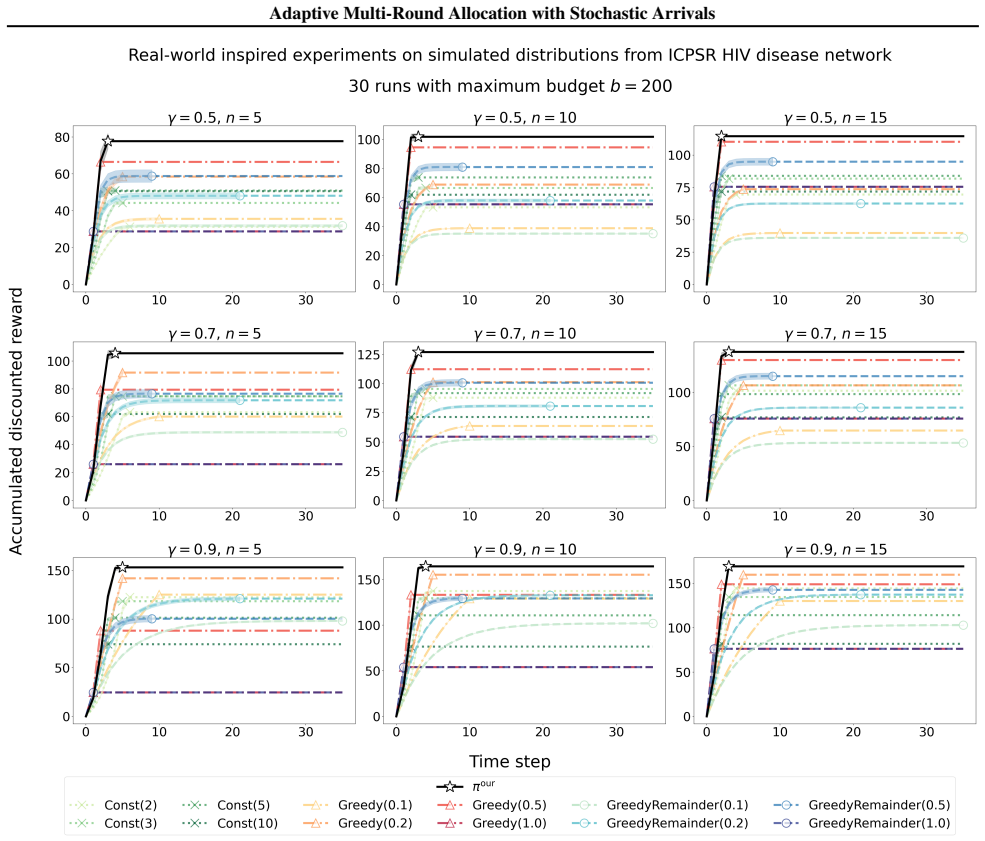
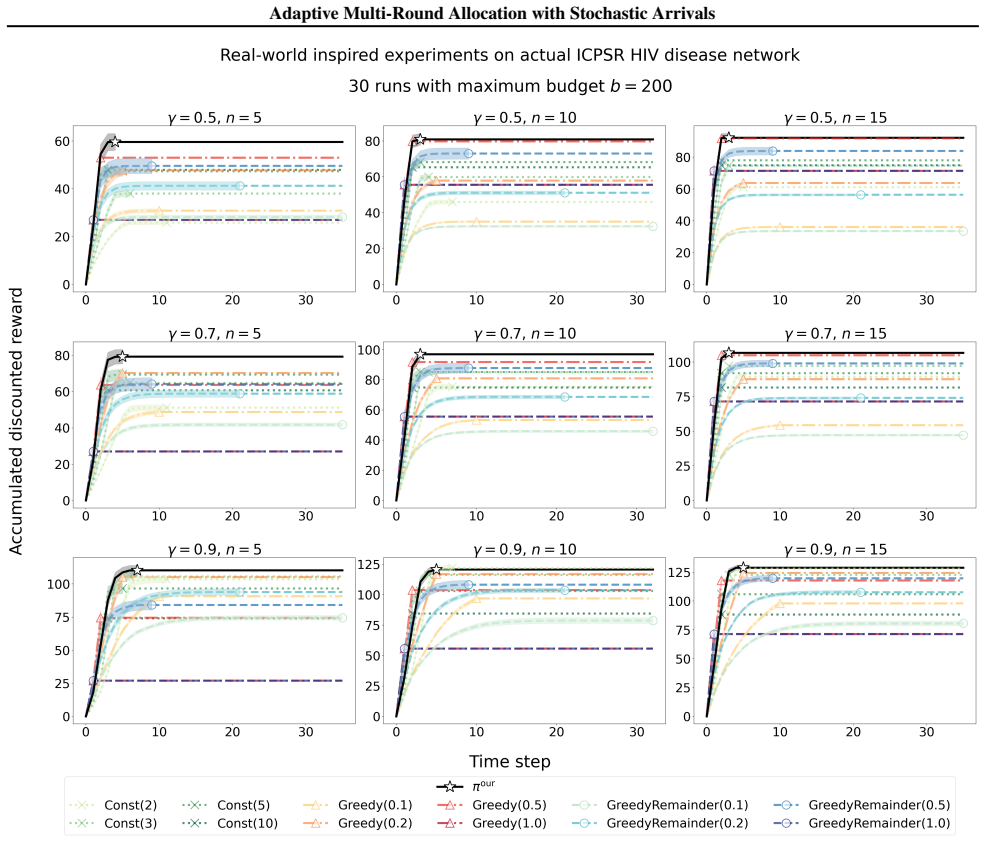
- The resulting algorithm can be evaluated directly on recruitment scenarios drawn from real-world data distributions.
Where Pith is reading between the lines
- The same surrogate reduction might apply to other sequential allocation settings that combine stochastic arrivals with diminishing returns per recipient.
- One could measure the surrogate's fidelity by running both the surrogate DP and a small-scale exact DP on identical instances and plotting the gap as budget grows.
- The polynomial dependence on budget suggests the method could scale to budgets large enough for practical network-recruitment campaigns where exact dynamic programming was previously impossible.
Load-bearing premise
The population-level surrogate that depends only on remaining budget and frontier size is a close enough approximation to the true value function even though the frontier evolves stochastically in high dimension.
What would settle it
Compute the exact Bellman values on small-budget instances where the full frontier state can be enumerated, then check whether the surrogate-based dynamic program produces values within the derived multi-round error bound.
Figures



read the original abstract
We study a sequential resource allocation problem motivated by adaptive network recruitment, in which a limited budget of identical resources must be allocated over multiple rounds to individuals with stochastic referral capacity. Successful referrals endogenously generate future decision opportunities while allocating additional resources to an individual exhibits diminishing returns. We first show that the single-round allocation problem admits an exact greedy solution based on marginal survival probabilities. In the multi-round setting, the resulting Bellman recursion is intractable due to the stochastic, high-dimensional evolution of the frontier. To address this, we introduce a population-level surrogate value function that depends only on the remaining budget and frontier size. This surrogate enables an exact dynamic program via truncated probability generating functions, yielding a planning algorithm with polynomial complexity in the total budget. We further analyze robustness under model misspecification, proving a multi-round error bound that decomposes into a tight single-round frontier error and a population-level transition error. Finally, we evaluate our method on real-world inspired recruitment scenarios.
Editorial analysis
A structured set of objections, weighed in public.
Referee Report
Summary. The manuscript studies a sequential resource allocation problem for adaptive network recruitment, where a fixed budget of identical resources is allocated over multiple rounds to individuals whose successful referrals stochastically generate new allocation opportunities, subject to diminishing returns. It shows that the single-round subproblem admits an exact greedy solution based on marginal survival probabilities. For the multi-round case, the Bellman recursion is intractable due to the high-dimensional stochastic frontier evolution; the authors introduce a population-level surrogate value function depending only on remaining budget B and frontier cardinality n. This surrogate is claimed to enable an exact dynamic program via truncated probability generating functions, producing a planning algorithm with polynomial complexity in the total budget. The paper further derives a multi-round error bound under model misspecification that decomposes into single-round frontier error plus population-level transition error, and reports numerical evaluation on real-world-inspired recruitment scenarios.
Significance. If the surrogate approximation is shown to be sufficiently accurate and the error bounds hold uniformly, the work would provide a useful algorithmic contribution to scalable planning in stochastic networked allocation problems. The polynomial dependence on budget (rather than frontier size or horizon) and the explicit error decomposition are technically attractive features that could extend to related domains such as viral marketing or epidemic control. The use of truncated PGFs for exact computation under the reduced state is a positive technical choice.
major comments (2)
- [Abstract and §4] Abstract and §4: The central claim that the population-level surrogate V(B, n) 'enables an exact dynamic program' and yields polynomial complexity rests on the unproven assertion that aggregation by frontier size alone preserves the Markov property and bounds transition error under heterogeneous referral distributions. The skeptic note correctly identifies that nothing in the given description rules out regimes where variance from distinct referral capacities makes the size statistic insufficient, which directly undermines the claimed multi-round error bound.
- [§5.1] §5.1, error-bound decomposition: The multi-round error bound is stated to separate cleanly into single-round frontier error plus population-level transition error, but the argument does not address possible correlations induced by the shared remaining budget across rounds or by the truncation of the PGF; without an explicit uniform bound on these terms, the decomposition does not yet guarantee that the surrogate policy remains near-optimal.
minor comments (3)
- [§6] The experimental section provides only high-level descriptions of the recruitment scenarios; specific parameter values, number of Monte Carlo replications, and statistical significance tests for the reported performance gaps are missing.
- Notation for the truncated PGF (e.g., the truncation threshold and the exact form of the generating function) is introduced without a self-contained definition in the main text, forcing the reader to infer details from the appendix.
- [§6] No comparison is reported against natural baselines such as myopic single-round greedy allocation or a fixed-horizon approximation that ignores future referrals entirely.
Simulated Author's Rebuttal
We thank the referee for their constructive and detailed comments. We address each major comment below, clarifying the technical status of the surrogate model and error analysis.
read point-by-point responses
-
Referee: [Abstract and §4] Abstract and §4: The central claim that the population-level surrogate V(B, n) 'enables an exact dynamic program' and yields polynomial complexity rests on the unproven assertion that aggregation by frontier size alone preserves the Markov property and bounds transition error under heterogeneous referral distributions. The skeptic note correctly identifies that nothing in the given description rules out regimes where variance from distinct referral capacities makes the size statistic insufficient, which directly undermines the claimed multi-round error bound.
Authors: The surrogate V(B, n) is defined as the optimal value function for an auxiliary population-level MDP whose state is exactly (remaining budget B, frontier cardinality n) and whose transitions are obtained by averaging the referral distribution over the current frontier. By construction, this auxiliary process is Markovian in (B, n). The dynamic program is therefore exact for the surrogate; the polynomial-time algorithm follows from the fact that the next-state distribution can be computed exactly via a truncated probability generating function whose size is linear in B. The multi-round error bound (Theorem 5.1) then measures the sub-optimality of the surrogate policy relative to the true heterogeneous process, with the population-level transition error term explicitly controlling the effect of heterogeneity. We agree that the manuscript would benefit from a clearer separation between the exact surrogate MDP and the approximation error; we will revise §4 to state the Markov property of the surrogate formally and to emphasize that the error bound, rather than exact optimality, is the guarantee provided under heterogeneity. revision: partial
-
Referee: [§5.1] §5.1, error-bound decomposition: The multi-round error bound is stated to separate cleanly into single-round frontier error plus population-level transition error, but the argument does not address possible correlations induced by the shared remaining budget across rounds or by the truncation of the PGF; without an explicit uniform bound on these terms, the decomposition does not yet guarantee that the surrogate policy remains near-optimal.
Authors: The proof in Appendix C proceeds by induction on the horizon, conditioning each one-step error on the realized remaining budget B_t at that round; because B_t is part of the surrogate state, the shared-budget dependence is already internalized. The resulting bound is taken uniformly over all feasible B by using the trivial Lipschitz constant equal to the maximum single-round reward. For PGF truncation we fix a threshold T such that the total-variation distance between the true and truncated transition kernels is at most ε; this ε is absorbed into the population-level transition error with an explicit multiplicative factor of 2 (from the triangle inequality in the value-function difference). We will add a short lemma in §5.1 that records this uniform bound over B and the explicit contribution of truncation error, thereby making the decomposition fully rigorous. revision: yes
Circularity Check
No circularity in surrogate DP construction or error bounds
full rationale
The derivation introduces an explicit population-level surrogate value function indexed only by remaining budget and frontier cardinality as a modeling approximation to the high-dimensional state; this surrogate then admits an exact (surrogate) DP via truncated PGFs, with polynomial complexity following directly from the reduced state space. The multi-round error bound is obtained by standard decomposition into single-round frontier error plus population-level transition error, without any reduction of the claimed result to a fitted parameter, self-referential definition, or load-bearing self-citation. The central claims remain self-contained against external benchmarks and do not collapse to their inputs by construction.
Axiom & Free-Parameter Ledger
axioms (2)
- domain assumption Stochastic referral arrivals with diminishing marginal returns on repeated allocations to the same individual
- ad hoc to paper Population-level summary (budget + frontier size) suffices to approximate the true value function
Reference graph
Works this paper leans on
-
[1]
Hilbe, Joseph M. , year=
- [2]
-
[3]
Dean, Brian C. and Goemans, Michel X. and Vondr. Mathematics of Operations Research , year=
-
[4]
Gupta, Anupam and Krishnaswamy, Ravishankar and Molinaro, Marco and Ravi, Ramamoorthi , booktitle=
-
[5]
Badanidiyuru, Ashwinkumar and Kleinberg, Robert and Slivkins, Aleksandrs , journal=
-
[6]
Samuel-Cahn, Ester , journal=
-
[7]
Krengel, Ulrich and Sucheston, Louis , journal=
-
[8]
Kleinberg, Robert and Weinberg, Seth Matthew , booktitle=
-
[9]
Hajiaghayi, Mohammad Taghi and Kleinberg, Robert and Sandholm, Tuomas , booktitle=
-
[10]
Conference on Economics and Computation (EC) , year=
D. Conference on Economics and Computation (EC) , year=
-
[11]
Altman, Eitan , year=
-
[12]
Puterman, Martin L. , year=
- [13]
-
[14]
Bertsekas, Dimitri P. , year=
-
[15]
Powell, Warren B. , year=
-
[16]
Morris, Martina and Rothenberg, Richard , journal=. 2011 , publisher=
work page 2011
- [17]
- [18]
-
[19]
Munzert, Simon and Selb, Peter and Gohdes, Anita and Stoetzer, Lukas F. and Lowe, Will , journal=
-
[20]
Newman, M. E. J. , journal=
- [21]
-
[22]
Journal of Machine Learning Research (JMLR) , year=
Munos, R. Journal of Machine Learning Research (JMLR) , year=
-
[23]
Meuleau, Nicolas and Hauskrecht, Milos and Kim, Kee-Eung and Peshkin, Leonid and Kaelbling, Leslie Pack and Dean, Thomas and Boutilier, Craig , booktitle=
-
[24]
Boutilier, Craig and Lu, Tyler , booktitle=
-
[25]
Dolgov, Dmitri and Durfee, Edmund , booktitle=
-
[26]
Carrara, Nicolas and Leurent, Edouard and Laroche, Romain and Urvoy, Tanguy and Maillard, Odalric-Ambrym and Pietquin, Olivier , booktitle=
-
[27]
Etessami, Kousha and Stewart, Alistair and Yannakakis, Mihalis , journal=
- [28]
-
[29]
and Schapire, Robert and Slivkins, Aleksandrs , journal=
Immorlica, Nicole and Sankararaman, Karthik A. and Schapire, Robert and Slivkins, Aleksandrs , journal=
-
[30]
Kesselheim, Thomas and Singla, Sahil , booktitle=
-
[31]
Kumar, Raunak and Kleinberg, Robert , booktitle=
-
[32]
Clauset, Aaron and Shalizi, Cosma Rohilla and Newman, M. E. J. , journal=
-
[33]
Caldarelli, Guido , year=
- [34]
-
[35]
and Sonnenberg, Pam and Hayes, Richard J
McCreesh, Nicky and Copas, Andrew and Seeley, Janet and Johnston, Lisa G. and Sonnenberg, Pam and Hayes, Richard J. and Frost, Simon D. W. and White, Richard G. , journal=. 2013 , publisher=
work page 2013
- [36]
-
[37]
Truong, Hong-Ha M. and Fatch, Robin and Ogolla, David and Otieno, Beatrice and Amboka, Sayo and Kadede, Kevin and Cohen, Craig R. and Bukusi, Elizabeth A. and Guz. Annals of epidemiology , volume=. 2023 , publisher=
work page 2023
-
[38]
Wang, Wei and Sun, Guangsheng and Li, Chen and Qiu, Cunxi and Fan, Junyi and Jin, Yuhan , journal=. 2025 , publisher=
work page 2025
discussion (0)
Sign in with ORCID, Apple, or X to comment. Anyone can read and Pith papers without signing in.