Recognition: no theorem link
A Deep Learning-based Receiver for Asynchronous Grant-Free Random Access in Control-to-Control Networks
Pith reviewed 2026-05-13 04:06 UTC · model grok-4.3
The pith
A single convolutional neural network detects the boundaries of overlapping asynchronous command units in grant-free wireless control networks.
A machine-rendered reading of the paper's core claim, the machinery that carries it, and where it could break.
Core claim
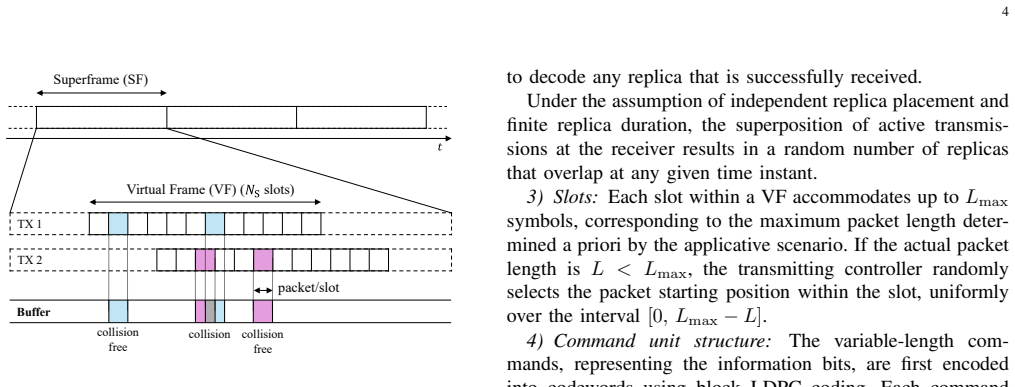
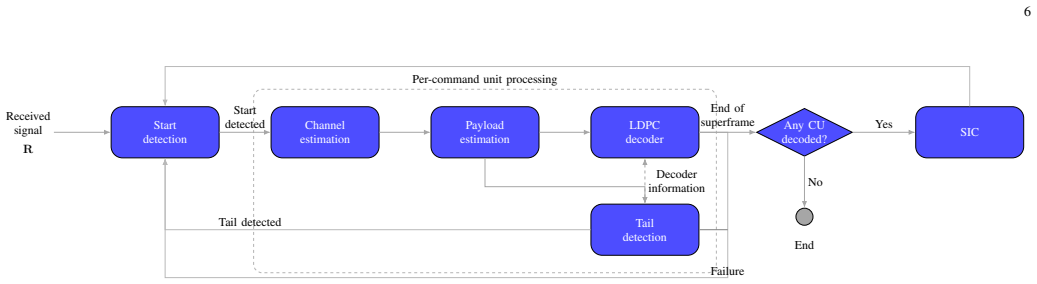
In grant-free asynchronous C2C communications, each node transmits replicas of a command unit consisting of a start sequence, LDPC-coded payload, and tail sequence, resulting in time-overlapped superpositions at the receiver. The proposed architecture uses one CNN operating directly on the received signal to detect command-unit boundaries. Start-sequence detection relies solely on the waveform, whereas tail-sequence detection additionally exploits soft information produced by the LDPC decoder together with channel estimates. After successful decoding, successive interference cancellation is applied to the recovered command units.
What carries the argument
A single convolutional neural network that identifies start and tail sequences of LDPC-coded command units by processing the received signal directly, with tail detection enhanced by LDPC decoder soft outputs and channel estimates.
If this is right
- The CNN enables reliable identification of packet boundaries despite asynchronous overlaps and signal superpositions.
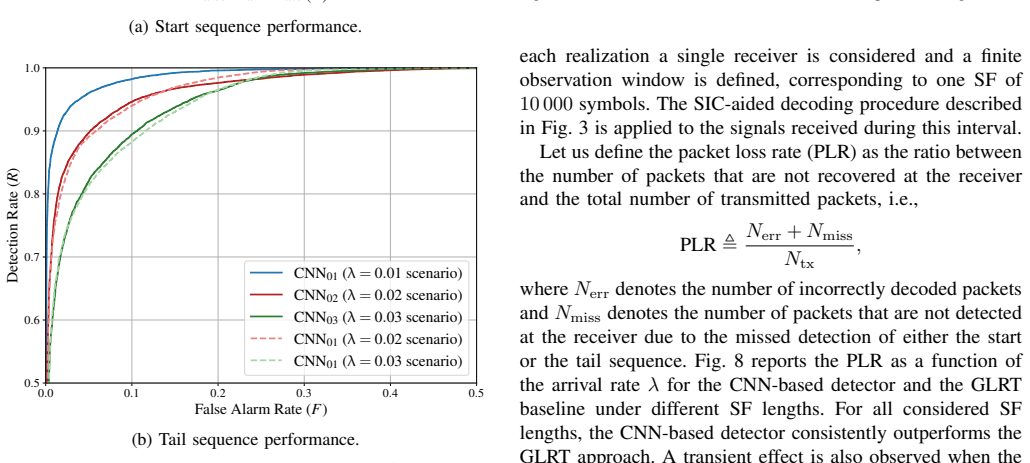
- Tail-sequence detection benefits from LDPC decoder feedback to improve accuracy over waveform-only detection.
- Successful decoding of command units permits successive interference cancellation to reduce the impact of remaining transmissions.
- The approach supports variable-length payloads and replica transmissions while maintaining low end-to-end packet loss under high-traffic uncoordinated conditions.
Where Pith is reading between the lines
- The method could shorten response times in industrial control loops by removing the need for prior scheduling grants.
- Similar CNN-based boundary detection might be tested on other grant-free protocols that use preamble and postamble markers.
- Hardware trials would reveal whether training-data mismatch or real hardware impairments degrade performance beyond simulation predictions.
Load-bearing premise
The indoor wireless channel model, asynchronous overlaps, and noise used in training and testing the CNN accurately represent real-world conditions, and the network trained on simulated data generalizes to actual hardware.
What would settle it
Deploy the receiver on real indoor wireless hardware with multiple uncoordinated transmitters sending overlapping command units at high load and measure whether the observed boundary detection accuracy and end-to-end packet loss rate match the reported simulation results.
Figures




read the original abstract
In this paper, we study grant-free, asynchronous control-to-control (C2C) communications in an indoor scenario with a shared wireless channel. Each communication node transmits command units, each consisting of a variable-length low-density parity-check (LDPC)--coded payload preceded by a start sequence and followed by a tail sequence. Due to the asynchronous nature of the access, transmissions from different nodes are not aligned over time. As a result, each receiving controller observes the superposition of multiple command units transmitted by different nodes over a receiver-defined superframe interval. Each node transmits one or more replicas of the same command unit. We propose a receiver architecture in which the detection of command unit boundaries (start/tail sequences) is carried out by a single convolutional neural network (CNN) operating directly on the received signal. We show that, while start-sequence detection must rely only on the received waveform, tail-sequence detection can additionally exploit the soft information produced by the LDPC decoder, together with channel estimates. Finally, once commands units are successfully decoded, successive interference cancellation (SIC) can be applied. Simulation results demonstrate that the receiver we propose achieves reliable packet-boundary identification and a low end-to-end packet loss rate, even under uncoordinated and high-traffic operating conditions.
Editorial analysis
A structured set of objections, weighed in public.
Referee Report
Summary. The manuscript proposes a CNN-based receiver for asynchronous grant-free random access in indoor control-to-control networks. Command units consist of start sequences, variable-length LDPC-coded payloads, and tail sequences; nodes transmit replicas asynchronously, leading to superpositions at the receiver. A single CNN detects boundaries directly from the waveform, tail detection additionally uses LDPC soft outputs and channel estimates, and SIC is applied after decoding. Simulations are reported to show reliable start/tail identification and low end-to-end packet loss even under high uncoordinated traffic.
Significance. If the simulation results prove robust, the architecture offers a practical way to manage asynchronous overlaps in grant-free C2C systems without explicit coordination, potentially benefiting industrial wireless control. The design choice of a unified CNN for boundary detection combined with conventional LDPC/SIC elements is a constructive contribution. However, the significance is constrained by the absence of hardware validation and limited reproducibility details.
major comments (3)
- [Simulation Results] The central performance claims (reliable boundary detection and low packet loss) rest entirely on simulation results, yet the manuscript provides no error bars, number of Monte Carlo trials, or statistical significance measures for the reported packet-loss rates under varying traffic loads.
- [Receiver Architecture] Details on the CNN architecture (number of layers, kernel sizes, activation functions, training hyperparameters) and the exact procedure for generating the training dataset (modeling of asynchronous overlaps, multipath profiles, and noise) are insufficient to allow reproduction or independent verification of the claimed generalization.
- [Channel and Signal Model] The indoor channel model, timing-offset distributions, and overlap statistics are not compared against hardware measurements or established measurement campaigns; any mismatch would directly undermine the transferability of the reported end-to-end packet-loss performance.
minor comments (2)
- [Abstract] The abstract states that tail detection exploits LDPC soft outputs, but the precise interface between the CNN output, channel estimates, and the decoder soft information is not formalized with equations.
- [System Model] Notation for the superframe duration, replica count, and command-unit length variability would benefit from an accompanying diagram or explicit definitions in the system model.
Simulated Author's Rebuttal
We thank the referee for the thorough review and valuable feedback on our manuscript. We address each major comment below and outline the revisions we will incorporate to strengthen the paper.
read point-by-point responses
-
Referee: [Simulation Results] The central performance claims (reliable boundary detection and low packet loss) rest entirely on simulation results, yet the manuscript provides no error bars, number of Monte Carlo trials, or statistical significance measures for the reported packet-loss rates under varying traffic loads.
Authors: We agree that statistical measures are important for assessing the reliability of the simulation results. In the revised manuscript, we will explicitly state the number of Monte Carlo trials used for each data point (typically on the order of 10,000–100,000 realizations, depending on the traffic load) and include error bars or 95% confidence intervals on the packet-loss curves. This addition will allow readers to evaluate the variability and statistical significance of the reported performance. revision: yes
-
Referee: [Receiver Architecture] Details on the CNN architecture (number of layers, kernel sizes, activation functions, training hyperparameters) and the exact procedure for generating the training dataset (modeling of asynchronous overlaps, multipath profiles, and noise) are insufficient to allow reproduction or independent verification of the claimed generalization.
Authors: We acknowledge that the current level of detail is insufficient for full reproducibility. We will add a new subsection in the revised manuscript that fully specifies the CNN architecture, including the number of convolutional layers, kernel sizes, stride values, activation functions (ReLU for hidden layers and sigmoid for the output), pooling operations, and training hyperparameters such as optimizer, learning rate schedule, batch size, and number of epochs. We will also describe the training dataset generation procedure in detail, including how asynchronous overlaps are modeled (random timing offsets and replica counts), the specific multipath profiles and power delay profiles employed, and the additive noise model with SNR ranges. revision: yes
-
Referee: [Channel and Signal Model] The indoor channel model, timing-offset distributions, and overlap statistics are not compared against hardware measurements or established measurement campaigns; any mismatch would directly undermine the transferability of the reported end-to-end packet-loss performance.
Authors: We recognize the value of grounding the simulation assumptions in real-world data. While a dedicated hardware measurement campaign lies outside the scope of this theoretical and simulation-based study, we will revise the channel-model section to explicitly reference established indoor measurement campaigns (e.g., IEEE 802.11 TGn and industrial wireless sensor network studies) that support the chosen power-delay profiles and path-loss exponents. We will also clarify that timing offsets are drawn uniformly over one symbol duration and that overlap statistics follow from the Poisson-arrival grant-free model, with a brief discussion of how these choices align with reported indoor C2C traffic patterns in the literature. revision: partial
Circularity Check
No circularity; performance claims rest on independent simulation evaluation
full rationale
The paper describes a receiver architecture using a single CNN operating on the raw received waveform for start/tail sequence detection in asynchronous superpositions of LDPC-coded packets, with tail detection additionally using decoder soft outputs and channel estimates, followed by SIC. The central result is an empirical claim that simulations under uncoordinated high-traffic conditions yield reliable boundary identification and low end-to-end packet loss. No equations, fitted parameters, or predictions are presented that reduce by construction to the inputs or to self-citations; the architecture and evaluation are described directly without self-definitional loops or renamed known results. Any self-citations (e.g., on LDPC or SIC) are not load-bearing for the novelty or performance assertions, which remain falsifiable via the described simulation setup.
Axiom & Free-Parameter Ledger
axioms (1)
- domain assumption Indoor wireless channel and noise follow standard statistical models used in simulations
Reference graph
Works this paper leans on
-
[1]
G. Aceto, V . Persico, and A. Pescap ´e, “A survey on information and communication technologies for industry 4.0: state-of-the-art, tax- onomies, perspectives, and challenges,”IEEE Commun. Surveys Tuts., vol. 21, no. 4, pp. 3467–3501, Dec. 2019
work page 2019
-
[2]
Research directions and modeling guidelines for industrial Internet of Things applications,
G. Cuozzo, E. Testi, S. Riolo, L. Miuccio, G. Cena, G. Pasolini, L. De Nardis, D. Panno, M. Chiani, M.-G. Di Benedetto, E. Buracchini, and R. Verdone, “Research directions and modeling guidelines for industrial Internet of Things applications,”IEEE Commun. Standards Mag., vol. 9, no. 3, pp. 94–103, Sep. 2025
work page 2025
-
[3]
TR 22.804 V16.3.0: Study on communication for automation in vertical domains (Release 16),
3rd Generation Partnership Project (3GPP), “TR 22.804 V16.3.0: Study on communication for automation in vertical domains (Release 16),” 3GPP, Technical Report TR 22.804 V16.3.0, Jul. 2020, available: https: //www.3gpp.org/ftp/Specs/archive/22 series/22.804/22804-g30.zip
work page 2020
-
[4]
5G for Industrial Internet of Things (IIoT): capabilities, features, and potential,
5G-ACIA, “5G for Industrial Internet of Things (IIoT): capabilities, features, and potential,” ZVEI – German Electrical and Electronic Manufacturers’ Association, Frankfurt, Germany, Tech. Rep., Oct. 2021
work page 2021
-
[5]
Grant-free random access in machine-type communication: Approaches and challenges,
J. Choi, J. Ding, N.-P. Le, and Z. Ding, “Grant-free random access in machine-type communication: Approaches and challenges,”IEEE Wireless Commun., vol. 29, no. 1, pp. 151–158, Feb. 2022
work page 2022
-
[6]
Unsourced multiple access: A coding paradigm for massive random access,
G. Liva and Y . Polyanskiy, “Unsourced multiple access: A coding paradigm for massive random access,”Proc. IEEE, vol. 112, no. 9, pp. 1214–1229, Sep. 2024
work page 2024
-
[7]
Asynchronous contention resolution diversity ALOHA: making CRDSA truly asynchronous,
R. De Gaudenzi, O. Del R ´ıo Herrero, G. Acar, and E. Gar- rido Barrab ´es, “Asynchronous contention resolution diversity ALOHA: making CRDSA truly asynchronous,”IEEE Trans. Wireless Commun., vol. 13, no. 11, pp. 6193–6206, Nov. 2014
work page 2014
-
[8]
Grant-free radio access for short-packet communications over 5G networks,
A. Azari, P. Popovski, G. Miao, and C. Stefanovic, “Grant-free radio access for short-packet communications over 5G networks,” inProc. 2017 IEEE Global Commun. Conf., Singapore, Dec. 2017
work page 2017
-
[9]
Coded slotted ALOHA: a graph- based method for uncoordinated multiple access,
E. Paolini, G. Liva, and M. Chiani, “Coded slotted ALOHA: a graph- based method for uncoordinated multiple access,”IEEE Trans. Inf. Theory, vol. 61, no. 12, pp. 6815–6832, Dec. 2015
work page 2015
-
[10]
Autonomous D2D transmission scheme in URLLC for real-time wireless control systems,
B. Chang, L. Li, G. Zhao, Z. Chen, and M. A. Imran, “Autonomous D2D transmission scheme in URLLC for real-time wireless control systems,” IEEE Trans. Commun., vol. 69, no. 8, pp. 5546–5558, Aug. 2021
work page 2021
-
[11]
MAC for machine-type communications in industrial IoT—Part I: Protocol design and analysis,
J. Gao, W. Zhuang, M. Li, X. Shen, and X. Li, “MAC for machine-type communications in industrial IoT—Part I: Protocol design and analysis,” IEEE Internet Things J., vol. 8, no. 12, pp. 9945–9957, Jun. 2021
work page 2021
-
[12]
An asynchronous high-throughput random access protocol for low power wide area networks,
V . Almonacid and L. Franck, “An asynchronous high-throughput random access protocol for low power wide area networks,” inProc. 2017 IEEE Int. Conf. Commun., Paris, France, May 2017
work page 2017
-
[13]
Energy-efficient and reliable IoT access without radio resource reservation,
A. Azari, ˇC. Stefanovi ´c, P. Popovski, and C. Cavdar, “Energy-efficient and reliable IoT access without radio resource reservation,”IEEE Trans. Green Commun. Netw., vol. 5, no. 2, pp. 908–920, Jun. 2021
work page 2021
-
[14]
Y . Hu, H. Jin, and J.-B. Seo, “Asynchronous random access systems with immediate collision resolution for low power wide area networks,” IEEE Trans. Veh. Technol., vol. 73, no. 2, pp. 2755–2770, Feb. 2024
work page 2024
-
[15]
Deep-learned approximate message passing for asynchronous massive connectivity,
W. Zhu, M. Tao, X. Yuan, and Y . Guan, “Deep-learned approximate message passing for asynchronous massive connectivity,”IEEE Trans. Wireless Commun., vol. 20, no. 8, pp. 5434–5448, Aug. 2021
work page 2021
-
[16]
Enabling LP- W AN massive access: Grant-free random access with massive MIMO,
H. Jiang, D. Qu, J. Ding, Z. Wang, H. He, and H. Chen, “Enabling LP- W AN massive access: Grant-free random access with massive MIMO,” IEEE Wireless Commun., vol. 29, no. 4, pp. 72–77, Aug. 2022
work page 2022
-
[17]
Coded random access design for constrained outage,
M. Ebrahimi, F. Lahouti, and V . Kostina, “Coded random access design for constrained outage,” inProc. 2017 IEEE Int. Symp. Inf. Theory, Aachen, Germany, Jun. 2017, pp. 2732–2736
work page 2017
-
[18]
Deep learning-based activity detection for grant-free random access,
J. H. I. de Souza and T. Abr ˜ao, “Deep learning-based activity detection for grant-free random access,”IEEE Syst. J., vol. 17, no. 1, pp. 940–951, Mar. 2023
work page 2023
-
[19]
Preamble detection in asynchronous random access using deep learning,
M. U. Khan, E. Testi, E. Paolini, and M. Chiani, “Preamble detection in asynchronous random access using deep learning,”IEEE Wireless Commun. Lett., vol. 13, no. 2, pp. 279–283, Feb. 2024
work page 2024
-
[20]
Deep learning for replica detection and combining in asynchronous grant-free mMTC,
D. De Crescenzo, E. Testi, and E. Paolini, “Deep learning for replica detection and combining in asynchronous grant-free mMTC,”IEEE Wireless Commun. Lett., vol. 15, pp. 225–229, Oct. 2025
work page 2025
-
[21]
A perspective on massive random-access,
Y . Polyanskiy, “A perspective on massive random-access,” inProc. 2017 IEEE Int. Symp. Inf. Theory, Aachen, Germany, Jun. 2017, pp. 2523– 2527
work page 2017
-
[22]
Washington, DC, USA: CCSDS, Jul
Consultative Committee for Space Data Systems,TC Synchronization and Channel Coding. Washington, DC, USA: CCSDS, Jul. 2021, Blue Book CCSDS 231.0-B-4
work page 2021
-
[23]
On sequential frame synchronization in AWGN channels,
M. Chiani and M. G. Martini, “On sequential frame synchronization in AWGN channels,”IEEE Trans. Commun., vol. 54, no. 2, pp. 339–348, Feb. 2006
work page 2006
-
[24]
R. Giuliani, M. Battaglioni, M. Baldi, F. Chiaraluce, and N. Maturo, “Telecommand rejection probability in CCSDS-compliant LDPC-coded space transmissions with tail sequence,”IEEE Access, vol. 13, pp. 8924– 8940, Jan. 2025
work page 2025
-
[25]
Machine learning-based tail sequence detection in LDPC-coded space transmis- sions,
M. Battaglioni, R. Giuliani, F. Chiaraluce, and M. Baldi, “Machine learning-based tail sequence detection in LDPC-coded space transmis- sions,” inProc. 2025 IEEE Wireless Commun. Netw. Conf., Milan, Italy, Mar. 2025
work page 2025
-
[26]
M. Battaglioni, E. Carnevali, D. De Crescenzo, E. Testi, and E. Paolini, “Boundary detection via deep learning for grant-free asynchronous random access in control-to-control industrial networks,” inProc. 2025 IEEE Conf. Standards Commun. Netw., Bologna, Italy, Sep. 2025
work page 2025
-
[27]
E. Casini, R. De Gaudenzi, and O. Del R ´ıo Herrero, “Contention reso- lution diversity slotted ALOHA (CRDSA): an enhanced random access scheme for satellite access packet networks,”IEEE Trans. Wireless Commun., vol. 6, no. 4, pp. 1408–1419, Apr. 2007
work page 2007
-
[28]
Density evolution for BP-based decoding algorithms of LDPC codes and their quantized versions,
J. Chen and P. M. C. Fossorier, “Density evolution for BP-based decoding algorithms of LDPC codes and their quantized versions,” in Proc. 2002 IEEE Global Telecommun. Conf., Taipei, Taiwan, Nov. 2002, pp. 1378–1382
work page 2002
-
[29]
R. E. Blahut,Algebraic Codes for Data Transmission. Cambridge, U.K.: Cambridge Univ. Press, 2003
work page 2003
-
[30]
Design and analysis of the tail sequence for short LDPC- coded space communications,
M. Battaglioni, K. Andrews, R. Giuliani, F. Marinelli, F. Chiaraluce, and M. Baldi, “Design and analysis of the tail sequence for short LDPC- coded space communications,”IEEE Trans. Aerosp. Electron. Syst., vol. 61, no. 6, pp. 16 938–16 952, Dec. 2025
work page 2025
-
[31]
I. Goodfellow, Y . Bengio, and A. Courville,Deep Learning. MIT Press, 2016, http://www.deeplearningbook.org
work page 2016
discussion (0)
Sign in with ORCID, Apple, or X to comment. Anyone can read and Pith papers without signing in.