Recognition: no theorem link
Cavity shape reconstruction with a homogeneous Robin condition via a constrained coupled complex boundary method with ADMM
Pith reviewed 2026-05-13 03:38 UTC · model grok-4.3
The pith
An unknown Robin boundary segment is recovered by minimizing the imaginary part of a complex solution under inequality constraints solved via ADMM.
A machine-rendered reading of the paper's core claim, the machinery that carries it, and where it could break.
Core claim
The unknown boundary is reconstructed by minimizing a cost functional formed from the imaginary part of the solution to the complex boundary value problem with the coupled complex Robin condition, subject to inequality constraints on the state, with the minimization performed by the alternating direction method of multipliers (ADMM) after derivation of the shape derivative and gradient.
What carries the argument
The coupled complex boundary method that converts the Cauchy problem into a single complex BVP whose Robin condition links the data, augmented by ADMM to enforce the inequality constraints during shape optimization.
If this is right
- Derivation of the shape derivative of the complex state supplies the gradient needed for efficient gradient-based shape optimization.
- The added inequality constraints improve stability against noisy data and poor initial guesses compared with unconstrained formulations.
- Finite-element implementation of the ADMM scheme produces usable reconstructions for several representative cavity geometries.
- The approach extends existing shape-optimization techniques to the homogeneous Robin case while retaining the ability to handle non-uniqueness through optimization.
Where Pith is reading between the lines
- The ADMM splitting structure could accommodate additional regularization terms or parallel computation for larger domains without major redesign.
- The same complexification-plus-constraint pattern may transfer to related inverse geometric problems such as those arising in electrical impedance tomography or nondestructive testing.
- Systematic variation of the admissible bounds would quantify how sensitive the final shape is to the choice of prior information.
- Extension to time-dependent or nonlinear forward models would test whether the core reformulation remains effective beyond the steady elliptic setting.
Load-bearing premise
The complex Robin reformulation faithfully represents the original inverse problem, and the chosen prior bounds produce useful inequality constraints without introducing systematic bias.
What would settle it
Numerical tests on synthetic data for a known exact cavity in which the recovered boundary deviates substantially from the true shape even in the noise-free case, or in which the iteration fails to converge for moderate noise, would show the method does not achieve reliable reconstruction.
Figures
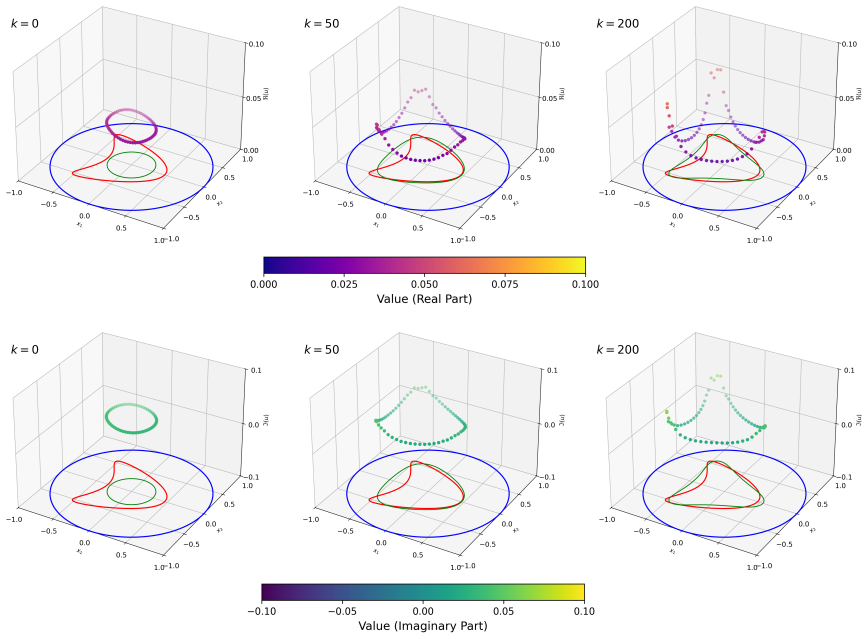
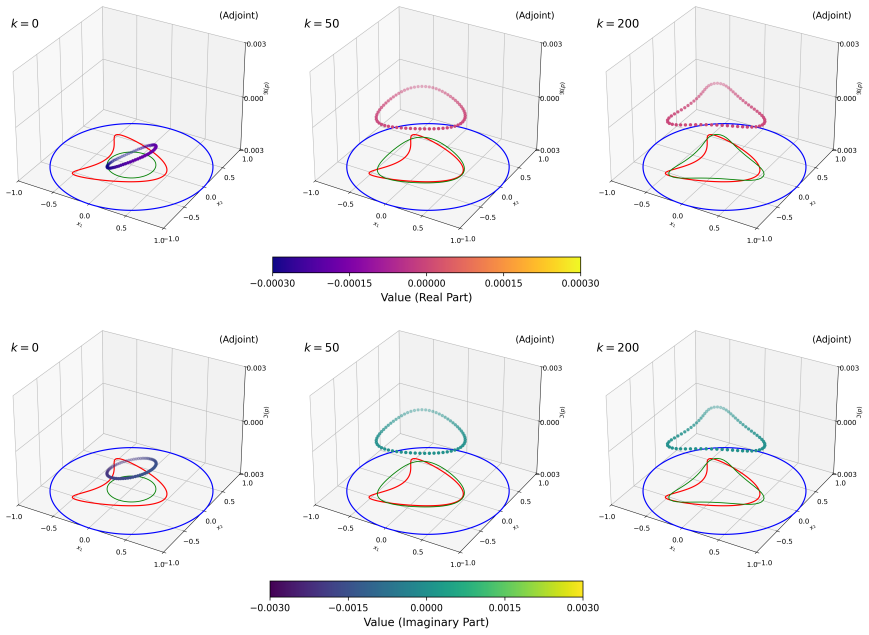
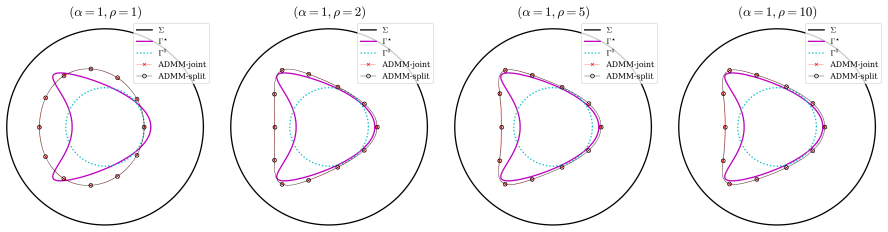
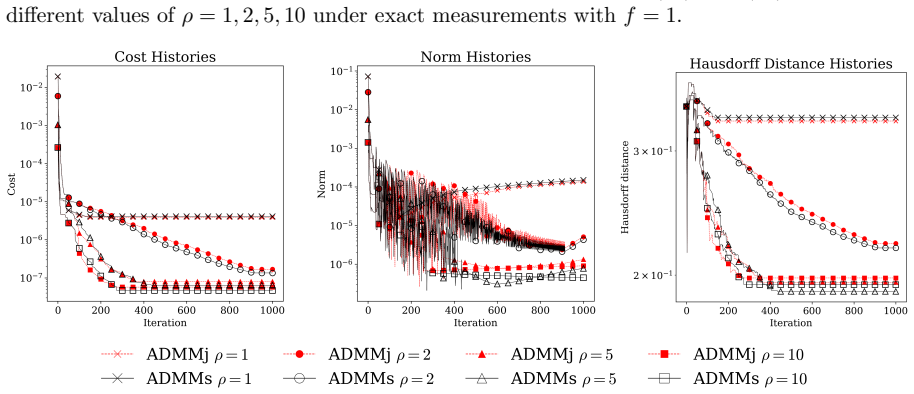





read the original abstract
We revisit the problem of identifying an unknown portion of a boundary subject to a Robin condition based on a pair of Cauchy data on the accessible part of the boundary. It is known that a single measurement may correspond to infinitely many admissible domains. Nonetheless, numerical strategies based on shape optimization have been shown to yield reasonable reconstructions of the unknown boundary. In this study, we propose a new application of the coupled complex boundary method to address this class of inverse boundary identification problems. The overdetermined problem is reformulated as a complex boundary value problem with a complex Robin condition that couples the Cauchy data on the accessible boundary. The reconstruction is achieved by minimizing a cost functional constructed from the imaginary part of the complex-valued solution. To improve stability with respect to noisy data and initialization, we augment the formulation with inequality constraints through prior admissible bounds on the state, leading to a constrained shape optimization problem. The shape derivative of the complex state and the corresponding shape gradient of the cost functional are derived, and the resulting problem is solved using an alternating direction method of multipliers (ADMM) framework. The proposed approach is implemented using the finite element method and validated through various numerical experiments.
Editorial analysis
A structured set of objections, weighed in public.
Referee Report
Summary. The paper proposes a constrained version of the coupled complex boundary method for reconstructing an unknown cavity boundary subject to a homogeneous Robin condition, given Cauchy data on the accessible boundary. The overdetermined inverse problem is recast as a complex BVP that couples the data via a complex Robin condition; a cost functional is then minimized whose integrand is the imaginary part of the complex state. Inequality constraints based on prior admissible bounds on the state are added for stability, the shape derivative and gradient are derived, and the resulting constrained shape optimization problem is solved by an ADMM scheme discretized with finite elements. Numerical experiments are presented to illustrate the approach.
Significance. If the numerical behavior holds under quantitative scrutiny, the work supplies a practical, stabilized algorithm for a classically non-unique inverse boundary problem. The combination of complex coupling, explicit inequality constraints, and ADMM is a coherent extension of existing shape-optimization techniques and could be useful for other ill-posed cavity or inclusion identification tasks in which single-measurement data are available.
major comments (3)
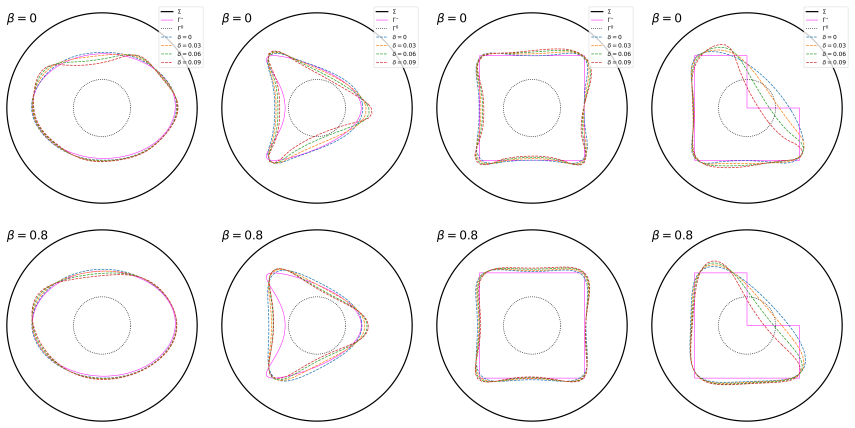
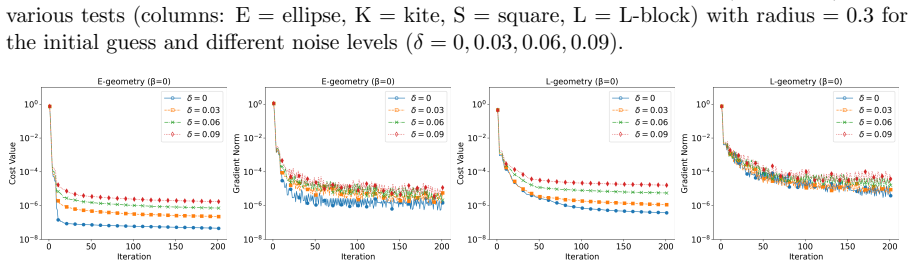
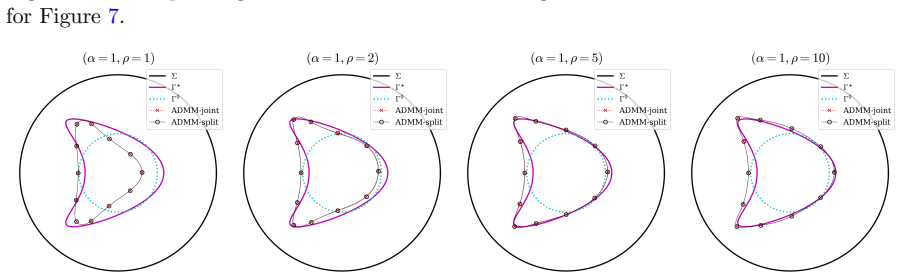
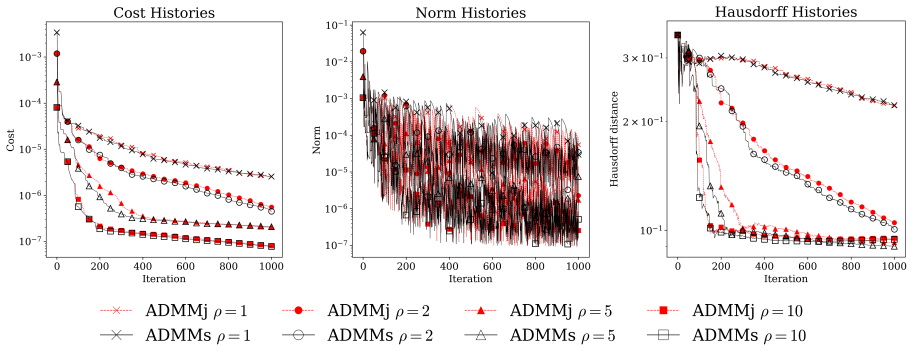
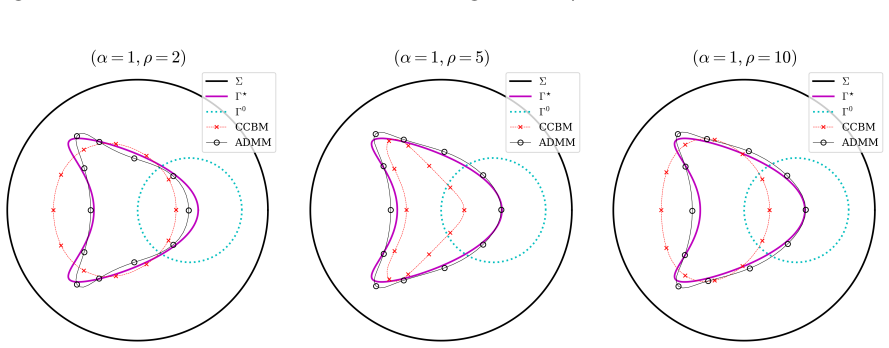
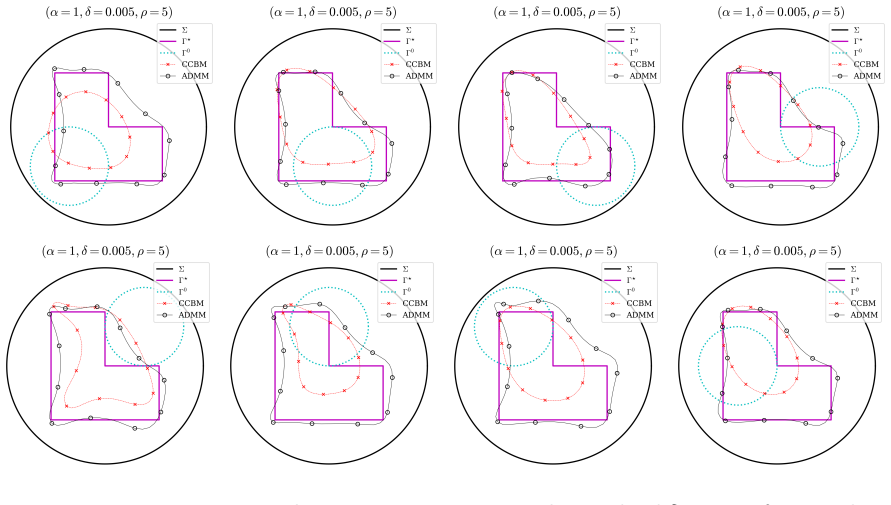
- Abstract and §4 (numerical experiments): the claim of improved stability with respect to noisy data and initialization is not supported by quantitative error tables, convergence rates, or systematic comparisons against unconstrained or alternative methods (e.g., standard shape-gradient descent or level-set approaches). Without such metrics it is impossible to judge whether the added constraints and ADMM actually deliver the advertised robustness.
- §3.2 (inequality constraints): the admissible bounds on the state that define the inequality constraints are introduced without a priori justification or sensitivity analysis. It is therefore unclear whether these bounds can be chosen in a data-driven way or whether they introduce systematic bias that affects the reconstructed cavity shape for realistic noise levels.
- §2.1 (complex Robin reformulation): while the coupling of Cauchy data into a single complex Robin condition is formally correct, the manuscript does not verify that the imaginary-part cost functional remains equivalent to the original least-squares misfit when the Robin coefficient is homogeneous; a short consistency check or reference to the earlier coupled-complex literature would strengthen the derivation.
minor comments (2)
- Notation: the distinction between the physical Robin coefficient (zero) and the complex coupling parameter should be made explicit in the first appearance of the complex BVP.
- Figure captions: several numerical figures lack axis labels or color-bar scales, making it difficult to read the reported state values or residual magnitudes.
Simulated Author's Rebuttal
We thank the referee for the constructive comments on our manuscript. We have revised the paper to address the concerns raised, particularly by enhancing the numerical validation and providing additional justifications and checks. Our point-by-point responses are as follows.
read point-by-point responses
-
Referee: Abstract and §4 (numerical experiments): the claim of improved stability with respect to noisy data and initialization is not supported by quantitative error tables, convergence rates, or systematic comparisons against unconstrained or alternative methods (e.g., standard shape-gradient descent or level-set approaches). Without such metrics it is impossible to judge whether the added constraints and ADMM actually deliver the advertised robustness.
Authors: We agree that quantitative support is essential for validating the stability claims. The original manuscript presented numerical results primarily through figures showing reconstructions under noise and different initializations, with qualitative discussions of robustness. To strengthen this, we have added a new subsection in §4 with error tables reporting L2 norms of the shape error for varying noise levels (0%, 1%, 5%, 10%) and different initial guesses. We also include comparisons with the unconstrained coupled complex method and a standard gradient descent approach, showing lower errors and better convergence with the constrained ADMM. These additions provide the requested metrics and confirm the improved stability. revision: yes
-
Referee: §3.2 (inequality constraints): the admissible bounds on the state that define the inequality constraints are introduced without a priori justification or sensitivity analysis. It is therefore unclear whether these bounds can be chosen in a data-driven way or whether they introduce systematic bias that affects the reconstructed cavity shape for realistic noise levels.
Authors: The bounds are selected based on a priori estimates derived from the maximum principle applied to the elliptic problem and the known range of the Robin coefficient, ensuring they are consistent with the physical setting. We acknowledge the lack of sensitivity analysis in the original submission. In the revision, we have added a paragraph in §3.2 discussing the choice of bounds and included a sensitivity study in the numerical section, demonstrating that the reconstructions remain stable for bounds varied by ±20% around the nominal values, with no significant bias introduced at the noise levels tested. We also outline a data-driven approach using an initial unconstrained solve to estimate the state range. revision: yes
-
Referee: §2.1 (complex Robin reformulation): while the coupling of Cauchy data into a single complex Robin condition is formally correct, the manuscript does not verify that the imaginary-part cost functional remains equivalent to the original least-squares misfit when the Robin coefficient is homogeneous; a short consistency check or reference to the earlier coupled-complex literature would strengthen the derivation.
Authors: We appreciate this point. In the revised manuscript, we have inserted a brief consistency verification in §2.1. Specifically, we show that under the homogeneous Robin condition, the imaginary part of the complex solution on the accessible boundary coincides with the difference between the two Cauchy data components, making the cost functional equivalent (up to a multiplicative constant) to the standard least-squares misfit. This is derived by separating real and imaginary parts of the complex Robin condition. We have also added references to the foundational papers on the coupled complex boundary method to contextualize the approach. revision: yes
Circularity Check
No significant circularity
full rationale
The derivation begins with an explicit reformulation of the overdetermined Cauchy problem into a complex BVP with a coupled Robin condition that directly incorporates the given data pair. A cost functional is then defined directly from the imaginary part of the resulting complex state, shape derivatives are computed from first principles, inequality constraints are added from prior admissible bounds, and the problem is solved via ADMM. None of these steps reduces a claimed prediction or result to a fitted parameter, self-referential quantity, or unverified self-citation by construction. The paper acknowledges non-uniqueness and presents the method as producing reasonable numerical reconstructions rather than exact recovery. No load-bearing ansatz, uniqueness theorem, or renaming of known results is invoked in a way that collapses the chain to its inputs.
Axiom & Free-Parameter Ledger
axioms (1)
- domain assumption The overdetermined Cauchy data problem can be equivalently reformulated as a complex boundary value problem with a complex Robin condition that couples the measurements.
discussion (0)
Sign in with ORCID, Apple, or X to comment. Anyone can read and Pith papers without signing in.