Recognition: 2 theorem links
· Lean TheoremAnalytical emission model for the design of primary effusive sources
Pith reviewed 2026-05-13 03:18 UTC · model grok-4.3
The pith
An analytical model predicts the full angular intensity distribution of effusive sources using long collimation tubes across molecular flow regimes.
A machine-rendered reading of the paper's core claim, the machinery that carries it, and where it could break.
Core claim
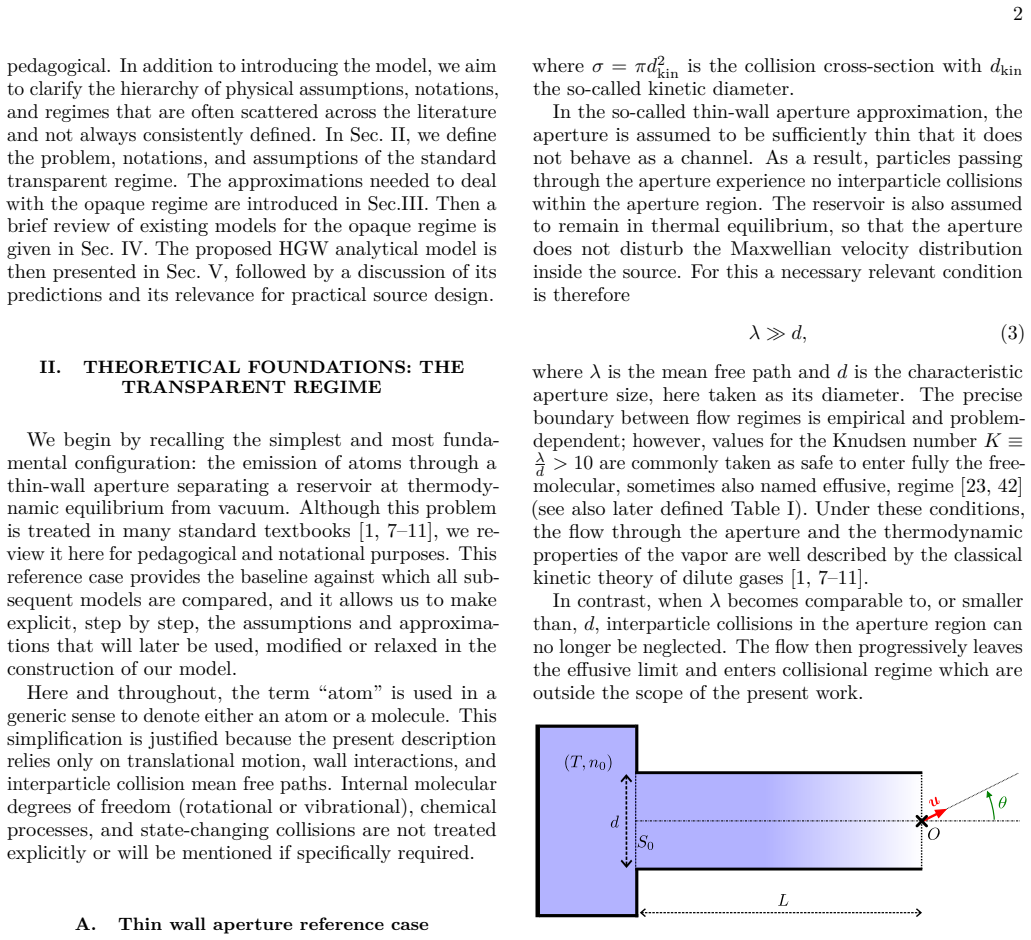
We present an analytical emission model that accurately predicts the properties of effusive sources formed by long collimation tubes. By construction, it captures the full range of molecular flow, from the transparent flux regime, which occurs in highly rarefied gases, to the opaque regime, which arises as the flux increases and interparticle collisions become non-negligible. The model is based on a previously developed secondary-emission-surface approach, improved here to overcome its internal limitations and recover the well-established axial flux intensity. It provides accurate analytical predictions of the angular intensity distribution in the molecular flow regime, offering valuable 0.
What carries the argument
The improved secondary-emission-surface approach, which treats particle-wall interactions analytically to derive the angular intensity distribution while spanning transparent to opaque conditions.
If this is right
- Designers can select tube length and diameter to achieve desired beam collimation using closed-form expressions instead of case-by-case simulations.
- The recovered axial intensity serves as a built-in consistency check against known limiting cases.
- The model supplies intensity maps that can be inserted directly into beam propagation codes for downstream experiment optimization.
- It extends usable flux ranges for sources in atomic clocks, interferometers, and molecular beam machines.
Where Pith is reading between the lines
- The same surface-emission framework might be adapted to predict deposition profiles inside vacuum chambers or coating systems.
- Coupling the analytic output to Monte Carlo codes could accelerate hybrid modeling of intermediate Knudsen-number flows.
- The approach suggests a path toward parameter-free scaling laws for source performance when tube aspect ratio and gas species vary.
Load-bearing premise
The assumption that refining the secondary-emission-surface treatment alone suffices to capture the transition from transparent to opaque molecular flow without further hydrodynamic corrections.
What would settle it
Precise experimental measurement of the angular intensity profile from a long collimation tube at increasing gas fluxes, checked against the model's predicted curves for deviations larger than measurement uncertainty.
Figures


read the original abstract
We present an analytical emission model that accurately predicts the properties of effusive sources formed by long collimation tubes. By construction, it captures the full range of molecular flow, from the transparent flux regime, which occurs in highly rarefied gases, to the opaque regime, which arises as the flux increases and interparticle collisions become non-negligible. The model is based on a previously developed secondary-emission-surface approach, improved here to overcome its internal limitations and recover the well-established axial flux intensity. It provides accurate analytical predictions of the angular intensity distribution in the molecular flow regime, offering valuable guidance for the design of efficient primary sources across a broad range of experiments in atomic and molecular physics
Editorial analysis
A structured set of objections, weighed in public.
Referee Report
Summary. The manuscript presents an analytical emission model for effusive sources formed by long collimation tubes. The model is constructed to predict the angular intensity distribution accurately across the full molecular flow regime, from the transparent flux regime in highly rarefied gases to the opaque regime where interparticle collisions become non-negligible. It improves upon a prior secondary-emission-surface approach to overcome internal limitations and recover the well-established axial flux intensity by construction.
Significance. If the derivations and comparisons hold, the result would provide a practical analytical tool for designing primary effusive sources in atomic and molecular physics experiments. The parameter-free character of the model, its exact recovery of known axial limits, and its coverage of both transparent and opaque regimes without regime-specific adjustments represent clear strengths that could reduce dependence on numerical simulations for beam optimization.
minor comments (1)
- [Abstract] The abstract asserts accuracy and full regime coverage; a single sentence summarizing the key functional form of the improved secondary-emission-surface construction would improve accessibility for readers who encounter only the abstract.
Simulated Author's Rebuttal
We thank the referee for their positive assessment of the manuscript and their recommendation to accept.
Circularity Check
No significant circularity detected
full rationale
The paper presents an analytical emission model derived from an improved secondary-emission-surface construction. The full manuscript supplies the explicit modification to the prior approach, the resulting angular intensity distribution formulas, and direct comparisons against established limits including the known axial flux intensity. No load-bearing derivation step reduces by construction to a fitted parameter, self-citation chain, or input quantity; the central predictions are independently verifiable against molecular-flow benchmarks and do not rely on renaming or smuggling ansatzes via citation. The argument is internally consistent on its own terms.
Axiom & Free-Parameter Ledger
Lean theorems connected to this paper
-
IndisputableMonolith/Foundation/RealityFromDistinction.leanreality_from_one_distinction unclearThe model is based on a previously developed secondary-emission-surface approach, improved here to overcome its internal limitations and recover the well-established axial flux intensity... IHGW(0) = ITW(0)·AGW(n*0)
-
IndisputableMonolith/Cost/FunctionalEquation.leanwashburn_uniqueness_aczel unclearlinear density profile n(z) = n0(ζ1 + (ζ0−ζ1)z/L) ... Clausing factor WClau(Γ)
Reference graph
Works this paper leans on
-
[1]
In particular, once n(z)is specified, the evaluation of the emitted intensity reduces to a purely geometrical problem involving the propagation of particles from different positions inside the tube to the far field. B. Angular profiles We now follow the model and notations of [37]. The main advantage is that it encounters all other model we are going to m...
-
[2]
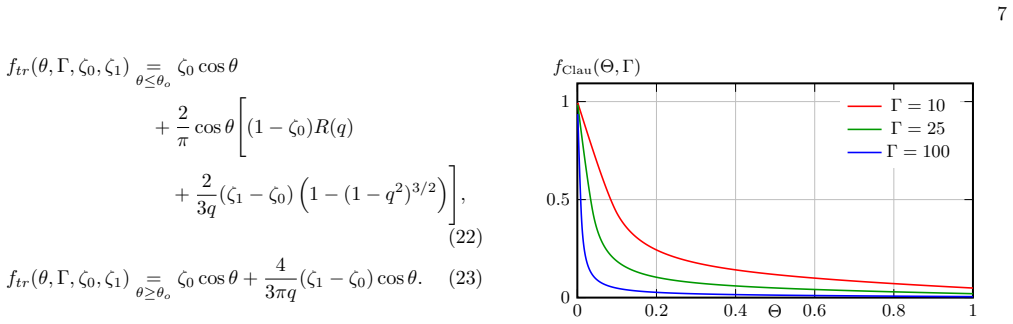
In practice, it can often be approximated as a functionA(n∗ 0). d. General angular profiles.The angular profiles can be expressed as f(θ,n∗ 0,Γ,ζ0,ζ1) = θ≤θo 1 A(n∗ 0,ζ0,ζ1) ( ζ0 cosθ + 2 πcosθ {√π 2 √ 2 n∗ 0 exp ( δ2 0 cosθ ) √ (ζ1−ζ0) cosθ × [( erf ( δ1√ cosθ ) −erf ( δ0√ cosθ )) R(q) + 2S(q) ] + (1−ζ1) exp ( δ2 0 cosθ−δ2 1 cosθ ) R(q) }) , (20) f(θ,n∗ ...
-
[3]
= √π 2 √ 2 n∗ 0 erf (√ n∗ 0 2 ) .(28) This result has been confirmed by later studies [35, 40] and constitutes a key reference for modeling axial emission. c. Zugenmaier model (reference model).TheZugen- maier model[ 34, 75]) is generally regarded as one of the most accurate descriptions of molecular-flow emission [11, 68, 76]. It combines a refined estim...
-
[4]
(39) 9 This construction ensures continuity atn∗ 0 = 1, where LH =L and nH =n0
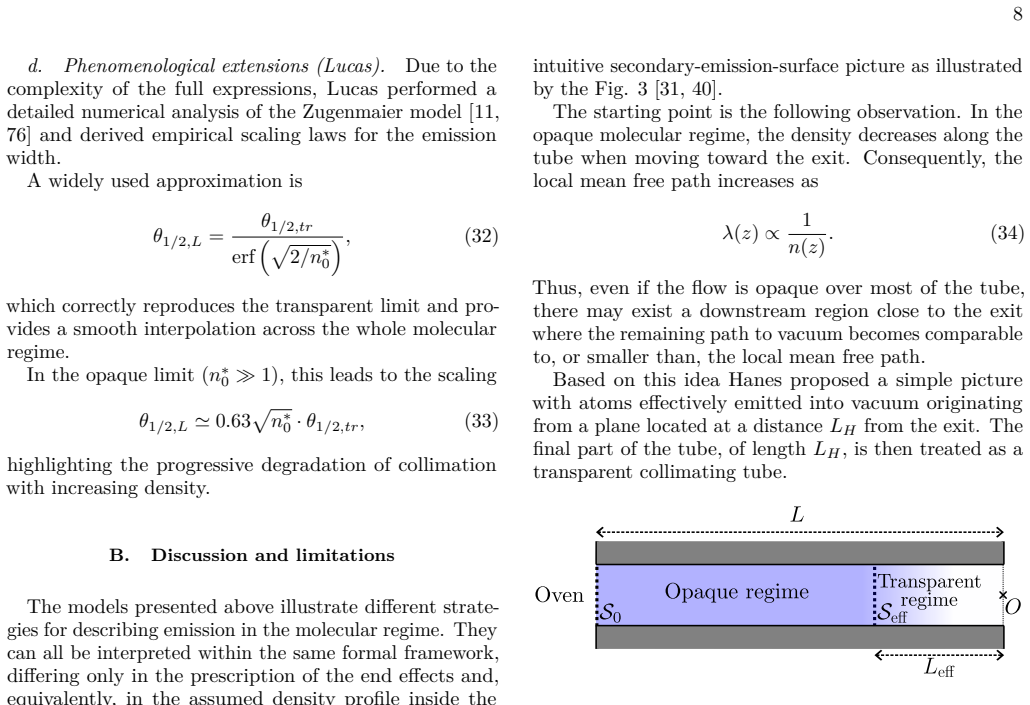
= { 1/ √ n∗ 0, n∗ 0 >1, 1, n ∗ 0≤1. (39) 9 This construction ensures continuity atn∗ 0 = 1, where LH =L and nH =n0. Forn∗ 0 > 1, the effective emitting surface moves progressively toward the tube exit. Using the transparent-tube result for the downstream part of the tube, Hanes obtains IH(0) = nH ¯va2 4 =I TW (0)AH(n∗ 0),(40) fH(θ,n∗ 0,Γ) =f Clau(θ,ΓH),(4...
-
[5]
Γ.(42) The emission width is therefore immediately obtained from the transparent long-tube scaling: θ1/2,H = θ1/2,tr AH(n∗
-
[6]
(43) opaque = 0.84 √ n∗ 0 Γ .(44) where the opaque overset indicate the case wheren∗ 0 >
-
[7]
However, the model also has important quantitative limitations
One of the main strength of the Hanes model is that with a very simple physical construction, it recovers the expected broadening of the beam as √ n∗ 0 in the opaque molecular regime. However, the model also has important quantitative limitations. The criterionλ(LH) = LH is only a rough estimate of where transparent propagation begins. It does not account...
-
[8]
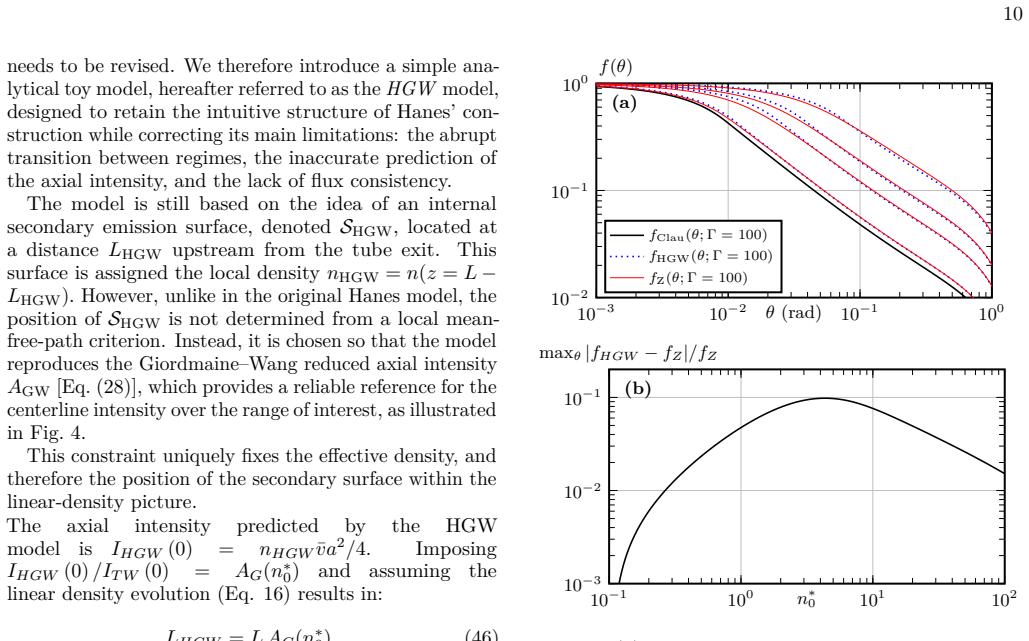
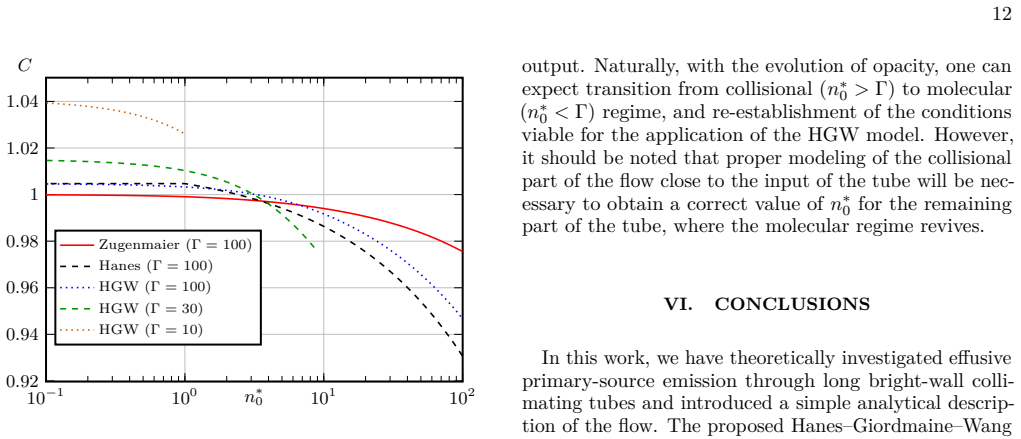
The deviations are greatest for1≲n∗ 0 ≲ 10, that is, in the region just above the transition between 11 the transparent and opaque regimes. Qualitatively, the cusp-shaped functional form of the Clausing profile (black line) is preserved in the opaque regime [30, 31], consistent with predictions for a well-collimated source. In the same manner as for the H...
-
[9]
(51) Contrary to Eq.(44) which application involves a condi- tional definition, Eq.(51) is fully analytical over all the density range of the molecular flow and provides a smooth transition between the flow regimes. Figure 6 plots the value ofθ1/2 as a function ofn∗ 0 forΓ = 100, as predicted by all the emission models which capture the opaque regime. The...
-
[10]
The inset shows a magnified view of the transition region region. The emission widthθ1/2,L obtained by Lucas (Eq.(32), orange line) is a phenomenological guess for an analytical description of θ1/2,Z: it captures both regimes of flow and connects them smoothly, but among the analytical predictions, appears to yield the largest underestimate of θ1/2 deep i...
-
[11]
= √π 2 √ 2 n∗ 0 erf (√ n∗ 0 2 ) LHGW =LA GW(n∗ 0) ΓHGW = ΓA GW(n∗ 0) Axial intensity ITW(0) = n0¯vd2 16 IHGW(0) =I TW(0)AGW(n∗ 0) Angular intensity ITW(θ) =ITW(0) cosθ IHGW(θ) =IHGW(0)fHGW (θ) fHGW(θ) = cosθ [ α+2 π { (1−α)R(q) +2(1−2α) 3q [ 1−(1−q2)3/2]}] , q≤1, cosθ [ α+4(1−2α) 3πq ] , q≥1. withq= Γ HGW tanθ,α= 2/(3ΓHGW),R(q) = arccosq−q √ 1−q2 To...
-
[12]
N. Ramsey,Molecular beams, Vol. 20 (Oxford University Press, 1956)
work page 1956
-
[13]
DeMarcus,THE PROBLEM OF KNUDSEN FLOW, Tech
W. DeMarcus,THE PROBLEM OF KNUDSEN FLOW, Tech. Rep. (Oak Ridge Gaseous Diffusion Plant, Tenn., 1956)
work page 1956
-
[14]
J. B. Anderson,Molecular beams and low density gas 14 dynamics. (A75-28372 12-72) New York, Marcel Dekker, Inc., 1974, p. 1-91., Tech. Rep. (NASA, 1974)
work page 1974
-
[15]
F. O. Goodman and H. Y. Wachman,Dynamics of Gas- Surface Scattering(Academic Press, New York, 1976)
work page 1976
-
[16]
R. B. Bernstein, ed.,Atom–Molecule Collision Theory: A Guide for the Experimentalist(Plenum Press, New York, 1979)
work page 1979
-
[17]
R. D. Levine and R. B. Bernstein,Molecular Reaction Dynamics and Chemical Reactivity(Oxford University Press, New York, 1987)
work page 1987
- [18]
- [19]
-
[20]
Campargue, ed.,Atomic and Molecular Beams: The State of the Art 2000, 1st ed
R. Campargue, ed.,Atomic and Molecular Beams: The State of the Art 2000, 1st ed. (Springer, Berlin, Heidelberg, 2001)
work page 2000
-
[21]
H. Pauly,Atom, Molecule and Clusterbeams I: Basic Theory, Production and Detection of Thermal Beams (Springer-Verlag, Berlin, 2000)
work page 2000
-
[22]
C. B. Lucas,Atomic and molecular beams: production and collimation(CRC press, 2013)
work page 2013
-
[23]
D. C. Gray and H. H. Sawin, Journal of Vacuum Science & Technology A: Vacuum, Surfaces, and Films10, 3229 (1992)
work page 1992
-
[24]
K. J. Ross and B. Sonntag, Review of Scientific Instru- ments66, 4409 (1995)
work page 1995
-
[25]
B. Jana, A. Majumder, K. B. Thakur, and A. K. Das, Review of Scientific Instruments84, 106113 (2013)
work page 2013
-
[26]
R. Senaratne, S. V. Rajagopal, Z. A. Geiger, K. M. Fu- jiwara, V. Lebedev, and D. M. Weld, Review of Sci- entific Instruments86, 023105 (2015), arXiv:1407.6391 [physics.atom-ph]
- [27]
- [28]
- [29]
-
[30]
Y. Li, X. Chen, X. Bai, Q. Che, and Y. Li, Vacuum97, 60 (2013)
work page 2013
- [31]
- [32]
-
[33]
Steckelmacher, Reports on Progress in Physics49, 1083 (1986)
W. Steckelmacher, Reports on Progress in Physics49, 1083 (1986)
work page 1986
-
[34]
N. M. Laurendeau,Statistical thermodynamics: funda- mentals and applications(Cambridge University Press, 2005)
work page 2005
-
[35]
H. Pauly,Atom, Molecule, and Cluster Beams II: Cluster Beams, Fast and Slow Beams, Accessory Equipment and Applications, Vol. 32 (Springer Science & Business Media, 2013)
work page 2013
-
[36]
Knudsen, Annalen der Physik333, 75 (1909)
M. Knudsen, Annalen der Physik333, 75 (1909)
work page 1909
-
[37]
Knudsen, Annalen der Physik333, 999 (1909)
M. Knudsen, Annalen der Physik333, 999 (1909)
work page 1909
-
[38]
M. v. Smoluchowski, Annalen der Physik338, 1559 (1910)
work page 1910
-
[39]
Clausing, Zeitschrift für Physik66, 471 (1930)
P. Clausing, Zeitschrift für Physik66, 471 (1930)
work page 1930
-
[40]
Clausing, Journal of Vacuum Science and Technology 8, 636 (1971)
P. Clausing, Journal of Vacuum Science and Technology 8, 636 (1971)
work page 1971
-
[41]
J. A. Giordmaine and T. C. Wang, Journal of Applied Physics31, 463 (1960)
work page 1960
-
[42]
G. R. Hanes, Journal of Applied Physics31, 2171 (1960)
work page 1960
-
[43]
Becker, Zeitschrift für Physik162, 290 (1961)
G. Becker, Zeitschrift für Physik162, 290 (1961)
work page 1961
-
[44]
B. S. Ivanov and V. S. Troitskii, Soviet Physics–Technical Physics8, 365 (1963), original Russian: Zhurnal Tekhnich- eskoi Fiziki 33, 494–499 (1963)
work page 1963
-
[45]
Zugenmaier, Zeitschrift fur angewandte Physik20, 184 (1966)
P. Zugenmaier, Zeitschrift fur angewandte Physik20, 184 (1966)
work page 1966
-
[46]
R. H. Jones, D. R. Olander, and V. R. Kruger, Journal of Applied Physics40, 4641 (1969)
work page 1969
-
[47]
D. R. Olander, Journal of Applied Physics40, 4650 (1969)
work page 1969
-
[48]
D. R. Olander and V. Kruger, Journal of Applied Physics 41, 2769 (1970)
work page 1970
-
[49]
D. R. Olander, R. H. Jones, and W. J. Siekhaus, Journal of Applied Physics41, 4388 (1970)
work page 1970
-
[50]
W. J. Siekhaus, R. H. Jones, and D. R. Olander, Journal of Applied Physics41, 4392 (1970)
work page 1970
-
[51]
H. C. W. Beijerinck and N. F. Verster, Journal of Applied Physics46, 2083 (1975)
work page 2083
-
[52]
C. A. Flory and L. S. Cutler, Journal of Applied Physics 73, 1561 (1993)
work page 1993
-
[53]
G. Karniadakis, A. Beskok, and N. Aluru,Microflows and nanoflows: fundamentals and simulation(Springer, 2005)
work page 2005
-
[54]
Steckelmacher, Japanese Journal of Applied Physics 13, 117 (1974)
W. Steckelmacher, Japanese Journal of Applied Physics 13, 117 (1974)
work page 1974
- [55]
-
[56]
R. E. Drullinger, D. J. Glaze, J. Lowe, and J. H. Shirley, IEEE Transactions on Instrumentation and Measurement 40, 162 (1991)
work page 1991
-
[57]
M. De Muri, A. Rizzolo, E. Sartori, S. Cristofaro, M. Bar- bisan, M. Fadone, D. Ravarotto, R. Rizzieri, R. Capo- bianco, P. Cinetto,et al., Fusion Engineering and Design 167, 112331 (2021)
work page 2021
-
[58]
R. Hahn, T. Battard, O. Boucher, Y. J. Picard, H. Lig- nier, D. Comparat, N.-A. Keriel, C. Lopez, E. Oswald, M. Reveillard, and M. Viteau, Review of Scientific Instru- ments93, 043302 (2022)
work page 2022
-
[59]
Z. Pan, K. L. Jensen, and E. J. Montgomery, Journal of Applied Physics114(2013)
work page 2013
-
[60]
C. Li, X. Chai, B. Wei, J. Yang, A. Daruwalla, F. Ayazi, and C. Raman, Nature communications10, 1831 (2019)
work page 2019
- [61]
-
[62]
R. Drullinger, D. Glaze, and D. Sullivan, in39th Annual Symposium on Frequency Control(IEEE, 1985) pp. 13–17
work page 1985
-
[63]
C. M. Davies and C. B. Lucas, Journal of Physics D: Applied Physics16, 1 (1983)
work page 1983
-
[64]
D. A. King, Surface Science47, 384 (1975)
work page 1975
-
[65]
Matsushima, Surface science reports52, 1 (2003)
T. Matsushima, Surface science reports52, 1 (2003)
work page 2003
-
[66]
V. Levdansky, J. Smolik, and P. Moravec, International Journal of Heat and Mass Transfer51, 2471 (2008)
work page 2008
-
[67]
S. Bernasek and G. Somorjai, Progress in Surface Science 5, 377 (1975)
work page 1975
-
[68]
D.M.Murphy,JournalofVacuumScienceandTechnology A7, 3075 (1989)
work page 1989
-
[69]
C. Eibl, G. Lackner, and A. Winkler, Journal of Vacuum Science and Technology A16, 2979 (1998)
work page 1998
-
[70]
T. Schwarz-Selinger, A. von Keudell, and W. Jacob, Jour- nal of Vacuum Science and Technology A18, 995 (2000)
work page 2000
- [71]
-
[72]
Hurlbut, inRecent Research in Molecular Beams(Aca- demic Press, 1959) pp
F. Hurlbut, inRecent Research in Molecular Beams(Aca- demic Press, 1959) pp. 145–156
work page 1959
-
[73]
R. M. Logan and R. E. Stickney, The Journal of Chemical Physics44, 195 (1966)
work page 1966
-
[74]
T. Edmonds and J. P. Hobson, Journal of Vacuum Science and Technology2, 182 (1965)
work page 1965
-
[75]
J. P. Hobson, Journal of Vacuum Science and Technology 6, 257 (1969)
work page 1969
-
[76]
D. H. Davis, L. L. Levenson, and N. Milleron, Journal of Applied Physics35, 529 (1964)
work page 1964
-
[77]
V. Aquilanti, D. Ascenzi, M. de Castro Vítores, F. Pirani, and D. Cappelletti, The Journal of Chemical Physics111, 2620 (1999)
work page 1999
- [78]
-
[79]
Z. He, H. Fan, H. Bi, M. Xu, X. Wang, and J. Yang, Vacuum , 114740 (2025)
work page 2025
-
[80]
J. C. Helmer, Journal of Vacuum Science and Technology 4, 360 (1967)
work page 1967
discussion (0)
Sign in with ORCID, Apple, or X to comment. Anyone can read and Pith papers without signing in.