Recognition: 1 theorem link
· Lean TheoremImpact of coalescence signals on the search for continuous gravitational waves with Einstein Telescope
Pith reviewed 2026-05-13 03:59 UTC · model grok-4.3
The pith
Unresolved compact binary coalescences act as extra noise that worsens Frequency-Hough sensitivity for continuous waves by 7-10% around 7 Hz in the Einstein Telescope.
A machine-rendered reading of the paper's core claim, the machinery that carries it, and where it could break.
Core claim
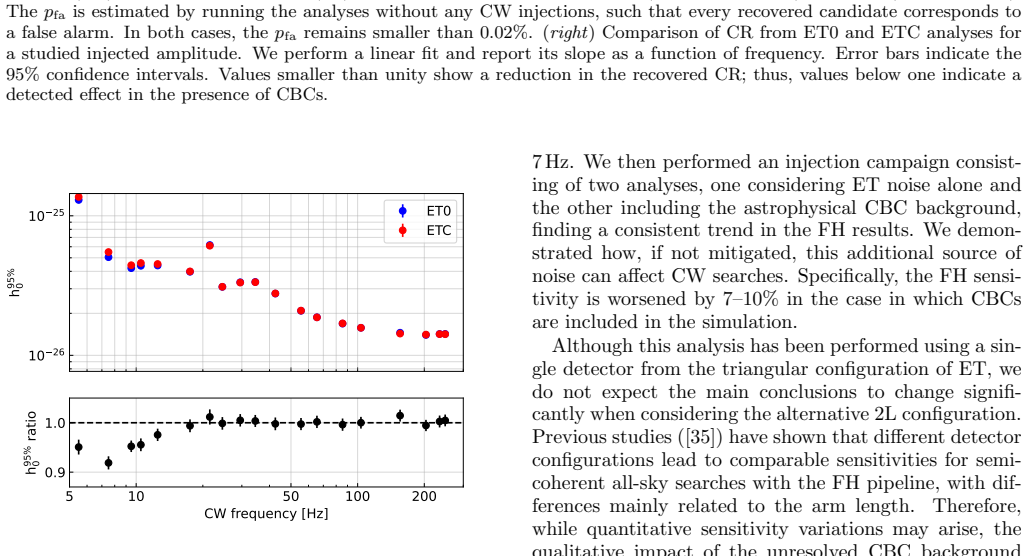
Through realistic simulations of the unresolved CBC background, we find that it acts as an additional noise source, most strongly affecting the detection of CW signals around 7 Hz, worsening the FH sensitivity by about 7-10%.
What carries the argument
The Frequency-Hough pipeline run on Einstein Telescope noise curves that include a simulated unresolved compact-binary-coalescence foreground.
Load-bearing premise
The simulated unresolved CBC background accurately represents the real astrophysical foreground without significant correlations or unmodeled features that could alter the Frequency-Hough pipeline response.
What would settle it
Applying the Frequency-Hough pipeline to real Einstein Telescope data and measuring a sensitivity loss around 7 Hz that differs markedly from the 7-10% degradation found in the simulations.
Figures


read the original abstract
The current network of gravitational wave detectors has already revealed hundreds of compact binary coalescences (CBCs), including binary neutron stars, binary black holes, and black hole-neutron star systems. As detector sensitivity improves, the superposition of these signals is expected to form an astrophysical background that becomes increasingly relevant for future observatories. In third generation detectors, such as the Einstein Telescope (ET), this background will be most prominent at low frequencies, potentially affecting the search for continuous gravitational waves (CWs) from spinning neutron stars. In this work, we evaluate the impact of the CBC background on CW detection using the Frequency-Hough pipeline, with a focus on the low-frequency performance in ET sensitivity conditions. Through realistic simulations of the unresolved CBC background, we find that it acts as an additional noise source, most strongly affecting the detection of CW signals around 7 Hz, worsening the FH sensitivity by about 7-10%.
Editorial analysis
A structured set of objections, weighed in public.
Referee Report
Summary. The paper evaluates the effect of the unresolved compact binary coalescence (CBC) astrophysical background on continuous gravitational wave (CW) searches in the Einstein Telescope (ET) using the Frequency-Hough (FH) pipeline. Through simulations of this background, it concludes that the foreground acts as additional noise, with the strongest impact on CW signals near 7 Hz, where the FH sensitivity is degraded by approximately 7-10%.
Significance. If validated, the quantitative estimate of sensitivity loss provides a useful benchmark for CW search strategies in third-generation detectors, where low-frequency performance is critical. The simulation-based approach is a strength, offering concrete numbers rather than purely analytic estimates, and could inform pipeline tuning or data cleaning priorities. The result is most relevant if the simulated background faithfully reproduces the statistical properties that affect the Hough voting statistic.
major comments (2)
- The central claim that the CBC background worsens FH sensitivity by 7-10% near 7 Hz rests on the assumption that its effect on the Hough map is statistically equivalent to a simple increase in the noise power spectral density. No explicit comparison is described between the pipeline response to the simulated (potentially non-Gaussian or correlated) background and to stationary Gaussian noise with identical PSD, leaving open whether excess variance or time-frequency alignments in the CBC superposition produce a larger degradation than a pure noise-floor model would predict.
- The simulation methods and statistical treatment of the unresolved CBC background are not described in sufficient detail to allow independent verification of the 7-10% figure. In particular, the background model, injection procedure into the ET-like data, and how the FH detection statistic responds to the foreground are not fully specified, which is load-bearing for the quantitative result reported in the abstract.
Simulated Author's Rebuttal
We thank the referee for their constructive comments, which help clarify the interpretation and reproducibility of our results. We address each major comment below and will revise the manuscript to incorporate the suggested improvements.
read point-by-point responses
-
Referee: The central claim that the CBC background worsens FH sensitivity by 7-10% near 7 Hz rests on the assumption that its effect on the Hough map is statistically equivalent to a simple increase in the noise power spectral density. No explicit comparison is described between the pipeline response to the simulated (potentially non-Gaussian or correlated) background and to stationary Gaussian noise with identical PSD, leaving open whether excess variance or time-frequency alignments in the CBC superposition produce a larger degradation than a pure noise-floor model would predict.
Authors: We agree that an explicit comparison to stationary Gaussian noise with matched PSD would strengthen the central claim. In the revised manuscript we will add a new subsection presenting the Frequency-Hough statistic distributions and sensitivity curves obtained from the simulated CBC background versus an equivalent Gaussian noise realization. This will quantify any excess degradation arising from non-Gaussianity or correlations and will be reflected in the updated discussion and abstract if differences are found. revision: yes
-
Referee: The simulation methods and statistical treatment of the unresolved CBC background are not described in sufficient detail to allow independent verification of the 7-10% figure. In particular, the background model, injection procedure into the ET-like data, and how the FH detection statistic responds to the foreground are not fully specified, which is load-bearing for the quantitative result reported in the abstract.
Authors: We acknowledge that the current Methods section lacks sufficient detail for independent reproduction of the 7-10% result. In the revised version we will expand the description to include the specific CBC population model and waveform approximations, the exact injection procedure into the ET-like time series, and the step-by-step computation of the Frequency-Hough detection statistic in the presence of the foreground. Additional figures illustrating the statistical properties of the background and its effect on the Hough maps will be added to the main text or supplementary material. revision: yes
Circularity Check
No circularity; central result obtained from direct simulation comparison
full rationale
The paper evaluates the CBC background's effect on the Frequency-Hough pipeline exclusively through realistic simulations of unresolved coalescences injected into ET-like data. The reported 7-10% sensitivity degradation near 7 Hz is measured by comparing pipeline outputs (detection statistics, sensitivity curves) in the presence versus absence of the simulated foreground. No load-bearing step reduces to a self-definition, a fitted parameter renamed as a prediction, or a self-citation chain that supplies the uniqueness or ansatz for the result. The simulation is treated as an external input whose statistical properties are not derived from the paper's own FH equations, satisfying the criteria for a self-contained numerical experiment.
Axiom & Free-Parameter Ledger
Lean theorems connected to this paper
-
IndisputableMonolith/Foundation/RealityFromDistinction.leanreality_from_one_distinction unclearThrough realistic simulations of the unresolved CBC background, we find that it acts as an additional noise source, most strongly affecting the detection of CW signals around 7 Hz, worsening the FH sensitivity by about 7-10%.
Reference graph
Works this paper leans on
-
[1]
E. Bigongiari, M. Di Giovanni, and G. Losurdo, Gravi- tational wave experiments: Achievements and plans, in Reference Module in Materials Science and Materials En- gineering(Elsevier, 2026)
work page 2026
-
[2]
LSC Collaboration, Advanced ligo, Classical Quant. Grav.32, 074001 (2015)
work page 2015
-
[3]
Virgo Collaboration, Advanced Virgo: a second- generation interferometric gravitational wave detector, Classical Quant. Grav.32, 024001 (2014)
work page 2014
-
[4]
K. Somiya and K. collaboration, Detector configuration of kagra–the japanese cryogenic gravitational-wave detec- tor, Classical and Quantum Gravity29, 124007 (2012)
work page 2012
-
[5]
LVC Collaboration, Gwtc-1: a gravitational-wave tran- sient catalog of compact binary mergers observed by ligo and virgo during the first and second observing runs, Physical Review X9, 031040 (2019)
work page 2019
-
[6]
LVC Collaboration, Gwtc-2: Compact binary coales- cences observed by ligo and virgo during the first half of the third observing run, Physical Review X11, 021053 (2021)
work page 2021
-
[7]
LVC Collaboration, Gwtc-2.1: Deep extended catalog of compact binary coalescences observed by ligo and virgo during the first half of the third observing run, Physical Review D109, 022001 (2024)
work page 2024
-
[8]
LVC Collaboration, Gwtc-3: Compact binary coales- cences observed by ligo and virgo during the second part of the third observing run, Physical Review X13, 041039 (2023)
work page 2023
-
[9]
LVK Collaboration, Gwtc-4.0: Updating the gravitational-wave transient catalog with observa- tions from the first part of the fourth ligo-virgo-kagra observing run, arXiv preprint arXiv:2508.18082 (2025)
work page internal anchor Pith review Pith/arXiv arXiv 2025
-
[10]
LVK Collaboration, GW250114: Testing Hawking’s area law and the Kerr nature of black holes, Physical Review Letters135, 10.1103/kw5g-d732 (2025)
-
[11]
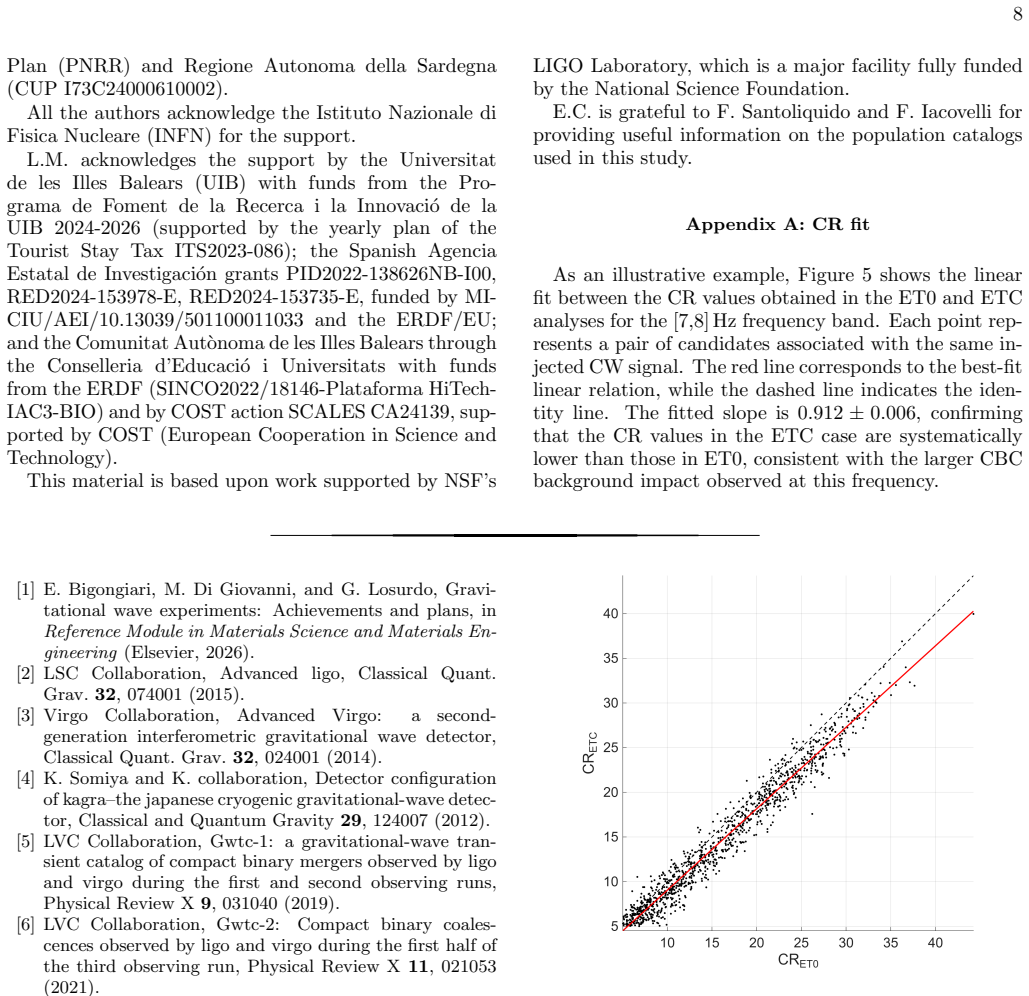
LVK Collaboration, Gw241011 and gw241110: Exploring binary formation and fundamental physics with asym- metric, high-spin black hole coalescences, The Astrophys- ical Journal Letters993, L21 (2025). FIG. 5. Example of the linear fit between CRET0 and CRET C for the [7,8] Hz frequency band. The red line represents the best-fit linear relation, and the dash...
work page 2025
-
[12]
LVK Collaboration, Population of merging compact bi- naries inferred using gravitational waves through gwtc-3, Physical Review X13, 011048 (2023)
work page 2023
-
[13]
LVK Collaboration, Gwtc-4.0: Population proper- ties of merging compact binaries, arXiv preprint arXiv:2508.18083 (2025)
work page internal anchor Pith review Pith/arXiv arXiv 2025
-
[14]
LVC Collaboration (LIGO Scientific Collaboration and Virgo Collaboration), GW170817: Observation of gravi- tational waves from a binary neutron star inspiral, Phys. Rev. Lett.119, 161101 (2017)
work page 2017
-
[15]
LVC Collaboration, Multi-messenger observations of a bi- nary neutron star merger, Astrophys. J.848, L12 (2017). 9
work page 2017
-
[16]
Lasky, Gravitational waves from neutron stars: A review, Publ Astron Soc of Aust32, e034 (2015)
work page 2015
-
[17]
K. Wette, Searches for continuous gravitational waves from neutron stars: A twenty-year retrospective, As- tropart Phys153, 102880 (2023)
work page 2023
-
[18]
K. Riles, Searches for continuous-wave gravitational ra- diation, Living Reviews in Relativity26, 3 (2023)
work page 2023
-
[19]
Isiet al., Probing dynamical gravity with the polariza- tion of continuous gravitational waves, Phys Rev D96, 042001 (2017)
work page 2017
-
[20]
LVC Collaboration, All-sky search for periodic gravita- tional waves in the O1 LIGO data, Phys Rev D96, 062002 (2017)
work page 2017
-
[21]
LVC Collaboration, All-sky search for continuous gravita- tional waves from isolated neutron stars using advanced LIGO O2 data, Phys Rev D100, 024004 (2019)
work page 2019
-
[22]
C. Palombaet al., Direct constraints on the ultralight bo- son mass from searches of continuous gravitational waves, Phys Rev Lett123, 171101 (2019)
work page 2019
-
[23]
LVC Collaboration, First low frequency all-sky search for continuous gravitational wave signals, Phys Rev D93, 042007 (2016)
work page 2016
-
[24]
LVK Collaboration, All-sky search for continuous grav- itational waves from isolated neutron stars using Ad- vanced LIGO and advanced Virgo O3 data, Phys Rev D106, 102008 (2022)
work page 2022
-
[25]
LVC Collaboration, All-sky search for continuous gravita- tional waves from isolated neutron stars using advanced ligo and advanced virgo o3 data, Physical Review D106, 102008 (2022)
work page 2022
- [26]
-
[27]
B. Steltner, M. A. Papa, H.-B. Eggenstein, R. Prix, M. Bensch, B. Allen, and B. Machenschalk, Deep ein- stein@home all-sky search for continuous gravitational waves in ligo o3 public data, Astrophys. J.952, 55 (2023)
work page 2023
- [28]
- [29]
-
[30]
LVK Collaboration, Search for continuous gravitational waves from known pulsars in the first part of the fourth ligo-virgo-kagra observing run, Astrophysical Journal 983, 99 (2025)
work page 2025
-
[31]
P. Astoneet al., Method for all-sky searches of continu- ous gravitational wave signals using the frequency-hough transform, Physical Review D90, 042002 (2014)
work page 2014
-
[32]
Hough, Machine analysis of bubble chamber pictures, inProceedings, 2nd International Conference on High- Energy Accelerators and Instrumentation, Conf. Proc. C No. 590914 (1959) pp. 554–558
work page 1959
-
[33]
Hough, Method and means for recognizing complex pat- terns, US Patent3069654(1962)
work page 1962
-
[34]
Maggioreet al., Science case for the einstein telescope, JCAP2020(03), 050
M. Maggioreet al., Science case for the einstein telescope, JCAP2020(03), 050
-
[35]
M. Branchesiet al., Science with the Einstein Telescope: a comparison of different designs, JCAP2023(07), 068
-
[36]
M. Di Giovanniet al., The impact of local noise recorded at the et candidate sites on the signal to noise ratio of cbc gravitational wave signals for the et triangle con- figuration, Classical and Quantum Gravity42, 155001 (2025)
work page 2025
-
[37]
Cosmic Explorer: The U.S. Contribution to Gravitational-Wave Astronomy beyond LIGO
D. Reitzeet al., Cosmic Explorer: The US contri- bution to gravitational-wave astronomy beyond LIGO, arxiv.org/abs/1907.04833 (2019)
work page internal anchor Pith review Pith/arXiv arXiv 1907
-
[38]
A Horizon Study for Cosmic Explorer: Science, Observatories, and Community
C. Evanset al., A horizon study for Cosmic Explorer: Science, observatories, and community, arxiv.org/abs/2109.09882 (2021)
work page internal anchor Pith review arXiv 2021
-
[39]
Hallet al., Cosmic Explorer: A next-generation ground-based gravitational-wave observatory, Galaxies 10, 10.3390/galaxies10040090 (2022)
-
[40]
M. Di Giovanni, Einstein Telescope and Cosmic Explorer, inProceedings of the 59th Rencontres de Moriond – Grav- itation 2025, edited by E. Aug´ e, J. Dumarchez, and J. Tran Thanh Van (2025) pp. 135–140
work page 2025
-
[41]
M. Punturoet al., The Einstein Telescope: a third- generation gravitational wave observatory, Classical Quant. Grav.27, 194002 (2010)
work page 2010
-
[42]
ET Science Team, The Einstein Telescope: a third- generation gravitational wave observatory, Classical Quant. Grav.27, 194002 (2010)
work page 2010
-
[43]
ET Science Team, Einstein gravitational wave telescope conceptual design study, ET-0106C-10 (2011)
work page 2011
-
[44]
ET Science Team, Design report update for the Einstein Telescope, ET-0028A-20 (2020)
work page 2020
-
[45]
F. Iacovelliet al., Combining underground and on- surface third-generation gravitational-wave interferom- eters, Journal of Cosmology and Astroparticle Physics 2024(10), 085
work page 2024
-
[46]
A. Abacet al., The science of the einstein telescope, Jour- nal of Cosmology and Astroparticle Physics2026(03), 081
-
[47]
A. Buonannoet al., Stochastic gravitational-wave back- ground from cosmological supernovae, Physical Review D72, 084001 (2005), published 3 October 2005, astro- ph/0412277
-
[48]
T. Regimbau and V. Mandic, Astrophysical sources of a stochastic gravitational-wave background, Classical and Quantum Gravity25, 184018 (2008), published 21 September 2008
work page 2008
-
[49]
T. Regimbau, The astrophysical gravitational wave stochastic background, Research in Astronomy and As- trophysics11, 369 (2011)
work page 2011
-
[50]
D. S.et al., Unresolved stochastic background from compact binary mergers detectable by next-generation ground-based gravitational-wave observatories, Physical Review D110, 023006 (2024), published 8 July 2024
work page 2024
-
[51]
H. Zhonget al., Searching for cosmological stochastic backgrounds by notching out resolvable compact binary foregrounds with next-generation gravitational-wave de- tectors, Physical Review D110, 064047 (2024)
work page 2024
-
[52]
H. Zhonget al., Two-step procedure to detect cosmologi- cal gravitational wave backgrounds with next-generation terrestrial gravitational-wave detectors, Physical Review Letters135, 111401 (2025)
work page 2025
-
[53]
S. Sachdevet al., Subtracting compact binary foreground sources to reveal primordial gravitational-wave back- grounds, Physical Review D102, 024051 (2020). 10
work page 2020
-
[54]
A. Sharma and J. Harms, Searching for cosmologi- cal gravitational-wave backgrounds with third-generation detectors in the presence of an astrophysical foreground, Physical Review D102, 063009 (2020)
work page 2020
-
[55]
P. Jaranowski and A. Krolak, Data analysis of gravita- tional wave signals from spinning neutron stars. 3. De- tection statistics and computational requirements, Phys. Rev. D61, 062001 (2000), arXiv:gr-qc/9901013
-
[56]
P. Astoneet al., The short fft database and the peak map for the hierarchical search of periodic sources, Classical and Quantum Gravity22, S1197 (2005)
work page 2005
-
[57]
O. J. Piccinni and S. Frasca, The band-sampled-data col- lection for the search of continuous gravitational wave signals, in2018 26th European Signal Processing Confer- ence (EUSIPCO)(IEEE, 2018) pp. 2653–2657
work page 2018
- [58]
-
[59]
Astoneet al., Search for periodic gravitational wave sources with the explorer detector, Phys
P. Astoneet al., Search for periodic gravitational wave sources with the explorer detector, Phys. Rev. D65, 022001 (2002), arXiv:gr-qc/0011072
-
[60]
L. Mirasolaet al., New semicoherent targeted search for continuous gravitational waves from pulsars in binary systems, Phys. Rev. D110, 123043 (2024), arXiv:2404.03721 [gr-qc]
-
[61]
M. Mapelliet al., The cosmic evolution of binary black holes in young, globular, and nuclear star clusters: rates, masses, spins, and mixing fractions, Monthly Notices of the Royal Astronomical Society511, 5797 (2022)
work page 2022
-
[62]
M. Mapelliet al., Hierarchical black hole mergers in young, globular and nuclear star clusters: the effect of metallicity, spin and cluster properties, Monthly Notices of the Royal Astronomical Society505, 339 (2021)
work page 2021
-
[63]
F. Santoliquidoet al., The cosmic merger rate density of compact objects: impact of star formation, metallicity, initial mass function, and binary evolution, Monthly No- tices of the Royal Astronomical Society502, 4877 (2021)
work page 2021
-
[64]
G. Iorioet al., Compact object mergers: exploring un- certainties from stellar and binary evolution with sevn, Monthly Notices of the Royal Astronomical Society524, 426 (2023)
work page 2023
-
[65]
T. Regimbau and S. Jishnu, A mock data chal- lenge for next-generation detectors, arXiv preprint arXiv:2506.12237 (2025)
-
[66]
LVK Collaboration, LVK Algorithm Library - LALSuite, Free software (GPL) (2018)
work page 2018
-
[67]
F. Santoliquido, M. Mapelli, G. Iorio, G. Costa, S. C. Glover, T. Hartwig, R. S. Klessen, and L. Merli, Bi- nary black hole mergers from population iii stars: uncer- tainties from star formation and binary star properties, Monthly Notices of the Royal Astronomical Society524, 307 (2023)
work page 2023
-
[68]
K. K. Ng, S. Chen, B. Goncharov, U. Dupletsa, S. Borhanian, M. Branchesi, J. Harms, M. Maggiore, B. Sathyaprakash, and S. Vitale, On the single-event- based identification of primordial black hole mergers at cosmological distances, The Astrophysical Journal Let- ters931, L12 (2022)
work page 2022
-
[69]
V. D. Luca, G. Franciolini, P. Pani, and A. Riotto, Pri- mordial black holes confront ligo/virgo data: current sit- uation, Journal of Cosmology and Astroparticle Physics 2020(06), 044
work page 2020
-
[70]
T. Kinugawa, T. Nakamura, and H. Nakano, Chirp mass and spin of binary black holes from first star remnants, Monthly Notices of the Royal Astronomical Society498, 3946 (2020)
work page 2020
-
[71]
V. De Luca, G. Franciolini, P. Pani, and A. Riotto, Con- straints on primordial black holes: the importance of ac- cretion, Physical Review D102, 043505 (2020)
work page 2020
-
[72]
D. M. Macleodet al., GWpy: A Python package for gravitational-wave astrophysics, SoftwareX13, 100657 (2021)
work page 2021
-
[73]
Macleodet al., gwpy/gwpy: Gwpy 3.0.4 (2023)
D. Macleodet al., gwpy/gwpy: Gwpy 3.0.4 (2023)
work page 2023
-
[74]
Nitzet al., gwastro/pycbc: v2.1.0 release of pycbc (2023)
A. Nitzet al., gwastro/pycbc: v2.1.0 release of pycbc (2023)
work page 2023
- [75]
-
[76]
C. Palomba,On the sensitivity of peakmap-based methods for the search of continuous gravitational wave signals, Tech. Rep. VIR-0724A-25 (Virgo, 2025)
work page 2025
- [77]
-
[78]
LVC Collaboration, Narrowband searches for continu- ous and long-duration transient gravitational waves from known pulsars in the ligo-virgo third observing run, The Astrophysical Journal932, 133 (2022)
work page 2022
-
[79]
S. Hildet al., Sensitivity studies for third-generation gravitational wave observatories, Classical and Quantum gravity28, 094013 (2011)
work page 2011
-
[80]
KAGRA Collaboration, Kagra: 2.5 generation interfer- ometric gravitational wave detector, Nat. Astron.3, 35 (2019)
work page 2019
discussion (0)
Sign in with ORCID, Apple, or X to comment. Anyone can read and Pith papers without signing in.