Recognition: 1 theorem link
· Lean TheoremInto the Unknown: Accounting for Missing Demographic Data when Mitigating Ad Delivery Skew
Pith reviewed 2026-05-13 03:17 UTC · model grok-4.3
The pith
A budget split targeting inferred genders while reaching unknown users reduces gender skew in ad delivery.
A machine-rendered reading of the paper's core claim, the machinery that carries it, and where it could break.
Core claim
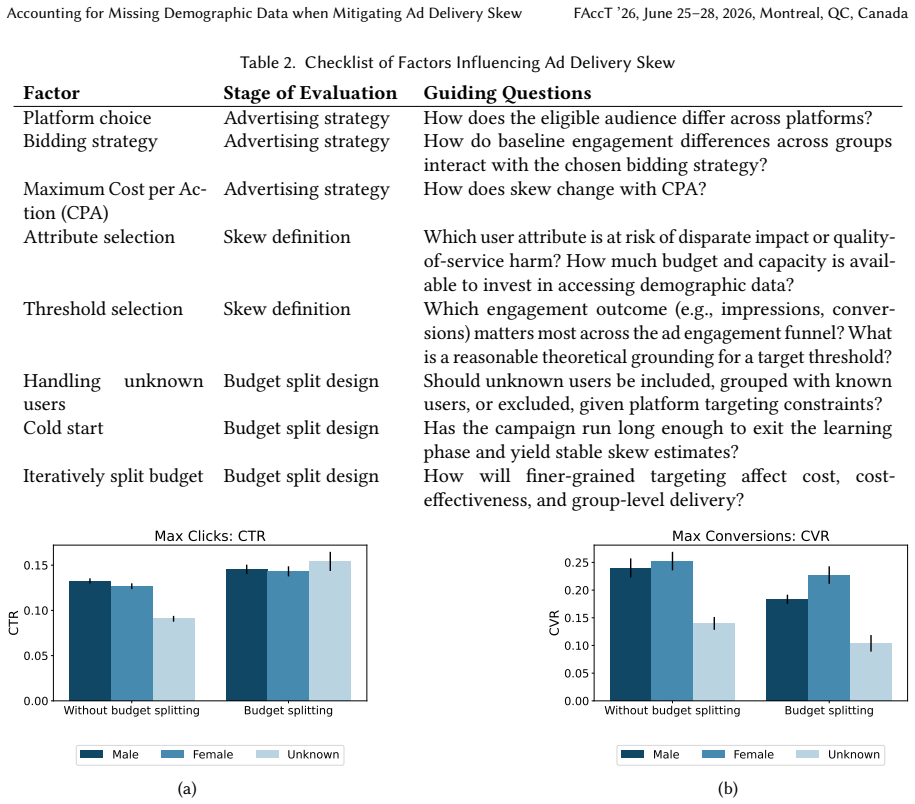
The paper establishes that a budget split intervention—dividing ad spend between campaigns targeting Google-inferred male and female users and a non-targeted campaign open to all users including those with unknown demographics—mitigates gender-based ad delivery skew on Google Ads for public service announcements without excluding unknown users.
What carries the argument
The budget split intervention that pairs gender-based targeting for inferred demographics with inclusive non-targeted campaigns to include unknown users.
If this is right
- Ad delivery becomes closer to proportional across gender groups without excluding unknown users.
- The method requires no new platform features beyond standard targeting and budget controls.
- It serves as a middle ground between higher-cost granular targeting and skew from ignoring demographics entirely.
- The approach directly addresses needs of resource-constrained government advertisers for equitable public service outreach.
Where Pith is reading between the lines
- Similar budget splits could be applied to other inferred attributes like age or location on the same platform.
- Platforms could reduce the need for such workarounds by offering direct targeting options for unknown users.
- If inference accuracy improves over time, the skew reduction from this split would increase further.
- Other public agencies might standardize this allocation pattern for outreach campaigns.
Load-bearing premise
The platform's gender inference labels are reliable enough for targeting and the budget split can be implemented using only existing platform tools.
What would settle it
Compare delivery rates by inferred gender in parallel campaigns using the budget split versus a no-demographic-targeting baseline; if skew does not decrease measurably, the intervention fails to work as claimed.
Figures



read the original abstract
Online advertising platforms use algorithmic systems to power the process of matching ads to users, termed ad delivery. Prior audits have demonstrated that ad delivery can be skewed by demographic attributes, such that ads are systematically under-delivered to certain groups despite advertiser intent to reach groups proportionally. This under-delivery raises a serious concern in the context of ads promoting public services, which might prevent certain groups of individuals from accessing information about resources on the basis of their demographic identity. In the absence of platform-provided solutions to skewed ad delivery, advertisers can counteract skew by targeting demographic groups directly. However, direct targeting excludes users whose demographics the platform cannot infer ("unknown users") if advertising platforms do not provide a way to target unknown users directly, as is the case on Google Ads. We collaborate with a state-level government agency to reduce gender-based skew in ad delivery with an intervention that accounts for unknown users while incorporating gender-based targeting. In particular, we design a budget split intervention that directly incorporates unknown users and targets users with Google-inferred gender labels (i.e., male, female). We find that this intervention is a valuable approach to addressing ad delivery skew without excluding unknown users, and serves as a middle ground in the trade-off between higher costs (from more granular demographic targeting) and skew (from ignoring demographics entirely). This approach is responsive to the needs of real-world, resource-constrained advertisers who are committed to the equitable distribution of public service outreach via online advertising. We conclude with recommendations for government advertisers, online advertising platforms, and researchers.
Editorial analysis
A structured set of objections, weighed in public.
Referee Report
Summary. The paper reports on a real-world collaboration with a state-level government agency to test a budget-split intervention on Google Ads. The intervention allocates budget across three buckets—inferred male, inferred female, and unknown users—while using gender-based targeting for the known buckets. The authors claim this reduces gender delivery skew relative to a no-targeting baseline, avoids the exclusion of unknown users that occurs with fully granular demographic targeting, and offers a practical middle ground for resource-constrained public-service advertisers.
Significance. If the reported reduction in skew holds under external validation, the work supplies a concrete, deployable tactic for advertisers who must reach demographic proportions without platform support for unknown-user targeting. The government-agency partnership and emphasis on public-service outreach give the result immediate applicability in algorithmic fairness and digital equity research.
major comments (2)
- [Results / evaluation of the intervention] The evaluation of skew reduction is performed entirely inside Google’s gender-inference labels: delivery proportions, skew metrics, and success criteria all use the same inferred male/female/unknown buckets. No ground-truth validation (surveys, self-reports, or third-party data) is described that would show the reached users match the intended demographic proportions on self-identified gender. Because inference error rates may differ by group or correlate with engagement, the observed reduction in inferred skew need not imply reduced skew on true demographics. This assumption is load-bearing for the central claim that the intervention mitigates actual ad-delivery skew (Abstract; results description of the intervention).
- [Methods / experimental design] Quantitative details required to assess the strength of the empirical claim are missing: the manuscript does not report campaign counts, total impressions or reach, exact budget-split ratios, the precise skew metric employed, or the statistical tests and confidence intervals used to declare the intervention superior to baselines. These omissions prevent evaluation of whether the positive findings are robust or sensitive to small changes in design (Abstract and intervention-results section).
minor comments (2)
- [Abstract] The abstract states that the intervention “serves as a middle ground” but supplies no numeric effect sizes or skew-reduction percentages; adding these would strengthen the summary.
- [Intervention design] Notation for the three budget buckets (inferred male, inferred female, unknown) is introduced informally; a short table or equation defining the split proportions and the skew metric would improve clarity.
Simulated Author's Rebuttal
We thank the referee for their constructive and detailed comments. We address each major point below and indicate the revisions we will make to strengthen the manuscript.
read point-by-point responses
-
Referee: [Results / evaluation of the intervention] The evaluation of skew reduction is performed entirely inside Google’s gender-inference labels: delivery proportions, skew metrics, and success criteria all use the same inferred male/female/unknown buckets. No ground-truth validation (surveys, self-reports, or third-party data) is described that would show the reached users match the intended demographic proportions on self-identified gender. Because inference error rates may differ by group or correlate with engagement, the observed reduction in inferred skew need not imply reduced skew on true demographics. This assumption is load-bearing for the central claim that the intervention mitigates actual ad-delivery skew (Abstract; results description of the intervention).
Authors: We agree that reliance on platform-inferred labels is a limitation. Our evaluation uses Google's gender inferences because these are the only demographic signals available to advertisers for both targeting and measurement on the platform; obtaining self-reported gender data at the scale of the campaigns would violate user privacy and platform policies. The intervention is explicitly designed to operate within this inference system, which is the relevant metric for real-world advertisers seeking to reduce delivery skew. In the revised manuscript we will add an expanded limitations section that discusses potential inference errors, the possibility of differential error rates across groups, and the implications for interpreting the results as mitigation of true demographic skew rather than inferred skew. revision: partial
-
Referee: [Methods / experimental design] Quantitative details required to assess the strength of the empirical claim are missing: the manuscript does not report campaign counts, total impressions or reach, exact budget-split ratios, the precise skew metric employed, or the statistical tests and confidence intervals used to declare the intervention superior to baselines. These omissions prevent evaluation of whether the positive findings are robust or sensitive to small changes in design (Abstract and intervention-results section).
Authors: We thank the referee for identifying these omissions. The revised manuscript will report the number of campaigns conducted, aggregate impressions and reach, the exact budget-split ratios employed, the precise definition of the skew metric (including how target proportions were set), and the statistical tests together with confidence intervals or p-values used to compare the intervention against baselines. These additions will allow readers to evaluate the robustness of the reported findings. revision: yes
- Ground-truth self-reported demographic data for reached users cannot be obtained due to platform privacy constraints and terms of service.
Circularity Check
Empirical intervention study with no derivations or self-referential fitting
full rationale
The paper reports results from a real-world collaboration with a government agency that deployed a budget-split intervention on Google Ads to address gender skew in ad delivery. All claims rest on observed delivery metrics from that external deployment rather than any equations, parameter fits presented as predictions, or load-bearing self-citations. No derivation chain exists that reduces the reported reduction in skew to the paper's own inputs by construction; the work is therefore self-contained against external benchmarks.
Axiom & Free-Parameter Ledger
axioms (1)
- domain assumption Google Ads provides inferred gender labels for targeting and does not allow direct targeting of unknown users
Reference graph
Works this paper leans on
-
[1]
Iman Ahmadi, Nadia Abou Nabout, Bernd Skiera, Elham Maleki, and Johannes Fladenhofer. 2024. Overwhelming Targeting Options: Selecting Audience Segments for Online Advertising. International Journal of Research in Marketing 41, 1 (2024), 24–40. doi:10.1016/j. ijresmar.2023.08.004
work page doi:10.1016/j 2024
-
[2]
Muhammad Ali, Piotr Sapiezynski, Miranda Bogen, Aleksandra Korolova, Alan Mislove, and Aaron Rieke. 2019. Discrimination through Optimization: How Facebook’s Ad Delivery Can Lead to Biased Outcomes.Proc. ACM Hum.-Comput. Interact. 3, CSCW, Article 199 (Nov. 2019), 30 pages. doi:10.1145/3359301
-
[3]
Muhammad Ali, Piotr Sapiezynski, Aleksandra Korolova, Alan Mislove, and Aaron Rieke. 2021. Ad Delivery Algorithms: The Hidden Arbiters of Political Messaging. In Proceedings of the 14th ACM International Conference on Web Search and Data Mining. ACM, Virtual Event Israel, 13–21. doi:10.1145/3437963.3441801
-
[4]
Katja Andrić and Atoosa Kasirzadeh. 2023. Reconciling Governmental Use of Online Targeting With Democracy. In Proceedings of the 2023 ACM Conference on Fairness, Accountability, and Transparency (Chicago, IL, USA) (FAccT ’23). Association for Computing Machinery, New York, NY, USA, 1871–1881. doi:10.1145/3593013.3594133
-
[5]
Barbosa, Gang Wang, Blase Ur, and Yang Wang
Natã M. Barbosa, Gang Wang, Blase Ur, and Yang Wang. 2021. Who Am I?: A Design Probe Exploring Real-Time Transparency about Online and Offline User Profiling Underlying Targeted Ads. Proceedings of the ACM on Interactive, Mobile, Wearable and Ubiquitous Technologies 5, 3 (Sept. 2021), 1–32. doi:10.1145/3478122
-
[6]
Joachim Baumann, Piotr Sapiezynski, Christoph Heitz, and Aniko Hannak. 2024. Fairness in Online Ad Delivery. In Proceedings of the 2024 ACM Conference on Fairness, Accountability, and Transparency (Rio de Janeiro, Brazil) (FAccT ’24). Association for Computing Machinery, New York, NY, USA, 1418–1432. doi:10.1145/3630106.3658980
-
[7]
Dirk Bergemann and Alessandro Bonatti. 2019. Markets for Information: An Introduction. Annual Review of Economics 11 (2019), 85–107. doi:10.1146/annurev-economics-080315-015439
-
[8]
Rena Bivens. 2017. The gender binary will not be deprogrammed: Ten years of coding gender on Facebook. New Media & Society 19, 6 (2017), 880–898. doi:10.1177/1461444815621527
-
[9]
Rena Bivens and Oliver L. Haimson. 2016. Baking Gender Into Social Media Design: How Platforms Shape Categories for Users and Advertisers. Social Media + Society 2, 4 (2016). doi:10.1177/2056305116672486
-
[10]
Miranda Bogen. 2023. A new system to help ensure ads are delivered fairly to different demographic groups. https://ai.meta.com/blog/ advertising-fairness-variance-reduction-system-vrs/ Retrieved 2026-01-13
work page 2023
-
[11]
Camilla Cannon. 2022. Non-binary gender identity and algorithmic-psychometric marketing legibility. Feminist Media Studies 22, 6 (2022), 1529–1545. doi:10.1080/14680777.2021.1902367
-
[12]
Margaret Coker. 2025. The Firm Running Georgia’s Struggling Medicaid Experiment Was Also Paid Millions to Sell It to the Public. https://www.propublica.org/article/deloitte-georgia-medicaid-work-requirement-pathways-campaign Retrieved 2026-01-13
work page 2025
-
[13]
Ben Collier, Gemma Flynn, James Stewart, and Daniel Thomas. 2022. Influence government: Exploring practices, ethics, and power in the use of targeted advertising by the UK state. Big Data & Society 9, 1 (2022), 20539517221078756. doi:10.1177/20539517221078756
-
[14]
Isabel Corpus, Eric Giannella, Allison Koenecke, and Don Moynihan. 2025. As Government Outsources More IT, Highly Skilled In-House Technologists Are More Essential. Commun. ACM 68, 7 (June 2025), 37–40. doi:10.1145/3727635
-
[15]
Matthew Crain. 2018. The limits of transparency: Data brokers and commodification. New Media & Society 20, 1 (2018), 88–104. doi:10.1177/1461444816657096
-
[16]
Vacha Dave, Saikat Guha, and Yin Zhang. 2013. ViceROI: catching click-spam in search ad networks. In Proceedings of the 2013 ACM SIGSAC Conference on Computer & Communications Security (Berlin, Germany) (CCS ’13). Association for Computing Machinery, New York, NY, USA, 765–776. doi:10.1145/2508859.2516688
-
[17]
Cynthia Dwork and Christina Ilvento. 2019. Fairness Under Composition, In 10th Innovations in Theoretical Computer Science Conference (ITCS 2019). LIPIcs, Volume 124, ITCS 2019 124, 33:1–33:20. doi:10.4230/LIPICS.ITCS.2019.33 Accounting for Missing Demographic Data when Mitigating Ad Delivery Skew FAccT ’26, June 25–28, 2026, Montreal, QC, Canada
- [18]
-
[19]
Noemi Festic, Moritz Büchi, and Michael Latzer. 2021. How long and what for? Tracking a nationally representative sample to quantify internet use. Journal of Quantitative Description 1 (2021), 1–23
work page 2021
-
[20]
Google. 2026. AdWords for nonprofits — Google Ad Grants Programme Details. https://www.google.com/intl/en_au/grants/details.html. Retrieved 2026-01-13
work page 2026
- [21]
-
[22]
Lelia Marie Hampton. 2021. Black Feminist Musings on Algorithmic Oppression. In Proceedings of the 2021 ACM Conference on Fairness, Accountability, and Transparency (Virtual Event, Canada) (FAccT ’21). Association for Computing Machinery, New York, NY, USA, 1. doi:10.1145/3442188.3445929
- [23]
-
[24]
Basileal Imana, Aleksandra Korolova, and John Heidemann. 2021. Auditing for Discrimination in Algorithms Delivering Job Ads. In Proceedings of the Web Conference 2021 (Ljubljana, Slovenia) (WWW ’21). Association for Computing Machinery, New York, NY, USA, 3767–3778. doi:10.1145/3442381.3450077
-
[25]
Basileal Imana, Aleksandra Korolova, and John Heidemann. 2023. Having your Privacy Cake and Eating it Too: Platform-supported Auditing of Social Media Algorithms for Public Interest.Proc. ACM Hum.-Comput. Interact. 7, CSCW1, Article 134 (April 2023), 33 pages. doi:10.1145/3579610
-
[26]
Basileal Imana, Aleksandra Korolova, and John Heidemann. 2024. Auditing for Racial Discrimination in the Delivery of Education Ads. In Proceedings of the 2024 ACM Conference on Fairness, Accountability, and Transparency (Rio de Janeiro, Brazil) (FAccT ’24). Association for Computing Machinery, New York, NY, USA, 2348–2361. doi:10.1145/3630106.3659041
-
[27]
Basileal Imana, Aleksandra Korolova, and John Heidemann. 2025. Auditing for Bias in Ad Delivery Using Inferred Demographic Attributes. In Proceedings of the 2025 ACM Conference on Fairness, Accountability, and Transparency (FAccT ’25). Association for Computing Machinery, New York, NY, USA, 2640–2656. doi:10.1145/3715275.3732172
-
[28]
Basileal Imana, Zeyu Shen, John Heidemann, and Aleksandra Korolova. 2025. External Evaluation of Discrimination Mitigation Efforts in Meta’s Ad Delivery. InProceedings of the 2025 ACM Conference on Fairness, Accountability, and Transparency (FAccT ’25). Association for Computing Machinery, New York, NY, USA, 2616–2629. doi:10.1145/3715275.3732170
-
[29]
Mike Isaac. 2022. Meta Agrees to Alter Ad Technology in Settlement With U.S. https://www.nytimes.com/2022/06/21/technology/meta- ad-targeting-settlement.html
work page 2022
-
[30]
Nari Johnson, Elise Silva, Harrison Leon, Motahhare Eslami, Beth Schwanke, Ravit Dotan, and Hoda Heidari. 2025. Legacy Procurement Practices Shape How U.S. Cities Govern AI: Understanding Government Employees’ Practices, Challenges, and Needs. InProceedings of the 2025 ACM Conference on Fairness, Accountability, and Transparency (FAccT ’25). Association f...
-
[31]
Levi Kaplan, Nicole Gerzon, Alan Mislove, and Piotr Sapiezynski. 2022. Measurement and analysis of implied identity in ad delivery optimization. In Proceedings of the 22nd ACM Internet Measurement Conference (Nice, France) (IMC ’22). Association for Computing Machinery, New York, NY, USA, 195–209. doi:10.1145/3517745.3561450
-
[32]
Nadia Karizat, Dan Delmonaco, Motahhare Eslami, and Nazanin Andalibi. 2021. Algorithmic Folk Theories and Identity: How TikTok Users Co-Produce Knowledge of Identity and Engage in Algorithmic Resistance. Proc. ACM Hum.-Comput. Interact. 5, CSCW2, Article 305 (Oct. 2021), 44 pages. doi:10.1145/3476046
-
[33]
Jennifer King, Daniel Ho, Arushi Gupta, Victor Wu, and Helen Webley-Brown. 2023. The Privacy-Bias Tradeoff: Data Minimization and Racial Disparity Assessments in U.S. Government. In Proceedings of the 2023 ACM Conference on Fairness, Accountability, and Transparency (Chicago, IL, USA) (FAccT ’23). Association for Computing Machinery, New York, NY, USA, 49...
-
[34]
Allison Koenecke, Eric Giannella, Robb Willer, and Sharad Goel. 2023. Popular Support for Balancing Equity and Efficiency in Resource Allocation: A Case Study in Online Advertising to Increase Welfare Program Awareness. Proceedings of the International AAAI Conference on Web and Social Media 17, 1 (Jun. 2023), 494–506. doi:10.1609/icwsm.v17i1.22163
-
[35]
Aleksandra Korolova. 2010. Privacy Violations Using Microtargeted Ads: A Case Study. In 2010 IEEE International Conference on Data Mining Workshops. IEEE, Sydney, NSW, Australia, 474–482. doi:10.1109/ICDMW.2010.137
-
[36]
Anja Lambrecht and Catherine Tucker. 2019. Algorithmic Bias? An Empirical Study of Apparent Gender-Based Discrimination in the Display of STEM Career Ads. Management Science 65, 7 (July 2019), 2966–2981. doi:10.1287/mnsc.2018.3093
-
[37]
Anja Lambrecht and Catherine Tucker. 2024. Apparent Algorithmic Discrimination and Real-Time Algorithmic Learning in Digital Search Advertising. Quantitative Marketing and Economics 22, 4 (Dec. 2024), 357–387. doi:10.1007/s11129-024-09286-z FAccT ’26, June 25–28, 2026, Montreal, QC, Canada Isabel Corpus and Allison Koenecke
-
[38]
Jonathan Levin and Steven Tadelis. 2010. Contracting for Government Services: Theory and Evidence from U.S. Cities. The Journal of Industrial Economics 58, 3 (2010), 507–541. doi:10.1111/j.1467-6451.2010.00430.x
-
[39]
Yabing Liu, Chloe Kliman-Silver, Robert Bell, Balachander Krishnamurthy, and Alan Mislove. 2014. Measurement and analysis of OSN ad auctions. In Proceedings of the Second ACM Conference on Online Social Networks (Dublin, Ireland) (COSN ’14). Association for Computing Machinery, New York, NY, USA, 139–150. doi:10.1145/2660460.2660475
- [40]
-
[41]
Jeremy B. Merrill. 2021. Google Has Been Allowing Advertisers to Exclude Nonbinary People from Seeing Job Ads – The Markup. https://themarkup.org/google-the-giant/2021/02/11/google-has-been-allowing-advertisers-to-exclude-nonbinary-people- from-seeing-job-ads Retrieved 2026-01-13
work page 2021
- [42]
-
[43]
Seb Murray. 2025. Why Google Dominates the Search Engine Market. https://knowledge.wharton.upenn.edu/article/why-google- dominates-the-search-engine-market/
work page 2025
-
[44]
Tucker, Levi Kaplan, Alan Mislove, and Piotr Sapiezynski
Nico Neumann, Catherine E. Tucker, Levi Kaplan, Alan Mislove, and Piotr Sapiezynski. 2024. Data Deserts and Black Boxes: The Impact of Socio-Economic Status on Consumer Profiling. Management Science 70, 11 (2024), 8003–8029. doi:10.1287/mnsc.2023.4979
-
[45]
Nico Neumann, Catherine E. Tucker, and Timothy Whitfield. 2019. Frontiers: How Effective Is Third-Party Consumer Profiling? Evidence from Field Studies. Marketing Science 38, 6 (2019), 918–926. doi:10.1287/mksc.2019.1188
-
[46]
Aafaq Sabir, Evan Lafontaine, and Anupam Das. 2022. Analyzing the Impact and Accuracy of Facebook Activity on Facebook’s Ad-Interest Inference Process. Proc. ACM Hum.-Comput. Interact. 6, CSCW1, Article 76 (April 2022), 34 pages. doi:10.1145/3512923
-
[47]
Diego Saez-Trumper, Yabing Liu, Ricardo Baeza-Yates, Balachander Krishnamurthy, and Alan Mislove. 2014. Beyond CPM and CPC: determining the value of users on OSNs. In Proceedings of the Second ACM Conference on Online Social Networks (Dublin, Ireland) (COSN ’14). Association for Computing Machinery, New York, NY, USA, 161–168. doi:10.1145/2660460.2660477
-
[48]
Princess Sampson, Ro Encarnacion, and Danaë Metaxa. 2023. Representation, Self-Determination, and Refusal: Queer People’s Experiences with Targeted Advertising. In Proceedings of the 2023 ACM Conference on Fairness, Accountability, and Transparency (Chicago, IL, USA) (FAccT ’23). Association for Computing Machinery, New York, NY, USA, 1711–1722. doi:10.11...
-
[49]
Piotr Sapiezynski, Avijit Ghosh, Levi Kaplan, Aaron Rieke, and Alan Mislove. 2022. Algorithms that "Don’t See Color": Measuring Biases in Lookalike and Special Ad Audiences. In Proceedings of the 2022 AAAI/ACM Conference on AI, Ethics, and Society (Oxford, United Kingdom) (AIES ’22). Association for Computing Machinery, New York, NY, USA, 609–616. doi:10....
-
[50]
Piotr Sapiezynski, Levi Kaplan, Alan Mislove, and Aleksandra Korolova. 2024. On the Use of Proxies in Political Ad Targeting. Proc. ACM Hum.-Comput. Interact. 8, CSCW2, Article 378 (Nov. 2024), 31 pages. doi:10.1145/3686917
-
[51]
Nisha Shekhawat, Aakanksha Chauhan, and Sakthi Balan Muthiah. 2019. Algorithmic Privacy and Gender Bias Issues in Google Ad Settings. In Proceedings of the 10th ACM Conference on Web Science (Boston, Massachusetts, USA) (WebSci ’19). Association for Computing Machinery, New York, NY, USA, 281–285. doi:10.1145/3292522.3326033
-
[52]
Similarweb Ltd. 2025. Website Analysis – google.com. Similarweb. https://www.similarweb.com/website/google.com/ Retrieved 2026-01-13
work page 2025
-
[53]
Gummadi, Patrick Loiseau, and Alan Mislove
Till Speicher, Muhammad Ali, Giridhari Venkatadri, Filipe Nunes Ribeiro, George Arvanitakis, Fabrício Benevenuto, Krishna P. Gummadi, Patrick Loiseau, and Alan Mislove. 2018. Potential for Discrimination in Online Targeted Advertising. In Proceedings of the 1st Conference on Fairness, Accountability and Transparency (Proceedings of Machine Learning Resear...
work page 2018
- [54]
-
[55]
Harini Suresh and John Guttag. 2021. A Framework for Understanding Sources of Harm throughout the Machine Learning Life Cycle. In Proceedings of the 1st ACM Conference on Equity and Access in Algorithms, Mechanisms, and Optimization (New York, NY, USA) (EAAMO ’21). Association for Computing Machinery, New York, NY, USA, Article 17, 9 pages. doi:10.1145/34...
-
[56]
Latanya Sweeney. 2013. Discrimination in Online Ad Delivery. Commun. ACM 56, 5 (May 2013), 44–54. doi:10.1145/2447976.2447990
-
[57]
Michael Carl Tschantz, Serge Egelman, Jaeyoung Choi, Nicholas Weaver, and Gerald Friedland. 2018. The Accuracy of the Demographic Inferences Shown on Google’s Ad Settings. InProceedings of the 2018 Workshop on Privacy in the Electronic Society (Toronto, Canada) (WPES’18). Association for Computing Machinery, New York, NY, USA, 33–41. doi:10.1145/3267323.3268962
-
[58]
U.S. Census Bureau. 2025. Census Bureau Releases New Data About Characteristics of Employer and Nonemployer Business Owners. https://www.census.gov/newsroom/press-releases/2025/business-owner-characteristics.html. Press Release Number: CB25-TPS.77
work page 2025
-
[59]
Redmiles, Alan Mislove, Oana Goga, Michelle Mazurek, and Krishna P
Giridhari Venkatadri, Piotr Sapiezynski, Elissa M. Redmiles, Alan Mislove, Oana Goga, Michelle Mazurek, and Krishna P. Gummadi
-
[60]
In The World Wide Web Conference (San Francisco, CA, USA) (WWW ’19)
Auditing Offline Data Brokers via Facebook’s Advertising Platform. In The World Wide Web Conference (San Francisco, CA, USA) (WWW ’19). Association for Computing Machinery, New York, NY, USA, 1920–1930. doi:10.1145/3308558.3313666 Accounting for Missing Demographic Data when Mitigating Ad Delivery Skew FAccT ’26, June 25–28, 2026, Montreal, QC, Canada
-
[61]
Jun Yan, Ning Liu, Gang Wang, Wen Zhang, Yun Jiang, and Zheng Chen. 2009. How much can behavioral targeting help online advertising?. In Proceedings of the 18th International Conference on World Wide Web (Madrid, Spain) (WWW ’09). Association for Computing Machinery, New York, NY, USA, 261–270. doi:10.1145/1526709.1526745
-
[62]
Shuai Yuan, Jun Wang, and Xiaoxue Zhao. 2013. Real-time bidding for online advertising: measurement and analysis. In Proceedings of the Seventh International Workshopon Data Mining for Online Advertising (Chicago, Illinois)(ADKDD ’13). Association for Computing Machinery, New York, NY, USA, Article 3, 8 pages. doi:10.1145/2501040.2501980
-
[63]
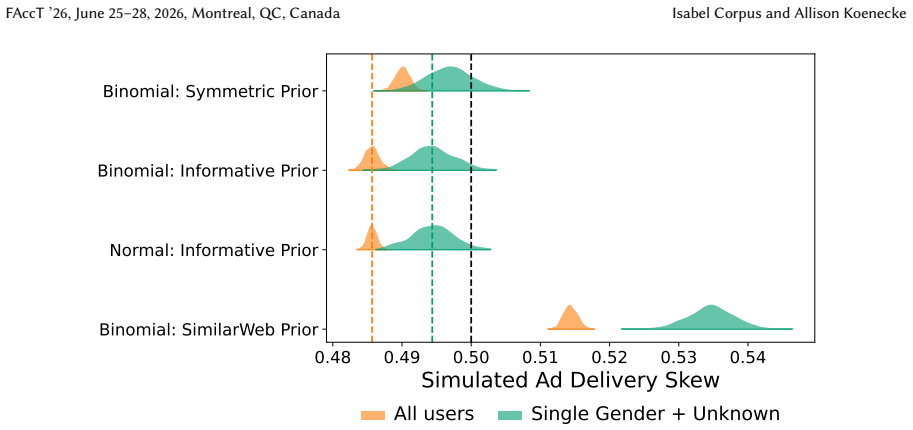
Shoshana Zuboff. 2019. Surveillance Capitalism and the Challenge of Collective Action. New Labor Forum 28, 1 (2019), 10–29. doi:10.1177/1095796018819461 A Supplementary Information A.1 Models for Simulation of Unknown Users In November 2025, SimilarWeb, a platform that aggregates browsing data and data broker reports, reported Google users to be 58% male ...
discussion (0)
Sign in with ORCID, Apple, or X to comment. Anyone can read and Pith papers without signing in.