Recognition: 2 theorem links
· Lean TheoremFeedback vertex sets of planar digraphs with fixed digirth
Pith reviewed 2026-05-13 03:45 UTC · model grok-4.3
The pith
In planar digraphs of digirth g the minimum feedback vertex set has size at most (n-2)/(g-2).
A machine-rendered reading of the paper's core claim, the machinery that carries it, and where it could break.
Core claim
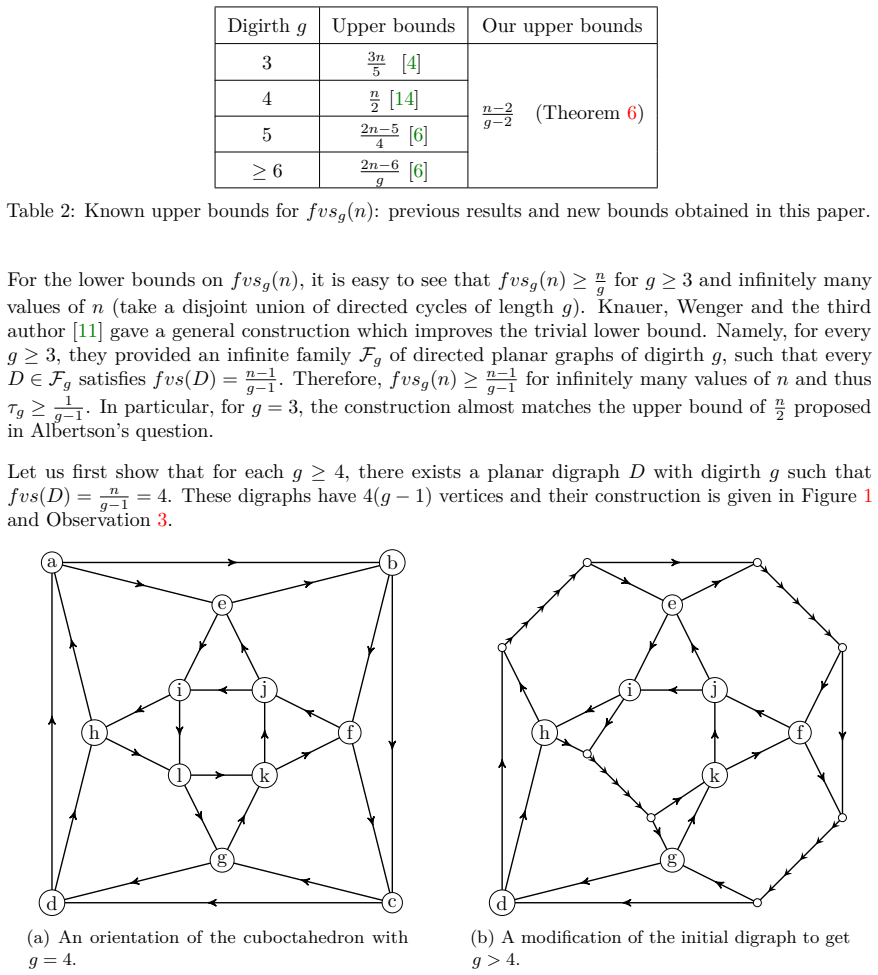
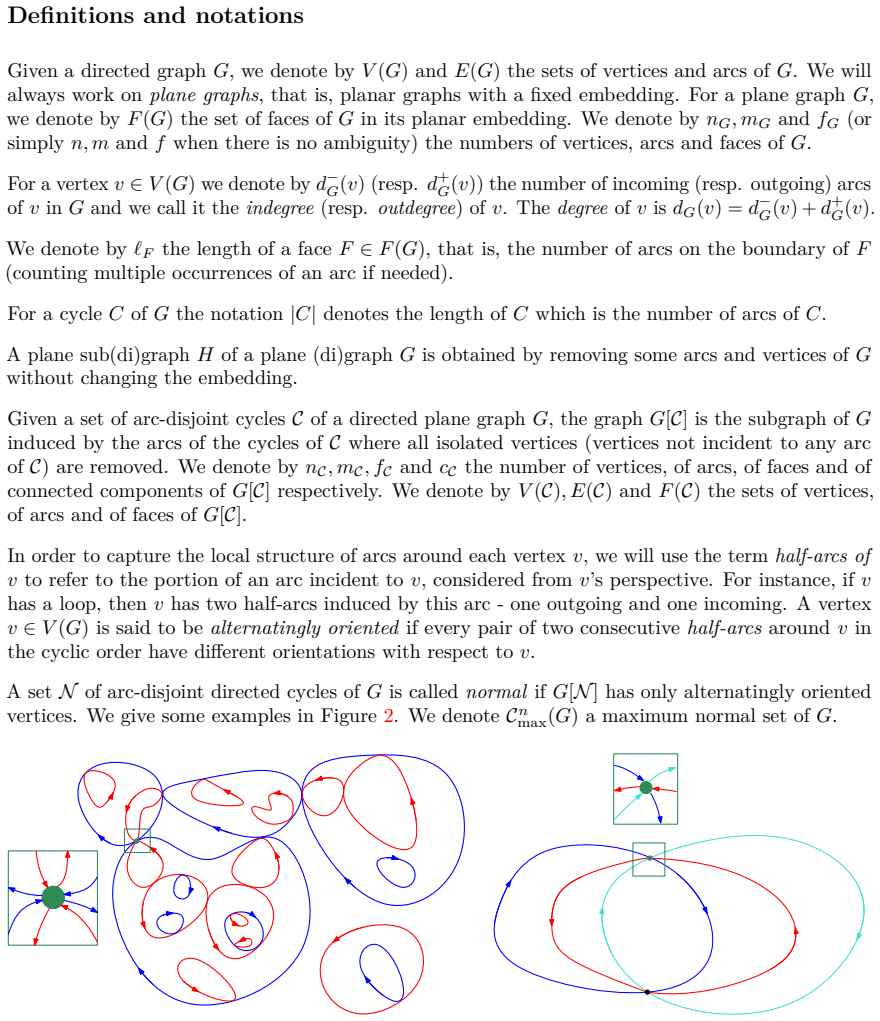
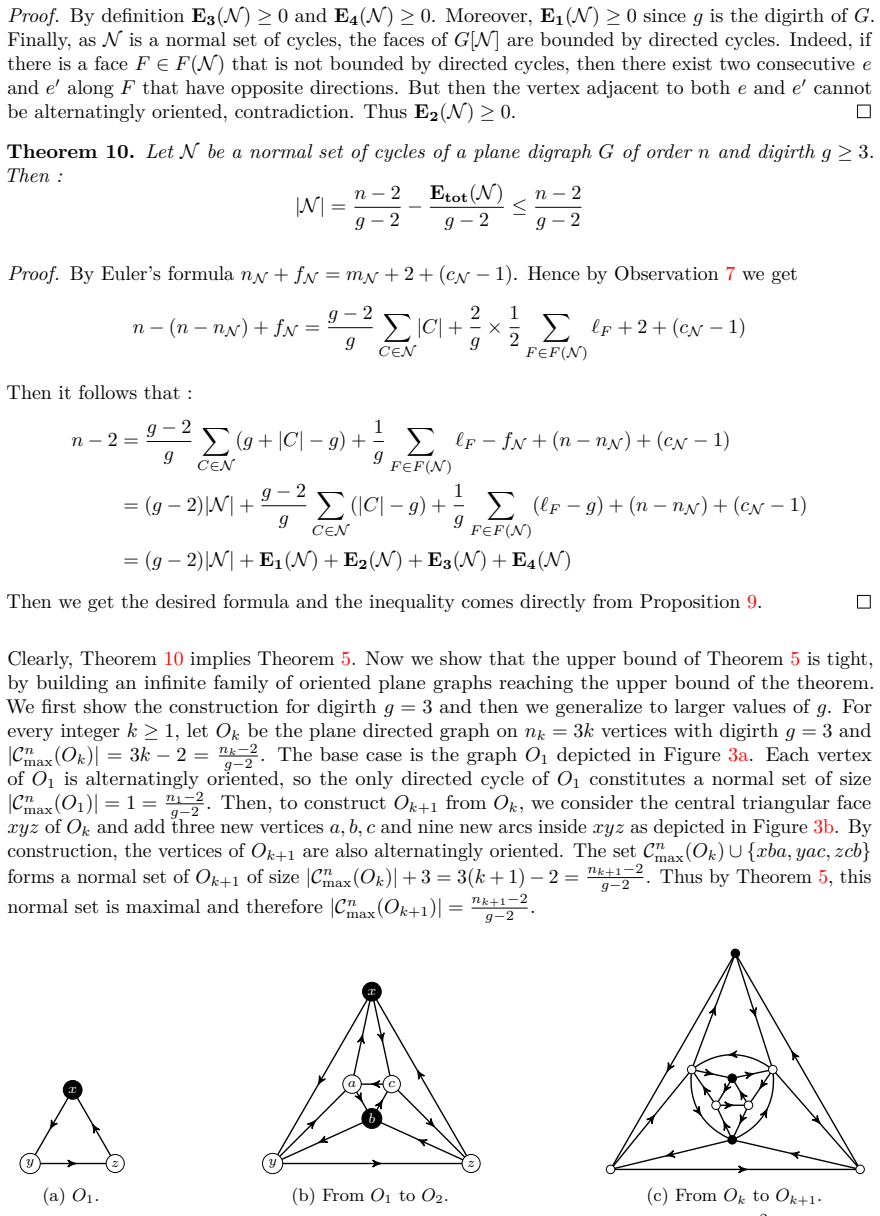
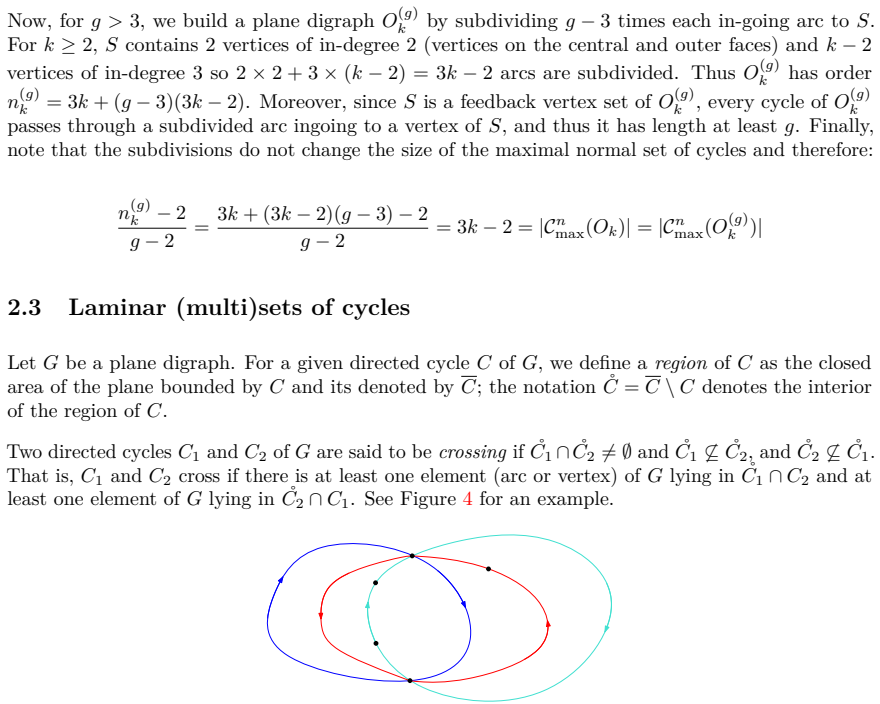
The authors prove that every planar digraph G of digirth g has a feedback vertex set of size at most (n-2)/(g-2). This follows from showing that the minimum size of a feedback vertex set is equal to the maximum number of arc-disjoint directed cycles that can be packed under the planarity constraint, providing a planar-digraph version of the Lucchesi-Younger min-max theorem. The bound is paired with constructions of infinite families of planar digraphs of fixed digirth g that force feedback vertex sets of size roughly n/g.
What carries the argument
The equality between the minimum feedback vertex set and the maximum packing of certain directed cycles in planar digraphs, serving as a planar analogue of the Lucchesi-Younger theorem.
If this is right
- For every g at least 3, the supremum of fvs_g(n)/n over all n is at most 1/(g-2).
- For g at least 6 the same supremum lies between (g+2)/g^2 and 1/(g-2), shrinking the previous gap by a factor of roughly g.
- For g equal to 4 or 5 the new upper bound improves earlier estimates by an additive constant.
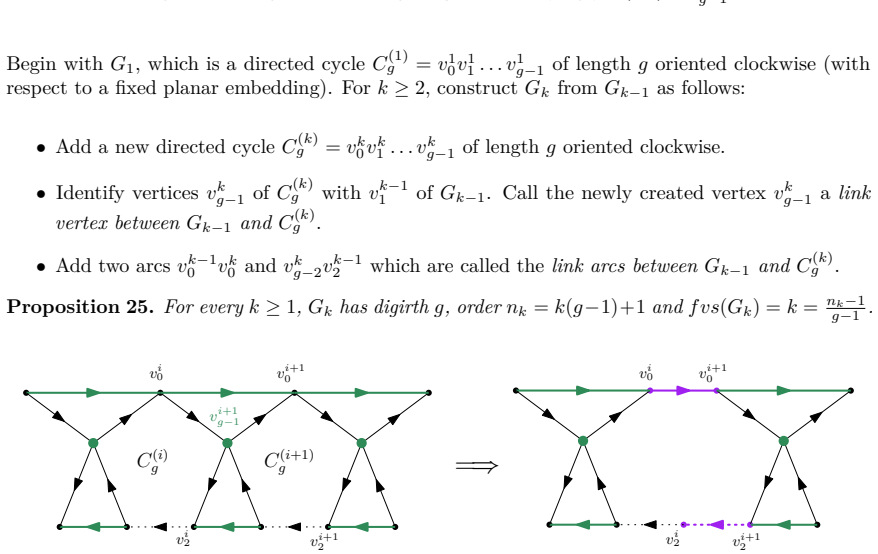
- Infinite families of planar digraphs of any fixed digirth g at least 4 exist whose minimum feedback vertex sets are asymptotically at least (g+2)n/g^2 in size.
Where Pith is reading between the lines
- The min-max equality may hold in digraph classes that are not planar but still forbid certain minors.
- The cycle-connection construction technique could be adapted to produce lower-bound examples in other surface embeddings.
- Computational checks on small instances would directly test whether the equality between feedback vertex set size and cycle packing holds in every planar digraph.
Load-bearing premise
That the minimum feedback vertex set size in a planar digraph is at most the maximum number of arc-disjoint cycles of the special type used in the packing.
What would settle it
A single planar digraph of digirth g in which the smallest feedback vertex set is strictly larger than (n-2)/(g-2), or strictly larger than the maximum size of a packing of the relevant directed cycles.
Figures










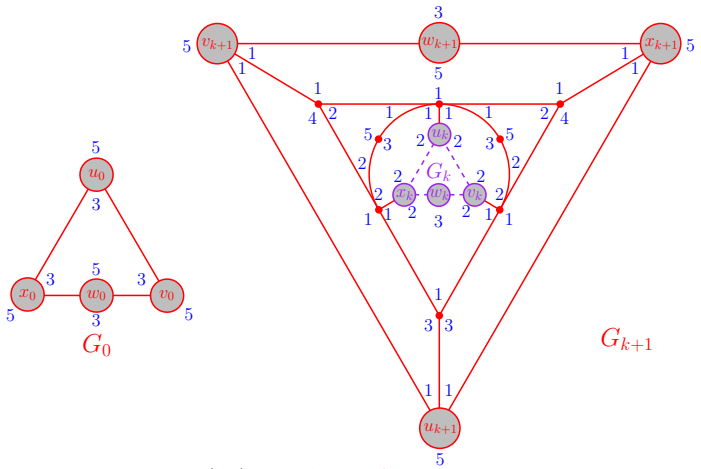



read the original abstract
Let $fvs(G)$ denote the size of a minimum feedback vertex set of a digraph $G$. We study $fvs_g(n)$, which is the maximum $fvs(G)$ over all $n$-vertex planar digraphs $G$ of digirth $g$. It is known in the literature that $\lfloor\frac{n-1}{g-1}\rfloor \le fvs_g(n)$ and $fvs_3(n)\le \frac{3n}{5}$, $fvs_4(n)\le \frac{n}{2}$, $fvs_5(n)\le \frac{2n-5}{4}$ and $\lfloor\frac{n-1}{g-1}\rfloor \le fvs_g(n) \le \frac{2n-6}{g}$ for $g \ge 6$. In particular for $g \ge 6$, $\frac{1}{g-1}\le \sup_{n \ge 1} \frac{fvs_g(n)}{n} \le \frac{2}{g}$. We improve all lower and upper bounds starting with digirth 4. Namely, we show that $fvs_g(n)\le \frac{n-2}{g-2}$ for all $g\geq 3$, by proving that the minimum feedback vertex set is at most the maximum packing of a special type of directed cycles. This last result is a planar-digraph analogue of the celebrated Lucchesi-Younger theorem and is of independent interest. On the other hand, we develop a new tool to construct planar digraphs of fixed digirth and large $fvs$ by connecting arc-disjoint directed cycles. Using it, we provide constructions of infinite families of planar digraphs of digirth $g\ge 4$ and large $fvs$. These constructions together with our upper bound show that $\frac{g+2}{g^2} \le \sup_{n \ge 1} \frac{fvs_g(n)}{n} \le \frac{1}{g-2}$ for all values $g \ge 6$, except $g =7$, for which the lower bound is different. We thus decrease the gap between the lower and the upper bound for $\sup_{n \ge 1} \frac{fvs_g(n)}{n}$ from $\frac{g-2}{g(g-1)}$ to $\frac{4}{g^2(g-2)}$. For $g = 7$ this gap goes from $\frac{5}{42}$ to $\frac{1}{55}$. For digirth 4 and 5, both improvements are by an additive constant.
Editorial analysis
A structured set of objections, weighed in public.
Referee Report
Summary. The manuscript studies the function fvs_g(n), defined as the largest possible size of a minimum feedback vertex set in an n-vertex planar digraph with digirth g. It proves a new upper bound fvs_g(n) ≤ (n-2)/(g-2) for g ≥ 3 by establishing a min-max theorem equating (or bounding) the minimum feedback vertex set size to the maximum packing of certain special directed cycles, which is presented as a planar digraph version of the Lucchesi-Younger theorem. The paper also introduces a construction technique for connecting arc-disjoint directed cycles to create planar digraphs with fixed digirth and large feedback vertex sets, leading to improved lower bounds on the asymptotic ratio sup fvs_g(n)/n for g ≥ 4 and a reduced gap between lower and upper bounds on this ratio.
Significance. If the proofs hold, this paper makes a valuable contribution to extremal graph theory for directed planar graphs. The analogue of the Lucchesi-Younger theorem provides a new structural tool for planar digraphs, and the explicit constructions allow for concrete improvements in the known bounds, narrowing the gap in the density from (g-2)/(g(g-1)) to 4/(g^2(g-2)) for g ≥ 6 (with a special case for g=7). The work is of independent interest due to the cycle packing result.
minor comments (2)
- Abstract: the lower bound for g=7 is described only as 'different' without stating the explicit value; adding the precise expression would improve completeness.
- Section introducing the min-max theorem: the precise definition of the 'special type of directed cycles' should be stated with formal notation immediately upon first use to aid readers.
Simulated Author's Rebuttal
We thank the referee for their positive and accurate summary of our manuscript, as well as for recommending minor revision. The report correctly captures the main results, including the new upper bound via the planar-digraph analogue of the Lucchesi-Younger theorem and the improved constructions narrowing the asymptotic gap.
Circularity Check
No significant circularity
full rationale
The paper proves its key upper bound fvs_g(n) ≤ (n-2)/(g-2) by establishing a new min-max relation (min FVS size ≤ max packing of special directed cycles) that is proved directly in the manuscript as a planar-digraph analogue of Lucchesi-Younger; this is an independent theorem rather than a self-definition or fitted input. Lower-bound constructions rely on explicit arc-disjoint cycle connections whose planarity and exact digirth are verified by direct embedding arguments, not by renaming known results or smuggling ansatzes via self-citation. No load-bearing self-citations, no uniqueness theorems imported from the authors' prior work, and no reduction of any claimed prediction to its own inputs by construction. The derivation chain is self-contained.
Axiom & Free-Parameter Ledger
axioms (1)
- domain assumption Planar digraphs admit embeddings in the plane without arc crossings, and digirth is the length of the shortest directed cycle.
Reference graph
Works this paper leans on
-
[1]
J. Akiyama and M. Watanabe. Maximum induced forests of planar graphs.Graphs and Combinatorics, 3(1):201–202, 1987
work page 1987
-
[2]
M.O. Albertson and D.M. Berman. A conjecture on planar graphs. InGraph Theory and Related Topics (J.A. Bondy and U.S.R. Murty, eds.). Academic Press, 1976
work page 1976
- [3]
-
[4]
O.V. Borodin. On acyclic colorings of planar graphs.Discrete Mathematics, 25(3):211–236, 1979
work page 1979
- [5]
-
[6]
L. Esperet, L. Lemoine, and F. Maffray. Small feedback vertex sets in planar digraphs.Electronic Journal of Combinatorics, 24(2), 2017
work page 2017
-
[7]
M. R. Garey and D. S. Johnson.Computers and Intractability: A Guide to the Theory of NP-Completeness (Series of Books in the Mathematical Sciences). W. H. Freeman, 1979
work page 1979
-
[8]
M. X. Goemans and D. P. Williamson. Primal-dual approximation algorithms for feedback problems in planar graphs.Combinatorica, 18(1):37–59, 1998
work page 1998
-
[9]
R. M. Karp. Reducibility among combinatorial problems. In Raymond E. Miller and James W. Thatcher, editors,Complexity of Computer Computations, pages 85–103. Plenum Press, New York, 1972. 41
work page 1972
-
[10]
T. Kelly and C.-H. Liu. Minimum size of feedback vertex sets of planar graphs of girth at least five.European Journal of Combinatorics, 61:138–150, 2017
work page 2017
- [11]
-
[12]
Ł. Kowalik, B. Lužar, and R. Škrekovski. An improved bound on the largest induced forests for triangle-free planar graphs.Discrete Mathematics & Theoretical Computer Science, 12:87–100, 2010
work page 2010
-
[13]
H. Le. A better bound on the largest induced forests in triangle-free planar graphs.Graphs and Combinatorics, 34:1217–1246, 2018
work page 2018
- [14]
-
[15]
L. Lovász. On two minimax theorems in graph.Journal of Combinatorial Theory, Series B, 21(2):96–103, 1976
work page 1976
-
[16]
C. L. Lucchesi and D. H. Younger. A minimax theorem for directed graphs.Journal of the London Mathematical Society, 2(17):369–374, 1978
work page 1978
-
[17]
B. Mohar. Acyclic partitions of planar digraphs. Problem of the Month, July 2002, July 2002. Accessed: 2025-10-28
work page 2002
-
[18]
V. Neumann-Lara. Vertex colourings in digraphs. some problems. Technical report, University of Waterloo, July 8 1985
work page 1985
-
[19]
E. R. Scheinerman and D. H. Ullman.Fractional Graph Theory: A Rational Approach to the Theory of Graphs. Courier Corporation, 2013
work page 2013
- [20]
-
[21]
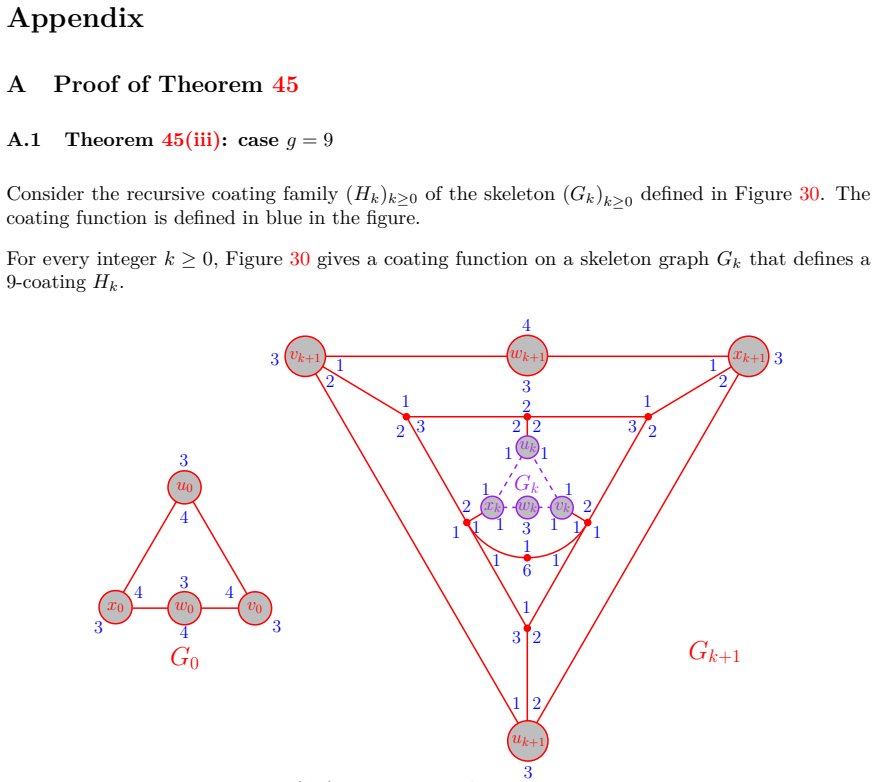
D. B. West. Induced acyclic subgraphs in planar digraphs, 2006.https://dwest.web.illinois. edu/regs/plandifor.html. 42 Appendix A Proof of Theorem 45 A.1 Theorem 45(iii): caseg= 9 Consider the recursive coating family(Hk)k≥0of the skeleton(Gk)k≥0defined in Figure 30. The coating function is defined in blue in the figure. For every integerk≥0, Figure 30 gi...
work page 2006
-
[22]
Ak 2i−1) are identified with vertices of layer 45 0 of the blockBa 2i (resp
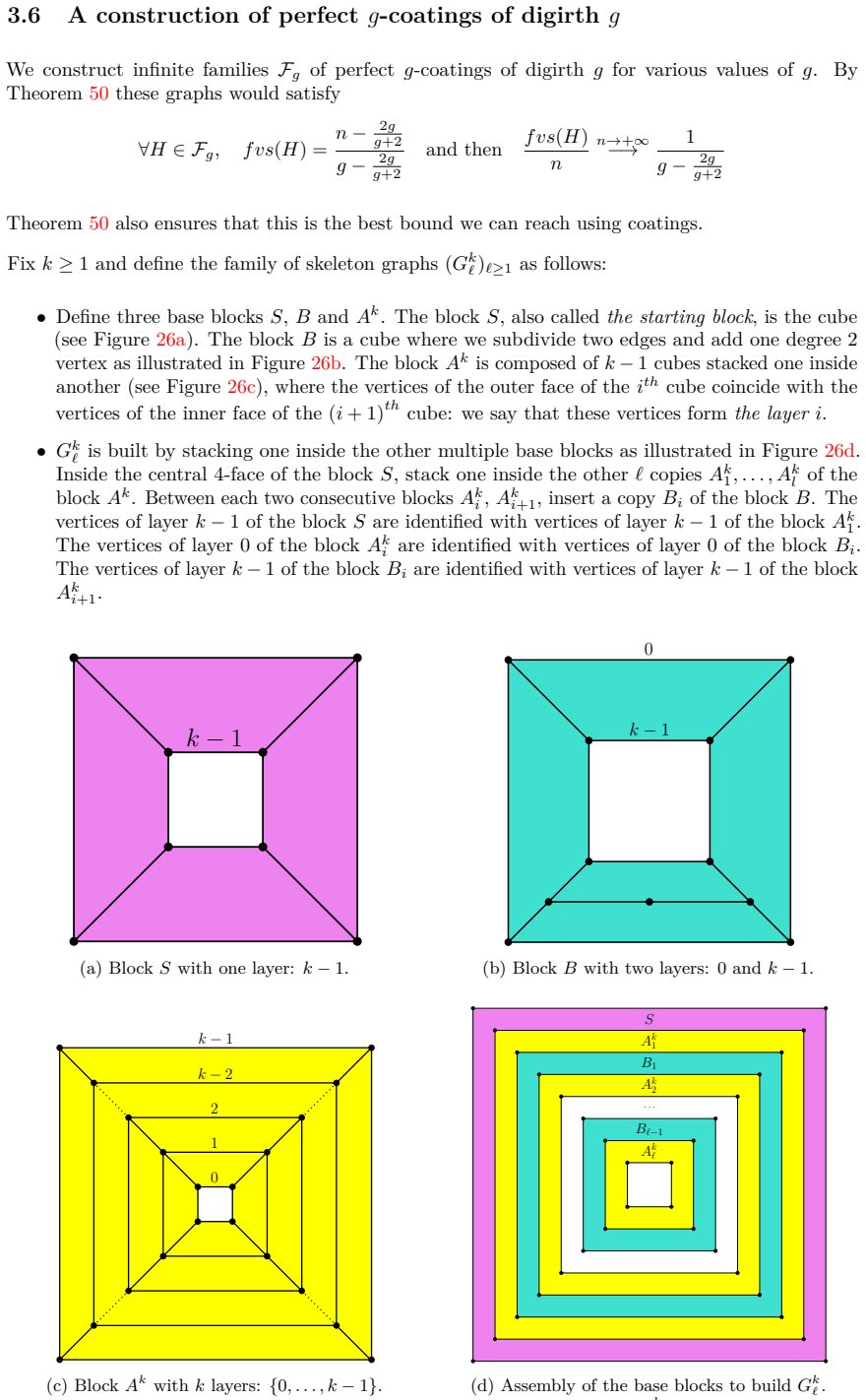
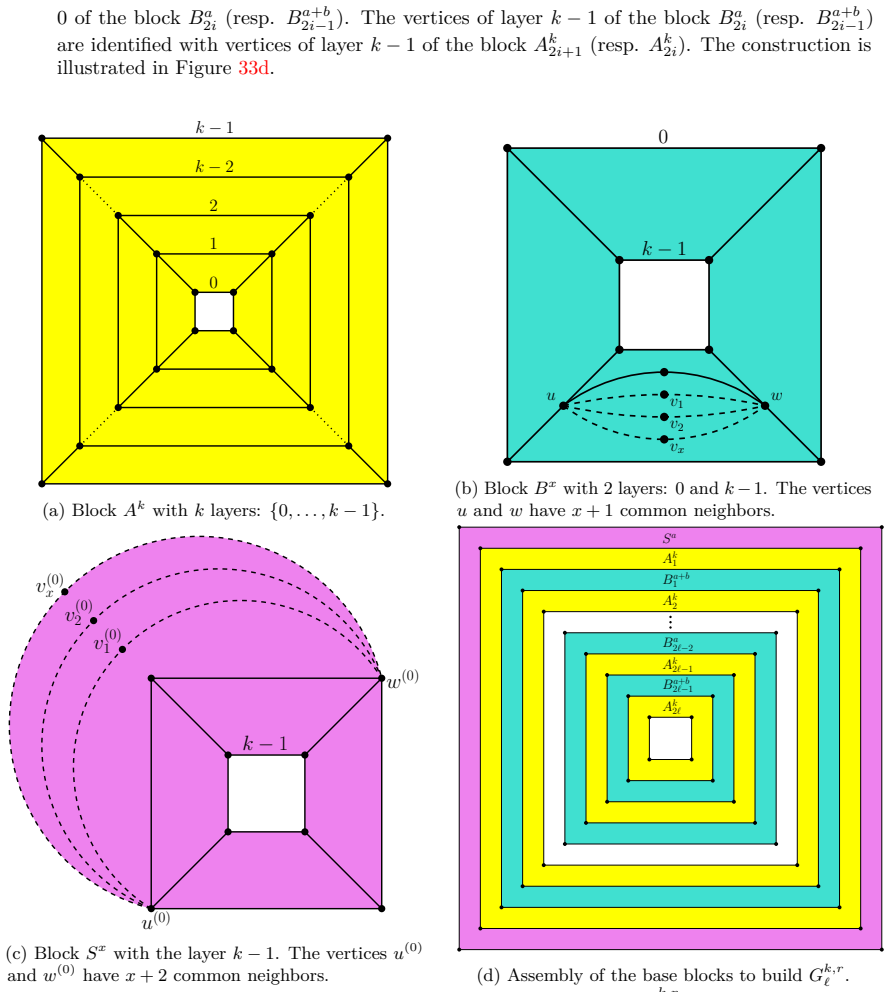
The vertices of layer 0 of the blockAk 2i (resp. Ak 2i−1) are identified with vertices of layer 45 0 of the blockBa 2i (resp. Ba+b 2i−1). The vertices of layerk−1of the block Ba 2i (resp. Ba+b 2i−1) are identified with vertices of layerk−1of the blockAk 2i+1 (resp. Ak 2i). The construction is illustrated in Figure 33d. k − 1 0 1 2 k − 2 (a) BlockA k withk...
-
[23]
Ak 2i) can be identified with a unique edge ofA k 1 (resp.A k 2)
So every edge ofAk 2i−1(resp. Ak 2i) can be identified with a unique edge ofA k 1 (resp.A k 2). •For1 ≤i≤ℓ, every colored blockBa+b 2i−1is identical toBa+b 1 . So every edge ofBa+b 2i−1can be identified with a unique edge ofBa+b 1 . •For1 ≤i≤ℓ−1, every edge in blockBa 2i incident to a vertexv(2i) j (for1 ≤j≤a) can be identified with a unique edge ofSa inc...
-
[24]
Denote byc 1,c 2 the color of the two half-edges offe
To reach the remaining weight 2 g+2, distinguish multiple cases depending on the nature offe. Denote byc 1,c 2 the color of the two half-edges offe. 51 •If fe is inAk 1 or Ak 2 then e is used inTc,x1,x2 when c /∈{c1,c 2}and fe∈{x1,x 2}. Ifb = 0or if {c1,c 2}̸={black,blue}and{c1,c 2}̸={red,green}then it contributes to two trees of weight 1 g+2. If b = 1and...
-
[25]
Thus the total contribution is 2 g+2
From Observation 71(i), this contributes to2k trees of weight b k(g+2). Thus the total contribution is 2 g+2. Thuseis contained in trees ofAof total weight at least 1. HenceAis a 2g g+2-arborization ofGk,r ℓ. Theorem 57 together with Remark 69 show thataf(Gk,r ℓ) = 2g g+2 forg= 8k+ 4 + 2a+b. Finally we can prove Lemma 61. Lemma.For allg≥12, there exists a...
discussion (0)
Sign in with ORCID, Apple, or X to comment. Anyone can read and Pith papers without signing in.