pith. machine review for the scientific record. sign in

arxiv: 2605.12302 · v1 · submitted 2026-05-12 · 🧮 math.AG · math.AC

Recognition: no theorem link

The real Jacobian conjecture for maps with one component having degree 6

B. Or\'efice-Okamoto, F. Braun, F. Fernandes, J. Gwo\'zdziewicz

Pith reviewed 2026-05-13 04:19 UTC · model grok-4.3

classification 🧮 math.AG math.AC
keywords real Jacobian conjecturepolynomial mapsinjectivityJacobian determinantreal planedegree 6algebraic geometry
0
0 comments X

The pith

Polynomial maps from the real plane to itself with one component of degree 6 and non-vanishing Jacobian determinant are injective.

A machine-rendered reading of the paper's core claim, the machinery that carries it, and where it could break.

The paper establishes that any polynomial map F = (p, q) from R² to R² with the degree of p equal to 6 and with Jacobian determinant nowhere zero must be injective. This result extends a sequence of earlier theorems that handled the same statement for degrees up to 5. A sympathetic reader cares because the real Jacobian conjecture asserts that a non-vanishing Jacobian for polynomial maps R² to R² forces the map to be bijective; settling injectivity up to degree 6 therefore narrows the remaining cases. The argument proceeds by combining algebraic properties of real polynomials with topological facts about the plane to rule out non-injective behavior at this specific degree.

Core claim

If F = (p, q) : R² → R² is a polynomial map such that the degree of p is 6 and the Jacobian determinant is nowhere zero, then F is injective. Combined with previous results in the literature, this guarantees that the real Jacobian conjecture holds in the plane whenever one of the coordinate functions has degree smaller than 7.

What carries the argument

The non-vanishing Jacobian determinant for a degree-6 polynomial in one coordinate, which is shown to imply global injectivity on the real plane by reduction to lower-degree cases via algebraic and topological constraints.

Load-bearing premise

The correctness of earlier injectivity results for polynomial maps of degree at most 5 together with standard facts about real polynomials and the topology of the plane.

What would settle it

An explicit pair of polynomials p of degree 6 and q such that the Jacobian determinant never vanishes yet two distinct points in R² are sent to the same image point.

Figures
Figures reproduced from arXiv: 2605.12302 by B. Or\'efice-Okamoto, F. Braun, F. Fernandes, J. Gwo\'zdziewicz.

Figure 1
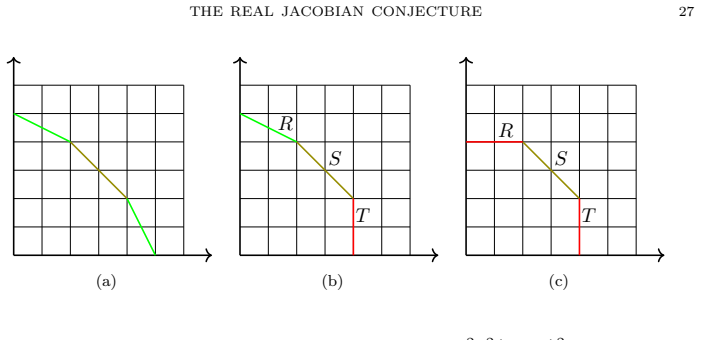
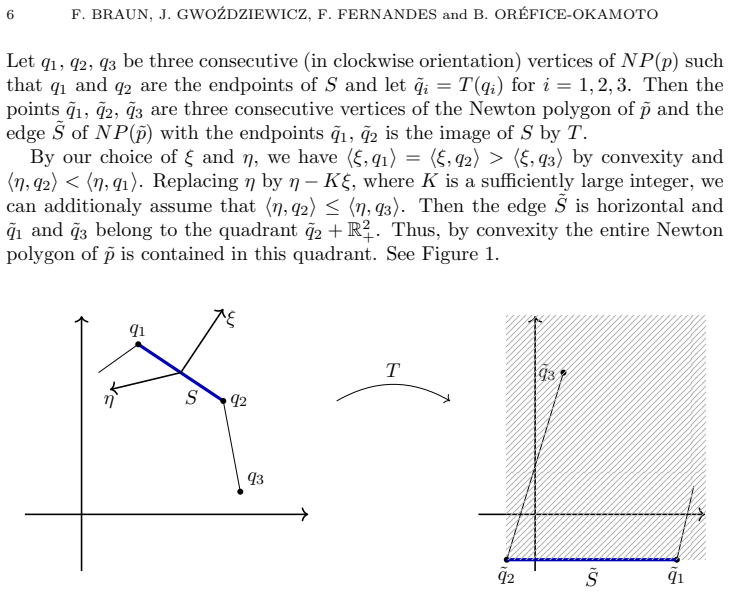
Figure 1. Figure 1: The Newton polygons of p and of ˜p. The edge S˜ is the Newton polygon of pS ◦ σ. Moreover by (6) and (7) we get (pS ◦ σ)(u, v) = u −Av −B Y k i=1 (u − ci) νi for suitable A, B ∈ Z. By convexity argument the origin (0, 0) = T (0, 0) belongs to ˜q2 + R 2 +, so A ≥ 0. Since (0, 0) does not belong to the line containing S, we get that (0, 0) does not belong to the line containing S˜ and consequently B > 0. Sum… view at source ↗
Figure 2
Figure 2. Figure 2: The Newton polygon of p(x, y) [PITH_FULL_IMAGE:figures/full_fig_p010_2.png] view at source ↗
Figure 3
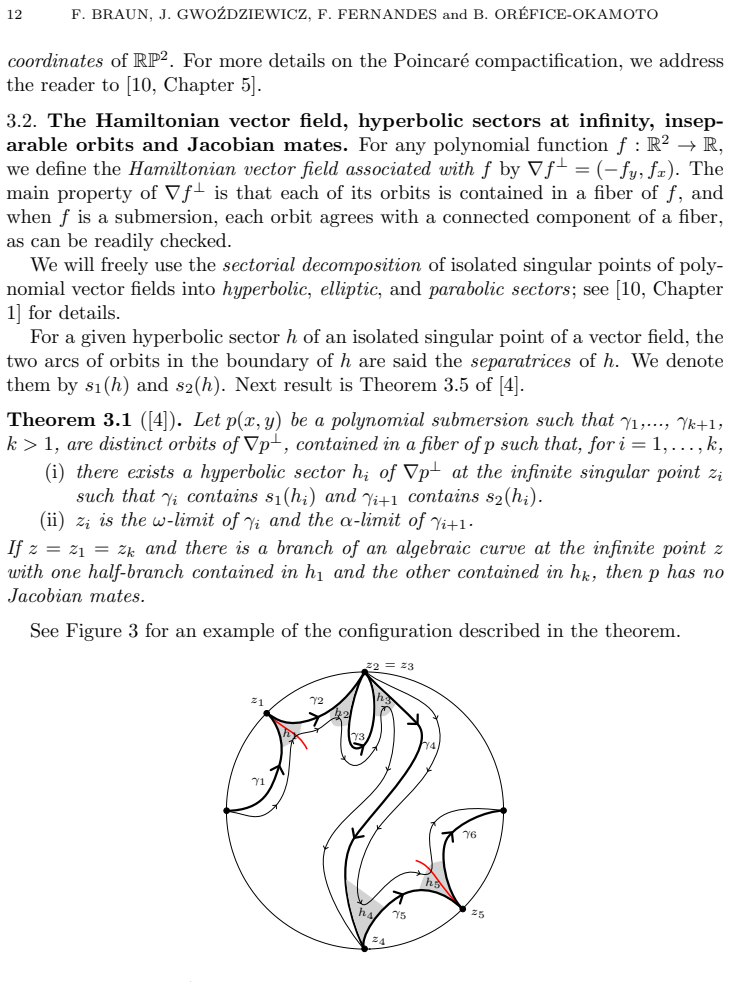
Figure 3. Figure 3: A chain of hyperbolic sectors h1, . . . , h5 representing conditions (i) and (ii) of theorem 3.1. In red the half-branches of an algebraic curve entering both h1 and h5, representing the last assumption of that theorem Theorem 3.1 will be one of the essential tools we shall use in Section 5, but it is quite difficult to check its hypotheses for a given polynomial submersion. We therefore develop some suffi… view at source ↗
Figure 4
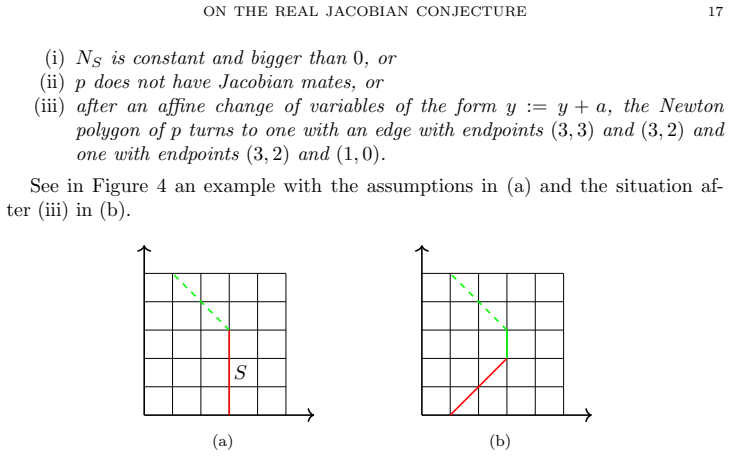
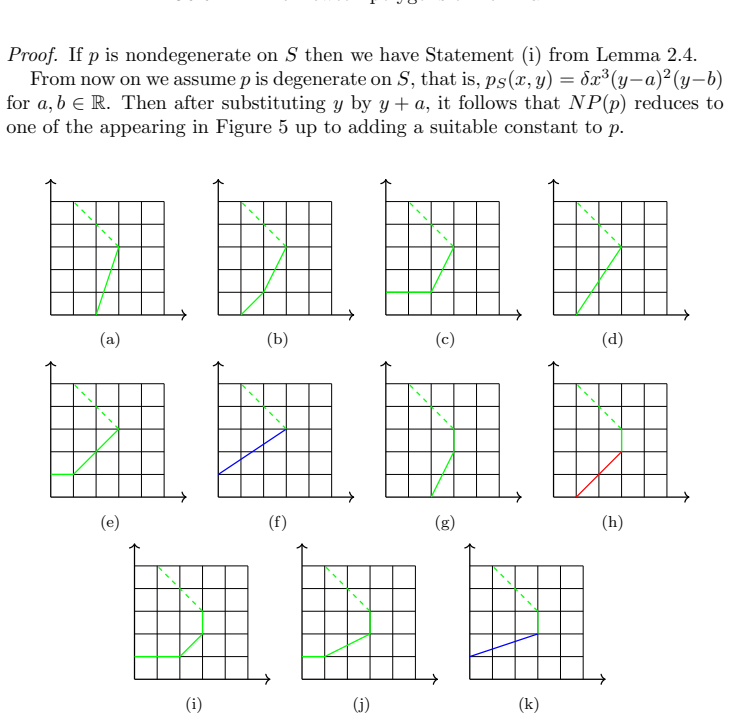
Figure 4. Figure 4: The Newton polygons of Lemma 4.4. Proof. If p is nondegenerate on S then we have Statement (i) from Lemma 2.4. From now on we assume p is degenerate on S, that is, pS(x, y) = δx3 (y−a) 2 (y−b) for a, b ∈ R. Then after substituting y by y + a, it follows that NP(p) reduces to one of the appearing in [PITH_FULL_IMAGE:figures/full_fig_p017_4.png] view at source ↗
Figure 5
Figure 5. Figure 5: The proof of Lemma 4.4. The cases (a), (b), (c), (d), (g), and (i) will provide Statement (i) because of the following remark: let ˜p be the polynomial p after the application of the substi￾tution y → y + a, that is, ˜p(x, y) = p(x, y + a), and let γ(t) = (x(t), y(t)) be the parametrization of any branch of ˜p = c at infinity associated with an edge with outer [PITH_FULL_IMAGE:figures/full_fig_p017_5.png] view at source ↗
Figure 6
Figure 6. Figure 6: Newton polygon when deg h = 4 [PITH_FULL_IMAGE:figures/full_fig_p019_6.png] view at source ↗
Figure 7
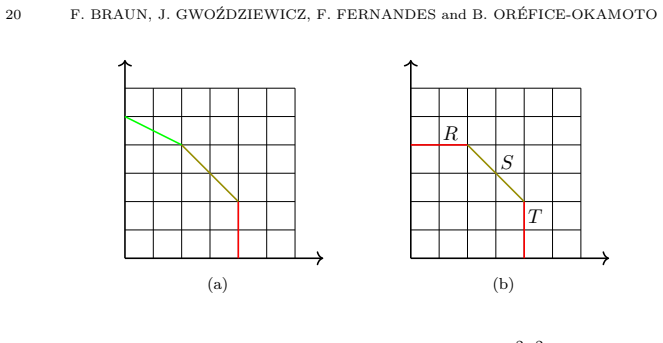
Figure 7. Figure 7: Newton polygons when deg h = 3. on the olive edge, which has 4 lattice points, it follows by Lemma 2.4 that N(c) is constant bigger than 1, so that p cannot be a submersion. In case (ii), p has no Jacobian mates. Finally, in case (iii), the Newton polygon of p can be reduced to the one as in (b) of [PITH_FULL_IMAGE:figures/full_fig_p019_7.png] view at source ↗
Figure 8
Figure 8. Figure 8: When deg h = 3 and p+ = x 2y 2h. in the figure. If NR or NT is constant then we apply Lemma 4.3 once more to conclude that p has no Jacobian mates. If both are nonconstant, then Theorem 4.1 makes us conclude that R NR dχ ≤ 0 and R NT dχ ≤ 0. Since NS is constant and equal to 0 or 2 by Lemma 2.4, it follows from the equality Z (NR + NS + NT ) dχ = −1, given by Corollary 2.8, that, up to symmetry, Z NR dχ = … view at source ↗
Figure 9
Figure 9. Figure 9: When deg h = 3 and p+ = y 4h [PITH_FULL_IMAGE:figures/full_fig_p020_9.png] view at source ↗
Figure 10
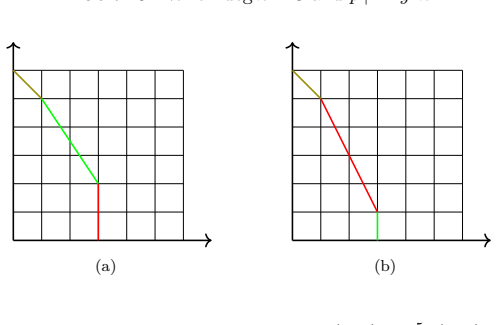
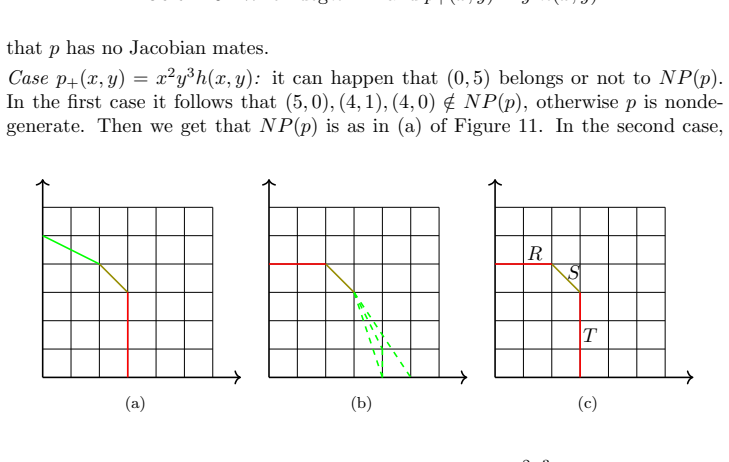
Figure 10. Figure 10: When deg h = 1 and p+(x, y) = y 5h(x, y). that p has no Jacobian mates. Case p+(x, y) = x 2y 3h(x, y): it can happen that (0, 5) belongs or not to NP(p). In the first case it follows that (5, 0),(4, 1),(4, 0) ∈/ NP(p), otherwise p is nonde￾generate. Then we get that NP(p) is as in (a) of [PITH_FULL_IMAGE:figures/full_fig_p021_10.png] view at source ↗
Figure 11
Figure 11. Figure 11: When deg h = 1 and p+ = x 2y 3h. that is (0, 5) ∈/ NP(p), it follows that the possible degenerate Newton polygons of p are the three ones represented in (b) or the one in (c) of [PITH_FULL_IMAGE:figures/full_fig_p021_11.png] view at source ↗
Figure 12
Figure 12. Figure 12: Reductions. We now analyze case (c) of [PITH_FULL_IMAGE:figures/full_fig_p022_12.png] view at source ↗
Figure 13
Figure 13. Figure 13: When deg h = 0 and p+ = y 6 . (3, 2) ∈/ NP(p), it follows that p is nondegenerate, or NP(p) is as in (b) or (c) of [PITH_FULL_IMAGE:figures/full_fig_p022_13.png] view at source ↗
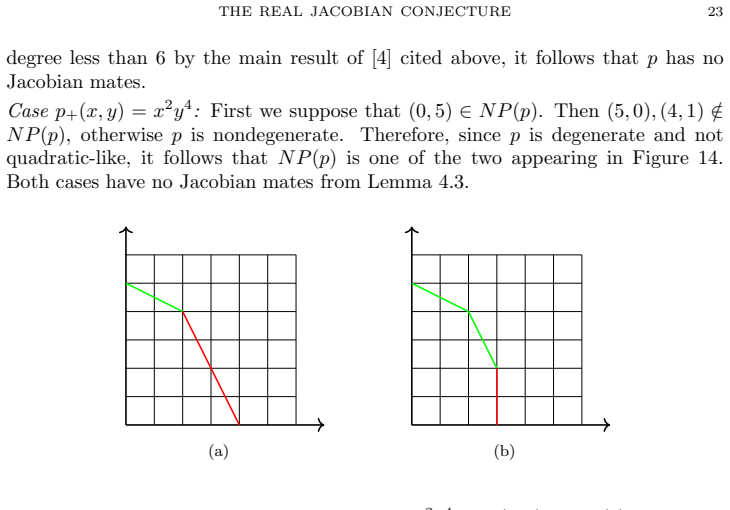
Figure 14
Figure 14. Figure 14: When deg h = 0, p+ = x 2y 4 and (0, 5) ∈ NP(p). Now we assume that (0, 5) ∈/ NP(p). Then the possible NP(p) with p not being quadratic-like are the ones of [PITH_FULL_IMAGE:figures/full_fig_p023_14.png] view at source ↗
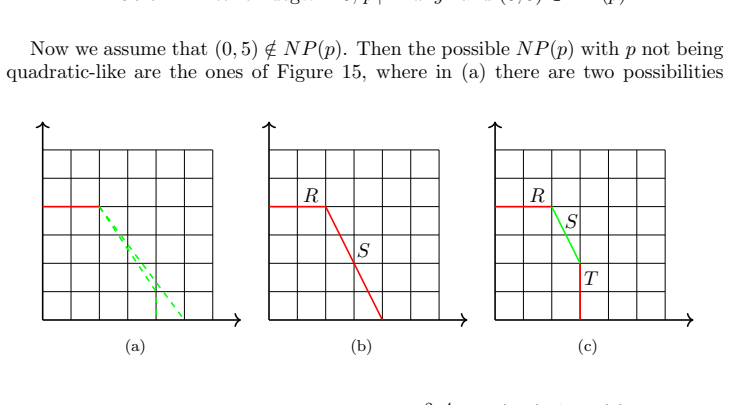
Figure 15
Figure 15. Figure 15: When deg h = 0, p+ = x 2y 4 and (0, 5) 6∈ NP(p). drawn in the figure, both of them have no Jacobian mates by Lemma 4.3. As for the case (b), we can assume that both NR and NS are not constant, otherwise we apply Lemma 4.3 to conclude that p has no Jacobian mates. Therefore, it follows from Theorem 4.1 that NR is of type 0b12 and NS is of type 0b22. By applying Corollary 2.8, it follows that b1 + b2 > 0 so… view at source ↗
Figure 16
Figure 16. Figure 16: cR = cT = 0. Here we draw the values c < 0 in red, c = 0 in black, and c > 0 in blue. In (b) and (c) we draw two possible foliations coming from (a) [PITH_FULL_IMAGE:figures/full_fig_p024_16.png] view at source ↗
Figure 17
Figure 17. Figure 17: 0 = cR < cT = 1. Here we draw the values c < 0 in red, c = 0 in black, 0 < c < 1 in blue, c = 1 in green, and c > 1 in magenta. we similarly use the expressions of the second coordinates of the parametrizations [PITH_FULL_IMAGE:figures/full_fig_p025_17.png] view at source ↗
Figure 18
Figure 18. Figure 18: When deg h = 0 and p+ = x 3 y 3 . possibilities of case (a), we apply lemmas 4.4 and 4.3 in sequence to conclude that p has no Jacobian mates. Now we deal with case (b). If NR or NS is constant, then after application of lemmas 4.4 and 4.3 in sequence, we conclude that p has no Jacobian mates. So we assume that both are not constant. Then after two further applications of Lemma 4.4, it follows that p has … view at source ↗
Figure 19
Figure 19. Figure 19: Reduction of case (b) of [PITH_FULL_IMAGE:figures/full_fig_p026_19.png] view at source ↗
Figure 20
Figure 20. Figure 20: When deg h = 0 and p+ = x 2y 2 (x + y) 2 edge. In case (a), Lemma 4.3 applies to show that p has no Jacobian mates. In case (b), by the same Lemma 4.3, we can assume that NS and NT are not constant, so by Theorem 4.1 it follows that NS is of type 0bS2 and NT is of type 0bT2, with bS, bT ≤ 2. By Lemma 2.4, NR ≡ 1 so by Corollary 2.8 it follows that R NS + NT dχ = 0, forcing that bS = bT = 2. By letting cS … view at source ↗
read the original abstract

We show that if $F=(p,q):\mathbb R^2\to \mathbb R^2$ is a polynomial map such that the degree of $p$ is $6$ and whose Jacobian determinant is nowhere zero, then $F$ is injective. This together with previous works in the literature, guarantees the validity of the real Jacobian conjecture in the plane provided that one of the coordinate functions of the map has degree smaller than $7$.

Editorial analysis

A structured set of objections, weighed in public.

Desk editor's note, referee report, simulated authors' rebuttal, and a circularity audit. Tearing a paper down is the easy half of reading it; the pith above is the substance, this is the friction.

Referee Report

0 major / 0 minor

Summary. The manuscript proves that if F=(p,q):R²→R² is a polynomial map with deg(p)=6 and Jacobian determinant nowhere zero, then F is injective. Combined with prior results for degrees ≤5, this establishes the real Jacobian conjecture in the plane whenever one coordinate function has degree at most 6.

Significance. If the result holds, it constitutes a solid incremental advance on the real Jacobian conjecture by resolving the degree-6 case via case analysis of leading homogeneous parts, topological arguments at infinity, and factorization in R[x,y]. The approach relies on standard facts about real polynomial rings and the topology of the plane together with earlier theorems, without introducing free parameters, ad-hoc axioms, or circular derivations.

Simulated Author's Rebuttal

0 responses · 0 unresolved

We thank the referee for the positive assessment of our manuscript and the recommendation for minor revision. The report correctly summarizes the main result: that a polynomial map F = (p, q) : R² → R² with deg(p) = 6 and nowhere-vanishing Jacobian determinant is injective, which together with earlier results for degrees at most 5 settles the real Jacobian conjecture in the plane when one coordinate has degree at most 6. No specific major comments were raised in the report.

Circularity Check

0 steps flagged

No significant circularity detected

full rationale

The paper proves injectivity for polynomial maps F=(p,q) with deg(p)=6 and non-vanishing Jacobian by reducing to topological properness at infinity and algebraic factorization in R[x,y], then invoking independent prior theorems for degrees ≤5. These priors are external results whose statements do not depend on the present work. No step equates a derived quantity to its own input by definition, renames a fitted parameter as a prediction, or relies on a self-citation chain that is itself unverified. The logical chain is grounded in standard facts about real polynomials and plane topology, making the derivation self-contained.

Axiom & Free-Parameter Ledger

0 free parameters · 2 axioms · 0 invented entities

The central claim rests on standard facts about real polynomials and the topology of the plane together with previously published theorems for lower degrees. No new free parameters, ad-hoc axioms, or invented entities are introduced.

axioms (2)
  • standard math The Jacobian determinant of a polynomial map is a polynomial and therefore either identically zero or zero only on a lower-dimensional set.
    Invoked implicitly when the hypothesis 'Jacobian determinant nowhere zero' is used to conclude global injectivity.
  • domain assumption Prior results establishing the real Jacobian conjecture for maps with maximum degree ≤5.
    The abstract explicitly states that the new theorem plus those earlier works together cover all cases with one component of degree <7.

pith-pipeline@v0.9.0 · 5378 in / 1297 out tokens · 86399 ms · 2026-05-13T04:19:47.990075+00:00 · methodology

discussion (0)

Sign in with ORCID, Apple, or X to comment. Anyone can read and Pith papers without signing in.

Reference graph

Works this paper leans on

23 extracted references · 23 canonical work pages

  1. [1]

    Bia/suppress lynicki-Birula and M

    A. Bia/suppress lynicki-Birula and M. Rosenlicht, Injective morphisms of real algebraic varieties , Proc. Amer. Math. Soc. 13 (1962), 200–203

  2. [2]

    Braun and F

    F. Braun and F. Fernandes , Very degenerate polynomial submersions and counterexampl es to the real Jacobian conjecture , J. Pure Appl. Algebra 227 (2023), 107345, 10pp

  3. [3]

    Braun, F

    F. Braun, F. Fernandes, and I.S. Meza-Sarmiento , Foliations raised by quadratic-like polynomial submersions on the real plane and a sharp result o n the real Jacobian conjecture , J. Differential Equations 449 (2025), 113742, 27pp. 28 F. BRAUN, J. GWO ´ZDZIEWICZ, F. FERNANDES and B. OR ´EFICE-OKAMOTO

  4. [4]

    Braun, F

    F. Braun, F. Fernandes, and B. Or ´efice-Okamoto, Injectivity of polynomial maps and foliations in the real plane , Nonlinear Anal. TMA 250 (2025), 113645, 27pp

  5. [5]

    Braun and B

    F. Braun and B. Or ´efice-Okamoto, On polynomial submersions of degree 4 and the real Jacobian conjecture in R2, J. Math. Anal. Appl. 443 (2016), 688–706

  6. [6]

    Braun, J.R

    F. Braun, J.R. dos Santos Filho, and M.A. Teixeira , Foliations, solvability, and global injectivity, Arch. Math. 119 (2022), 649–665

  7. [7]

    Braun and C

    F. Braun and C. V alls , A weight-homogenous condition to the real Jacobian conject ure in R2, Proc. Edinb. Math. Soc. 64 (2021), 1028–1036

  8. [8]

    Campbell , The asymptotic variety of a Pinchuk map as a polynomial curve , Appl

    L.A. Campbell , The asymptotic variety of a Pinchuk map as a polynomial curve , Appl. Math. Lett. 24 (2011), 62–65

  9. [9]

    A. Cima, A. Gasull, and F. Ma ˜nosas, On polynomial Hamiltonian planar vector fields , J. Differential Equations 106 (1993), 367–383

  10. [10]

    Dumortier, J

    F. Dumortier, J. Llibre, and J.C. Art ´es, Qualitative theory of planar differential systems , Universitext. Springer-Verlag, Berlin 2006, xvi+298pp

  11. [11]

    Fernandes , A new class of non-injective polynomial local diffeomorphis ms on the plane , J

    F. Fernandes , A new class of non-injective polynomial local diffeomorphis ms on the plane , J. Math. Anal. Appl. 507 (2021), 125736, 5pp

  12. [12]

    Gwo ´zdziewicz, Real Jacobian pairs with components of low degrees , Ann

    J. Gwo ´zdziewicz, Real Jacobian pairs with components of low degrees , Ann. Polon. Math. 135 (2025), 185–194

  13. [13]

    Gwo ´zdziewicz, Real Jacobian mates , Ann

    J. Gwo ´zdziewicz, Real Jacobian mates , Ann. Polon. Math. 117 (2016), 207–213

  14. [14]

    Gwo ´zdziewicz The index at infinity of a polynomial in two variables , Univ

    J. Gwo ´zdziewicz The index at infinity of a polynomial in two variables , Univ. Iagel. Acta Math. 47 (2009), 243–247

  15. [15]

    Gwo ´zdziewicz, The real Jacobian conjecture for polynomials of degree 3, Ann

    J. Gwo ´zdziewicz, The real Jacobian conjecture for polynomials of degree 3, Ann. Polon. Math. 76 (2001), 121–125

  16. [16]

    H ¨ormander, The analysis of linear partial differential operators III: P seudo-differential operators, Springer Science & Business Media, 2007, xv+525pp

    L. H ¨ormander, The analysis of linear partial differential operators III: P seudo-differential operators, Springer Science & Business Media, 2007, xv+525pp

  17. [17]

    Jarque and J

    X. Jarque and J. Llibre , Polynomial foliations of R2, Pac. J. Math. 197 (2001), 53–72

  18. [18]

    Koll ´ar, Lectures on resolution of singularities , Princeton University Press, 2009, vi+208 pp

    J. Koll ´ar, Lectures on resolution of singularities , Princeton University Press, 2009, vi+208 pp

  19. [19]

    Oka , Note on estimation of the number of the critical values at infinity , in: W orkshop on Geometry and Topology, Hanoi, 1993, in: Kod ai Math

    Le V an Thanh Le and M. Oka , Note on estimation of the number of the critical values at infinity , in: W orkshop on Geometry and Topology, Hanoi, 1993, in: Kod ai Math. J., 17 (1994), 409–419

  20. [20]

    Milnor , Singular Points of Complex Hypersurfaces, Annals of Mathe matics Studies 61, Princeton University Press, 1968, iii+122pp

    J. Milnor , Singular Points of Complex Hypersurfaces, Annals of Mathe matics Studies 61, Princeton University Press, 1968, iii+122pp

  21. [21]

    Pinchuk , A counterexample to the strong real Jacobian conjecture , Math

    S. Pinchuk , A counterexample to the strong real Jacobian conjecture , Math. Z. 217 (1994), 1–4

  22. [22]

    Se ¸kalski, The degree at infinity of the gradient of a polynomial in two re al variables , Ann

    M. Se ¸kalski, The degree at infinity of the gradient of a polynomial in two re al variables , Ann. Polon. Math. 87 (2005), 229–235

  23. [23]

    Tib ˘ar and A

    M. Tib ˘ar and A. Zaharia , Asymptotic behaviour of families of real curves , Manuscripta Math. 99 (1999), 383–393. ∗ Departamento de Matem´atica, Universidade Federal de S ˜ao Carlos, 13565–905 S ˜ao Carlos, S ˜ao Paulo, Brazil Email address : franciscobraun@ufscar.br Email address : brunaorefice@ufscar.br † Universidade do Distrito Federal Jorge Amaury,...