Recognition: 2 theorem links
· Lean TheoremAn analytical approach to calculating stationary PDFs for reflected random walks with an application to BESS-based ramp-rate control
Pith reviewed 2026-05-13 03:20 UTC · model grok-4.3
The pith
An exact analytical solution for the stationary PDF of a reflected random walk is derived from a Wiener-Hopf integral equation using a Neumann series.
A machine-rendered reading of the paper's core claim, the machinery that carries it, and where it could break.
Core claim
The central claim is that the stationary PDF of the reflected random walk can be found by solving a derived Wiener-Hopf-type integral equation with an analytical Neumann series solution, which is then used to analyze BESS power for ramp-rate control.
What carries the argument
The Wiener-Hopf-type integral equation for the stationary PDF solved by Neumann series.
If this is right
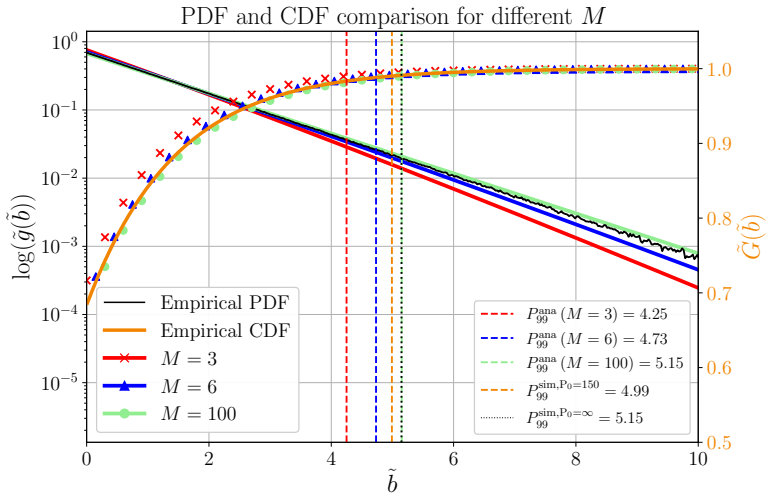
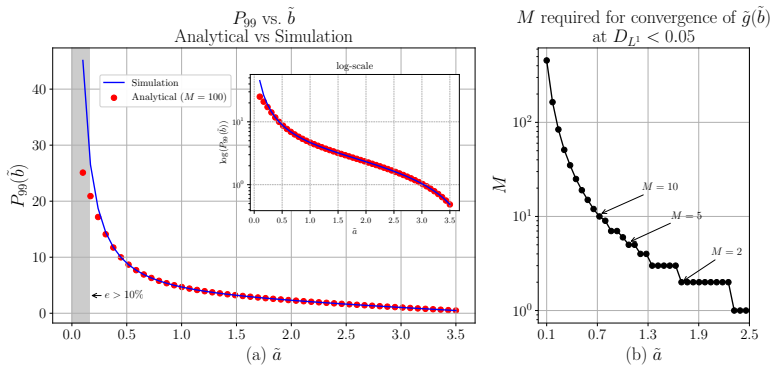
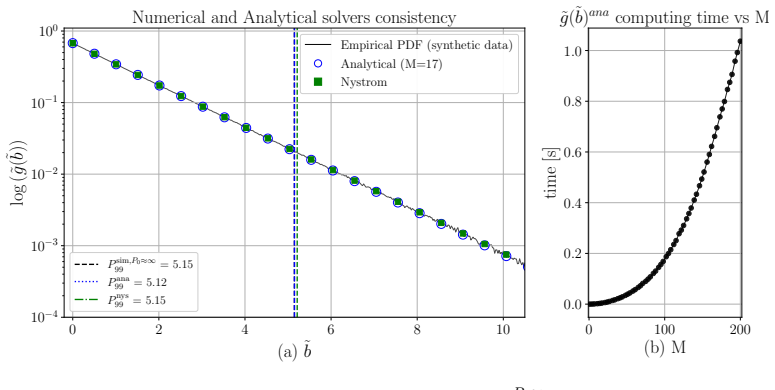
- The analytical solution agrees with numerical Nystrom method and simulation results.
- Truncated versions yield simplified design rules for BESS inverter sizing.
- General insights into sizing criteria for storage systems in VRE ramp-rate control are obtained.
- The method provides an alternative to pure numerical or simulation-based approaches.
Where Pith is reading between the lines
- The approach could be used to derive sensitivity of the stationary distribution to model parameters for better optimization of BESS.
- Similar methods might apply to other Markov processes with reflection in engineering applications.
- Exact analytical forms enable probabilistic assessments of ramp compliance in renewable systems.
Load-bearing premise
The BESS power dynamics are accurately captured by the chosen reflected random walk Markov kernel whose transition probabilities are independent of the stationary distribution.
What would settle it
Significant discrepancy between the Neumann series results and those from the Nystrom method or from direct simulation of the input time series would falsify the analytical solution.
Figures


read the original abstract
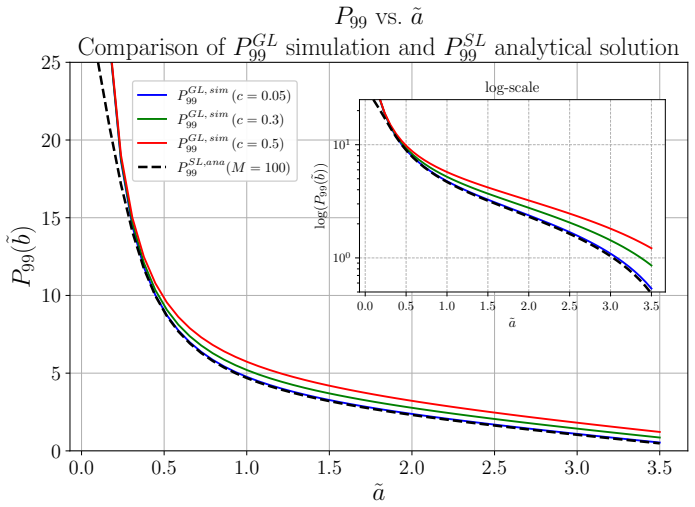
A Wiener-Hopf-type integral equation for the stationary PDF of a reflected random walk is derived rigorously based on modern probability theory, and an application to battery energy storage systems (BESS), specifically the sizing of the inverter, is discussed in depth. The methodological steps include the construction of a Markov kernel, the derivation of a Fredholm integral equation of the second kind for the PDF of the BESS power, and an analytical solution of the equation based on a Neumann series. The analytical results were compared against numerical solutions obtained with the Nystrom method, as well as against the results of an algorithmic simulation using simulated input time series. The use of truncated versions of the analytic solution allows for the construction of simplified design rules for the power systems practitioner. General insights into inverter sizing criteria of storage systems for ramp-rate control of variable renewable energy (VRE) sources such as wind and solar are provided.
Editorial analysis
A structured set of objections, weighed in public.
Referee Report
Summary. The paper derives a Wiener-Hopf-type integral equation for the stationary PDF of a reflected random walk from a Markov kernel constructed via modern probability theory, solves the resulting Fredholm equation of the second kind analytically using a Neumann series, and applies the truncated series to obtain simplified design rules for inverter sizing in BESS-based ramp-rate control of VRE sources. Analytical results are compared to Nyström numerical solutions and algorithmic simulations on simulated time series.
Significance. If the derivation and modeling assumptions hold, the work supplies an analytical framework for stationary distributions of reflected random walks that can yield practical, truncated closed-form approximations for power-system design. The internal consistency checks against Nyström methods and direct simulation are a clear strength, as is the explicit construction of the Markov kernel from first principles without fitted parameters. The BESS application illustrates how such expressions translate into inverter sizing criteria, though the utility depends on the fidelity of the chosen kernel to real inverter dynamics and VRE correlations.
major comments (2)
- [BESS application and Markov kernel construction] The central modeling step for the BESS application (described in the abstract and the application section) fixes the transition probabilities of the reflected random walk independently of the unknown stationary distribution. Real inverter control feedback loops or temporal correlations in VRE inputs can render the effective kernel occupancy-dependent; if this occurs, the stationary PDF obtained from the integral equation will not match the actual power distribution, undermining the derived design rules. A concrete justification or sensitivity analysis of this independence assumption is required.
- [Validation and results] The abstract states that analytic results were compared against Nyström solutions and algorithmic simulations, yet supplies no quantitative error metrics (e.g., integrated absolute error, maximum pointwise deviation, or convergence rates with respect to truncation order). Without these, it is impossible to assess how well the Neumann series approximates the true stationary PDF or to judge the practical accuracy of the truncated design rules.
minor comments (2)
- [Derivation] Notation for the reflected random walk state space and the precise definition of the reflection mechanism should be stated explicitly at the outset of the derivation section to avoid ambiguity when the Wiener-Hopf equation is introduced.
- [Neumann series solution] The manuscript would benefit from a brief remark on the radius of convergence of the Neumann series or on conditions guaranteeing its applicability to the specific kernel arising from the BESS model.
Simulated Author's Rebuttal
We thank the referee for the careful reading and constructive comments on our manuscript. We address each major comment below and outline the revisions we will make.
read point-by-point responses
-
Referee: The central modeling step for the BESS application (described in the abstract and the application section) fixes the transition probabilities of the reflected random walk independently of the unknown stationary distribution. Real inverter control feedback loops or temporal correlations in VRE inputs can render the effective kernel occupancy-dependent; if this occurs, the stationary PDF obtained from the integral equation will not match the actual power distribution, undermining the derived design rules. A concrete justification or sensitivity analysis of this independence assumption is required.
Authors: We appreciate the referee highlighting this modeling choice. The Markov kernel is constructed from the deterministic ramp-rate control law and the known statistical properties of VRE increments, so that transition probabilities are independent of the unknown stationary PDF by design; the integral equation then yields the self-consistent stationary distribution. This independence is a deliberate simplification that enables the closed-form Neumann-series solution. We acknowledge that real-world feedback or strong temporal correlations could introduce occupancy dependence. In the revised manuscript we will add a paragraph in Section 3.2 explicitly justifying the assumption from the control architecture and include a sensitivity study in which the kernel parameters are perturbed to quantify the effect on the resulting design rules. revision: partial
-
Referee: The abstract states that analytic results were compared against Nyström solutions and algorithmic simulations, yet supplies no quantitative error metrics (e.g., integrated absolute error, maximum pointwise deviation, or convergence rates with respect to truncation order). Without these, it is impossible to assess how well the Neumann series approximates the true stationary PDF or to judge the practical accuracy of the truncated design rules.
Authors: We agree that quantitative error metrics are necessary for a rigorous assessment. Although visual comparisons appear in Section 4, explicit numerical measures are not reported. In the revised version we will insert a new table (and accompanying text) that tabulates the integrated absolute error, maximum pointwise deviation, and convergence rate of the truncated Neumann series as a function of truncation order N, for both the Nyström reference solution and the direct Monte-Carlo simulations. These additions will allow readers to judge the practical accuracy of the truncated design rules. revision: yes
Circularity Check
No significant circularity; derivation self-contained from first-principles kernel
full rationale
The paper constructs a Markov kernel for the reflected random walk from modeling assumptions on BESS dynamics, derives a Wiener-Hopf/Fredholm integral equation of the second kind for the stationary PDF, and obtains an analytical Neumann-series solution that is then truncated for design rules. This chain is compared to independent Nystrom numerics and Monte-Carlo simulation on input time series. No quoted step reduces the final PDF expression to a fitted parameter, self-citation, or redefinition of the input kernel; the stationary distribution is the standard output of solving the balance equation given a fixed transition kernel. The modeling choice of kernel independence from the unknown PDF is the usual Markov assumption and does not constitute circularity by construction.
Axiom & Free-Parameter Ledger
axioms (2)
- domain assumption The reflected random walk possesses a unique stationary probability distribution.
- standard math The transition kernel of the walk can be written explicitly from the underlying stochastic process without reference to the stationary measure.
Reference graph
Works this paper leans on
-
[1]
Lazard, Lazard’s Levelized Cost of Energy Plus Analy- sis – June 2025, https://www.lazard.com/media/eijnqja3/ lazards-lcoeplus-june-2025.pdf(2025)
work page 2025
-
[2]
Our World in Data, Levelized cost of energy for renewables, World, https://ourworldindata.org/grapher/levelized-cost-of-energy (2025)
work page 2025
-
[3]
International Renewable Energy Agency (IRENA), Renewable Capacity Statistics 2025 (2025), iSBN: 978-92-9260-652-7
work page 2025
-
[4]
Statistisches Bundesamt (Destatis), Bruttostromerzeugung: 57% stammten aus erneuerbaren energien (2024)
work page 2024
-
[5]
A. C. Beck-Bang, S. B. Overgaard, and D. Keles, Energy Policy208, 114910 (2026)
work page 2026
-
[6]
B. F. Hobbs, J. Zhang, H. F. Hamann, C. Siebenschuh, R. Zhang, B. Li, I. Krad, V. Krishnan, E. Spyrou, Y. Wang, Q. Xu, and S. Zhang, Solar Energy Advances2, 100024 (2022)
work page 2022
- [7]
- [8]
-
[9]
S. Sukumar, M. Marsadek, K. Agileswari, and H. Mokhlis, Journal of Energy Storage20, 218 (2018)
work page 2018
-
[10]
Y. Liu, Q. Peng, T. Liu, T. Gu, and Y. Yang, Journal of Energy Storage 131, 117421 (2025)
work page 2025
-
[11]
M. Montalà Palau, M. Cheah Mañé, and O. Gomis-Bellmunt, Journal of Energy Storage105, 114631 (2025)
work page 2025
-
[12]
D. Fregosi, N. Pilot, M. Bolen, and W. B. Hobbs, IEEE Journal of Photovoltaics13, 315 (2023)
work page 2023
-
[13]
Probst, Journal of Renewable and Sustainable Energy17, 014102 (2025)
O. Probst, Journal of Renewable and Sustainable Energy17, 014102 (2025). 42
work page 2025
-
[14]
Kleinrock,Queueing Systems, Volume I: Theory(Wiley, New York,
L. Kleinrock,Queueing Systems, Volume I: Theory(Wiley, New York,
-
[15]
D. V. Lindley, Mathematical Proceedings of the Cambridge Philosophical Society48, 277–289 (1952)
work page 1952
-
[16]
F. Karpelevich, M. Kelbert, and Y. Suhov, Stochastic Processes and their Applications53, 65 (1994)
work page 1994
-
[17]
Kartashevskiy, Journal of Physics: Conference Series1096, 012179 (2018)
I. Kartashevskiy, Journal of Physics: Conference Series1096, 012179 (2018)
work page 2018
-
[18]
Biggins, Stochastic Processes and their Applications75, 105 (1998)
J. Biggins, Stochastic Processes and their Applications75, 105 (1998)
work page 1998
- [19]
-
[20]
E. Lucrezia, L. Sacerdote, and C. Zucca, Mathematics13, 10.3390/math13071166 (2025)
-
[21]
R. Durrett,Probability: Theory and Examples, 5th ed., Cambridge Series in Statistical and Probabilistic Mathematics (Cambridge University Press, 2019)
work page 2019
-
[22]
M. Ayaz, D. e Zehra Baig, S. M. H. Rizvi, S. S. Alharbi, S. Iqbal, and M. Shafiullah, Scientific Reports15, 20857 (2025)
work page 2025
-
[23]
Probst, International Journal of Electrical Power & Energy Systems 120, 105969 (2020)
O. Probst, International Journal of Electrical Power & Energy Systems 120, 105969 (2020)
work page 2020
-
[24]
D. J.-Arreguín, C. Colchero, Á. Herrera, J. E. Pérez-García, and O. Probst, BESS sizing simulator (2025)
work page 2025
-
[25]
Devroye, Handbookswiki in operations research and management science13, 83 (2006)
L. Devroye, Handbookswiki in operations research and management science13, 83 (2006). 43
work page 2006
discussion (0)
Sign in with ORCID, Apple, or X to comment. Anyone can read and Pith papers without signing in.