Recognition: no theorem link
Self-consistent dynamical modelling of the Milky Way bar with orbital frequency analysis
Pith reviewed 2026-05-13 03:18 UTC · model grok-4.3
The pith
Multiple bar lengths and pattern speeds are consistent with Milky Way data within 5 percent.
A machine-rendered reading of the paper's core claim, the machinery that carries it, and where it could break.
Core claim
Using an updated classification criterion to isolate Warm inner Lindblad resonance orbits in frequency analysis of N-body models, the authors find that multiple bar lengths and pattern speeds are consistent with Gaia, APOGEE, and OGLE data to within 5 percent.
What carries the argument
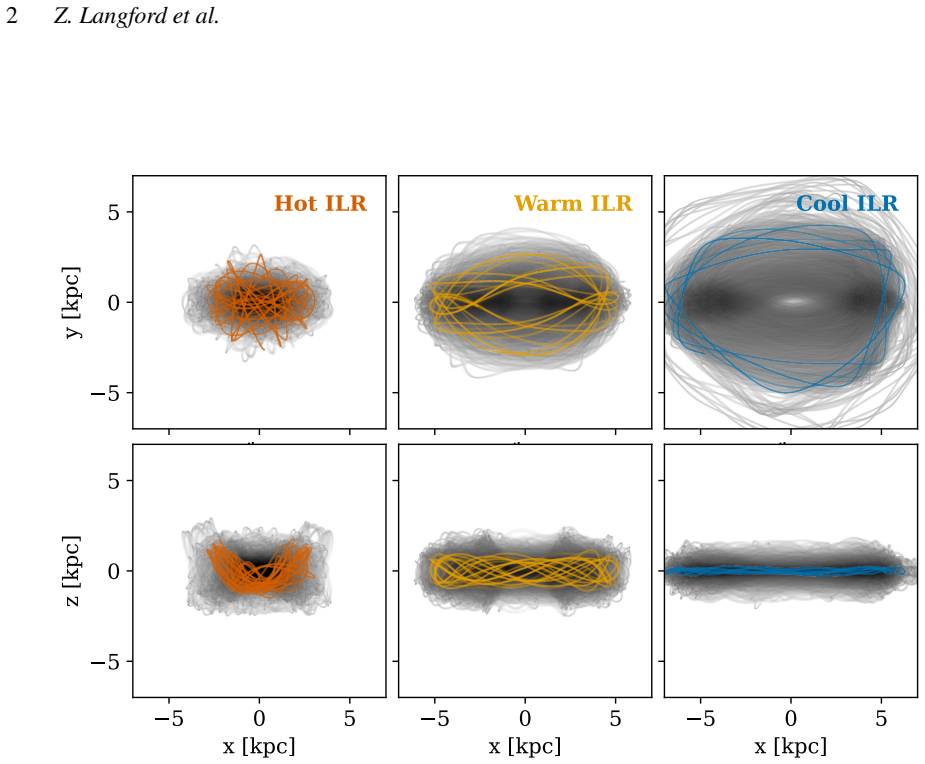
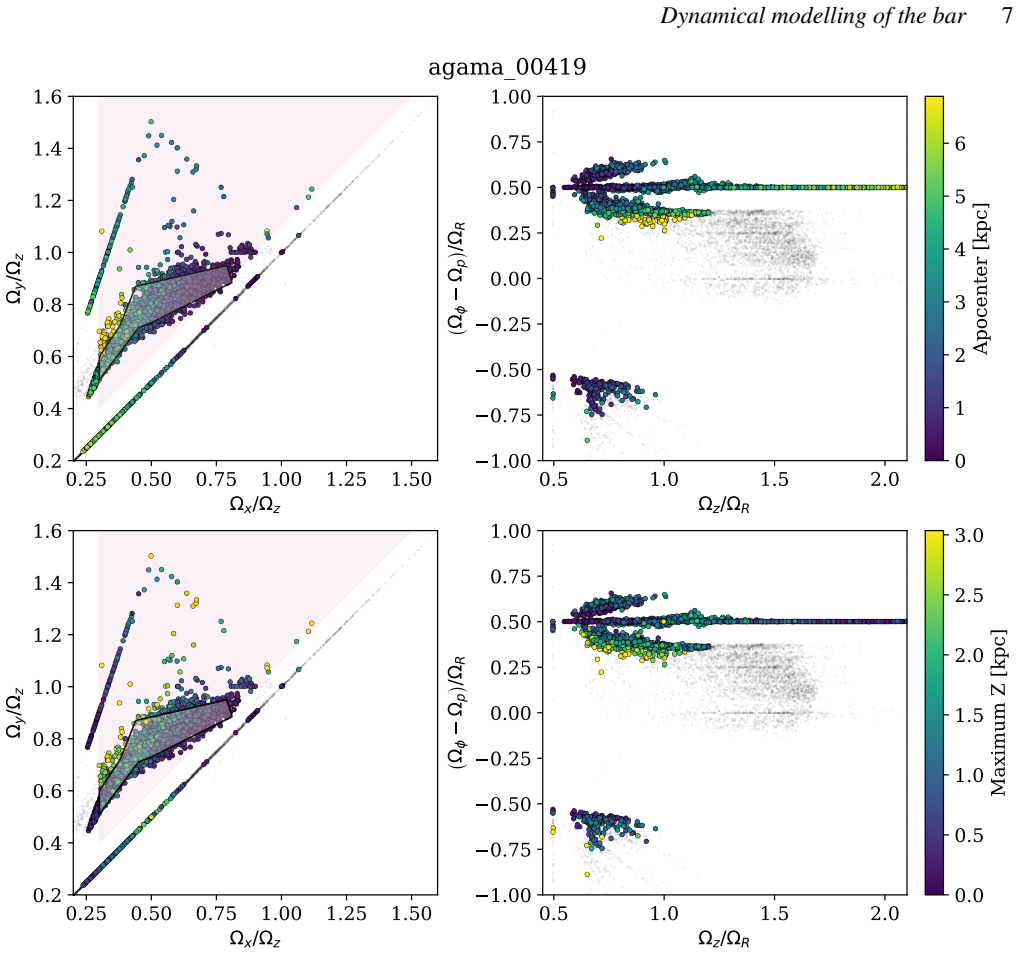
Updated classification criterion for Warm inner Lindblad resonance orbits that contain the looped x1 orbits dominating the bar shoulder regions, used to measure the extent of the apo-centre distribution.
If this is right
- Several bar models with different lengths and speeds remain viable explanations for the Milky Way's structure.
- The bar's radial extent and pattern speed are not uniquely constrained by current observations.
- Self-consistent dynamical models must incorporate this range of possible bar properties.
- Higher-precision or larger stellar samples will be needed to reduce the set of acceptable parameters.
Where Pith is reading between the lines
- The degeneracy between length and speed may require additional observables such as gas kinematics to resolve.
- Bar formation simulations could be checked to see whether multiple steady configurations produce similar frequency distributions.
- The same frequency-analysis pipeline could be tested on other galaxies with comparable kinematic coverage to check whether this multiplicity appears elsewhere.
Load-bearing premise
The updated classification criterion correctly isolates the Warm inner Lindblad resonance orbits that contain the looped x1 orbits dominating the bar's shoulder regions and radial extent.
What would settle it
Recovering a bar length or pattern speed more than 5 percent different from the known input value when the method is applied to an N-body simulation with a known bar would falsify the claim of consistency.
Figures



read the original abstract
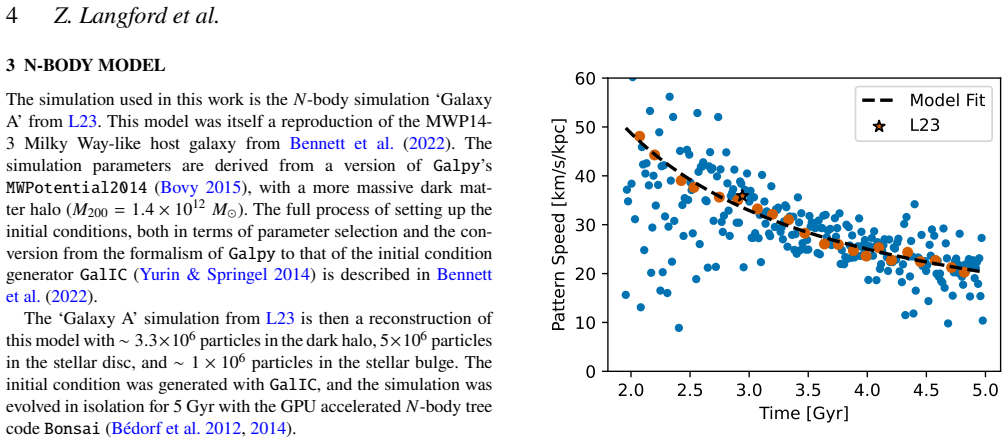
We present an update to the frequency analysis method for measuring the properties of a galactic bar. The method involves computing the fundamental frequencies of orbits in rotating, N-body-derived potential models, classifying the stars as members of bar supporting orbits, and finding the extent of the apo-centre distribution. In this work, we apply an updated classification criterion designed to isolate the so-called "Warm" inner Lindblad resonance (ILR) orbits. These orbits have been shown to contain the looped x1 orbits, which dominate the "shoulder regions" of the bar and largely contribute to the radial extent. We apply this method to existing Gaia, APOGEE, and OGLE data of more than 200,000 stars to constrain the properties of the Milky Way bar. We find that multiple bar lengths and pattern speeds are consistent with the data to within 5 percent.
Editorial analysis
A structured set of objections, weighed in public.
Referee Report
Summary. The manuscript updates the orbital frequency analysis technique for galactic bars by introducing a revised classification criterion to isolate Warm inner Lindblad resonance orbits (containing looped x1 orbits) in N-body-derived rotating potentials. Fundamental frequencies are computed for stellar orbits, bar-supporting stars are selected via the new criterion, and bar length is inferred from the apo-centre distribution. The method is applied to a combined Gaia+APOGEE+OGLE sample of more than 200,000 stars, yielding the result that multiple bar lengths and pattern speeds remain consistent with the data to within 5%.
Significance. If the classification criterion is shown to be reliable, the work demonstrates that current Milky Way kinematic data admit a range of bar parameters rather than a unique solution, which has implications for dynamical models of the inner Galaxy. The approach is self-consistent in its use of N-body potentials and leverages a large multi-survey dataset, providing a concrete strength in observational application.
major comments (1)
- [Methods (orbit classification and frequency analysis)] The central claim that multiple bar lengths and pattern speeds are consistent within 5% rests on the updated classification criterion for Warm ILR orbits. The manuscript does not present a controlled validation test on N-body simulations with known input bar length and pattern speed to confirm that the criterion recovers the true values (or stays within the stated tolerance). This test is load-bearing for the result, as the reported consistency could otherwise be driven by the specific choice of classification rather than the data.
minor comments (2)
- [Abstract and Results] The abstract and results section would benefit from explicit numerical values for the range of bar lengths and pattern speeds found to be consistent within 5%, rather than the qualitative statement alone.
- [Methods] Notation for the fundamental frequencies and resonance conditions should be defined at first use with a brief reminder of the standard definitions from the literature.
Simulated Author's Rebuttal
We thank the referee for their constructive review and recommendation for major revision. We address the single major comment below and will revise the manuscript to incorporate the requested validation.
read point-by-point responses
-
Referee: The central claim that multiple bar lengths and pattern speeds are consistent within 5% rests on the updated classification criterion for Warm ILR orbits. The manuscript does not present a controlled validation test on N-body simulations with known input bar length and pattern speed to confirm that the criterion recovers the true values (or stays within the stated tolerance). This test is load-bearing for the result, as the reported consistency could otherwise be driven by the specific choice of classification rather than the data.
Authors: We agree that a controlled validation test on N-body simulations with known input bar length and pattern speed is necessary to confirm that the updated Warm ILR classification criterion recovers the true values within the stated 5% tolerance. The manuscript presents the criterion as an update to prior frequency analysis techniques and applies it self-consistently within N-body-derived potentials to the observational sample, but does not include the explicit recovery test on simulated data with known truth. In the revised manuscript we will add a dedicated validation subsection. We will extract orbits from N-body barred galaxy simulations with prescribed bar lengths and pattern speeds, apply the updated classification, and demonstrate that the inferred bar parameters match the inputs to within 5%. This addition will directly address the concern that the observational consistency result could be an artifact of the classification choice. revision: yes
Circularity Check
No significant circularity; derivation applies independent classification to external data
full rationale
The paper describes computing frequencies in N-body-derived potentials, applying an updated classification criterion for Warm ILR orbits (which contain looped x1 orbits), and measuring apo-centre extent on >200k Gaia+APOGEE+OGLE stars. The claim of multiple bar lengths/pattern speeds fitting within 5% follows directly from this application to observational data. No quoted step shows a parameter fitted to the target data then renamed as a prediction, nor a self-citation chain that reduces the central result to an unverified input by construction. The method uses external N-body models and data; the classification update is presented as theory-driven rather than data-tuned in a circular manner. This is the normal case of a self-contained analysis.
Axiom & Free-Parameter Ledger
Reference graph
Works this paper leans on
-
[5]
Baydin A. G., Pearlmutter B. A., Radul A. A., Siskind J. M., 2018, Journal of Machine Learning Research, 18, 1
work page 2018
-
[11]
Contopoulos G., Mertzanides C., 1977, , https://ui.adsabs.harvard.edu/abs/1977A&A....61..477C 61, 477
work page 1977
-
[12]
Contopoulos G., Papayannopoulos T., 1980, , https://ui.adsabs.harvard.edu/abs/1980A&A....92...33C 92, 33
work page 1980
-
[44]
Virtanen P., et al., 2020, @doi [Nature Methods] 10.1038/s41592-019-0686-2 , https://rdcu.be/b08Wh 17, 261
-
[52]
Dynamically constraining the length of the Milky way bar. , keywords =. doi:10.1093/mnras/stad406 , archivePrefix =. 2206.01798 , primaryClass =
-
[53]
Deep learning of multi-element abundances from high-resolution spectroscopic data. , keywords =. doi:10.1093/mnras/sty3217 , archivePrefix =. 1808.04428 , primaryClass =
-
[54]
Simultaneous calibration of spectro-photometric distances and the Gaia DR2 parallax zero-point offset with deep learning. , keywords =. doi:10.1093/mnras/stz2245 , archivePrefix =. 1902.08634 , primaryClass =
-
[55]
The Apache Point Observatory Galactic Evolution Experiment (APOGEE). , keywords =. doi:10.3847/1538-3881/aa784d , archivePrefix =. 1509.05420 , primaryClass =
-
[56]
The Seventeenth Data Release of the Sloan Digital Sky Surveys: Complete Release of MaNGA, MaStar, and APOGEE-2 Data. , keywords =. doi:10.3847/1538-4365/ac4414 , archivePrefix =. 2112.02026 , primaryClass =
-
[57]
The Gaia mission. , keywords =. doi:10.1051/0004-6361/201629272 , archivePrefix =. 1609.04153 , primaryClass =
-
[58]
Summary of the contents and survey properties
Gaia Early Data Release 3. Summary of the contents and survey properties. , keywords =. doi:10.1051/0004-6361/202039657 , archivePrefix =. 2012.01533 , primaryClass =
-
[59]
A Unified Framework for the Orbital Structure of Bars and Triaxial Ellipsoids. , keywords =. doi:10.3847/0004-637X/818/2/141 , archivePrefix =. 1512.03467 , primaryClass =
-
[60]
The Far Side of the Galactic Bar/Bulge Revealed through Semi-regular Variables. , keywords =. doi:10.3847/1538-3881/ad01bf , archivePrefix =. 2305.19319 , primaryClass =
-
[61]
Spending Too Much Time at the Galactic Bar: Chaotic Fanning of the Ophiuchus Stream. , keywords =. doi:10.3847/0004-637X/824/2/104 , archivePrefix =. 1601.06790 , primaryClass =
-
[62]
Adrian M. Price-Whelan , title =. doi:10.21105/joss.00388 , url =
-
[63]
doi:10.5281/zenodo.18787 , adsurl =
SuperFreq. doi:10.5281/zenodo.18787 , adsurl =
-
[64]
doi:10.1051/0004-6361/201322068 , Eid =. arXiv , Author =:1307.6212 , Journal =
-
[65]
The Astropy Project: Building an Open-science Project and Status of the v2.0 Core Package. , keywords =. doi:10.3847/1538-3881/aabc4f , archivePrefix =. 1801.02634 , primaryClass =
-
[66]
The Astropy Project: Sustaining and Growing a Community-oriented Open-source Project and the Latest Major Release (v5.0) of the Core Package. apj , keywords =. doi:10.3847/1538-4357/ac7c74 , archivePrefix =. 2206.14220 , primaryClass =
work page internal anchor Pith review Pith/arXiv arXiv doi:10.3847/1538-4357/ac7c74
-
[67]
Charles R. Harris and K. Jarrod Millman and St. Array programming with. 2020 , month = sep, journal =. doi:10.1038/s41586-020-2649-2 , publisher =
-
[68]
Hunter, J. D. , Title =. Computing in Science & Engineering , Volume =
-
[69]
Orbital Support and Evolution of Flat Profiles of Bars (Shoulders). , keywords =. doi:10.3847/1538-4357/ace976 , archivePrefix =. 2303.04828 , primaryClass =
-
[70]
Application to the standard mapping
The measure of chaos by the numerical analysis of the fundamental frequencies. Application to the standard mapping. Physica D Nonlinear Phenomena , year = 1992, month = may, volume =. doi:10.1016/0167-2789(92)90028-L , adsurl =
-
[71]
2010, MNRAS, 408, 2115, doi: 10.1111/j.1365-2966.2010.17291.x
Galaxy Zoo: bars in disc galaxies. , keywords =. doi:10.1111/j.1365-2966.2010.17834.x , archivePrefix =. 1003.0449 , primaryClass =
-
[72]
Reports on Progress in Physics , keywords =
Dynamics of barred galaxies. Reports on Progress in Physics , keywords =. doi:10.1088/0034-4885/56/2/001 , archivePrefix =. astro-ph/0608665 , primaryClass =
-
[73]
H 3: an H imaging survey of HI selected galaxies from ALFALFA. VI. The role of bars in quenching star formation from z = 3 to the present epoch. , keywords =. doi:10.1051/0004-6361/201425351 , archivePrefix =. 1505.07836 , primaryClass =
-
[74]
The Effect of the Outer Lindblad Resonance of the Galactic Bar on the Local Stellar Velocity Distribution. , keywords =. doi:10.1086/301226 , archivePrefix =. astro-ph/9911161 , primaryClass =
-
[75]
A New Mechanism for Radial Migration in Galactic Disks: Spiral-Bar Resonance Overlap. , keywords =. doi:10.1088/0004-637X/722/1/112 , archivePrefix =. 0911.1794 , primaryClass =
-
[76]
A dynamically young and perturbed Milky Way disk. , keywords =. doi:10.1038/s41586-018-0510-7 , archivePrefix =. 1804.10196 , primaryClass =
-
[77]
The 4:1 outer Lindblad resonance of a long-slow bar as an explanation for the Hercules stream. , keywords =. doi:10.1093/mnras/sty921 , archivePrefix =. 1803.02358 , primaryClass =
-
[78]
Modelling the Milky Way as a dry Galaxy. , keywords =. doi:10.1093/mnras/sty2747 , archivePrefix =. 1807.10019 , primaryClass =
-
[79]
Measuring the dynamical length of galactic bars. , keywords =. doi:10.1093/mnras/stae736 , archivePrefix =. 2305.13366 , primaryClass =
-
[80]
Using commensurabilities and orbit structure to understand barred galaxy evolution. , keywords =. doi:10.1093/mnras/staa3202 , archivePrefix =. 1902.05081 , primaryClass =
-
[81]
Made-to-measure models of the Galactic box/peanut bulge: stellar and total mass in the bulge region. , keywords =. doi:10.1093/mnras/stv058 , archivePrefix =. 1502.00633 , primaryClass =
-
[82]
Galactic Bulges , year = 2016, editor =
The Milky Way Bulge: Observed Properties and a Comparison to External Galaxies. Galactic Bulges , year = 2016, editor =. doi:10.1007/978-3-319-19378-6\_9 , archivePrefix =. 1503.07252 , primaryClass =
-
[83]
Fluctuations in galactic bar parameters due to bar-spiral interaction. , keywords =. doi:10.1093/mnras/staa1934 , archivePrefix =. 2003.05457 , primaryClass =
-
[84]
Inner Lindblad resonance in galaxies. Nonlinear theory. II. Bars. , keywords =
- [85]
-
[86]
Orbital classification in an N-body bar. , keywords =. doi:10.1093/mnras/stw2301 , archivePrefix =. 1609.02632 , primaryClass =
-
[87]
2019a, MNRAS, 482, 1525, doi: 10.1093/mnras/sty2672
AGAMA: action-based galaxy modelling architecture. , keywords =. doi:10.1093/mnras/sty2672 , archivePrefix =. 1802.08239 , primaryClass =
-
[88]
Small Amplitude Variable Red Giants in the Magellanic Clouds
The Optical Gravitational Lensing Experiment. Small Amplitude Variable Red Giants in the Magellanic Clouds. , keywords =. doi:10.48550/arXiv.astro-ph/0407057 , archivePrefix =. astro-ph/0407057 , primaryClass =
work page internal anchor Pith review doi:10.48550/arxiv.astro-ph/0407057
-
[89]
The OGLE-III Catalog of Variable Stars
The Optical Gravitational Lensing Experiment. The OGLE-III Catalog of Variable Stars. IV. Long-Period Variables in the Large Magellanic Cloud. , keywords =. doi:10.48550/arXiv.0910.1354 , archivePrefix =. 0910.1354 , primaryClass =
-
[90]
The buildup of strongly barred galaxies in the TNG100 simulation. , keywords =. doi:10.1093/mnras/stz3180 , archivePrefix =. 1908.00547 , primaryClass =
-
[91]
What determines the strength and the slowdown rate of bars?. , keywords =. doi:10.1046/j.1365-8711.2003.06473.x , archivePrefix =. astro-ph/0302519 , primaryClass =
-
[92]
Agama reference documentation. arXiv e-prints , keywords =. doi:10.48550/arXiv.1802.08255 , archivePrefix =. 1802.08255 , primaryClass =
-
[93]
Virtanen, Pauli and Gommers, Ralf and Oliphant, Travis E. and Haberland, Matt and Reddy, Tyler and Cournapeau, David and Burovski, Evgeni and Peterson, Pearu and Weckesser, Warren and Bright, Jonathan and. Nature Methods , year =
-
[94]
The OGLE-III Catalog of Variable Stars
The Optical Gravitational Lensing Experiment. The OGLE-III Catalog of Variable Stars. XV. Long-Period Variables in the Galactic Bulge. , keywords =. doi:10.48550/arXiv.1304.2787 , archivePrefix =. 1304.2787 , primaryClass =
-
[95]
Morphology of bar orbits. , keywords =. doi:10.1093/mnras/259.2.328 , adsurl =
-
[96]
Pearlmutter and Alexey Andreyevich Radul and Jeffrey Mark Siskind , title =
Atilim Gunes Baydin and Barak A. Pearlmutter and Alexey Andreyevich Radul and Jeffrey Mark Siskind , title =. Journal of Machine Learning Research , year =
-
[97]
Exploring the Sgr-Milky Way-disk Interaction Using High-resolution N-body Simulations. , keywords =. doi:10.3847/1538-4357/ac5021 , archivePrefix =. 2107.08055 , primaryClass =
-
[98]
galpy: A python Library for Galactic Dynamics. , keywords =. doi:10.1088/0067-0049/216/2/29 , archivePrefix =. 1412.3451 , primaryClass =
-
[99]
An iterative method for the construction of N-body galaxy models in collisionless equilibrium. , keywords =. doi:10.1093/mnras/stu1421 , archivePrefix =. 1402.1623 , primaryClass =
-
[100]
Journal of Computational Physics , keywords =
A sparse octree gravitational N-body code that runs entirely on the GPU processor. Journal of Computational Physics , keywords =. doi:10.1016/j.jcp.2011.12.024 , archivePrefix =. 1106.1900 , primaryClass =
-
[101]
24.77 Pflops on a Gravitational Tree-Code to Simulate the Milky Way Galaxy with 18600 GPUs. Proceedings of the International Conference for High Performance Computing , year = 2014, month = nov, pages =. doi:10.1109/SC.2014.10 , archivePrefix =. 1412.0659 , primaryClass =
-
[102]
A kinematic method for measuring the pattern speed of barred galaxies. , keywords =. doi:10.1086/184292 , adsurl =
-
[103]
Mapping the X-shaped Milky Way Bulge. , keywords =. doi:10.1088/0004-6256/142/3/76 , archivePrefix =. 1107.5360 , primaryClass =
-
[104]
Mapping the three-dimensional density of the Galactic bulge with VVV red clump stars. , keywords =. doi:10.1093/mnras/stt1376 , archivePrefix =. 1308.0593 , primaryClass =
-
[105]
The structure of the Milky Way's bar outside the bulge. , keywords =. doi:10.1093/mnras/stv745 , archivePrefix =. 1504.01401 , primaryClass =
-
[106]
Kinematics and dynamics of the Galactic bar revealed by Gaia long-period variables. , keywords =. doi:10.1093/mnras/stae2023 , archivePrefix =. 2406.06678 , primaryClass =
-
[107]
Gaia DR3 data consistent with a short bar connected to a spiral arm. , keywords =. doi:10.1093/mnras/stae083 , archivePrefix =. 2312.03854 , primaryClass =
-
[108]
Milky Way dynamics in light of Gaia. , keywords =. doi:10.1016/j.newar.2024.101721 , archivePrefix =. 2501.04075 , primaryClass =
-
[109]
Disentangling the Galaxy's Gordian knot: evidence from APOGEE Gaia for a knotted and slower bar in the Milky Way. , keywords =. doi:10.1093/mnras/staf348 , archivePrefix =. 2402.07986 , primaryClass =
-
[110]
Nature Chemical Biology , year = 2011, month = jun, volume =
Points of view: Color blindness. Nature Chemical Biology , year = 2011, month = jun, volume =. doi:10.1038/nmeth.1618 , adsurl =
discussion (0)
Sign in with ORCID, Apple, or X to comment. Anyone can read and Pith papers without signing in.