Recognition: 2 theorem links
· Lean Theoremell^{p} improving estimates for multilinear forms motivated by distance graphs
Pith reviewed 2026-05-13 02:30 UTC · model grok-4.3
The pith
ℓ^p improving estimates for distance graph forms depend only on vertex count in many cases
A machine-rendered reading of the paper's core claim, the machinery that carries it, and where it could break.
Core claim
The central claim is that the ℓ^p improving estimates for the multilinear forms Λ_G associated to distance graphs G in Z^d hold uniformly across all graphs with a fixed vertex count (explicitly for two, three, and four vertices) and across chains and simplices of arbitrary size. Certain mapping properties therefore depend only on the number of vertices and not on the specific combinatorial structure of the edges, while subgraph forms can fail to inherit the full range of estimates available to the larger graph.
What carries the argument
The multilinear form Λ_G that sums the product of functions over all tuples of points in Z^d whose pairwise Euclidean distances realize the edges of the graph G.
If this is right
- Every graph on two vertices yields the same improving estimates.
- Every graph on three vertices and every graph on four vertices likewise share uniform improving ranges.
- Chains and simplices of any length admit the same estimates as their small-vertex counterparts.
- A subgraph's form can have strictly weaker mapping properties than the form of the full graph.
Where Pith is reading between the lines
- The vertex-count dependence hints that the bounds may be governed by a combinatorial rather than geometric invariant of the point configuration.
- The same independence might be tested for graphs on five or more vertices or for distance graphs using other norms.
- Results of this type could inform discrete analogs of multilinear restriction problems in higher-dimensional lattices.
Load-bearing premise
The forms are translation-invariant and their Fourier multipliers behave like those of spherical averages, so the same analytic tools apply.
What would settle it
A concrete counterexample would be a specific four-vertex graph whose ℓ^p improving range is strictly smaller than the range that holds for the complete graph on four vertices.
Figures
read the original abstract
We undertake a systematic study of the mapping properties of forms based on distance graphs in $\mathbb{Z}^{d}$ to see how the structure of a graph, $G$, affects the $\ell^{p}$ improving estimates of the form, $\Lambda_{G}$, based on $G$. This extends previous work on $\ell^{p}$ improving properties for the spherical averaging operator, which corresponds to a distance graph of a single distance. We obtain $\ell^{p}$ improving estimates for the collection of forms based on all graphs with 2, 3, and 4 vertices, as well as chains and simplexes of any size in $\mathbb{Z}^{d}$. Surprisingly, certain mapping properties only seem to depend on the number of vertices in the graph, not its structure, and forms based on subgraphs of a graph, $G$, do not necessarily inherit all mapping properties from $G$.
Editorial analysis
A structured set of objections, weighed in public.
Referee Report
Summary. The manuscript undertakes a systematic study of the ℓ^p improving properties of multilinear forms Λ_G associated to distance graphs G in Z^d. It extends prior results on spherical averaging operators (corresponding to single-distance graphs) by deriving explicit estimates for all graphs on 2, 3, and 4 vertices as well as for the infinite families of chains and simplices of arbitrary size. The authors additionally observe that certain admissible (p,q) ranges appear to depend only on the number of vertices rather than the specific edge structure of G, and that subgraphs need not inherit the full set of mapping properties from their parent graphs.
Significance. If the stated estimates are established, the work supplies a broad catalogue of boundedness results for a natural class of translation-invariant multilinear forms on the lattice. The reported independence of the exponent ranges on graph structure (beyond vertex count) would be a noteworthy simplification with potential consequences for other problems in discrete harmonic analysis and additive combinatorics. The treatment of infinite families (chains, simplices) further strengthens the contribution by moving beyond finite enumeration.
major comments (1)
- [Abstract and main results] The central novelty claim that admissible (p,q) ranges depend only on vertex count (rather than graph structure) is load-bearing for the paper's contribution. The abstract employs tentative language ('only seem to depend'), and no dedicated theorem or proposition is referenced that proves this independence uniformly for the listed families; explicit verification or a general argument is required in the main text.
minor comments (2)
- [Abstract] The abstract states that subgraphs do not necessarily inherit all mapping properties; this observation should be illustrated with at least one concrete counter-example (with explicit exponents) in the body of the paper.
- The dependence of the estimates on the ambient dimension d should be stated explicitly in each theorem; it is unclear from the abstract whether the results are uniform in d or require d sufficiently large.
Simulated Author's Rebuttal
We thank the referee for the careful reading and constructive comments on our manuscript. We address the major comment point by point below.
read point-by-point responses
-
Referee: [Abstract and main results] The central novelty claim that admissible (p,q) ranges depend only on vertex count (rather than graph structure) is load-bearing for the paper's contribution. The abstract employs tentative language ('only seem to depend'), and no dedicated theorem or proposition is referenced that proves this independence uniformly for the listed families; explicit verification or a general argument is required in the main text.
Authors: We agree that the independence claim requires stronger support in the main text to be load-bearing. In the revised manuscript we will add a new Proposition (placed in Section 2) that collects the explicit computations from Sections 3--5 into a uniform statement: for every fixed vertex count k=2,3,4 the admissible (p,q) ranges are identical across all distance graphs on k vertices; likewise, for chains and simplices the ranges depend only on the number of vertices. The proposition will cite the specific theorems where each family is treated, thereby supplying the requested explicit verification. We will also revise the abstract to remove the tentative phrasing and reference the new proposition. This is a minor change that clarifies the contribution without altering any estimates. revision: yes
Circularity Check
Minor self-citation to prior spherical averaging work; central estimates are independently derived
full rationale
The paper extends prior results on the spherical averaging operator (a single-distance graph) to obtain explicit ℓ^p-improving bounds for all graphs on 2–4 vertices plus arbitrary chains and simplices. These bounds and the observation that admissible ranges depend only on vertex count are presented as new computations in the current work, without any reduction of the target estimates to fitted parameters, self-definitions, or load-bearing self-citations. The standard Euclidean-distance and translation-invariant multiplier assumptions are the usual setup in the literature and do not create circularity. This is a normal, self-contained extension.
Axiom & Free-Parameter Ledger
axioms (2)
- standard math Z^d equipped with the Euclidean distance forms a translation-invariant abelian group suitable for Fourier analysis.
- domain assumption Multilinear forms associated to distance graphs admit Fourier multiplier representations.
Lean theorems connected to this paper
-
IndisputableMonolith/Cost/FunctionalEquation.leanwashburn_uniqueness_aczel unclearWe obtain ℓ^p improving estimates for the collection of forms based on all graphs with 2, 3, and 4 vertices, as well as chains and simplexes of any size in Z^d. Surprisingly, certain mapping properties only seem to depend on the number of vertices in the graph, not its structure.
-
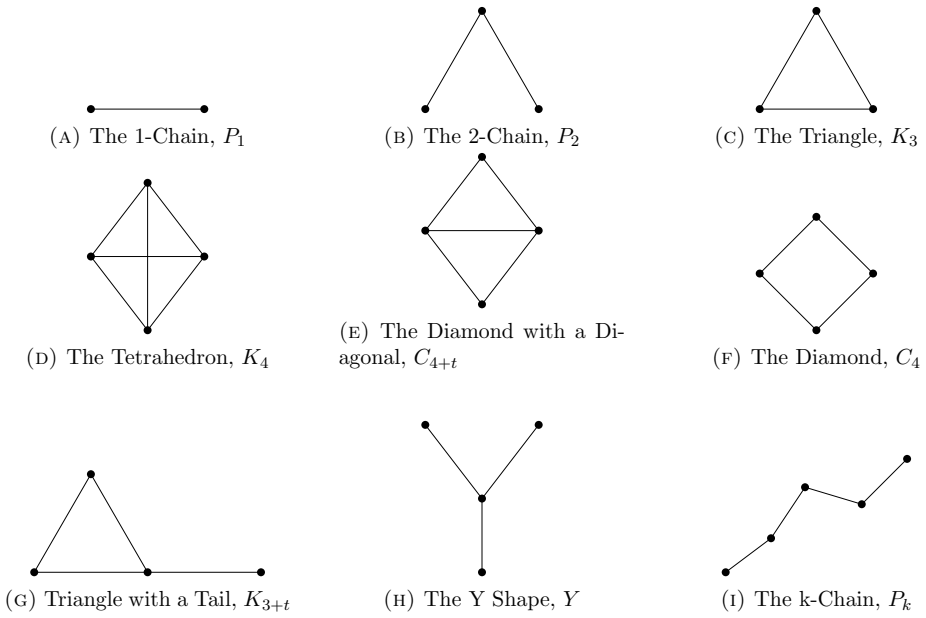
IndisputableMonolith/Foundation/RealityFromDistinction.leanreality_from_one_distinction unclearTheorem 1.9. Conjecture 1.8 is true for the graphs K_3, K_4, C_4+t, C_4, K_3+t, Y, P_k, and K_k for k≥1.
Reference graph
Works this paper leans on
-
[1]
Theresa C. Anderson, Angel V. Kumchev, and Eyvindur A. Palsson. Discrete maximal operators over surfaces of higher codimension.Matematica, 1(2):442–479, 2022
work page 2022
-
[2]
Theresa C. Anderson, Angel V. Kumchev, and Eyvindur A. Palsson. A framework for discrete bilinear spherical averages and applications toℓ p-improving estimates.Colloq. Math., 175(1):55–76, 2024
work page 2024
-
[3]
Finite chains inside thin subsets ofR d.Anal
Michael Bennett, Alexander Iosevich, and Krystal Taylor. Finite chains inside thin subsets ofR d.Anal. PDE, 9(3):597–614, 2016
work page 2016
-
[4]
Multi-linear forms, graphs, andL p- improving measures inF d q.Canad
Pablo Bhowmik, Alex Iosevich, Doowon Koh, and Thang Pham. Multi-linear forms, graphs, andL p- improving measures inF d q.Canad. J. Math., 77(1):208–251, 2025
work page 2025
-
[5]
Falconer-type results for any finite graph with multiple pins, 2026
Tainara Borges, Ben Foster, Yumeng Ou, Eyvindur Palsson, and Francisco Romero Acosta. Falconer-type results for any finite graph with multiple pins, 2026. arXiv preprint arXiv:2603.01954
-
[6]
Nonempty interior of pinned dis- tance and tree sets.Advances in Mathematics, 493:110917, 2026
Tainara Borges, Benjamin Foster, Yumeng Ou, and Eyvindur Palsson. Nonempty interior of pinned dis- tance and tree sets.Advances in Mathematics, 493:110917, 2026
work page 2026
- [7]
-
[8]
Multilinear maximal operators associated to simplices.J
Brian Cook, Neil Lyall, and ´Akos Magyar. Multilinear maximal operators associated to simplices.J. Lond. Math. Soc. (2), 104(4):1491–1514, 2021. 39
work page 2021
-
[9]
Burak Erdogan, Derrick Hart, and Alex Iosevich. Multiparameter projection theorems with applications to sums-products and finite point configurations in the Euclidean setting. InRecent advances in harmonic analysis and applications, volume 25 ofSpringer Proc. Math. Stat., pages 93–103. Springer, New York, 2013
work page 2013
-
[10]
Multilinear generalized Radon transforms and point configurations.Forum Math., 27(4):2323–2360, 2015
Loukas Grafakos, Allan Greenleaf, Alex Iosevich, and Eyvindur Palsson. Multilinear generalized Radon transforms and point configurations.Forum Math., 27(4):2323–2360, 2015
work page 2015
-
[11]
Allan Greenleaf and Alex Iosevich. On triangles determined by subsets of the Euclidean plane, the asso- ciated bilinear operators and applications to discrete geometry.Anal. PDE, 5(2):397–409, 2012
work page 2012
-
[12]
A group-theoretic viewpoint on Erd¨ os- Falconer problems and the Mattila integral.Rev
Allan Greenleaf, Alex Iosevich, Bochen Liu, and Eyvindur Palsson. A group-theoretic viewpoint on Erd¨ os- Falconer problems and the Mattila integral.Rev. Mat. Iberoam., 31(3):799–810, 2015
work page 2015
-
[13]
On necklaces inside thin subsets ofR d.Math
Allan Greenleaf, Alex Iosevich, and Malabika Pramanik. On necklaces inside thin subsets ofR d.Math. Res. Lett., 24(2):347–362, 2017
work page 2017
-
[14]
Onk-point configuration sets with nonempty interior
Allan Greenleaf, Alex Iosevich, and Krystal Taylor. Onk-point configuration sets with nonempty interior. Mathematika, 68(1):163–190, 2022
work page 2022
-
[15]
Nonempty interior of configuration sets via microlocal partition optimization.Math
Allan Greenleaf, Alex Iosevich, and Krystal Taylor. Nonempty interior of configuration sets via microlocal partition optimization.Math. Z., 306(4):Paper No. 66, 20, 2024
work page 2024
-
[16]
Kevin Hughes.ℓ p-improving for discrete spherical averages.Ann. H. Lebesgue, 3:959–980, 2020
work page 2020
-
[17]
A. Iosevich, E. Palsson, E. Wyman, and Y. Zhai. Multi-linear forms, structure of graphs and Lebesgue spaces.Math. Z., 310(4):Paper No. 76, 25, 2025
work page 2025
-
[18]
The VC-dimension and point config- urations inR d, 2025
Alex Iosevich, Akos Magyar, Alex McDonald, and Brian McDonald. The VC-dimension and point config- urations inR d, 2025. arXiv preprint arXiv:2510.13984
-
[19]
Alex Iosevich, Eyvindur Ari Palsson, and Sean R. Sovine. Simplex averaging operators: quasi-Banach and Lp-improving bounds in lower dimensions.J. Geom. Anal., 32(3):Paper No. 87, 16, 2022
work page 2022
-
[20]
Pinned simplices and connections to product of sets on paraboloids.Indiana Univ
Alex Iosevich, Minh-Quy Pham, Thang Pham, and Chun-Yen Shen. Pinned simplices and connections to product of sets on paraboloids.Indiana Univ. Math. J., 74(3):647–668, 2025
work page 2025
-
[21]
R. Kesler and M. T. Lacey.ℓ p-improving inequalities for discrete spherical averages.Anal. Math., 46(1):85– 95, 2020
work page 2020
-
[22]
In Partial differential equations (Proc
Walter Littman.L p −L q-estimates for singular integral operators arising from hyperbolic equations. In Partial differential equations (Proc. Sympos. Pure Math., Vol. XXIII, Univ. California, Berkeley, Calif., 1971), Proc. Sympos. Pure Math., Vol. XXIII, pages 479–481. Amer. Math. Soc., Providence, RI, 1973
work page 1971
- [23]
-
[24]
Akos Magyar.L p-bounds for spherical maximal operators onZ n.Rev. Mat. Iberoamericana, 13(2):307–317, 1997
work page 1997
-
[25]
Finite point configurations and the regular value theorem in a fractal setting.Indiana Univ
Yumeng Ou and Krystal Taylor. Finite point configurations and the regular value theorem in a fractal setting.Indiana Univ. Math. J., 71(4):1707–1761, 2022
work page 2022
-
[26]
A Mattila-Sj¨ olin theorem for triangles.J
Eyvindur Ari Palsson and Francisco Romero Acosta. A Mattila-Sj¨ olin theorem for triangles.J. Funct. Anal., 284(6):Paper No. 109814, 20, 2023
work page 2023
-
[27]
A Mattila-Sj¨ olin theorem for simplices in low dimen- sions.Math
Eyvindur Ari Palsson and Francisco Romero Acosta. A Mattila-Sj¨ olin theorem for simplices in low dimen- sions.Math. Ann., 391(1):1123–1146, 2025
work page 2025
-
[28]
Elias M. Stein. Maximal functions. I. Spherical means.Proc. Nat. Acad. Sci. U.S.A., 73(7):2174–2175, 1976
work page 1976
-
[29]
Robert S. Strichartz. Convolutions with kernels having singularities on a sphere.Trans. Amer. Math. Soc., 148:461–471, 1970. 40 Email address:palsson@vt.edu Department of Mathematics, Virginia Tech, Blacksburg, V A 24061 Email address:jennifer21@vt.edu Department of Mathematics, Virginia Tech, Blacksburg, V A 24061 41
work page 1970
discussion (0)
Sign in with ORCID, Apple, or X to comment. Anyone can read and Pith papers without signing in.