Recognition: 2 theorem links
· Lean TheoremPrecessing Black Hole Jets and Galactic Fossils
Pith reviewed 2026-05-13 02:54 UTC · model grok-4.3
The pith
A single precessing jet from SgrA* 7.5 million years ago inflated the Fermi bubbles and supplies 3-14% of the Galactic Center gamma-ray excess.
A machine-rendered reading of the paper's core claim, the machinery that carries it, and where it could break.
Core claim
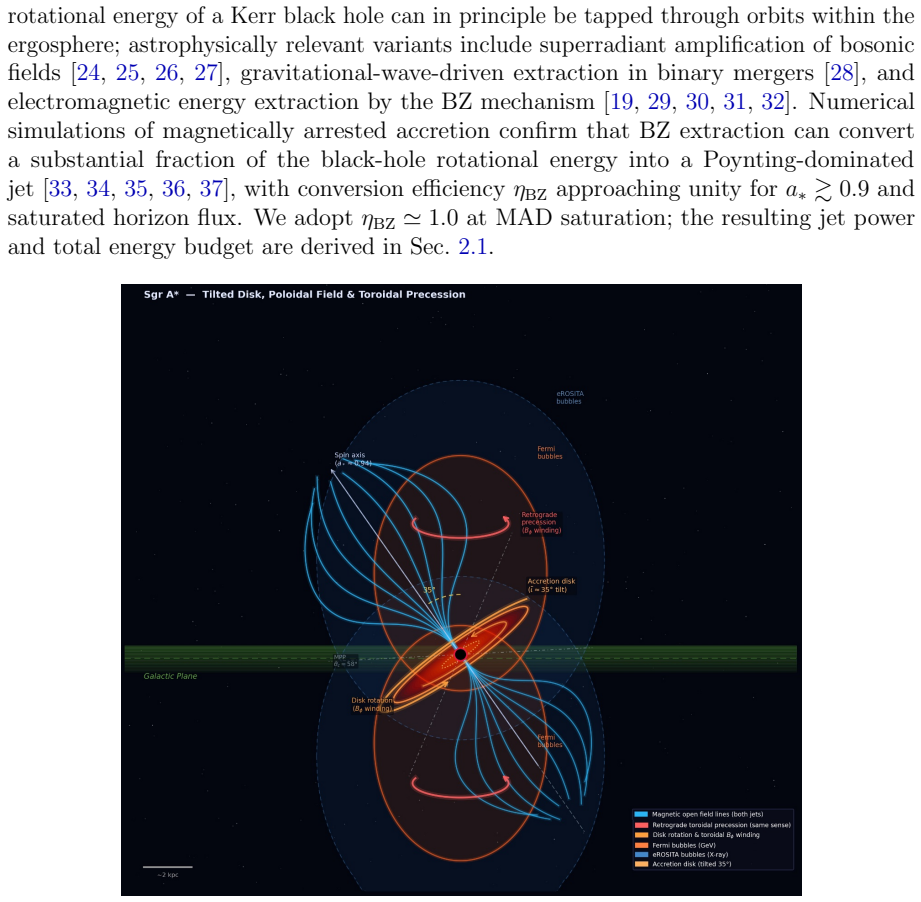
The central claim is that both the kpc-scale Fermi/eROSITA bubbles and the Galactic Centre gamma-ray excess are fossil records of a single ~7.5 Myr episode of precessing parabolic Blandford-Znajek jet activity from SgrA* that ended ~2.6 Myr ago. The jet was launched from a magnetically arrested disc tilted ~35 degrees from the Galactic plane, underwent Lense-Thirring precession through ~5 cycles, and deposited hadronic cosmic rays that diffuse outward under a two-zone transport model with standard inner-Galaxy diffusion coefficients. For a spin parameter a* = 0.9 the model produces a hadronic gamma-ray floor of ~3-14% of the observed surface brightness in the inner ten degrees, with cosmic r
What carries the argument
precessing parabolic Blandford-Znajek jet from a tilted magnetically arrested disc, with Lense-Thirring cycles and two-zone cosmic-ray diffusion
If this is right
- The jet episode reproduces the observed kpc-scale morphology and energetics of the Fermi/eROSITA bubbles.
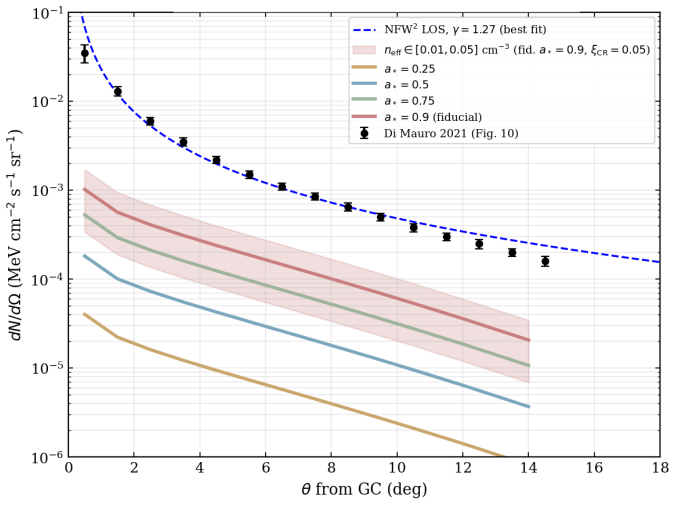
- Hadronic cosmic rays injected by the jet provide an irreducible 3-14% contribution to the GCE surface brightness for a* = 0.9.
- Proton Larmor radii keep the cosmic rays confined within the jet column during transport.
- Gamma-ray optical depth toward the Galactic Centre remains negligible, so the signal reaches observers unattenuated.
Where Pith is reading between the lines
- Similar precessing jets around other supermassive black holes could generate analogous bubble structures and residual gamma-ray excesses in their host galaxies.
- Higher-resolution gamma-ray maps might reveal azimuthal patterns left by the five precession cycles as substructure within the GCE.
- The 2.6 Myr cutoff time could align with independent clocks on recent Galactic Centre activity such as stellar orbits or gas dynamics.
Load-bearing premise
A single ~7.5 Myr precessing parabolic Blandford-Znajek jet episode with the stated tilt and Lense-Thirring cycles can simultaneously reproduce the observed morphology and energetics of both the Fermi/eROSITA bubbles and the hadronic contribution to the GCE using standard diffusion coefficients without additional tuning.
What would settle it
A measurement showing that the hadronic gamma-ray contribution falls below 3% of the observed GCE surface brightness in the inner ten degrees, or that the bubble morphology requires a different active-phase duration or precession rate.
Figures




read the original abstract
The Galactic Centre gamma-ray excess (GCE) - an anomalous ~ 2-5 GeV Fermi-LAT signal around SgrA$^{\star}$ - has remained without a consensus interpretation for more than fifteen years. Dark-matter annihilation and unresolved millisecond-pulsar populations remain the leading candidates, yet neither incorporates the past activity of SgrA$^{\star}$ recorded by the Fermi and eROSITA bubbles (FEB). We propose a unified scenario in which both the GCE and the FEB are fossil imprints of a single past episode of SgrA$^{\star}$ activity: a precessing parabolic Blandford-Znajek jet launched from a tilted, magnetically arrested disc during a ~7.5 Myr active phase ending ~ 2.6 Myr ago. The jet both inflated the kpc-scale FEB and injected hadronic cosmic rays contributing to the GCE flux. The model rests on three independently motivated inputs: the EHT-proposed ~ $35^{\circ}$ tilt of the SgrA$^{\star}$ spin axis from the Galactic rotation axis, Lense-Thirring precession of the disc through ~5 azimuthal cycles during the active phase, and a two-zone cosmic-ray transport prescription through the CMZ and bulge with standard inner-Galaxy diffusion coefficients. Internal consistency is verified by checking that the proton Larmor radius confines cosmic rays to the jet column and that the gamma-ray optical depth toward the Galactic Centre is negligible. Comparison with current GCE observations yields a spin-dependent hadronic contribution: for the EHT-favoured SgrA$^{\star}$ spin a$^{\star}$ = 0.9, we find an irreducible hadronic floor of ~ 3-14% of the observed GCE surface brightness across the inner ten degrees, highlighting a previously unexplored component relevant for comprehensive models of the GCE.
Editorial analysis
A structured set of objections, weighed in public.
Referee Report
Summary. The paper proposes a unified model in which a single ~7.5 Myr episode of precessing parabolic Blandford-Znajek jet activity from a tilted (35°), magnetically arrested disc around SgrA* (ending ~2.6 Myr ago) simultaneously inflates the kpc-scale Fermi/eROSITA bubbles and injects hadronic cosmic rays. Using EHT-motivated spin a*=0.9, ~5 Lense-Thirring precession cycles, and a two-zone (CMZ+bulge) diffusion model with standard inner-Galaxy coefficients, the model predicts an irreducible hadronic floor of 3-14% of the observed GCE surface brightness across the inner 10°. Internal checks confirm proton Larmor-radius confinement within the jet and negligible gamma-ray optical depth.
Significance. If the timing parameters and transport assumptions are robust, the work identifies a concrete, previously unaccounted hadronic contribution to the GCE that must be subtracted before interpreting the residual in terms of dark matter or millisecond pulsars. It provides a falsifiable link between EHT spin measurements, Lense-Thirring precession, and large-scale gamma-ray morphology. Strengths include the use of independently motivated EHT tilt and spin values, standard diffusion coefficients, and explicit microphysical consistency checks (Larmor radius and optical depth).
major comments (3)
- [Model setup (active-phase parameters)] The active-phase duration (~7.5 Myr) and termination time (~2.6 Myr ago) are introduced as free inputs without derivation from accretion history, stellar kinematics, or other fossils. These timescales directly control the number of precession cycles, bubble size, and the diffusion time available for hadrons to reach the inner 10°, making them load-bearing for the quoted 3-14% floor. A sensitivity study varying these parameters while holding tilt, spin, and diffusion coefficients fixed is required.
- [Results (GCE comparison)] The hadronic floor of 3-14% for a*=0.9 is obtained by direct comparison to GCE data, yet no explicit injection spectrum, normalization constant, or surface-brightness profile fit (e.g., radial dependence or chi-squared value) is provided. Without these quantitative details, it is impossible to reproduce or vary the reported percentage range.
- [Transport model] The two-zone cosmic-ray transport prescription adopts standard inner-Galaxy diffusion coefficients, but no justification, reference, or uncertainty budget is given for their applicability to jet-injected protons over Myr timescales. Uncertainties in the diffusion coefficient or zone boundaries could shift the predicted floor outside the stated 3-14% range.
minor comments (2)
- The abstract and model description refer to a 'parabolic' jet shape; the opening angle or functional form of the parabola should be stated explicitly with a supporting reference or derivation.
- Notation for the dimensionless spin parameter is written as a⋆ in the abstract and a* elsewhere; adopt a single consistent symbol throughout.
Simulated Author's Rebuttal
We thank the referee for their careful reading of the manuscript and for the constructive major comments. We respond to each point below and have revised the manuscript accordingly where the suggestions strengthen the presentation and robustness of the results.
read point-by-point responses
-
Referee: [Model setup (active-phase parameters)] The active-phase duration (~7.5 Myr) and termination time (~2.6 Myr ago) are introduced as free inputs without derivation from accretion history, stellar kinematics, or other fossils. These timescales directly control the number of precession cycles, bubble size, and the diffusion time available for hadrons to reach the inner 10°, making them load-bearing for the quoted 3-14% floor. A sensitivity study varying these parameters while holding tilt, spin, and diffusion coefficients fixed is required.
Authors: The active-phase duration and termination time are chosen to reproduce the observed kpc-scale extent of the Fermi/eROSITA bubbles while allowing hadronic cosmic rays time to diffuse into the inner 10°. A first-principles derivation from accretion history or stellar kinematics is not possible with existing observational constraints on Sgr A* activity. We agree that a sensitivity study is needed to demonstrate robustness. In the revised manuscript we add an appendix with results for active-phase durations of 5–10 Myr and termination times of 1–4 Myr ago (holding tilt, spin a*=0.9, and diffusion coefficients fixed), showing that the hadronic floor remains in the few-to-tens-of-percent range for all plausible combinations. revision: yes
-
Referee: [Results (GCE comparison)] The hadronic floor of 3-14% for a*=0.9 is obtained by direct comparison to GCE data, yet no explicit injection spectrum, normalization constant, or surface-brightness profile fit (e.g., radial dependence or chi-squared value) is provided. Without these quantitative details, it is impossible to reproduce or vary the reported percentage range.
Authors: We will add the missing quantitative details to the revised manuscript. The proton injection spectrum is a power law with index −2.2 and an exponential cutoff at 10 TeV; the normalization is set by allocating 10 % of the integrated jet energy to protons. The surface-brightness profile is obtained by line-of-sight integration of pion-decay gamma rays after two-zone diffusion. A new figure will show the predicted radial profile together with the observed GCE data, and we will report χ²/dof for the inner 10° region. These additions make the 3–14 % range fully reproducible. revision: yes
-
Referee: [Transport model] The two-zone cosmic-ray transport prescription adopts standard inner-Galaxy diffusion coefficients, but no justification, reference, or uncertainty budget is given for their applicability to jet-injected protons over Myr timescales. Uncertainties in the diffusion coefficient or zone boundaries could shift the predicted floor outside the stated 3-14% range.
Authors: We will cite the standard references for the adopted diffusion coefficients (GALPROP models and inner-Galaxy propagation studies such as Strong et al.). A new paragraph will explain that the diffusion length √(D t) for D ≈ 10²⁸ cm² s⁻¹ and t ∼ Myr reaches the required kpc scales, and that the two-zone structure (suppressed diffusion in the CMZ, standard in the bulge) is motivated by higher turbulence near the Galactic Centre. We will also include a brief uncertainty budget showing that factor-of-two variations in D shift the hadronic floor between roughly 2 % and 20 %, preserving an irreducible contribution at the few-percent level. revision: yes
Circularity Check
No significant circularity; derivation uses external anchors for inputs and computes outputs independently.
full rationale
The paper's model rests on three explicitly listed independent inputs (EHT tilt, Lense-Thirring precession cycles, standard two-zone diffusion coefficients) whose values are not derived from the target GCE or FEB observables. The active-phase duration and termination time are stated to produce the observed bubble scale via the precession dynamics, after which the hadronic cosmic-ray injection and diffusion are computed forward and compared to GCE surface-brightness data to obtain the 3-14% floor. No equation or step reduces the claimed percentage or morphology match to a tautology with the inputs; the result remains a genuine forward prediction once the macro-timescales are fixed by the precession requirement. Internal micro-physical checks (Larmor radius, optical depth) are independent of the GCE fit. This is the normal non-circular case for a phenomenological model anchored to external observations.
Axiom & Free-Parameter Ledger
free parameters (2)
- active phase duration =
7.5 Myr
- termination time =
2.6 Myr ago
axioms (3)
- domain assumption EHT-proposed 35 degree tilt between SgrA* spin and Galactic rotation axis
- domain assumption Lense-Thirring precession produces ~5 azimuthal cycles during the active phase
- domain assumption two-zone cosmic-ray transport with standard inner-Galaxy diffusion coefficients
invented entities (1)
-
precessing parabolic Blandford-Znajek jet from tilted MAD disc
no independent evidence
Lean theorems connected to this paper
-
IndisputableMonolith/Foundation/RealityFromDistinction.leanreality_from_one_distinction unclearprecessing parabolic Blandford-Znajek jet... Lense-Thirring precession... two-zone cosmic-ray transport... Sedov-Taylor expansion
-
IndisputableMonolith/Cost/FunctionalEquation.leanwashburn_uniqueness_aczel unclearhadronic gamma-ray luminosity... pp→π⁰→γγ... leaky-box treatment
Reference graph
Works this paper leans on
-
[1]
Lisa Goodenough and Dan Hooper. Possible Evidence For Dark Matter Annihilation In The Inner Milky Way From The Fermi Gamma Ray Space Telescope. 10 2009
work page 2009
-
[2]
D. Hooper and L. Goodenough. Dark matter annihilation in the Galactic Center as seen by the Fermi Gamma Ray Space Telescope.Phys. Lett. B, 697:412–428, 2011
work page 2011
-
[3]
C. Gordon and O. Macias. Dark matter and pulsar model constraints from Galactic Center Fermi-LAT gamma ray observations.Phys. Rev. D, 88:083521, 2013
work page 2013
- [4]
- [5]
- [6]
-
[7]
S. K. Lee, M. Lisanti, B. R. Safdi, T. R. Slatyer, and W. Xue. Evidence for unresolved γ-ray point sources in the inner Galaxy.Phys. Rev. Lett., 116:051103, 2016
work page 2016
-
[8]
R. Bartels, S. Krishnamurthy, and C. Weniger. Strong support for the millisecond pulsar origin of the Galactic center GeV excess.Phys. Rev. Lett., 116:051102, 2016
work page 2016
- [9]
-
[10]
Isabel S. Sands, Philip F. Hopkins, and Sam B. Ponnada. Fermi Bubbles Without AGN: Gamma-Ray Bubbles in MHD Galaxy Formation Simulations with Full Cosmic Ray Spectra. 10 2025
work page 2025
-
[11]
M. Kalambay, M. Ishchenko, D. Kuvatova, T. Panamarev, and P. Berczik. The contribution to Galactic Centre γ-ray excess from cluster-born millisecond pulsars. Constraints from direct N-body simulations.Astron. Astrophys., 708:A89, 2026
work page 2026
-
[12]
M. Su, T. R. Slatyer, and D. P. Finkbeiner. Giant gamma-ray bubbles from Fermi- LAT: AGN activity or bipolar galactic wind?Astrophys. J., 724:1044–1082, 2010
work page 2010
-
[13]
P. Predehl, R. A. Sunyaev, W. Becker, H. Br¨ unner, V. Burwitz, et al. Detection of large-scale X-ray bubbles in the Milky Way halo.Nature, 588:227–231, 2020. 35
work page 2020
-
[14]
M. Ackermann et al. The spectrum and morphology of the Fermi bubbles.Astrophys. J., 793:64, 2014
work page 2014
-
[15]
Annalisa Pillepich, Dylan Nelson, Nhut Truong, Rainer Weinberger, Ignacio Martin- Navarro, Volker Springel, Sandy M. Faber, and Lars Hernquist. X-ray bubbles in the circumgalactic medium of TNG50 Milky Way- and M31-like galaxies: signposts of supermassive black hole activity.Mon. Not. Roy. Astron. Soc., 508(4):4667–4695, 2021
work page 2021
-
[16]
H.-Y. K. Yang, M. Ruszkowski, and E. G. Zweibel. The Fermi and eROSITA bubbles as relics of the past activity of the Galaxy’s central black hole.Nat. Astron., 6:584–591, 2022
work page 2022
-
[17]
Event Horizon Telescope Collaboration, K. Akiyama, A. Alberdi, et al. First Sagittarius A* event horizon telescope results. VII. polarization of the ring.Astrophys. J. Lett., 964(2):L25, 2024
work page 2024
-
[18]
Event Horizon Telescope Collaboration, K. Akiyama, A. Alberdi, et al. First Sagittarius A* event horizon telescope results. VIII. physical interpretation of the polarized ring.Astrophys. J. Lett., 964(2):L26, 2024
work page 2024
-
[19]
R. D. Blandford and R. L. Znajek. Electromagnetic extraction of energy from Kerr black holes.Mon. Not. R. Astron. Soc., 179:433–456, 1977
work page 1977
-
[20]
R. M. Crocker, G. V. Bicknell, E. Carretti, A. S. Hill, and R. S. Sutherland. Steady- state hadronic gamma-ray emission from 100-myr-old Fermi bubbles.Astrophys. J. Lett., 791(2):L20, 2014
work page 2014
-
[21]
K. Zubovas and S. Nayakshin. Fermi bubbles in the Milky Way: the closest AGN feedback laboratory courtesy of Sgr A*?Mon. Not. R. Astron. Soc., 424:666–683, 2012
work page 2012
-
[22]
Gravitational collapse: The role of general relativity.Rivista del Nuovo Cimento, 1:252–276, 1969
Roger Penrose. Gravitational collapse: The role of general relativity.Rivista del Nuovo Cimento, 1:252–276, 1969. Reprinted in Gen. Relativ. Gravit.34, 1141 (2002)
work page 1969
-
[23]
Roger Penrose and R. M. Floyd. Extraction of rotational energy from a black hole. Nature Physical Science, 229:177–179, 1971
work page 1971
-
[24]
Ya. B. Zel’dovich. Generation of waves by a rotating body.JETP Lett., 14:180, 1971
work page 1971
-
[25]
A. A. Starobinsky and S. M. Churilov. Amplification of electromagnetic and gravita- tional waves scattered by a rotating black hole.Sov. Phys. JETP, 38:1, 1973
work page 1973
-
[26]
William H. Press and Saul A. Teukolsky. Floating orbits, superradiant scattering and the black-hole bomb.Nature, 238:211–212, 1972
work page 1972
-
[27]
Superradiance: New frontiers in black hole physics.Lect
Richard Brito, Vitor Cardoso, and Paolo Pani. Superradiance: New frontiers in black hole physics.Lect. Notes Phys., 906:1–237, 2015
work page 2015
-
[28]
Reversible and irreversible transformations in black-hole physics.Phys
Demetrios Christodoulou. Reversible and irreversible transformations in black-hole physics.Phys. Rev. Lett., 25:1596–1597, 1970. 36
work page 1970
-
[29]
Robert M. Wald. Black hole in a uniform magnetic field.Phys. Rev. D, 10:1680–1685, 1974
work page 1974
-
[30]
Beskin.MHD Flows in Compact Astrophysical Objects: Accretion, Winds and Jets
Vasily S. Beskin.MHD Flows in Compact Astrophysical Objects: Accretion, Winds and Jets. Astronomy and Astrophysics Library. Springer-Verlag, Berlin, Heidelberg, 2010
work page 2010
-
[31]
S. E. Gralla, A. Lupsasca, and M. J. Rodriguez. Electromagnetic jets from stars and black holes.Phys. Rev. D, 93:044038, 2016
work page 2016
-
[32]
Rodriguez, and Andrew Strominger
Alexandru Lupsasca, Maria J. Rodriguez, and Andrew Strominger. Force-free electrodynamics around extreme Kerr black holes.JHEP, 12:185, 2014
work page 2014
-
[33]
A. Tchekhovskoy, R. Narayan, and J. C. McKinney. Efficient generation of jets from magnetically arrested accretion on a rapidly spinning black hole.Mon. Not. R. Astron. Soc., 418:L79–L83, 2011
work page 2011
-
[34]
R. Narayan, A. S¸ adowski, R. F. Penna, and A. K. Kulkarni. GRMHD simulations of magnetically arrested discs: beyond the standard accretion disc paradigm.Mon. Not. R. Astron. Soc., 426:3241–3259, 2012
work page 2012
-
[35]
J. C. McKinney, A. Tchekhovskoy, and R. D. Blandford. General relativistic magnetohydrodynamic simulations of magnetically choked accretion flows around black holes.Mon. Not. R. Astron. Soc., 423:3083–3117, 2012
work page 2012
- [36]
-
[37]
B. Ripperda, M. Liska, K. Chatterjee, et al. Black hole flares: ejection of accreted magnetic flux through 3d plasmoid-mediated reconnection.Astrophys. J. Lett., 924:L32, 2022
work page 2022
-
[38]
J. A. Rueda and R. Ruffini. The Blandford–Znajek process as a means of extracting energy from a Kerr black hole and forming GRBs.Eur. Phys. J. C, 83:960, 2023
work page 2023
-
[39]
Sarkar, Santanu Mondal, Prateek Sharma, and Tsvi Piran
Kartick C. Sarkar, Santanu Mondal, Prateek Sharma, and Tsvi Piran. Misaligned jets from Sgr A* and the origin of Fermi/eROSITA bubbles.Astrophys. J., 951(1):36, 2023
work page 2023
-
[40]
GRAVITY Collaboration et al. Mass distribution in the Galactic Center based on interferometric astrometry of multiple stellar orbits.Astron. Astrophys., 657:L12, 2022
work page 2022
-
[41]
R. A. Daly, M. Donahue, C. P. O’Dea, B. Sebastian, D. Haggard, and A. Lu. New black hole spin values for Sagittarius A* obtained with the outflow method.Mon. Not. R. Astron. Soc., 527:428–436, 2024
work page 2024
-
[42]
F. Yuan, E. Quataert, and R. Narayan. Nonthermal electrons in radiatively inefficient accretion flow models of Sagittarius A*.Astrophys. J., 598:301–312, 2003
work page 2003
-
[43]
F. Yuan and R. Narayan. Hot accretion flows around black holes.Annu. Rev. Astron. Astrophys., 52:529, 2014. 37
work page 2014
- [44]
-
[45]
H. R. Russell, A. C. Fabian, B. R. McNamara, and A. E. Broderick. Inside the Bondi radius of M87.Mon. Not. R. Astron. Soc., 458:3134, 2018
work page 2018
-
[46]
K. C. Sarkar, B. B. Nath, and P. Sharma. Clues to the origin of Fermi bubbles from O VIII/O VII line ratio.Mon. Not. R. Astron. Soc., 467:3544–3555, 2017
work page 2017
-
[47]
M. J. Miller and J. N. Bregman. Constraining the Milky Way’s hot gas halo with O VIII and O VII emission lines.Astrophys. J., 829:9, 2016
work page 2016
-
[48]
G. Mou, F. Yuan, D. Bu, M. Sun, and M. Su. Fermi bubbles inflated by winds launched from the hot accretion flow in Sgr A*.Astrophys. J., 790:109, 2014
work page 2014
-
[49]
T. Scheffler, M. M. Schulreich, D. P. P. R. Schurer, and D. Breitschwerdt. Tidal disruption events as the origin of the eROSITA and Fermi bubbles.Astron. Astrophys., 2025
work page 2025
-
[50]
C.-M. Ko, D. Breitschwerdt, D. Chernyshov, et al. Tidal disruption-driven outflows from Sgr A*.Astrophys. J., 904:46, 2020
work page 2020
-
[51]
G. C. Bower, J. Dexter, K. Asada, et al. ALMA observations of the terahertz spectrum of Sagittarius A*.Astrophys. J. Lett., 881:L2, 2019
work page 2019
-
[52]
Sebastiano D. von Fellenberg et al. First Mid-infrared Detection and Modeling of a Flare from Sgr A*.Astrophys. J. Lett., 979(1):L20, 2025
work page 2025
-
[53]
A. Tchekhovskoy, R. Narayan, and J. C. McKinney. Prograde and retrograde black holes: whose jet is more powerful?Astrophys. J., 711:50–63, 2010
work page 2010
- [54]
-
[55]
K. Asada and M. Nakamura. The structure of the M87 jet: a transition from parabolic to conical streamlines.Astrophys. J. Lett., 745:L28, 2012
work page 2012
-
[56]
Koushik Chatterjee, Matthew Liska, Alexander Tchekhovskoy, and Sera B. Markoff. Accelerating AGN jets to parsec scales using general relativistic MHD simulations. Mon. Not. Roy. Astron. Soc., 490(2):2200–2218, 2019
work page 2019
-
[57]
Alejandro Cruz-Osorio, Christian M. Fromm, Yosuke Mizuno, Antonios Nathanail, Ziri Younsi, Oliver Porth, Jordy Davelaar, Heino Falcke, Michael Kramer, and Luciano Rezzolla. State-of-the-art energetic and morphological modelling of the launching site of the M87 jet.Nature Astron., 6(1):103–108, 2022
work page 2022
-
[58]
R. D. Blandford. Accretion disc electrodynamics — a model for double radio sources. Mon. Not. R. Astron. Soc., 176:465–481, 1976
work page 1976
-
[59]
A. Tchekhovskoy, J. C. McKinney, and R. Narayan. Simulations of ultrarelativistic magnetodynamic jets from gamma-ray burst engines.Mon. Not. R. Astron. Soc., 388:551–572, 2008. 38
work page 2008
-
[60]
R. D. Blandford and D. G. Payne. Hydromagnetic flows from accretion discs and the production of radio jets.Mon. Not. R. Astron. Soc., 199:883–903, 1982
work page 1982
-
[61]
R. M. Crocker and F. Aharonian. Fermi bubbles: giant, multibillion-year-old reservoirs of Galactic center cosmic rays.Phys. Rev. Lett., 106:101102, 2011
work page 2011
-
[62]
I. Heywood, I. Rammala, F. Camilo, et al. The 1.28 GHz MeerKAT Galactic center mosaic.Astrophys. J., 925:165, 2022
work page 2022
-
[63]
J. Lense and H. Thirring. ¨Uber den Einfluss der Eigenrotation der Zentralk¨ orper auf die Bewegung der Planeten und Monde nach der Einsteinschen Gravitationstheorie. Physikalische Zeitschrift, 19:156–163, 1918
work page 1918
-
[64]
J. M. Bardeen and J. A. Petterson. The Lense–Thirring effect and accretion disks around Kerr black holes.Astrophys. J. Lett., 195:L65–L67, 1975
work page 1975
-
[65]
A. Franchini, G. Lodato, and S. Facchini. Lense–Thirring precession around su- permassive black holes during tidal disruption events.Mon. Not. R. Astron. Soc., 455:1946–1956, 2016
work page 1946
-
[66]
P. C. Fragile, O. M. Blaes, P. Anninos, and J. D. Salmonson. Global general relativistic magnetohydrodynamic simulation of a tilted black hole accretion disk. Astrophys. J., 668:417–429, 2007
work page 2007
-
[67]
S. M. Ressler, C. J. White, and E. Quataert. The accretion of stellar winds in Sgr A*: Observational constraints from GRMHD simulations.Astrophys. J. Lett., 950:L3, 2023
work page 2023
- [68]
- [69]
-
[70]
M. Wielgus, M. Mo´ scibrodzka, J. Vos, Z. Gelles, I. Mart´ ı-Vidal, J. Farah, N. Marchili, C. Goddi, and H. Messias. Orbital motion near Sagittarius A* — constraints from polarimetric ALMA observations.Astron. Astrophys., 665:L6, 2022
work page 2022
-
[71]
J. Kataoka et al. New spectral evidence of an unresolved component of the galactic ridge X-ray emission and its contribution to the INTEGRAL MeV excess.Astrophys. J., 779:57, 2013
work page 2013
-
[72]
M. Tahara et al. Suzaku observations of iron-line diagnostics of the Fermi bubble with XIS stacked spectra.Astrophys. J., 802:91, 2015
work page 2015
-
[73]
R. A. Chevalier. The interaction of supernovae with the interstellar medium.Annu. Rev. Astron. Astrophys., 15:175–196, 1977
work page 1977
-
[74]
J. P. Ostriker and C. F. McKee. Astrophysical blastwaves.Rev. Mod. Phys., 60:1–68, 1988
work page 1988
- [75]
-
[76]
F. N. Owen, J. A. Eilek, and N. E. Kassim. M87 at 90 centimeters: a different picture.Astrophys. J., 543:611, 2000
work page 2000
-
[77]
D. Caprioli and A. Spitkovsky. Simulations of ion acceleration at non-relativistic shocks. I. acceleration efficiency.Astrophys. J., 783:91, 2014
work page 2014
- [78]
-
[79]
E. G. Berezhko and H. J. V¨ olk. Kinetic theory of cosmic ray acceleration in supernova remnants.Astropart. Phys., 7(3):183–202, 1997
work page 1997
-
[80]
J. Bednarz and M. Ostrowski. Energy spectra of cosmic rays accelerated at ultrarel- ativistic shock waves.Phys. Rev. Lett., 80(18):3911–3914, 1998
work page 1998
discussion (0)
Sign in with ORCID, Apple, or X to comment. Anyone can read and Pith papers without signing in.