Recognition: 2 theorem links
· Lean TheoremSimultaneously Minimizing Storage and Bandwidth Under Exact Repair With Quantum Entanglement
Pith reviewed 2026-05-13 03:14 UTC · model grok-4.3
The pith
In entanglement-assisted distributed storage, exact repair achieves the optimal regenerating point that minimizes both storage and repair bandwidth when d is at least 2k-2.
A machine-rendered reading of the paper's core claim, the machinery that carries it, and where it could break.
Core claim
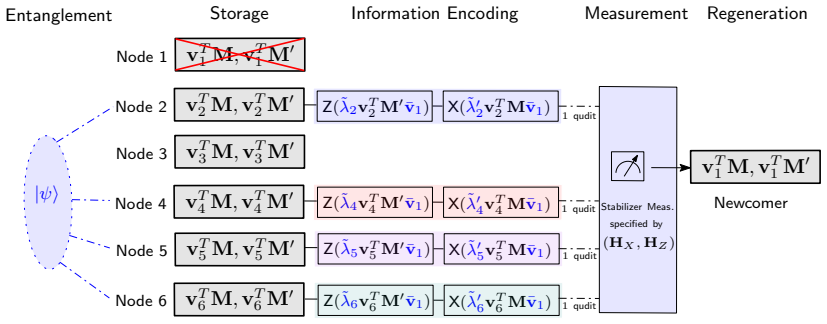
The paper establishes that in an (n,k,d,alpha,beta_q,B) entanglement-assisted distributed storage system, when d is at least 2k-2, an exact-regenerating code exists that attains the same minimal alpha and minimal d beta_q previously known only for functional repair. The construction integrates the product-matrix framework with the CSS stabilizer formalism so that d helper nodes sharing entanglement each send beta_q qudits; the newcomer performs a joint measurement that exactly reproduces the failed node's classical symbols and quantum state.
What carries the argument
Product-matrix framework combined with CSS stabilizer formalism, which lets the newcomer reconstruct the precise failed-node content from entangled transmissions without extra resources.
Load-bearing premise
The product-matrix framework and CSS stabilizer formalism can be combined to enforce exact regeneration in the entanglement-assisted model without introducing extra storage or bandwidth costs.
What would settle it
A concrete counterexample with parameters n, k, d where d is at least 2k-2, in which no exact-repair code meets the minimal alpha and d beta_q known for functional repair, would disprove the claim.
Figures
read the original abstract
We study exact-regenerating codes for entanglement-assisted distributed storage systems. Consider an $(n,k,d,\alpha,\beta_{\mathsf{q}},B)$ distributed system that stores a file of $B$ classical symbols across $n$ nodes with each node storing $\alpha$ symbols. A data collector can recover the file by accessing any $k$ nodes. When a node fails, any $d$ surviving nodes share an entangled state, and each of them transmits a quantum system of $\beta_{\mathsf{q}}$ qudits to a newcomer. The newcomer then performs a measurement on the received quantum systems to generate its storage. Recent work [1] showed that, under functional repair where the regenerated content may differ from that of the failed node, there exists a unique optimal regenerating point that \emph{simultaneously minimizes both storage $\alpha$ and repair bandwidth $d \beta_{\mathsf{q}}$} when $d \geq 2k-2$. In this paper, we show that, under \emph{exact repair}, where the newcomer reproduces exactly the same content as the failed node, this optimal point remains achievable. Our construction builds on the classical product-matrix framework and the Calderbank-Shor-Steane (CSS)-based stabilizer formalism.
Editorial analysis
A structured set of objections, weighed in public.
Referee Report
Summary. The paper claims that in an (n,k,d,α,β_q,B) entanglement-assisted distributed storage system, the unique optimal regenerating point that simultaneously minimizes storage α and repair bandwidth d β_q (previously shown for functional repair when d ≥ 2k-2) remains achievable under exact repair. The construction lifts the classical product-matrix framework into the entanglement-assisted model using CSS stabilizer codes, with the newcomer performing a measurement on received quantum systems to recover exactly the failed node's state.
Significance. If the construction attains the functional-repair optimum without overhead, the result is significant: it shows exact repair is possible at the information-theoretic minimum for both storage and entanglement-assisted bandwidth, extending prior functional-repair optimality to the more practical exact-repair setting. The approach reuses existing frameworks without new parameters, offering a concrete path toward quantum-enhanced regenerating codes.
major comments (1)
- [Construction and main theorem] The central achievability claim rests on the CSS-based lifting of the product-matrix construction enforcing exact regeneration. The manuscript must explicitly verify (e.g., in the construction section or proof of the main theorem) that the newcomer's measurement recovers the precise quantum state of the failed node while using exactly β_q qudits per helper and without increasing α, as any hidden cost would move the operating point away from the claimed optimum.
minor comments (2)
- [Abstract and references] The abstract refers to 'recent work [1]' for the functional-repair bound; the full reference list should include the complete bibliographic details for [1] to allow readers to cross-check the cut-set parameters.
- [System model] Notation for the quantum repair bandwidth (β_q) and the number of qudits is introduced without an early definition of the underlying finite-field or qudit dimension; a brief clarifying sentence in the system model would improve readability.
Simulated Author's Rebuttal
We thank the referee for the careful reading and positive recommendation for minor revision. We address the single major comment below.
read point-by-point responses
-
Referee: [Construction and main theorem] The central achievability claim rests on the CSS-based lifting of the product-matrix construction enforcing exact regeneration. The manuscript must explicitly verify (e.g., in the construction section or proof of the main theorem) that the newcomer's measurement recovers the precise quantum state of the failed node while using exactly β_q qudits per helper and without increasing α, as any hidden cost would move the operating point away from the claimed optimum.
Authors: We agree that an explicit verification strengthens the presentation. The CSS stabilizer formalism in our lifting of the product-matrix construction is designed so that the newcomer's joint measurement on the d received quantum systems (each of dimension β_q) extracts the exact stabilizer syndrome of the failed node, thereby reconstructing its precise quantum state. Because the encoding matrices satisfy the same rank conditions as the classical case and the entanglement is pre-shared without additional qudit cost, α and β_q remain unchanged. To address the referee's request directly, the revised manuscript will expand Section III (Construction) and the proof of Theorem 1 with a dedicated paragraph that walks through the measurement operators, commutation relations, and post-measurement state, confirming zero overhead. revision: yes
Circularity Check
No significant circularity in the claimed derivation
full rationale
The paper's central result is an achievability construction for exact repair in the entanglement-assisted model that attains the same (α, β_q) point shown optimal for functional repair in prior work [1]. This construction is obtained by adapting the classical product-matrix framework using CSS stabilizer codes, providing an independent explicit method rather than deriving the parameters from the paper's own data or definitions. The optimality bound itself is imported from external prior work without reduction to self-citation chains or fitted inputs within this paper. No step in the derivation reduces to an input by construction.
Axiom & Free-Parameter Ledger
axioms (2)
- domain assumption Existence of a unique optimal regenerating point for functional repair when d ≥ 2k-2 (from cited prior work).
- domain assumption Product-matrix framework and CSS stabilizer formalism can be adapted to enforce exact repair in the entanglement-assisted model.
Lean theorems connected to this paper
-
IndisputableMonolith/Cost/FunctionalEquation.leanwashburn_uniqueness_aczel unclearOur construction builds on the classical product-matrix framework and the Calderbank-Shor-Steane (CSS)-based stabilizer formalism.
-
IndisputableMonolith/Foundation/RealityFromDistinction.leanreality_from_one_distinction unclearthe regenerating point (α = B/k , dβ_q = B/k ) is achievable and optimal
Reference graph
Works this paper leans on
- [1]
-
[2]
S. Rhea, C. Wells, P. Eaton, D. Geels, B. Zhao, H. Weatherspoon, and J. Kubiatowicz. Maintenance-free global data storage.IEEE Internet Computing, 5(5):40–49, September 2001
work page 2001
-
[3]
R. Bhagwan, K. Tati, Y . Cheng, S. Savage, and G. V oelker. Total recall: System support for automated availability management. In First Conference on Symposium on Networked Systems Design and Implementation, March 2004
work page 2004
- [4]
-
[5]
L. Hu, M. Nomeir, A. Aytekin, Y . Shi, S. Ulukus, and S. Guha. Entanglement-assisted coding for arbitrary linear computations over a quantum MAC. InIEEE ITW, September 2025
work page 2025
-
[6]
A. Aytekin, M. Nomeir, S. Vithana, and S. Ulukus. Quantum symmetric private information retrieval with secure storage and eavesdroppers. In IEEE Globecom, December 2023
work page 2023
- [7]
- [8]
- [9]
-
[10]
L. Hu, M. Nomeir, A. Aytekin, and S. Ulukus. Distributed storage systems with quantum entanglement assistance. 2026. Submitted. Avail- able online: https://user.eng.umd.edu/ ulukus/papers/journal/quantum- regenerating-codes.pdf
work page 2026
-
[11]
A. Dimakis, P. Godfrey, Y . Wu, M. Wainwright, and K. Ramchandran. Network coding for distributed storage systems.IEEE Transactions on Information Theory, 56(9):4539–4551, August 2010
work page 2010
-
[12]
K. V . Rashmi, N. B. Shah, and P. V . Kumar. Optimal exact-regenerating codes for distributed storage at the MSR and MBR points via a product–matrix construction.IEEE Transactions on Information Theory, 57(8):5227–5239, July 2011
work page 2011
-
[13]
C. Tian. Characterizing the rate region of the (4, 3, 3) exact-repair regenerating codes.IEEE Journal on Selected Areas in Communications, 32(5):967–975, April 2014
work page 2014
-
[14]
A. R. Calderbank and P. W. Shor. Good quantum error-correcting codes exist.Physical Review A, 54(2):1098, 1996
work page 1996
-
[15]
A. Steane. Multiple-particle interference and quantum error correction. Proceedings of the Royal Society of London. Series A: Mathematical, Physical and Engineering Sciences, 452(1954):2551–2577, 1996
work page 1954
- [16]
- [17]
discussion (0)
Sign in with ORCID, Apple, or X to comment. Anyone can read and Pith papers without signing in.