Recognition: 2 theorem links
· Lean TheoremDivergent Multi-Version Execution (DME): Canonical Instruction-Trace Fault Detection via Structural Address-Space Decorrelation
Pith reviewed 2026-05-14 20:34 UTC · model grok-4.3
The pith
DME detects faults by comparing address-free instruction traces from independently compiled replicas with different memory layouts.
A machine-rendered reading of the paper's core claim, the machinery that carries it, and where it could break.
Core claim
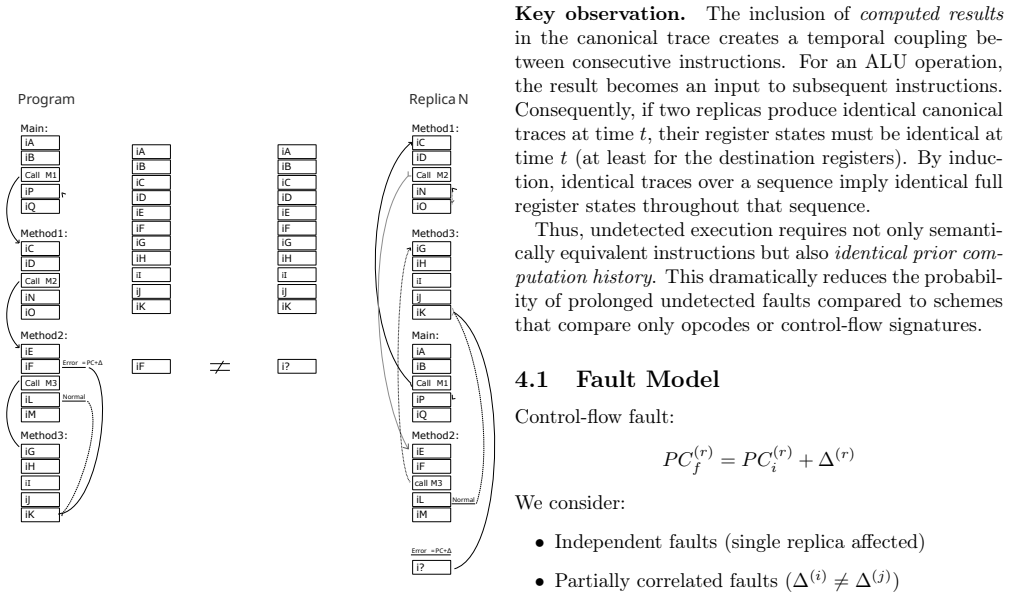
DME is a runtime semantic consistency verifier that detects faults by comparing canonical instruction traces (opcodes, register identifiers, loaded/stored values, results) from independently compiled replicas while discarding layout-dependent addresses.
What carries the argument
Canonical instruction traces that exclude address information, produced by structural address-space decorrelation from independent compilation of semantic equivalents.
If this is right
- Correlated faults such as simultaneous PC corruption or pointer tampering become detectable instead of producing silent errors.
- The same mechanism works for faults from hardware disturbance, software bugs, compilation errors, or deliberate tampering.
- Redundant execution no longer requires identical binaries or layouts.
- Semantic consistency can be checked at runtime without depending on physical address equality.
Where Pith is reading between the lines
- The approach could be layered with existing diversity techniques to protect against both transient and persistent faults.
- It opens a path to runtime detection of certain classes of compilation or optimization bugs that preserve semantics within one binary but differ across builds.
- Practical deployment would require efficient trace extraction and comparison hardware or software support to keep overhead low.
Load-bearing premise
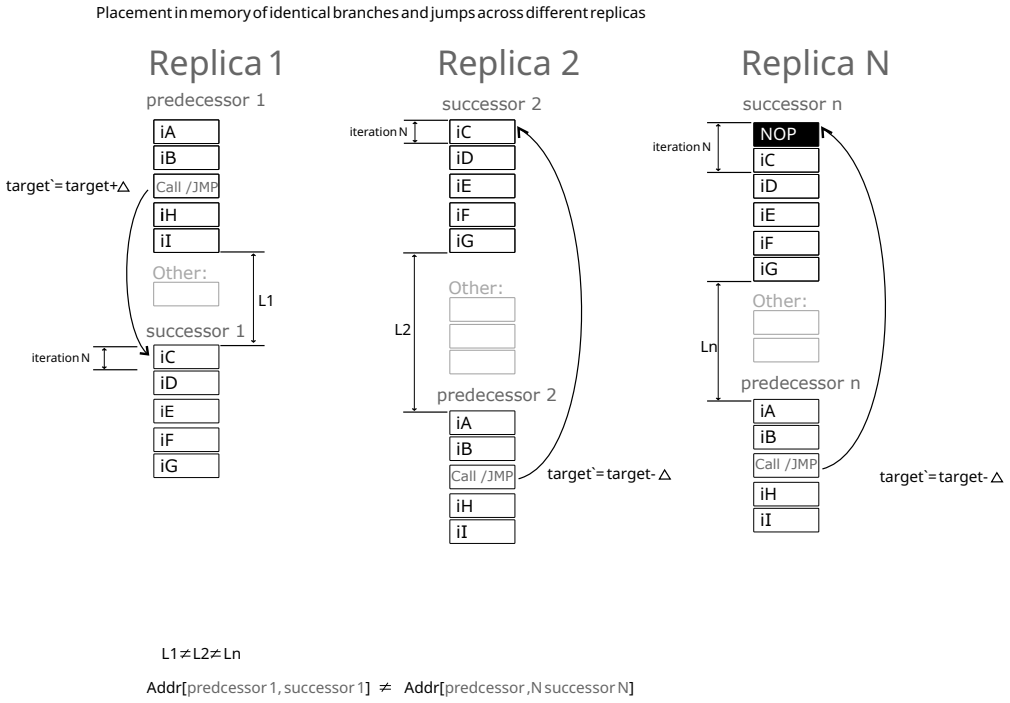
Independent compilation produces memory layouts different enough to decorrelate faults yet keeps semantics identical so address-free traces remain directly comparable.
What would settle it
A fault that alters program-counter or data-pointer values identically across all replicas despite their different layouts, producing matching but incorrect canonical traces.
Figures




read the original abstract
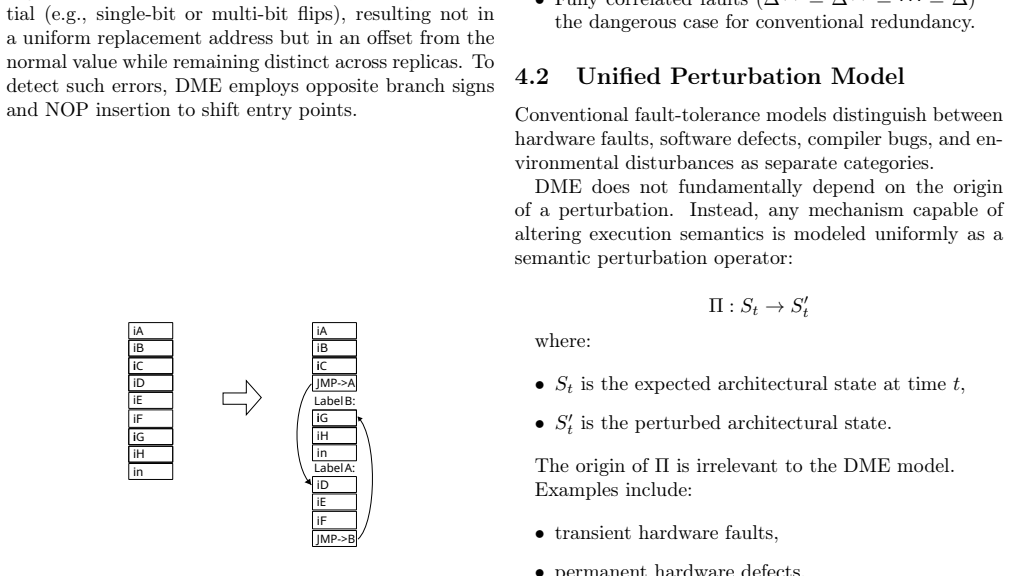
Traditional redundancy (lockstep, TMR) executes identical binaries with identical memory layouts. A single correlated fault - for example, an arbitrary program counter value or a perturbation delta-PC in all replicas - redirects all replicas along the same incorrect path. The same applies to corruption of data pointers. Both types of faults, regardless of their origin (deliberate tampering, software bug, compilation bug, or physical disturbance), cause silent data corruption and erroneous program execution. This work presents Divergent Multi-Version Execution (DME), a runtime semantic consistency verifier for diversified executions. Each replica is compiled independently, producing different code and data memory layouts while preserving identical semantics. Faults are detected by comparing canonical instruction traces, which include opcodes, register identifiers, loaded/stored values, and results, while discarding layout-dependent addresses.
Editorial analysis
A structured set of objections, weighed in public.
Referee Report
Summary. The paper proposes Divergent Multi-Version Execution (DME) as a runtime semantic consistency verifier for diversified program executions. Each replica is compiled independently to produce different code and data memory layouts while preserving identical semantics; faults are detected by comparing canonical instruction traces (opcodes, register identifiers, loaded/stored values, and results) across replicas while discarding layout-dependent addresses, thereby avoiding the correlated faults that affect traditional lockstep or TMR redundancy.
Significance. If the central mechanism can be realized with a well-defined trace normalization that preserves exact matching for fault-free runs, DME would address a genuine limitation of conventional redundancy by decorrelating address-space faults. The absence of any implementation, evaluation, or formal argument in the current manuscript, however, leaves the practical significance undetermined.
major comments (2)
- [Abstract] Abstract: the claim that 'canonical instruction traces ... match exactly' once addresses are discarded is not supported by any description of a normalization step, equivalence relation, or abstraction layer. Independent compilation routinely produces different opcode sequences, register allocations, and instruction orders for the same semantics, so the consistency check is undefined without additional machinery.
- [Abstract] Abstract: no empirical results, implementation details, or proofs are supplied to demonstrate that the proposed trace comparison actually detects the targeted faults (arbitrary PC values, pointer corruption, etc.) while producing zero false positives on correct diversified executions.
Simulated Author's Rebuttal
We thank the referee for the thoughtful and constructive review. The manuscript presents DME as a conceptual approach to decorrelating faults through diversified compilation and canonical trace comparison. We agree that the abstract requires clarification on normalization and that the lack of implementation details limits demonstration of the claims. We address each major comment below and will revise the manuscript accordingly.
read point-by-point responses
-
Referee: [Abstract] Abstract: the claim that 'canonical instruction traces ... match exactly' once addresses are discarded is not supported by any description of a normalization step, equivalence relation, or abstraction layer. Independent compilation routinely produces different opcode sequences, register allocations, and instruction orders for the same semantics, so the consistency check is undefined without additional machinery.
Authors: We agree that the abstract's phrasing is imprecise and that the manuscript does not yet specify the normalization machinery. The intended canonical trace abstracts only layout-dependent addresses while retaining opcodes, register identifiers (via a fixed canonical register mapping), loaded/stored values, and computation results. To achieve exact matching across independently compiled replicas, an equivalence relation over instruction semantics and a normalization pass that canonicalizes register names and instruction ordering within basic blocks are required. In the revised version we will add a dedicated section (likely Section 3) that formally defines this normalization step, the equivalence relation, and the conditions under which fault-free diversified executions produce identical canonical traces. revision: yes
-
Referee: [Abstract] Abstract: no empirical results, implementation details, or proofs are supplied to demonstrate that the proposed trace comparison actually detects the targeted faults (arbitrary PC values, pointer corruption, etc.) while producing zero false positives on correct diversified executions.
Authors: The current manuscript is a conceptual proposal and therefore contains neither implementation nor evaluation. We acknowledge that this omission prevents direct demonstration of fault coverage and zero false positives. In the revision we will include a new section describing a prototype implementation (LLVM-based independent compilation with address-space diversification) together with initial experimental results on standard benchmarks. These results will report detection rates for injected faults of the targeted classes (PC corruption, pointer errors) and measured false-positive rates on fault-free diversified runs. We will also outline a sketch of a formal argument establishing that, under the assumption of semantically equivalent diversification, the normalized trace comparison yields zero false positives. revision: yes
Circularity Check
No circularity; purely conceptual description with no equations, derivations, or self-referential reductions
full rationale
The manuscript describes DME at a conceptual level, asserting that independently compiled replicas produce address-discarded canonical traces (opcodes, registers, values) that can be compared for fault detection. No equations, parameters, or formal derivations appear in the provided text. The core claim rests on the unformalized assumption that semantic equivalence survives diversification, but this is presented as a premise rather than derived from prior steps within the paper. No self-citation chains, fitted inputs renamed as predictions, or ansatzes are invoked, so the argument does not reduce to its own inputs by construction.
Axiom & Free-Parameter Ledger
axioms (1)
- domain assumption Independent compilation produces sufficiently different memory layouts to decorrelate faults while preserving identical semantics.
invented entities (1)
-
DME (Divergent Multi-Version Execution)
no independent evidence
Lean theorems connected to this paper
-
IndisputableMonolith/Cost/FunctionalEquation.leanwashburn_uniqueness_aczel unclear?
unclearRelation between the paper passage and the cited Recognition theorem.
Faults are detected by comparing canonical instruction traces, which include opcodes, register identifiers, loaded/stored values, and results — while discarding layout-dependent addresses.
-
IndisputableMonolith/Foundation/RealityFromDistinction.leanreality_from_one_distinction unclear?
unclearRelation between the paper passage and the cited Recognition theorem.
Under fault-free execution, all replicas produce identical canonical traces.
What do these tags mean?
- matches
- The paper's claim is directly supported by a theorem in the formal canon.
- supports
- The theorem supports part of the paper's argument, but the paper may add assumptions or extra steps.
- extends
- The paper goes beyond the formal theorem; the theorem is a base layer rather than the whole result.
- uses
- The paper appears to rely on the theorem as machinery.
- contradicts
- The paper's claim conflicts with a theorem or certificate in the canon.
- unclear
- Pith found a possible connection, but the passage is too broad, indirect, or ambiguous to say the theorem truly supports the claim.
Reference graph
Works this paper leans on
-
[1]
fetching a canonically equivalent instruction (prob- ability≤C/|S|),
-
[2]
Thus: Pstep ≤ C |S| ·ε
producing an identical result (probability≤ε). Thus: Pstep ≤ C |S| ·ε. Overksteps: Pundetected(k)≤ C |S| ·ε k . Discussion.The bound is conservative: •assumes uniform instruction distribution, •ignores control-flow constraints, •ignores state divergence amplification. In practice, detection is significantly stronger. Example.Let: •|S|= 2048, •C= 12, •ε≤2 ...
2048
-
[3]
alignment to the same logical instruction,
-
[4]
canonical equivalence,
-
[5]
Thus, detection follows: Pundetected(k)≤ C |S| ·ε k
identical computed results. Thus, detection follows: Pundetected(k)≤ C |S| ·ε k . 5.5 Summary of Detection Regimes •Deterministic regime:For fully correlated per- turbations with|∆P C| ≥l/N, detection is guaran- teed within one instruction. •Alignment window:For|∆P C|< l/N, replicas may remain aligned; no guarantee. •Non-correlated perturbations:Detection...
-
[6]
CVA6-CFI: A First Glance at RISC-V Control-Flow Integrity Extensions,
S. Manoni et al., “CVA6-CFI: A First Glance at RISC-V Control-Flow Integrity Extensions,”arXiv preprint arXiv:2602.04991, Feb. 2026
-
[7]
The N-Version Approach to Fault- Tolerant Software,
A. Avizienis, “The N-Version Approach to Fault- Tolerant Software,”IEEE Trans. Software Eng., 1985
1985
-
[8]
ErrorDetectionbyDuplicatedInstruc- tions (EDDI),
N.Ohetal., “ErrorDetectionbyDuplicatedInstruc- tions (EDDI),”MICRO-35, 2002
2002
-
[9]
SWIFT: Software Implemented Fault Tolerance,
G. A. Reis et al., “SWIFT: Software Implemented Fault Tolerance,” CGO, 2005
2005
-
[10]
Control-Flow Integrity,
M. Abadi et al., “Control-Flow Integrity,” CCS, 2005
2005
-
[11]
Experimental Analysis of the Electro- magnetic Instruction Skip Fault Model and Conse- quences for Software Countermeasures,
J.-M. Dutertre, A. Menu, O. Potin, J.-B. Rigaud, J.-L. Danger, “Experimental Analysis of the Electro- magnetic Instruction Skip Fault Model and Conse- quences for Software Countermeasures,”Microelec- tronics Reliability, 2021
2021
-
[12]
System structure for software fault tol- erance,
B. Randell, “System structure for software fault tol- erance,”IEEE Transactions on Software Engineer- ing, vol. SE-1, no. 2, pp. 220-232, June 1975
1975
-
[13]
Review and analysis of synthetic diversity for breaking monocultures,
J. Just and M. Cornwell, “Review and analysis of synthetic diversity for breaking monocultures,” inProc. 2004 ACM Workshop on Rapid Malcode (WORM ’04), Washington DC, USA, 2004, pp. 23- 32
2004
-
[14]
Low- overhead fault-tolerance technique for a dynamically reconfigurable softcore processor,
H.-M. Pham, S. Pillement, and S. J. Piestrak, “Low- overhead fault-tolerance technique for a dynamically reconfigurable softcore processor,”IEEE Transac- tions on Computers, vol. 62, no. 6, pp. 1202-1215, June 2013. 16
2013
-
[15]
Dynamic Triple Modular Re- dundancy in Interleaved Hardware Threads,
M. Barbiottia et al., “Dynamic Triple Modular Re- dundancy in Interleaved Hardware Threads,”IEEE Access, vol. 12, pp. 32456-32470, 2024
2024
-
[16]
The Illusion of Randomness: An Empirical Analysis of Address Space Layout Randomization Implementations,
S. Binosi et al., “The Illusion of Randomness: An Empirical Analysis of Address Space Layout Randomization Implementations,” inProc. ACM SIGSAC Conf. Computer and Communications Se- curity (CCS ’24), 2024
2024
-
[17]
Basic concepts and taxonomy of de- pendable and secure computing,
A. Avizienis, J. C. Laprie, B. Randell, and C. Landwehr, “Basic concepts and taxonomy of de- pendable and secure computing,”IEEE Transac- tions on Dependable and Secure Computing, vol. 1, no. 1, pp. 11-33, Jan.-March 2004
2004
-
[18]
M. Amel Solouki, S. Angizi, and M. Violante, “Dependability in Embedded Systems: A Sur- vey of Fault Tolerance Methods and Software- Based Mitigation Techniques,”arXiv preprint arXiv:2404.10509, April 2024
-
[19]
Honest to a Fault: Root-Causing Fault Attacks with Pre-Silicon RISC Pipeline Characterization,
A. A. Malik, H. Mihir, and A. Aysu, “Honest to a Fault: Root-Causing Fault Attacks with Pre-Silicon RISC Pipeline Characterization,”arXiv preprint arXiv:2503.04846, March 2025
-
[20]
Improved address space layout randomization,
“Improved address space layout randomization,” Google Patents DE112017002277T5, 2017. 17
2017
discussion (0)
Sign in with ORCID, Apple, or X to comment. Anyone can read and Pith papers without signing in.