Recognition: unknown
On the Anticipation of Lunar Travel in the Early 20th Century: A Pedagogical Exercise
Pith reviewed 2026-05-14 20:51 UTC · model grok-4.3
The pith
A 1923 popular science book used basic Newtonian gravity to map Earth-Moon travel phases and estimate a 49-hour duration of the same order as Apollo missions.
A machine-rendered reading of the paper's core claim, the machinery that carries it, and where it could break.
Core claim
Berget approached space travel using physical reasoning grounded in Newtonian gravitation. Using qualitative and semi-quantitative arguments based on the inverse-square law, he identified the principal phases of an Earth-Moon trajectory: escape from Earth, inertial translunar motion, transition through competing Earth-Moon gravitational fields, and final lunar capture and deceleration. His estimated Earth-Moon travel time of approximately 49 hours is of the same order of magnitude as Apollo mission transit times.
What carries the argument
The inverse-square law of gravitation applied to identify the principal phases of an Earth-Moon trajectory and to derive an order-of-magnitude travel time.
If this is right
- Basic Newtonian arguments suffice to outline the main phases of translunar trajectories without requiring advanced numerical integration.
- Early popular treatments can serve as accessible entry points for teaching modern concepts such as restricted three-body dynamics and Lagrange-point passages.
- Berget's attention to human factors like food supply and confinement anticipates operational constraints that later shaped crewed mission design.
- The work demonstrates that order-of-magnitude estimates derived from first principles can align with actual mission durations even when detailed planning is absent.
Where Pith is reading between the lines
- Such historical cases suggest that order-of-magnitude Newtonian models remain useful today for rapid feasibility checks on new mission concepts before full simulation.
- The pattern of popular science preceding technical development may recur in emerging domains such as crewed Mars trajectories or asteroid resource utilization.
- Comparing Berget's phases directly to Artemis distant retrograde orbits could test whether the same qualitative sequence still governs modern high-fidelity paths.
Load-bearing premise
Berget's qualitative and semi-quantitative Newtonian arguments constitute a meaningful anticipation of actual spaceflight mechanics rather than a loose popularization.
What would settle it
A step-by-step recalculation of Berget's semi-quantitative estimates using the inverse-square law on a realistic Earth-Moon distance and escape velocity that yields a travel time differing by more than an order of magnitude from 49 hours.
Figures

read the original abstract
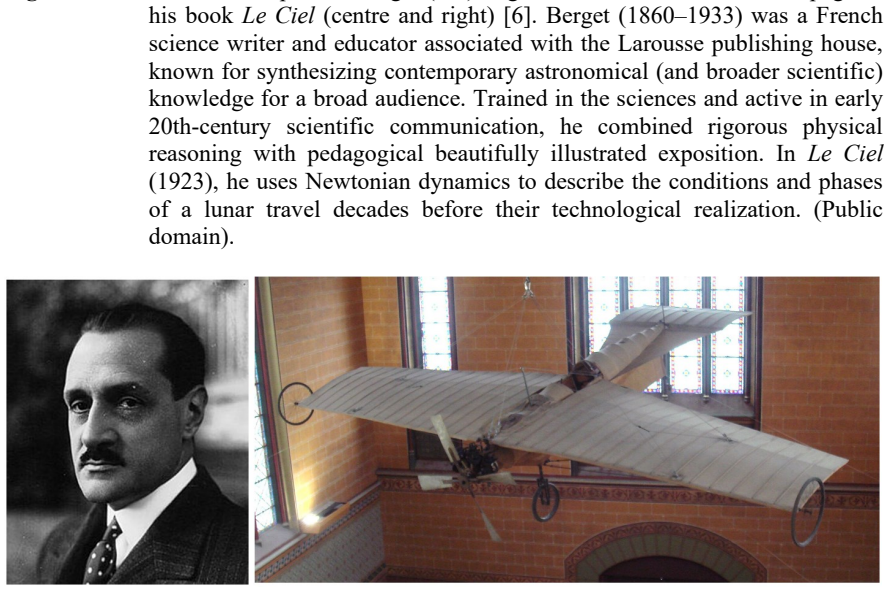
This article examines, from historical and pedagogical perspectives, Alphonse Berget's anticipation of Earth-Moon travel in Le Ciel (Larousse, 1923), decades before the beginning of the space age. The discussion is triggered by Le Ciel, a richly illustrated French popular science work, which has a devoted chapter examining lunar and interplanetary travel within a Newtonian framework. Although Berget's treatment was not developed in isolation and reflects a broader early 20th century context that included pioneers such as French aero-engineer Robert Esnault-Pelterie, the book provides a striking pedagogical synthesis of elementary celestial mechanics and scientific popularization. Unlike earlier fictional treatments such as Jules Verne's De la Terre a la Lune, Berget approached space travel using physical reasoning grounded in Newtonian gravitation. Using qualitative and semi-quantitative arguments based on the inverse-square law, he identified the principal phases of an Earth-Moon trajectory: escape from Earth, inertial translunar motion, transition through competing Earth-Moon gravitational fields, and final lunar capture and deceleration. His estimated Earth-Moon travel time of approximately 49 hours is of the same order of magnitude as Apollo mission transit times (approx. 72 h). We compare these early ideas with modern elementary concepts of astrodynamics, including restricted three-body trajectories, Lagrange-point dynamics, and distant retrograde orbits associated with the Artemis program. We also examine Berget's discussion of interplanetary travel, lunar landscapes, and human factors associated with prolonged voyages, including confinement, food supply, and travel duration. The analysis highlights the pedagogical value of historically grounded scientific reasoning underpinning spaceflight mechanics.
Editorial analysis
A structured set of objections, weighed in public.
Referee Report
Summary. The paper examines Alphonse Berget's 1923 popular-science book Le Ciel, in which Berget applies Newtonian inverse-square gravitation to outline the principal phases of an Earth-Moon trajectory (escape, inertial coast, field transition, and lunar capture) and arrives at an estimated transit time of approximately 49 hours. The authors compare this figure to Apollo mission durations (~72 h), situate Berget within the early-20th-century context of Esnault-Pelterie and others, and draw pedagogical parallels to modern restricted three-body dynamics, Lagrange-point concepts, and Artemis-era distant retrograde orbits, while also addressing interplanetary travel and human-factors considerations.
Significance. If the historical reconstruction is accurate, the manuscript usefully illustrates how elementary Newtonian reasoning was already being deployed in popular literature to anticipate key features of lunar trajectories decades before Apollo. It supplies a concrete pedagogical bridge between classical celestial mechanics and contemporary astrodynamics teaching, and documents an early instance of semi-quantitative spaceflight analysis outside the technical literature.
major comments (1)
- [Section discussing Berget's trajectory phases and 49-hour estimate] The central claim that Berget's ~49-hour estimate constitutes a meaningful Newtonian anticipation rests on the assertion that he employed 'qualitative and semi-quantitative arguments based on the inverse-square law' to identify trajectory phases. However, the manuscript does not reproduce or reconstruct those steps (e.g., the escape-speed calculation, the duration of the coasting phase under 1/r², or the radius at which Earth and Moon gravity compete). Without the intermediate values or the gravitational parameters Berget would have adopted in 1923, it remains unclear whether the numerical proximity to Apollo transit times reflects mechanically grounded reasoning or an order-of-magnitude coincidence. This gap directly affects the strength of the anticipation thesis.
minor comments (2)
- Add page numbers and direct quotations (or close paraphrases) from Le Ciel for all specific claims attributed to Berget, especially the 49-hour figure and the description of gravitational-field transition.
- The comparison between Berget's two-body picture and modern restricted three-body or Lagrange-point concepts would benefit from a short clarifying sentence stating that Berget did not explicitly treat multi-body effects.
Simulated Author's Rebuttal
We thank the referee for the positive summary, the recognition of the manuscript's pedagogical value, and the recommendation for minor revision. We address the single major comment below and will revise the text accordingly.
read point-by-point responses
-
Referee: [Section discussing Berget's trajectory phases and 49-hour estimate] The central claim that Berget's ~49-hour estimate constitutes a meaningful Newtonian anticipation rests on the assertion that he employed 'qualitative and semi-quantitative arguments based on the inverse-square law' to identify trajectory phases. However, the manuscript does not reproduce or reconstruct those steps (e.g., the escape-speed calculation, the duration of the coasting phase under 1/r², or the radius at which Earth and Moon gravity compete). Without the intermediate values or the gravitational parameters Berget would have adopted in 1923, it remains unclear whether the numerical proximity to Apollo transit times reflects mechanically grounded reasoning or an order-of-magnitude coincidence. This gap directly affects the strength of the anticipation thesis.
Authors: We agree that reproducing or plausibly reconstructing Berget's intermediate steps would strengthen the anticipation claim. Le Ciel is a popular-science volume, so Berget presents the four phases (escape, inertial coast, field transition, capture) and the 49-hour total with only brief numerical indications rather than full derivations. In the revised manuscript we will add a short subsection that (i) states the gravitational constants and lunar distance available in 1923, (ii) sketches the escape-velocity estimate (~11 km s⁻¹), (iii) estimates the coasting time under an inverse-square force with a representative average speed, and (iv) notes the approximate radius where lunar gravity begins to dominate. These steps are presented as a transparent reconstruction consistent with the inverse-square framework Berget invokes, not as verbatim quotations from the book. We will also qualify the comparison to Apollo transit times as order-of-magnitude agreement rather than precise numerical equivalence. This addition directly addresses the gap identified by the referee while preserving the historical and pedagogical focus of the paper. revision: yes
Circularity Check
No circularity: interpretive historical analysis with no derivations or self-referential reductions
full rationale
The paper is a historical and pedagogical discussion of Berget's 1923 qualitative Newtonian arguments for lunar travel. It reports Berget's ~49-hour estimate and notes its order-of-magnitude similarity to Apollo times without reproducing or deriving any equations, fitted parameters, or predictions from first principles. No self-citations, ansatzes, or uniqueness claims appear in a load-bearing role. The central claim is an interpretive comparison of historical ideas to modern concepts, fully self-contained against external historical sources and not reducible to its own inputs by construction.
Axiom & Free-Parameter Ledger
Reference graph
Works this paper leans on
-
[1]
Исследование мировых пространств реактивными приборами
Tsiolkovsky K.E., “Исследование мировых пространств реактивными приборами” [“Exploration of Outer Space by Means of Reactive Devices”], Nauchnoe Obozrenie 5 (1903), pp. 45–75; English trans. in Selected Works of K. E. Tsiolkovsky, Mir / Russian Academy of Sciences, Moscow, 2006
1903
-
[2]
Available at: https://www.nasa.gov/wp-content/uploads/2018/09/beyond-earth-tagged.pdf
Siddiqi A.A., Beyond Earth: A Chronicle of Deep Space Exploration, 1958–2016, NASA History Program Office, Washington DC, 2018. Available at: https://www.nasa.gov/wp-content/uploads/2018/09/beyond-earth-tagged.pdf
1958
-
[3]
A Method of Reaching Extreme Altitudes
Goddard R.H., “A Method of Reaching Extreme Altitudes”, Smithsonian Miscellaneous Collections 71 (1919), no. 2, pp. 1–69
1919
-
[4]
Robert Goddard and the First Liquid-Propellant Rocket
National Air and Space Museum, “Robert Goddard and the First Liquid-Propellant Rocket”, Smithsonian Institution, Washington DC. Available at: https://airandspace.si.edu/stories/editorial/robert-goddard-and-first-liquid- propellant-rocket
-
[5]
Bilstein R.E., Stages to Saturn: A Technological History of the Apollo/Saturn Launch Vehicles, NASA History Office, Washington DC, 1996
1996
-
[6]
Berget A., Le Ciel, Larousse, Paris, 1923
1923
-
[7]
Verne J., De la Terre à la Lune, Hetzel, Paris, 1865
-
[8]
Chaikin A., A Man on the Moon: The Voyages of the Apollo Astronauts, Viking, New York, 1994
1994
-
[9]
NASA, Apollo 11 Mission Report, NASA Manned Spacecraft Center, Houston TX,
-
[10]
Available at: https://history.nasa.gov/ap11fj/
-
[11]
Available at: https://www.nasa.gov/wp-content/uploads/2023/04/sp-4029.pdf
Orloff R.W., Apollo by the Numbers: A Statistical Reference, NASA SP-2000- 4029, NASA History Office, Washington DC, 2000. Available at: https://www.nasa.gov/wp-content/uploads/2023/04/sp-4029.pdf
2000
-
[12]
Bate R.R., Mueller D.D., White J.E., Fundamentals of Astrodynamics, Dover Publications, New York, 1971
1971
-
[13]
Ryden B., Peterson B.M., Foundations of Astrophysics, Pearson/Addison-Wesley, San Francisco, 2009
2009
-
[14]
Astronaut Photo AS08-14-2383: Earthrise
NASA, “Astronaut Photo AS08-14-2383: Earthrise”, NASA Johnson Space Center,
-
[15]
Available at: https://eol.jsc.nasa.gov/SearchPhotos/photo.pl?mission=AS08&roll=14&frame=23 83
-
[16]
Prussing J.E., Conway B.A., Orbital Mechanics, 2nd ed., Oxford University Press, Oxford, 2012
2012
-
[17]
https://doi.org/10.1007/978-3-642-35963-7 20
Lang K.R., Essential Astrophysics, Springer, Berlin, Heidelberg, 2013. https://doi.org/10.1007/978-3-642-35963-7 20
-
[18]
Battin R.H., An Introduction to the Mathematics and Methods of Astrodynamics, revised ed., American Institute of Aeronautics and Astronautics, Reston VA, 1999
1999
-
[19]
Artemis I
NASA, “Artemis I”, NASA, 2022. Available at: https://www.nasa.gov/mission/artemis-i/
2022
-
[20]
Mars Science Laboratory Mission Overview
NASA, “Mars Science Laboratory Mission Overview”, Jet Propulsion Laboratory, Pasadena CA, 2011. Available at: https://mars.nasa.gov/msl/
2011
-
[21]
Artemis II: NASA’s First Crewed Lunar Flyby in 50 Years
NASA, “Artemis II: NASA’s First Crewed Lunar Flyby in 50 Years”, NASA,
-
[22]
Available at: https://www.nasa.gov/mission/artemis-ii/
discussion (0)
Sign in with ORCID, Apple, or X to comment. Anyone can read and Pith papers without signing in.