Recognition: no theorem link
SIMPLIFI -- Study of Interstellar Magnetic Polarization: a Legacy Investigation of Filaments. I. Magnetically-Guided Accretion onto the DR21 Ridge
Pith reviewed 2026-05-14 20:20 UTC · model grok-4.3
The pith
Projected gravity and magnetic fields remain aligned throughout the DR21 cloud at all densities
A machine-rendered reading of the paper's core claim, the machinery that carries it, and where it could break.
Core claim
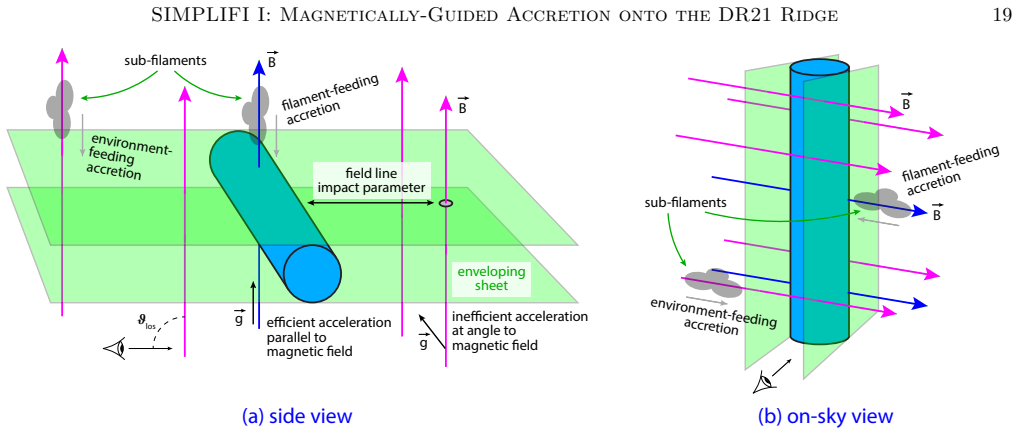
Our central finding is that vec g_pos and hat B_pos remain aligned throughout the cloud regardless of column density or environment, unlike the environment-dependent behavior of either quantity versus the intensity gradient. This persistent alignment is consistent with magnetically-guided accretion: sub-filaments channel material along field lines at several 10^{-3} solar masses per year, sufficient to assemble the Ridge within about 1 Myr and sustain high-mass star formation. The framework also explains why observed radial velocities of about 2 km/s fall well below free-fall expectations of about 8 km/s due to projection effects.
What carries the argument
The persistent alignment between the projected gravitational acceleration vec g_pos and the plane-of-sky magnetic field hat B_pos, independent of column density, used to infer ongoing channeled accretion along field lines.
If this is right
- Sub-filaments supply gas to the main ridge at rates of several 10^{-3} solar masses per year.
- The DR21 ridge can be assembled on a timescale of roughly 1 Myr.
- Observed radial velocities around 2 km/s are lower than free-fall values of 8 km/s because of projection along the line of sight.
- Magnetic field orientation changes with column density only relative to intensity gradients, not relative to gravity directions.
Where Pith is reading between the lines
- The same alignment signature may appear in other filamentary clouds formed from strongly magnetized gas.
- Time-dependent velocity mapping could test whether the inferred flows actually deliver the predicted mass over Myr timescales.
- The column-density threshold for orientation shifts may vary between clouds according to their initial magnetization.
Load-bearing premise
That the observed alignment between projected gravity and magnetic field directions indicates net mass flow along those lines rather than static configurations or projection effects that could produce the same geometry without accretion.
What would settle it
A direct measurement of the three-dimensional velocity field along the inferred field directions that shows no net systematic inflow toward the ridge despite the alignment.
Figures




read the original abstract
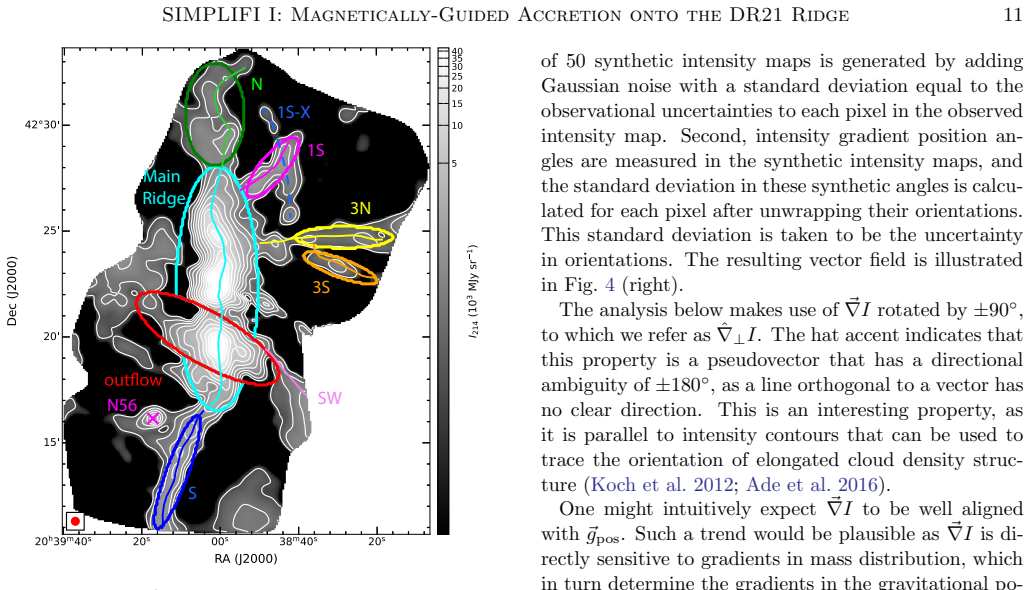
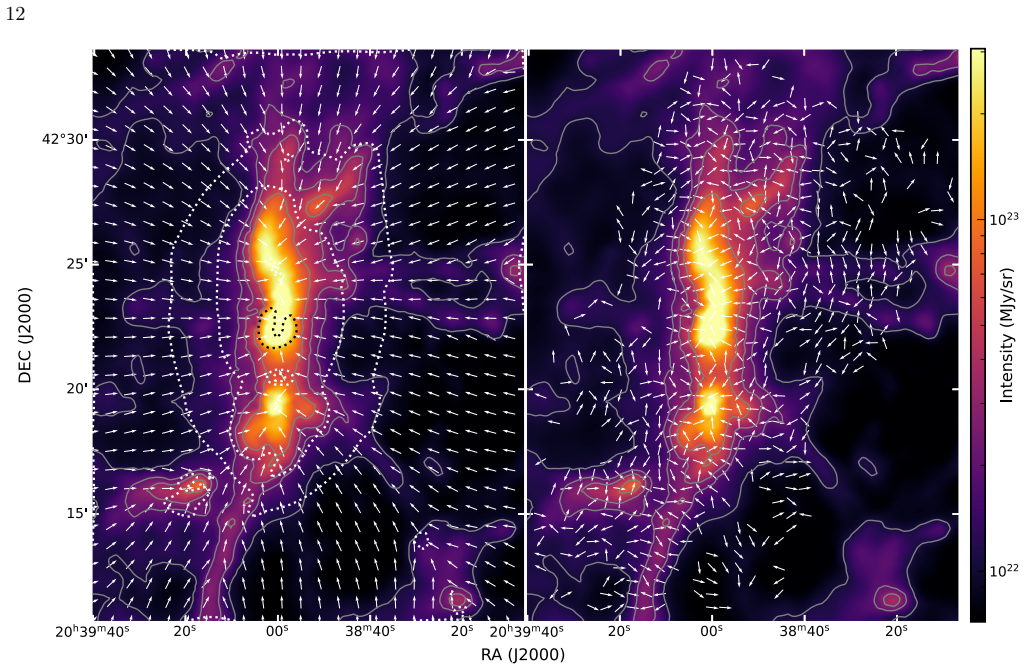
We present first results from SIMPLIFI (Study of Interstellar Magnetic Polarization: a Legacy Investigation of Filaments), a SOFIA/HAWC+ $214~\mu\rm{}m$ polarimetric survey of Galactic molecular cloud filaments. We trace magnetic field morphology from the DR21 Main Ridge into surrounding sub-filaments at $\sim{}0.1~\rm{}pc$ resolution, extending polarimetric detections for the first time beyond high-column-density regions probed by prior submillimeter observations. We compare the plane-of-sky orientations of the magnetic field $\hat{B}_{\rm{}pos}$, the projected gravitational acceleration $\vec{g}_{\rm{}pos}$, and the intensity gradient rotated by $90^{\circ}$. The relative orientation of $\hat{B}_{\rm{}pos}$ and the rotated gradient transitions from preferentially parallel in sub-filaments to perpendicular in the Main Ridge at $N({\rm{}H_2})\sim{}2\times{}10^{22}~\rm{}cm^{-2}$, consistent with thresholds seen with Planck. This is expected in clouds formed from strongly magnetized, sub-Alfvenic, magnetically sub-critical gas. We find region-to-region and pixel-to-pixel variations at fixed column density, indicating that column density alone is not sufficient to encode changes in magnetic field structure. Our central finding is that $\vec{g}_{\rm{}pos}$ and $\hat{B}_{\rm{}pos}$ remain aligned throughout the cloud regardless of column density or environment, unlike the environment-dependent behavior of either quantity vs. the intensity gradient. This persistent alignment is consistent with magnetically-guided accretion: sub-filaments channel material along field lines at several $10^{-3}\,M_{\odot}\,\rm{}yr^{-1}$, sufficient to assemble the Ridge within $\sim{}1~\rm{}Myr$ and sustain high-mass star formation. The framework also explains why observed radial velocities $\sim{}2~\rm{}km\,s^{-1}$ fall well below free-fall expectations $\sim{}8~\rm{}km\,s^{-1}$ due to projection effects.
Editorial analysis
A structured set of objections, weighed in public.
Referee Report
Summary. The paper reports first results from the SIMPLIFI SOFIA/HAWC+ 214 μm polarimetric survey of the DR21 Ridge and its sub-filaments. It finds that the plane-of-sky magnetic field (B_pos) remains aligned with the projected gravitational acceleration (g_pos) across the entire region independent of column density, while the intensity gradient shows a transition from parallel to perpendicular alignment at N(H2) ~ 2e22 cm^{-2}. This persistent g_pos–B_pos alignment is interpreted as evidence for magnetically-guided accretion along field lines at rates of several 10^{-3} M_⊙ yr^{-1}, sufficient to assemble the ridge in ~1 Myr; projection effects are invoked to reconcile observed velocities (~2 km s^{-1}) with free-fall expectations (~8 km s^{-1}).
Significance. If the alignment result is placed on a statistically robust footing, the work would strengthen the case for magnetic fields guiding accretion in high-mass star-forming filaments, extending polarimetry to lower-column sub-filaments and providing a concrete link between sub-filament morphology and ridge assembly. The consistency with Planck thresholds and the explicit accretion-rate estimate are positive features. The significance is limited, however, by the absence of quantitative error analysis and independent kinematic confirmation of net mass flow.
major comments (3)
- [alignment analysis] Alignment analysis section: the central claim of persistent g_pos–B_pos alignment independent of column density and environment is presented without reported uncertainties on the orientation angles, without statistical tests (e.g., Kuiper or Rayleigh tests on the angle distributions), and without pixel-by-pixel or region-by-region significance values. This leaves the “regardless of column density” statement only qualitatively supported.
- [accretion-rate section] Accretion-rate derivation: the quoted rate of several 10^{-3} M_⊙ yr^{-1} is obtained by combining the observed alignment with geometric assumptions about filament length and density; no independent mass-flux calculation (e.g., from coherent velocity gradients parallel to B_pos) is supplied, so the numerical value rests entirely on the interpretive step that alignment equals net accretion.
- [discussion of velocities and projection] Projection-effects discussion: the text invokes projection to explain why observed radial velocities are ~2 km s^{-1} rather than the ~8 km s^{-1} free-fall speed, yet supplies no quantitative Monte-Carlo or radiative-transfer assessment of how line-of-sight geometry affects both the measured alignment and the velocity discrepancy. This weakens the claim that the alignment directly demonstrates ongoing accretion.
minor comments (2)
- [figures and notation] Notation for vec g_pos and hat B_pos should be defined once in the text and used consistently in all figure captions and axis labels.
- [results on intensity gradient] The transition column density N(H2) ~ 2e22 cm^{-2} is stated without an accompanying uncertainty or sensitivity test to the exact threshold choice.
Simulated Author's Rebuttal
We thank the referee for the constructive comments, which have improved the statistical rigor and clarity of the manuscript. We address each major comment below and indicate the revisions made.
read point-by-point responses
-
Referee: Alignment analysis section: the central claim of persistent g_pos–B_pos alignment independent of column density and environment is presented without reported uncertainties on the orientation angles, without statistical tests (e.g., Kuiper or Rayleigh tests on the angle distributions), and without pixel-by-pixel or region-by-region significance values. This leaves the “regardless of column density” statement only qualitatively supported.
Authors: We agree that quantitative uncertainties and statistical tests are needed to support the claim robustly. In the revised manuscript we now report uncertainties on mean alignment angles from the standard deviation within each column-density bin, apply Rayleigh tests to the angle distributions (finding p < 0.01 for non-uniformity consistent with alignment across all bins), and include a pixel-by-pixel alignment significance map. These additions place the “independent of column density” statement on a statistically firmer footing. revision: yes
-
Referee: Accretion-rate derivation: the quoted rate of several 10^{-3} M_⊙ yr^{-1} is obtained by combining the observed alignment with geometric assumptions about filament length and density; no independent mass-flux calculation (e.g., from coherent velocity gradients parallel to B_pos) is supplied, so the numerical value rests entirely on the interpretive step that alignment equals net accretion.
Authors: The quoted rate is an order-of-magnitude estimate derived from the observed alignment together with standard geometric assumptions for filament length and density profile; no direct velocity-gradient measurement along B_pos is available in the present polarimetric dataset. We have revised the text to state explicitly that the value rests on the magnetically-guided accretion interpretation, to list the key assumptions, and to note that independent kinematic confirmation would require additional line observations. revision: partial
-
Referee: Projection-effects discussion: the text invokes projection to explain why observed radial velocities are ~2 km s^{-1} rather than the ~8 km s^{-1} free-fall speed, yet supplies no quantitative Monte-Carlo or radiative-transfer assessment of how line-of-sight geometry affects both the measured alignment and the velocity discrepancy. This weakens the claim that the alignment directly demonstrates ongoing accretion.
Authors: A full Monte-Carlo or radiative-transfer treatment of 3D geometry lies beyond the scope of this observational paper. We have expanded the discussion with a simple analytic projection argument showing that random inclinations typically reduce the line-of-sight velocity component by a factor of ~3–4, reconciling the observed ~2 km s^{-1} with free-fall expectations. The plane-of-sky alignment measurement itself is a direct orientation comparison and is less sensitive to projection than the velocity amplitude. revision: partial
- Independent kinematic confirmation of net mass flow along the field lines, which would require new velocity-resolved observations not present in the current dataset.
Circularity Check
No significant circularity; derivation rests on independent observational measurements
full rationale
The paper measures plane-of-sky magnetic field orientations directly from SOFIA/HAWC+ polarimetry and derives projected gravitational acceleration from the column density map; their alignment is reported as an observed fact across column densities. No equations or steps reduce the alignment result to a fitted parameter by construction, nor does the text invoke self-citations for uniqueness theorems or smuggle ansatzes. The accretion-rate estimate is presented as a derived consequence using the observed alignment and geometric factors, not as an input that is then renamed a prediction. The chain is therefore self-contained against external benchmarks such as Planck thresholds and does not exhibit any of the enumerated circularity patterns.
Axiom & Free-Parameter Ledger
free parameters (1)
- accretion rate =
several 10^{-3} M_sun yr^{-1}
axioms (2)
- domain assumption Dust polarization at 214 um reliably traces the plane-of-sky magnetic field orientation
- domain assumption Persistent alignment between projected gravity and magnetic field indicates net mass flow along field lines
Reference graph
Works this paper leans on
-
[1]
Ade, P. A., Aghanim, N., Alves, M. I., et al. 2016, , 586, A138, 10.1051/0004-6361/201525896
-
[2]
Andersson , B.-G., Lazarian , A., & Vaillancourt , J. E. 2015, , 53, 501, 10.1146/annurev-astro-082214-122414
-
[3]
2014, in Protostars and Planets VI, ed
Andr \'e , P., Di Francesco , J., Ward-Thompson , D., et al. 2014, in Protostars and Planets VI, ed. H. Beuther , R. S. Klessen , C. P. Dullemond , & T. Henning , 27--51, 10.2458/azu_uapress_9780816531240-ch002
-
[4]
2010, , 518, L102, 10.1051/0004-6361/201014666
Andr \'e , P., Men'shchikov , A., Bontemps , S., et al. 2010, , 518, L102, 10.1051/0004-6361/201014666
-
[5]
2019, , 621, A42, 10.1051/0004-6361/201832725
Arzoumanian , D., Andr \'e , P., K \"o nyves , V., et al. 2019, , 621, A42, 10.1051/0004-6361/201832725
-
[6]
T., Kauffmann, J., Bigiel, F., et al
Barnes, A. T., Kauffmann, J., Bigiel, F., et al. 2020, , 497, 1972, 10.1093/mnras/staa1814
-
[8]
Beerer, I. M., Koenig, X. P., Hora, J. L., et al. 2010, , 720, 679, 10.1088/0004-637X/720/1/679
-
[9]
2020, , 644, 10.1051/0004-6361/202038281
Bonne, L., Bontemps, S., Schneider, N., et al. 2020, , 644, 10.1051/0004-6361/202038281
-
[10]
2023, , 951, 39, 10.3847/1538-4357/acd536
---. 2023, , 951, 39, 10.3847/1538-4357/acd536
-
[11]
Butterfield, N. O., Chuss, D. T., Guerra, J. A., et al. 2024, , 963, 130, 10.3847/1538-4357/ad12b9
-
[12]
Chapman , N. L., Goldsmith , P. F., Pineda , J. L., et al. 2011, , 741, 21, 10.1088/0004-637X/741/1/21
-
[13]
2017, , 838, 121, 10.3847/1538-4357/aa65cc
Ching , T.-C., Lai , S.-P., Zhang , Q., et al. 2017, , 838, 121, 10.3847/1538-4357/aa65cc
-
[14]
2018, , 865, 110, 10.3847/1538-4357/aad9fc
---. 2018, , 865, 110, 10.3847/1538-4357/aad9fc
-
[15]
2022, , 941, 122, 10.3847/1538-4357/ac9dfb
Ching, T.-C., Qiu, K., Li, D., et al. 2022, , 941, 122, 10.3847/1538-4357/ac9dfb
-
[16]
T., Andersson, B.-G., Bally, J., et al
Chuss, D. T., Andersson, B.-G., Bally, J., et al. 2019, , 872, 187, 10.3847/1538-4357/aafd37
-
[17]
Coudé, S., Stephens, I. W., Myers, P. C., et al. 2026, ApJS, 282, 2, 10.3847/1538-4365/AE0E61
-
[18]
Crutcher, R. M. 2012, , 50, 29, 10.1146/annurev-astro-081811-125514
-
[19]
Crutcher , R. M., Troland , T. H., Lazareff , B., Paubert , G., & Kaz \`e s , I. 1999, , 514, L121, 10.1086/311952
-
[20]
Davis , C. J., Kumar , M. S. N., Sandell , G., et al. 2007, , 374, 29, 10.1111/j.1365-2966.2006.11163.x
-
[21]
J., & Smith , M
Davis , C. J., & Smith , M. D. 1996, , 310, 961
1996
-
[22]
2019, PASJ, 71, S12, 10.1093/pasj/psz041
Dobashi, K., Shimoikura, T., Katakura, S., Nakamura, F., & Shimajiri, Y. 2019, PASJ, 71, S12, 10.1093/pasj/psz041
-
[23]
Dolginov , A. Z., & Mitrofanov , I. G. 1976, , 43, 291, 10.1007/BF00640010
-
[24]
Dotson , J. L., Vaillancourt , J. E., Kirby , L., et al. 2010, , 186, 406, 10.1088/0067-0049/186/2/406
-
[25]
Dowell , C. D., Cook , B. T., Harper , D. A., et al. 2010, in Society of Photo-Optical Instrumentation Engineers (SPIE) Conference Series, Vol. 7735, Ground-based and Airborne Instrumentation for Astronomy III, ed. I. S. McLean , S. K. Ramsay , & H. Takami , 77356H, 10.1117/12.857842
-
[26]
2013, , 558, A125, 10.1051/0004-6361/201321393
Duarte-Cabral , A., Bontemps , S., Motte , F., et al. 2013, , 558, A125, 10.1051/0004-6361/201321393
-
[27]
Falgarone , E., Troland , T. H., Crutcher , R. M., & Paubert , G. 2008, , 487, 247, 10.1051/0004-6361:200809577
-
[28]
Fissel , L. M., Ade , P. A. R., Angil \`e , F. E., et al. 2019, , 878, 110, 10.3847/1538-4357/ab1eb0
-
[29]
Garden , R. P., Geballe , T. R., Gatley , I., & Nadeau , D. 1991 a , , 366, 474, 10.1086/169582
-
[30]
P., Hayashi , M., Gatley , I., Hasegawa , T., & Kaifu , N
Garden , R. P., Hayashi , M., Gatley , I., Hasegawa , T., & Kaifu , N. 1991 b , , 374, 540, 10.1086/170143
-
[31]
M., Frau , P., Zhang , Q., et al
Girart , J. M., Frau , P., Zhang , Q., et al. 2013, , 772, 69, 10.1088/0004-637X/772/1/69
-
[32]
Glenn , J., Walker , C. K., & Young , E. T. 1999, , 511, 812, 10.1086/306707
-
[33]
F., Heyer , M., Narayanan , G., et al
Goldsmith , P. F., Heyer , M., Narayanan , G., et al. 2008, , 680, 428, 10.1086/587166
-
[34]
Gonz \'a lez-Casanova , D. F., & Lazarian , A. 2017, , 835, 41, 10.3847/1538-4357/835/1/41
-
[35]
Hacar, A., Clark, S. E., Heitsch, F., et al. 2023, ASPC, 534, 153, 10.48550/ARXIV.2203.09562
-
[36]
Harper , D. A., Runyan , M. C., Dowell , C. D., et al. 2018, Journal of Astronomical Instrumentation, 7, 1840008, 10.1142/S2251171718400081
-
[37]
Harris, C. R., Millman, K. J., van der Walt, S. J., et al. 2020, Nature 2020 585:7825, 585, 357, 10.1038/s41586-020-2649-2
-
[38]
Harvey-Smith , L., Soria-Ruiz , R., Duarte-Cabral , A., & Cohen , R. J. 2008, , 384, 719, 10.1111/j.1365-2966.2007.12737.x
-
[39]
2013, , 769, 115, 10.1088/0004-637X/769/2/115
Heitsch, F. 2013, , 769, 115, 10.1088/0004-637X/769/2/115
-
[40]
2013, , 556, A153, 10.1051/0004-6361/201321292
Hennebelle , P. 2013, , 556, A153, 10.1051/0004-6361/201321292
-
[41]
2012, , 543, L3, 10.1051/0004-6361/201219429
Hennemann, M., Motte, F., Schneider, N., et al. 2012, , 543, L3, 10.1051/0004-6361/201219429
-
[43]
2021, , 908, 70, 10.3847/1538-4357/abd03a
Hu, B., Qiu, K., Cao, Y., et al. 2021, , 908, 70, 10.3847/1538-4357/abd03a
-
[44]
Hu , Y., Yuen , K. H., Lazarian , V., et al. 2019, Nature Astronomy, 3, 776, 10.1038/s41550-019-0769-0
-
[45]
C., Mac Low , M.-M., & Klessen , R
Ib \'a \ n ez-Mej \' a , J. C., Mac Low , M.-M., & Klessen , R. S. 2022, , 925, 196, 10.3847/1538-4357/ac3b58
-
[46]
2018, , 70, S53, 10.1093/pasj/psx089
Inoue , T., Hennebelle , P., Fukui , Y., et al. 2018, , 70, S53, 10.1093/pasj/psx089
-
[47]
Itoh , Y., Chrysostomou , A., Burton , M., Hough , J. H., & Tamura , M. 1999, , 304, 406, 10.1046/j.1365-8711.1999.02318.x
-
[48]
L., Hill , R., Scott , D., et al
Jow , D. L., Hill , R., Scott , D., et al. 2018, , 474, 1018, 10.1093/mnras/stx2736
-
[49]
Kane , B. D., Clemens , D. P., Barvainis , R., & Leach , R. W. 1993, , 411, 708, 10.1086/172873
-
[50]
Kauffmann, J., Bertoldi, F., Bourke, T. L., Evans, N. J., & Lee, C. W. 2008, , 487, 993, 10.1051/0004-6361:200809481
-
[51]
doi:10.1088/0004-637X/712/2/1137 , eprint =
Kauffmann, J., Pillai, T., Shetty, R., Myers, P. C., & Goodman, A. A. 2010, , 712, 1137, 10.1088/0004-637X/712/2/1137
-
[52]
2009, , 694, 1056, 10.1088/0004-637X/694/2/1056
Kirby , L. 2009, , 694, 1056, 10.1088/0004-637X/694/2/1056
-
[53]
Koch , P. M., Tang , Y.-W., & Ho , P. T. P. 2012, , 747, 79, 10.1088/0004-637X/747/1/79
-
[54]
Koley , A., Roy , N., Menten , K. M., et al. 2021, , 501, 4825, 10.1093/mnras/staa3898
-
[55]
Kumar , M. S. N., Davis , C. J., Grave , J. M. C., Ferreira , B., & Froebrich , D. 2007, , 374, 54, 10.1111/j.1365-2966.2006.11145.x
-
[56]
Kumar , M. S. N., Palmeirim , P., Arzoumanian , D., & Inutsuka , S. I. 2020, , 642, A87, 10.1051/0004-6361/202038232
-
[57]
Lada, C. J., Lombardi, M., & Alves, J. F. 2010, , 724, 687, 10.1088/0004-637X/724/1/687
-
[58]
Lai , S.-P., Girart , J. M., & Crutcher , R. M. 2003, , 598, 392, 10.1086/378769
-
[59]
Lazarian , A., & Hoang , T. 2007, , 378, 910, 10.1111/j.1365-2966.2007.11817.x
-
[60]
Li , H.-B., Goodman , A., Sridharan , T. K., et al. 2014, in Protostars and Planets VI, ed. H. Beuther , R. S. Klessen , C. P. Dullemond , & T. Henning , 101--123, 10.2458/azu_uapress_9780816531240-ch005
-
[61]
S., Lopez-Rodriguez, E., Ajeddig, H., et al
Li, P. S., Lopez-Rodriguez, E., Ajeddig, H., et al. 2022, , 510, 6085, 10.1093/mnras/stab3448
-
[62]
2022, , 936, 65, 10.3847/1538-4357/ac83ac
Lopez-Rodriguez, E., Clarke, M., Shenoy, S., et al. 2022, , 936, 65, 10.3847/1538-4357/ac83ac
-
[63]
McGuiness , R., Smith , R. J., & Whitworth , D. 2026, , 546, stag099, 10.1093/mnras/stag099
-
[64]
Malicious User Experience Design Research for Cybersecurity
McKee , C. F., & Ostriker , E. C. 2007, , 45, 565, 10.1146/annurev.astro.45.051806.110602
work page internal anchor Pith review Pith/arXiv arXiv doi:10.1146/annurev.astro.45.051806.110602 2007
-
[65]
F., Zweibel, E
McKee, C. F., Zweibel, E. G., Goodman, A. A., & Heiles, C. 1993, Protostars and Planets III Editors. http://adsabs.harvard.edu/abs/1993prpl.conf..327M
1993
-
[66]
1985, Physica Scripta, 1985, 53, 10.1088/0031-8949/1985/T11/007
Mestel, L. 1985, Physica Scripta, 1985, 53, 10.1088/0031-8949/1985/T11/007
-
[67]
1956, MNRAS, 116, 503, 10.1093/MNRAS/116.5.503
Mestel, L., & Spitzer, L. 1956, MNRAS, 116, 503, 10.1093/MNRAS/116.5.503
-
[68]
R., & Murray , A
Minchin , N. R., & Murray , A. G. 1994, , 286, 579
1994
-
[69]
2010, , 518, L100, 10.1051/0004-6361/201014659
Molinari , S., Swinyard , B., Bally , J., et al. 2010, , 518, L100, 10.1051/0004-6361/201014659
-
[70]
Momjian , E., & Sarma , A. P. 2017, , 834, 168, 10.3847/1538-4357/834/2/168
-
[71]
2007, , 476, 1243, 10.1051/0004-6361:20077843
Motte , F., Bontemps , S., Schilke , P., et al. 2007, , 476, 1243, 10.1051/0004-6361:20077843
-
[72]
Mouschovias, T. C. 1976 a , ApJ, 206, 753, 10.1086/154436
-
[73]
1976 b , ApJ, 207, 141, 10.1086/154478
---. 1976 b , ApJ, 207, 141, 10.1086/154478
-
[74]
Myers , P. C. 2009, , 700, 1609, 10.1088/0004-637X/700/2/1609
-
[75]
Myers , P. C., Basu , S., & Auddy , S. 2018, , 868, 51, 10.3847/1538-4357/aae695
-
[76]
Myers , P. C., Stephens , I. W., Auddy , S., et al. 2020, , 896, 163, 10.3847/1538-4357/ab9110
-
[77]
Nakamura, F., & Li, Z.-Y. 2008, , 687, 354, 10.1086/591641
-
[78]
1978, , 30, 671, 10.1093/PASJ/30.4.671
Nakano, T., & Nakamura, T. 1978, , 30, 671, 10.1093/PASJ/30.4.671
-
[79]
Ostriker, E. C., Stone, J. M., & Gammie, C. F. 2001, , 546, 980, 10.1086/318290
-
[80]
1964, , 140, 1056, 10.1086/148005
Ostriker, J. 1964, , 140, 1056, 10.1086/148005
-
[81]
Padovani , M., Galli , D., & Glassgold , A. E. 2009, , 501, 619, 10.1051/0004-6361/200911794
-
[82]
2023, ASPC, 534, 193, 10.48550/ARXIV.2203.11179
Pattle, K., Fissel, L., Tahani, M., et al. 2023, ASPC, 534, 193, 10.48550/ARXIV.2203.11179
discussion (0)
Sign in with ORCID, Apple, or X to comment. Anyone can read and Pith papers without signing in.