Recognition: 2 theorem links
· Lean TheoremRelative accessibility for graphs
Pith reviewed 2026-05-14 20:32 UTC · model grok-4.3
The pith
Relative accessibility for graphs is characterized by a subring of the Boolean ring and matches the algebraic definition for groups.
A machine-rendered reading of the paper's core claim, the machinery that carries it, and where it could break.
Core claim
Relative accessibility, defined by requiring that every peripheral system admits a finite collection of cuts whose removal leaves only one-ended components after deleting any finite set, is equivalent, in the locally finite quasi-transitive case, to the subring generated by the cuts being closed under the Boolean operations induced by the graph. This equivalence transfers directly to finitely generated groups, showing that the graph definition agrees with the usual algebraic one and therefore inherits quasi-isometry invariance under the stated coarse-preservation hypothesis.
What carries the argument
the subring of the Boolean ring of the graph consisting of all finite Boolean combinations of cuts that witness relative accessibility
If this is right
- Relative accessibility is preserved by quasi-isometries that coarsely preserve peripheral cosets, so it is a quasi-isometry invariant for the corresponding finitely generated groups.
- Any finitely generated group that is relatively accessible with respect to a peripheral system admits a graph model whose cycle space is finitely generated only when the relative accessibility condition holds.
- The relative Hamann theorem supplies an accessibility criterion for graphs whose cycle spaces are finitely generated once the peripheral system is fixed.
- The Boolean-ring characterization gives an algebraic test that can be checked directly on the cut space without enumerating all finite vertex sets.
Where Pith is reading between the lines
- The same subring test may extend accessibility questions to graphs that are only coarsely quasi-transitive.
- Because the invariance holds only under coset-preserving maps, other geometric equivalences such as coarse embeddings could produce new examples where relative accessibility changes.
- The Boolean-ring description suggests that relative accessibility can be viewed as a finiteness condition inside the cut algebra, potentially linking it to other algebraic invariants of the graph.
Load-bearing premise
The graphs are locally finite and quasi-transitive, and any quasi-isometry under consideration coarsely preserves the left cosets of the peripheral subgroups.
What would settle it
A single locally finite quasi-transitive graph equipped with a peripheral system in which the Boolean subring fails to be closed yet every finite set of vertices still leaves only one-ended components after removal of the peripheral cuts.
Figures

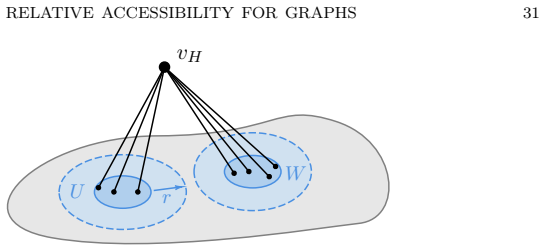
read the original abstract
We relativise the Thomassen--Woess definition of accessibility in graphs, defining what it means for a graph to be accessible relative to a peripheral system. In the case of locally finite, quasi-transitive graphs, we characterise relative accessibility in terms of a certain subring of the Boolean ring of the graph, and apply this to show that our definition agrees with the usual algebraic notion of relative accessibility in finitely generated groups. This implies, in particular, that relative accessibility is a quasi-isometry invariant amongst finitely generated groups, when the quasi-isometry coarsely preserves the left cosets of the peripheral subgroups. We also deduce a relative variant of Hamann's accessibility theorem on graphs with finitely generated cycle spaces.
Editorial analysis
A structured set of objections, weighed in public.
Referee Report
Summary. The manuscript relativizes the Thomassen-Woess definition of accessibility to a peripheral system on graphs. For locally finite quasi-transitive graphs it characterizes relative accessibility via a specific subring of the Boolean ring of the graph; this is applied to prove agreement with the algebraic notion of relative accessibility for finitely generated groups. The agreement yields quasi-isometry invariance of relative accessibility among such groups when the quasi-isometry coarsely preserves left cosets of the peripheral subgroups. A relative version of Hamann's accessibility theorem for graphs with finitely generated cycle spaces is also deduced.
Significance. If the characterization and transfer to groups hold, the work supplies a graph-theoretic foundation for relative accessibility that matches the algebraic definition and confirms quasi-isometry invariance under an explicitly stated hypothesis. This strengthens the interface between accessibility theory for graphs and geometric group theory, while the relative Hamann variant extends an existing theorem in a controlled way.
minor comments (2)
- [Main characterization theorem] The statement of the main characterization (presumably Theorem 3.4 or equivalent) should explicitly list the standing assumptions of local finiteness and quasi-transitivity so that the scope is visible at a glance.
- [Quasi-isometry invariance result] In the quasi-isometry invariance corollary, restate the coset-preservation hypothesis in the theorem statement itself rather than only in the surrounding text, to avoid any ambiguity about the precise invariance class.
Simulated Author's Rebuttal
We thank the referee for their positive assessment of the manuscript, including the summary of our relativization of Thomassen-Woess accessibility, the characterization via Boolean rings, the agreement with the algebraic notion for groups, the quasi-isometry invariance result, and the relative Hamann theorem. We appreciate the recommendation for minor revision.
Circularity Check
No significant circularity identified
full rationale
The paper defines relative accessibility by relativizing the Thomassen-Woess notion with respect to a peripheral system, then proves a characterization for locally finite quasi-transitive graphs via a specific subring of the Boolean ring of the graph. This characterization is applied to establish agreement with the standard algebraic definition for finitely generated groups. The quasi-isometry invariance is stated only under the explicit additional hypothesis that the quasi-isometry coarsely preserves left cosets of the peripheral subgroups. All steps rest on explicit definitions, standard Boolean-ring operations, and quasi-isometry properties; no load-bearing step reduces by construction to a fitted parameter, self-citation chain, or renamed input. The argument structure (characterization, transfer to groups, conditional invariance) is self-contained against external benchmarks.
Axiom & Free-Parameter Ledger
axioms (1)
- standard math Standard definitions and properties of locally finite graphs, quasi-transitive actions, Boolean rings of subsets, and quasi-isometries.
Lean theorems connected to this paper
-
IndisputableMonolith/Foundation/AbsoluteFloorClosure.leanreality_from_one_distinction unclear?
unclearRelation between the paper passage and the cited Recognition theorem.
Theorem A. Let Γ be a connected, locally finite, quasi-transitive G-graph and H a thin, G-invariant peripheral system. The following are equivalent: (1) Γ is accessible relative to H. (2) BH(Γ) is finitely generated as a G-module.
-
IndisputableMonolith/Cost/FunctionalEquation.leanwashburn_uniqueness_aczel unclear?
unclearRelation between the paper passage and the cited Recognition theorem.
We characterise relative accessibility in terms of a certain subring of the Boolean ring of the graph
What do these tags mean?
- matches
- The paper's claim is directly supported by a theorem in the formal canon.
- supports
- The theorem supports part of the paper's argument, but the paper may add assumptions or extra steps.
- extends
- The paper goes beyond the formal theorem; the theorem is a base layer rather than the whole result.
- uses
- The paper appears to rely on the theorem as machinery.
- contradicts
- The paper's claim conflicts with a theorem or certificate in the canon.
- unclear
- Pith found a possible connection, but the passage is too broad, indirect, or ambiguous to say the theorem truly supports the claim.
Reference graph
Works this paper leans on
-
[1]
Planar graphs and covers , author=. arXiv preprint arXiv:0708.0920 , year=
work page internal anchor Pith review Pith/arXiv arXiv
-
[2]
Quasi-actions on trees and property (
Manning, Jason Fox , journal=. Quasi-actions on trees and property (. 2006 , publisher=
2006
-
[3]
The electronic journal of combinatorics , volume=
The structure of locally finite two-connected graphs , author=. The electronic journal of combinatorics , volume=
-
[4]
International Journal of Algebra and Computation , volume=
A cactus theorem for end cuts , author=. International Journal of Algebra and Computation , volume=. 2014 , publisher=
2014
-
[5]
2013 , publisher=
Metric spaces of non-positive curvature , author=. 2013 , publisher=
2013
-
[6]
Combinatorica , volume=
Accessibility in transitive graphs , author=. Combinatorica , volume=. 2018 , publisher=
2018
-
[7]
Transactions of the American Mathematical Society , volume=
On planar Cayley graphs and Kleinian groups , author=. Transactions of the American Mathematical Society , volume=
-
[8]
Mathematica Slovaca , volume=
Transitive planar graphs , author=. Mathematica Slovaca , volume=. 1979 , publisher=
1979
-
[9]
Journal of Combinatorial Theory, Series B , volume=
Vertex-transitive graphs and accessibility , author=. Journal of Combinatorial Theory, Series B , volume=. 1993 , publisher=
1993
-
[10]
2002 , publisher=
Trees , author=. 2002 , publisher=
2002
-
[11]
Accessibility, planar graphs, and quasi-isometries
Accessibility, planar graphs, and quasi-isometries , author=. arXiv preprint arXiv:2310.15242 , year=
work page internal anchor Pith review Pith/arXiv arXiv
-
[12]
Journal of Pure and Applied Algebra , volume=
Pairs of relative cohomological dimension one , author=. Journal of Pure and Applied Algebra , volume=. 1971 , publisher=
1971
-
[13]
Inventiones mathematicae , volume=
The accessibility of finitely presented groups , author=. Inventiones mathematicae , volume=. 1985 , publisher=
1985
-
[14]
Journal of Pure and Applied Algebra , volume=
On accessibility of groups , author=. Journal of Pure and Applied Algebra , volume=. 1983 , publisher=
1983
-
[15]
Geometric group theory , volume=
An inaccessible group , author=. Geometric group theory , volume=. 1993 , publisher=
1993
-
[16]
2017 , Publisher =
Guirardel, Vincent and Levitt, Gilbert , Title =. 2017 , Publisher =
2017
-
[17]
1989 , publisher=
Groups acting on graphs , author=. 1989 , publisher=
1989
-
[18]
Relatively hyperbolic groups: Intrinsic geometry, algebraic properties, and algorithmic problems , volume =
Osin, Denis , year =. Relatively hyperbolic groups: Intrinsic geometry, algebraic properties, and algorithmic problems , volume =. Memoirs of the American Mathematical Society , doi =
-
[19]
2000 , publisher=
Random walks on infinite graphs and groups , author=. 2000 , publisher=
2000
-
[20]
Journal of Pure and Applied Algebra , volume=
Remarks on a technique of Dunwoody , author=. Journal of Pure and Applied Algebra , volume=. 1991 , publisher=
1991
-
[21]
Pacific journal of mathematics , volume=
Groups acting on Cantor sets and the end structure of graphs , author=. Pacific journal of mathematics , volume=. 2002 , publisher=
2002
-
[22]
2008 , publisher=
Topological methods in group theory , author=. 2008 , publisher=
2008
-
[23]
Mathematical Proceedings of the Cambridge Philosophical Society , volume=
Ends of graphs , author=. Mathematical Proceedings of the Cambridge Philosophical Society , volume=. 1992 , organization=
1992
-
[24]
Hamann, Matthias , TITLE =. Abh. Math. Semin. Univ. Hambg. , FJOURNAL =. 2017 , NUMBER =. doi:10.1007/s12188-016-0164-z , URL =
-
[25]
Proceedings of the London Mathematical Society , volume=
Accessibility and groups of cohomological dimension one , author=. Proceedings of the London Mathematical Society , volume=. 1979 , publisher=
1979
-
[26]
, TITLE =
Roller, Martin A. , TITLE =. 1993 , TYPE =
1993
-
[27]
On infinite cycles
Diestel, Reinhard and K. On infinite cycles. Combinatorica , volume=. 2004 , publisher=
2004
-
[28]
Journal of Combinatorial Theory, Series B , volume=
A Stallings type theorem for quasi-transitive graphs , author=. Journal of Combinatorial Theory, Series B , volume=. 2022 , publisher=
2022
-
[29]
Journal of Combinatorial Theory, Series B , volume=
Accessibility and ends of graphs , author=. Journal of Combinatorial Theory, Series B , volume=. 1996 , publisher=
1996
-
[30]
Journal of Combinatorial Theory, Series B , volume=
The structure of quasi-transitive graphs avoiding a minor with applications to the domino problem , author=. Journal of Combinatorial Theory, Series B , volume=. 2024 , publisher=
2024
-
[31]
Transactions of the American Mathematical Society , volume=
3-connected planar spaces uniquely embed in the sphere , author=. Transactions of the American Mathematical Society , volume=
discussion (0)
Sign in with ORCID, Apple, or X to comment. Anyone can read and Pith papers without signing in.