Recognition: 2 theorem links
· Lean TheoremSubperiodic groups and bounded automorphisms of periodic graphs
Pith reviewed 2026-05-14 20:21 UTC · model grok-4.3
The pith
The 75 crystallographic rod groups belong to 32 isomorphism classes and the 80 layer groups to 34, distinguished by subgroup counts up to small indices.
A machine-rendered reading of the paper's core claim, the machinery that carries it, and where it could break.
Core claim
A subperiodic group contains a translation lattice of rank r less than the ambient dimension as a finite-index subgroup. For r=1 in 3D, the 75 rod groups partition into 32 isomorphism classes; for r=2, the 80 layer groups partition into 34 classes. These classes are distinguished by an invariant consisting of the number of subgroups of each index up to a bound and the number of those that are normal. Separately, a Cayley graph on a space group G admits bounded finite-order automorphisms if and only if its inverse-closed generating set is stabilized by conjugation by an element of finite order in G.
What carries the argument
Invariants given by the counts of subgroups of index at most n (with n<=12 for rods and n<=8 for layers) together with the count of normal subgroups among them.
If this is right
- Isomorphism classes of these groups can be recognized from finite presentations using only small-index subgroup data.
- Bounded automorphisms of finite order on space-group Cayley graphs occur exactly when the generating set is conjugation-invariant under a finite-order element.
- Subperiodic groups in four dimensions with three-dimensional lattices yield systematic embeddings of three-periodic ladder graphs into three-space.
- The classification separates all listed groups without overlap under the given bounds.
Where Pith is reading between the lines
- The subgroup-counting method may extend to classify subperiodic groups in higher dimensions without exhaustive enumeration.
- The bounded-automorphism criterion could characterize symmetry in other periodic graphs beyond Cayley graphs of crystallographic groups.
- These invariants offer a computational shortcut for identifying group isomorphism in crystallographic contexts.
Load-bearing premise
The lists of 75 rod groups and 80 layer groups are complete, and the chosen bounds on subgroup index together with normality information suffice to distinguish all isomorphism classes without missing any or identifying distinct groups as the same.
What would settle it
An exhaustive computation of all subgroups of index up to 12 for a rod group that yields a different pattern of counts or normality numbers than the one assigned in the classification.
Figures


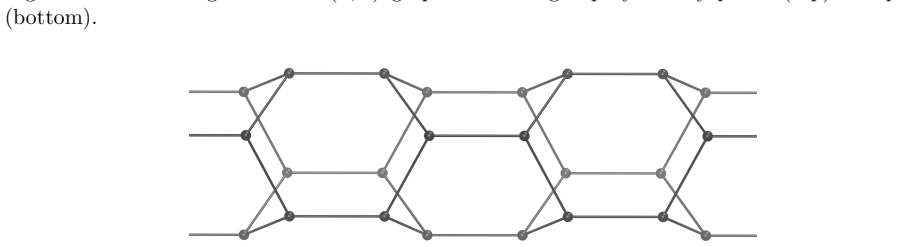


read the original abstract
A subperiodic group is a group of motions of $d$-dimensional Euclidean space $\R^d$ which contains a translation lattice $\Z^r$ of rank $r < d$ as a subgroup of finite index. A classification into abstract group isomorphism classes is performed for subperiodic groups in dimension~3: 75 \emph{crystallographic} rod groups ($r=1$) and 80 layer groups ($r=2$) are shown to belong to 32 and 34 isomorphism classes, respectively. An easy-to-compute set of invariants is developed for recognizing these isomorphism classes from finite presentations which makes use only of the number of subgroups up to a given finite index~$n$ ($n \leq 12$ for rod groups and $n \leq 8$ for layer groups) and how many of them are normal. Cayley graphs of rod and layer groups are used to illustrate the concept of bounded automorphisms of finite order, \emph{i.e.} those when the distance between a graph vertex and its image has an upper bound. It is proven that a Cayley graph of a crystallographic space group $G$ (in which case $r=d$) possesses bounded automorphisms of finite order, if and only if the respective inverse-closed generating set is stabilized by conjugation by an element of finite order in $G$. As an application, subperiodic groups in $\R^4$ with a three-dimensional translation lattice are used to systematically derive embeddings of three-periodic \emph{ladder graphs} in~$\R^3$.
Editorial analysis
A structured set of objections, weighed in public.
Referee Report
Summary. The manuscript classifies subperiodic groups in three-dimensional Euclidean space: 75 crystallographic rod groups (r=1) and 80 layer groups (r=2) are shown to belong to 32 and 34 abstract isomorphism classes, respectively. It develops an invariant based on the number of subgroups (and normal subgroups) of index at most n (n≤12 for rods, n≤8 for layers) to recognize these classes from finite presentations. A theorem states that a Cayley graph of a crystallographic space group G has bounded automorphisms of finite order if and only if the inverse-closed generating set is stabilized by conjugation by a finite-order element of G. The framework is applied to derive embeddings of three-periodic ladder graphs in R^3 from subperiodic groups in R^4 with a three-dimensional translation lattice.
Significance. If the classification and separation claims hold, the low-index subgroup counts supply a concrete, computable invariant for distinguishing isomorphism classes of subperiodic groups, which is useful for computational crystallography and geometric group theory. The iff characterization of bounded finite-order automorphisms is a clean group-theoretic statement that directly ties graph automorphisms to the group structure. The application to ladder-graph embeddings illustrates a systematic way to construct periodic graphs in lower dimensions from higher-dimensional subperiodic groups.
major comments (2)
- [Classification and invariants (abstract and main classification section)] The central classification claim (75 rod groups into 32 classes; 80 layer groups into 34 classes) rests on the assertion that the tuple (total subgroups of index ≤ n, normal subgroups of index ≤ n) with n=12 (rods) and n=8 (layers) forms a complete invariant separating all isomorphism classes among the enumerated groups. No general theorem is supplied showing that these specific bounds suffice to distinguish all groups containing a rank-r lattice of finite index, nor is there an explicit verification that no two non-isomorphic groups in the lists share the same tuple.
- [Enumeration of rod and layer groups] The enumeration of exactly 75 rod groups and 80 layer groups is stated without a detailed listing, generating procedure, or cross-check against known tables of subperiodic groups; exhaustiveness is therefore not independently verifiable from the given information, which directly affects the reported class counts.
minor comments (1)
- [Abstract] The abstract refers to 'an easy-to-compute set of invariants' but does not specify the precise tuple format or the algorithm used to compute the counts from a finite presentation.
Simulated Author's Rebuttal
We thank the referee for the careful reading and constructive comments on our manuscript. We address each major comment below and will revise the paper to incorporate additional verification and references for improved clarity and verifiability.
read point-by-point responses
-
Referee: The central classification claim (75 rod groups into 32 classes; 80 layer groups into 34 classes) rests on the assertion that the tuple (total subgroups of index ≤ n, normal subgroups of index ≤ n) with n=12 (rods) and n=8 (layers) forms a complete invariant separating all isomorphism classes among the enumerated groups. No general theorem is supplied showing that these specific bounds suffice to distinguish all groups containing a rank-r lattice of finite index, nor is there an explicit verification that no two non-isomorphic groups in the lists share the same tuple.
Authors: The classification relies on explicit computational verification for the finite enumerated sets rather than a general theorem. We computed the invariants for all groups in our lists and confirmed that non-isomorphic classes produce distinct tuples; the chosen bounds (n=12 for rods, n=8 for layers) were selected precisely because they achieve separation in these cases. To address the concern, the revised manuscript will include an appendix or table explicitly listing the invariant tuples for each isomorphism class, demonstrating the separation with no collisions. revision: yes
-
Referee: The enumeration of exactly 75 rod groups and 80 layer groups is stated without a detailed listing, generating procedure, or cross-check against known tables of subperiodic groups; exhaustiveness is therefore not independently verifiable from the given information, which directly affects the reported class counts.
Authors: The counts of 75 rod groups and 80 layer groups are taken from the standard crystallographic classification (as in the International Tables for Crystallography). Our focus is the partitioning into abstract isomorphism classes via the invariants. In the revision we will add explicit citations to these standard tables together with a brief outline of the enumeration procedure used to confirm the counts. revision: yes
Circularity Check
No circularity: classification uses independent standard invariants
full rationale
The paper enumerates subperiodic groups and applies the standard isomorphism invariants consisting of the counts of all subgroups and normal subgroups of index at most a fixed n. These counts are well-defined group-theoretic quantities that do not depend on the final class tally; different values immediately imply non-isomorphism by construction. The central theorem on bounded automorphisms of Cayley graphs is stated and proved directly from the definition of conjugation action on generating sets, without any reduction to fitted parameters or self-referential definitions. No load-bearing step invokes a prior result by the same author that itself lacks independent verification, nor does any equation or claim equate a derived quantity to its own input by construction. The derivation chain therefore remains self-contained and non-circular.
Axiom & Free-Parameter Ledger
axioms (1)
- standard math Standard axioms of group theory and the geometry of isometries of Euclidean space R^d.
Lean theorems connected to this paper
-
IndisputableMonolith/Foundation/ArithmeticFromLogic.leanLogicNat recovery and embed_injective unclear?
unclearRelation between the paper passage and the cited Recognition theorem.
An easy-to-compute set of invariants is developed for recognizing these isomorphism classes from finite presentations which makes use only of the number of subgroups up to a given finite index n (n≤12 for rod groups and n≤8 for layer groups) and how many of them are normal.
-
IndisputableMonolith/Foundation/AlexanderDuality.leanalexander_duality_circle_linking unclear?
unclearRelation between the paper passage and the cited Recognition theorem.
It is proven that a Cayley graph of a crystallographic space group G possesses bounded automorphisms of finite order if and only if the respective inverse-closed generating set is stabilized by conjugation by an element of finite order in G.
What do these tags mean?
- matches
- The paper's claim is directly supported by a theorem in the formal canon.
- supports
- The theorem supports part of the paper's argument, but the paper may add assumptions or extra steps.
- extends
- The paper goes beyond the formal theorem; the theorem is a base layer rather than the whole result.
- uses
- The paper appears to rely on the theorem as machinery.
- contradicts
- The paper's claim conflicts with a theorem or certificate in the canon.
- unclear
- Pith found a possible connection, but the passage is too broad, indirect, or ambiguous to say the theorem truly supports the claim.
Reference graph
Works this paper leans on
-
[1]
Baburin, I. A. On the group-theoretical approach to the study of interpenetrating nets. Acta Cryst. 2016, A72, 366-375
2016
-
[2]
Baburin, I. A. On Cayley graphs ofZ 4. Acta Cryst. 2020, A76, 584-588
2020
-
[3]
Baburin, I. A. Short presentations for crystallographic groups. Acta Cryst. 2026, A82, 18-31
2026
-
[4]
Bandura, A. V. and Evarestov, R. A. From anatase (101) surface to TiO 2 nanotubes: rolling procedure and first-principles LCAO calculations. Surface Science, 2009, 603, L117-L120
2009
-
[5]
U., Eick B., O’Brien, E
Besche, H. U., Eick B., O’Brien, E. A. A millenium project: constructing small groups. Int. J. Algebra Comput., 2002, 12, 623-644
2002
-
[6]
Algebraic Graph Theory, 2nd edition
Biggs, N. Algebraic Graph Theory, 2nd edition. Cambridge University Press, 1993
1993
-
[7]
Blatov V. A. Topological relations between three-dimensional periodic nets. I. Uninodal nets. Acta Cryst. 2007, A63, 329-343
2007
-
[8]
Crystallographic groups of four-dimensional space
Brown, H., B¨ ulow, R., Neub¨ user, J., Wondratschek, H., Zassenhaus, H. Crystallographic groups of four-dimensional space. Wiley, 1978
1978
-
[9]
and Proserpio, D
Carlucci, L., Ciani, G. and Proserpio, D. M. Polycatenation, polythreading and polyknotting in coor- dination network chemistry. Coord. Chem. Rev., 2003, 246, 247-289
2003
-
[10]
Line groups in physics
Damnjanovi´ c, M., Miloˇ ssevi´ c, I. Line groups in physics. Springer, 2010
2010
-
[11]
Barycentric drawings of periodic graphs
Delgado-Friedrichs, O. Barycentric drawings of periodic graphs. Lecture Notes in Computer Science, vol. 2912. Springer, 2004, 178-189
2004
-
[12]
and Treacy, M
Delgado-Friedrichs, O., O’Keeffe, M. and Treacy, M. M. J. Periodic graphs with coincident edges: folding-ladder and related graphs. Acta Cryst. 2025, A81, 49-56
2025
-
[13]
and Vandeputte, L
Der´ e, J. and Vandeputte, L. Effective conjugacy separability of virtually abelian groups. Comm. in Algebra, 2026, 54, 1129-1152
2026
-
[14]
Eick, B., G¨ ahler, F., Nickel, W.Cryst– computing with crystallographic groups, a refereedGAP4 package
-
[15]
Eick, B., Nickel, W., Horn, M.Polycyclic– computation with polycyclic groups, a refereedGAP4 package
-
[16]
Graph-theoretical characterization of periodicity in crystallographic nets and other infinite graphs
Eon, J.-G. Graph-theoretical characterization of periodicity in crystallographic nets and other infinite graphs. Acta Cryst. 2005, A61, 501-511
2005
-
[17]
Existenzbedingungen homogener Kugelpackungen in Raumgruppen tetragonaler Symme- trie
Fischer, W. Existenzbedingungen homogener Kugelpackungen in Raumgruppen tetragonaler Symme- trie. Z. Kristallogr., 1971, 133, 18-42
1971
-
[18]
Existenzbedingungen homogener Kugelpackungen zu kubischen Gitterkomplexen mit drei Freiheitsgraden
Fischer, W. Existenzbedingungen homogener Kugelpackungen zu kubischen Gitterkomplexen mit drei Freiheitsgraden. Z. Kristallogr., 1974, 140, 50-74
1974
-
[19]
Tetragonal sphere packings
Fischer, W. Tetragonal sphere packings. III. Lattice complexes with three degrees of freedom. Z. Kristal- logr., 1993, 205, 9-26
1993
-
[20]
Version 4.19
TheGAPGroup.GAP– Groups, Algorithms, Programming. Version 4.19. Available from https://www.gap-system.org
-
[21]
Godsil, C. D. and McKay, B. D. The dimension of a graph. Quart. J. Math. Oxford, 1980, 31, 423-427
1980
-
[22]
D., Imrich, W., Seifter, N., Watkins, M
Godsil, C. D., Imrich, W., Seifter, N., Watkins, M. E. and Woess, W. A note on bounded automorphisms of infinite graphs. Graphs and Combinatorics, 1989, 5, 333-338
1989
-
[23]
Groups of polynomial growth and expanding maps
Gromov, M. Groups of polynomial growth and expanding maps. Publ. Math. Inst. Hautes ´Etudes Sci., 1981, 53, 53-78
1981
-
[24]
Infinite groups as geometric objects
Gromov, M. Infinite groups as geometric objects. ICM Proceedings, Warszawa, 1983, Vol. 1, 385-392
1983
-
[25]
and Seifter, N
Imrich, W. and Seifter, N. A survey on graphs with polynomial growth. Discrete Math., 1991, 95, 101-117
1991
-
[26]
Volume E (2006)
International tables for crystallography. Volume E (2006). Available from https://it.iucr.org
2006
-
[27]
Jones, G. A. Detecting and identifying wallpaper groups. Symmetry: Culture and Science, 2011, 22, pp. 131-157
2011
-
[28]
Jung, H. A. and Watkins, M. E. Fragments and automorphisms of infinite graphs. Eur. J. Comb., 1984, 5, 149-162. 20
1984
-
[29]
and Saito, S
Kato, K., Koretsune, T. and Saito, S. Energetics and electronic properties of twisted single-walled carbon nanotubes. Phys. Rev. B 85, 115448
-
[30]
and Fischer, W
Koch, E. and Fischer, W. Automorphismengruppen von Raumgruppen und die Zuordnung von Punkt- lagen zu Konfigurationslagen. Acta Cryst. 1975, A31, 88-95
1975
-
[31]
and Fischer, W
Koch, E. and Fischer, W. Complexes for crystallographic point groups, rod groups and layer groups. Z. Kristallogr., 1978, 147, 21-38
1978
-
[32]
and Fischer, W
Koch, E. and Fischer, W. Types of sphere packings for crystallographic point groups, rod groups and layer groups. Z. Kristallogr., 1978, 148, 107-152
1978
-
[33]
On the structure and the determination ofn-dimensional partially periodic crystallo- graphic groups.MATCH, 1981, 10, 27-53
K¨ ohler, K.-J. On the structure and the determination ofn-dimensional partially periodic crystallo- graphic groups.MATCH, 1981, 10, 27-53
1981
-
[34]
Mahmoudi, S., Dresselhaus, E. J. and Dimitriyev, M. S. An orbifold framework for classifying layer groups with an application to knitted fabrics. arXiv:2512.05149
work page internal anchor Pith review Pith/arXiv arXiv
-
[35]
and Eon, J.-G
Moreira de Oliveira Jr, M. and Eon, J.-G. Non-crystallographic nets with finite blocks of imprimitivity for bounded automorphisms. Acta Cryst. 2013, A69, 276-288
2013
-
[36]
A., Ramsden, S
O’Keeffe, M., Peskov, M. A., Ramsden, S. J. and Yaghi, O. M. The Reticular Chemistry Structure Resource (RCSR) database of, and symbols for, crystal nets. Acc. Chem. Res. 2008, 41, 1782-1789. http://rcsr.net
2008
-
[37]
and Treacy, M
O’Keeffe, M. and Treacy, M. M. J. Isogonal piecewise linear embeddings of 1-periodic weaves and some related structures. Acta Cryst. 2021, A77, 130-137
2021
-
[38]
Characterizing a vertex-transitive graph by a large ball
de la Salle, M., Tessera, R. Characterizing a vertex-transitive graph by a large ball. Journal of topology, 2019, 12, 704-742
2019
-
[39]
and Tointon, M
Tessera, R. and Tointon, M. C. H. A finitary structure theorem for vertex-transitive graphs of polyno- mial growth. Combinatorica, 2021, 41, 263-298
2021
-
[40]
and Trofimov, V
Seifter, N. and Trofimov, V. I. Automorphism groups of graphs with quadratic growth. J. Comb. Theory B, 1997, 71, 205-210
1997
-
[41]
It’s all in the group
Souvignier, B. It’s all in the group. Acta Cryst., 2026, A82, 79-82
2026
-
[42]
Orthorhombic sphere packings
Sowa, H. Orthorhombic sphere packings. IV. Trivariant lattice complexes of space groups without mirror planes belonging to crystal classmmm. Acta Cryst., 2012, A68, 763-777
2012
-
[43]
Tomkinson, M. J. FC-groups, Res. Notes in Math. 96. Pitman, London, 1984
1984
-
[44]
Trofimov, V. I. Automorphisms of graphs and a characterization of lattices. Math. USSR Izvestiya, 1984, 22, 379-391
1984
-
[45]
Trofimov, V. I. Graphs with polynomial growth. Math. USSR Sbornik, 1985, 51, 405-417
1985
-
[46]
Watkins, M. E. On the action of non-abelian groups on graphs. J. Comb. Theory, 1971, 11, 95-104
1971
-
[47]
Finite permutation groups
Wielandt, H. Finite permutation groups. Academic Press, 1964. 21
1964
discussion (0)
Sign in with ORCID, Apple, or X to comment. Anyone can read and Pith papers without signing in.